Where Stories, Songs and Sorcery Meet
Folklore in the Central African Republic is best understood as a living oral culture rather than a neat national mythology with one official pantheon. Its stories, songs and beliefs are shaped by many peoples, especially Gbaya, Banda, Mandjia, Sara, Mboum, M’Baka, Yakoma, Aka and Zande communities, and by the national spread of Sango as a shared language.
Page outline Jump by section
Introduction
The most distinctive material includes Banda and Mandjia storytelling, the trickster figure Tere, the celebrated polyphonic oral traditions of the Aka forest people, Zande ideas about witchcraft and divination, and legends attached to strange landscapes such as the Lake of Sorcerers. The evidence is uneven: some traditions are well documented by UNESCO, ethnographers and published collections, while many local stories remain mainly oral, fragile and under-recorded.[unesco.org]unesco.orgdocument 3750document 3750
Why Central African folklore is not one single mythology
The Central African Republic is a large, landlocked country with many ethnic and language communities, so its folklore does not fit the pattern of a single national myth cycle. Minority Rights Group lists Gbaya, Banda, Mandjia, Sara, Mboum, M’Baka and Yakoma among the country’s main communities, while Sango and French are official languages; this matters because oral traditions have historically lived in many local languages as well as in wider shared forms.[Minority Rights Group]minorityrights.orgMinority Rights GroupCentral African RepublicMain minorities and indigenous peoples include: Gbaya 33 per cent, Banda 27 per cent, Mandji…
A useful way to picture the country’s folklore is as overlapping circles. At the local level, each community has its own stories, ritual specialists, moral tales, hunting knowledge, songs and explanations of misfortune. At the national level, Sango has helped some figures and story forms circulate more widely. Encyclopedia.com’s Central Africans entry, drawing on Jacqueline Woodfork’s work, notes that each ethnic group has its own oral tradition, but also that a broader Sango-linked folklore has emerged across ethnic lines.[Encyclopedia.com]encyclopedia.comCentral AfricansOral tradition plays a very important role in the education of children in the CAR, Woodfork, Jacqueline. Culture and Cus…
That makes Central African folklore especially interesting for general readers. It is not simply a list of monsters or gods. It is a cultural system in which story, song, religion, children’s education, local landscape and social anxiety all meet. A tale told beside a fire, a song performed during a hunting or funeral ritual, and an accusation of harmful occult power can all belong to the wider world of belief culture, even though they do very different social work.
The storyteller’s world: Tere, children’s lessons and oral performance
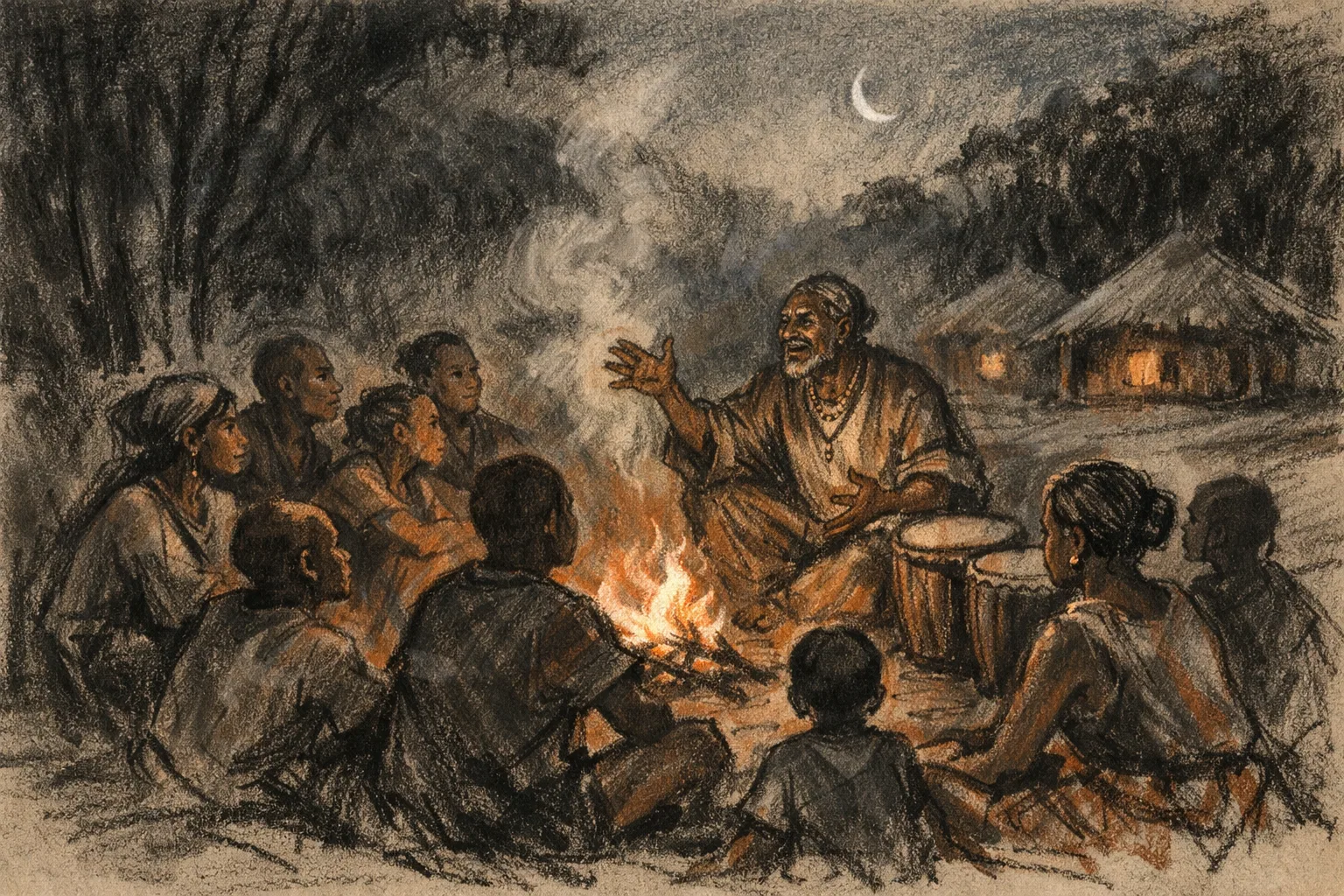
One of the clearest nationally recognisable figures is Tere, described in the Central Africans entry as a clever and witty man with supernatural powers who outsmarts opponents through tricks and guile. The same source says Tere was originally associated with Banda mythology but became so central in wider Central African oral tradition that, in Sango, his name is linked with storytelling itself.[Encyclopedia.com]encyclopedia.comCentral AfricansOral tradition plays a very important role in the education of children in the CAR, Woodfork, Jacqueline. Culture and Cus…
That detail is important because it shows how folklore can move from one community setting into a national language culture. Tere is not just “a character”; he is a sign of what stories are for. Trickster tales often make intelligence more powerful than force. They allow listeners to laugh at arrogance, greed or foolishness while also learning how social rules can be bent, tested or defended.
Older patterns of storytelling also had a practical educational role. Oral tradition has been described as important in children’s education in the Central African Republic, passing on lessons about the origins of the natural world, morality, traditional healing and hunting. Stories once associated with evening fires have also moved into modern media, including radio and television.[Encyclopedia.com]encyclopedia.comCentral AfricansOral tradition plays a very important role in the education of children in the CAR, Woodfork, Jacqueline. Culture and Cus…
Published collections give outsiders only a partial view of this wider oral field. Polly Strong’s African Tales: Folklore of the Central African Republic, published in 1992, is described by Internet Archive as a collection concerning Manja and Banda peoples, while Google Books says it shares tales from Manjia and Banda storytellers in Sango-to-English translation.[Internet Archive]archive.orgisbn 9781878893154isbn 9781878893154 That kind of book is valuable as a doorway, but it should not be mistaken for the whole tradition: it is a translated sample of oral performance, not a complete national canon.

The Aka forest tradition: song as memory, ritual and identity
The best-known Central African intangible heritage on the world stage is the polyphonic singing of the Aka people of the south-western forest region. UNESCO describes the Aka as having a distinctive vocal musical tradition based on complex four-voice contrapuntal polyphony, mastered by members of the community rather than preserved through written notation.[UNESCO]unesco.orgdocument 3750document 3750
For a folklore page, the Aka tradition matters because it blurs the usual line between “music” and “myth”. UNESCO’s account says music and dance are integral to rituals connected with new encampments, hunting and funerals. The songs allow spontaneous expression and variation, so performance is both inherited and newly made each time.[UNESCO]unesco.orgdocument 3750document 3750
This is folklore in action: not a dead text, but a social practice that carries memory, skill and values. UNESCO notes that Aka songs help preserve community knowledge and cohesion, with children included in rituals from an early age. The same heritage dossier also warns that deforestation, rural exodus and the “folklorization” of heritage for tourism threaten many traditional customs, rituals and skills.[UNESCO]unesco.orgdocument 3750document 3750
That last point is crucial. Public interest in “Pygmy music” can sometimes turn living communities into picturesque symbols. A better reading sees Aka oral tradition as intellectual and cultural property: a way of organising social life, marking life events, teaching children and maintaining bonds with the forest. UNESCO’s safeguarding work, including an action plan for the oral tradition of the Aka Pygmies of the Central African Republic, shows that this is recognised as heritage requiring active protection, not just admiration.[ICH UNESCO]ich.unesco.orgOpen source on unesco.org.
Witchcraft belief: folklore, fear and modern law
No account of Central African belief culture can ignore witchcraft, but it needs careful handling. Witchcraft here should not be presented as spooky entertainment or as proof of supernatural events. It is better understood as a powerful explanatory framework through which some people interpret illness, death, failure, envy, conflict and misfortune.
The issue is not only historical. The US State Department’s 2023 religious freedom report says some Christians and Muslims in the Central African Republic incorporate aspects of animist or traditional faith into their religious practice.[State Department]state.govDepartment Central African RepublicDepartment Central African Republic The CIA World Factbook’s religion data similarly notes a Christian majority, a Muslim minority and ethnic religionists, with animistic beliefs and practices strongly influencing many Christians.[World Factbook]worldfactbook.coWorld Factbook Central African RepublicWorld Factbook Central African Republic
Legal and human rights sources show the darker side. Avocats Sans Frontières reported in 2022 that the practice of charlatanism and witchcraft is treated as a crime under the Central African penal code, and that prosecutions of suspected people often produce serious rights violations affecting women and children.[Avocats Sans Frontières]asf.beOpen source on asf.be. Prison Insider likewise reported in 2023 that accusations and convictions are numerous, and that vulnerable people, especially older and isolated women, are repeatedly targeted.[Prison Insider]prison-insider.comPrison Insider Central African Republic: witchcraftPrison Insider Central African Republic: witchcraft
This is where folklore crosses into real harm. A belief system that explains misfortune can also become a weapon in family disputes, village conflict or armed violence. Reuters reported in 2015 that rebels had used public accusations against alleged “witches” to control areas during conflict, citing a leaked UN report.[Reuters]reuters.comWitch burning rebels stoke Central African Republic violenceWitch burning rebels stoke Central African Republic violence The folklore angle is therefore inseparable from the ethical one: stories about hidden power can comfort, explain and organise life, but accusations can destroy lives when fear becomes punishment.
Zande witchcraft and oracles: a famous Central African case
The Azande, or Zande, live across the Central African Republic, South Sudan and the Democratic Republic of the Congo, and their ideas about witchcraft and oracles became famous through E. E. Evans-Pritchard’s 1937 ethnography Witchcraft, Oracles and Magic among the Azande. Internet Archive identifies the book as a major study of Zande people, witchcraft, oracles and magic in Central Africa.[Internet Archive]archive.orgwitchcraftoracle0000evan d5h2witchcraftoracle0000evan d5h2
Zande material is useful for understanding the region because it shows that witchcraft belief is not just a vague fear of the supernatural. In Evans-Pritchard’s classic analysis, witchcraft helped explain why a misfortune happened to a particular person at a particular time. A granary might collapse because termites weakened it, but witchcraft could explain why it collapsed just when certain people were sitting beneath it. That kind of reasoning made unseen social tension part of the explanation of ordinary events.
Later summaries and film resources emphasise that, among the Azande, witchcraft could be thought of as inherited and even unconscious: a person might harm another without knowingly intending it. The Royal Anthropological Institute’s page for Witchcraft Among the Azande says the film revisited Evans-Pritchard’s analysis and notes the importance of oracles as diagnostic tools in dealing with suspected witchcraft.[RAI FILM]raifilm.org.ukRAI FILMWitchcraft Among the AzandeRAI FILMWitchcraft Among the Azande
For a Central African Republic folklore page, the key point is not that all Central Africans share Zande ideas. They do not. The value of the Zande case is that it gives readers a well-documented example of how belief, divination, social order and misfortune can form a coherent world of explanation. It also cautions against treating “witchcraft” as a single African category: local systems differ sharply in language, practice, gender assumptions and social consequences.
Sacred and uncanny places: the Lake of Sorcerers
Central African folklore also attaches meaning to landscape. One vivid example is the Lake of Sorcerers, linked in later retellings to a story of a village swallowed by black waters after a mysterious woman marks the ground around it. A modern blog retelling, explicitly crediting Woodfork’s Culture and Customs of the Central African Republic, describes the lake as bottomless, avoided by fishermen and haunted by voices, drums and lights rising from below.[My Virtual World Trip]myvirtualworldtrip.comOpen source on myvirtualworldtrip.com.
This is a good example of how a place legend works. The lake becomes more than scenery: it is a moral and supernatural memory site. The tale’s details — initiation celebration, drums, balafons, a woman who laughs and cries, waters that do not behave like normal waters — transform natural landscape into warning, mystery and cultural explanation.
There is also a real geographical hook. A place called Lac des Sorciers appears in gazetteer-style listings of Central African lakes, and scientific sampling of water sites in the country has included Lac des Sorciers among named locations.[iTouchMap]itouchmap.comi Touch Map Central African Republici Touch Map Central African Republic That does not prove the legend’s events, of course. It shows something more useful: a named place and a narrative tradition have become attached strongly enough for the “sorcerers” identity to persist in public reference.
The Lake of Sorcerers should therefore be handled as a legend, not as a paranormal fact. Its power lies in the way it gathers anxieties about ritual, colonial disbelief, forbidden water and the voices of the dead into one memorable landscape.
Christianity, Islam and older belief did not simply replace one another
Modern Central African religious life is layered. Official and demographic sources show Christianity as the largest religious identity, Islam as a significant minority, and traditional or ethnic religion as a continuing category; they also note that traditional beliefs influence many people who identify as Christian or Muslim.[State Department]state.govDepartment Central African RepublicDepartment Central African Republic
This layering is vital for understanding folklore today. A Central African person may attend church, speak Sango, know local tales, fear witchcraft accusations, respect ancestral customs and participate in modern media culture without seeing these as separate museum compartments. Folklore survives not only as “old religion” but as idiom, family memory, children’s education, healing language, music, place legend and moral storytelling.
Missionary, colonial and postcolonial change also altered how traditions were recorded. Some oral traditions were translated for outsiders; some rituals were discouraged, reinterpreted or Christianised; some stories travelled through Sango into wider national circulation; and some practices, especially those associated with forest communities, became vulnerable to commercial performance or tourist simplification. UNESCO’s warning about the tourist “folklorization” of Aka heritage is one of the clearest documented examples of this tension.[UNESCO]unesco.orgdocument 3750document 3750
The result is not a simple before-and-after story. Older traditions have not vanished, but neither have they remained unchanged. The living question is how communities keep control of their own heritage while adapting to urban life, insecurity, religious change, schooling, media and outside curiosity.
What is well attested, and what should be treated cautiously
The strongest evidence for Central African folklore comes from several kinds of sources. UNESCO provides strong documentation for the Aka polyphonic oral tradition and its safeguarding needs. Published folklore collections and cultural surveys preserve samples of Banda, Manjia and wider Sango-linked storytelling. Ethnographic classics and later films document Zande witchcraft and oracular practice in the wider Central African region. Human rights and religious freedom sources show that witchcraft belief remains socially consequential in the present.[unesco.org]unesco.orgdocument 3750document 3750
Other material needs more caution. Modern web retellings of legends such as the Lake of Sorcerers can be useful when they identify a print source or named tradition, but they are still retellings. Claims about “national monsters”, secret societies or haunted places should be checked carefully because Central African Republic folklore is underrepresented online, and thin evidence can easily be inflated into internet-era mythmaking.
A good rule for readers is to ask three questions:
- Is this from a living oral tradition, a published retelling, an ethnographic study, a tourist text or a modern internet adaptation?
- Does the source identify a community, language, place or collector, or does it make vague claims about “African mythology”?
- Does the story describe belief and social meaning, or does it present supernatural claims as proven fact?
Those questions protect both the reader and the tradition. They make room for wonder without turning Central African culture into fantasy material.
Why this folklore still matters
Central African Republic folklore matters because it carries memory in a country whose cultural record has often been overshadowed internationally by conflict, poverty and humanitarian crisis. Oral tales, trickster figures, forest songs, initiation memories, lake legends and explanations of misfortune show a deeper cultural world: one concerned with wit, danger, morality, community survival, landscape and unseen forces.
It also matters because the traditions are not only old. Tere stories still help explain the social role of cleverness and storytelling. Aka polyphony remains a living heritage tradition under pressure from environmental and social change. Witchcraft belief continues to shape fears, accusations and legal realities. Place legends still attach mystery to named landscapes.
The most honest picture is therefore neither romantic nor dismissive. Central African folklore is rich, fragmented, locally varied and often under-documented. Some of it is joyful performance; some of it is moral teaching; some of it is sacred memory; and some of it has painful consequences when fear becomes accusation. Taken together, it reveals a country whose legendary culture is not a single mythology, but a many-voiced oral world.
Amazon book picks
Further Reading
Books and field guides related to Where Stories, Songs and Sorcery Meet. Use these as the next step if you want deeper reading beyond the article.
African Folktales
Broadly covers the oral traditions and themes found across Central Africa.
The Art of Not Being Governed
Helps contextualise communities and social organisation.
eBay marketplace picks
Marketplace Samples
Live-tested eBay searches with available results related to this page.



Endnotes
1.
Source: encyclopedia.com
Link:https://www.encyclopedia.com/humanities/encyclopedias-almanacs-transcripts-and-maps/central-africans
Source snippet
Central AfricansOral tradition plays a very important role in the education of children in the CAR, Woodfork, Jacqueline. Culture and Cus...
2.
Source: unesco.org
Title: document 3750
Link:https://www.unesco.org/archives/multimedia/document-3750
3.
Source: archive.org
Title: isbn 9781878893154
Link:https://archive.org/details/isbn_9781878893154
4.
Source: archive.org
Title: witchcraftoracle0000evan d5h2
Link:https://archive.org/details/witchcraftoracle0000evan_d5h2
5.
Source: books.google.com
Link:https://books.google.com/books/about/African_Tales.html?id=maOckBX0n-MC
6.
Source: ich.unesco.org
Link:https://ich.unesco.org/en/state/central-african-republic-CF
7.
Source: ich.unesco.org
Link:https://ich.unesco.org/en/projects/action-plan-for-the-safeguarding-and-revitalization-of-the-oral-tradition-of-the-aka-pygmies-of-the-central-african-republic-00014
8.
Source: state.gov
Title: Department Central African Republic
Link:https://www.state.gov/reports/2023-report-on-international-religious-freedom/central-african-republic
9.
Source: prison-insider.com
Title: Prison Insider Central African Republic: witchcraft
Link:https://www.prison-insider.com/en/articles/republique-centrafricaine-sorcellerie
10.
Source: reuters.com
Title: Witch burning rebels stoke Central African Republic violence
Link:https://www.reuters.com/article/world/witch-burning-rebels-stoke-central-african-republic-violence-idUSKBN0TF038/
11.
Source: raifilm.org.uk
Title: RAI FILMWitchcraft Among the Azande
Link:https://raifilm.org.uk/films/witchcraft-among-the-azande/
12.
Source: itouchmap.com
Title: i Touch Map Central African Republic
Link:https://itouchmap.com/?DG=LK&c=ct
13.
Source: ia903100.us.archive.org
Title: African Folklore An Encyclopedia
Link:https://ia903100.us.archive.org/30/items/africanfolkloreanencyclopedia/African%20Folklore%20-%20An%20Encyclopedia.pdf
14.
Source: ich.unesco.org
Title: polyphonic singing of the aka pygmies of central africa 00082
Link:https://ich.unesco.org/en/RL/polyphonic-singing-of-the-aka-pygmies-of-central-africa-00082
15.
Source: unesco.org
Title: guardians forest baka and living spirit dja
Link:https://www.unesco.org/en/articles/guardians-forest-baka-and-living-spirit-dja
16.
Source: ich.unesco.org
Title: central african republic CF
Link:https://ich.unesco.org/en/state/central-african-republic-CF?cp=CF&info=projects&topic=fr-etat
17.
Source: ich.unesco.org
Link:https://ich.unesco.org/en/video/41484
18.
Source: ich.unesco.org
Title: central african republic CF
Link:https://ich.unesco.org/en/state/central-african-republic-CF?info=periodic-reporting
19.
Source: ich.unesco.org
Title: oral traditions and expressions 00053
Link:https://ich.unesco.org/en/oral-traditions-and-expressions-00053
20.
Source: ich.unesco.org
Title: congo CG
Link:https://ich.unesco.org/en/state/congo-CG
21.
Source: ich.unesco.org
Title: photo pop up 00973
Link:https://ich.unesco.org/en/photo-pop-up-00973?photoID=00159
22.
Source: books.google.com
Title: Culture and Customs of the Central Afric
Link:https://books.google.com/books/about/Culture_and_Customs_of_the_Central_Afric.html?id=54B1AAAAMAAJ
23.
Source: 2009-2017.state.gov
Link:https://2009-2017.state.gov/j/drl/rls/irf/2010_5/168395.htm
24.
Source: state.gov
Title: Central African Republic
Link:https://www.state.gov/reports/2022-report-on-international-religious-freedom/central-african-republic
25.
Source: youtube.com
Title: The Fascinating Songs of the Pygmies
Link:https://www.youtube.com/watch?v=fHNkSYXbVMI
Source snippet
Witchcraft Among The Azande...
26.
Source: youtube.com
Title: Witchcraft Among The Azande
Link:https://www.youtube.com/watch?v=yiGSpr1_ixI
Source snippet
Inside Azande Witchcraft and Oracles...
27.
Source: minorityrights.org
Link:https://minorityrights.org/country/central-african-republic/
Source snippet
Minority Rights GroupCentral African RepublicMain minorities and indigenous peoples include: Gbaya 33 per cent, Banda 27 per cent, Mandji...
28.
Source: worldfactbook.co
Title: World Factbook Central African Republic
Link:https://www.worldfactbook.co/country.php?slug=central-african-republic
29.
Source: asf.be
Link:https://asf.be/the-penalisation-of-charlatanism-and-witchcraft-practices-an-obstacle-to-the-realisation-of-the-rights-of-women-and-minors-in-the-central-african-republic/
30.
Source: myvirtualworldtrip.com
Link:https://myvirtualworldtrip.com/2022/08/29/a-legend-from-the-central-african-republic-the-lake-of-sorcerers/
31.
Source: beastsoflegend.com
Link:https://beastsoflegend.com/bestiary/africa/central/
32.
Source: Wikipedia
Title: Central African Republic
Link:https://en.wikipedia.org/wiki/Central_African_Republic
33.
Source: Wikipedia
Title: Witchcraft, Oracles and Magic Among the Azande
Link:https://en.wikipedia.org/wiki/Witchcraft%2C_Oracles_and_Magic_Among_the_Azande
34.
Source: myvirtualworldtrip.com
Link:https://myvirtualworldtrip.com/2022/08/29/
35.
Source: myvirtualworldtrip.com
Title: jerome ramedane dieudonne sana wambeti artists from the central african republic
Link:https://myvirtualworldtrip.com/2022/09/05/jerome-ramedane-dieudonne-sana-wambeti-artists-from-the-central-african-republic/
36.
Source: myvirtualworldtrip.com
Title: central african republic
Link:https://myvirtualworldtrip.com/category/central-african-republic/
37.
Source: myvirtualworldtrip.com
Title: bangui the capital of the central african republic
Link:https://myvirtualworldtrip.com/2022/08/21/bangui-the-capital-of-the-central-african-republic/
38.
Source: dictionary.cambridge.org
Link:https://dictionary.cambridge.org/dictionary/english/central
39.
Source: minorityrights.org
Link:https://minorityrights.org/communities/mbororo/
40.
Source: minorityrights.org
Link:https://minorityrights.org/communities/aka/
41.
Source: asf.be
Link:https://asf.be/witchcraft-representations-and-judicial-treatment-of-the-offence-of-charlatanism-and-witchcraft-practices-in-car/
42.
Source: asf.be
Link:https://asf.be/international-womens-day-gender-and-witchcraft-in-the-central-african-republic-fighting-discrimination-against-women-and-children/
43.
Source: worldfactbookarchive.org
Link:https://worldfactbookarchive.org/archive/field/CF/Ethnic%20groups
44.
Source: faculty.washington.edu
Link:https://faculty.washington.edu/stevehar/Witchcraft.pdf
45.
Source: lughayangu.com
Title: zande people
Link:https://lughayangu.com/post/zande-people
46.
Source: ebsco.com
Link:https://www.ebsco.com/research-starters/social-sciences-and-humanities/zande-people
47.
Source: ebsco.com
Link:https://www.ebsco.com/research-starters/geography-and-cartography/central-african-republic
48.
Source: exploringafrica.matrix.msu.edu
Title: central african republic
Link:https://exploringafrica.matrix.msu.edu/country-overview/central-african-republic/
49.
Source: assets.publishing.service.gov.uk
Link:https://assets.publishing.service.gov.uk/media/5a81ada2e5274a2e8ab5545f/human-rights-report-2005.pdf
50.
Source: openfactbook.org
Title: Central African Republic
Link:https://openfactbook.org/countries/central-african-republic/
51.
Source: study.com
Link:https://study.com/academy/lesson/azande-history-kingdom-witchcraft-zande-people.html
52.
Source: wepa.unima.org
Title: central african republic
Link:https://wepa.unima.org/en/central-african-republic/
Additional References
53.
Source: youtube.com
Title: Polyphonic Singing of the Aka Pygmies of Central Africa
Link:https://www.youtube.com/watch?v=yKLxFmnYO_I
Source snippet
Central African Brotos, a Musical Tradition Under Threat...
54.
Source: scribd.com
Link:https://www.scribd.com/document/816779441/AfricanFalktales
55.
Source: anikefoundation.org
Link:https://anikefoundation.org/african-folktales
56.
Source: goodreads.com
Link:https://www.goodreads.com/en/book/show/1963326.African_Tales
57.
Source: amazon.nl
Link:https://www.amazon.nl/African-Tales-Folklore-Central-Republic/dp/1878893157?tag=searcht-20
58.
Source: amazon.com
Link:https://www.amazon.com/African-Tales-Folklore-Central-Republic/dp/1878893149?tag=searcht-20
59.
Source: joshuaproject.net
Link:https://joshuaproject.net/people_groups/10526/CT
60.
Source: inlibra.com
Link:https://www.inlibra.com/10.5771/9781538185773-705.pdf
61.
Source: facebook.com
Link:https://www.facebook.com/groups/275114380263865/posts/1274643376977622/
62.
Source: 101lasttribes.com
Link:https://www.101lasttribes.com/tribes/banda.html
Topic Tree
Follow this branch
Related pages 192
- Afghan Folklore
- Albanian Folklore
- Algerian Folklore
- Australian Folklore
- Azerbaijan Folklore
- +187 more in sidebar