Layered Folklore of Algeria
Algerian folklore is not one single mythology with a fixed cast of gods and monsters.
Page outline Jump by section
Introduction
At its centre are tales of clever girls and dangerous ogresses, stories of desert queens and ancestral founders, ritual songs performed through the night, spirits and jinn spoken of with caution, and seasonal customs that connect food, fertility, weather and community. Some traditions are well documented by UNESCO, museums and scholars; others survive mainly as family stories, regional variants, literary retellings or modern internet folklore. That uneven evidence matters: Algeria’s folklore is rich, but not every viral “Algerian myth” is equally old, local or well attested. UNESCO’s wider definition of oral tradition includes tales, legends, myths, poems, charms, songs and dramatic performance, which fits the Algerian material especially well.[UNESCO Intangible Cultural Heritage]ich.unesco.orgUNESCO Intangible Cultural HeritageOral traditions and expressions including language as a…Oral traditions and expressions are used to…
What makes Algerian folklore distinctive?
Algerian folklore is distinctive because it sits at a crossroads: Mediterranean, Saharan, Amazigh, Arab-Islamic and African routes all meet inside the same country. A tale told in a Kabyle mountain village, a women’s divinatory poem in Algiers, a Tuareg ceremony in Djanet and a sung religious-poetic performance in Gourara may all belong to “Algerian folklore”, but they do not come from the same social world.
That is why country-level folklore in Algeria is best read through regions and practices. Kabylia is especially important for folktales and oral poetry; the Sahara preserves major ritual and musical traditions; urban Algeria has women’s oral poetry and saintly or domestic customs; and the prehistoric landscapes of Tassili n’Ajjer supply a deep visual memory that modern readers often mistake for straightforward “mythology”. UNESCO lists Algeria’s recognised intangible heritage elements separately, including Ahellil of Gourara, Sebeïba in Djanet, Imzad practices, Raï, couscous knowledge and other rituals or crafts, showing how broad the living heritage field is.[UNESCO Intangible Cultural Heritage]ich.unesco.orgalgeria DZalgeria DZ
A second distinctive feature is the importance of performance. Algerian tradition is often not just a story to be repeated, but a timed event: a wedding song, a night gathering, a pilgrimage, a New Year meal, a dance competition, a riddle game, a sung poem, or a tale told in a domestic setting. Scholars of Kabyle oral culture, for example, describe folktale, riddle, women’s poetic forms and other oral arts as communicative practices embedded in social life, not merely entertainment.[ResearchGate]researchgate.netResearch Gate An Anthropological Analysis of the Kabyle FolktaleResearch Gate An Anthropological Analysis of the Kabyle Folktale
Folktales, ogresses and the teaching power of stories
Algerian folktales often do several jobs at once. They entertain children, test wit, warn against greed or disobedience, dramatise family tensions, and give ordinary people a way to talk about fear, authority and survival. In Kabyle tradition especially, the folktale is a social tool: it teaches listening, memory, verbal skill and moral judgement while passing down shared images of danger and cleverness.[КиберЛенинка]cyberleninka.ruOpen source on cyberleninka.ru.
One of the most striking figures is the ogress of Kabyle tradition. She appears in scholarship under names and spellings that vary by source, and she is not simply a “monster” in the modern horror sense. She can represent devouring motherhood, social danger, wilderness, female power, or the frightening other side of domestic life. A study of female monsters in Kabyle myth and folktale notes that these figures are transformed into foundational monsters in narrative memory, including the she-ogress figure associated with child-devouring and social transgression.[ASJP]asjp.cerist.dzdown Articledown Article
The tale often known in English as “The Son of the Ogress” shows how Algerian/Kabyle material also connects to wider folktale patterns. Collected in Kabylia and published in the early twentieth century, it resembles the international “lost husband” or “animal bridegroom” cycle: a human girl marries a supernatural or mysterious husband, loses him after breaking a taboo, then must complete difficult tasks to recover him. The Algerian version is not a copy of a European fairy tale; it belongs to a wider shared grammar of oral narrative, with local images such as the ogress household, impossible labour and helpers from the natural world.[Wikipedia]WikipediaThe Son of the OgressThe Son of the Ogress
Women are central in many Algerian tales, not only as princesses or victims but as tricksters, fighters, mothers, ogresses, poets and carriers of memory. Modern literary discussion of Algerian folktales often highlights named women such as Loundja, El-Djazia, Hiziya and Tin Hinan as figures through whom beauty, intelligence, danger, desire, tribal memory and national imagination are debated.[ARABLIT & ARABLIT QUARTERLY]arablit.org& ARABLIT QUARTERLYThe Women of Algeria's Folktales& ARABLIT QUARTERLYThe Women of Algeria's Folktales
Spirits, jinn and the problem of “Algerian monsters”
Readers often come to Algerian folklore looking for a bestiary: jinn, ghosts, witches, ogresses and desert spirits. Those figures exist in story culture, but they are not always documented in the tidy way online monster lists suggest. The safest rule is to separate three things: widespread Islamic and North African beliefs about unseen beings; specifically Algerian regional traditions; and modern retellings that borrow freely from Morocco, Tunisia, the Sahara and internet horror.
Jinn are part of the broader Islamic and Arabic-speaking imaginative world, and in Algeria they appear in cautionary tales, domestic warnings, healing narratives and haunted-place stories. They are usually discussed as beings of the unseen world rather than as “demons” in a Christian sense. In folk storytelling, they can be dangerous, ambiguous, comic, seductive or morally testing. Because jinn belief is shared across the Muslim world, a claim about “the Algerian jinn” needs local detail before it becomes genuinely Algerian folklore.
A good example of the boundary problem is the famous female spirit often associated with Morocco under the name Aicha Qandicha or similar spellings. She is widely described in Moroccan folklore as a seductive, water-associated female figure with animal feet who endangers men, and she has become popular in modern horror and online mythology.[Wikipedia]WikipediaAisha QandichaAisha Qandicha Algeria has related North African ideas about female spirits, jinn, ogresses and dangerous women, but a webpage on Algeria should not simply import a Moroccan figure and present her as a major Algerian national creature unless a source gives a clear Algerian variant.
The better-attested Algerian “monster” material is often in Kabyle ogress stories and in localised cautionary tales, not in a fixed national monster catalogue. That may disappoint readers expecting a neat list, but it is more faithful to how folklore works: beings travel, names change, and stories attach themselves to households, springs, caves, deserts, graves, ruins and roads.
Tin Hinan: legend, tomb and ancestral memory
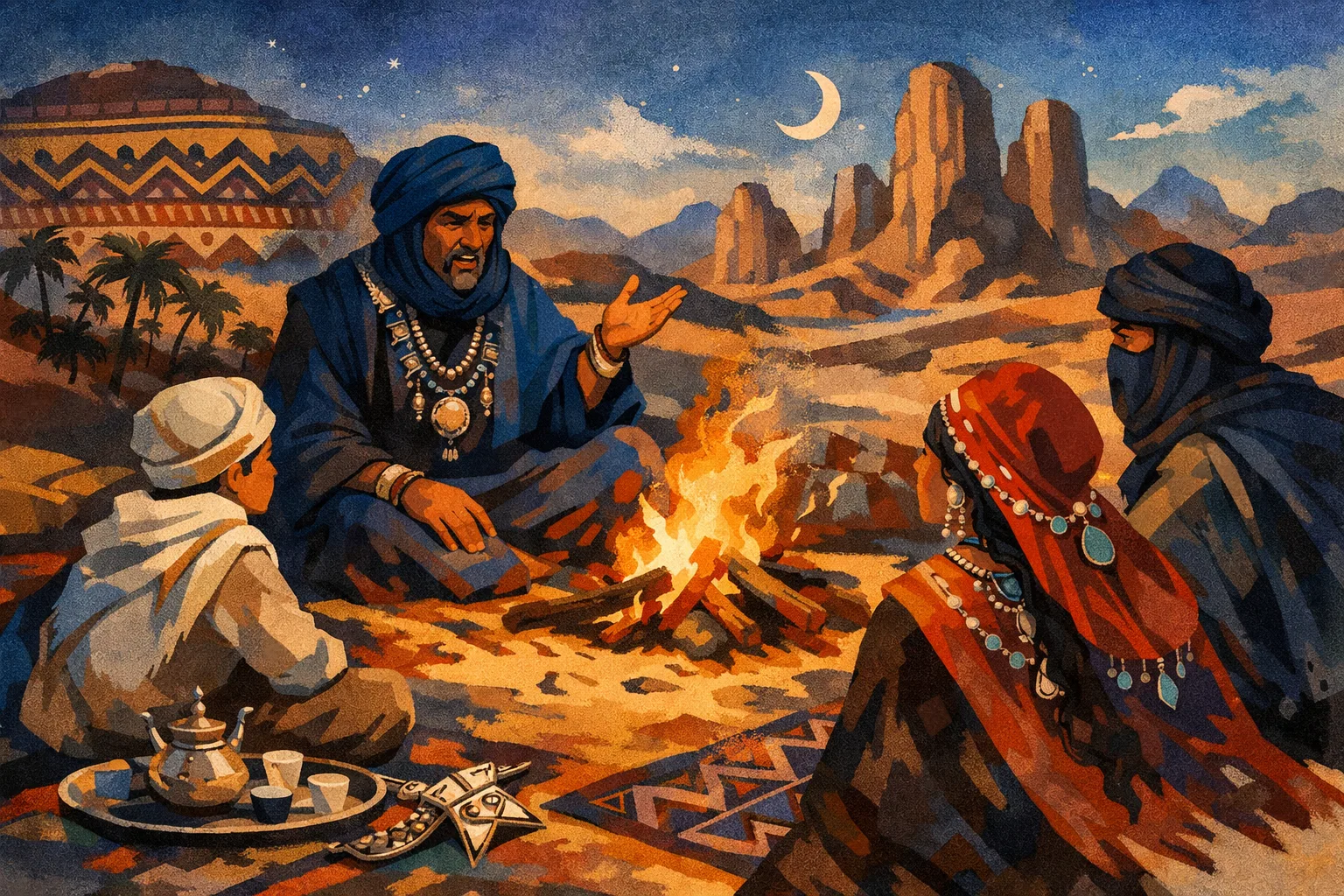
Tin Hinan is one of Algeria’s most memorable legendary figures because she stands between oral tradition and archaeology. In Tuareg memory, she is often presented as an ancestral queen of the Hoggar, a founder or motherly figure connected with noble lineages. The name is commonly interpreted in tradition as meaning something like “woman of the tents”, and stories describe her as a woman who travelled through the Sahara with companions, survived hardship, and became a source of ancestry and prestige.[Wikipedia]WikipediaTin HinanTin Hinan
What makes Tin Hinan unusual is that the legend is tied to a real monumental tomb at Abalessa in southern Algeria. The tomb was excavated in the twentieth century, and scholarly summaries connect it with a high-status woman from late antiquity, often dated around the fourth or fifth century through associated material. The remains and objects from the tomb became part of museum heritage in Algiers, and the story continues to carry cultural meaning beyond the technical archaeological debate.[Wikipedia]WikipediaTin Hinan TombTin Hinan Tomb
Tin Hinan should not be treated as a simple fairy-tale queen whose biography is fully known. The evidence is layered: Tuareg oral tradition, colonial-era excavation history, museum display, archaeological dating, and modern identity politics all shape how she is understood. For folklore, that layering is the point. Tin Hinan matters because she shows how Algerian legend can attach itself to a landscape, a tomb, a body, a lineage and a modern public symbol all at once.
Tassili n’Ajjer and the temptation to call rock art “mythology”
Tassili n’Ajjer, in south-eastern Algeria, is one of the world’s great rock-art landscapes. UNESCO describes more than 15,000 drawings and engravings there, recording climate change, wildlife migration and human life on the edge of the Sahara over immense spans of time. The site is listed as World Heritage and is important both for its cultural record and its natural landscape.[UNESCO World Heritage Centre]whc.unesco.orgOpen source on unesco.org.
For folklore readers, Tassili is fascinating but easy to misuse. The paintings and engravings include animals, human figures, hunting, herding and ritual-looking scenes, and some older interpretations gave them dramatic names or speculative religious meanings. Modern readers sometimes turn them into “ancient alien”, lost-civilisation or secret-cult stories. A grounded approach is more interesting: the art shows that the Sahara was not always the desert it is now, and that ancient communities represented animals, bodies, movement and possibly ritual in ways that later cultures could remember, reinterpret or mythologise.[UNESCO]unesco.orgdocument 25 eng 2document 25 eng 2
Tassili therefore belongs on an Algerian folklore page, but not as proof of a single surviving prehistoric myth. It is better understood as a deep symbolic landscape: a place where archaeology, environmental memory, tourism, national heritage and modern imagination meet. Its images are older than most named folktales, but they still shape how Algeria is imagined as a country of deserts, ancestors, hidden histories and sacred-looking stone.
Ahellil of Gourara: poetry, music and night-long memory
Ahellil of Gourara is one of Algeria’s clearest examples of folklore as living performance. UNESCO describes it as a poetic and musical genre emblematic of the Zenete population of Gourara, performed during collective ceremonies. Gourara itself is an oasis region in south-western Algeria, and Ahellil is linked to religious occasions, weddings, local gatherings and the social life of oasis communities.[UNESCO Intangible Cultural Heritage]ich.unesco.orgOpen source on unesco.org.
Ahellil matters because it joins poetry, music, movement, language and communal memory. It is not simply “folk music” in the background of a festival; it is a form through which people remember religious feeling, social belonging, local history and the rhythms of oasis life. Smithsonian Folkways’ recording notes the diversity of Gourara music and its religious subject matter, including ritual pieces connected with fertility and the ahellil tradition often performed through the night.[Smithsonian Folkways Recordings]folkways.si.eduOpen source on si.edu.
The tradition also shows why safeguarding is complicated. Once a performance depends on local language, older singers, community occasions and long nights of participation, it cannot be preserved by notation alone. UNESCO recognition helps make the tradition visible, but its survival depends on transmission: younger performers learning not just the words and melodies, but when, why and how they are performed.
Sebeïba in Djanet: a war dance without bloodshed
Sebeïba, practised in the oasis of Djanet in south-eastern Algeria, is one of the country’s most vivid ritual traditions. UNESCO lists the ritual and ceremonies of Sebeïba in Djanet as intangible cultural heritage, and recent reporting describes it as a ten-day Tuareg festival that culminates in a dance competition between two historic neighbourhoods. Dancers carry swords and cloths, while women’s chanting and drumming frame the performance.[UNESCO Intangible Cultural Heritage]ich.unesco.orgOpen source on unesco.org.
The stories explaining Sebeïba vary. One version connects it to joy after Moses’ victory over Pharaoh; another presents it as a ritualised resolution of rivalry between neighbourhoods. These explanations are not necessarily contradictions in the way a modern history book would treat them. In folklore, different explanations can coexist because the ceremony does several kinds of work: it remembers sacred history, channels conflict, displays beauty and skill, honours ancestors and turns rivalry into public form.[AP News]apnews.comLegends attribute the festival to either the celebration of Moses' victory over Pharaoh or the resolution of a historic local rivalry. Re…
Sebeïba is a good example of how Algerian folklore remains socially active. It is not a vanished legend reconstructed from old books. Children imitate the dancers, families prepare costumes, visitors attend, and local judges evaluate performance, dress, poetry and song. The “monster” here is not a creature but conflict itself: the ceremony turns the memory of violence into rhythm, competition and peace.
Women’s oral poetry, riddles and domestic divination
Some of Algeria’s most important folklore has lived in women’s spaces rather than in formal chronicles. The women’s poetic form often referred to in scholarship as Būqālah is associated with a ceramic pitcher and with a divinatory pastime in which poems are ritually embedded. It belongs especially to urban women’s oral culture and has been studied as literature, cultural memory and anti-colonial expression.[HCommons Works]works.hcommons.orgOpen source on hcommons.org.
This matters because folklore is sometimes reduced to “old stories for children”. Algerian women’s oral forms show a wider field: poetry used for courtship, longing, coded speech, humour, fate, resistance and social commentary. In societies where public speech could be constrained by gender, class or politics, oral poetry offered a way to say things indirectly.
Riddles and other short forms also deserve attention. Scholars of Algerian oral culture discuss riddles, folktales and women-linked oral arts as part of a wider communication system. Riddles train intelligence and memory, but they also create social occasions: a riddle is a miniature contest, a performance of cleverness, and a way of belonging to a shared world of images.[ResearchGate]researchgate.netResearch Gate An Anthropological Analysis of the Kabyle FolktaleResearch Gate An Anthropological Analysis of the Kabyle Folktale
Saints, pilgrimage and sacred geography
Algerian folklore is deeply shaped by sacred geography: tombs, shrines, zawiyas, pilgrimage routes, old cities, oases and mountain places. These are not always “mythological” in the narrow sense, but they are central to how stories of blessing, protection, danger and memory attach to the land.
UNESCO’s Algeria list includes the annual pilgrimage to the mausoleum of Sidi Abd el-Qader Ben Mohammed, known as Sidi Cheikh, and the Sbuâ pilgrimage to the zawiya of Sidi El Hadj Belkacem in Gourara. Such elements show how folk religion, collective movement, music, hospitality, saintly memory and local identity overlap.[Archiqoo]archiqoo.comOpen source on archiqoo.com.
For readers interested in haunted or sacred places, this is one of the most important distinctions to make. A shrine story is not the same thing as a ghost story. It may involve blessing, dreams, vows, healing, family memory or moral fear rather than a “haunting”. Modern tourism often flattens these places into scenic heritage, but locally they may remain part of social and spiritual life.
Seasonal customs: Yennayer, couscous and the folklore of prosperity
Algerian seasonal folklore is often practical: food, weather, fertility, household luck and the hope of a good year. Yennayer, the Amazigh New Year, is celebrated on 12 January in Algeria and became an official public holiday after state recognition in 2017, with the first official national celebration in 2018. Recent explainers connect the celebration with North African agrarian traditions, family meals and ideas of renewal, abundance and balance with nature.[Middle East Eye]middleeasteye.netyennayer what you need know about amazigh new yearyennayer what you need know about amazigh new year
Yennayer is a good example of a tradition that is both old and modern. The seasonal celebration is rooted in Amazigh and agrarian custom, but the numbered calendar and modern public-holiday politics are more recent. That does not make the celebration fake; it means readers should distinguish lived seasonal practice from modern identity-making and official recognition.
Couscous also belongs in the folklore frame when treated as practice rather than just cuisine. UNESCO’s inscription of couscous knowledge, know-how and practices, submitted jointly by Algeria, Mauritania, Morocco and Tunisia, recognises the ceremonial and social value of its preparation and consumption.[UNESCO]unesco.orgs inscription couscous traditions example international cultural cooperations inscription couscous traditions example international cultural cooperation In Algerian households, food traditions can carry memory, hospitality, gendered skill, family continuity and festival meaning. The folklore is not only in a spoken tale; it can be in how grain is rolled, when a dish is served, who gathers, and what prosperity is wished into the meal.
Music as folklore: Imzad and Raï
Algerian folklore is also sung. Imzad music, associated with Tuareg communities of Algeria, Mali and Niger, is performed by women on a single-string bowed instrument and is recognised by UNESCO as a body of practices and knowledge.[UNESCO Intangible Cultural Heritage]ich.unesco.orgOpen source on unesco.org. In folklore terms, its importance is not only musical. It carries ideals of Tuareg identity, gendered performance, memory and social prestige.
Raï, now globally associated with modern Algerian popular music, also has roots in folk expression. UNESCO describes Raï as a popular folk song of Algeria that conveyed social reality without taboos or censorship, addressing love, freedom, despair and social pressures. It began in rural settings with poetic texts in Algerian vernacular Arabic, before later transformations by women singers and then modern performers.[UNESCO Intangible Cultural Heritage]ich.unesco.orgOpen source on unesco.org.
This makes Raï a useful bridge between old oral culture and modern reinterpretation. It is not a medieval legend, yet it continues the folk function of saying what polite or official speech may avoid. Like folktales and women’s poems, it turns social pressure into performance.
How old is Algerian folklore?
There is no single age for Algerian folklore. Some symbolic landscapes, such as Tassili n’Ajjer, preserve prehistoric visual culture thousands of years old. Some legendary cycles, such as Tin Hinan traditions, are tied to late antique archaeology and Tuareg ancestral memory. Many Kabyle folktales were written down by scholars in the nineteenth and twentieth centuries but clearly draw on older oral transmission. Some practices, such as Ahellil, Sebeïba and Imzad, are living traditions with deep roots but changing modern forms.[unesco.org]whc.unesco.orgOpen source on unesco.org.
The key point is that “first written down” does not mean “first created”. Oral traditions may be much older than their earliest printed versions, but that does not give permission to assign them imaginary ancient dates. A tale collected in 1922 may contain very old motifs; it may also have changed many times before reaching the collector. Good folklore writing holds both truths together.
Colonial collecting also complicates the record. French-era scholarship preserved many oral texts, but it often filtered them through colonial assumptions about Arabs, Berbers, gender and “primitive” society. Later Algerian and Amazigh intellectuals, including figures such as Mouloud Mammeri, helped reframe oral poetry and Kabyle literature as serious cultural heritage rather than raw material for outsiders. Modern scholarship notes that periodising Kabyle literature is difficult precisely because of its oral character, and that Mammeri was central to making Kabyle poetry legible as literary history.[Chicago Journals]journals.uchicago.eduOpen source on uchicago.edu.
What changed in modern Algeria?
Modern Algeria changed folklore in three major ways: it moved many traditions into archives and festivals, made some of them symbols of national or regional identity, and exposed them to mass media and internet retelling.
UNESCO recognition has helped traditions such as Ahellil, Sebeïba, Imzad, Raï and couscous gain international visibility. That visibility can support safeguarding, tourism and pride, but it can also freeze flexible practices into staged versions for official events.[UNESCO Intangible Cultural Heritage]ich.unesco.orgalgeria DZalgeria DZ A ceremony performed for a local community and the same ceremony presented to visitors or heritage committees are not identical, even when both are sincere.
Language politics also matter. Algeria’s folklore lives across Algerian Arabic, Tamazight varieties, Tuareg speech communities, French-language scholarship and translation. When a tale moves into French, English or online Arabic, it becomes more accessible but may lose local sound, formula, humour and social setting. This is especially important for oral poetry, riddles and sung forms, where meaning depends on performance as much as plot.
The internet has added a new layer. Creatures from Morocco, the wider Maghreb, Islamic tradition and global horror now circulate together, often labelled broadly as “North African” or “Algerian”. That can spark curiosity, but it also blurs evidence. A careful reader should ask: Is this figure documented in Algeria? Is it a local variant, a neighbouring import, a literary invention, or a recent horror adaptation?
How to read Algerian folklore without flattening it
The best way to read Algerian folklore is to keep the country’s variety visible. A Kabyle ogress tale, a Tuareg desert ceremony, a Gourara song-cycle and an Algiers women’s divinatory poem do not need to be forced into one neat mythology. Their shared Algerian frame matters, but so do their local roots.
A few practical distinctions help:
Oral tradition versus written retelling. A printed folktale is often only one version of a story. Variants may differ by village, language, family or performer.
Belief versus story. Some people may treat jinn, saints’ blessings or ritual dangers as real parts of life; others may treat them as inherited stories. A public article should describe the tradition without declaring supernatural claims true.
Local creature versus regional motif. Ogresses, jinn, seductive female spirits and saintly legends travel across North Africa. A figure is not automatically Algerian just because it is Maghrebi.
Ancient evidence versus modern identity. Tin Hinan, Tassili n’Ajjer and Yennayer all involve old material, but modern museums, state recognition, tourism and cultural activism also shape how they are presented today.
Safeguarding versus performance for outsiders. UNESCO inscription can protect and promote living heritage, but it can also change how communities present it. The most meaningful folklore is still carried by people who know when to tell, sing, cook, dance, mourn, joke or keep silent.
Why Algeria’s folklore still matters
Algerian folklore matters because it keeps forms of knowledge that ordinary history often misses. It remembers women’s speech, children’s fears, farmers’ hopes, desert rivalries, saintly protection, ancestral prestige, ecological change, music as social criticism, and the ways communities turn danger into story.
It also complicates easy labels. Algeria is not only Arab, only Amazigh, only Mediterranean, only Saharan, only Islamic or only African. Its folklore shows all of these strands interacting. The ogress in a Kabyle tale, the poetic circle of Ahellil, the Sebeïba dancers holding sword and cloth, the remembered queen Tin Hinan, the women’s divinatory poem and the family meal at Yennayer all reveal a culture where story is not separate from life. It is a way of organising memory, identity, warning, pleasure and belonging.
Amazon book picks
Further Reading
Books and field guides related to What Makes Algerian Folklore So Layered?. Use these as the next step if you want deeper reading beyond the article.
Legends of the Fire Spirits
Relevant to Algerian beliefs about jinn and unseen beings.

Thousand and One Nights
Reflects the wider Arabic storytelling tradition influencing Algeria.
Berber Folk Tales of Algeria
Direct source for Algerian and Amazigh storytelling traditions.
eBay marketplace picks
Marketplace Samples
Live-tested eBay searches with available results related to this page.

Endnotes
1.
Source: ich.unesco.org
Link:https://ich.unesco.org/en/oral-traditions-and-expressions-00053
Source snippet
UNESCO Intangible Cultural HeritageOral traditions and expressions including language as a...Oral traditions and expressions are used to...
2.
Source: ich.unesco.org
Title: algeria DZ
Link:https://ich.unesco.org/en/state/algeria-DZ
3.
Source: archiqoo.com
Link:https://archiqoo.com/unesco/intangible_heritage_countries/intangible_list_algeria.php
4.
Source: researchgate.net
Title: Research Gate An Anthropological Analysis of the Kabyle Folktale
Link:https://www.researchgate.net/publication/367715828_The_Oral_Communication_System_in_the_Traditional_Algerian_Society_An_Anthropological_Analysis_of_the_Kabyle_Folktale
5.
Source: asjp.cerist.dz
Title: down Article
Link:https://asjp.cerist.dz/en/downArticle/346/7/10/20168
6.
Source: Wikipedia
Title: The Son of the Ogress
Link:https://en.wikipedia.org/wiki/The_Son_of_the_Ogress
7.
Source: arablit.org
Title: & ARABLIT QUARTERLYThe Women of Algeria’s Folktales
Link:https://arablit.org/2015/11/23/the-women-of-algerias-folktales/
8.
Source: Wikipedia
Title: Aisha Qandicha
Link:https://en.wikipedia.org/wiki/Aisha_Qandicha
9.
Source: Wikipedia
Title: Tin Hinan
Link:https://en.wikipedia.org/wiki/Tin_Hinan
10.
Source: Wikipedia
Title: Tin Hinan Tomb
Link:https://en.wikipedia.org/wiki/Tin_Hinan_Tomb
11.
Source: whc.unesco.org
Link:https://whc.unesco.org/en/list/179/
12.
Source: unesco.org
Title: document 25 eng 2
Link:https://www.unesco.org/archives/multimedia/document-25-eng-2
13.
Source: ich.unesco.org
Link:https://ich.unesco.org/en/RL/ahellil-of-gourara-00121
14.
Source: ich.unesco.org
Link:https://ich.unesco.org/en/RL/ritual-and-ceremonies-of-sebeiba-in-the-oasis-of-djanet-algeria-00665
15.
Source: works.hcommons.org
Link:https://works.hcommons.org/records/083wg-mb917
16.
Source: unesco.org
Title: s inscription couscous traditions example international cultural cooperation
Link:https://www.unesco.org/en/articles/unescos-inscription-couscous-traditions-example-international-cultural-cooperation
17.
Source: ich.unesco.org
Link:https://ich.unesco.org/en/RL/knowledge-know-how-and-practices-pertaining-to-the-production-and-consumption-of-couscous-01602
18.
Source: ich.unesco.org
Link:https://ich.unesco.org/en/RL/practices-and-knowledge-linked-to-the-imzad-of-the-tuareg-communities-of-algeria-mali-and-niger-00891
19.
Source: ich.unesco.org
Link:https://ich.unesco.org/en/RL/rai-popular-folk-song-of-algeria-01894
20.
Source: ich.unesco.org
Link:https://ich.unesco.org/en/video/62286
21.
Source: ich.unesco.org
Link:https://ich.unesco.org/en/lists
22.
Source: ich.unesco.org
Title: 01857 EN
Link:https://ich.unesco.org/doc/src/01857-EN.pdf
23.
Source: whc.unesco.org
Link:https://whc.unesco.org/en/statesparties/dz
24.
Source: ich.unesco.org
Title: 00114 EN
Link:https://ich.unesco.org/doc/src/00114-EN.pdf
25.
Source: ich.unesco.org
Title: algeria DZ
Link:https://ich.unesco.org/en/state/algeria-DZ?info=periodic-reporting
26.
Source: ich.unesco.org
Title: LHE 24 19.CO M INF.6.c EN.docx
Link:https://ich.unesco.org/doc/src/LHE-24-19.COM-INF.6.c_EN.docx
27.
Source: ich.unesco.org
Link:https://ich.unesco.org/en/home?id=41537&include=film_inc.php
28.
Source: whc.unesco.org
Title: publi wh papers 06 en
Link:https://whc.unesco.org/documents/publi_wh_papers_06_en.pdf
29.
Source: whc.unesco.org
Link:https://whc.unesco.org/archive/websites/venice2002/press/brief2002.pdf
30.
Source: whc.unesco.org
Link:https://whc.unesco.org/document/106707
31.
Source: whc.unesco.org
Link:https://whc.unesco.org/archive/2014/whc14-38com-inf8B1-en.pdf
32.
Source: whc.unesco.org
Link:https://whc.unesco.org/uploads/nominations/1430.pdf
33.
Source: whc.unesco.org
Link:https://whc.unesco.org/en/list/179/gallery/
34.
Source: ich.unesco.org
Link:https://ich.unesco.org/en/decisions/8.COM/8.2
35.
Source: ich.unesco.org
Link:https://ich.unesco.org/en/video/52557
36.
Source: ich.unesco.org
Title: photo pop up 00973
Link:https://ich.unesco.org/en/photo-pop-up-00973?photoID=08467
37.
Source: ich.unesco.org
Title: 20046 EN.doc
Link:https://ich.unesco.org/doc/src/20046-EN.doc
38.
Source: archiqoo.com
Link:https://archiqoo.com/unesco/unesco_intangible_list.php
39.
Source: archiqoo.com
Link:https://archiqoo.com/unesco/unesco_list_countries/unesco_list_algeria.php
40.
Source: archiqoo.com
Link:https://archiqoo.com/unesco/intangible_sub_lists.php?subsite=ahellil_of_gourara&uw_country=algeria
41.
Source: Wikipedia
Title: List of World Heritage Sites in Algeria
Link:https://en.wikipedia.org/wiki/List_of_World_Heritage_Sites_in_Algeria
42.
Source: Wikipedia
Title: Lists of Intangible Cultural Heritage elements
Link:https://en.wikipedia.org/wiki/Lists_of_Intangible_Cultural_Heritage_elements
43.
Source: Wikipedia
Title: List of Intangible Cultural Heritage elements in Algeria
Link:https://en.wikipedia.org/wiki/List_of_Intangible_Cultural_Heritage_elements_in_Algeria
44.
Source: Wikipedia
Link:https://en.wikipedia.org/wiki/Sebiba
45.
Source: Wikipedia
Title: Tassili n’Ajjer
Link:https://en.wikipedia.org/wiki/Tassili_n%27Ajjer
46.
Source: Wikipedia
Link:https://en.wikipedia.org/wiki/Yennayer
47.
Source: folktales.africa
Link:https://folktales.africa/category/african-folktales/north-african-folktales/algerian-folktales/
48.
Source: researchgate.net
Link:https://www.researchgate.net/publication/389900093_Rock_art_of_Tassili_n%27Ajjer_Towards_a_digital_approach_to_the_preservation_of_cultural_heritage
49.
Source: researchgate.net
Link:https://www.researchgate.net/publication/376730531_Kabyle_Literary_History_and_Questions_Related_to_its_Periodization_The_Case_of_Poetry
50.
Source: fits.dz
Title: Heritage Elements of Global Significance
Link:https://fits.dz/en/timimoun/intangible-cultural-heritage/heritage-elements-of-global-significance/
51.
Source: cyberleninka.ru
Link:https://cyberleninka.ru/article/n/the-oral-communication-system-in-the-traditional-algerian-society-an-anthropological-analysis-of-the-kabyle-folktale
52.
Source: folkways.si.edu
Link:https://folkways.si.edu/algeria-sahara-music-of-gourara/world/music/album/smithsonian
53.
Source: apnews.com
Link:https://apnews.com/article/d896fe02373bc6514e25df82767a3603
Source snippet
Legends attribute the festival to either the celebration of Moses' victory over Pharaoh or the resolution of a historic local rivalry. Re...
54.
Source: middleeasteye.net
Title: yennayer what you need know about amazigh new year
Link:https://www.middleeasteye.net/discover/yennayer-what-you-need-know-about-amazigh-new-year
55.
Source: officeholidays.com
Link:https://www.officeholidays.com/holidays/algeria/yennayer
56.
Source: journals.uchicago.edu
Link:https://www.journals.uchicago.edu/doi/10.1086/731862
57.
Source: shs.hal.science
Link:https://shs.hal.science/halshs-02945641/document
58.
Source: asjp.cerist.dz
Title: down Article
Link:https://asjp.cerist.dz/en/downArticle/315/18/2/270834
59.
Source: asjp.cerist.dz
Title: down Article
Link:https://www.asjp.cerist.dz/en/downArticle/821/6/2/188844
60.
Source: oryxvoyage.com
Link:https://oryxvoyage.com/yennayer/
61.
Source: athar.uomosul.edu.iq
Link:https://athar.uomosul.edu.iq/index.php/athar/article/view/37641
62.
Source: forbes.com
Link:https://www.forbes.com/sites/sylviebigar/2020/12/17/unesco-announces-couscous-now-inscribed-on-intangible-cultural-heritage-of-humanity-list/
63.
Source: opvm.dz
Link:https://www.opvm.dz/en/10_Articles/69_THE_INTANGIBLE_HERITAGE/d
Additional References
64.
Source: socionauki.ru
Title: 004 Touati
Link:https://www.socionauki.ru/upload/socionauki.ru/journal/seh/2022_1/004_Touati.pdf
Source snippet
An Anthropological Analysis of the Kabyle Folktaleby R Touati · 2022 — This paper aims at highlighting the specific character o...
65.
Source: youtube.com
Title: Algerian Folklore: The Blue Jackal’s Integrity
Link:https://www.youtube.com/watch?v=nKagk42N1T0
Source snippet
Sunrise at Midnight, a Play by Algerian American Artist Taous Khazem...
66.
Source: sfu.ca
Link:https://www.sfu.ca/~alderete/pubs/jucovyAlderete2001_berberBiblio.pdf
67.
Source: reddit.com
Link:https://www.reddit.com/r/mythology/comments/lf0sgq/aisha_kandisha_%E2%B5%84%E2%B4%B0%E2%B5%A2%E2%B5%9B%E2%B4%B0_%E2%B5%87%E2%B4%B0%E2%B5%8F%E2%B4%B7%E2%B5%89%E2%B5%9B%E2%B4%B0_is_a_dangerous/
68.
Source: facebook.com
Link:https://www.facebook.com/groups/920989489263873/posts/1455075612521922/
69.
Source: pinkjinn.com
Link:https://www.pinkjinn.com/tag/algeria/
70.
Source: al24news.dz
Link:https://al24news.dz/en/algeria-submits-blousa-and-other-heritage-elements-to-unesco/
71.
Source: aps.dz
Link:https://www.aps.dz/en/culture/heritage/mngd63cv-algeria-submits-el-blousa-other-heritage-elements-for-unesco-listing
72.
Source: medafricatimes.com
Link:https://medafricatimes.com/1535-algeria-wants-ahellil-as-intangible-cultural-heritage.html
73.
Source: s3.amazonaws.com
Link:https://s3.amazonaws.com/media.africanrockart.org/wp-content/uploads/2018/12/26145312/Coulson-article-A10-proof.pdf
Topic Tree
Follow this branch
Related pages 192
- Afghan Folklore
- Albanian Folklore
- Australian Folklore
- Azerbaijan Folklore
- Belarus Folklore
- +187 more in sidebar