Singapore's Uncanny Folklore
Singapore’s folklore is not a single, sealed book of myths. It is a living mix of Malay court legend, island stories, sacred shrines, Chinese ritual culture, ghost lore, children’s retellings, horror cinema and urban haunting.
Page outline Jump by section
What counts as Singapore folklore?
Singapore folklore is best understood as a crossroads tradition. Some tales belong to the old Malay world of Temasek and Singapura, preserved through court chronicles such as the Malay Annals and later retellings. Others are shrine legends attached to particular graves, hills or offshore islands. Others come from Chinese religious practice, Indian and wider Southeast Asian belief culture, colonial-era memory, schoolyard ghost stories, local horror publishing and screen adaptations.
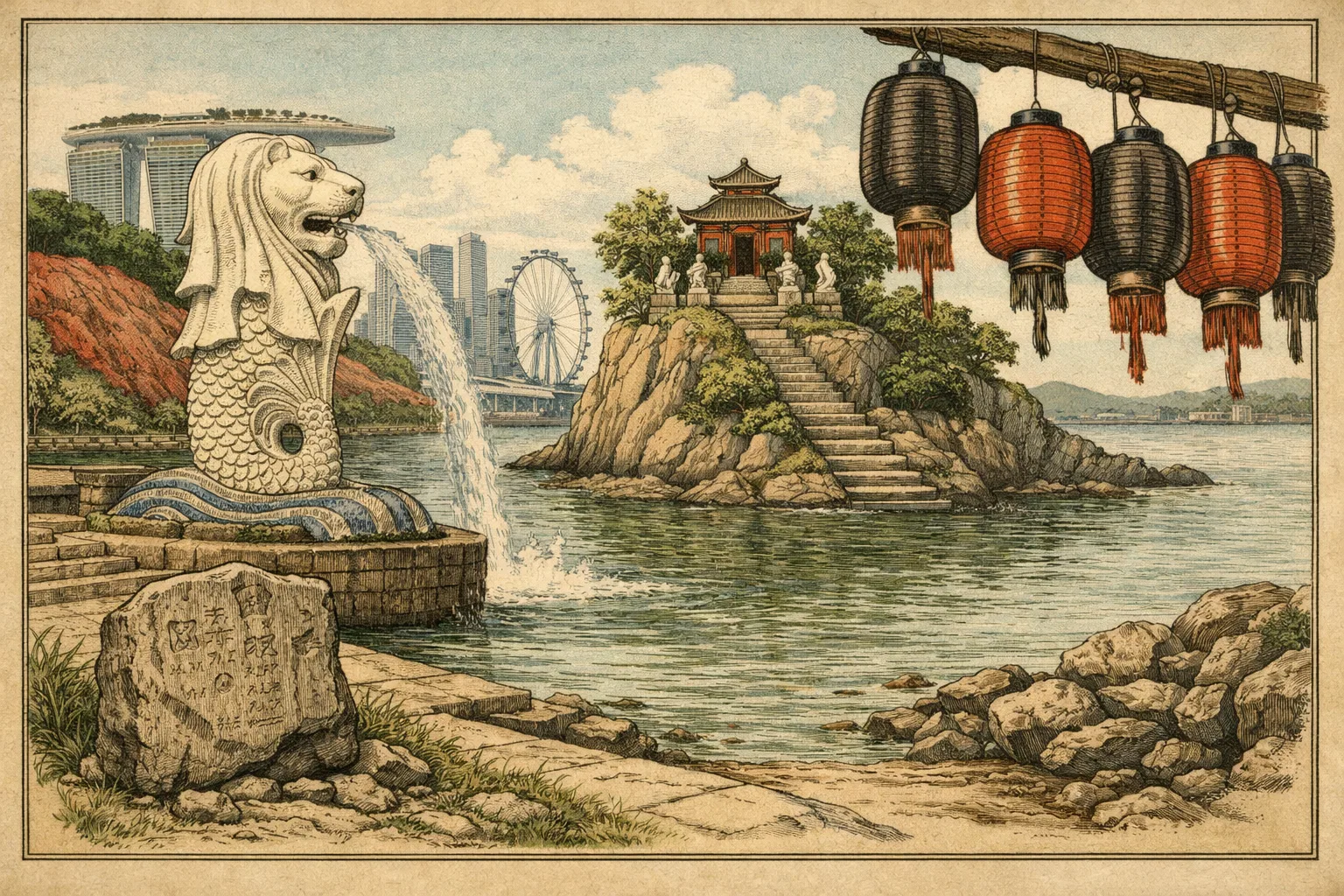
That means Singapore’s folklore is often tied to places rather than to a single ancient pantheon. A reader is likely to encounter it through names on the map: Redhill, Telok Blangah, Fort Canning, Kusu Island, Sisters’ Islands, Palmer Road, the Singapore River and Merlion Park. Some stories are clearly legendary. Some are devotional traditions. Some are modern inventions that use older symbols. The Merlion, for example, is now one of Singapore’s most recognisable mythical figures, but it was designed in 1964 for the Singapore Tourist Promotion Board, drawing on the older lion-sighting story and the idea of Singapore’s maritime beginnings.[National Library Board]nlb.gov.sgNational Library Board MerlionNational Library Board Merlion
This is one reason Singapore folklore can feel unusually compressed: a medieval-style founding legend, a colonial newspaper record, a shrine pilgrimage, a children’s book and a horror film can all refer to the same story-world. The result is not a museum case of “old beliefs” but a set of narratives still being reworked in education, tourism, religious practice and popular culture.[National Library Board]nlb.gov.sgNational Library Board Theme: Legends of SingapuraNational Library Board Theme: Legends of Singapura
The lion that gave Singapore its name
The founding legend of Singapore centres on Sang Nila Utama, a prince from Palembang who, according to the Malay Annals, founded a settlement called Singapura on the island of Temasek around 1299. In the familiar version, a storm threatens his fleet; he throws his crown into the sea; the storm calms; and after landing he sees a strange, noble animal identified as a lion. The sighting is taken as an auspicious sign, and the island is renamed the Lion City.[National Library Board]nlb.gov.sgNational Library Board Sang Nila UtamaNational Library BoardSang Nila Utama - SingaporeIn the Sejarah Melayu (SM; Malay Annals), Sang (Nila) Utama is a reference to a 13th-cen…
The story’s power is not that zoologists think lions once roamed Singapore. Its power is symbolic. It gives the island a royal origin, a maritime crossing, a sacrifice, a miraculous calm and a name. National Library Board writing on Sang Nila Utama treats him as a figure who “looms” in Singapore’s imagination while also noting the difficulty of separating myth from historical reality.[BiblioAsia]biblioasia.nlb.gov.sgvol 16 issue 2 jul sep 2020 sang nilavol 16 issue 2 jul sep 2020 sang nila
The lion legend has also outgrown its medieval source. It feeds directly into modern national imagery: the Merlion’s lion head refers to the prince’s sighting, while its fish body points to Singapore’s older maritime identity and the name Temasek. This makes the Merlion a useful example of modern folklore-making. It is not an ancient creature in the way the pontianak or Badang are attached to older narrative worlds, but it has become a mythic national icon precisely because it turns older legend into a simple visual form.[National Library Board]nlb.gov.sgNational Library Board MerlionNational Library Board Merlion
Badang, the Singapore Stone and the problem of proof
Badang is one of Singapore’s most memorable legendary heroes. In the story, he begins as a humble man and becomes a figure of immense strength after an encounter with a supernatural being. His feats become attached to the mouth of the Singapore River and, in modern memory, to the Singapore Stone: a surviving fragment of a much larger inscribed stone, dated broadly to the 10th to 14th centuries and now displayed by the National Museum of Singapore.[Roots]roots.gov.sgRoots A Fragment of HistoryRoots A Fragment of History
The attraction of the Badang story is that it appears to touch something physical. Unlike a purely oral tale, it seems to point to a real object. Yet this is also where the evidence becomes complicated. National Heritage Board writing presents the Singapore Stone as a material remnant from Singapore’s ancient past, while more recent research in BiblioAsia stresses that the Malay Annals do not actually say Badang’s rock carried an inscription. The written stone and Badang’s thrown rock have become intertwined in popular imagination, but the connection is not straightforward proof that the legend explains the artefact.[Roots]roots.gov.sgRoots A Fragment of HistoryRoots A Fragment of History
That tension is part of what makes the tale valuable. It shows how folklore often works around ruins and fragments: a damaged object invites explanation; a remembered hero gives it drama; later generations fuse the two. The Singapore Stone is therefore both a historical artefact and a folklore magnet. It does not need to “prove” Badang existed to show how Singaporeans imagine deep time beneath the modern city.

Place legends: Redhill, Sisters’ Islands and Radin Mas
Many of Singapore’s best-loved folktales explain why a place has a particular name or emotional charge. These are not just stories about the past; they are ways of making the urban map feel storied.
The Redhill tale, also known through children’s retellings, tells of a time when swordfish attack Singapore’s shore. The ruler first orders men to stand in the water to fight the fish, with deadly results. A clever boy suggests using banana stems instead. The plan works, but the ruler fears the boy’s intelligence and has him killed; his blood stains the hill red, giving Redhill its name.[National Library Board]nlb.gov.sgOpen source on nlb.gov.sg.
The story endures because it is not merely an origin tale. It is also a warning about insecure power. The child saves the community, but authority destroys him. That gives the tale a sharp moral edge: intelligence can be feared by rulers when it exposes their foolishness.
Sisters’ Islands carries a different emotional pattern. National Library Board’s account gives the legend of two devoted sisters, Minah and Linah, whose closeness and tragedy are remembered in the naming of the two islands south of Singapore. The story turns geography into grief: two islands become two sisters separated and memorialised by the sea.[National Library Board]nlb.gov.sgNational Library Board Sisters' IslandsNational Library Board Sisters' Islands
Radin Mas Ayu belongs to the same map of memory but with a stronger shrine tradition. According to National Library Board and National Heritage Board accounts, Radin Mas was a Javanese princess associated with Telok Blangah who died protecting her father. Her shrine, Keramat Radin Mas, keeps the tale tied to a specific sacred site rather than leaving it as a detached children’s story.[National Library Board]nlb.gov.sgNational Library Board Keramat Radin MasNational Library Board Keramat Radin Mas
These place legends share a pattern: they take familiar landscapes and add moral memory. Redhill becomes a story about cleverness and fear. Sisters’ Islands becomes a story about loyalty. Radin Mas becomes a story about filial sacrifice, migration and sacred remembrance.
Sacred shrines and living pilgrimage
Some of Singapore’s folklore is not best described as “myth” at all. It belongs to lived religious practice, especially the tradition of keramat, or sacred grave-shrines associated with holy persons, local saints, royal figures or miracle-working presences. These sites blur categories that modern readers often keep separate: history, devotion, legend, local memory and supernatural petition.
Kusu Island is the clearest public example. The island lies south-west of mainland Singapore and is associated with a Chinese temple and three Malay shrines, attracting large numbers of pilgrims, especially in the ninth lunar month. National Library Board notes that Kusu means tortoise or turtle in the Hokkien dialect, and BiblioAsia research shows that the island’s shrine origin stories have changed over time.[National Library Board]nlb.gov.sgNational Library Board Kusu IslandNational Library Board Kusu Island
The legend often told of Kusu Island involves a tortoise that saves shipwrecked men and becomes an island, or a sacred island where devotees seek blessings. The exact story varies, but the important point is the island’s shared devotional landscape. William Gibson’s work on the Kusu shrines emphasises how little is definitively known about the origin of the keramat despite the site’s popularity, making it a good example of a tradition sustained by practice as much as by a fixed written account.[BiblioAsia]biblioasia.nlb.gov.sgBiblio Asia The Origin Stories of Keramat KusuBiblio Asia The Origin Stories of Keramat Kusu
Keramat Habib Noh at Palmer Road shows the same relationship between sacred story and city space. National Library Board identifies it as a shrine dedicated to Sayyid Noh bin Sayyid Mohamad bin Sayyid Ahmad Al-Habshi, widely known as Habib Noh. The site remains important in Singapore’s religious landscape, and heritage writing on nearby shrines records how miracles and saintly reputation form part of local memory around such places.[National Library Board]nlb.gov.sgNational Library Board Keramat Habib NohNational Library Board Keramat Habib Noh
The keramat tradition also shows how urban redevelopment affects folklore. BiblioAsia’s recent discussion of the keramat phenomenon notes that Singapore once had many such shrines, ranging from Fort Canning’s Keramat Iskandar Shah to small roadside sites, but that many disappeared over the past half-century as the city changed.[BiblioAsia]biblioasia.nlb.gov.sgOpen source on nlb.gov.sg.
Ghosts, pontianaks and the Singapore horror imagination
Ghost stories are one of Singapore’s most energetic folklore forms. They move easily between Malay belief, Chinese ritual calendars, school rumours, national service stories, haunted hospitals, urban legends and commercial horror. Unlike the older place-name legends, these stories often survive because they are retold informally: in families, dormitories, online forums, books, podcasts and late-night conversations.
The pontianak is the most famous Malay supernatural figure in Singapore’s horror tradition. She is usually described as the vengeful spirit of a woman who died during childbirth, often imagined with long hair and a white dress. In Singapore, the pontianak became more than a folk figure: she helped create a local screen horror tradition. Cathay-Keris Productions’ Pontianak premiered at Cathay cinema in Dhoby Ghaut at midnight on 27 April 1957, and National Library Board notes that its success led to sequels and helped establish horror in the local film industry.[National Library Board]nlb.gov.sgNational Library Board Pontianak – a pioneer horror film seriesNational Library Board Pontianak – a pioneer horror film series
That film history matters because it shows folklore becoming mass media. The pontianak was not invented by cinema, but cinema standardised and amplified her image for multilingual audiences. The National Archives of Singapore records that the 1957 film was dubbed into Mandarin and Cantonese for local Chinese viewers and the Hong Kong market, showing how a Malay spirit figure travelled across language communities through popular entertainment.[ACRA]corporate.nas.gov.sgOpen source on nas.gov.sg.
Modern Singapore ghost culture also includes newer hauntings: old schools, army camps, hospitals, lifts, roads and public housing estates. These may not be “ancient” in the way some readers expect folklore to be, but they are still folklore in the modern sense: repeated, localised stories that express shared anxieties. In a dense, highly planned city, ghost stories often cluster around spaces that feel transitional, abandoned, over-disciplined or emotionally charged.
Hungry Ghost Festival and public ritual
The Hungry Ghost Festival is one of the most visible forms of supernatural belief in Singapore’s public calendar. It is observed during the seventh lunar month in Chinese religious tradition, when spirits are believed to roam the human world and require offerings, respect and entertainment. In Singapore, the festival is not hidden away in temples. It appears in public space through incense, food offerings, paper offerings, community rituals and outdoor performances.
Getai, literally a song-stage performance form, is now strongly associated with the festival. National Library Board describes getai as the most common entertainment during the Hungry Ghost Festival, often staged on temporary platforms in open-air venues in Housing and Development Board estates. National Heritage Board’s intangible cultural heritage portal notes that Chinese opera and puppet shows were traditionally staged during the festival, but getai gradually became the main attraction from the 1970s onward.[National Library Board]nlb.gov.sgNational Library Board GetaiNational Library Board Getai
This is folklore as performance, not just story. The logic is relational: the living offer food, music and spectacle to unseen guests, while the community also gathers, watches and socialises. Research on getai in Singapore describes the Hungry Ghost Festival as a material and visible way in which Chinese communities perform rituals for gods, ghosts and ancestors.[MDPI]mdpi.comOpen source on mdpi.com.
For visitors, the festival is sometimes reduced to “ghost month taboos”, but that misses the point. Its public forms are about obligation, memory, respect and neighbourhood life. The empty front-row seats at performances, offerings placed carefully at the roadside and the temporary stages in estates all make the unseen socially present.
Folklore in books, classrooms and children’s culture
Singapore’s legends have been repeatedly adapted for younger readers. This matters because children’s versions often become the form in which adults remember a story: Sang Nila Utama throws his crown into the sea; Badang lifts or throws a great stone; the Redhill boy saves Singapore from swordfish; two sisters become islands.
National Library Board’s children’s resources explicitly frame these as “Legends of Singapura”, asking readers to explore how true such stories might be while introducing figures such as Prince Nila, Badang and the Merlion.[National Library Board]nlb.gov.sgNational Library Board Theme: Legends of SingapuraNational Library Board Theme: Legends of Singapura
The retelling process can soften older material, but it also keeps the stories alive. The Redhill tale, for instance, is violent and political in outline, yet children’s versions often emphasise clever problem-solving before revealing the tragedy. The Sang Nila Utama story becomes an accessible founding tale. Badang becomes a superhero-like strongman. Radin Mas becomes an example of filial courage. These versions are not merely simplified; they are one of the main ways Singapore folklore remains culturally available.
This is also why Singapore folklore often appears in schools, heritage trails, library displays and family books rather than only in specialist folklore collections. The tradition is partly archival and partly pedagogical: stories are kept because they help explain names, places and values.
Old tradition, modern invention and internet-era folklore
A useful way to read Singapore folklore is to ask what kind of tradition a story is.
Older legendary material includes stories preserved in or linked to the Malay Annals, such as Sang Nila Utama and Badang. These are not straightforward historical records, but they are old enough to show how pre-modern Malay court culture imagined kingship, power and Singapura’s place in the region.[BiblioAsia]biblioasia.nlb.gov.sgBiblio Asia Legends of the Malay KingsBiblio Asia Legends of the Malay Kings
Place-name folklore includes Redhill, Sisters’ Islands and Radin Mas. These tales explain landscapes through memorable human drama: cleverness punished, sisters lost, daughters sacrificed. Their power lies in making everyday geography emotionally legible.[National Library Board]nlb.gov.sgOpen source on nlb.gov.sg.
Living ritual tradition includes Kusu Island pilgrimage, keramat veneration and Hungry Ghost Festival performance. These are not just stories people tell; they are practices people perform, maintain, debate and adapt.[nlb.gov.sg]nlb.gov.sgNational Library Board Kusu IslandNational Library Board Kusu Island
Modern national myth-making includes the Merlion: a deliberately designed emblem that has become mythic through repetition, tourism, souvenirs, public sculpture and national branding.[National Library Board]nlb.gov.sgNational Library Board MerlionNational Library Board Merlion
Urban and internet-era folklore includes haunted schools, ghostly army stories, lift encounters and online retellings of older spirits. These stories may be recent, but they behave like folklore because they circulate through repeated telling, local detail and claims of “someone I know” experience.
The differences matter. A shrine legend should not be treated in the same way as a tourist logo; a film monster is not the same as an oral spirit belief; a school ghost rumour is not the same as a chronicle legend. But together they show how Singapore’s supernatural imagination keeps finding new containers.

Why Singapore’s folklore still matters
Singapore’s folklore survives because it answers questions that official history alone does not answer. It asks what kind of beginning a city imagines for itself. It asks why certain places feel sacred, unlucky, mournful or powerful. It asks how migrant communities honour the dead, how children learn the map, how horror expresses social unease, and how a modern nation turns old symbols into public identity.
The traditions are also reminders that Singapore has never been culturally flat. The island’s folklore carries Malay royal memory, Javanese princess legend, Chinese ritual practice, Islamic shrine devotion, colonial-era documentation, post-war cinema, public housing performance culture and modern internet storytelling. Its most interesting feature is not one monster or one myth, but the way stories cross boundaries: a Malay spirit becomes a multilingual film icon; a sacred island draws different communities; a designed tourist emblem becomes a national creature; a stone fragment becomes a legendary strongman’s trace.
Singapore folklore is therefore not a retreat from modernity. It is one of the ways Singapore has narrated modernity: by letting old hills, reclaimed shores, offshore islands, shrines, cinemas, estates and online spaces remain haunted by memory.
Amazon book picks
Further Reading
Books and field guides related to What Haunts Singapore's Storied Map?. Use these as the next step if you want deeper reading beyond the article.
Malay Annals, The: Attack Of The Garfish And Other Adventures
Primary source for major Singapore origin legends.
Singapore: A Biography
Provides cultural and historical context behind local folklore.
eBay marketplace picks
Marketplace Samples
Live-tested eBay searches with available results related to this page.
Endnotes
1.
Source: corporate.nas.gov.sg
Link:https://corporate.nas.gov.sg/media/collections-and-research/pontianak/
2.
Source: mdpi.com
Link:https://www.mdpi.com/2077-1444/11/7/356
3.
Source: mdpi.com
Link:https://www.mdpi.com/2078-2489/17/2/170
4.
Source: nlb.gov.sg
Title: National Library Board Sang Nila Utama
Link:https://www.nlb.gov.sg/main/article-detail?cmsuuid=7dc04ff9-f9fb-44ba-867e-8b714f87b324
Source snippet
National Library BoardSang Nila Utama - SingaporeIn the Sejarah Melayu (SM; Malay Annals), Sang (Nila) Utama is a reference to a 13th-cen...
5.
Source: nlb.gov.sg
Link:https://www.nlb.gov.sg/main/book-detail?cmsuuid=057c03bd-634c-4e6c-922e-e9b057c665e9
6.
Source: roots.gov.sg
Title: Roots A Fragment of History
Link:https://www.roots.gov.sg/stories-landing/stories/a-fragment-of-history/story
7.
Source: nlb.gov.sg
Title: National Library Board Getai
Link:https://www.nlb.gov.sg/main/article-detail?cmsuuid=5f641690-731c-4816-b84b-733232c8d44f
8.
Source: nlb.gov.sg
Title: National Library Board Merlion
Link:https://www.nlb.gov.sg/main/article-detail?cmsuuid=f9c0fd6c-acfa-4eb0-8585-2aa155c1d74d
9.
Source: roots.gov.sg
Link:https://www.roots.gov.sg/stories-landing/stories/celebrating-50-years-of-the-merlion-stories-behind-the-national-icon/story
10.
Source: nlb.gov.sg
Title: National Library Board Theme: Legends of Singapura
Link:https://www.nlb.gov.sg/main/site/learnx/learnx-singapore/children/legends-of-singapura
11.
Source: nlb.gov.sg
Link:https://www.nlb.gov.sg/main/book-detail?cmsuuid=68bf7c3c-0424-400a-ae35-1f6444de6cc9
12.
Source: biblioasia.nlb.gov.sg
Title: vol 16 issue 2 jul sep 2020 sang nila
Link:https://biblioasia.nlb.gov.sg/all-sections/vol-16-issue-2-jul-sep-2020-sang-nila/
13.
Source: biblioasia.nlb.gov.sg
Link:https://biblioasia.nlb.gov.sg/all-sections/vol-21-issue-1-apr-jun-2025-origins-badang-strongman-singapore-stone/
14.
Source: nlb.gov.sg
Title: National Library Board Sisters’ Islands
Link:https://www.nlb.gov.sg/main/article-detail?cmsuuid=e7644831-8051-4a14-8b27-848a1bf31989
15.
Source: nlb.gov.sg
Title: National Library Board Keramat Radin Mas
Link:https://www.nlb.gov.sg/main/article-detail?cmsuuid=c1515f0d-5556-4620-bcf5-09748d26fd57
16.
Source: roots.gov.sg
Link:https://www.roots.gov.sg/stories-landing/stories/the-legend-of-radin-mas-ayu/story
17.
Source: nlb.gov.sg
Title: National Library Board Kusu Island
Link:https://www.nlb.gov.sg/main/article-detail?cmsuuid=88b893d8-6da3-45a9-ab08-c2b795c989cc
18.
Source: biblioasia.nlb.gov.sg
Title: Biblio Asia The Origin Stories of Keramat Kusu
Link:https://biblioasia.nlb.gov.sg/all-sections/vol-18-issue-4-jan-mar-2023-shrines-keramat-kusu/
19.
Source: biblioasia.nlb.gov.sg
Link:https://biblioasia.nlb.gov.sg/all-sections/vol-8-issue-4-jan-mar-2013-life-death-keramats/
20.
Source: nlb.gov.sg
Title: National Library Board Keramat Habib Noh
Link:https://www.nlb.gov.sg/main/article-detail?cmsuuid=fdd0c6a6-9e0b-4855-b558-5cc75da33e22
21.
Source: roots.gov.sg
Link:https://www.roots.gov.sg/places/places-landing/Places/surveyed-sites/Sharifah-Rogayah-Keramat
22.
Source: biblioasia.nlb.gov.sg
Link:https://biblioasia.nlb.gov.sg/chapters-of-asia/chapters-on-asia-2024-keramat-grave-shrine-singapore/
23.
Source: nlb.gov.sg
Title: National Library Board Pontianak – a pioneer horror film series
Link:https://www.nlb.gov.sg/main/article-detail?cmsuuid=d483baba-d96a-436d-abf9-0ded52884b67
24.
Source: biblioasia.nlb.gov.sg
Title: Biblio Asia A History of Singapore Horror | Biblio Asia
Link:https://biblioasia.nlb.gov.sg/all-sections/vol-13-issue-2-jul-sep-2017-history-of-singaporean-horror/
25.
Source: roots.gov.sg
Link:https://www.roots.gov.sg/ich-landing/ich/getai
26.
Source: biblioasia.nlb.gov.sg
Title: Biblio Asia Legends of the Malay Kings
Link:https://biblioasia.nlb.gov.sg/all-sections/vol-11-issue-4-jan-mar-2016-sejarah-malayu-malay-annals/
27.
Source: nlb.gov.sg
Link:https://www.nlb.gov.sg/main/about-us/press-room-and-publications/media-releases/2019/the-first-print-stories-and-legends-of-early-singapore-display
28.
Source: nlb.gov.sg
Link:https://www.nlb.gov.sg/main/book-detail?cmsuuid=925e462f-2cc2-4063-8dbc-a861948072ca
29.
Source: eresources.nlb.gov.sg
Link:https://eresources.nlb.gov.sg/main/Browse?browseBy=teens&filter=10&startsWith=S
30.
Source: nlb.gov.sg
Title: NLB Cheatsheet IslandsofSingapore Jul2019
Link:https://www.nlb.gov.sg/main/site/-/media/NLBMedia/Images/SURE/Resources-for-Teens/cheatsheet/NLB_Cheatsheet_IslandsofSingapore_Jul2019.pdf
31.
Source: eresources.nlb.gov.sg
Title: nlb.gov.sg Newspaper S G
Link:https://eresources.nlb.gov.sg/newspapers/digitised/issue/straitstimes20150914-1
32.
Source: eresources.nlb.gov.sg
Title: nlb.gov.sg Newspaper S G
Link:https://eresources.nlb.gov.sg/newspapers/digitised/issue/straitstimes20080901-1
33.
Source: biblioasia.nlb.gov.sg
Title: nlb.gov.sg The Stories Behind the Shrines on Kusu Island
Link:https://biblioasia.nlb.gov.sg/all-sections/podcast-keramat-kusu/
34.
Source: eresources.nlb.gov.sg
Title: nlb.gov.sg Newspaper S G
Link:https://eresources.nlb.gov.sg/newspapers/digitised/issue/straitstimes19940828-1
35.
Source: biblioasia.nlb.gov.sg
Title: vol 10 issue 4 jan march 2015 nation of island
Link:https://biblioasia.nlb.gov.sg/all-sections/vol-10-issue-4-jan-march-2015-nation-of-island/
Published: march 2015
36.
Source: catalogue.nlb.gov.sg
Link:https://catalogue.nlb.gov.sg/search/card?recordId=13063254
37.
Source: eresources.nlb.gov.sg
Title: nlb.gov.sg Newspaper S G
Link:https://eresources.nlb.gov.sg/newspapers/digitised/issue/straitstimes19960129-1
38.
Source: biblioasia.nlb.gov.sg
Link:https://biblioasia.nlb.gov.sg/all-sections/vol-14-issue-1-apr-jun-2018-st-johns-island-gateway-getaway/
39.
Source: eresources.nlb.gov.sg
Title: nlb.gov.sg Newspaper S G
Link:https://eresources.nlb.gov.sg/newspapers/digitised/issue/straitstimes20180126-1
40.
Source: biblioasia.nlb.gov.sg
Title: nlb.gov.sg Standing Firm: Stories of Ubin
Link:https://biblioasia.nlb.gov.sg/all-sections/vol-10-issue-2-jul-sep-2014-stories-of-ubin/
41.
Source: biblioasia.nlb.gov.sg
Title: vol 22 issue 2 jul sep 2026 the lions of the lion city
Link:https://biblioasia.nlb.gov.sg/all-sections/vol-22-issue-2-jul-sep-2026-the-lions-of-the-lion-city/
42.
Source: eresources.nlb.gov.sg
Title: nlb.gov.sg Newspaper S G
Link:https://eresources.nlb.gov.sg/newspapers/digitised/issue/straitstimes20110106-1
43.
Source: eresources.nlb.gov.sg
Link:https://eresources.nlb.gov.sg/linkeddata/primary-entity/work/3fe1779e-d5ed-4d43-a4c3-c1fd8a7184ce
44.
Source: biblioasia.nlb.gov.sg
Title: vol 13 issue 1 apr jun 2017 land from sand
Link:https://biblioasia.nlb.gov.sg/all-sections/vol-13-issue-1-apr-jun-2017-land-from-sand/
45.
Source: nlb.gov.sg
Title: FANLB DIYActivity Sheet 9 10
Link:https://www.nlb.gov.sg/main/site/-/media/NLBMedia/Documents/DiscoveReads/Children/Highlights/World-and-Us/FANLB-DIYActivitySheet-9–10.pdf
46.
Source: nlb.gov.sg
Title: Musical Practice of Malay ‘traditional’ forms
Link:https://www.nlb.gov.sg/main/api/MusicDetailPage/ViewPdf?resourceUuid=a918f676-223d-41a0-9e7f-6ae4c53aab0c
47.
Source: biblioasia.nlb.gov.sg
Title: nlb.gov.sg Cholera in 19th-century Singapore | Biblio Asia
Link:https://biblioasia.nlb.gov.sg/all-sections/vol-16-issue-2-jul-sep-2020-cholera/
48.
Source: biblioasia.nlb.gov.sg
Title: vol 18 issue 4 jan mar 2023 asian film archive restoration
Link:https://biblioasia.nlb.gov.sg/all-sections/vol-18-issue-4-jan-mar-2023-asian-film-archive-restoration/
49.
Source: catalogue.nlb.gov.sg
Link:https://catalogue.nlb.gov.sg/search/card?entityType=FormatGroup&id=5978970a-24cb-4bae-b897-0a24cb9baef9&identifier=topics&showcase=topics
50.
Source: nlb.gov.sg
Title: Habib Noh
Link:https://www.nlb.gov.sg/main/article-detail?cmsuuid=d464e640-b732-44f4-a32f-56920531994c
51.
Source: nlb.gov.sg
Title: Princess Radin Mas
Link:https://www.nlb.gov.sg/main/book-detail?cmsuuid=b88afbb4-abf2-4925-87d5-4c3e1e1c1d87
52.
Source: Wikipedia
Title: Keramat Iskandar Shah
Link:https://en.wikipedia.org/wiki/Keramat_Iskandar_Shah
53.
Source: Wikipedia
Title: Keramat Habib Noh
Link:https://en.wikipedia.org/wiki/Keramat_Habib_Noh
54.
Source: Wikipedia
Title: Radin Mas Ayu
Link:https://en.wikipedia.org/wiki/Radin_Mas_Ayu
55.
Source: visitsingapore.com
Title: hungry ghost festival
Link:https://www.visitsingapore.com/whats-happening/all-happenings/festivals/hungry-ghost-festival/
56.
Source: atlasobscura.com
Title: keramat iskandar shah
Link:https://www.atlasobscura.com/places/keramat-iskandar-shah
Additional References
57.
Source: academia.edu
Link:https://www.academia.edu/41711115/Delving_into_Singapore_Ghost_Stories
58.
Source: academia.edu
Link:https://www.academia.edu/93825247/The_Origins_of_Keramat_Kusu
59.
Source: researchgate.net
Link:https://www.researchgate.net/publication/374087056_The_Corporeal_and_Monstrosity_of_Supernatural_Entities_Towards_a_Socio-Functional_Illustration_of_Pontianak_In_Tunku_Halim%27s_Horror_Stories
60.
Source: explorersg.com
Link:https://explorersg.com/7-myths-folklores-singapore-never-believe/
61.
Source: instagram.com
Link:https://www.instagram.com/p/DXutlK-EYCg/
62.
Source: facebook.com
Link:https://www.facebook.com/EsplanadeSG/posts/a-story-of-love-betrayal-and-sacrifice-the-legend-of-radin-mas-ayu-is-about-a-da/768400688916875/
63.
Source: sistersislandmarinepark.blogspot.com
Link:https://sistersislandmarinepark.blogspot.com/p/about.html
64.
Source: dokumen.pub
Link:https://dokumen.pub/alluring-monsters-the-pontianak-and-cinemas-of-decolonization-9780231554046.html
65.
Source: scribd.com
Link:https://www.scribd.com/document/628833810/Badang-and-the-Singapore-Stone
66.
Source: facebook.com
Link:https://www.facebook.com/TheStarOnline/posts/drawing-heavily-from-malaysias-rich-folklore-the-series-features-many-recognisab/1496083715887482/
Topic Tree
Follow this branch
Related pages 192
- Afghan Folklore
- Albanian Folklore
- Algerian Folklore
- Australian Folklore
- Azerbaijan Folklore
- +187 more in sidebar