Why Italian Folklore Is So Regional
Italian folklore is not a single, tidy mythology. It is a dense patchwork of regional tales, saintly cults, fairy stories, witches, protective rituals, carnival masks, ghostly places and literary retellings shaped by Italy’s long history of city-states, dialects, rural communities, Catholic practice and Mediterranean exchange.
Page outline Jump by section
Introduction
The most useful way to understand Italian folklore is therefore not to ask, “What is the Italian equivalent of Greek mythology?” Ancient Roman myth is part of the background, but country-level Italian folklore is more often found in village calendars, oral tales, local saints, protective gestures, healing rites, ghost stories, carnival performances and written collections that preserve or reshape older oral material. The tradition is old, but the evidence varies: some customs are documented in early modern trial records, some in nineteenth-century folklore collections, some in UNESCO heritage files, and some mainly through local memory and tourism retellings.[archive.org]archive.orgOpen source on archive.org.
Why Italian folklore is so regional
Italy became a unified state only in the nineteenth century, and its folklore still reflects older regional worlds: Alpine valleys, the Po plain, Tuscan towns, Neapolitan streets, Apulian villages, Sicilian theatres, Sardinian mountain communities and Adriatic borderlands. This helps explain why an Italian folk creature, charm or ritual often belongs more strongly to a province, island or town than to the whole nation. A “national” survey of Italian folklore has to keep that local texture rather than flatten it into one invented pantheon.[unesco.org]ich.unesco.orgIntangible Cultural Heritage ItalyIntangible Cultural Heritage Italy
The official UNESCO list for Italy makes this regional pattern visible. Its recognised intangible heritage includes Sicilian puppet theatre, Sardinian pastoral song, Cremonese violin craftsmanship, big shoulder-borne processional structures, truffle knowledge, transhumance, Neapolitan pizza-making and other practices. Not all of these are supernatural folklore, but they show the same cultural mechanism: knowledge is passed through families, guilds, performers, ritual communities and local calendars rather than simply through books.[UNESCO Intangible Cultural Heritage]ich.unesco.orgIntangible Cultural Heritage ItalyIntangible Cultural Heritage Italy
This regionalism also protects Italy from a common misunderstanding. Italian folklore is not just “pagan survivals” under a Christian surface, nor is it merely Catholic devotion with colourful local decorations. It is a changing mixture. A winter gift-bringer may be explained through both older seasonal rites and the Christian Epiphany; a healing ritual may use prayer, saints, oil, water and inherited words; a carnival mask may be described today as “ancient” even when the strongest documentation is more recent or the meaning has changed. Good folklore reading keeps those layers separate without stripping the stories of their power.[italia.it]italia.itEpiphany in Italy: Befana meaning and traditionsEpiphany in Italy: Befana meaning and traditions
The Befana: Italy’s best-known folk figure
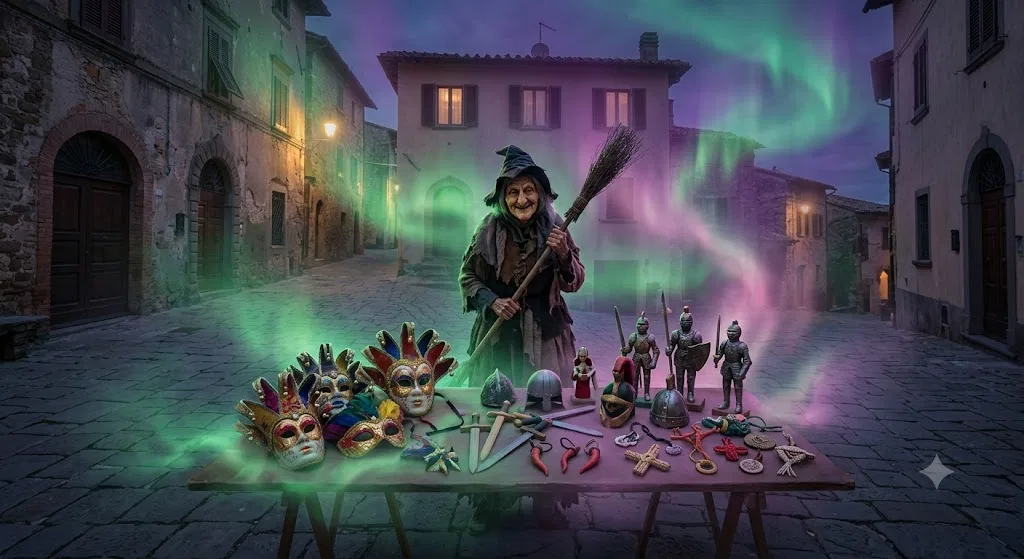
The Befana is probably Italy’s most widely recognised folklore figure today. In the popular tradition, she visits children on the night before 6 January, the Feast of the Epiphany, bringing sweets or small gifts to the well-behaved and symbolic coal to the naughty. She is usually imagined as an old woman with a broom, which makes English-language summaries call her a “Christmas witch”, though in Italy she belongs more precisely to the Epiphany season than to Christmas Day itself.[italia.it]italia.itEpiphany in Italy: Befana meaning and traditionsEpiphany in Italy: Befana meaning and traditions
Her story matters because it shows how Italian folklore often blends domestic ritual, Christian calendar time and older seasonal symbolism. The official Italian tourism account links her origins to ancient propitiatory rites connected with the winter cycle and future harvests, while modern retellings often connect her with the Magi: she is said to have missed the chance to accompany them and now searches for the Christ Child by leaving gifts for children. These explanations do not need to be treated as a single fixed origin story; they are better read as layers that helped a winter female figure become a national seasonal character.[Italia.it]italia.itEpiphany in Italy: Befana meaning and traditionsEpiphany in Italy: Befana meaning and traditions
The Befana also shows how folklore survives by becoming playful. Markets, parades, stockings, sweets and local festivals have made her child-friendly, but the figure still carries older themes: the old year giving way to the new, the household visited by a mysterious stranger, the moral testing of children, and the transformation of fearsome female magic into family celebration. That mixture is one reason she is more than a quaint holiday mascot. She is a living example of how Italian supernatural tradition can move from rural belief into national popular culture.[italia.it]italia.itEpiphany in Italy: Befana meaning and traditionsEpiphany in Italy: Befana meaning and traditions
Witches, healers and the fear of harmful looking
Italy has a rich record of vernacular magic: charms, prayers, protective gestures, healing rites, witch beliefs and suspicions about envy or hostile attention. One of the most durable belief-complexes is the evil eye, understood as harm caused by an envious or dangerous look. Scholarly work on Italian vernacular magic describes the evil eye as central to many local healing practices, and recent field-based writing shows that rituals for undoing it have persisted in different forms, especially through family transmission and women’s ritual knowledge.[semanticscholar.org]pdfs.semanticscholar.orgSemantic Scholar Witchcraft, healing and vernacular magic in ItalySemantic Scholar Witchcraft, healing and vernacular magic in Italy
The evil eye is important because it turns a social feeling into a supernatural problem. Envy, praise, rivalry and vulnerability become things that can affect the body: headaches, unease, sleeplessness, misfortune or a crying baby. Ritual responses may involve oil and water, spoken formulas, prayer, signs of the cross or inherited words taught only at particular times. A sceptical reader does not have to accept the supernatural claim to see the cultural logic: the ritual gives shape to anxiety, restores a sense of protection and places personal distress inside a shared moral world.[ledonline.it]ledonline.it996 7 language of magic 04996 7 language of magic 04
Italian witchcraft traditions are not all the same. Some are local stories about dangerous women or night-flying beings; some are accusations preserved in church or court records; some are modern religious reinventions influenced by Italian-American identity and contemporary Paganism. Folklorist Sabina Magliocco notes that Italy has a rich body of ethnographic material on folk magic and healing, but modern self-identified witch traditions do not simply reproduce that material unchanged. That distinction matters because internet-era “Italian witchcraft” often blends old regional practice, diaspora memory, modern spirituality and new invention.[ResearchGate]researchgate.netOpen source on researchgate.net.
The benandanti: night battles in Friuli
One of the best-documented and most fascinating Italian supernatural traditions is that of the benandanti in Friuli, north-eastern Italy. Early modern records describe people who believed they were born with a caul and could travel in spirit during special nights to fight harmful witches for the fertility of the crops. They were not simply “witches” in their own eyes; they presented themselves as defenders of harvest and community.[JSTOR]jstor.orgOpen source on jstor.org.
The reason the benandanti are so important is the quality of the evidence. Their beliefs are known largely through sixteenth- and seventeenth-century Inquisition records, and Carlo Ginzburg’s famous study made them central to debates about popular religion, witchcraft and possible pre-Christian survivals in Europe. Reviewers and later historians have noted both the power and the controversy of Ginzburg’s interpretation: the records clearly show a distinctive visionary agrarian tradition, but scholars have debated how far it can be treated as a survival of a much older fertility cult.[JSTOR]jstor.orgThe Work of Carlo GinzburgThe Work of Carlo Ginzburg
For general readers, the benandanti are a warning against two easy mistakes. The first is to dismiss folk belief as mere superstition; the records show a coherent moral world in which dream travel, crop protection and communal duty made sense. The second is to romanticise every strange tradition as untouched paganism. What survives in the archive is already shaped by interrogation, Christian categories and the pressure of demonological thinking. The benandanti are most interesting when seen as a local belief system caught in the machinery of early modern religious authority.[JSTOR]jstor.orgOpen source on jstor.org.
Tarantism: when music, illness and ritual met in Apulia
Tarantism, associated especially with Apulia and Salento, is one of Italy’s most discussed ritual healing traditions. The basic belief was that a person, often described in the sources as bitten or afflicted by a spider, required music and dance to release or cure the condition. The tarantella and related local musical forms became bound up with the idea that rhythm, movement and colour could draw out the affliction.[rais.education]journal.rais.educationThe Tarantism Phenomenon in ItalyThe Tarantism Phenomenon in Italy
This tradition matters because it sits at the border of folklore, medicine, performance, religion and gender. Scholars have treated tarantism not just as a mistaken spider-bite cure but as a ritual system that gave expression to distress, constraint and social pressure. In many accounts, the final healing could be connected with Saint Paul, showing again that Italian folklore often works through a Catholic frame rather than outside it.[ut.ee]dspace.ut.eeOpen source on ut.ee.
Today, tarantism is also an example of heritage transformation. What was once described as a painful affliction and curative rite has partly become a public performance culture associated with regional identity, summer festivals and the revival of local music. That does not make the old belief false as folklore; it means the social function has changed. A ritual once focused on crisis and cure can become a marker of place, memory and cultural pride.[Dspace]dspace.ut.eeOpen source on ut.ee.
Fairies, houses of the dead and Sardinian memory
Sardinia has some of Italy’s most distinctive legendary landscapes. One of the best-known examples is the association between prehistoric rock-cut tombs and fairy-like beings known in local tradition as janas. UNESCO’s World Heritage material on Sardinia’s prehistoric funerary tradition describes the Domus de Janas as rock-cut tombs created between the fifth and third millennia BCE and notes that they are locally known as “fairy houses”.[UNESCO World Heritage Centre]whc.unesco.orgOpen source on unesco.org.
The folklore here is not that fairies literally built Neolithic tombs; rather, the old tombs became a place where later communities imagined hidden beings, treasures, danger and otherworldly presence. This is a common pattern in European folklore: ancient monuments whose original purpose is forgotten or only partly understood are reinterpreted as the work or dwelling-place of giants, fairies, witches or the dead. In Sardinia, that reinterpretation gives prehistoric archaeology a second life inside oral tradition.[UNESCO World Heritage Centre]whc.unesco.orgOpen source on unesco.org.
Sardinian folklore also lives strongly in performance. The masked figures of Mamoiada, especially the Mamuthones and their companions, appear in winter and carnival contexts with heavy bells, dark masks and choreographed movement. Local cultural sources stress the ritual’s importance around the feast of Saint Anthony in January, while also acknowledging that claims about deep antiquity are difficult to prove with precision. This makes the tradition a good example of “old-feeling” folklore: powerful, locally rooted and ritually serious, even where exact origins are debated.[Mamuthones]mamuthones.itle originile origini
Sicily’s puppet epics and the folklore of heroic storytelling
Sicily’s Opera dei Pupi, or puppet theatre, is one of Italy’s clearest examples of oral narrative becoming public performance. UNESCO describes it as a Sicilian puppet theatre tradition that emerged at the beginning of the nineteenth century and stages stories from chivalric literature, especially heroic cycles associated with Charlemagne and medieval romance.[UNESCO Intangible Cultural Heritage]ich.unesco.orgOpen source on unesco.org.
At first glance, armoured puppets fighting battles may look more like theatre than folklore. But the tradition belongs in Italian folklore because it carried epic stories into popular entertainment, family workshops, local performance lineages and community memory. Puppeteers preserved, adapted and serialised tales of honour, betrayal, love, war and marvels for audiences who did not experience them as distant literature alone.[unesco.org]ich.unesco.orgOpen source on unesco.org.
The Opera dei Pupi also shows why folklore is not always anonymous. Named families, theatres, collectors and safeguarding associations matter. A tradition can be popular and inherited while also depending on skilled artists, workshops, archives and museums. Its UNESCO recognition has helped frame the puppet theatre as heritage, but that modern label sits on top of a living performance culture with its own techniques, repertories and local styles.[Heritage Awards]europeanheritageawards.eusafeguarding of sicilian puppet theatresafeguarding of sicilian puppet theatre
Naples and the dead who ask to be remembered
Naples has a particularly intense folklore of death, memory and exchange between the living and the dead. The Fontanelle Cemetery, a former ossuary in the city’s Sanità district, is famous for the devotion to souls in Purgatory and for the practice in which worshippers adopted and cared for anonymous skulls, praying for the dead in the hope of receiving help, protection or grace in return.[Cimitero delle Fontanelle]cimiterodellefontanelle.itOpen source on cimiterodellefontanelle.it.
This tradition is powerful because it makes Purgatory social and intimate. The dead are not only absent ancestors; they are neglected souls who need care. The living clean, decorate, name, visit and pray for them, while the dead may respond through dreams, favours or warnings. Such practices blur the boundary between Catholic doctrine, folk devotion, neighbourhood identity and ghostly reciprocity.[Cimitero delle Fontanelle]cimiterodellefontanelle.itCimitero delle Fontanelle The Worship of SoulsCimitero delle Fontanelle The Worship of Souls
The cemetery also shows how official religion and popular devotion can become uneasy partners. Historical accounts note that the site’s devotions could be viewed with suspicion by church authorities when they seemed to move beyond approved practice. Yet the cult of the souls remained an important part of Neapolitan religious imagination. For folklore readers, the lesson is clear: haunted places are not always about fear. In Naples, the dead may be frightening, but they are also vulnerable, useful, beloved and woven into the moral life of the city.[Harpaceas E-Shop & HC Club]services.harpaceas.itE-Shop & HC Club The Fontanelle Cemetery: Between legend and realityE-Shop & HC Club The Fontanelle Cemetery: Between legend and reality
Mountains, caves and prophetic women
Italian folklore is strongly tied to landscape: caves, lakes, volcanoes, mountain passes, forests, ruins and sanctuaries. One of the most evocative examples is the Apennine Sibyl, associated with the Sibillini Mountains between Umbria and Marche. Medieval and later legends imagined a prophetic or fairy-like female figure connected with a cave beneath the mountain, and later literary tradition helped spread the story beyond the immediate region.[researchgate.net]researchgate.netResearch Gatethe apennine sibyl a mystery and a legend world of the sibylResearch Gatethe apennine sibyl a mystery and a legend world of the sibyl
The Sibyl tradition matters because it links Italy’s classical inheritance with medieval romance and local mountain legend. The word “sibyl” recalls ancient prophetesses, but the Apennine material developed its own legendary geography: a cave, a hidden realm, dangerous knowledge and the possibility that a seeker might cross a boundary not meant for ordinary human life. In some later accounts, chivalric literature helped popularise the mountain as a place of temptation, marvel and spiritual risk.[ResearchGate]researchgate.netResearch Gatethe apennine sibyl a mystery and a legend world of the sibylResearch Gatethe apennine sibyl a mystery and a legend world of the sibyl
This is a useful pattern for reading Italian sacred and haunted landscapes more broadly. A place may have archaeological depth, Christian devotion, classical echoes, medieval storytelling and modern tourism all at once. The folklore is not found by choosing only one “true” layer. It is found in the way those layers accumulate, contradict and keep attracting visitors, pilgrims, writers and local storytellers.[ResearchGate]researchgate.netResearch Gatesibillini mountain range,the chthonian legend (part 1Research Gatesibillini mountain range,the chthonian legend (part 1
From oral tales to literary classics
Italian folklore has also had an unusually strong literary afterlife. Giambattista Basile’s seventeenth-century Neapolitan collection, often known in English as The Tale of Tales or the Pentamerone, is one of the landmark early European fairy-tale books. Published in Naples in 1634–1636, it contains complex magic tales and early literary versions related to stories later known internationally through Perrault and the Brothers Grimm, including Cinderella, Rapunzel, Puss in Boots and Sleeping Beauty-type narratives.[Wikipedia]WikipediaOpen source on wikipedia.org.
Basile is important because he complicates the idea that fairy tales are simply “German” or “French” classics. Italy was central to the early literary history of the European fairy tale, and Naples was one of the places where oral-style wonder stories entered ambitious written literature. His work is not a transparent recording of peasant storytelling; it is baroque, comic, literary and local. But it preserves tale-types, motifs and narrative energies that connect learned writing with popular tradition.[ScholarWorks]scholarworks.iu.eduOpen source on iu.edu.
In the nineteenth century, collectors such as Giuseppe Pitrè documented Sicilian traditions, tales and customs on a large scale. Pitrè’s Biblioteca delle tradizioni popolari siciliane, first published from the 1870s, remains a major monument of Italian folklore collecting, and later English selections have made some of that material more accessible to wider readers. Like many folklore collections, it should be read with awareness of dialect, editing, class position and the collector’s choices, but it is still essential evidence for Sicily’s oral narrative wealth.[archive.org]archive.orgOpen source on archive.org.
The twentieth-century writer Italo Calvino gave Italian folktales their best-known modern literary presentation. His Italian Folktales, published in 1956, selected and retold 200 stories using earlier collectors rather than fresh fieldwork, with notes on sources and changes. That makes the book a brilliant literary gateway rather than a raw archive. It helped many readers recognise Italy as a major fairy-tale country, but it also reshaped the tales for readability, national scope and modern style.[wikipedia.org]WikipediaItalian FolktalesItalian Folktales
What Italian folk creatures and spirits tend to do
Italian folk beings are hard to reduce to a single bestiary, but several recurring roles appear across regions. Some figures guard houses, fields, animals or treasures. Others threaten children, punish greed, explain illness, lure travellers, test hospitality or mark dangerous places. Many are not “monsters” in the modern horror sense; they are social and moral forces dressed as witches, fairies, ghosts, animal beings, saints’ helpers or restless souls.[wikipedia.org]WikipediaFolklore of ItalyFolklore of Italy
A few broad patterns help make sense of the variety:
- Household and family protection: charms against the evil eye, domestic saints, inherited prayers and local spirit beliefs focus on keeping illness, envy and misfortune outside the home.[Semantic Scholar]pdfs.semanticscholar.orgSemantic Scholar Witchcraft, healing and vernacular magic in ItalySemantic Scholar Witchcraft, healing and vernacular magic in Italy
- Agrarian fertility and seasonal renewal: the benandanti, Befana’s winter associations, transhumance customs and carnival rites all connect supernatural or ritual action with crops, animals, weather and the turning year.[jstor.org]jstor.orgOpen source on jstor.org.
- The dead as neighbours: Neapolitan soul devotion and cemetery legends show the dead not simply as ghosts but as beings in need of care, prayer and negotiation.[Cimitero delle Fontanelle]cimiterodellefontanelle.itCimitero delle Fontanelle The Worship of SoulsCimitero delle Fontanelle The Worship of Souls
- Ancient places reimagined: Sardinian tombs, mountain caves and old ruins become fairy houses, prophetic dwellings, treasure sites or thresholds to hidden worlds.[UNESCO World Heritage Centre]whc.unesco.orgOpen source on unesco.org.
- Performance as preservation: puppet theatre, carnival masks, songs and dances keep legendary structures alive through repetition, craft and public participation.[UNESCO Intangible Cultural Heritage]ich.unesco.orgOpen source on unesco.org.
These patterns are often more useful than a long list of names. They show what Italian folklore does: it protects the household, explains misfortune, binds people to the dead, gives old places new stories, and turns seasonal anxiety into ritual form.
How Italian folklore is understood today
Modern Italy treats folklore in several different ways at once. Some traditions remain part of family or local practice, especially around holidays, foodways, protective customs, saints’ days and carnival. Some are preserved through archives, museums and scholarly editions. Some have become tourist experiences, heritage festivals or regional branding. Some circulate online in simplified forms, especially creatures and witches presented as spooky entertainment.[unesco.org]ich.unesco.orgIntangible Cultural Heritage ItalyIntangible Cultural Heritage Italy
UNESCO recognition has given several Italian traditions international visibility, but heritage status changes how folklore is framed. A practice that once belonged to a neighbourhood, guild, village or seasonal ritual may be re-described as national patrimony, cultural identity or tourism asset. That can help preservation, but it can also smooth out conflict, uncertainty and local variation. Sicilian puppet theatre, Sardinian ritual performance, transhumance and processional customs are not just “old things saved”; they are practices continually interpreted by communities, institutions and visitors.[unesco.org]ich.unesco.orgIntangible Cultural Heritage ItalyIntangible Cultural Heritage Italy
The internet adds another layer. Italian witches, demons, haunted cemeteries and fairy creatures now appear in podcasts, listicles, fantasy writing and social media posts, often detached from region, language and evidence. That does not make modern retellings worthless; folklore has always changed as it travelled. But readers should ask where a claim comes from: an early modern trial record, a nineteenth-century collector, a local museum, a family custom, a tourism site, a literary author, a modern spiritual movement or an online horror adaptation. The answer often changes how old, local or reliable the story really is.[researchgate.net]researchgate.netOpen source on researchgate.net.
A grounded way to read Italian folklore
The richest reading of Italian folklore keeps three truths together. First, Italy has some very old legendary materials, from prehistoric landscapes reimagined as fairy dwellings to early modern visionary traditions and Baroque fairy-tale literature. Second, much of what readers now encounter as “Italian folklore” has been filtered through collectors, courts, churches, writers, tourism bodies, museums and heritage institutions. Third, the traditions are still meaningful because they speak to ordinary human problems: illness, envy, death, hunger, fertility, luck, childhood, belonging and the need to feel protected in an uncertain world.[unesco.org]whc.unesco.orgOpen source on unesco.org.
That is why Italy is such a rewarding folklore country. Its legends are not locked in a remote mythic past. They sit in stockings on Epiphany morning, in bells on Sardinian backs, in Sicilian puppet armour, in Apulian dance rhythms, in Neapolitan skull cults, in fairy-tale books, in mountain caves and in whispered family remedies against a harmful glance. The best approach is neither credulous nor dismissive: treat the supernatural claims as traditions, pay attention to place and evidence, and notice how each story reveals the fears, hopes and social imagination of the community that kept it alive.
Amazon book picks
Further Reading
Books and field guides related to Why Italian Folklore Is So Regional. Use these as the next step if you want deeper reading beyond the article.
The Penguin Book of Italian Folktales
Excellent overview of Italian oral storytelling traditions.
eBay marketplace picks
Marketplace Samples
Live-tested eBay searches with available results related to this page.
Endnotes
1.
Source: italia.it
Title: Epiphany in Italy: Befana meaning and traditions
Link:https://www.italia.it/en/italy/things-to-do/epiphany-in-italy-befana-meaning-and-traditions
2.
Source: jstor.org
Link:https://www.jstor.org/stable/1879831
3.
Source: ich.unesco.org
Link:https://ich.unesco.org/en/RL/opera-dei-pupi-sicilian-puppet-theatre-00011
4.
Source: archive.org
Link:https://archive.org/details/afm3499.0001.001.umich.edu
5.
Source: ebsco.com
Link:https://www.ebsco.com/research-starters/literature-and-writing/italian-folktales-italo-calvino
6.
Source: ich.unesco.org
Title: Intangible Cultural Heritage Italy
Link:https://ich.unesco.org/en/state/italy-IT
7.
Source: ich.unesco.org
Title: Intangible Cultural Heritage Italy
Link:https://ich.unesco.org/en/state/italy-IT?info=elements-on-the-lists
8.
Source: ich.unesco.org
Link:https://ich.unesco.org/en/RL/transhumance-the-seasonal-droving-of-livestock-01964
9.
Source: mamuthones.it
Title: le origini
Link:https://mamuthones.it/en/the-ritual/le-origini/
10.
Source: researchgate.net
Link:https://www.researchgate.net/publication/276914357_Spells_Saints_and_Streghe_Witchcraft_Folk_Magic_and_Healing_in_Italy
11.
Source: Wikipedia
Link:https://en.wikipedia.org/wiki/Benandanti
12.
Source: jstor.org
Title: The Work of Carlo Ginzburg
Link:https://www.jstor.org/stable/3789031
13.
Source: jstor.org
Link:https://www.jstor.org/stable/25022410
14.
Source: jstor.org
Link:https://www.jstor.org/stable/4091571
15.
Source: jstor.org
Link:https://www.jstor.org/stable/43297752
16.
Source: journal.rais.education
Title: The Tarantism Phenomenon in Italy
Link:https://journal.rais.education/index.php/raiss/article/download/94/74/153
17.
Source: researchgate.net
Link:https://www.researchgate.net/publication/365397337_Healing_Songs_and_Music_in_Southern_Italy_the_Case_of_Tarantism
18.
Source: whc.unesco.org
Link:https://whc.unesco.org/en/list/1730/
19.
Source: mamuthones.it
Link:https://mamuthones.it/en/the-ritual/
20.
Source: Wikipedia
Title: Opera dei Pupi
Link:https://en.wikipedia.org/wiki/Opera_dei_Pupi
21.
Source: services.harpaceas.it
Title: E-Shop & HC Club The Fontanelle Cemetery: Between legend and reality
Link:https://services.harpaceas.it/wp-content/uploads/2017/03/I13_The-Fontanelle-Cemetery-Between-legend-and-reality.pdf
22.
Source: researchgate.net
Title: Research Gatethe apennine sibyl a mystery and a legend world of the sibyl
Link:https://www.researchgate.net/publication/331641574_THE_APENNINE_SIBYL_A_MYSTERY_AND_A_LEGEND_WORLD_OF_THE_SIBYL_THE_ITALIAN_APENNINES_AND_THE_SIBILLINI_MOUNTAIN_RANGE
23.
Source: zenodo.org
Link:https://zenodo.org/record/4007820/files/Sanvico_Michele%20-%20ApennineSibyl%20%28In_Search_of_Ancient_Mentions%2024%20Ott%202018%29.pdf
24.
Source: Wikipedia
Title: Sibyl’s Cave
Link:https://en.wikipedia.org/wiki/Sibyl%27s_Cave
25.
Source: researchgate.net
Title: Research Gatesibillini mountain range,the chthonian legend (part 1)
Link:https://www.researchgate.net/publication/340163317_SIBILLINI_MOUNTAIN_RANGETHE_CHTHONIAN_LEGEND_PART_1
26.
Source: zenodo.org
Link:https://zenodo.org/record/4008259
27.
Source: Wikipedia
Link:https://en.wikipedia.org/wiki/Pentamerone
28.
Source: books.google.com.py
Link:https://books.google.com.py/books?hl=it&id=fIskVVNHEXoC&printsec=copyright&source=gbs_pub_info_r
29.
Source: researchgate.net
Title: 233247109 The Indomitable Giuseppe Pitre
Link:https://www.researchgate.net/publication/233247109_The_Indomitable_Giuseppe_Pitre
30.
Source: Wikipedia
Title: Italian Folktales
Link:https://en.wikipedia.org/wiki/Italian_Folktales
31.
Source: Wikipedia
Title: Folklore of Italy
Link:https://en.wikipedia.org/wiki/Folklore_of_Italy
32.
Source: Wikipedia
Link:https://en.wikipedia.org/wiki/Italy
33.
Source: Wikipedia
Title: Dante Alighieri
Link:https://en.wikipedia.org/wiki/Dante_Alighieri
34.
Source: Wikipedia
Title: List of World Heritage Sites in Italy
Link:https://en.wikipedia.org/wiki/List_of_World_Heritage_Sites_in_Italy
35.
Source: Wikipedia
Title: List of Intangible Cultural Heritage elements in Italy
Link:https://en.wikipedia.org/wiki/List_of_Intangible_Cultural_Heritage_elements_in_Italy
36.
Source: Wikipedia
Title: The Night Battles
Link:https://en.wikipedia.org/wiki/The_Night_Battles
37.
Source: Wikipedia
Link:https://en.wikipedia.org/wiki/Befana
38.
Source: Wikipedia
Title: Giuseppe Pitrè
Link:https://en.wikipedia.org/wiki/Giuseppe_Pitr%C3%A8
39.
Source: researchgate.net
Link:https://www.researchgate.net/publication/361647612_THE_CULTURAL_NON-HUMAN_ANIMAL_ANALYSING_ITALO_CALVINO%27S_ITALIAN_FAIRY_TALES_WITH_ZOOSEMIOTICS
40.
Source: researchgate.net
Title: 377794574 The Donna de Fora A Sicilian Fairy Witch in the Early Modern Age
Link:https://www.researchgate.net/publication/377794574_The_Donna_de_Fora_A_Sicilian_Fairy-Witch_in_the_Early_Modern_Age
41.
Source: researchgate.net
Link:https://www.researchgate.net/profile/Michela-Baldo/publication/324531331_Malocchio_in_Nino_Ricci%27s_Lives_Of_The_Saints/links/5ad36eb80f7e9b285935f227/Malocchio-in-Nino-Riccis-Lives-Of-The-Saints.pdf
42.
Source: researchgate.net
Title: 324531331 Malocchio in Nino Ricci’s Lives Of The Saints
Link:https://www.researchgate.net/publication/324531331_Malocchio_in_Nino_Ricci%27s_Lives_Of_The_Saints
43.
Source: researchgate.net
Link:https://www.researchgate.net/publication/358336112_THE_GROTESQUE_AND_MYTH_IN_GIAMBATTISTA_BASILE%27S_IL_PENTAMERONE
44.
Source: ich.unesco.org
Title: celebrations of big shoulder borne processional structures 00721
Link:https://ich.unesco.org/en/RL/celebrations-of-big-shoulder-borne-processional-structures-00721
45.
Source: ich.unesco.org
Title: celestinian forgiveness celebration 01276
Link:https://ich.unesco.org/en/RL/celestinian-forgiveness-celebration-01276
46.
Source: ich.unesco.org
Title: un borgo di libri festival 2025 edition odysseys 00622
Link:https://ich.unesco.org/es/actividades/un-borgo-di-libri-festival-2025-edition-odysseys-00622
47.
Source: ich.unesco.org
Link:https://ich.unesco.org/en/Decisions/20.COM/7.b.27
48.
Source: archive.org
Link:https://archive.org/details/italianfolktales00calv
49.
Source: archive.org
Link:https://archive.org/details/afm3499.0012.001.umich.edu
50.
Source: archive.org
Link:https://archive.org/details/italianfolktales0000calv
51.
Source: jstor.org
Link:https://www.jstor.org/stable/2639333
52.
Source: jstor.org
Link:https://www.jstor.org/stable/2861342
53.
Source: jstor.org
Link:https://www.jstor.org/stable/4286218
54.
Source: jstor.org
Link:https://www.jstor.org/stable/4285988
55.
Source: jstor.org
Link:https://www.jstor.org/stable/41721541
56.
Source: daily.jstor.org
Title: when dancing plagues struck medieval europe
Link:https://daily.jstor.org/when-dancing-plagues-struck-medieval-europe/
57.
Source: jstor.org
Link:https://www.jstor.org/stable/1259477
58.
Source: jstor.org
Link:https://www.jstor.org/stable/41388631
59.
Source: jstor.org
Link:https://www.jstor.org/stable/23070836
60.
Source: books.google.com
Title: Italian Folktales
Link:https://books.google.com/books/about/Italian_Folktales.html?id=3Bwb6sTtLLEC
61.
Source: books.google.com
Title: The Collected Sicilian Folk and Fairy Ta
Link:https://books.google.com/books/about/The_Collected_Sicilian_Folk_and_Fairy_Ta.html?id=-HLALr2g2s8C
62.
Source: italia.it
Title: Discover Italy: Official Tourism Website
Link:https://www.italia.it/en
63.
Source: italia.it
Title: The intangible heritage of UNESCO in Italy
Link:https://www.italia.it/en/italy/things-to-do/intangible-heritage-unesco-italy
64.
Source: ebsco.com
Link:https://www.ebsco.com/research-starters/sports-and-leisure/befana
65.
Source: books.google.tt
Title: tt Italian Folktales
Link:https://books.google.tt/books?id=WZCPAAAAQBAJ&printsec=frontcover
66.
Source: history.state.gov
Link:https://history.state.gov/countries/italy
67.
Source: cimiterodellefontanelle.it
Title: Cimitero delle Fontanelle The Worship of Souls
Link:https://cimiterodellefontanelle.it/en/the-cult-of-souls/
68.
Source: scholarworks.iu.edu
Link:https://scholarworks.iu.edu/journals/index.php/jfrr/article/view/40024
69.
Source: ledonline.it
Title: 996 7 language of magic 04
Link:https://www.ledonline.it/Il-Segno-le-Lettere/allegati/996-7-language-of-magic_04.pdf
70.
Source: visittuscany.com
Link:https://www.visittuscany.com/en/ideas/who-is-la-befana/
71.
Source: pdfs.semanticscholar.org
Title: Semantic Scholar Witchcraft, healing and vernacular magic in Italy
Link:https://pdfs.semanticscholar.org/11d0/08a9dc4a855cde3b35047e5dee9d76fdb9eb.pdf
72.
Source: digitalcommons.ciis.edu
Link:https://digitalcommons.ciis.edu/cgi/viewcontent.cgi?article=1117&context=ijts-transpersonalstudies
73.
Source: dspace.ut.ee
Link:https://dspace.ut.ee/server/api/core/bitstreams/08a928e4-10ef-4a10-b899-54f327b6e1bb/content
74.
Source: liveinitalymag.com
Title: mamuthones the ancestral heart of sardinian carnival
Link:https://liveinitalymag.com/mamuthones-the-ancestral-heart-of-sardinian-carnival/
75.
Source: europeanheritageawards.eu
Title: safeguarding of sicilian puppet theatre
Link:https://www.europeanheritageawards.eu/winners/safeguarding-of-sicilian-puppet-theatre/
76.
Source: cimiterodellefontanelle.it
Link:https://cimiterodellefontanelle.it/en/
77.
Source: cimiterofontanelle.com
Link:https://www.cimiterofontanelle.com/en/
78.
Source: facebook.com
Title: The Apennine Sibyl
Link:https://www.facebook.com/MountSibyl/
79.
Source: audiorel.com
Title: Italian Folktales | Fiabe Italiane
Link:https://www.audiorel.com/en/collection/italian-folktales/
80.
Source: midnight-muse.com
Link:https://www.midnight-muse.com/benandanti/
81.
Source: jps.library.utoronto.ca
Link:https://jps.library.utoronto.ca/index.php/qua/article/view/17087
82.
Source: inceptiontravelers.com
Title: cimitero delle fontanelle naples guide
Link:https://www.inceptiontravelers.com/italy/cimitero-delle-fontanelle-naples-guide
83.
Source: foliosociety.com
Link:https://www.foliosociety.com/row/italian-folktales?srsltid=AfmBOorX-FLi6syYw4gKa-WqrsoM7ScmGZhPUPpd_TMryMsv9UOzcS8q
84.
Source: naplesldm.com
Title: Giambattista Basile
Link:https://www.naplesldm.com/Basile.php
85.
Source: scholarworks.iu.edu
Link:https://scholarworks.iu.edu/journals/index.php/jfrr/article/view/40259
86.
Source: en.wikisource.org
Title: Giuseppe Pitrè
Link:https://en.wikisource.org/wiki/Folk-Lore/Volume_27/Obituary/Giuseppe_Pitr%C3%A8
87.
Source: forage.com
Title: Italian Folktales
Link:https://forage.com/book/611019
88.
Source: studysmarter.co.uk
Title: italian folklore
Link:https://www.studysmarter.co.uk/explanations/italian/italian-social-issues/italian-folklore/
89.
Source: kids.nationalgeographic.com
Link:https://kids.nationalgeographic.com/geography/countries/article/italy
90.
Source: nationsonline.org
Link:https://www.nationsonline.org/oneworld/italy.htm
91.
Source: cntraveler.com
Link:https://www.cntraveler.com/destinations/italy
Additional References
92.
Source: ft.com
Link:https://www.ft.com/content/2cbb1173-3917-4c70-9b36-997e38f7c580
Source snippet
These rituals, often performed by women and passed down matrilineally, blend pre-Christian folklore with regional Catholic practices, sur...
93.
Source: youtube.com
Link:https://www.youtube.com/watch?v=-P0yrlBz_Pg
Source snippet
Life in a Small Italian Village: Sant'Antonio Festival in Abruzzo...
94.
Source: youtube.com
Title: A Guide to Italian Folklore | Human Voiced, No Ads
Link:https://www.youtube.com/watch?v=fZtDhIG-0D0
Source snippet
ITALIAN ELVES: 15 Folklore Creatures You Didn't Know About (With Exclusive Images)...
95.
Source: youtube.com
Title: Life in a Small Italian Village: Sant’Antonio Festival in Abruzzo
Link:https://www.youtube.com/watch?v=GW5qbdP01_Y
Source snippet
4 Chilling Ghost Stories from the streets of Florence...
96.
Source: youtube.com
Title: 4 Chilling Ghost Stories from the streets of Florence
Link:https://www.youtube.com/watch?v=wqxn4hxfl14
Source snippet
Milan Legends of Dragons, Ghosts, and the Devil...
97.
Source: academia.edu
Link:https://www.academia.edu/1203720/Ritual_Healing_in_Arbereshe_Albanian_and_Italian_Communities_of_Lucania_Southern_Italy
98.
Source: academia.edu
Link:https://www.academia.edu/35676297/THE_APENNINE_SIBYL_A_MYSTERY_AND_A_LEGEND_WORLD_OF_THE_SIBYL_THE_ITALIAN_APENNINES_AND_THE_SIBILLINI_MOUNTAIN_RANGE
99.
Source: reddit.com
Link:https://www.reddit.com/r/italy/comments/x5ipxx/are_there_any_notable_italian_paranormal_horror/
100.
Source: bionity.com
Link:https://www.bionity.com/en/encyclopedia/Benandanti.html
101.
Source: crazyalchemist.com
Link:https://www.crazyalchemist.com/bestiary/benandanti/
Topic Tree
Follow this branch
Related pages 192
- Afghan Folklore
- Albanian Folklore
- Algerian Folklore
- Australian Folklore
- Azerbaijan Folklore
- +187 more in sidebar