Within Albanian Folklore
The Fairies, Witches and Dragons of Albania
Albania's fairies, witches and storm-dragons show how folklore gave shape to illness, weather, mountains and danger.
On this page
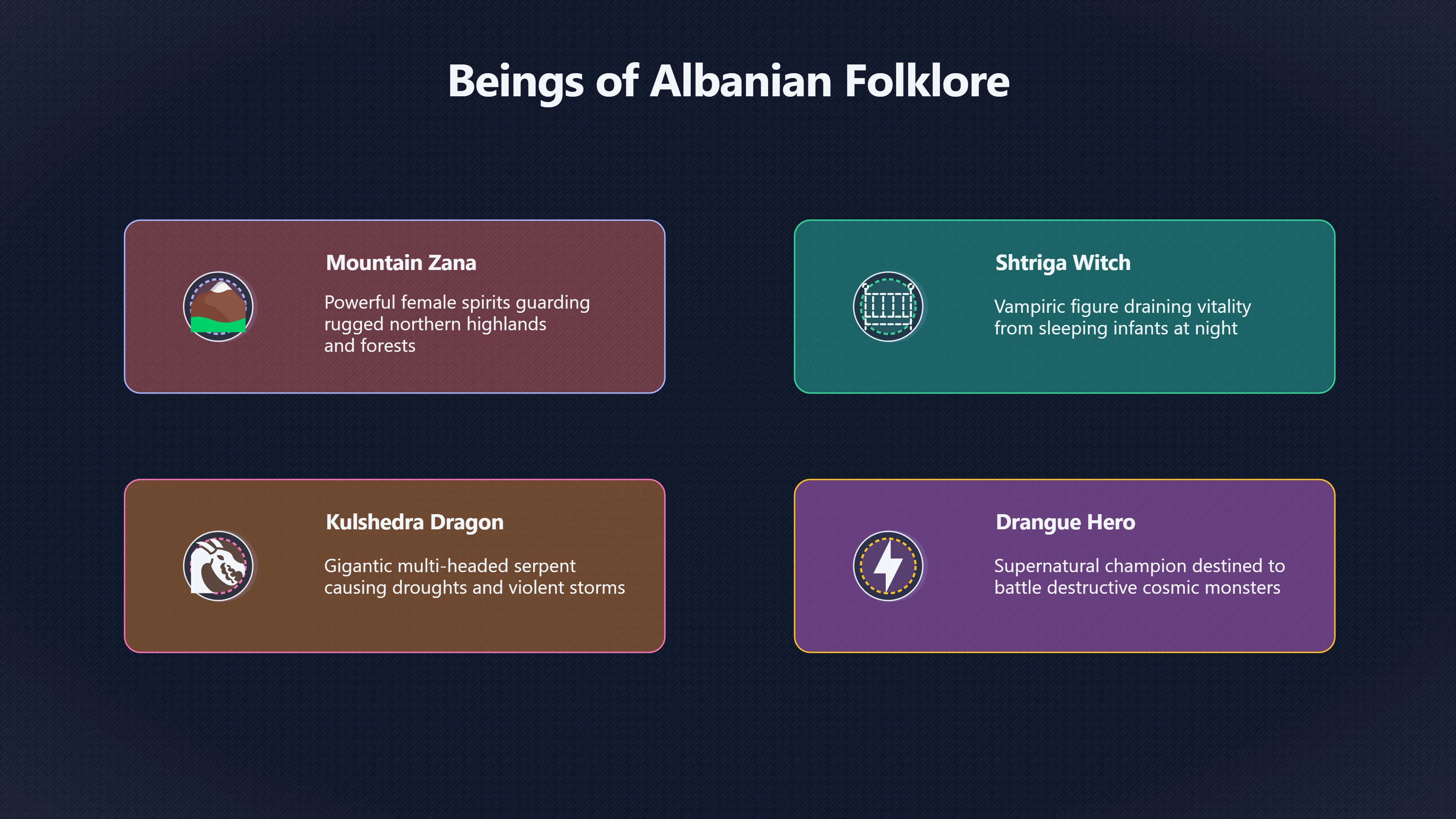
- Mountain zana and wild female power
- Shtriga, night fear and infant illness
- Kulshedra, drangue and storm battles
Page outline Jump by section
Introduction
Among the many supernatural beings of Albanian folklore, three figures stand out for the way they explain the dangers of everyday life: the zana, the shtriga and the kulshedra. Together they form a striking picture of how earlier generations understood mountains, illness, storms and misfortune. The zana appears as a powerful female being linked to wild landscapes and heroic legends. The shtriga embodies fears surrounding sickness, especially the vulnerability of children. The kulshedra is a monstrous force associated with destructive weather, drought and chaos. Although these beings belong to different kinds of stories, they reveal a common theme in Albanian belief: nature and human life were filled with unseen powers that could protect, threaten or test a community. Their stories remain among the most recognisable elements of Albanian traditional culture.[Wikipedia]WikipediaOpen source on wikipedia.org.
Mountain zana and wild female power
The zana is one of the most celebrated supernatural figures in Albanian tradition. Often described as a mountain fairy or spirit, she belongs above all to the rugged northern highlands, where folklore places her among cliffs, forests, springs and remote valleys. Unlike the delicate fairies of many Victorian storybooks, the Albanian zana is powerful, independent and closely connected to strength, courage and the untamed landscape.
In heroic songs and epic poetry, zana figures sometimes act as protectors of warriors. They can bless heroes, grant unusual strength or intervene in moments of danger. Their connection with mountain life reflects the importance of the highlands in Albanian oral tradition, where survival depended on courage, endurance and intimate knowledge of the land. Scholars of Albanian folklore have often noted similarities between the zana and older nature spirits found elsewhere in the Balkans and Europe, though the Albanian figure developed its own distinctive character through local storytelling traditions.
The zana also illustrates an important feature of Albanian folklore: female supernatural power is not automatically benevolent or malevolent. A zana may help a hero, punish an offender or simply remain beyond human control. She represents the beauty and danger of the mountains themselves. To encounter her is to step outside ordinary society and enter a world governed by different rules.
Because many traditional Albanian tales were transmitted orally, descriptions vary from region to region. Some stories emphasise beauty and grace, while others stress supernatural strength and fierce independence. What remains consistent is the zana’s role as a guardian of wild places and a symbol of the mysterious forces believed to inhabit the landscape.
Shtriga, night fear and infant illness
If the zana reflects awe before nature, the shtriga reflects fear. The shtriga is among the most dreaded beings in Albanian folk belief, combining elements of witchcraft, vampirism and the evil eye. Traditional accounts describe her as a woman who attacks people at night, especially infants and young children, draining their vitality while they sleep. In many versions of the belief, she can transform into a flying insect such as a moth, bee or fly.[Wikipedia]WikipediaOpen source on wikipedia.org.
The persistence of the shtriga tradition reveals something important about the historical realities of life in rural communities. Before modern medicine, infant mortality was tragically common, and many childhood illnesses appeared sudden and mysterious. Folklore provided explanations for events that families could not otherwise understand. The shtriga became a way of making sense of sickness, weakness and unexplained deaths among children.[Wikipedia]WikipediaOpen source on wikipedia.org.
Stories about shtriga were not merely tales told for entertainment. They influenced protective practices. Folk remedies, prayers, charms and rituals were used to guard households against harmful supernatural forces. Some traditions identified unusual eyes, strange behaviour or social isolation as signs that a woman might secretly be a shtriga. Such beliefs could reinforce existing fears, suspicions and tensions within small communities.[Wikipedia]WikipediaOpen source on wikipedia.org.
The figure also demonstrates how Albanian folklore absorbed influences from a wider European family of witch and vampire traditions. The name itself is related to ancient words associated with witches and night-flying beings, yet the Albanian shtriga developed distinctive characteristics, particularly her connection with child illness and her ability to cure the very harm she caused. According to some traditions, only the shtriga herself could reverse her attack, creating a troubling image of a supernatural predator who was also the only possible healer.[Wikipedia]WikipediaOpen source on wikipedia.org.
Today, the word is often used simply as an insult meaning “witch”, but the older folklore remains one of the most vivid examples of how traditional societies explained disease and misfortune.[Wikipedia]WikipediaOpen source on wikipedia.org.

Kulshedra, drangue and storm battles
The kulshedra occupies a different corner of Albanian belief: the realm of weather, natural disaster and cosmic struggle. Usually imagined as a gigantic female serpent or dragon, often with multiple heads, the kulshedra is blamed for droughts, floods, storms, earthquakes and other calamities. She is one of the most formidable monsters in Albanian folklore.[Wikipedia]WikipediaOpen source on wikipedia.org.
Traditional stories describe the kulshedra as a destructive force that threatens both nature and human communities. In some versions she blocks water sources, bringing drought and hunger. In others she unleashes storms or spits fire across the landscape. Such tales reflect the very real dangers posed by extreme weather in agricultural societies, where a failed harvest could mean disaster for an entire village.[Van Helsing Own Story]van-helsing-own-story.fandom.comHeavy thunderstorms are thoughtVan Helsing Own StoryKulshedra - Van Helsing Own Story Wiki - FandomIn Albanian mythology she is usually fought and defeated by a drangue…
The kulshedra is rarely the sole focus of the story. More often she appears as the enemy of the drangue, a heroic supernatural champion associated with storms, lightning and protection. Albanian folklore portrays the drangue as a powerful being destined from birth to combat destructive monsters. The clashes between drangue and kulshedra are among the most famous episodes in Albanian mythic tradition. Thunderstorms were sometimes interpreted as signs that such battles were taking place in the sky.[Wikipedia]WikipediaOpen source on wikipedia.org.
These stories belong to a much wider pattern found across Indo-European mythologies, where a heroic figure associated with the sky or thunder fights a serpent or dragon linked to chaos and destructive waters. In the Albanian version, however, the conflict became deeply rooted in local landscapes and folk imagination. Rather than existing as distant gods in a formal mythology, the drangue and kulshedra remained active participants in village storytelling and explanations of natural events.[Wikipedia]WikipediaOpen source on wikipedia.org.
The kulshedra’s appearance also varies. Some traditions depict a monstrous dragon, while others describe a terrifying hag-like figure. This flexibility is typical of oral folklore, where details shift from one region and storyteller to another while the central role remains unchanged: the kulshedra is the embodiment of destructive disorder threatening both people and the natural world.[Goodreads]goodreads.comWorld of Kore</span><span class="citation-popover-snippet">World of Kore - Kulshetra and the Drangue3 Aug 2017 — The Kulshetra (in Gheg), or Kuçedra (in Tosk), is widely considered to be…
Why these beings still matter
The zana, shtriga and kulshedra are more than colourful creatures from old stories. Each helped communities interpret a different aspect of life. The zana gave meaning to the power and mystery of the mountains. The shtriga offered an explanation for illness and childhood vulnerability. The kulshedra transformed frightening weather and environmental disaster into a narrative struggle between order and chaos.[Wikipedia]WikipediaOpen source on wikipedia.org.
Modern Albanians are unlikely to treat these beings as literal realities, yet they remain deeply embedded in cultural memory. They appear in folklore collections, literature, educational materials, artistic works and discussions of national heritage. Their continued presence demonstrates how folklore survives not because people necessarily believe every detail, but because the stories preserve older ways of understanding the world.
Together, these figures reveal a characteristic feature of Albanian tradition: the supernatural is rarely detached from everyday experience. Fairies are tied to mountains, witches to sickness, dragons to storms. The stories are memorable because they emerge from real fears, real landscapes and real challenges that shaped life across generations.[Wikipedia]WikipediaOpen source on wikipedia.org.
Amazon book picks
Further Reading
Books and field guides related to The Fairies, Witches and Dragons of Albania. Use these as the next step if you want deeper reading beyond the article.
Albanian Folktales and Legends
Contains stories featuring legendary creatures and spirits.

The Dictionary of Albanian Religion, Mythology and Folk Culture
Includes zana, shtriga, kulshedra and related figures.

The Penguin Book of Dragons
Useful for readers interested in dragon-like beings such as the kulshedra.
eBay marketplace picks
Marketplace Samples
Live-tested eBay searches with available results related to this page.
Endnotes
1.
Source: Wikipedia
Link:https://en.wikipedia.org/wiki/Shtriga
2.
Source: Wikipedia
Link:https://en.wikipedia.org/wiki/Drangue
3.
Source: Wikipedia
Link:https://en.wikipedia.org/wiki/Kulshedra
4.
Source: goodreads.com
Title: World of Kore`
Link:https://www.goodreads.com/author_blog_posts/15514996-kulshetra-and-the-drangue
Source snippet
World of Kore` - Kulshetra and the Drangue3 Aug 2017 — The Kulshetra (in Gheg), or Kuçedra (in Tosk), is widely considered to be...
5.
Source: Wikipedia
Link:https://en.wikipedia.org/wiki/Robert
Source snippet
RobertThe name Robert is an ancient Germanic given name, from Proto-Germanic *Hrōþi- "fame" and *berhta- "bright" (Hrōþiberhtaz).Read...
6.
Source: Wikipedia
Title: Albanian language
Link:https://en.wikipedia.org/wiki/Albanian_language
Source snippet
Albanian languageStandard Albanian is the official language of [Albania]({{ 'albania/' | relative_url }}) and Kosovo, and a co-official language in North Macedonia and M...
7.
Source: Wikipedia
Title: Robert (film)
Link:https://en.wikipedia.org/wiki/Robert_%28film%29
Source snippet
Robert (film)Robert (also known as Robert the Doll) is a 2015 British horror film written and directed by Andrew Jones. The first inst...
8.
Source: van-helsing-own-story.fandom.com
Title: Heavy thunderstorms are thought
Link:https://van-helsing-own-story.fandom.com/wiki/Kulshedra
Source snippet
Van Helsing Own StoryKulshedra - Van Helsing Own Story Wiki - FandomIn Albanian mythology she is usually fought and defeated by a drangue...
9.
Source: van-helsing-own-story.fandom.com
Title: Blood Witch
Link:https://van-helsing-own-story.fandom.com/wiki/Blood_Witch
Source snippet
Witch | Van Helsing Own Story Wiki - FandomA shtriga (Albanian: shtrigë) is a vampiric witch in Albanian mythology and folklore that suck...
10.
Source: supernatural.fandom.com
Link:https://supernatural.fandom.com/wiki/Shtriga
Source snippet
Supernatural Wiki - FandomA shtriga is an Albanian quasi-vampiric witch that feeds off children's lifeforce and takes on a friendly appea...
11.
Source: bloodrayne-mia-the-vampire-slayer.fandom.com
Link:https://bloodrayne-mia-the-vampire-slayer.fandom.com/wiki/Shtriga
Source snippet
BloodRayne & Mia, the Vampire Slayer Wiki | FandomIn Albanian folklore a Shtriga is a witch who preys upon infants by drinking their bl...
12.
Source: the-demonic-paradise.fandom.com
Link:https://the-demonic-paradise.fandom.com/wiki/Shtriga
Source snippet
The Demonic Paradise Wiki - FandomA shtriga is a vampiric witch in traditional Albanian folklore that sucks the blood of infants at night...
13.
Source: unnaturalworld.fandom.com
Link:https://unnaturalworld.fandom.com/wiki/Shtriga
Source snippet
Unnatural World Wiki - FandomIn Albanian folklore a shtriga is a witch who preys upon children by sucking their essence at night, this de...
14.
Source: the-demonic-paradise.fandom.com
Link:https://the-demonic-paradise.fandom.com/wiki/Kulshedra
Source snippet
The Demonic Paradise Wiki - FandomThe kulshedra or kuçedra is a water, storm, fire and chthonic demon in Albanian mythology and folklore...
15.
Source: mythlok.com
Link:https://mythlok.com/beings/shtriga/
Source snippet
The Vampiric WitchSep 4, 2025 — Her primary ability lies in draining life force, often by sucking the blood of sleeping infants. This act...
16.
Source: youtube.com
Link:https://www.youtube.com/watch?v=qRU6fqtz2Cw
Source snippet
SHTRIGA - THE SILENT REAPER OF THE NIGHT - SLAVIC...The Striga or Shtriga, one of the most terrifying creatures in European folklore, is...
17.
Source: reddit.com
Link:https://www.reddit.com/r/worldbuilding/comments/hbdbd8/kulshedra_the_demonic_force_of_chaos_a_bringer_of/
Source snippet
Its draconic-like body and multiple heads bring terror to those who had a chance of encountering one.Read more...
18.
Source: supernaturalwiki.com
Link:https://supernaturalwiki.com/Shtriga
Source snippet
Super-wikiMar 10, 2023 — According to Albanian folklore, a shtriga was a vampire-like witch who was said to suck the blood of infant chil...
19.
Source: markberepeterson.com
Link:https://markberepeterson.com/2021/04/24/shtriga/
Source snippet
24 Apr 2021 — The Shtriga was a vampire-like witch that was found in Albania. The creature was similar to the Strigon, which was a witch...
Additional References
20.
Source: reddit.com
Link:https://www.reddit.com/r/mythology/comments/15xn1fs/kulshedra/
Source snippet
Kulshedra: r/mythologyThe kulshedra or kuçedra is a water, storm, fire and chthonic demon in Albanian mythology and folklore, usually de...
21.
Source: novusbestiary.com
Link:https://novusbestiary.com/striga
Source snippet
StrigaThe shtriga in Albanian mythology is a vampiric witch that sucks the blood of infants and can transform into a flying insect. The s...
22.
Source: reddit.com
Link:https://www.reddit.com/r/AskBalkans/comments/i3fg3b/question_about_mythology_and_legend/
Source snippet
Question about Mythology and Legend: r/AskBalkansSo like "Shtriga"?! I saw on the Witcher series, that Shtriga is a monster. - And it co...
23.
Source: linkedin.com
Link:https://www.linkedin.com/pulse/ciklopi-kucedra-personal-window-albanian-balkan-mythology-shaska-wbkgf
24.
Source: godsandmonsters.info
Link:https://godsandmonsters.info/kulshedra/
25.
Source: dictionary.com
Link:https://www.dictionary.com/browse/robert
26.
Source: roberthalf.com
Link:https://www.roberthalf.com/us/en
Source snippet
Robert Half: Staffing, Recruitment & Job SearchRobert Half connects employers & job seekers to staff positions in finance, law, technolog...
27.
Source: lerobert.com
Link:https://www.lerobert.com/
Source snippet
Editions Le Robert: la référence en langues pour définir...Depuis 1951, Le Robert est la seule maison d'édition entièrement dédiée à la...
28.
Source: instagram.com
Link:https://www.instagram.com/p/DHRBx-QgW9A/
Source snippet
ce of people, especially children, by sucking their blood at night.Read more...
29.
Source: writewrotewritten.wordpress.com
Title: She is said to drink the blood of young children during the night.Read more
Link:https://writewrotewritten.wordpress.com/2014/02/03/monster-monday-shtriga/
Source snippet
Monday: Shtriga - Write Wrote Written - WordPress.com3 Feb 2014 — Shtriga is a witch, but she shares many of the same characteristics as...
Topic Tree