Why Denmark's Old Stories Still Linger
Denmark’s folklore is not just a shelf of old fairy tales. It is a living mix of farm spirits, elf hills, cliff kings, ghost horses, sea beings, heroic sleepers, witchcraft memories, seasonal fires, and literary retellings that turned local belief into national culture.
Page outline Jump by section
Introduction
The most useful way to understand Danish folklore is to treat it as layered. Some traditions draw on pre-Christian Nordic religion; some belong to medieval and early modern legends; some were gathered from oral storytellers by collectors such as Svend Grundtvig, Henning Frederik Feilberg and Evald Tang Kristensen; some were reshaped by writers, museums and tourism. That layering matters because a farm spirit, a Christmas decoration and a national hero sleeping under a castle may all look “mythic”, but they reached modern Denmark by very different routes.[kb.dk]kb.dkOpen source on kb.dk.
What makes Danish folklore distinctive?
Danish folklore shares much with the wider Nordic world: old gods, elves, trolls, household spirits, omen animals, magical women, sea beings and stories attached to hills, churches, farms and coastlines. What gives it a distinct flavour is its lowland, village-and-farm setting. Many Danish tales do not begin in vast wilderness but close to everyday life: the stable loft, the churchyard, the mound beyond the field, the cliff edge, the kitchen at Christmas, the road where a traveller hears something moving in the dark.
That closeness is important. Danish folklore often turns ordinary places into negotiated territory. A farm may prosper if the resident spirit is respected. A hill may not be only a hill, but the dwelling of hidden people. A churchyard may have a guardian or a death omen. A midsummer fire may be both a communal celebration and a symbolic casting-out of evil. The supernatural is rarely random scenery; it explains why people should behave carefully towards land, animals, neighbours, the dead and seasonal change.
The written record is also unusually strong because nineteenth-century Denmark became intensely interested in collecting oral tradition. The Royal Danish Library notes that Svend Grundtvig organised a network of hundreds of people across Denmark to write down rural narratives and childhood memories, while later archive material was arranged by locality, person and genre, including folk beliefs, legends and fairy tales.[kb.dk]kb.dkhistory danish folklore archiveshistory danish folklore archives Evald Tang Kristensen’s collecting is especially important for Jutland: historical GIS research on his work traces his field routes across a fifty-year career and treats his archive as a major body of Danish folklore evidence rather than a casual antiquarian scrapbook.[humanit.hb.se]humanit.hb.seh GI S, Text Mining, and Folklore Collection in 19th Centuryh GI S, Text Mining, and Folklore Collection in 19th Century
The old gods did not simply vanish
Denmark’s folklore is often discussed alongside Norse mythology, but the two should not be treated as identical. Norse mythology is the organised body of stories about gods such as Odin and Thor, preserved through medieval literature and archaeology. Folklore is broader and messier: it includes charms, rumours, place legends, seasonal customs, ghost stories, household spirits and local explanations of danger or luck.
The National Museum of Denmark states that Nordic gods were worshipped in Denmark before Christianity and that evidence for such worship reaches back into the Iron Age, before the Viking period. It also notes that the names of several weekdays still preserve old divine names, and that Thor’s battle with the Midgard serpent appears in Danish material such as the stone from Hørdum Church in Jutland.[National Museum of Denmark]en.natmus.dkNational Museum of Denmark The old religionNational Museum of Denmark The old religion By around 1050, however, most Vikings in Denmark were Christian, according to the same museum’s account of Christianisation. The change was gradual and entangled with trade, politics and pressure from Christian Europe.[National Museum of Denmark]en.natmus.dkNational Museum of Denmark Christianity comes to DenmarkNational Museum of Denmark Christianity comes to Denmark
That transition helps explain why Danish folklore often feels double-layered. Older powers may survive in disguised form, be reinterpreted as dangerous beings, or become attached to specific landscapes. Modern museum interpretation still presents Viking religion, magic and ritual as part of Denmark’s cultural memory, including the National Museum’s current exhibition on Viking sorcery and Norse mythology, running from 2024 to 2027.[National Museum of Denmark]nationalmuseet.dkthe viking sorceressthe viking sorceress Contemporary revival is a separate matter: the National Museum estimates that between 500 and 1,000 people in Denmark today practise the old Nordic religion, but modern religious revival should not be confused with unbroken folk belief.[National Museum of Denmark]en.natmus.dkNational Museum of Denmark The old Nordic religion (asatro) todayNational Museum of Denmark The old Nordic religion (asatro) today
The nisse: Denmark’s small spirit of the farm and home
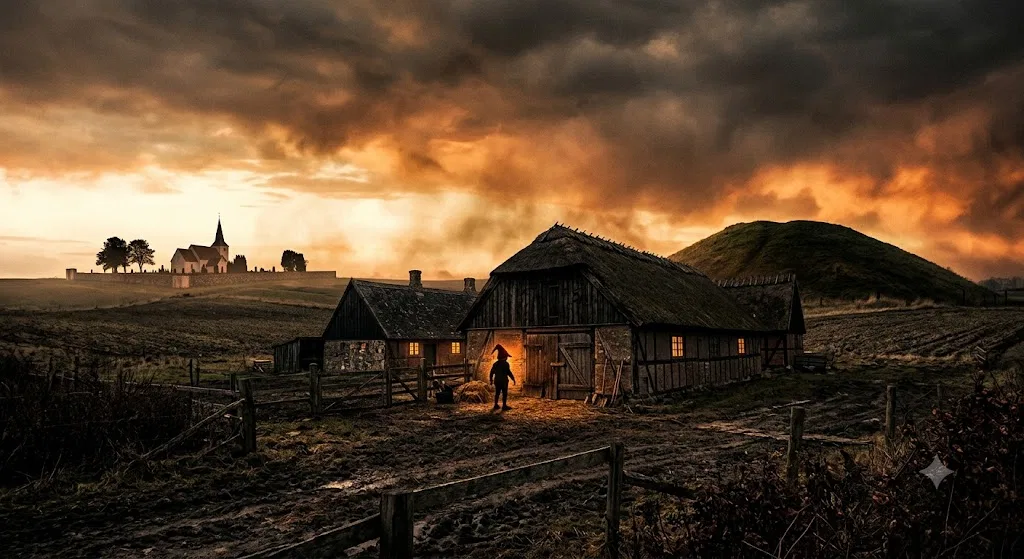
The nisse is probably the most familiar figure in Danish everyday folklore. In older rural tradition, he is not simply a cute Christmas elf. He is a small household or farm spirit attached to a place, often imagined around barns, stables and lofts. He can protect animals, help with chores and bring luck, but he is easily offended. Stories warn that disrespect, laziness or failure to give him his expected food may lead to mischief or worse.[Wikipedia]WikipediaNisse (folkloreNisse (folklore
The nisse matters because he shows how folklore regulates behaviour. He rewards careful farming, respect for animals and attention to old custom. The famous bowl of porridge is not just quaint decoration; it is a ritualised sign that the household recognises its obligations to unseen powers. Later Christmas culture softened and commercialised him, but the older figure had teeth. He belonged to a moral world where luck on the farm was personal, negotiated and fragile.
Collectors and artists helped shape the nisse’s modern image. Nineteenth-century folklore collecting recorded stories about him, while later visual culture made the Christmas nisse more recognisable with a red cap and seasonal role. This is a good example of Danish folklore changing without disappearing: a being once bound to agrarian belief becomes a national Christmas figure, then a decoration, children’s character and brand image. The continuity is real, but the meaning has shifted.[Wikipedia]WikipediaDanish folkloreDanish folklore
Elf hills, trolls and hidden neighbours
Danish elf and troll traditions are strongly tied to landscape. Hills, mounds, cliffs, woods and old roads may become entrances into another society. These beings are not always “fairies” in the modern, pretty sense. They can be alluring, dangerous, wealthy, musical, deceptive or territorially powerful. Their stories often warn people not to trespass, boast, ignore local knowledge or treat the land as empty.
Stevns in eastern Denmark is a strong example of local folklore becoming public heritage. Stevns Folklore Museum says the area has traditions of the Elf Hill, elf people, the King of the Cliff and other local legends, and VisitDenmark describes the museum as collecting folk tales, myths and legends from Stevns, including elf people, trolls and the Cliff King.[Stevns Folklore Museum]folkloremuseum.dkStevns Folklore Museum About Stevns Folklore MuseumStevns Folklore Museum About Stevns Folklore Museum This matters because it shows Danish folklore at a regional scale: not just national myths, but stories rooted in a particular cliff, peninsula and community memory.
The Cliff King tradition also shows how older religious imagery can be localised. A tourism site for the region explains the legend of the Cliff King at Høje Møn and explicitly links him with Odin in later interpretation, suggesting that after Christianity older gods could be hidden under local legendary forms.[Klintekongens Rige]klintekongensrige.dkOpen source on klintekongensrige.dk. Such claims need careful handling: they are interpretive, not proof that every cliff king story is a direct survival of Odin worship. But they do capture a real folkloric process: old sacred figures can be displaced into local legend, where they become kings, giants, hidden lords or dangerous neighbours.
Death omens, ravens and churchyard creatures
Danish folklore is rich in ominous beings connected with death, burial and churchyards. The helhest, often described as a three-legged horse associated with death and illness, appears in recorded Danish phrases and nineteenth-century folklore commentary. It is said to be heard or seen in places where death is near, especially around graveyards.[Wikipedia]WikipediaOpen source on wikipedia.org.
The valravn is darker and more literary-ballad-like: a supernatural raven from Danish tradition, especially known through the ballad “Valravnen”. The tradition links battlefield death, ravens and transformation, with the bird sometimes imagined as a cursed or enchanted being requiring blood to regain human form. The earliest known version of the ballad is associated with a sixteenth-century manuscript, while the story itself is thought to draw on late medieval material.[Wikipedia]WikipediaOpen source on wikipedia.org.
These creatures are useful reminders that Danish folklore is not only cosy. It includes violent, uncanny and morally troubling material: unburied warriors, death warnings, graveyard guardians, curses and animal forms that blur the line between the human and non-human. They also show how folklore preserves older anxieties about proper burial, social order and the boundary between the living and the dead.
Holger the Dane and the sleeping hero under Kronborg
One of Denmark’s most powerful national legends is Holger the Dane, the sleeping hero beneath Kronborg Castle. Kronborg’s own interpretation explains that the stories of Holger date back to the Middle Ages, but Hans Christian Andersen’s 1846 fairy tale placed him in the casemates under Kronborg and gave him his modern role as Denmark’s protector, asleep until the country faces grave danger.[Kronborg Slot]kronborg.dkholger the daneholger the dane
This is folklore as national symbolism. Holger is not merely a monster or household spirit; he is a figure of collective reassurance. The “king or hero asleep under the mountain” motif appears in many cultures, but in Denmark it has become tied to Kronborg, national defence and the emotional geography of Helsingør. VisitCopenhagen says the figure is widely known in Denmark as the sleeping defender of the mother country.[Visit Copenhagen]visitcopenhagen.comVisit Copenhagen Holger DanskeVisit Copenhagen Holger Danske
The Holger legend also shows how literary retelling can strengthen folklore rather than simply replace it. Andersen did not invent all of Holger’s medieval background, but his version fixed the story in a memorable Danish place and gave it a national function. That makes Holger a useful case study in how oral legend, medieval romance, nineteenth-century nationalism, castle tourism and children’s storytelling can merge into one durable image.
Hans Christian Andersen: folklore transformed into literature
No account of Danish folklore can ignore Hans Christian Andersen, but he needs to be placed accurately. Andersen was not simply a collector of folk tales in the manner of the Brothers Grimm. He drew on folk tradition, childhood memory, local speech, religious feeling, social observation and his own literary imagination to create works that became global fairy-tale classics.
The Hans Christian Andersen Center at the University of Southern Denmark curates an English-language site presenting his fairy tales and stories, including famous works such as “The Little Mermaid”, “The Snow Queen”, “The Emperor’s New Clothes” and “The Ugly Duckling”.[Hcandersen.dk]hcandersen.dkOpen source on hcandersen.dk. Public-facing literary summaries often note that his tales draw on Danish folk tradition while also being highly original creations rather than straightforward transcripts of oral tales.[Fairytalez]fairytalez.comOpen source on fairytalez.com.
That distinction matters for readers. Andersen’s mermaids, snow queens, tin soldiers and talking objects have become part of how the world imagines Danish fairy tale, but they are literary art as much as folklore. “The Little Mermaid”, for example, now belongs to Copenhagen tourism, global children’s culture and film adaptation as well as Danish literary heritage. It is folklore-adjacent, not because medieval villagers necessarily told Andersen’s exact story, but because Andersen transformed older wonder-tale materials into modern symbolic stories with Danish cultural weight.
Midsummer fires and the uneasy witch on the bonfire
One of Denmark’s most visible seasonal traditions is the midsummer celebration on St John’s Eve, often marked with bonfires. Today many Danes gather by beaches, parks, lakes or local community spaces, and some bonfires include a witch figure. The custom is widely understood as a symbolic farewell to evil or darkness, but its history is more recent and more complicated than many visitors assume.
Several recent Danish cultural explainers note that the witch doll is not an ancient, unchanged pagan survival. The Museum of Danish America says it became common in the late nineteenth century to place a witch-like figure on the bonfire, while Visit Rømø states that the custom came into use around 1900 and has roots in German and Jutlandic traditions.[Museum of Danish America]danishmuseum.orgmidsummer celebration 2024midsummer celebration 2024 Studieskolen similarly describes the witch doll as a relatively new tradition, with the first known occurrence around 1900.[studieskolen.dk]studieskolen.dkmidsummers eve in denmarkmidsummers eve in denmark
This is a good example of how folklore can be both beloved and contested. The bonfire is communal and atmospheric; the witch figure is more divisive because it recalls real early modern witch persecutions. Some modern communities have questioned or dropped the effigy because it can seem to trivialise historical violence against accused witches. The tradition therefore sits at the intersection of seasonal custom, folk symbolism, gendered memory and modern ethical debate.
Witches, magic and the difference between belief and persecution
Danish folklore contains witches, cunning people, charms and magical fears, but “witch folklore” should not be confused with the historical reality of witch trials. Folk belief may imagine witches flying, harming cattle, spoiling butter or meeting at uncanny places; legal persecution turned such fears into accusations, trials and executions. The two overlap, but they are not the same thing.
The modern St John’s Eve witch effigy shows how a symbolic figure can carry memories of both folklore and persecution. Some explanations frame the burning figure as sending evil away; others emphasise discomfort because Denmark, like many European countries, did execute people for witchcraft in the early modern period.[Museum of Danish America]danishmuseum.orgmidsummer celebration 2024midsummer celebration 2024 For a public folklore page, the safest reading is not “Danes once burned witches at midsummer and still do symbolically”, but rather: a relatively modern bonfire custom borrowed and reshaped older fears about witches, evil and seasonal magic, while today’s viewers may interpret it very differently.
Magic in Danish tradition also reaches further back than early modern witchcraft. The National Museum’s Viking material discusses runic magic, ritual, seeresses and the religious world before Christianisation, while its exhibition on the Viking sorceress presents magic as a way Viking-age people sought answers about fate and danger.[National Museum of Denmark]en.natmus.dkNational Museum of Denmark The old religionNational Museum of Denmark The old religion Again, this is not one continuous system from Viking seeress to village witch to modern midsummer doll. It is a chain of changing ideas about hidden knowledge, danger and power.
Haunted Denmark: castles, churches and stories for visitors
Denmark’s haunted-place folklore often attaches to castles, churches and old aristocratic buildings. Dragsholm Castle is the best-known example in English-language popular ghost tourism, with stories of a white lady, a grey lady and Lord Bothwell. The castle itself has a long history, including medieval origins and use as a prison for noble and ecclesiastical prisoners after the Reformation.[Wikipedia]WikipediaDragsholm CastleDragsholm Castle
Haunted castle stories need a careful tone. They are traditions and claims, not verified supernatural events. Their cultural value lies in how they turn historical architecture into emotional narrative: imprisonment, forbidden love, betrayal, aristocratic decline and the persistence of the dead. A hotel guest may encounter them as entertainment; a folklorist would ask when each ghost story was first recorded, who told it, how it changed, and how tourism shaped its present form.
Kronborg provides a different kind of haunting presence. It is not mainly a ghost site in Danish folklore; it is a legendary and literary castle, home to Holger the Dane and internationally associated with Shakespeare’s Hamlet. Kronborg’s own materials describe the castle as the historic setting that inspired Shakespeare’s Elsinore, while also presenting Holger as a Danish legendary figure beneath the castle.[Kronborg Slot]kronborg.dkSlot Experience Hamlet at Kronborg | 27 JunSlot Experience Hamlet at Kronborg | 27 Jun In Danish legendary geography, a castle can therefore be haunted by several kinds of story at once: national hero, literary prince, royal history and tourist performance.

Why nineteenth-century collectors matter
Much of what modern readers call Danish folklore survives because nineteenth-century and early twentieth-century collectors wrote it down. This was not neutral work. Collectors were influenced by Romantic nationalism, anxiety that rural traditions were disappearing, and ideas about “the people” as carriers of national memory. The Royal Danish Library’s history of the folklore archives explicitly links Danish collection to European intellectual currents and to the belief that rural language, poetry and custom preserved deep national character.[kb.dk]kb.dkhistory danish folklore archiveshistory danish folklore archives
That history gives Danish folklore both strength and caution. The strength is that Denmark has rich archival material from named collectors, localities and informants. The caution is that archives reflect choices: who was asked, where collectors travelled, what genres they valued, and what they thought folklore was for. Research on Evald Tang Kristensen’s routes, for example, treats geography, transport and fieldwork bias as part of understanding the collection itself.[humanit.hb.se]humanit.hb.seh GI S, Text Mining, and Folklore Collection in 19th Centuryh GI S, Text Mining, and Folklore Collection in 19th Century
For readers, this means Danish folklore is not a single timeless voice. It is a record of many voices filtered through collectors, editors, archives, schools, museums, artists and later tourism. A tale written down in Jutland in the nineteenth century may preserve older motifs, but it also belongs to the moment when someone decided it was worth recording.
How Danish folklore is understood today
Today Danish folklore survives in several forms at once. It appears in museums such as Stevns Folklore Museum, in archive collections at the Royal Danish Library, in Christmas nisse figures, in Andersen tourism in Odense and Copenhagen, in Viking exhibitions, in midsummer fires, in local legends attached to cliffs and castles, and in modern fantasy, games and internet retellings.[folkloremuseum.dk]folkloremuseum.dkOpen source on folkloremuseum.dk.
The key is to separate layers without draining the stories of interest. A nisse on a shop shelf is not the same as the old farm spirit, but it points back to him. Andersen’s “The Snow Queen” is not an oral tale copied from a peasant storyteller, but it belongs to a Danish literary world shaped by folklore. Holger under Kronborg is not a historical sleeping warrior, but he is a real cultural symbol. A witch doll on a bonfire is not an ancient proof of pagan continuity, but it is a revealing modern custom with older fears behind it.
Denmark’s folklore is therefore best read as a map of relationships: between farm and luck, hill and hidden people, coast and sea imagination, churchyard and death, old gods and Christian reinterpretation, archive and oral memory, literary fairy tale and local belief. Its most memorable stories endure because they make ordinary Danish places feel storied — not by proving the supernatural, but by showing how generations of people imagined the powers just beyond the visible world.
Amazon book picks
Further Reading
Books and field guides related to Why Denmark's Old Stories Still Linger. Use these as the next step if you want deeper reading beyond the article.
The Fairy-Faith in Celtic Countries
Useful comparative reading for European supernatural belief.
eBay marketplace picks
Marketplace Samples
Example marketplace items related to this page. Use the search link to explore similar finds on eBay.
Endnotes
1.
Source: kb.dk
Title: history danish folklore archives
Link:https://www.kb.dk/en/find-materials/collections/folklore-archive/history-danish-folklore-archives
2.
Source: kb.dk
Link:https://www.kb.dk/en/find-materials/collections/folklore-archive
3.
Source: kronborg.dk
Title: holger the dane
Link:https://kronborg.dk/en/knowledge/holger-the-dane
4.
Source: humanit.hb.se
Title: h GI S, Text Mining, and Folklore Collection in 19th Century
Link:https://humanit.hb.se/article/download/581/706
5.
Source: Wikipedia
Title: Nisse (folklore)
Link:https://en.wikipedia.org/wiki/Nisse_%28folklore%29
6.
Source: Wikipedia
Title: Danish folklore
Link:https://en.wikipedia.org/wiki/Danish_folklore
7.
Source: visitdenmark.nl
Link:https://www.visitdenmark.nl/denemarken/reis-plannen/stevns-folklore-museum-gdk1125278
8.
Source: Wikipedia
Link:https://en.wikipedia.org/wiki/Helhest
9.
Source: Wikipedia
Link:https://en.wikipedia.org/wiki/Valravn
10.
Source: kronborg.dk
Link:https://kronborg.dk/en/knowledge/holger-the-dane/the-story-of-holger-the-dane
11.
Source: visitcopenhagen.com
Title: Visit Copenhagen Holger Danske
Link:https://www.visitcopenhagen.com/copenhagen/planning/holger-danske-ogier-dane-gdk784308
12.
Source: hcandersen.dk
Link:https://hcandersen.dk/en/
13.
Source: fairytalez.com
Link:https://fairytalez.com/region/danish/
14.
Source: studieskolen.dk
Title: midsummers eve in denmark
Link:https://www.studieskolen.dk/en/danish/blog/midsummers-eve-in-denmark
15.
Source: Wikipedia
Title: Dragsholm Castle
Link:https://en.wikipedia.org/wiki/Dragsholm_Castle
16.
Source: kronborg.dk
Title: Slot Experience Hamlet at Kronborg | 27 Jun
Link:https://kronborg.dk/en/events/hamlet-highlights
17.
Source: kronborg.dk
Link:https://kronborg.dk/en/knowledge/who-is-hamlet
18.
Source: Wikipedia
Title: Nordic folklore
Link:https://en.wikipedia.org/wiki/Nordic_folklore
19.
Source: Wikipedia
Title: Fairy Tales Told for Children. First Collection
Link:https://en.wikipedia.org/wiki/Fairy_Tales_Told_for_Children._First_Collection
20.
Source: Wikipedia
Title: Danmarks gamle Folkeviser
Link:https://en.wikipedia.org/wiki/Danmarks_gamle_Folkeviser
21.
Source: Wikipedia
Title: Ogier the Dane
Link:https://en.wikipedia.org/wiki/Ogier_the_Dane
22.
Source: Wikipedia
Title: Henning Frederik Feilberg
Link:https://en.wikipedia.org/wiki/Henning_Frederik_Feilberg
23.
Source: kronborg.dk
Title: Historien om Holger Danske i kasematterne
Link:https://kronborg.dk/viden/holger-danske
24.
Source: archive.org
Title: fairytalesfromha00ande 1
Link:https://archive.org/details/fairytalesfromha00ande_1
25.
Source: archive.org
Link:https://archive.org/details/danishfairytales00bayj
26.
Source: visitdenmark.de
Title: Holger Danske
Link:https://www.visitdenmark.de/daenemark/reiseplanung/holger-danske-holger-der-daene-gdk784308
27.
Source: visitdenmark.com
Link:https://www.visitdenmark.com/denmark/things-to-do/history-heritage/viking-facts-and-myths
28.
Source: en.natmus.dk
Title: National Museum of Denmark The old religion
Link:https://en.natmus.dk/historical-knowledge/denmark/prehistoric-period-until-1050-ad/the-viking-age/religion-magic-death-and-rituals/the-old-religion/
29.
Source: en.natmus.dk
Title: National Museum of Denmark Christianity comes to Denmark
Link:https://en.natmus.dk/historical-knowledge/denmark/prehistoric-period-until-1050-ad/the-viking-age/religion-magic-death-and-rituals/christianity-comes-to-denmark/
30.
Source: nationalmuseet.dk
Title: the viking sorceress
Link:https://nationalmuseet.dk/en/exhibitions/the-viking-sorceress
31.
Source: en.natmus.dk
Title: National Museum of Denmark The old Nordic religion (asatro) today
Link:https://en.natmus.dk/historical-knowledge/denmark/prehistoric-period-until-1050-ad/the-viking-age/religion-magic-death-and-rituals/the-old-nordic-religion-today/
32.
Source: folkloremuseum.dk
Title: Stevns Folklore Museum About Stevns Folklore Museum
Link:https://www.folkloremuseum.dk/en/about-us/
33.
Source: klintekongensrige.dk
Link:https://www.klintekongensrige.dk/en/places/
34.
Source: danishmuseum.org
Title: midsummer celebration 2024
Link:https://www.danishmuseum.org/event/midsummer-celebration-2024/
35.
Source: folkloremuseum.dk
Link:https://www.folkloremuseum.dk/en/
36.
Source: mythfolks.com
Title: danish folklore
Link:https://www.mythfolks.com/danish-folklore
37.
Source: instagram.com
Link:https://www.instagram.com/folkloremuseum/
38.
Source: folkloremuseum.dk
Link:https://www.folkloremuseum.dk/en/exhibitions/
39.
Source: mythus.fandom.com
Link:https://mythus.fandom.com/wiki/Nisse
40.
Source: animated-character-database.fandom.com
Link:https://animated-character-database.fandom.com/wiki/Valravn
41.
Source: danishmuseum.org
Link:https://www.danishmuseum.org/thomas-dambo-troll/
42.
Source: amazon.com
Title: Henning Frederik Feilberg
Link:https://www.amazon.com/Reference-Henning-Frederik-Feilberg-Books/s?rh=n%3A21%2Cp_27%3AHenning%2BFrederik%2BFeilberg&tag=searcht-20
43.
Source: en.natmus.dk
Title: dk Dwarves
Link:https://en.natmus.dk/historical-knowledge/denmark/middle-ages-1000-1536/j-r-r-tolkien/dwarves/
Additional References
44.
Source: youtube.com
Title: The Legend of Holger Danske | Famous Danish Folklore
Link:https://www.youtube.com/watch?v=j05MCq3yRPU
Source snippet
Valravn: The Monstrous Black Bird of Danish Folklore - Complete Documentary...
45.
Source: arcticportal.org
Link:https://arcticportal.org/ap-library/news/3635-scandinavian-christmas-traditions-the-nisse-and-its-role-as-farm-guardian-and-christmas-helper
46.
Source: facebook.com
Link:https://www.facebook.com/MetalTitansOfficial/posts/a-gorgeously-illustrated-book-in-english-about-the-scandinavian-folklore-a-defin/2623915540969316/
47.
Source: reddit.com
Link:https://www.reddit.com/r/Nordiccountries/comments/1egkpxd/a_question_about_nordicscandinavian_legend_of/
48.
Source: tripadvisor.nl
Link:https://www.tripadvisor.nl/Attraction_Review-g2556108-d23429329-Reviews-Stevns_Folklore_Museum-Store_Heddinge_Stevns_Municipality_South_Zealand_Zealand.html
49.
Source: southzealand-mon.com
Link:https://www.southzealand-mon.com/destination-stevns-klint/experience-stevns/attractions-stevns
50.
Source: instagram.com
Link:https://www.instagram.com/reel/DWHZLaru9Hb/
51.
Source: amazon.de
Link:https://www.amazon.de/-/en/Danish-Fairy-Legends-Memoir-Author/dp/B0010PNX4O?tag=searcht-20
52.
Source: facebook.com
Link:https://www.facebook.com/groups/onhmfd/posts/1187347839264057/
53.
Source: reddit.com
Link:https://www.reddit.com/r/AskEurope/comments/9z10fj/do_you_have_an_equivalent_to_the_scandinavian/
Topic Tree
Follow this branch
Related pages 192
- Afghan Folklore
- Albanian Folklore
- Algerian Folklore
- Australian Folklore
- Azerbaijan Folklore
- +187 more in sidebar