Where Mongolia's Legends Still Live
Mongolia’s folklore is a living tradition shaped by nomadic pastoral life, sacred landscapes, shamanic and Buddhist practice, heroic oral poetry, animal stories, family ritual and modern national memory.
Page outline Jump by section
Introduction
For a first-time reader, the key point is this: Mongolian folklore is inseparable from place. Mountains, passes, rivers, herds, horses, weather, family lines and ancestral memory are not background scenery; they are part of the story world. A sacred mountain may be a political symbol, a ritual site and a legendary landscape at the same time. A festival may look like sport to visitors, but still carry older ideas about skill, blessing, honour and communal identity.[ICH UNESCO]ich.unesco.orgOpen source on unesco.org.
Why Mongolian folklore feels different from “mythology”
Many readers arrive looking for a list of gods, monsters and myths. Mongolia does have divine beings, spirit beliefs and supernatural creatures, but its folklore is often better understood through relationships: between people and land, herders and animals, families and ancestors, rulers and sacred mountains, performers and inherited oral poetry. That makes the tradition feel less like a closed mythology and more like a cultural ecology of stories, rituals and remembered places.
Older shamanic ideas, later Buddhist ritual, imperial history and twentieth-century repression all affected how traditions were preserved and retold. UNESCO describes sacred-site worship in Mongolia as rooted in ancient shamanic belief in invisible deities of the natural surroundings, later threatened during the communist period and now recognised as intangible cultural heritage in need of safeguarding. The same pattern appears across several traditions: a practice may be old, interrupted, revived, formalised by the state and reinterpreted for tourism or national identity.[UNESCO]unesco.orgdocument 4668document 4668
This matters because it helps avoid two common mistakes. The first is treating every modern retelling as ancient and unchanged. The second is assuming that a living ritual is merely a museum survival. Mongolian folklore is both inherited and adaptive: epic singers, families, monks, shamans, local communities, scholars and heritage institutions all shape how it is understood today.
Origin stories and the memory of Chinggis Khan
One of Mongolia’s most famous legendary openings comes from The Secret History of the Mongols, the great thirteenth-century Mongol chronicle known through later manuscript traditions. In its origin account, the ancestors of Chinggis Khan are linked to a blue-grey wolf and a fallow doe who settle near the source of the Onon River by Burkhan Khaldun. Modern readers should treat this not as zoology, but as mythic genealogy: a way of making ancestry, landscape and destiny speak together.[Wikipedia]WikipediaSecret History of the MongolsSecret History of the Mongols
Chinggis Khan himself sits at the border between history and legend. Historically, he founded the Mongol Empire in the early thirteenth century; in folklore, literature and ritual memory, his figure can become larger than biography. UNESCO’s World Heritage account of Burkhan Khaldun states that the mountain is associated with Chinggis Khan as his reputed burial site and with the establishment of the Mongol Empire in 1206. It also notes that he gave official status to traditions of mountain worship rooted in long-standing shamanic practices among nomadic peoples.[UNESCO World Heritage Centre]whc.unesco.orgUNESCO World Heritage CentreGreat Burkhan Khaldun Mountain and its surrounding…Burkhan Khaldun is associated with the worship of sacre…
This is a good example of how Mongolian folklore works. A mountain is not only a mountain. It can be a sacred site, a claimed burial place, a state symbol, a pilgrimage landscape and a setting in national origin stories. The mythic aura around Chinggis Khan does not erase the historical person; it shows how history can be absorbed into oral tradition, ritual geography and collective identity.
Sacred mountains, cairns and the folklore of place
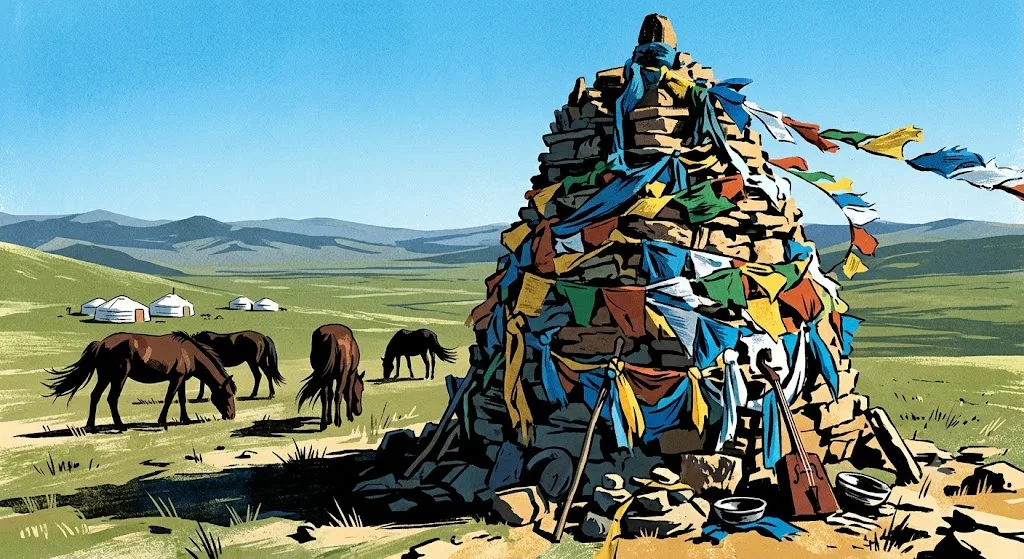
The most visible form of Mongolian folk religion for many travellers is the cairn or sacred heap found on mountains, passes and important routes. These sites are commonly associated with offerings, circumambulation, blessing, journey protection and respect for local spirits. UNESCO describes Burkhan Khaldun as linked to the worship of sacred mountains, rivers and shamanic rock cairns, with ceremonies shaped by a fusion of ancient shamanic and Buddhist practices.[UNESCO World Heritage Centre]whc.unesco.orgUNESCO World Heritage CentreGreat Burkhan Khaldun Mountain and its surrounding…Burkhan Khaldun is associated with the worship of sacre…
Mongolia’s sacred mountains also show how folklore can help protect landscapes. UNESCO’s tentative listing for the Sacred Mountains of Mongolia says that worshipping sacred mountains and waters is an outstanding cultural heritage element developed and practised by Mongolians since ancient times. It notes that the tradition began in a shamanic period, was later enriched with Buddhist ideas and rituals, and contributed to preserving natural environments and wildlife as sacred.[UNESCO World Heritage Centre]whc.unesco.orgOpen source on unesco.org.
These rituals are not simply “nature worship” in a vague sense. Recent scholarship on Mongolian cairn practice stresses that such worship is tied to specific relationships between particular people, mountains, spirits and animals, rather than to one uniform philosophy or religion. That point is important for readers: a local sacred site may have its own history, rules, taboos, stories and social group attached to it.[OpenEdition Journals]journals.openedition.orgOpen source on openedition.org.
Heroic epics: Mongolia’s oral encyclopaedia
Mongolian heroic epic is one of the country’s most important folklore traditions. UNESCO describes Mongol epic as an oral tradition made up of heroic poems ranging from hundreds to thousands of lines, combining benedictions, eulogies, spells, idioms, fairy tales, myths and folk songs. It calls the tradition a living encyclopaedia of Mongolian oral traditions and notes that it immortalises the heroic history of the Mongolian people.[ICH UNESCO]ich.unesco.orgMongol Tuuli, Mongolian epicThe Mongolian Tuuli is an oral tradition comprising heroic epics that run from hundreds to thousand…
Epic performance matters because it gathers many forms of folklore into one event. A singer may not merely “recite a story”; the performance can carry blessing, memory, moral instruction, entertainment and ritual force. The Cambridge Mongolia and Inner Asia Studies Unit’s account of a visit by a Mongolian state epic storyteller describes a heritage carrier who performed epic storytelling along with related musical traditions from the Altai region, showing how epic, overtone singing and instruments can belong to the same cultural world.[Miasu]miasu.socanth.cam.ac.ukvisit cultural envoy mongolia and state epic storytellervisit cultural envoy mongolia and state epic storyteller
The hero Geser is especially important in the wider Inner Asian epic world. UNESCO records the Gesar epic tradition among Tibetan, Mongolian and Tu communities in western and northern China, while scholarship on the Mongolian Geseriad shows how episodes and motifs moved, combined and changed within oral tradition. This is a useful reminder that Mongolian folklore has national shape, but many of its stories also cross linguistic, religious and regional borders.[ICH UNESCO]ich.unesco.orgOpen source on unesco.org.
Spirits, shamans and Buddhist change
Mongolian supernatural belief cannot be reduced to either shamanism or Buddhism alone. Older shamanic traditions gave importance to sky, ancestors, local spirits, mountains and ritual specialists who mediated between human and spirit worlds. Later Buddhist influence did not simply erase those ideas; in many places it reworked them through sutras, monastic ritual, sacred geography and moral cosmology.
UNESCO’s description of sacred-site worship explicitly frames the practice as based on belief in invisible deities of the natural surroundings, while also showing how it functions socially: ceremonies build community solidarity and raise awareness of the interdependence of humans and the environment.[ICH UNESCO]ich.unesco.orgOpen source on unesco.org.
The twentieth century brought a major break. During Mongolia’s communist period, many religious practices were suppressed or banned, including sacred-site worship. Since the democratic changes of the 1990s, shamanic and Buddhist practices have reappeared publicly in multiple forms: local rituals, state-recognised heritage, tourism, scholarship and new spiritual movements. That revival is not a simple return to the past. It involves reconstruction, debate and modern needs as well as inherited memory.[UNESCO]unesco.orgdocument 4668document 4668
Monsters, wild people and dangerous beings
Mongolia’s creature lore includes beings that sit between folklore, traveller’s tale and modern cryptid culture. The best-known example for international readers is the wild person or “almas”, often associated with the Altai and other Central Asian mountain regions. A 2009 study of the legend describes the almas as a wildman figure with a long history in Mongolia, especially in western provinces, while also asking how far the legend is known outside its traditional western setting.[SIT Digital Collections]digitalcollections.sit.eduisp collectionisp collection
This is where careful wording matters. The almas is a folklore figure and a subject of local legend; it should not be presented as a proven animal. Its modern life overlaps with global “mystery creature” culture, much as the yeti or Bigfoot do elsewhere. What makes it useful for a Mongolia folklore page is not whether it exists biologically, but what the stories reveal about mountains, remoteness, fear, human-animal boundaries and the way local tales are recast for modern curiosity.
Mongolian and neighbouring Turkic-Mongolic traditions also include underworld and death-related beings, dangerous spirits, demons and harmful forces. Some online summaries flatten these into fantasy-style villain lists, but better sources show a more complex ritual world in which misfortune, illness, death and spirit danger are interpreted through religious practice, offerings and shamanic mediation.[Encyclopedia.com]encyclopedia.comOpen source on encyclopedia.com.
Folktales, animal stories and everyday wisdom
Not all Mongolian folklore is grand epic or sacred ritual. Folktales, comic stories, cumulative tales and animal narratives also carry social lessons and entertainment. Manuscript studies show that Mongolian tales were not only orally performed but also written down, copied and preserved in collections. One study of the tale “About Old Borontai” identifies it as one of the earliest written fixations of a cumulative tale known among Mongolian people.[Eco-Vector Journals Portal]journals.eco-vector.comOpen source on eco-vector.com.
Animal stories have particular force in a pastoral society. Horses, camels, wolves, livestock and wild animals are not decorative figures; they belong to the practical and emotional world of herders. A story about a clever or dangerous animal can entertain children while also encoding knowledge about behaviour, risk, cunning, respect and survival. This does not mean every tale is a hidden manual, but it does help explain why animal folklore remains memorable in a country where herding, mobility and weather have shaped daily life for centuries.
Printed collections and children’s books have also changed how tales circulate. Once a story enters schoolbooks, illustrated editions or tourist retellings, it may become more fixed than it was in oral performance. That can preserve a tale for new audiences, but it may also smooth out local variants, humour, dialect and performance style.
Festivals where folklore becomes public life
Mongolia’s major festivals are not folklore in the narrow sense of “old stories”, but they carry traditional performance, ritual gesture, costume, symbolic food and communal memory. Naadam, held every year from 11 to 13 July across Mongolia, centres on the “three games” of horse racing, wrestling and archery. UNESCO notes that oral traditions, performing arts, national cuisine, craft forms, long song, overtone singing, dance and horse-head fiddle music also feature during the festival.[ICH UNESCO]ich.unesco.orgOpen source on unesco.org.
For visitors, Naadam may look like a national sports festival. Within Mongolian culture, it is also a display of skill, endurance, horsemanship, respect and identity. Its competitions connect modern public celebration with older nomadic values: the trained horse, the admired wrestler, the archer’s precision, the praise song and the collective gathering.
The lunar New Year celebration is another major seasonal tradition. Public-facing summaries of the festival emphasise household preparation, visits to elders, gift-giving, special foods and gestures of respect. These customs matter for folklore because they transmit values through repeated action: hierarchy, reconciliation, blessing, prosperity, family continuity and the renewal of social ties.[GOBI Cashmere]gobicashmere.comGOBI Cashmere Tsagaan Sar: A Guide to the Mongolian Lunar New YearGOBI Cashmere Tsagaan Sar: A Guide to the Mongolian Lunar New Year
Music, voice and the supernatural atmosphere
Mongolian folklore is often heard before it is read. Epic recitation, long song, overtone singing and fiddle music all contribute to the emotional atmosphere of traditional storytelling. UNESCO describes Mongolian overtone singing as a style in which a single performer produces multiple voice parts, including a sustained bass element. The technique is practised among Mongolian communities in Mongolia, Inner Mongolia and Tuva, and it is often associated by listeners with open landscapes, herding life and spiritual intensity.[ICH UNESCO]ich.unesco.orgOpen source on unesco.org.
The horse-head fiddle is another major emblem of Mongolian cultural imagination. While not every performance is supernatural, musical traditions frequently carry legends, origin stories and emotional associations with horses, longing, distance and the steppe. In public culture, these musical forms help make folklore feel present: a heroic tale, a sacred place or a national memory can be carried by voice and sound as much as by written narrative.
This is one reason purely text-based summaries of Mongolian folklore can feel thin. A story that looks simple on the page may become powerful in performance, especially when joined with melody, rhythm, gesture, costume, instrument and audience expectation.
What changed in the modern era
Modern Mongolia has not simply “kept” folklore unchanged. It has collected, suppressed, revived, staged, taught, marketed and reinterpreted it. Soviet-era and socialist policies affected religious practice and public ritual; democratic-era Mongolia saw renewed interest in shamanism, Buddhism, Chinggis Khan symbolism, sacred landscapes and heritage recognition. UNESCO listings and national heritage programmes have helped safeguard traditions, but they also standardise and frame them for official audiences.[UNESCO]unesco.orgdocument 4668document 4668
Tourism adds another layer. Sacred mountains, festivals, throat singing, eagle imagery, shamanic performances and Chinggis Khan sites can be presented to visitors in simplified form. That is not automatically false or harmful, but it can blur distinctions between local ritual, staged performance, national branding and older oral tradition. A tourist performance may be based on real heritage while still being adapted for schedule, spectacle and outsider expectations.
The internet adds still another layer, especially around monsters and mystery beings. Figures such as the almas can be pulled into global cryptid lists, losing their local geography and narrative context. A responsible folklore reading keeps the fascination but asks better questions: where is the story told, who tells it, how old is the attestation, what changed in translation, and what does the legend do for the community that carries it?

How to read Mongolian folklore well
The most useful way to approach Mongolian folklore is to ask what kind of tradition you are looking at. A sacred-site ritual is not the same as a children’s folktale; an epic song is not the same as a modern cryptid story; a state festival is not the same as a local household custom. Each has its own evidence, performers, audience and degree of change.
A few practical distinctions help:
- Old oral tradition: heroic epics, origin stories, animal tales and local legends passed through performance and memory.
- Written medieval and early modern tradition: chronicles such as The Secret History of the Mongols and later literary retellings that preserve, reshape or legitimise older material.
- Ritual practice: sacred mountains, cairns, offerings, seasonal ceremonies and family customs that are performed rather than merely narrated.
- Heritage revival: practices restored, taught, formalised or publicly promoted after periods of suppression.
- Modern popular retelling: tourist versions, children’s books, internet monster lore, national branding and media adaptations.
Seen this way, Mongolia’s folklore is not a scattered collection of odd tales. It is a cultural map: wolf ancestors and imperial memory in the north-east, epic heroes in oral performance, sacred mountains and cairns across the landscape, animal wisdom from pastoral life, seasonal rituals in the household and public festivals, and modern debates over what should be preserved, revived or reimagined. Its power comes from the way story, land and identity remain tied together.
Amazon book picks
Further Reading
Books and field guides related to Where Mongolia's Legends Still Live. Use these as the next step if you want deeper reading beyond the article.
Genghis Khan and the Making of the Modern World
Connects folklore, national memory and Mongol history.
The Hero with a Thousand Faces
Useful framework for interpreting epic and legendary material.
The Secret History of the Mongols
Central source for Mongolian legends, origins and heroic traditions.
eBay marketplace picks
Marketplace Samples
Live-tested eBay searches with available results related to this page.

Endnotes
1.
Source: medievalists.net
Title: The Secret History of the Mongols: The First Mongolian
Link:https://www.medievalists.net/2025/09/the-secret-history-of-the-mongols-the-first-mongolian-chronicle/
Source snippet
Wilson. The origins of Činggis Qa'an: At the beginning there was a blue-grey wolf, born with his destiny ordained by Heaven Above...
2.
Source: ich.unesco.org
Link:https://ich.unesco.org/en/USL/mongol-tuuli-mongolian-epic-00310
Source snippet
Mongol Tuuli, Mongolian epicThe Mongolian Tuuli is an oral tradition comprising heroic epics that run from hundreds to thousand...
3.
Source: whc.unesco.org
Link:https://whc.unesco.org/en/list/1440/
Source snippet
UNESCO World Heritage CentreGreat Burkhan Khaldun Mountain and its surrounding...Burkhan Khaldun is associated with the worship of sacre...
4.
Source: ich.unesco.org
Link:https://ich.unesco.org/en/USL/mongolian-traditional-practices-of-worshipping-the-sacred-sites-00871
5.
Source: ich.unesco.org
Link:https://ich.unesco.org/en/decisions/5.COM/6.32
6.
Source: unesco.org
Title: document 1679
Link:https://www.unesco.org/archives/multimedia/document-1679
7.
Source: unesco.org
Title: document 4668
Link:https://www.unesco.org/archives/multimedia/document-4668
8.
Source: Wikipedia
Title: Secret History of the Mongols
Link:https://en.wikipedia.org/wiki/Secret_History_of_the_Mongols
9.
Source: whc.unesco.org
Link:https://whc.unesco.org/en/tentativelists/6068/
10.
Source: journals.openedition.org
Link:https://journals.openedition.org/emscat/5165?lang=en
11.
Source: ich.unesco.org
Link:https://ich.unesco.org/en/RL/gesar-epic-tradition-00204
12.
Source: digitalcollections.sit.edu
Title: isp collection
Link:https://digitalcollections.sit.edu/isp_collection/801/
13.
Source: encyclopedia.com
Link:https://www.encyclopedia.com/environment/encyclopedias-almanacs-transcripts-and-maps/erlik
14.
Source: journals.openedition.org
Link:https://journals.openedition.org/emscat/1800
15.
Source: journals.eco-vector.com
Link:https://journals.eco-vector.com/2410-0145/article/view/35142
16.
Source: ich.unesco.org
Link:https://ich.unesco.org/en/RL/mongolian-art-of-singing-khoomei-00210
17.
Source: ich.unesco.org
Title: mongolia MN
Link:https://ich.unesco.org/en/state/mongolia-MN
18.
Source: unesco.org
Title: document 291
Link:https://www.unesco.org/archives/multimedia/document-291
19.
Source: ich.unesco.org
Link:https://ich.unesco.org/en/decisions/4.COM/14.10
20.
Source: ich.unesco.org
Title: mongolia MN
Link:https://ich.unesco.org/en/state/mongolia-MN?info=periodic-reporting
21.
Source: ich.unesco.org
Title: 28234 EN.doc
Link:https://ich.unesco.org/doc/src/28234-EN.doc
22.
Source: ich.unesco.org
Link:https://ich.unesco.org/en/video/41049
23.
Source: ich.unesco.org
Link:https://ich.unesco.org/en/decisions/6.COM/10.2
24.
Source: whc.unesco.org
Link:https://whc.unesco.org/en/tentativelists/5950/
25.
Source: ich.unesco.org
Link:https://ich.unesco.org/doc/src/33505.pdf
26.
Source: ich.unesco.org
Link:https://ich.unesco.org/en/video/3751
27.
Source: ich.unesco.org
Title: 36179 EN.doc
Link:https://ich.unesco.org/doc/src/36179-EN.doc
28.
Source: ich.unesco.org
Title: 11a urgent safeguarding list 00938
Link:https://ich.unesco.org/en/11a-urgent-safeguarding-list-00938?id=41049&include=film.inc.php
29.
Source: ich.unesco.org
Link:https://ich.unesco.org/en/lists
30.
Source: Wikipedia
Link:https://en.wikipedia.org/wiki/Mongolia
31.
Source: Wikipedia
Title: Mongolian language
Link:https://en.wikipedia.org/wiki/Mongolian_language
32.
Source: Wikipedia
Title: Mongol epic poetry
Link:https://en.wikipedia.org/wiki/Mongol_epic_poetry
33.
Source: Wikipedia
Title: Mongol mythology
Link:https://en.wikipedia.org/wiki/Mongol_mythology
34.
Source: Wikipedia
Link:https://en.wikipedia.org/wiki/Erlik
35.
Source: Wikipedia
Title: Alan Gua
Link:https://en.wikipedia.org/wiki/Alan_Gua
36.
Source: Wikipedia
Title: Burkhan Khaldun
Link:https://en.wikipedia.org/wiki/Burkhan_Khaldun
37.
Source: Wikipedia
Title: Tsagaan Sar
Link:https://en.wikipedia.org/wiki/Tsagaan_Sar
38.
Source: Wikipedia
Title: List of fairy tales
Link:https://en.wikipedia.org/wiki/List_of_fairy_tales
39.
Source: digitalcollections.sit.edu
Link:https://digitalcollections.sit.edu/cgi/viewcontent.cgi?article=1781&context=isp_collection
40.
Source: folklore.ee
Link:https://www.folklore.ee/folklore/vol98/kazakh.pdf
41.
Source: youtube.com
Title: What does a MONGOLIAN SHAMAN do?
Link:https://www.youtube.com/watch?v=DONJywWRjf4
Source snippet
Gesar epic tradition...
42.
Source: youtube.com
Title: Gesar epic tradition
Link:https://www.youtube.com/watch?v=Kv8IxLw3NWs
Source snippet
The Mongolian traditional art of Khöömei...
43.
Source: miasu.socanth.cam.ac.uk
Title: visit cultural envoy mongolia and state epic storyteller
Link:https://www.miasu.socanth.cam.ac.uk/news/visit-cultural-envoy-mongolia-and-state-epic-storyteller
44.
Source: gobicashmere.com
Title: GOBI Cashmere Tsagaan Sar: A Guide to the Mongolian Lunar New Year
Link:https://www.gobicashmere.com/blogs/news/tsagaan-sar-a-guide-to-the-mongolian-lunar-new-year/
45.
Source: shs.hal.science
Link:https://shs.hal.science/halshs-03464346v1/document
46.
Source: the-demonic-paradise.fandom.com
Link:https://the-demonic-paradise.fandom.com/wiki/Erlik
47.
Source: mongoliajol.info
Link:https://mongoliajol.info/index.php/SF/article/view/5159
49.
Source: mongolianembassy.us
Link:https://mongolianembassy.us/about-mongolia/history/
50.
Source: archive.unesco-ichcap.org
Link:https://archive.unesco-ichcap.org/eng/ek/sub8/pdf_file/08/08_CURRENT%20STATUS%20AND%20SAFEGUARDING%20MEASURES%20OF%20ORAL%20TRADITIONS%20AND%20EPICS%20IN%20MONGOLIA.pdf
51.
Source: travelbuddies.info
Link:https://www.travelbuddies.info/the-mongols/
Additional References
52.
Source: academia.edu
Link:https://www.academia.edu/41017183/Sacred_Mountains_Ancestors_and_Power_Origin_and_Development_of_the_Veneration_of_Burkhan_Khaldun_Mountain_in_the_Mongol_Empire
53.
Source: researchgate.net
Link:https://www.researchgate.net/publication/250979736_The_Mongolian_Great_Khans_in_Mongolian_Mythology_and_Folklore
54.
Source: academia.edu
Link:https://www.academia.edu/145780281/The_Wolf_Cult_and_B%C5%91rte_Chino
55.
Source: academia.edu
Link:https://www.academia.edu/61122402/The_mythological_world_of_Mongolian_charms
56.
Source: researchgate.net
Link:https://www.researchgate.net/publication/330150038_Tuvinian_Fairytales_Based_on_the_Mongol_Story_Plots_Magic_Dead_Man_Collection_of_Short_Stories
57.
Source: researchgate.net
Link:https://www.researchgate.net/publication/372159180_The_Mongols_and_The_Supernatural_A_Legend_About_an_Iron_Shaman_a_Returning_Deity_and_Rebelling_Spirits_POLISH_ACADEMY_OF_SCIENCES_COMMITTEE_OF_ORIENTAL_STUDIES_Oriental_Studies_Global_and_Local_Perspe
58.
Source: researchgate.net
Link:https://www.researchgate.net/publication/392668508_Comparative_Study_of_the_Culture_Attire_and_Ritual_Implements_of_Mongolian_Shamanism_and_Tibetan_Bon_Religion
59.
Source: amazon.de
Link:https://www.amazon.de/-/en/Mongolian-Fairy-Tales-collection-illustrated/dp/B0DCKD1YLQ?tag=searcht-20
60.
Source: austriaca.at
Link:https://austriaca.at/0xc1aa5572%200x00358456.pdf
61.
Source: tripadvisor.co.uk
Link:https://www.tripadvisor.co.uk/Attraction_Review-g12606374-d32867030-Reviews-Burkhan_Khaldun_Mountain-Chinggis_Khentii_Province.html
Topic Tree
Follow this branch
Related pages 192
- Afghan Folklore
- Albanian Folklore
- Algerian Folklore
- Australian Folklore
- Azerbaijan Folklore
- +187 more in sidebar