What Do Kiribati's Old Stories Remember?
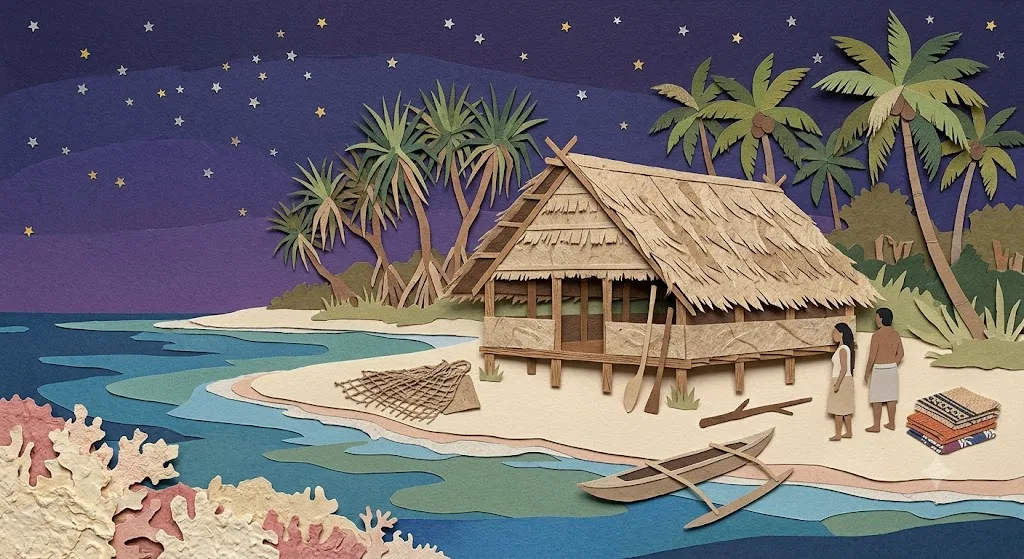
Kiribati folklore is best understood as a living island tradition rather than a fixed “mythology book”. Its best-attested stories come from the Gilbert Islands, where creation tales, ancestral spirits, sacred meeting houses, sea creatures, dance chants and local origin stories explain how people belong to land, kin and ocean.
Page outline Jump by section
What Kiribati folklore is really about
For a first-time reader, the most useful starting point is this: Kiribati folklore is not mainly about monsters in the modern horror sense. It is about origins, authority, land rights, ancestry, sacred order and survival on low coral islands. The Kiribati National Tourism Office summarises a key traditional theme: spirits move from Samoa to the Gilbert Islands, become part-spirit and part-human, and eventually become human ancestors; it also notes traditions in which turtle, spider, eel and stingray gods are involved in creating the universe.[Kiribati Tourism]kiribatitourism.gov.kiOpen source on kiribatitourism.gov.ki.
That matters because folklore in Kiribati often works like a cultural map. A story may explain where a clan came from, why a meeting house matters, why a species is taboo for certain people, or why a landscape carries memory. The eHRAF summary of Tungaru Traditions describes Grimble and Maude’s work as reconstructing the origins of clans, religious ceremonies, community houses, dance types and economic activities from rich oral traditions.[eHRAF World Cultures]ehrafworldcultures.yale.edue HRAF World Cultures Tungaru TraditionseHRAF World CulturesTungaru Traditions - eHRAF World Cultures…
Nareau and the making of the world
The best-known Kiribati creation figure is Nareau. In one accessible retelling preserved by Museums Victoria, Nareau appears in a world of water, sand and low sky. The story is not a tidy single-act creation myth: it features Nareau the Creator, Nareau the Wise, the octopus Na Kika and the eel Riiki, who helps lift the sky to its present height. By the end of the story, Riiki is associated with the Milky Way, and the world and heavens are imagined as a vast meeting house.[Museums Victoria]museumsvictoria.com.auMuseums Victoria The separation of earth and sky | Resources | Melbourne MuseumMuseums Victoria The separation of earth and sky | Resources | Melbourne Museum
This detail is important because it shows how Kiribati creation tradition links cosmic scale to everyday social space. The universe is not described as a remote, abstract machine; it is made meaningful through the image of a communal house, the kind of place where authority, storytelling and social order are enacted. Museums Victoria’s version also shows the oral-poetic texture of the tradition, with repeated chants and formulaic speech rather than a plain prose “plot summary”.[Museums Victoria]museumsvictoria.com.auMuseums Victoria The separation of earth and sky | Resources | Melbourne MuseumMuseums Victoria The separation of earth and sky | Resources | Melbourne Museum
There are variants. The Kiribati tourism account mentions traditions in which turtle and spider gods create the universe, and others in which eel and stingray gods overtake land gods before creation proceeds.[Kiribati Tourism]kiribatitourism.gov.kiOpen source on kiribatitourism.gov.ki. This variation is normal in oral tradition: island, clan, family and collector versions may emphasise different beings or sequences. A careful reader should therefore avoid treating any single online summary as the one official Kiribati creation myth.

Spirits, ancestors and the older religious world
Before nineteenth-century missionary influence became dominant, Kiribati religious life included a host of gods and spirits, often connected with ancestors. A Worldmark encyclopedia entry hosted by the University of the South Pacific states that I-Kiribati religious practice recognised spirits called anti, with important deified ancestors including Auriaria, Tabuariki, Nei Tituabine and Nei Teiti. It describes Tabuariki as linked with thunder and agriculture, and Auriaria as associated with war.[USP Electronic Research Repository]repository.usp.ac.fjUSP Electronic Research Repository
These beings were not simply decorative characters. They were part of how people understood danger, authority, illness, ritual and social obligation. The same source notes that some lesser spirits, including Rakunene of Abaiang and Te-Unimwane of Nonouti, were still feared or invoked, and that sacred places and ancestor remains could continue to matter even in Christianised communities.[USP Electronic Research Repository]repository.usp.ac.fjUSP Electronic Research Repository
The survival of older ideas does not mean Kiribati is “half-Christian, half-pagan” in any simple sense. A study of contemporary spiritual beliefs in eHRAF notes that when Christianity was introduced, many feared that ancestor worship and traditional practices would have to be abandoned, but converts found ways to incorporate older practices within Christian denominations.[eHRAF World Cultures]ehrafworldcultures.yale.edue HRAF World Cultures Spiritual Beliefse HRAF World Cultures Spiritual Beliefs
Nei Tituaabine, Auriaria and trees that remember
One of the most memorable Kiribati legendary figures is Nei Tituaabine, often presented as a vegetation or tree-associated goddess in secondary retellings. The core story usually links her with Auriaria: after her death, trees grow from her body, commonly including coconut, pandanus and almond. Oxford Reference identifies her as a Gilbertese vegetation goddess and connects the tale to Auriaria, while other summaries preserve the same broad pattern.[Oxford Reference]oxfordreference.comOpen source on oxfordreference.com.
The appeal of the story is obvious, but its cultural meaning is richer than “a woman becomes trees”. On atolls, trees are not background scenery. Coconut and pandanus are food, fibre, shade, building material and a sign of human continuity. A tale in which a beloved woman becomes life-giving trees turns grief into subsistence and memory. It also fits a wider Kiribati pattern in which persons, ancestors, places and useful species are not sharply separated in story.
Eels, taboos and the sea as sacred knowledge
Kiribati folklore is deeply marine. Katharine Luomala’s study of eels in Gilbert Islands culture describes eels as both valued food and prominent figures in ritual and myth, especially through the eel god Riiki, who belongs to the creation period. The study records that some people avoided eating eels because of clan totems, ancestral connections or ritual restrictions.[Persée]persee.frOpen source on persee.fr.
This is a useful corrective to modern fantasy-style expectations. The “creature” in Kiribati folklore is often not a monster to be slain, but a being woven into food practice, clan identity and ritual care. An eel can be food, ancestor, taboo and mythic actor at the same time. That layered role is exactly what makes Kiribati sea folklore distinctive.

The meeting house, dance and oral memory
Kiribati folklore has never lived only in spoken tales told apart from daily life. It is also carried in performance, community space and sound. Grimble’s collected material, according to the Pacific Manuscripts Bureau, includes creation myths, voyaging tales, ancient voyage and war songs, spells and witchcraft practices.[ANU College of Asia & the Pacific]asiapacific.anu.edu.auANU College of Asia & the Pacific Gilbertese myths, legends and oral traditionsANU College of Asia & the PacificGilbertese myths, legends and oral traditions - Pacific Manuscripts Bureau…
Modern archive projects show how important this performance heritage remains. The Ethnologisches Museum in Berlin describes a project to digitise and repatriate more than 200 Kiribati sound recordings made by Gerd and Sigrid Koch in the southern Gilbert Islands in 1963–64. The recordings include songs and dance chants from Tabiteuea, Nonouti and Onotoa, with some material connected to other islands such as Abemama, Beru, Butaritari, Marakei, Maiana and Tarawa.[Staatliche Museen zu Berlin]smb.museumOpen source on smb.museum.
This matters for folklore because songs and dance chants can preserve place names, genealogies, remembered conflicts, island identities and sacred associations in forms that do not look like “myths” on the page. A web article that focuses only on named gods would miss much of Kiribati’s traditional story culture.
Sacred places, museums and fragile memory
Kiribati has institutional efforts to preserve cultural memory. The Kiribati Museum and Cultural Centre, Te Umwanibong, is located at Bikenibeu on Tarawa; its site says the museum building opened in 1991 and holds prehistoric artefacts, traditional arts, material culture, contemporary history and art, plus a reference library and archive. It also notes cassette tapes containing historical songs and stories.[internalaffairs.gov.ki]internalaffairs.gov.kiOpen source on internalaffairs.gov.ki.
That preservation work matters because much Kiribati folklore is vulnerable to the same pressures affecting many Pacific oral traditions: migration, schooling away from elders, church change, modern media, climate stress and the physical fragility of low atoll landscapes. The museum’s collections and archives are not just tourist attractions; they are part of how stories remain available to future I-Kiribati communities.[internalaffairs.gov.ki]internalaffairs.gov.kiOpen source on internalaffairs.gov.ki.
Christianity did not simply erase the old stories
Kiribati today is overwhelmingly Christian, and that shapes how older traditions are understood. A 2021 study on gods, spirits and natural hazards reports that more than 95% of the country affiliated with a Christian denomination in the cited national statistics, while also arguing that I-Kiribati may maintain beliefs in gods, spirits and magic alongside Christian explanations of natural phenomena.[ResearchGate]researchgate.netOpen source on researchgate.net.
That coexistence is not always smooth. The Worldmark entry describes how Christian and Indigenous practices could sit side by side, but also notes tensions where some I-Kiribati viewed multiple loyalties or older practices as problematic. It also gives the example of Tioba, a nineteenth-century folk religion on Tabiteuea that blended local religious practice with influences brought by islanders who had served on foreign vessels, before becoming entangled with conflict and forced conversion.[USP Electronic Research Repository]repository.usp.ac.fjUSP Electronic Research Repository
For readers, the key point is that “old Kiribati religion” and “modern Kiribati Christianity” should not be treated as sealed historical boxes. The relationship is more like a long conversation: some practices were rejected, some reinterpreted, some remembered as heritage, and some quietly retained in everyday thinking.
What is well attested, and what should be treated carefully
The strongest evidence for Kiribati folklore comes from archival collections, older ethnography, museum projects and specialist studies. Grimble’s collected manuscripts are especially important because they preserve a large body of myths, legends, songs, spells and oral traditions recorded in the early twentieth century, while Tungaru Traditions is treated by eHRAF as an early systematic description of traditional Kiribati culture and social organisation.[ANU College of Asia & the Pacific]asiapacific.anu.edu.auANU College of Asia & the Pacific Gilbertese myths, legends and oral traditionsANU College of Asia & the PacificGilbertese myths, legends and oral traditions - Pacific Manuscripts Bureau…
At the same time, readers should be cautious with modern internet retellings. Many short mythology sites compress Kiribati stories into neat god-profiles, sometimes without showing their sources or variants. Those pages can be useful for orientation, but they often flatten oral tradition into a single character biography. Better evidence comes from named collections, museums, academic studies and Kiribati cultural institutions.
A reliable Kiribati folklore page should therefore hold two truths together: the traditions are vivid and memorable, but they are also locally varied, historically layered and sometimes incompletely documented in public English-language sources. The most distinctive picture that emerges is not of a single pantheon, but of an atoll world where creation, ancestry, sea life, sacred places, performance and Christian reinterpretation continue to shape how stories are told.
Amazon book picks
Further Reading
Books and field guides related to What Do Kiribati's Old Stories Remember?. Use these as the next step if you want deeper reading beyond the article.
Tungaru Traditions
One of the most important collections of Gilbert Islands traditions and folklore.
Return to the Islands
Contains observations on culture, oral tradition and island life.
eBay marketplace picks
Marketplace Samples
Live-tested eBay searches with available results related to this page.

Endnotes
1.
Source: kiribatitourism.gov.ki
Link:https://www.kiribatitourism.gov.ki/kiribati-pacific-ocean-location/history/
2.
Source: repository.usp.ac.fj
Title: USP Electronic Research Repository
Link:https://repository.usp.ac.fj/id/eprint/7832/1/Kiribati_Vol_3_pg_228_to_236.pdf
3.
Source: internalaffairs.gov.ki
Link:https://internalaffairs.gov.ki/cmd/
4.
Source: researchgate.net
Link:https://www.researchgate.net/publication/350607410_Gods_Spirits_and_Natural_Hazards_Ontologies_and_Epistemologies_of_Natural_Hazards_and_Climate_Change_in_Kiribati_and_Papua_New_Guinea
5.
Source: kiribatitourism.gov.ki
Link:https://www.kiribatitourism.gov.ki/
6.
Source: researchgate.net
Link:https://www.researchgate.net/publication/284536284_In_Their_Own_Words_History_and_Society_in_Gilbertese_Oral_Tradition
7.
Source: dfat.gov.au
Title: kiribati country brief
Link:https://www.dfat.gov.au/geo/kiribati/kiribati-country-brief
8.
Source: youtube.com
Title: Tales from Kiribati Part 1
Link:https://www.youtube.com/watch?v=D_ofMx_iSlY
Source snippet
Kiribati - Nareau the Creator...
9.
Source: asiapacific.anu.edu.au
Title: ANU College of Asia & the Pacific Gilbertese myths, legends and oral traditions
Link:https://asiapacific.anu.edu.au/pambu/catalogue/index.php/gilbertese-myths-legends-and-oral-traditions
Source snippet
ANU College of Asia & the PacificGilbertese myths, legends and oral traditions - Pacific Manuscripts Bureau...
10.
Source: ehrafworldcultures.yale.edu
Title: e HRAF World Cultures Tungaru Traditions
Link:https://ehrafworldcultures.yale.edu/cultures/or06/documents/006
Source snippet
eHRAF World CulturesTungaru Traditions - eHRAF World Cultures...
11.
Source: museumsvictoria.com.au
Title: Museums Victoria The separation of earth and sky | Resources | Melbourne Museum
Link:https://museumsvictoria.com.au/melbournemuseum/resources/tok-stori-vikitolia-pasifiki/kiribati/the-separation-of-earth-and-sky/
12.
Source: ehrafworldcultures.yale.edu
Title: e HRAF World Cultures Spiritual Beliefs
Link:https://ehrafworldcultures.yale.edu/cultures/or06/documents/021
13.
Source: oxfordreference.com
Link:https://www.oxfordreference.com/display/10.1093/oi/authority.20110803100227729?d=%2F10.1093%2Foi%2Fauthority.20110803100227729&p=emailAkpWbN7ECgQoA
14.
Source: Wikipedia
Link:https://en.wikipedia.org/wiki/Auriaria
15.
Source: persee.fr
Link:https://www.persee.fr/doc/jso_0300-953x_1981_num
16.
Source: smb.museum
Link:https://www.smb.museum/en/museums-institutions/ethnologisches-museum/collection-research/research/songs-and-dance-chants-from-the-pacific-state-of-kiribati/
17.
Source: Wikipedia
Link:https://en.wikipedia.org/wiki/Kiribati
18.
Source: Wikipedia
Link:https://en.wikipedia.org/wiki/Nareau
19.
Source: asiapacific.anu.edu.au
Link:https://asiapacific.anu.edu.au/pambu/reels/manuscripts/PMB0069.PDF
20.
Source: openresearch-repository.anu.edu.au
Link:https://openresearch-repository.anu.edu.au/bitstream/1885/132637/1/JPH_In_Their_Own_Words.pdf
21.
Source: sk.sagepub.com
Link:https://sk.sagepub.com/ency/edvol/globalreligion/chpt/kiribati
22.
Source: everyculture.com
Link:https://www.everyculture.com/Oceania/Kiribati-Religion-and-Expressive-Culture.html
23.
Source: youtube.com
Link:https://www.youtube.com/watch?v=IHxrlO4DPgs
24.
Source: 2009-2017.state.gov
Link:https://2009-2017.state.gov/outofdate/bgn/kiribati/35118.htm
25.
Source: travel.state.gov
Link:https://travel.state.gov/content/travel/en/international-travel/International-Travel-Country-Information-Pages/Kiribati.html
26.
Source: 2021-2025.state.gov
Link:https://2021-2025.state.gov/reports/2020-report-on-international-religious-freedom/kiribati/
27.
Source: thecommonwealth.org
Link:https://thecommonwealth.org/our-member-countries/kiribati
28.
Source: presentspace.com
Title: creation myths
Link:https://presentspace.com/creation-myths/
29.
Source: globaledge.msu.edu
Link:https://globaledge.msu.edu/countries/kiribati
30.
Source: ebsco.com
Link:https://www.ebsco.com/research-starters/geography-and-cartography/kiribati
Additional References
31.
Source: youtube.com
Title: Nareau: The Micronesian Spider God Who Wove the Universe
Link:https://www.youtube.com/watch?v=_UT2O9ITPOM
Source snippet
KIRIBATI Traditional Folk Music: "Te Taeka N Rabakau"...
32.
Source: academia.edu
Link:https://www.academia.edu/44235934/Tungaru_Traditions
33.
Source: facebook.com
Link:https://www.facebook.com/groups/302612704796652/posts/1265876225136957/
34.
Source: pasefikaproud.co.nz
Link:https://www.pasefikaproud.co.nz/assets/Initial-Content/Resources/Boutokaan-te-mweeraoi-A-Conceptual-Framework-for-enhancing-I-Kiribati-wellbeing/PasefikaProudResource-Nga-Vaka-o-Kaiga-Tapu-Pacific-Framework-Kiribati.pdf
35.
Source: degruyterbrill.com
Link:https://www.degruyterbrill.com/document/doi/10.1515/9780824860110-009/html?srsltid=AfmBOooqKGWohWhRSbGLRCMt25fYuaWP5luzefxMJNNLPH4kahQN3czu
36.
Source: spccfpstore1.blob.core.windows.net
Link:https://spccfpstore1.blob.core.windows.net/digitallibrary-docs/files/93/93768310fa8041cafbb96b723bc2570b.pdf?rscc=public%2C+max-age%3D864000%2C+max-stale%3D86400&rscd=inline%3B+filename%3D%22Endangered_Cultural_Heritage_Mapping_in_Kiribati.pdf%22&rsct=application%2Fpdf&se=2026-09-16T19%3A40%3A20Z&sig=kf6%2BWBQjXbzE0y11wqDtdHHQQ77FzO4hLJV4EHihir0%3D&sp=r&sr=b&sv=2015
37.
Source: scispace.com
Link:https://scispace.com/pdf/in-their-own-words-history-and-society-in-gilbertese-oral-5ad6ozs551.pdf
38.
Source: jenniferdsmallphd.com
Link:https://www.jenniferdsmallphd.com/MET_102_Readings/Talu_etal_1979.pdf
39.
Source: scribd.com
Link:https://www.scribd.com/document/2678596/kiribati-origins-and-culture
40.
Source: tepapa.govt.nz
Link:https://tepapa.govt.nz/discover-collections/read-watch-play/kiribati
Topic Tree
Follow this branch
Related pages 192
- Afghan Folklore
- Albanian Folklore
- Algerian Folklore
- Australian Folklore
- Azerbaijan Folklore
- +187 more in sidebar