Within Mozambique Folklore
What Do Mozambique's Trickster Animals Teach?
Hare, frog and other clever animals make southern Mozambican tales funny, frightening and morally sharp.
On this page
- Ronga and Tsonga storytelling settings
- Hare, frog and moral reversal
- From oral performance to fairy book retelling
Page outline Jump by section
Introduction
In the southern part of Mozambique, among Ronga- and Tsonga-speaking communities, some of the most memorable traditional stories are not about kings, warriors or spirits but about animals. Above all, the hare appears again and again as a trickster: small, vulnerable and apparently weak, yet capable of defeating stronger animals through wit, deception and quick thinking. In other tales, frogs and other creatures play similar roles, creating stories that are funny on the surface but often carry sharp lessons about greed, pride, foolish imitation and the misuse of power. These tales formed part of a rich oral storytelling tradition that was performed in homes and community gatherings long before they were written down. Early collectors such as Henri-Alexandre Junod recorded many examples, preserving valuable evidence of southern Mozambican narrative traditions while also filtering them through colonial-era assumptions.[SciELO]scielo.org.zaTrickster tropes: female storytelling and the re-imagination…by J Pieterse · 2010 · Cited by 7 — The trickster to whom Junod referred…
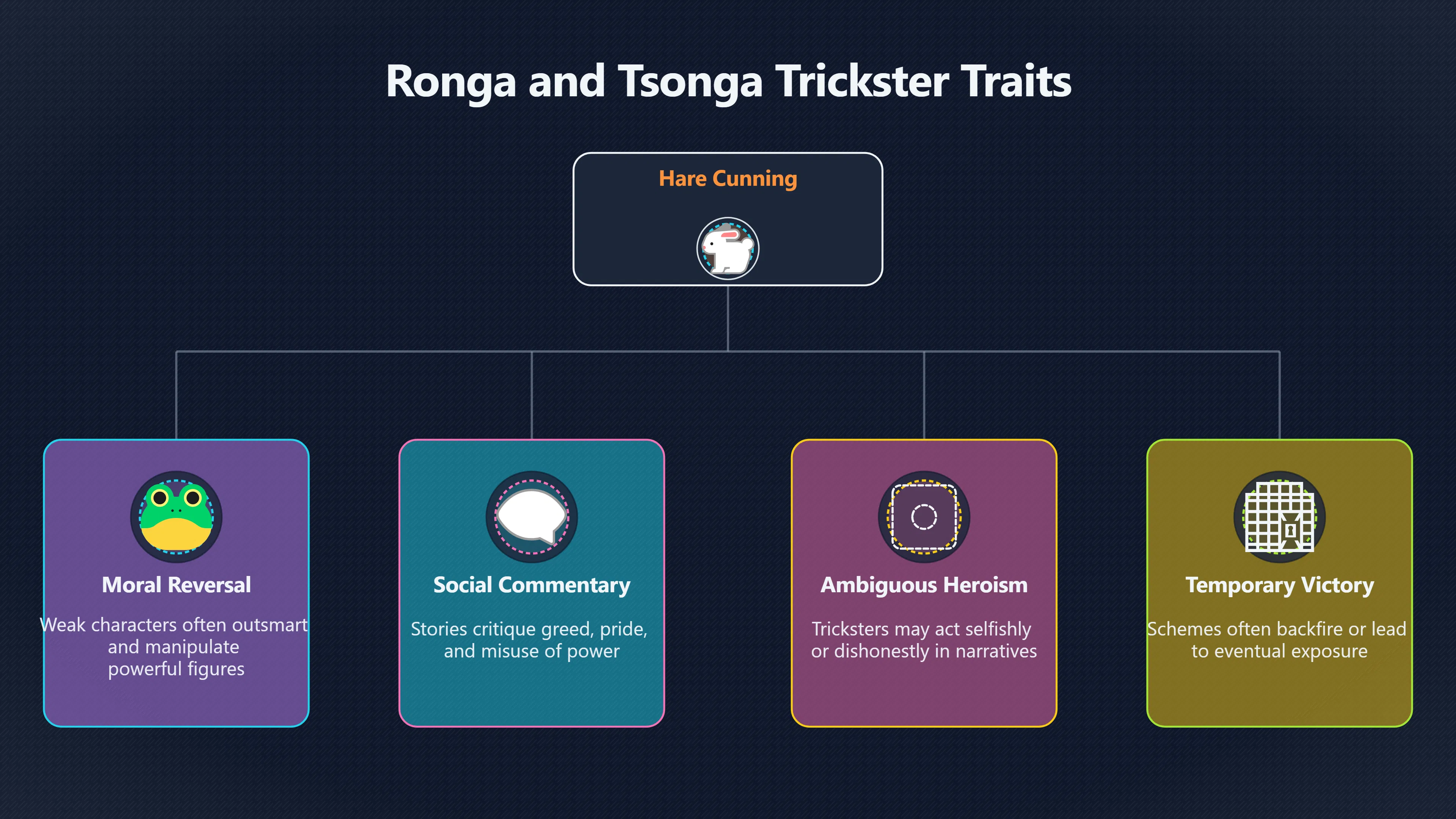
Rather than presenting simple moral fables, Ronga and Tsonga trickster stories often delight in reversals. The clever character may succeed through behaviour that is hardly admirable. Listeners are invited to laugh, judge, and think about the consequences all at once.
Ronga and Tsonga Storytelling Settings
Traditional storytelling in southern Mozambique was a social performance rather than a private reading experience. Tales were shared orally, often in the evenings, with narrators using repetition, dialogue, song and dramatic timing to hold attention. Folktales helped entertain audiences, but they also transmitted social knowledge, cultural values and observations about human behaviour. Oral tradition preserved local understandings of community life, relationships and the natural world long before widespread literacy.[South African History Online]sahistory.org.zaoral tradition and indigenous knowledgeSouth African History OnlineOral tradition and indigenous knowledge28 May 2011 — Oral history tells us what happened, and the folklore he…
Animal stories occupied a particularly important place because they allowed storytellers to discuss difficult human problems indirectly. A boastful lion, a gullible hyena or a scheming hare could stand in for recognisable human types. The audience could laugh at the animals while also recognising familiar social situations.
Among southern African traditions more broadly, scholars have repeatedly identified the hare as one of the dominant trickster figures. The pattern appears across many neighbouring cultures, but Ronga and Tsonga materials collected in and around present-day southern Mozambique provide some of the best-known examples.[researchspace.ukzn.ac.za]researchspace.ukzn.ac.zaThe choice of this animal character points to the bewildered…Read more…
Why the Hare Became the Great Trickster
The hare’s importance is not accidental. Unlike lions, elephants or buffalo, the hare possesses no obvious physical advantages. Its survival depends on speed, alertness and cunning. Folklore transforms those qualities into a narrative principle: intelligence can overcome brute strength.
In many stories the hare tricks larger animals into fighting each other, surrendering food, performing foolish tasks or walking into danger. The humour comes from seeing powerful creatures defeated by someone they underestimate. Yet the hare is rarely a perfect hero. He can be selfish, dishonest and cruel. Audiences are therefore not simply encouraged to admire him. Instead, they are invited to enjoy his cleverness while recognising the risks of arrogance, greed and misplaced trust.[researchspace.ukzn.ac.za]researchspace.ukzn.ac.zaThe choice of this animal character points to the bewildered…Read more…
This ambiguity is one reason trickster tales have endured. The hare exposes weaknesses in the social order. He proves that power is not always linked to size or authority, but he also demonstrates that cleverness without responsibility can become destructive.
Hare, Frog and Moral Reversal
One striking feature of Ronga and Tsonga trickster traditions is their fondness for moral reversal. The character who appears weak turns out to be dangerous. The character who appears powerful turns out to be foolish.
Stories involving hares and frogs often operate through this logic. The audience expects the larger or stronger creature to dominate, but events unfold differently. A seemingly insignificant animal notices something others miss, manipulates a situation or escapes punishment through verbal skill. In oral performance, much of the pleasure comes from anticipating how the trick will work and watching the victim fall into the trap.
The lessons are rarely presented directly. Instead, they emerge from the consequences:
- Pride makes powerful characters vulnerable.
- Greed encourages bad decisions.
- Blind imitation leads to disaster.
- Intelligence can be valuable, but dishonesty carries risks.
- Social status does not guarantee wisdom.
Because the stories are built around surprise and reversal, listeners learn through narrative experience rather than explicit instruction.
When the Trickster Goes Too Far
Many readers assume folktales reward good behaviour, but Ronga and Tsonga trickster tales often resist such neat conclusions. In some narratives the hare succeeds brilliantly and escapes punishment. In others, his schemes eventually backfire.
Collections of southern African hare stories show recurring plots in which the trickster deceives friends, cheats rivals or manipulates stronger animals. Yet those victories are often temporary. Another character may eventually expose him, imitate his trick incorrectly, or turn his own methods against him. The result is a more complex moral universe than a simple tale of virtue rewarded.[Fairytalez]fairytalez.comThe Little HareThe Little Hare - African Folk TaleAn African folk tale of a wife's strange craving, a dangerous beast called the nyamatsane an…
This complexity helps explain the popularity of the stories. They reflect real social tensions. People know that clever individuals sometimes prosper through manipulation, at least for a time. Trickster tales acknowledge that reality while still allowing audiences to debate whether such success is admirable.
From Oral Performance to Fairy-Book Retelling
Most modern readers encounter Ronga and Tsonga trickster tales through written collections rather than live storytelling. This shift has preserved important material but has also changed it.
Henri-Alexandre Junod’s recordings of southern African traditions remain among the most influential written sources. His work captured stories that might otherwise have been lost to researchers, yet it was produced within a missionary and colonial context. Modern readers therefore treat these collections as valuable records of oral tradition rather than exact transcripts of every aspect of performance. Elements such as audience participation, gestures, song and local interpretation were often difficult to capture fully on the page.[SciELO]scielo.org.zaTrickster tropes: female storytelling and the re-imagination…by J Pieterse · 2010 · Cited by 7 — The trickster to whom Junod referred…
Later anthologies and children’s retellings frequently softened the darker or more ambiguous aspects of the stories. Tricksters who were once morally unpredictable became more obviously heroic, while complex oral performances were reshaped into fairy-tale narratives for print audiences. The change made the tales accessible to wider readerships but sometimes reduced the social and comic complexity that characterised live storytelling.
Why These Tales Still Matter
Animal trickster stories remain one of the most vivid windows into southern Mozambican oral culture. They reveal how storytellers explored questions of power, intelligence, social behaviour and survival through memorable animal characters rather than abstract moral lectures.
The hare’s continuing popularity reflects a theme found throughout many Ronga and Tsonga narratives: strength alone is never enough. Success depends on judgement, awareness and adaptability. At the same time, the stories warn that cleverness can become dangerous when detached from responsibility.
That combination of humour, tension and moral ambiguity is what has allowed these tales to survive across generations. Even today, the image of the small animal outwitting the mighty remains one of the most recognisable and enduring motifs in the traditional storytelling heritage of southern Mozambique.[researchspace.ukzn.ac.za]researchspace.ukzn.ac.zaThe choice of this animal character points to the bewildered…Read more…
Amazon book picks
Further Reading
Books and field guides related to What Do Mozambique's Trickster Animals Teach?. Use these as the next step if you want deeper reading beyond the article.
Why Mosquitoes Buzz in People's Ears
Demonstrates the teaching role of animal folklore.
eBay marketplace picks
Marketplace Samples
Live-tested eBay searches with available results related to this page.
Endnotes
1.
Source: researchspace.ukzn.ac.za
Link:https://researchspace.ukzn.ac.za/items/9d40d662-e363-44b2-bdb4-11dc387e8625
Source snippet
The choice of this animal character points to the bewildered...Read more...
2.
Source: fairytalez.com
Title: The Little Hare
Link:https://fairytalez.com/the-little-hare/
Source snippet
The Little Hare - African Folk TaleAn African folk tale of a wife's strange craving, a dangerous beast called the nyamatsane an...
3.
Source: scielo.org.za
Link:https://www.scielo.org.za/scielo.php?pid=S0018-229X2010000100004&script=sci_arttext
Source snippet
Trickster tropes: female storytelling and the re-imagination...by J Pieterse · 2010 · Cited by 7 — The trickster to whom Junod referred...
4.
Source: sahistory.org.za
Title: oral tradition and indigenous knowledge
Link:https://sahistory.org.za/article/oral-tradition-and-indigenous-knowledge
Source snippet
South African History OnlineOral tradition and indigenous knowledge28 May 2011 — Oral history tells us what happened, and the folklore he...
Published: May 2011
5.
Source: youtube.com
Title: The Hare and the Tortoise
Link:https://www.youtube.com/watch?v=NGx7LM-cncs
Source snippet
Fairy tale - English Stories...The tortoise challenged the rabbit to a race let's see who reaches the tree on the hill...
Additional References
6.
Source: teachersinstitute.yale.edu
Link:https://teachersinstitute.yale.edu/curriculum/units/1998/2/98.02.04/3
Source snippet
yale.edu98.02.04: Three African Trickster Myths/Tales -- Primary StyleThe Hare is found in stories in most parts of Africa. One southern...
7.
Source: pressbooks.pub
Link:https://pressbooks.pub/africanguide/chapter/notes-to-the-stories/
Source snippet
Kamba Simango. For more stories about the trickster rabbit (or hare), see these books in the...Read more...
8.
Source: ujcontent.uj.ac.za
Title: A variety of characters are used in folktales
Link:https://ujcontent.uj.ac.za/esploro/outputs/graduate/Tricks-trickster-characters-and-trickster-tales/9912748707691
Source snippet
uj.ac.zaTricks, trickster characters and trickster tales in Tswana...by BB Serekoane · Cited by 1 — This dissertation will identify tric...
9.
Source: scribd.com
Link:https://www.scribd.com/document/415036135/Factor-Completely
Source snippet
ribes how trickster figures like Anansi the spider, the tortoise...
10.
Source: mythopia.io
Title: The Clever Hare and the Community Well
Link:https://mythopia.io/story/1203/the-clever-hare-and-the-community-well-a-southern-african-folktale-about-cooperation-and-cunning
Source snippet
6 Jul 2025 — So the Hare tied the Hyena hand and foot, but instead of giving him any honey, he went to the well and drank all he...
11.
Source: disang.wordpress.com
Title: Disang The Hare and the Hyena (2)
Link:https://disang.wordpress.com/2019/04/13/the-hare-and-the-hyena-2/
Source snippet
Hare and the Hyena (2) - Disang - WordPress.com13 Apr 2019 — Somehow Hare – who is a typical trickster – always gets the upper hand, whil...
12.
Source: oriire.com
Title: the trickster across africa
Link:https://oriire.com/article/the-trickster-across-africa
Source snippet
Mythology, folklore and...27 May 2026 — The text explores three African trickster figures—Anansi, Eshu, and the Hare—who use cleverness...
Published: May 2026
13.
Source: Wikipedia
Title: The Tortoise and the Hare
Link:https://en.wikipedia.org/wiki/The_Tortoise_and_the_Hare
Source snippet
The Tortoise and the HareThe fable itself is a variant of a common folktale theme in which ingenuity and trickery (rather than doggedn...
14.
Source: lavendersbluehomeschool.com
Title: story the foolish hare
Link:https://www.lavendersbluehomeschool.com/blogs/story-the-foolish-hare
Source snippet
Story: The Foolish Hare15 Feb 2026 — Once in the forest of India there was a hare who sat under a fruit tree. He looked like a rabbit, on...
15.
Source: religiousreading.blogspot.com
Title: week 4 story lab african trickster hare
Link:https://religiousreading.blogspot.com/2021/02/week-4-story-lab-african-trickster-hare.html
Source snippet
The hare and the frog, their mother-in-law, and her daughters The hare, the chickens, the goats, and the rats...
Topic Tree