Within Hungarian Folklore
Why Does Hungary Follow a Miraculous Stag?
The miraculous stag legend turns a hunt into a story of ancestry, migration and Hungarian national imagination.
On this page
- The hunt of Hunor and Magor
- Medieval chronicles and political meaning
- Modern retellings and national symbolism
Page outline Jump by section
Introduction
The miraculous stag is one of the most important foundation legends in Hungarian culture. Unlike a simple hunting tale, it explains how a people found its destiny. In the traditional story, the brothers Hunor and Magor pursue a mysterious deer or hind that can never be caught. The animal leads them away from familiar territory, across distant landscapes, and towards a new future. What begins as a hunt becomes a migration, and what appears to be prey reveals itself as a guide. Medieval chroniclers used the legend to explain the origins of both the Huns and the Hungarians, while later generations transformed it into a powerful symbol of national identity, ancestry and homeland.[Wikipedia]WikipediaHunor and MagorHunor and Magor
The story matters because it sits at the meeting point of folklore, political history and cultural memory. For centuries Hungarians have returned to the image of the miraculous stag when imagining where they came from and what binds the nation together.[Wikipedia]WikipediaHunor and MagorHunor and Magor
The Hunt of Hunor and Magor
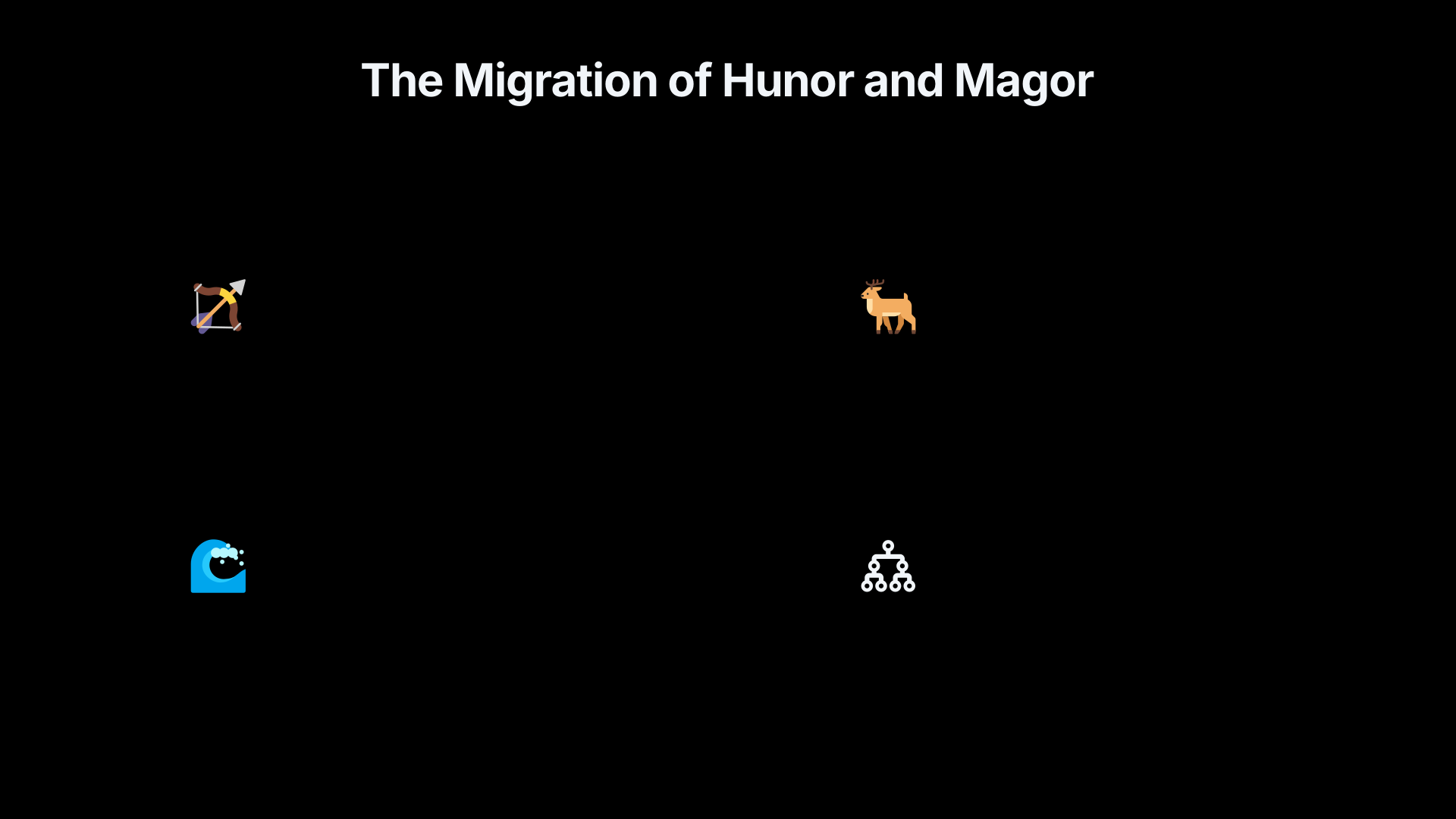
The best-known version of the legend tells of two brothers, Hunor and Magor, who are described as the ancestors of the Huns and the Magyars. While hunting, they encounter a wondrous hind or stag and set off in pursuit. The animal continually remains just out of reach, drawing them farther and farther from their homeland. Eventually the chase leads them into new lands near the Sea of Azov and the marshes of Meotis. There they encounter women who become the ancestors of future peoples, establishing the lineages from which the Huns and Hungarians are said to descend.[Wikipedia]WikipediaHunor and MagorHunor and Magor
A striking feature of the tale is that the stag is never captured. In many hunting legends, success comes when the animal is killed. Here the opposite happens. The creature’s purpose is not to be possessed but to lead. This gives the story a symbolic quality: the hunters are guided towards a destiny greater than the immediate goal that first motivated them.[EuroFolktales.com]europeanfolktales.comEnchanted Stag of Hungary - EuropeanFolktales.comDecember 4, 2025 — 4 Dec 2025 — The Csodaszarvas is the Enchanted Stag, a recurring Magy…
For folklorists, this pattern is significant because it turns movement itself into the central theme. The legend explains migration not as a random event but as something directed by a supernatural sign. The stag becomes a bridge between the natural world and the unfolding history of a people.[Wikipedia]WikipediaHungarian prehistoryHungarian prehistory
Why a Stag?
The animal at the centre of the legend has attracted almost as much attention as the human characters. Some historians and folklorists have suggested that the hind or stag may preserve traces of very old steppe traditions in which deer held special symbolic importance. The name Eneth, given to the mother of Hunor and Magor in one version of the story, has been linked by scholars to an old Hungarian word for a hind, leading to arguments that the deer may once have functioned as an ancestral or totemic figure before the story was reshaped within a Christian medieval framework.[Wikipedia]WikipediaHunor and MagorHunor and Magor
The motif itself is not uniquely Hungarian. Stories in which hunters pursue a supernatural deer and discover a new homeland appear elsewhere across the Eurasian steppe world. Because of this, scholars debate how much of the tale reflects specifically Hungarian tradition and how much belongs to a broader heritage shared among steppe peoples. What remains distinctive is the way the legend became attached to Hungarian national origins.[Wikipedia]WikipediaHungarian prehistoryHungarian prehistory
In later folklore and artistic depictions, the miraculous stag often acquires explicitly supernatural features. It may appear white, golden or radiant, and modern representations sometimes place stars between its antlers or associate it with celestial imagery. These details reinforce its role as a messenger of destiny rather than an ordinary animal.[Folkpedia]folkpedia.netCsodaszarvas - FolkpediaThe Csodaszarvas (Miracle Stag) is the legendary white deer that guided the brothers Hunor and Magor in…
Medieval Chronicles and Political Meaning
The legend survives because medieval writers recorded it. The most influential version appears in the late thirteenth-century Gesta Hunnorum et Hungarorum by Simon of Kéza, a chronicler working in the Kingdom of Hungary. His account linked the Huns and Hungarians through common ancestry and presented the story as part of a larger narrative of national origins.[Wikipedia]WikipediaSimon of KézaSimon of Kéza
The tale was not merely entertainment. It carried a political message. By connecting the Hungarians with Attila and the Huns, medieval authors helped create a sense of historical continuity between the contemporary kingdom and a heroic past. The miraculous stag therefore became part of a larger origin narrative that legitimised claims about ancestry, territory and identity.[Wikipedia]WikipediaHunor and MagorHunor and Magor
The story gained additional prestige through its appearance in the fourteenth-century Chronicon Pictum or Illuminated Chronicle. The famous illustrations of Hunor and Magor pursuing the stag helped fix the scene in the Hungarian historical imagination. For many later readers, the image became as memorable as the written narrative itself.[Wikipedia]WikipediaChronicon PictumJune 1, 2005 — The Chronicon Pictum or Illuminated Chronicle is a medieval illustrated chronicle from the Kingdom of Hungary from the 14t…
The political uses of the legend continued long after the Middle Ages. Early modern writers such as István Werbőczy incorporated Hunor and Magor into arguments about Hungarian noble identity and ancient rights. In this context the legend became part of a broader ideology that celebrated a supposedly ancient “Scythian” heritage.[Wikipedia]WikipediaHunor and MagorHunor and Magor
History, Folklore and Scholarly Debate
Modern historians do not treat the miraculous stag story as a literal account of Hungarian origins. Instead, it is understood as a foundation legend: a narrative that expresses how a community imagines its beginnings. The story reveals cultural values and historical self-understanding rather than providing a straightforward record of real events.[Wikipedia]WikipediaHungarian prehistoryHungarian prehistory
Scholars disagree on exactly how old the legend is and how much of it predates the medieval chronicles. Some argue that important elements preserve genuine pre-Christian traditions. Others note that many motifs in the story, including the founding brothers and the guided migration, have parallels elsewhere and may have been adapted or reshaped by chroniclers. The uncertainty itself is revealing. The legend sits at the boundary where oral tradition, political storytelling and historical memory overlap.[Wikipedia]WikipediaHungarian prehistoryHungarian prehistory
This debate has not diminished the story’s importance. In folklore, a legend’s influence often matters more than whether every detail can be traced to a single ancient source. The miraculous stag continues to function as a symbolic explanation of origins regardless of the precise age of its individual motifs.[Wikipedia]WikipediaHungarian prehistoryHungarian prehistory
Modern Retellings and National Symbolism
The miraculous stag remains one of the most recognisable symbols in Hungarian cultural life. During the nineteenth century, when Romantic nationalism encouraged renewed interest in legends and folk traditions, writers and artists embraced the story as a poetic expression of national destiny. The poet János Arany produced a celebrated retelling that helped introduce the legend to new audiences.[Wikipedia]WikipediaHunor and MagorHunor and Magor
In the twentieth and twenty-first centuries the stag continued to appear in literature, public monuments, school education and visual art. Marcell Jankovics’s animated film Song of the Miraculous Hind placed the legend within a sweeping narrative of Hungarian history, demonstrating how the story could still serve as a framework for thinking about the nation’s past.[Wikipedia]WikipediaSong of the Miraculous HindSong of the Miraculous Hind
Today the miraculous stag occupies a curious position. It is not an official state emblem, yet it remains instantly recognisable as a symbol of Hungarian heritage. Statues, festival imagery, historical illustrations and popular retellings all keep the legend alive. The animal represents guidance, migration, endurance and the search for a homeland—ideas that continue to resonate long after the medieval chronicles that first recorded the tale.[xpatloop.com]xpatloop.comExpat Explainer: The Miracle Stag - Important Symbol of…23 Jun 2025 — Within Hungarian tradition, the Miracle Stag is often viewed as…
How Stag Legend survived in retelling
Many national origin stories celebrate conquest or victory. The miraculous stag legend is different. Its central image is pursuit rather than possession. The ancestors do not succeed because they catch the animal; they succeed because they follow it.
That distinction helps explain the legend’s lasting appeal. The stag embodies a vision of history in which a people are guided towards their future by signs, journeys and choices rather than by brute force alone. Whether understood as folklore, political myth, literary symbol or cultural memory, the miraculous stag remains one of the most powerful images through which Hungary has imagined its beginnings.[wikipedia.org]WikipediaHunor and MagorHunor and Magor
Amazon book picks
Further Reading
Books and field guides related to Why Does Hungary Follow a Miraculous Stag?. Use these as the next step if you want deeper reading beyond the article.
The Hero with a Thousand Faces
Explores foundational narrative patterns relevant to origin myths.
The Mammoth Book of Celtic Myths and Legends
Offers comparative material on national foundation legends and symbolic beasts.
Myths and Symbols in Pagan Europe
Places sacred animals and migration legends into a wider European context.
The Golden Bough
Useful for readers interested in symbolic animals and ancient traditions.
eBay marketplace picks
Marketplace Samples
Live-tested eBay searches with available results related to this page.
Endnotes
1.
Source: Wikipedia
Title: Hunor and Magor
Link:https://en.wikipedia.org/wiki/Hunor_and_Magor
2.
Source: Wikipedia
Title: Hungarian prehistory
Link:https://en.wikipedia.org/wiki/Hungarian_prehistory
3.
Source: xpatloop.com
Link:https://xpatloop.com/channels/2025/06/expat-explainer-the-miracle-stag-important-symbol-of-hungarian-identity.html
Source snippet
Expat Explainer: The Miracle Stag - Important Symbol of...23 Jun 2025 — Within Hungarian tradition, the Miracle Stag is often viewed as...
4.
Source: folkpedia.net
Link:https://folkpedia.net/creature/en-csodaszarvas/
Source snippet
Csodaszarvas - FolkpediaThe Csodaszarvas (Miracle Stag) is the legendary white deer that guided the brothers Hunor and Magor in...
5.
Source: Wikipedia
Title: Simon of Kéza
Link:https://en.wikipedia.org/wiki/Simon_of_K%C3%A9za
6.
Source: Wikipedia
Title: Gesta Hunnorum et Hungarorum
Link:https://en.wikipedia.org/wiki/Gesta_Hunnorum_et_Hungarorum
7.
Source: Wikipedia
Title: Chronicon Pictum
Link:https://en.wikipedia.org/wiki/Chronicon_Pictum
Source snippet
June 1, 2005 — The Chronicon Pictum or Illuminated Chronicle is a medieval illustrated chronicle from the Kingdom of Hungary from the 14t...
Published: June 1, 2005
8.
Source: Wikipedia
Title: Song of the Miraculous Hind
Link:https://en.wikipedia.org/wiki/Song_of_the_Miraculous_Hind
9.
Source: Wikipedia
Title: Hungarian mythology
Link:https://en.wikipedia.org/wiki/Hungarian_mythology
Source snippet
Hungarian mythologyCsodaszarvas (animal), A central figure in the legends surrounding the origin of the Hungarian people. The name tra...
10.
Source: europeanfolktales.com
Link:https://europeanfolktales.com/the-enchanted-stag-of-hungary/
Source snippet
Enchanted Stag of Hungary - EuropeanFolktales.comDecember 4, 2025 — 4 Dec 2025 — The Csodaszarvas is the Enchanted Stag, a recurring Magy...
Published: December 4, 2025
11.
Source: noobs-guide-to-necromancy.fandom.com
Link:https://noobs-guide-to-necromancy.fandom.com/wiki/Csodaszarvas
Source snippet
The name translates to "Miraculous Deer". According to Hungarian legend...Read more...
Additional References
12.
Source: academia.edu
Link:https://www.academia.edu/39531457/48_The_Miracle_Stag
Source snippet
(PDF) 48 The Miracle StagTwo main theories exist regarding Hungarian origins: Turkic language adoption or prior Finno-Ugric influence. Th...
13.
Source: transcendentbird.com
Link:https://transcendentbird.com/section/252694-The%20Csodaszarvas%2C%20MFA%20Graduate%20Thesis%20Project.html
14.
Source: youtube.com
Link:https://www.youtube.com/watch?v=CdWyjS7ysoo
Source snippet
The Hungarian Mythical Stag After ChristianityHow did Christianity change the Hungarian miracle stag myth? Originally posted 2.16.24 #hun...
15.
Source: facebook.com
Link:https://www.facebook.com/mrmusette/posts/the-csodaszarvas-is-a-hungarian-mythological-creature-in-the-form-of-a-deer-on-h/1177604333332733/
Source snippet
On his forehead is the Morning Star, on his chest is the Moon and...Read more...
16.
Source: digitalcollections.wesleyan.edu
Title: 23798 Original%20File
Link:https://digitalcollections.wesleyan.edu/_flysystem/fedora/2023-03/23798-Original%2520File.pdf
Source snippet
Hunor and Magor marry one of the princesses they have kidnapped each, and says, “...and to these women all the Huns owe their...Read more...
17.
Source: dergipark.org.tr
Link:https://dergipark.org.tr/tr/download/article-file/3506931
Source snippet
The Miracle Stag, as a Common Actor in the Origin Myths...31 Oct 2023 — According to this fable two brothers named Hunor and Ma...
18.
Source: facebook.com
Link:https://www.facebook.com/groups/961092894092704/posts/2970076699860970/
Source snippet
The legend of the miraculous deer and hunor and magor...The deer symbolizes divine providence and the ancestral homeland, to which they...
19.
Source: steppenreiter.de
Link:https://steppenreiter.de/magyar2.htm
Source snippet
Geschichte Magyar - Der SteppenreiterThe Legend of the Wondrous Stag is, along with the Legend of the Turul Bird, one of the two oldest l...
20.
Source: youtube.com
Title: Tale about the Miraculous Deer
Link:https://www.youtube.com/watch?v=bxa2OQFniyM
Source snippet
Legend of the Miracle Stag Hungary Hunor Magor The Legend of the Magical Deer Legends of Hungary - Hungarian Legends...
21.
Source: youtube.com
Link:https://www.youtube.com/watch?v=5cqRAJ5V1Jk
Source snippet
Hunor and Magor – The Legend of the Miraculous Stag28 Sept 2025 — This 8-minute AI-generated video brings to life the epic Hungarian lege...
Topic Tree