Haunting Traditions of Uruguay
Uruguay’s folklore is not a single, ancient national mythology with one fixed pantheon. It is a layered tradition shaped by Indigenous memory, rural gaucho storytelling, Afro-Uruguayan ritual and music, Catholic imagery, borderland exchange with Argentina, Brazil and Paraguay, and modern heritage politics.
Page outline Jump by section
Why Uruguayan folklore feels borderless
Uruguayan folklore often feels “shared” rather than sealed inside modern borders. That is because Uruguay sits in the Río de la Plata cultural region, between Argentina and southern Brazil, with older Indigenous routes, colonial cattle frontiers, African diaspora communities and later European migration all crossing what are now national lines. This is why a reader searching for “Uruguayan legends” will quickly meet stories also told in Argentina, Paraguay or Brazil: the rural light in the fields, the cursed seventh son, the devilish teacher of impossible skills, the gaucho singer, the carnival drummer and the urban tango dancer all belong to wider regional worlds as well as to Uruguay. UNESCO’s description of tango, for example, explicitly frames it as a tradition of Buenos Aires and Montevideo, formed among European immigrants, descendants of enslaved Africans and local criollo communities in the Río de la Plata basin.[UNESCO]unesco.orgthe Tango | Intangible Heritagethe Tango | Intangible Heritage
That does not make the Uruguayan version generic. In Uruguay these traditions are tied to particular places and public rituals: candombe to Montevideo’s historic Afro-Uruguayan neighbourhoods; Iemanjá to Playa Ramírez and the Río de la Plata shore; gaucho identity to rural festivals and national imagery; Charrúa memory to a country that long claimed to have no living Indigenous people; and legends such as La Luz Mala to the lonely countryside of the interior. The useful way to read Uruguayan folklore is therefore not to ask whether every motif was “invented” in Uruguay, but how Uruguay has told, housed, performed and reinterpreted it.[gub.uy]municipiob.montevideo.gub.uyIemanjá | Municipio BIemanjá | Municipio B
The rural night: lights, werewolves and devilish bargains
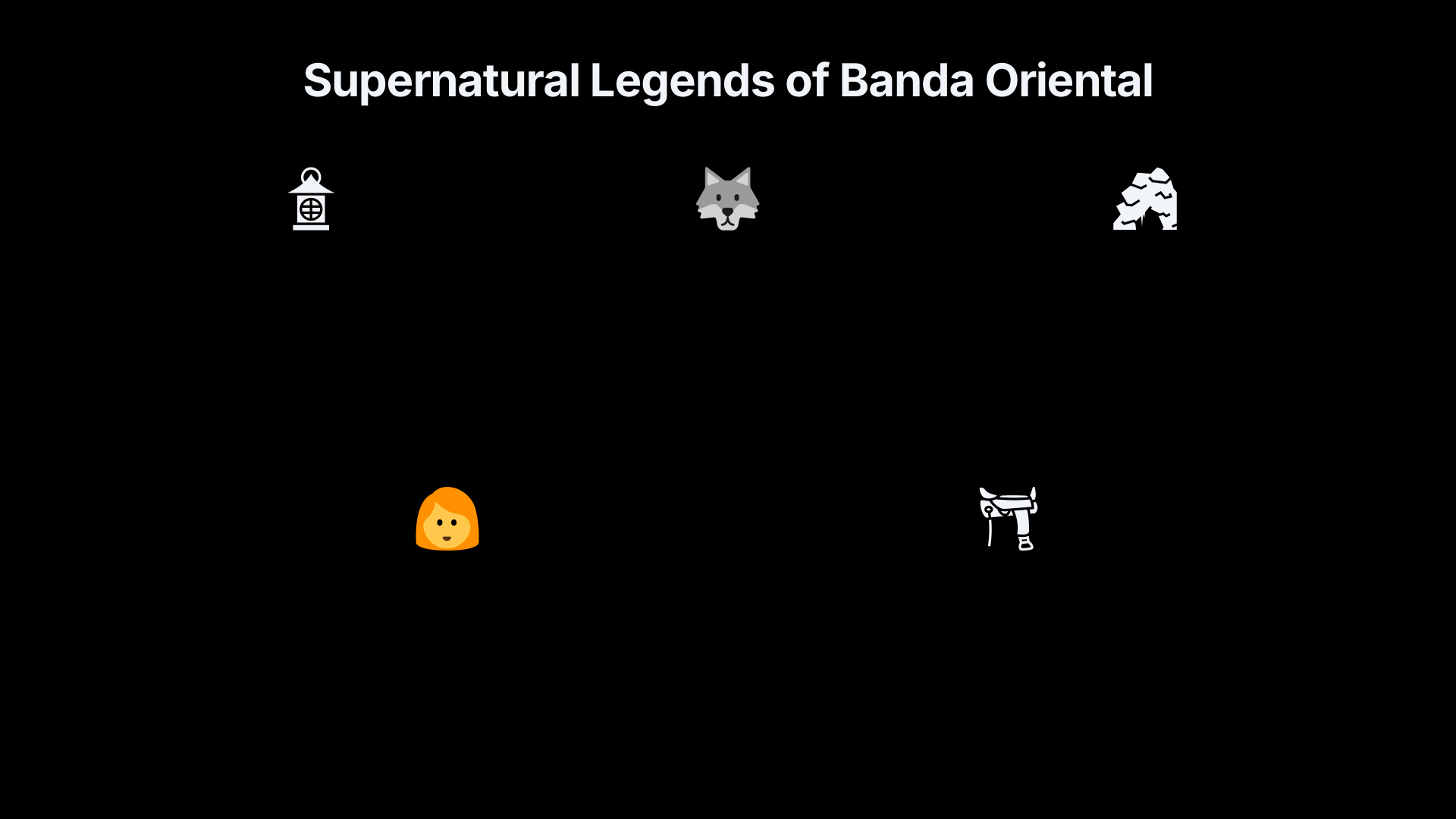
The most immediately recognisable supernatural Uruguay is rural. Its creatures and omens live on roads, in fields, near burial places, around isolated houses and in the stories of people who travel after dark. The catalogue record for Gonzalo Abella’s Mitos, leyendas y tradiciones de la Banda Oriental gives a useful map of this world: alongside Indigenous and Afro-Uruguayan material it lists gaucho beliefs and legends such as the white-clad woman, the Lobizón, La Luz Mala, the rider who never arrives, stones linked to Indigenous memory, dreams, cures and rural fables.[pmb.parlamento.gub.uy]pmb.parlamento.gub.uyMitos, leyendas y tradiciones de la Banda Oriental Catálogo en líneaMitos, leyendas y tradiciones de la Banda Oriental Catálogo en línea
La Luz Mala is the classic example. In Uruguay it is usually described as a strange light seen at night in the countryside, close to the ground or moving across open land. Educational material from Uruguay’s Plan Ceibal describes it as a popular name for nocturnal lights which legend interprets as wandering souls on earth. Wider Río de la Plata retellings connect it to souls in pain, improper burial, hidden treasure or danger to the witness, while modern explanations usually compare it with will-o’-the-wisp phenomena or other natural lights.[edu.uy]rea.ceibal.edu.uyOpen source on edu.uy.
The Lobizón belongs to another shared borderland pattern. It is commonly associated with the curse of the seventh son, who becomes a dog-like or wolf-like creature at night. The motif draws from Guaraní and Iberian werewolf traditions and circulates through Paraguay, Argentina, Uruguay and southern Brazil, changing shape as it moves. For Uruguay, its importance is less as a uniquely national monster than as a sign of how rural Catholic fear, family superstition, Indigenous mythic material and European werewolf lore blended across the Southern Cone.[Myth and Folklore]mythus.fandom.comMyth and Folklore Luison | Myth and Folklore WikiMyth and Folklore Luison | Myth and Folklore Wiki
Then there is La Salamanca: not just a cave, but a story about forbidden knowledge. In many Río de la Plata and northern Argentine versions, the Salamanca is a hidden place where witches, demons or the devil teach music, healing, animal language, dance, seduction or other extraordinary abilities in exchange for spiritual risk. Uruguayan bibliographic records explicitly include “The Legend of La Salamanca” within collections of Banda Oriental myth and tradition, showing that the motif has been absorbed into Uruguay’s own legendary repertoire even though its roots and strongest documentation extend across neighbouring regions.[pmb.parlamento.gub.uy]pmb.parlamento.gub.uyMitos, leyendas y tradiciones de la Banda Oriental Catálogo en líneaMitos, leyendas y tradiciones de la Banda Oriental Catálogo en línea
Gaucho folklore: the horseman as legend, singer and national image
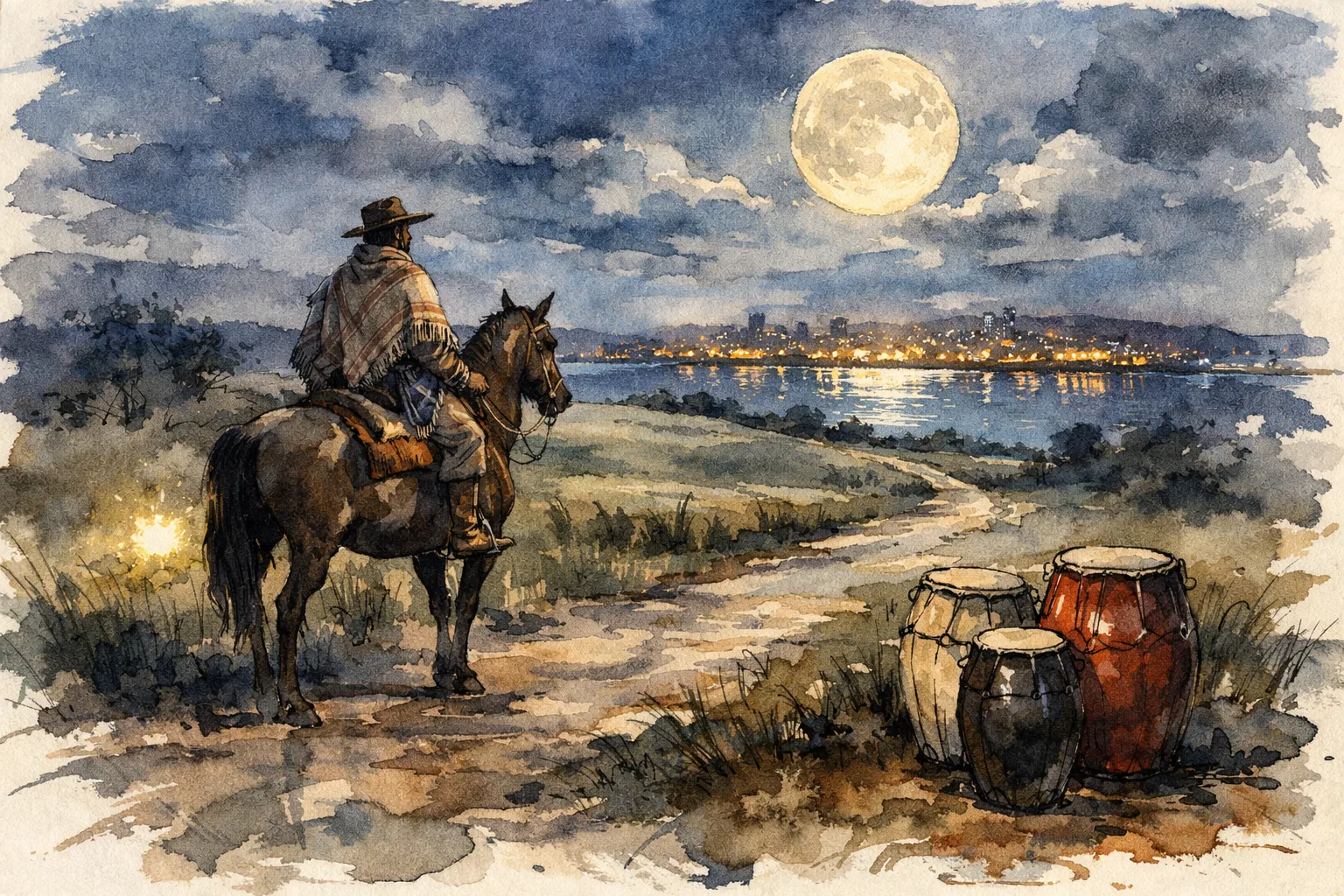
The gaucho is one of Uruguay’s central folk figures. Uruguay’s tourism ministry describes him as an important figure in national folklore, associated with freedom, individuality, courage, country skills, horsemanship, hospitality and independence. It also notes that the gaucho is more than a rural worker in music, literature and painting: he has become a symbolic figure in Uruguayan culture.[uruguaynatural.com]uruguaynatural.comThe Gaucho – Uruguay Natural – Ministerio de TurismoThe Gaucho – Uruguay Natural – Ministerio de Turismo
That symbolism matters because many Uruguayan legends are not “myths” in the ancient-gods sense. They are stories about a recognisable human world: the cattle frontier, the horse, the guitar, the campfire, the road, the inn, the duel, the boast, the promise and the fear of what waits beyond the lantern light. The supernatural often enters through ordinary rural skills. A brilliant singer may be suspected of having learnt in the Salamanca; a traveller may see La Luz Mala; a family may fear the destiny of a seventh son; a woman in white may appear where grief or betrayal has marked the landscape.[pmb.parlamento.gub.uy]pmb.parlamento.gub.uyMitos, leyendas y tradiciones de la Banda Oriental Catálogo en líneaMitos, leyendas y tradiciones de la Banda Oriental Catálogo en línea
The living performance side of this world survives in payada, the improvised sung verse tradition associated with gaucho culture. Uruguay’s tourism ministry lists the Vidalita, Milonga, Payada and Pericón among Uruguayan folklore expressions, typically accompanied by guitar, an instrument it calls inseparable from Creole song and gaucho expression. UNESCO’s living heritage material also identifies payada as Uruguayan and Mercosur intangible cultural heritage, describing it as improvised text accompanied by guitar, often in competitive exchange.[uruguaynatural.com]uruguaynatural.comTraditional Festivities – Uruguay Natural – Ministerio de TurismoTraditional Festivities – Uruguay Natural – Ministerio de Turismo
Rural festivals keep this imagery public. Uruguay Natural identifies the Fiesta de la Patria Gaucha in Tacuarembó, the Semana Criolla del Prado in Montevideo and other events as representative spaces for rural traditions. These events are not simply staged nostalgia: they turn horsemanship, music, craft, food, costume and regional memory into visible national culture, even as modern audiences debate safety, animal welfare and the difference between living tradition and tourist performance.[uruguaynatural.com]uruguaynatural.comOpen source on uruguaynatural.com.
Candombe: living folklore in drums, streets and memory
Candombe is one of Uruguay’s clearest examples of folklore as living practice rather than old story. UNESCO inscribed “Candombe and its socio-cultural space: a community practice” on the Representative List of the Intangible Cultural Heritage of Humanity in 2009. UNESCO describes it as transmitted within families of African descent and recognised both as an expression of resistance and as a Uruguayan musical celebration and collective social practice.[ICH UNESCO]ich.unesco.orgOpen source on unesco.org.
Its folklore lies not in a monster tale but in rhythm, neighbourhood, ancestry and performance. UNESCO’s archive notes that the beat of the largest drum, the piano, is distinctive to each of three neighbourhoods, so the organised call-and-response structure both unites districts and signals local identities. In everyday terms, candombe is a way of remembering through the body: drums, movement, procession and collective sound carry histories that were often marginalised in written national narratives.[UNESCO]unesco.orgdocument 364document 364
Recent reporting shows how alive and contested candombe remains. In 2026, The Guardian described a revival in which candombe groups have spread beyond historically Black Montevideo neighbourhoods across the country, while also reporting Afro-Uruguayan concerns about commercialisation, gentrification and the risk that the tradition may be treated as entertainment detached from its roots in resistance and communication under oppression.[The Guardian]theguardian.comFigures like Claudio Martínez and Diego Paredes are key to its revival, while celebrated singer Jorge Drexler has incorporated candombe i…
This tension is important for readers of folklore. Candombe is not a frozen “folk dance” preserved in a museum case. It is a public art of belonging, pride, disagreement and transmission. When it appears in carnival parades, weekly street gatherings or family teaching, it carries both celebration and the question of who gets to represent Afro-Uruguayan heritage.
Iemanjá and the sacred shore
Every 2 February, Uruguay’s beaches become the setting for one of the country’s most visible religious-folkloric events: offerings to Iemanjá, the sea-associated goddess honoured in Afro-Brazilian and Afro-Umbandist traditions. Montevideo’s Municipio B describes the annual homage at Playa Ramírez as a traditional celebration in which people bring offerings to the goddess, while the city’s own monument page records that the bronze monument to Yemanjá was inaugurated in 1994 through Afro-Umbandist initiative and stands near Playa Ramírez, where crowds gather each year.[municipiob.montevideo.gub.uy]municipiob.montevideo.gub.uyIemanjá | Municipio BIemanjá | Municipio B
For folklore, this is a powerful example of a tradition that is at once religious, public, aesthetic and civic. Flowers, candles, small boats, music, prayer and the shoreline turn the Río de la Plata into a ritual landscape. The Montevideo page connects the monument to the “mother universal of the waters” and explains that the 2020 restoration was linked to Afroumbandismo Verde, a collective promoting care for nature as part of the heritage of the orixás.[montevideo.gub.uy]montevideo.gub.uyMonumento a Yemanjá | Portal institucionalMonumento a Yemanjá | Portal institucional
The celebration also reveals Uruguay’s complexity as a famously secular country with strong public religion at the margins and on the shore. Reuters reported in 2024 that African-inspired religions were gaining more followers in South America and noted surveys in Uruguay and Argentina showing increased identification with Afro-descendant faiths such as Umbanda. The same report placed the 2 February Montevideo waterfront offerings in a wider discussion of African heritage, visibility and discrimination.[Reuters]reuters.comIn South America, African-inspired religions gain more followersAnnual rituals like the Feb. 2 offering to Yemanjá, the Yoruba goddess of fertility and prosperity, in Montevideo exemplify the visibilit…
Iemanjá’s Uruguayan folklore is therefore not just a pretty beach ritual. It is about water, motherhood, protection, desire, public devotion, Afro-Uruguayan recognition and the uneasy way a minority religion can be celebrated as culture while still facing prejudice as religion.
Indigenous memory and the problem of “lost” Charrúa tradition
Uruguay’s Indigenous folklore is difficult to write about responsibly because the country’s national story long treated Indigenous people, especially the Charrúa, as vanished. That “vanishing” is itself part of Uruguayan folklore and national myth-making. A 2020 scholarly article on myths about the Charrúa argues that much existing historical and anthropological belief about them is partly or wholly untrue, and specifically warns that the name “Charrúa” has often been used as a broad European label for different related groups.[hfrir.jvolsu.com]hfrir.jvolsu.comOpen source on jvolsu.com.
The violence behind that memory is real. The 1831 massacre of Salsipuedes, carried out in the early republic, became a central trauma in accounts of Charrúa destruction and erasure. Reporting in El País has described how the idea that Uruguay had no Indigenous people was sustained by the enslavement, dispersal and silencing of survivors and descendants, while recent Charrúa activists have worked to recover memory, identity and material traces such as the quillapí, a traditional cloak known today through scattered testimony and museum clues rather than surviving confirmed examples.[El País]elpais.comOpen source on elpais.com.
Genetic and social evidence has also complicated the old story of disappearance. A 2021 genomic study of Uruguayans with Charrúa heritage reported Indigenous ancestry segments, while earlier and contemporary public discussions have challenged the belief that Uruguay is populated only by descendants of European settlers.[PMC]pmc.ncbi.nlm.nih.govPMCIndigenous Ancestry and Admixture in the UruguayanPMCIndigenous Ancestry and Admixture in the Uruguayan
For folklore readers, the key point is caution. Many “Charrúa myths” circulating online are modern reconstructions, literary retellings or loose inventions rather than securely documented oral traditions. That does not make Charrúa memory unimportant. It makes it more important to distinguish between documented historical memory, living Indigenous identity work, literary imagination and internet-era pseudo-mythology. The most honest Uruguayan folklore page should not pretend to recover a complete ancient Charrúa mythology from thin evidence; it should show how absence, erasure and recovery have themselves become central to the country’s story culture.[hfrir.jvolsu.com]hfrir.jvolsu.comOpen source on jvolsu.com.

Tango, carnival and urban folklore
Uruguay’s folklore is not only rural or ancient. Montevideo’s urban traditions are central to the country’s identity. UNESCO’s tango archive describes tango as a tradition of Argentina and Uruguay developed by the urban lower classes of Buenos Aires and Montevideo, where European immigrants, descendants of enslaved Africans and criollo communities merged customs, beliefs and rituals into a distinctive Río de la Plata cultural identity.[UNESCO]unesco.orgthe Tango | Intangible Heritagethe Tango | Intangible Heritage
Tango matters here because folklore is not limited to supernatural stories. It includes expressive culture: dance halls, lyrics, social codes, gestures, neighbourhood identities, performance lineages and the emotional vocabulary through which people narrate love, loss, migration and city life. UNESCO notes that tango is practised in traditional dance halls in Buenos Aires and Montevideo and continues to adapt as it spreads to new environments.[UNESCO]unesco.orgthe Tango | Intangible Heritagethe Tango | Intangible Heritage
Carnival adds another major urban layer. Candombe’s llamadas, murga performance and carnival theatre turn satire, music, costume and communal memory into seasonal public folklore. This is the point at which Uruguay’s legendary culture becomes less about “once upon a time” and more about repetition: the annual return of drums, masks, parody, dance and neighbourhood rivalry. Candombe’s UNESCO status and its recent national revival show how carnival-linked traditions can move from marginalised practice to national emblem while still raising questions about ownership and representation.[ICH UNESCO]ich.unesco.orgOpen source on unesco.org.
What is old, what is collected, and what is modern?
A sensible guide to Uruguayan folklore needs to separate several layers that are often mixed together online.
Older oral and regional traditions include rural lights, cursed figures, ghostly riders, gaucho devil stories, improvised song and seasonal performance. These are well aligned with the topics found in Uruguayan legend collections and regional cultural memory, though individual versions vary by storyteller and place.[pmb.parlamento.gub.uy]pmb.parlamento.gub.uyMitos, leyendas y tradiciones de la Banda Oriental Catálogo en líneaMitos, leyendas y tradiciones de la Banda Oriental Catálogo en línea
Living heritage traditions include candombe, payada, tango, Iemanjá celebrations and rural festivals. These are not merely survivals from the past: they are practised now, taught, staged, debated and adapted. UNESCO and Uruguayan cultural institutions give some of them formal heritage recognition, but their authority also comes from communities who continue to perform them.[unesco.org]ich.unesco.orgOpen source on unesco.org.
Literary and antiquarian retellings shape how folklore is remembered. Printed collections such as Mitos, leyendas y tradiciones de la Banda Oriental gather Indigenous, Afro-Uruguayan and gaucho material into national form, but collection is never neutral: it selects, arranges and interprets oral culture for readers.[pmb.parlamento.gub.uy]pmb.parlamento.gub.uyMitos, leyendas y tradiciones de la Banda Oriental Catálogo en líneaMitos, leyendas y tradiciones de la Banda Oriental Catálogo en línea
Modern inventions and internet folklore are especially common around Indigenous themes and monsters. Some online “Charrúa myths” are imaginative contemporary tales with little clear documentation. They may be meaningful as modern storytelling, but they should not be presented as ancient, well-attested Indigenous tradition unless stronger evidence exists. The same caution applies to monster lists that simply import Argentine, Paraguayan or Brazilian beings into Uruguay without showing local circulation.[jvolsu.com]hfrir.jvolsu.comOpen source on jvolsu.com.
The places where Uruguayan folklore becomes visible
Uruguayan folklore is easiest to understand through places rather than abstract categories.
Montevideo’s Barrio Sur and Palermo are central to candombe’s historical identity, while streets, carnival routes and llamadas turn Afro-Uruguayan memory into sound and procession. UNESCO emphasises candombe’s social space as much as the music itself, because neighbourhood identity is part of the tradition.[UNESCO]unesco.orgdocument 364document 364
Playa Ramírez is the main public setting for Iemanjá in Montevideo. The city identifies the beach and nearby monument as annual focal points for offerings to the sea-associated mother figure, linking ritual, public space, Afro-Umbandist heritage and environmental care.[municipiob.montevideo.gub.uy]municipiob.montevideo.gub.uyIemanjá | Municipio BIemanjá | Municipio B
The rural interior is the imaginative home of La Luz Mala, the Lobizón, ghostly riders, Salamanca tales and gaucho supernatural memory. It is also where festivals and payada keep rural performance alive as public culture rather than private superstition.[uruguaynatural.com]uruguaynatural.comTraditional Festivities – Uruguay Natural – Ministerio de TurismoTraditional Festivities – Uruguay Natural – Ministerio de Turismo
Tacuarembó and Montevideo’s Prado show how gaucho identity is staged at scale. Uruguay Natural names the Fiesta de la Patria Gaucha and Semana Criolla del Prado among the country’s representative rural traditions, where riding, music, food, craft and costume become national display.[uruguaynatural.com]uruguaynatural.comOpen source on uruguaynatural.com.
Museums, catalogues and archives matter too. The Biblioteca del Poder Legislativo catalogue record for Abella’s legend collection shows how Uruguayan folklore has been organised into Indigenous, Afro-Uruguayan, Andean-influenced and gaucho sections, while current Charrúa memory work often depends on scattered museum traces, family memory and contested archival evidence.[pmb.parlamento.gub.uy]pmb.parlamento.gub.uyMitos, leyendas y tradiciones de la Banda Oriental Catálogo en líneaMitos, leyendas y tradiciones de la Banda Oriental Catálogo en línea
Why Uruguay’s folklore still matters
Uruguayan folklore matters because it complicates the country’s clean, secular, European-facing self-image. The legends and rituals point to a messier and more interesting Uruguay: Indigenous memory that was denied but not fully erased; Afro-Uruguayan traditions that moved from marginalisation to national symbolism; rural stories that turn loneliness, death and skill into supernatural narrative; and urban forms such as tango and candombe that grew from mixture rather than purity.[elpais.com]english.elpais.comOpen source on elpais.com.
It also matters because these traditions are not all equally old, equally documented or equally understood. La Luz Mala may be a long-lived rural legend with natural explanations layered beneath spiritual ones. Iemanjá is a living religious celebration with Afro-diasporic roots and modern environmental dimensions. Candombe is both heritage and contested public performance. Charrúa “mythology” is inseparable from erasure, recovery and the ethics of not inventing certainty where records are thin.[edu.uy]rea.ceibal.edu.uyOpen source on edu.uy.
The best way to approach folklore in Uruguay is therefore to listen for layers. A ghost light in a field, a drumline in Montevideo, a singer improvising with a guitar, a beach full of offerings, a disputed Indigenous memory and a carnival parade are not separate curiosities. Together they show how Uruguay tells stories about danger, ancestry, freedom, skill, belonging and survival.
Amazon book picks
Further Reading
Books and field guides related to What Haunts and Sustains Uruguay's Folklore?. Use these as the next step if you want deeper reading beyond the article.
The Book of Imaginary Beings
Explores legendary creatures and folklore motifs from Latin America and beyond, fitting a broad folklore overview.
Open Veins of Latin America
Provides historical context for cultural memory, identity and heritage across the region.
The Mythology of South America
Introduces Indigenous and regional mythic traditions that inform later folklore.
Mirror of the Americas: Stories from the Hispanic World
Provides folklore, myths and traditional narratives from across Hispanic America.
Endnotes
1.
Source: ich.unesco.org
Link:https://ich.unesco.org/en/RL/candombe-and-its-socio-cultural-space-a-community-practice-00182
2.
Source: unesco.org
Title: the Tango | Intangible Heritage
Link:https://www.unesco.org/archives/multimedia/document-319
3.
Source: uruguaynatural.com
Title: Traditional Festivities – Uruguay Natural – Ministerio de Turismo
Link:https://uruguaynatural.com/en/farmoretanacountry/fiestas-tradicionales-2/
4.
Source: pmb.parlamento.gub.uy
Title: Mitos, leyendas y tradiciones de la Banda Oriental Catálogo en línea
Link:https://pmb.parlamento.gub.uy/pmb/opac_css/index.php?id=34299&lvl=notice_display
5.
Source: municipiob.montevideo.gub.uy
Title: Iemanjá | Municipio B
Link:https://municipiob.montevideo.gub.uy/comunicacion/noticias/iemanja
6.
Source: montevideo.gub.uy
Title: Monumento a Yemanjá | Portal institucional
Link:https://montevideo.gub.uy/areas-tematicas/personas-y-ciudadania/mapeo-afrodescendencia-resiliente/monumento-a-yemanja
7.
Source: uruguaynatural.com
Title: The Gaucho – Uruguay Natural – Ministerio de Turismo
Link:https://uruguaynatural.com/en/farmoretanacountry/el-gaucho-2/
8.
Source: rea.ceibal.edu.uy
Link:https://rea.ceibal.edu.uy/elp/de-donde-viene-la-luz-mala/leyenda_de_la_luz_mala.html
9.
Source: ich.unesco.org
Link:https://ich.unesco.org/en/living-heritage-experience-and-covid-19-pandemic-01124?id=00041
10.
Source: uruguaynatural.com
Link:https://uruguaynatural.com/en/farmoretanacountry/fiestas-tradicionales/
11.
Source: unesco.org
Title: document 364
Link:https://www.unesco.org/archives/multimedia/document-364
12.
Source: reuters.com
Title: In South America, African-inspired religions gain more followers
Link:https://www.reuters.com/world/americas/south-america-african-inspired-religions-gain-more-followers-2024-02-03/
Source snippet
Annual rituals like the Feb. 2 offering to Yemanjá, the Yoruba goddess of fertility and prosperity, in Montevideo exemplify the visibilit...
13.
Source: hfrir.jvolsu.com
Link:https://hfrir.jvolsu.com/index.php/en/archive-en/704-science-journal-of-volsu-history-area-studies-international-relations-2020-vol-25-no-1/peoples-of-the-world-archaeology-anthropology-history/1947-nelin-t-v-myths-about-the-charrua-truth-and-fiction-in-the-history-of-the-indigenous-people-of-uruguay
14.
Source: pmc.ncbi.nlm.nih.gov
Title: PMCIndigenous Ancestry and Admixture in the Uruguayan
Link:https://pmc.ncbi.nlm.nih.gov/articles/PMC8495321/
15.
Source: folktalesamerica.com
Title: the charrua fire keeper a sacred guardian spirit tale from uruguay
Link:https://folktalesamerica.com/the-charrua-fire-keeper-a-sacred-guardian-spirit-tale-from-uruguay/
16.
Source: bibliotecadigital.bibna.gub.uy
Link:https://bibliotecadigital.bibna.gub.uy/jspui/bitstream/123456789/137303/1/grillo20.pdf
17.
Source: bibliotecadigital.bibna.gub.uy
Link:https://bibliotecadigital.bibna.gub.uy/jspui/bitstream/123456789/137331/1/Grillo15.pdf
18.
Source: bibliotecadigital.bibna.gub.uy
Title: Proteon18 19161209
Link:https://bibliotecadigital.bibna.gub.uy/jspui/bitstream/123456789/149760/1/Proteon18_19161209.pdf
19.
Source: bibliotecadigital.bibna.gub.uy
Title: MU N2384
Link:https://bibliotecadigital.bibna.gub.uy/jspui/bitstream/123456789/146577/1/MU_N2384.pdf
20.
Source: bibliotecadigital.bibna.gub.uy
Link:https://bibliotecadigital.bibna.gub.uy/jspui/bitstream/123456789/23328/1/La%20Pluma%20v3.pdf
21.
Source: bibna.gub.uy
Link:https://www.bibna.gub.uy/
22.
Source: opp.gub.uy
Title: Guía de fiestas uy 2015 web
Link:https://www.opp.gub.uy/sites/default/files/documentos/2019-05/Gu%C3%ADa%20de%20fiestas_uy_2015_web.pdf
23.
Source: ich.unesco.org
Link:https://ich.unesco.org/en/video/1176
24.
Source: ich.unesco.org
Link:https://ich.unesco.org/en/decisions/4.COM/13.74
25.
Source: ich.unesco.org
Title: uruguay UY
Link:https://ich.unesco.org/en/state/uruguay-UY
26.
Source: ich.unesco.org
Link:https://ich.unesco.org/en/projects/strengthening-national-capacities-for-effective-safeguarding-of-intangible-cultural-heritage-in-argentina-paraguay-and-uruguay-00283
27.
Source: ich.unesco.org
Link:https://ich.unesco.org/en/decisions/4.COM/13.01
28.
Source: ich.unesco.org
Title: photo pop up 00973
Link:https://ich.unesco.org/en/photo-pop-up-00973?photoID=14393
29.
Source: ich.unesco.org
Link:https://ich.unesco.org/en/RL?call=film&id=01812&include=film_inc.php&width=700
30.
Source: ich.unesco.org
Title: platform on living heritage experiences and covid 19 01123
Link:https://ich.unesco.org/en/platform-on-living-heritage-experiences-and-covid-19-01123
31.
Source: ich.unesco.org
Title: LHE 22 17.CO M INF.6.c Rev. EN
Link:https://ich.unesco.org/doc/src/LHE-22-17.COM-INF.6.c_Rev.-EN.pdf
32.
Source: ich.unesco.org
Title: Living Heritage in the face of COVID 19 High Resolution
Link:https://ich.unesco.org/doc/src/Living_Heritage_in_the_face_of_COVID-19_-_High_Resolution.pdf
33.
Source: ich.unesco.org
Title: Informe periódico firmado Informe periódico 50589
Link:https://ich.unesco.org/doc/src/Informe%20peri%C3%B3dico%20firmado%20-%20Informe%20peri%C3%B3dico-50589.pdf
34.
Source: ich.unesco.org
Link:https://ich.unesco.org/doc/src/Le_patrimoine_vivant_face_%C3%A0_la_COVID-19-HighRes.pdf?v=1623410372
35.
Source: ich.unesco.org
Title: LHE 22 17.CO M INF.6.c FR.docx
Link:https://ich.unesco.org/doc/src/LHE-22-17.COM-INF.6.c-FR.docx
36.
Source: ich.unesco.org
Title: LHE 22 17.CO M INF.6.c Rev. ES
Link:https://ich.unesco.org/doc/src/LHE-22-17.COM-INF.6.c_Rev.-ES.pdf
37.
Source: museos.gub.uy
Title: 47 94abe0eca9a1918d423dd5445cc02c7e
Link:https://www.museos.gub.uy/index.php/noticias/item/download/47_94abe0eca9a1918d423dd5445cc02c7e
38.
Source: montevideo.gub.uy
Title: agendaculturaldemontevideo2023espanol 1
Link:https://montevideo.gub.uy/sites/default/files/biblioteca/agendaculturaldemontevideo2023espanol_1.pdf
39.
Source: montevideo.gub.uy
Title: acciones por la fiesta de iemanja
Link:https://montevideo.gub.uy/noticias/institucional/acciones-por-la-fiesta-de-iemanja
40.
Source: montevideo.gub.uy
Title: cobertura de guardavidas en playas durante la celebracion de iemanja
Link:https://montevideo.gub.uy/noticias/cobertura-de-guardavidas-en-playas-durante-la-celebracion-de-iemanja
41.
Source: montevideo.gub.uy
Title: acciones por celebracion iemanja
Link:https://montevideo.gub.uy/noticias/medio-ambiente-y-sostenibilidad/acciones-por-celebracion-iemanja
42.
Source: montevideo.gub.uy
Title: se recolectaron 8800 kilos de residuos tras la celebracion por iemanja
Link:https://montevideo.gub.uy/noticias/medio-ambiente-y-sostenibilidad/se-recolectaron-8800-kilos-de-residuos-tras-la-celebracion-por-iemanja
43.
Source: montevideo.gub.uy
Title: operativo de limpieza tras celebracion por iemanja
Link:https://montevideo.gub.uy/noticias/operativo-de-limpieza-tras-celebracion-por-iemanja
44.
Source: montevideo.gub.uy
Title: playa ramirez
Link:https://montevideo.gub.uy/area-tematica/ambiente/cuerpos-de-agua-playas-y-humedales/playas/playa-ramirez
45.
Source: montevideo.gub.uy
Title: fiestas tradicionales de montevideo
Link:https://montevideo.gub.uy/tipo/area-tematica/turismo-y-tiempo-libre/fiestas-tradicionales-de-montevideo
46.
Source: montevideo.gub.uy
Title: operativo de limpieza por iemanja
Link:https://montevideo.gub.uy/noticias/operativo-de-limpieza-por-iemanja
47.
Source: montevideo.gub.uy
Link:https://montevideo.gub.uy/sites/default/files/biblioteca/abc40.pdf
48.
Source: cdf.montevideo.gub.uy
Link:https://cdf.montevideo.gub.uy/buscar/fotos/Ramirez?page=3
49.
Source: folklore.earth
Link:https://www.folklore.earth/culture/charr%C3%BAa/
50.
Source: archive.org
Link:https://archive.org/details/historiasmagicas0000gand
51.
Source: icau.mec.gub.uy
Title: mec.gub.uy Fiestas populares
Link:https://icau.mec.gub.uy/innovaportal/v/65085/3/mecweb/fiestas-populares
52.
Source: juntamvd.gub.uy
Link:https://juntamvd.gub.uy/viejo/data/actas/1575/ev23082019.pdf
53.
Source: gub.uy
Title: gobierno apoya fiestas populares masivas disena segunda edicion guia
Link:https://www.gub.uy/presidencia/comunicacion/noticias/gobierno-apoya-fiestas-populares-masivas-disena-segunda-edicion-guia
54.
Source: gub.uy
Title: libro saberes compartidos
Link:https://www.gub.uy/ministerio-educacion-cultura/sites/ministerio-educacion-cultura/files/documentos/publicaciones/libro_saberes_compartidos.pdf
55.
Source: mna.gub.uy
Link:https://www.mna.gub.uy/innovaportal/file/10904/1/d-_informe_religion.pdf
56.
Source: pmb.parlamento.gub.uy
Link:https://pmb.parlamento.gub.uy/pmb/opac_css/index.php?id=13758&l_typdoc=&lvl=categ_see&nb_per_page_custom=25&nbr_lignes=27&page=1
57.
Source: flex.flinders.edu.au
Title: John Clancy El Buen Salvaje Canta Library Copy
Link:https://flex.flinders.edu.au/file/94c4f98c-2cf2-49b7-b770-6800e10fc8bf/1/John%20Clancy_El%20Buen%20Salvaje%20Canta_%20Library%20Copy.pdf
58.
Source: universidad.claeh.edu.uy
Link:https://universidad.claeh.edu.uy/blog/leyendas-y-mitos-populares-nuestra-historia-ignorada-encuentro-con-nestor-ganduglia/
59.
Source: biblioteca.seminario.edu.uy
Link:https://biblioteca.seminario.edu.uy/index.php?lvl=more_results&mode=keyword&tags=ok&user_query=LEYENDAS+URUGUAYAS
60.
Source: english.elpais.com
Link:https://english.elpais.com/elpais/2017/11/06/inenglish/1509969553_044435.html
61.
Source: journeylatinamerica.com
Link:https://www.journeylatinamerica.com/travel-inspiration/culture-music-sport-and-festivals/halloween-inspired-latin-americas-spookiest-myths/
62.
Source: mythus.fandom.com
Title: Myth and Folklore Luison | Myth and Folklore Wiki
Link:https://mythus.fandom.com/wiki/Luison
63.
Source: theguardian.com
Link:https://www.theguardian.com/world/2026/mar/10/uruguay-candombe-afro-music
Source snippet
Figures like Claudio Martínez and Diego Paredes are key to its revival, while celebrated singer Jorge Drexler has incorporated candombe i...
64.
Source: elpais.com
Link:https://elpais.com/america-futura/2026-07-04/monica-michelena-y-la-busqueda-del-quillapi-de-la-memoria.html
65.
Source: Wikipedia
Link:https://en.wikipedia.org/wiki/Candombe
66.
Source: Wikipedia
Link:https://en.wikipedia.org/wiki/Luison
67.
Source: Wikipedia
Link:https://en.wikipedia.org/wiki/Payada
68.
Source: Wikipedia
Title: Massacre of Salsipuedes
Link:https://en.wikipedia.org/wiki/Massacre_of_Salsipuedes
69.
Source: facebook.com
Link:https://www.facebook.com/groups/1447268078825074/posts/2778928452325690/
70.
Source: facebook.com
Link:https://www.facebook.com/groups/1083183848377976/posts/25210931325176558/
71.
Source: guides.lib.uw.edu
Link:https://guides.lib.uw.edu/research/folklore
72.
Source: youtube.com
Link:https://www.youtube.com/watch?v=ubSun5K4S68
73.
Source: bn.gov.ar
Link:https://www.bn.gov.ar/micrositios/admin_assets/issues/files/54f81c4025bc28d9762027c4b704cdb7.pdf
74.
Source: theguardian.com
Title: tango uruguay argentina unesco
Link:https://www.theguardian.com/stage/2009/sep/30/tango-uruguay-argentina-unesco
75.
Source: theguardian.com
Title: Criolla week in Uruguay
Link:https://www.theguardian.com/world/gallery/2016/mar/24/criolla-week-in-uruguay-in-pictures
76.
Source: santiagociudad.gov.ar
Link:https://www.santiagociudad.gov.ar/cultura/salamanca
77.
Source: thingstodoinuruguay.com
Link:https://thingstodoinuruguay.com/events/
78.
Source: wanderlustmagazine.com
Title: unesco intangible cultural heritage
Link:https://www.wanderlustmagazine.com/news/unesco-intangible-cultural-heritage/
Additional References
79.
Source: youtube.com
Title: Creatures and Monsters of Central and South American Folklore
Link:https://www.youtube.com/watch?v=H5CrJSd-eeU
Source snippet
Candombe: The Afro-Uruguayan Rhythm That Shaped a Nation...
80.
Source: youtube.com
Title: Candombe: The Afro-Uruguayan Rhythm That Shaped a Nation
Link:https://www.youtube.com/watch?v=98UZ4_cTPkc
Source snippet
Uruguay's Carnival moves to candombe beat...
81.
Source: youtube.com
Title: Uruguay’s Carnival moves to candombe beat
Link:https://www.youtube.com/watch?v=LqBwkoMua60
Source snippet
The Candombe and its socio-cultural space: a community practice...
82.
Source: youtube.com
Title: The Bad Light
Link:https://www.youtube.com/watch?v=GMxDgopRTko
Source snippet
Creatures and Monsters of Central and South American Folklore...
83.
Source: researchgate.net
Link:https://www.researchgate.net/publication/339560548_Myths_About_the_Charrua_Truth_and_Fiction_in_the_History_of_the_Indigenous_People_of_Uruguay
84.
Source: academia.edu
Link:https://www.academia.edu/49192037/Representation_of_Charr%C3%BAa_Speech_in_19th_Century_Uruguayan_Literature
85.
Source: gettyimages.com.mx
Link:https://www.gettyimages.com.mx/fotos/uruguay-iemanja-celebration
86.
Source: facebook.com
Link:https://www.facebook.com/100068845255019/posts/a-continuaci%C3%B3n-publicamos-la-quinta-entrega-de-varias-historias-cortas-que-estam/2985372455057668/
87.
Source: hemisphericinstitute.org
Link:https://hemisphericinstitute.org/en/hidvl-collections/item/3692-ascendencia-charrua.html
88.
Source: echoesandfootprints.com
Link:https://www.echoesandfootprints.com/candombe-unesco/
Topic Tree
Follow this branch
Related pages 192
- Afghan Folklore
- Albanian Folklore
- Algerian Folklore
- Australian Folklore
- Azerbaijan Folklore
- +187 more in sidebar