Where Niger's Stories Meet Spirits and Sand
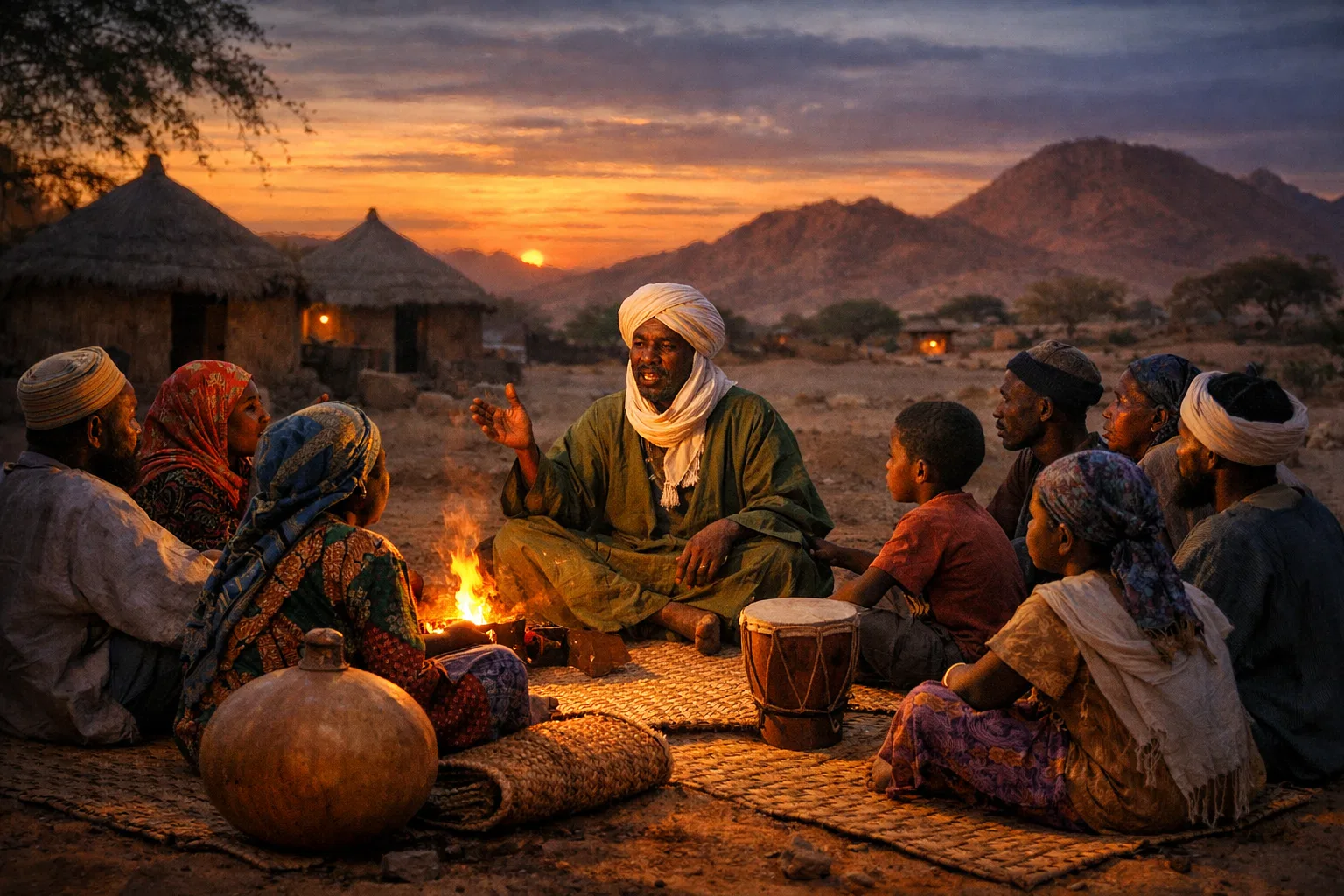
Niger’s folklore is best understood as a living Sahelian story-world rather than a single national mythology. Its traditions grow from Hausa, Zarma-Songhay, Tuareg, Fulani, Kanuri and other communities, and they move across borders with trade, migration, herding, Islam, radio, music and family storytelling.
Page outline Jump by section
Introduction
The most distinctive Niger-focused material includes Hausa folktales recorded from national radio broadcasts, Zarma folktales preserved in English translation, the bori spirit-possession complex in southern Niger, Songhay-Zarma possession traditions such as the Hauka, Tuareg oral legend and poetry around the Sahara and Aïr, and Wodaabe Fulani performance traditions such as Gerewol. These are not museum pieces. They remain tied to questions ordinary people still ask: who has power, why illness strikes, how communities remember the past, what counts as proper conduct, and how older practices survive in a modern Muslim republic.[google.com]books.google.comOpen source on google.com.
Why Niger’s folklore is regional, multilingual and hard to reduce
A reader looking for “the folklore of Niger” quickly runs into a useful complication: Niger’s cultural map does not match a single language or ethnicity. Hausa is especially prominent in the south and centre; Zarma-Songhay traditions are strongly associated with the Niger River valley and the west; Tuareg traditions are central in the Saharan north; Fulani and Wodaabe pastoral traditions cross the Sahel; Kanuri traditions connect Niger’s east with the Lake Chad world. Modern state borders cut across older cultural regions, so many traditions are shared with Nigeria, Mali, Algeria, Burkina Faso, Benin and Chad.[OpenFactBook]openfactbook.orgOpen Fact Book NigerOpen Fact Book Niger
That matters because Nigerien folklore is often misfiled under neighbouring countries. Hausa tales from Niger may be confused with Nigerian Hausa material; Zarma and Songhay traditions overlap with Mali’s Niger Bend; Tuareg oral culture is spread across the Sahara; Fulani and Wodaabe festivals are not confined to one state. The safest way to read Nigerien folklore is therefore to ask where a tradition was collected, performed or locally interpreted, rather than assuming every Hausa, Tuareg or Fulani story is automatically “Nigerien” in a narrow national sense.[google.com]books.google.comOpen source on google.com.
The country’s religious setting also shapes how folklore is spoken about. Niger is overwhelmingly Muslim, but many accounts of Nigerien culture note that local cosmologies and older ritual systems have continued to coexist with Islamic belief, sometimes in tension and sometimes through accommodation. This is why a spirit may be discussed as an older bush being in one context, as a jinn-like presence in another, and as an un-Islamic remnant in a reformist critique.[openfactbook.org]openfactbook.orgOpen Fact Book NigerOpen Fact Book Niger
Tales told for pleasure, warning and memory
One of the best-documented entry points into Niger’s folklore is the collected folktale. Robert S. Glew’s Hausa Folktales from Niger is especially valuable because the forty tales were not simply gathered as antiquarian curiosities: they were originally broadcast on Niger’s national radio station, La Voix du Sahel, in 1988 and 1989, and told by experienced storytellers. The collection’s description makes clear that some tales are animal stories explaining why creatures behave as they do, while others concern human society and expected conduct.[Google Books]books.google.comOpen source on google.com.
That radio origin is important. It shows folklore moving through a modern national medium, not only through village firesides or family compounds. The state broadcaster helped turn local oral performance into material that could circulate across regions, languages and generations. For a folklore reader, this is a reminder that “traditional” does not mean untouched by technology: in Niger, oral tales have been retold through radio, translation, books and later digital discovery.[Google Books]books.google.comOpen source on google.com.
Zarma material is also unusually visible for English-language readers through Zarma Folktales of Niger. The publisher’s summary stresses that Zarma folklore had been scarcely represented in Western texts and that the collection aimed to preserve oral material while providing cultural and historical context. This is not the same as claiming the tales are unchanged relics of the distant past. Rather, they are documented examples of a living oral tradition translated for outsiders, with all the gains and losses that translation brings.[Google Books]books.google.comOpen source on google.com.
Across both Hausa and Zarma examples, the key point is that Nigerien folktales often do several jobs at once. They entertain, teach social intelligence, encode expectations about generosity or cunning, explain features of the animal world, and preserve local ways of speaking about danger, kinship and authority. Their “mythic” quality is often modest rather than cosmic: the stories may not explain the creation of the universe, but they do explain how to live among people, animals, elders, rivals and invisible powers.
Bori: spirits, healing and contested tradition
The bori complex is one of the most important supernatural traditions associated with Hausa-speaking Niger. It is usually described as a spirit-possession institution involving music, dance, trance, healing, diagnosis and negotiation with spirits. Scholars caution that it is not best understood as a tidy mythology written down in a fixed canon. One study of Hausa bori argues that myth emerges through ceremony itself: songs, praise-names, musicians, bodily performance and the changing presence of spirits create a flexible ritual world rather than a single standard story.[ResearchGate]researchgate.netResearch Gate Exploring bori as a site of myth in Hausa cultureResearch Gate Exploring bori as a site of myth in Hausa culture
In Niger, anthropologist Adeline Masquelier’s work on Dogondoutchi and the wider Ader/Arewa region is central. Her book Prayer Has Spoiled Everything examines bori possession in an Islamic town of Niger, focusing on how spirit mediums interpret history, power and identity amid Muslim reform, economic hardship and social change. The title itself points to a local sense that prayer, reform and Islamic criticism had altered the place of older spirit practices.[Duke University Press]dukeupress.eduOpen source on dukeupress.edu.
Bori spirits are not simply “monsters” in the way a modern horror reader might expect. They can be dangerous, demanding, comic, prestigious, healing or socially revealing. In some accounts, spirits are linked to the bush and to older settlement histories; in others, they appear through illness, misfortune, trance and performance. Possession can be a crisis, but it can also become a relationship in which a person learns to live with a spirit’s demands through ritual practice.[dokumen.pub]dokumen.pubOpen source on dokumen.pub.
The tradition is also deeply contested. Masquelier’s later work on Dogondoutchi discusses how the spread of Islam transformed local imaginings of witchcraft, blood-sucking spirits and evil, while another source on Islamic revival in Niger notes that bori, once a central form of health-seeking and public entertainment, became widely condemned by reform-minded Muslims as corrupt or dangerous. This does not mean bori simply disappeared. It means its public meaning changed: what had once been a way to handle illness, social memory and invisible forces became, for many, a sign of improper religion.[OpenEdition Journals]journals.openedition.orgOpen source on openedition.org.
Songhay-Zarma possession and the strange power of the Hauka
Niger’s Songhay-Zarma world has produced one of the most discussed possession traditions in Africanist scholarship: the Hauka. These spirits are famous because they mimicked colonial authority — governors, soldiers, clerks, doctors, drivers and other figures of foreign power. Paul Stoller’s work describes the Hauka as Songhay spirits that imitate Nigerien colonial culture, using possession to make colonial power bodily, performable and negotiable.[Africabib]africabib.orgOpen source on africabib.org.
The Hauka became internationally known through Jean Rouch’s 1955 film Les Maîtres fous, which recorded a Hauka possession ceremony among Songhay-Zarma migrants in Accra, then in the Gold Coast. Because the film was shot outside Niger, it should not be treated as a simple documentary of “Nigerian national folklore” in place. Yet the tradition’s roots and participants connect strongly to the Niger River basin and Songhay-Zarma migrant experience, making it highly relevant to Niger’s folklore and modern cultural memory.[Research Explorer]research.manchester.ac.ukspirit possession power and the absent presence of islam re viewispirit possession power and the absent presence of islam re viewi
What makes the Hauka so striking is that they show folklore responding to modern history. These are not ancient spirits frozen before colonialism. They are spirits of encounter, imitation and power. Later scholarship on Rouch’s film argues that the ritual both endorses and questions colonial order: mediums may take on the roles of colonial officials, but possession scrambles hierarchy by letting Africans embody figures who normally stood above them.[OpenEdition Journals]journals.openedition.orgOpen source on openedition.org.
For a folklore page, the Hauka are a useful warning against a common mistake. “Folklore” is not only old village tales about animals and ancestors. It can also be a dramatic, improvised, embodied way of digesting new political realities. In Nigerien and Niger-linked traditions, colonialism did not simply replace the supernatural imagination; it entered it.

Tuareg oral tradition: desert, poetry and remembered origins
In northern Niger, Tuareg oral tradition gives folklore a very different texture. Here, stories are closely tied to desert mobility, genealogy, poetry, music, proverbs, honour and remembered origins. Tuareg literary culture has long depended heavily on oral transmission, including poetry, proverbs, folktales, legends and riddles; women are noted as composers of poems for major social occasions such as weddings, births and seasonal change.[Carnegie Endowment]carnegieendowment.orgthe tuareg literature language and culturethe tuareg literature language and culture
Susan Rasmussen’s work on Tuareg concepts of truth and children’s tales is especially helpful because it shows that Tuareg narrators distinguish between kinds of speech. Some oral historical legends are treated as material from long ago and as transmitters of history, while other narratives may be framed more as children’s tales, performance or less authoritative knowledge. That distinction matters: not every striking desert story has the same truth-status for its tellers.[Oral Tradition]journal.oraltradition.orgOral Tradition Tuareg Concepts of Truth, “Lies,” and “Children's Tales”Oral Tradition Tuareg Concepts of Truth, “Lies,” and “Children's Tales”
Agadez is the clearest built landscape where Tuareg history, trade and cultural memory meet. UNESCO describes the Historic Centre of Agadez as a former caravan centre marked by ancestral cultural, commercial and handicraft traditions still practised today, with earthen architecture including a 27-metre mud-brick minaret. Although UNESCO’s listing is architectural and historical rather than a catalogue of legends, the city’s value for folklore lies in its role as a setting for Tuareg authority, craft, memory and oral tradition.[UNESCO World Heritage Centre]whc.unesco.orgOpen source on unesco.org.
The wider Aïr and Ténéré landscape also matters, though it should not be romanticised as empty mystical scenery. UNESCO describes the Aïr and Ténéré Natural Reserves as one of Africa’s largest protected areas, including mountain massifs and desert plains, and a rare refuge for Saharo-Sahelian wildlife. Recent UNESCO material on Tuareg pastoralists in this region emphasises mobility, ancestral knowledge, sacred music, art and a living relationship with the visible and invisible worlds.[UNESCO World Heritage Centre]whc.unesco.orgOpen source on unesco.org.
Wodaabe Gerewol and performance as living tradition
Among Niger’s Fulani-related Wodaabe communities, Gerewol is one of the best-known public traditions. It is often described as a courtship festival in which young men dress, paint their faces, sing and dance in lines before women who may choose partners. Travel writing sometimes reduces it to spectacle, but within the folklore frame it is better understood as performance culture: beauty, endurance, singing, social display and pastoral identity are all made visible at once.[CultureRoad Travel]cultureroadtravel.comguerewol festivalguerewol festival
Gerewol is not primarily a monster legend or spirit myth, yet it belongs on a Niger folklore page because folklore includes seasonal customs, performed tradition, courtship ritual, song and embodied social memory. Its public fame has also made it one of the ways outsiders imagine Nigerien culture, especially because the visual drama of painted faces and synchronised dancing photographs easily. That popularity brings a risk: the festival can be flattened into exotic imagery unless readers remember that it belongs to living communities with their own pastoral histories and social rules.[Eye for the Light]eye.tpoty.comEye for the Light The WodaabeEye for the Light The Wodaabe
Sacred places, haunted landscapes and the limits of evidence
Niger has many landscapes that invite legendary reading: the Niger River valley, the bush around old settlements, the Aïr Mountains, desert oases, caravan routes, Agadez and the Ténéré. The strongest public evidence, however, is often for cultural and historical significance rather than for neatly documented “haunted places” in the tourist-guide sense. UNESCO can verify Agadez as a living historic centre and Aïr-Ténéré as a major protected desert reserve, but that does not automatically prove every modern ghost story attached to those places.[UNESCO World Heritage Centre]whc.unesco.orgOpen source on unesco.org.
The supernatural geography is clearest in ethnographic work on spirit traditions. In bori-related accounts, spirits may be linked to bush spaces, settlement histories, illness and moral disorder. In Tuareg accounts, desert places carry memory, trial, danger and ancestral knowledge. In Songhay-Zarma possession, landscapes of migration and labour — from Niger to coastal cities — can become part of the ritual imagination. These are better-evidenced patterns than isolated internet tales about “haunted Niger”.[pageplace.de]api.pageplace.deOpen source on pageplace.de.
How Nigerien folklore changed in the modern era
The biggest modern change is not that folklore vanished. It moved. Oral tales moved onto radio and into books; possession traditions moved through debate with reformist Islam, colonial rule, migration and public criticism; Tuareg music and poetry entered recordings and global circulation; Wodaabe performance became a subject of travel photography and cultural tourism.[google.com]books.google.comOpen source on google.com.
Modern Nigerien music also shows how older oral textures can appear in new forms. International reviews of Tal National, for example, describe the band as drawing on Hausa, Zarma and other Nigerien traditions while representing the country’s ethnic diversity through contemporary popular music. This is not folklore in the narrow sense of a folktale, but it shows how oral performance, regional identity and traditional motifs continue to be reworked for modern audiences.[Pitchfork]pitchfork.comZoy ZoyZoy Zoy
Digital language work may also affect how Niger’s folklore survives. Recent research on Zarma language resources describes Zarma as a Songhay dialect spoken by millions across Niger and neighbouring countries and introduces a French-Zarma corpus and glossary to support translation technology. Such projects are not folklore archives in themselves, but they matter because the future of folktales, songs and local memory depends partly on whether major Nigerien languages remain usable in education, media and digital tools.[arXiv]arxiv.orgarXiv Feriji: A French-Zarma Parallel Corpus, Glossary & TranslatorarXiv Feriji: A French-Zarma Parallel Corpus, Glossary & Translator
What readers should be careful not to misunderstand
The first mistake is to confuse Niger with Nigeria. Hausa traditions cross both countries, but a Hausa tale collected from Nigerien radio is not the same evidence as a tale from Kano or Sokoto. The second mistake is to treat every tradition as either “purely pre-Islamic” or “purely Islamic”. Niger’s folklore often lives in the difficult middle: older spirit worlds persist, but they are interpreted through Muslim language, reformist critique and everyday religious practice.[google.com]books.google.comOpen source on google.com.
The third mistake is to expect a single national mythology with named gods, monsters and a fixed creation story. Niger’s best-attested folklore is plural and performative. It appears in Hausa animal tales, Zarma storytelling, bori healing ceremonies, Songhay-Zarma possession, Tuareg oral legend, Fulani-Wodaabe performance and the remembered authority of places such as Agadez and the Aïr.[google.com]books.google.comOpen source on google.com.
The fourth mistake is to treat sparse evidence as permission for fantasy. Niger certainly has supernatural traditions, but many widely shareable English-language claims about “Nigerien monsters” are thinly sourced or imported from broader West African folklore. The more reliable path is to follow documented storytellers, ethnographers, language communities, ritual specialists, archives, museums, radio histories and UNESCO cultural landscapes — and to keep local names attached to local evidence.
The enduring shape of Niger’s folklore
Niger’s folklore matters because it shows how people in the Sahel make meaning under pressure: drought, migration, trade, colonial intrusion, religious reform, poverty, urbanisation and changing media all leave marks on story and ritual. A folktale can teach a child how cleverness works; a possession ceremony can make illness socially legible; a Tuareg poem can keep memory alive across desert distance; a Wodaabe dance can turn beauty and endurance into public social drama; a city such as Agadez can hold trade, architecture, authority and oral memory in one place.[google.com]books.google.comOpen source on google.com.
The result is a folklore landscape that is less about a single famous monster and more about relationships: between humans and spirits, elders and children, Islam and older ritual systems, desert and town, migrants and power, performance and memory. That is what gives Nigerien folklore its particular force. It is not merely a set of old stories from a remote country; it is a living cultural language for negotiating change while remembering where people come from.
Amazon book picks
Further Reading
Books and field guides related to Where Niger's Stories Meet Spirits and Sand. Use these as the next step if you want deeper reading beyond the article.
Sundiata: An Epic of Old Mali
Introduces West African oral narrative traditions shared across the region.
eBay marketplace picks
Marketplace Samples
Live-tested eBay searches with available results related to this page.

Endnotes
1.
Source: openfactbook.org
Title: Open Fact Book Niger
Link:https://openfactbook.org/countries/niger/
2.
Source: books.google.com
Link:https://books.google.com/books/about/Hausa_Folktales_from_Niger.html?id=zUtxAAAAMAAJ
3.
Source: books.google.com
Link:https://books.google.com/books/about/Zarma_Folktales_of_Niger.html?id=MF1v0wv7ncYC
4.
Source: africabib.org
Link:https://www.africabib.org/rec.php?RID=124976263
5.
Source: journals.openedition.org
Link:https://journals.openedition.org/etudesafricaines/10302?lang=en
6.
Source: arxiv.org
Title: arXiv Feriji: A French-Zarma Parallel Corpus, Glossary & Translator
Link:https://arxiv.org/abs/2406.05888
7.
Source: researchgate.net
Title: Research Gate Exploring bori as a site of myth in Hausa culture
Link:https://www.researchgate.net/publication/232938367_Exploring_bori_as_a_site_of_myth_in_Hausa_culture
8.
Source: api.pageplace.de
Link:https://api.pageplace.de/preview/DT0400.9780822380559_A35715009/preview-9780822380559_A35715009.pdf
9.
Source: dokumen.pub
Link:https://dokumen.pub/download/prayer-has-spoiled-everything-possession-power-and-identity-in-an-islamic-town-of-niger-0822326337-9780822326335.html
10.
Source: journals.openedition.org
Link:https://journals.openedition.org/africanistes/5553?lang=en
11.
Source: journals.openedition.org
Link:https://journals.openedition.org/africanistes/5553
12.
Source: whc.unesco.org
Link:https://whc.unesco.org/en/list/1268/
13.
Source: whc.unesco.org
Link:https://whc.unesco.org/en/list/573/
14.
Source: unesco.org
Link:https://www.unesco.org/en/articles/tuareg-nomadic-pastoralists-living-harmony-desert-air-and-tenere-natural-reserves
15.
Source: pitchfork.com
Title: Zoy Zoy
Link:https://pitchfork.com/reviews/albums/20392-zoy-zoy
16.
Source: journals.openedition.org
Link:https://journals.openedition.org/afriques/1174
17.
Source: journals.openedition.org
Link:https://journals.openedition.org/africanistes/2107
18.
Source: journals.openedition.org
Link:https://journals.openedition.org/etudesafricaines/12674
19.
Source: journals.openedition.org
Link:https://journals.openedition.org/etudesafricaines/6198?lang=en
20.
Source: journals.openedition.org
Link:https://journals.openedition.org/civilisations/pdf/1558
21.
Source: journals.openedition.org
Link:https://journals.openedition.org/etudesafricaines/pdf/10302
22.
Source: researchgate.net
Link:https://www.researchgate.net/profile/Anastacia-Motsei/publication/368396230_The_Palgrave_Handbook_of_African_Oral_Traditions_and_Folklore_ebook/links/63e63c016425237563a23126/The-Palgrave-Handbook-of-African-Oral-Traditions-and-Folklore-ebook.pdf
23.
Source: researchgate.net
Link:https://www.researchgate.net/publication/227786666_Spirit_Possession_Power_and_the_Absent_Presence_of_Islam_Re-viewing_Les_Maitres_Fous
24.
Source: researchgate.net
Link:https://www.researchgate.net/publication/269968301_Plucked_Lutes_in_West_Africa_An_Historical_Overview
25.
Source: researchgate.net
Link:https://www.researchgate.net/publication/379186796_Sedimentation_Fragmentation_and_Normative_Double-Binds_in_West_African_Public_Services
26.
Source: researchgate.net
Link:https://www.researchgate.net/publication/229489314_From_Hostage_to_Host_Confessions_of_a_Spirit_Medium_in_Niger
27.
Source: researchgate.net
Link:https://www.researchgate.net/publication/230331355_Embodying_Colonial_Memories_Spirit_Possession_Power_and_the_Hauka_In_West_Africa
28.
Source: whc.unesco.org
Link:https://whc.unesco.org/en/statesparties/ne
29.
Source: ich.unesco.org
Link:https://ich.unesco.org/en/RL/practices-and-knowledge-linked-to-the-imzad-of-the-tuareg-communities-of-algeria-mali-and-niger-00891
30.
Source: whc.unesco.org
Link:https://whc.unesco.org/document/152219
31.
Source: dokumen.pub
Link:https://dokumen.pub/download/studies-in-hausa-language-and-linguistics-first-edition-9781315683430-9781138926097.html
32.
Source: api.pageplace.de
Link:https://api.pageplace.de/preview/DT0400.9781136652592_A24439317/preview-9781136652592_A24439317.pdf
33.
Source: 2009-2017.state.gov
Link:https://2009-2017.state.gov/outofdate/bgn/niger/30112.htm
34.
Source: africa.com
Link:https://africa.com/countries-of-africa/west-africa/niger
35.
Source: medium.com
Link:https://medium.com/%40UNmigration/agadez-a-tale-of-two-cities-e1a4642ae0f8
36.
Source: play.google.com
Link:https://play.google.com/store/apps/details?hl=en&id=com.globecast.tve.ortn
37.
Source: africabib.org
Link:https://www.africabib.org/query_a.php?au=0000000121284012
38.
Source: everyculture.com
Link:https://www.everyculture.com/Ma-Ni/Niger.html
39.
Source: dukeupress.edu
Link:https://www.dukeupress.edu/Prayer-Has-Spoiled-Everything/
40.
Source: carnegieendowment.org
Title: the tuareg literature language and culture
Link:https://carnegieendowment.org/sada/2022/12/the-tuareg-literature-language-and-culture
41.
Source: cultureroadtravel.com
Title: guerewol festival
Link:https://cultureroadtravel.com/guerewol-festival/
42.
Source: ndl.ethernet.edu.et
Link:https://ndl.ethernet.edu.et/bitstream/123456789/45933/1/22.Adeline%20Masquelier.pdf
43.
Source: research.manchester.ac.uk
Title: spirit possession power and the absent presence of islam re viewi
Link:https://research.manchester.ac.uk/en/publications/spirit-possession-power-and-the-absent-presence-of-islam-re-viewi/
44.
Source: journal.oraltradition.org
Title: Oral Tradition Tuareg Concepts of Truth, “Lies,” and “Children’s Tales”
Link:https://journal.oraltradition.org/wp-content/uploads/files/articles/13ii/2_rasmussen.pdf
45.
Source: eye.tpoty.com
Title: Eye for the Light The Wodaabe
Link:https://eye.tpoty.com/the-wodaabe-gerewol/
46.
Source: geofactbook.com
Link:https://geofactbook.com/countries/niger
47.
Source: Wikipedia
Link:https://en.wikipedia.org/wiki/Niger
48.
Source: Wikipedia
Title: Voix du Sahel
Link:https://en.wikipedia.org/wiki/Voix_du_Sahel
49.
Source: Wikipedia
Title: Les maîtres fous
Link:https://en.wikipedia.org/wiki/Les_ma%C3%AEtres_fous
50.
Source: facebook.com
Link:https://www.facebook.com/jimmy.nelson.official/posts/wodaabe-gerewol-festival-chari-baguirmi-region-chad-human-beauty-is-a-central-th/3798166333597833/
51.
Source: ndl.ethernet.edu.et
Link:https://ndl.ethernet.edu.et/bitstream/123456789/88320/1/%5BF._Abiola_Irele%2C_Simon_Gikandi%5D_The_Cambridge_His%28BookFi.org%29%20%281%29.pdf
52.
Source: everyculture.com
Link:https://www.everyculture.com/wc/Mauritania-to-Nigeria/Nigeriens.html
53.
Source: read.dukeupress.edu
Title: Bori Power and Identity in Dogondoutchi
Link:https://read.dukeupress.edu/books/book/495/chapter/122283/Bori-Power-and-Identity-in-Dogondoutchi
54.
Source: fieldsupport.dliflc.edu
Link:https://fieldsupport.dliflc.edu/products/cip/niger/website/niger.pdf
55.
Source: 101lasttribes.com
Title: AFRIC A | 101 Last Tribes
Link:https://www.101lasttribes.com/tribes/zarma.html
56.
Source: researchrepository.rmit.edu.au
Link:https://researchrepository.rmit.edu.au/discovery/fulldisplay?adaptor=Local+Search+Engine&context=L&docid=alma9922305710401341&lang=en&mode=advanced&offset=0&query=title%2Cexact%2CReligion+and+Society+%2CAND&search_scope=Everything_Including_FigShare&tab=Everything_Including_Figshare&vid=61RMIT_INST%3ARMITU
57.
Source: afrospiritualities.com
Link:https://afrospiritualities.com/tag/bori/
58.
Source: journal.oraltradition.org
Title: 12 2 complete
Link:https://journal.oraltradition.org/wp-content/uploads/files/articles/12ii/12_2_complete.pdf
59.
Source: graphicmaps.com
Link:https://www.graphicmaps.com/niger/languages
60.
Source: beingafrican.org
Link:https://beingafrican.org/niger/
61.
Source: dash.harvard.edu
Link:https://dash.harvard.edu/bitstreams/92ad0946-517e-472e-a020-0d4a9e0ea6cd/download
Additional References
62.
Source: youtube.com
Link:https://www.youtube.com/watch?v=qcxX2twPrrY
Source snippet
Bori Niger, spirit possession ceremonies in Hausa land...
63.
Source: facebook.com
Link:https://www.facebook.com/cgtnafrica/posts/imageofafricathe-a%C3%AFr-and-t%C3%A9n%C3%A9r%C3%A9-national-nature-reserve-is-a-national-nature-res/4660944843955018/
64.
Source: facebook.com
Link:https://www.facebook.com/groups/1039361389428826/posts/9838057552892455/
65.
Source: danceus.org
Link:https://www.danceus.org/style/guerewol-dance-in-niger/
66.
Source: Wikipedia
Link:https://en.wikipedia.org/wiki/Gu%C3%A9rewol
67.
Source: brill.com
Link:https://brill.com/display/book/edcoll/9789004185432/Bej.9789004185425.i-310_002.pdf?srsltid=AfmBOop4s6hrpvdqU8UHmPpcvtYGIM6INBfFDy_WJWwNSG68M3ia00vo
68.
Source: tribeguess.com
Link:https://www.tribeguess.com/learn/hausa-niger
69.
Source: amazon.nl
Link:https://www.amazon.nl/Hausa-Folk-Tales-Niger-No/dp/0896801764?tag=searcht-20
70.
Source: abebooks.com
Link:https://www.abebooks.com/9780896801769/Hausa-Folk-Tales-Niger-Africa-0896801764/plp
71.
Source: amazon.com
Link:https://www.amazon.com/-/es/Robert-S-Glew/dp/0896801764?tag=searcht-20
Topic Tree
Follow this branch
Related pages 192
- Afghan Folklore
- Albanian Folklore
- Algerian Folklore
- Australian Folklore
- Azerbaijan Folklore
- +187 more in sidebar