Strange Folklore of Seychelles
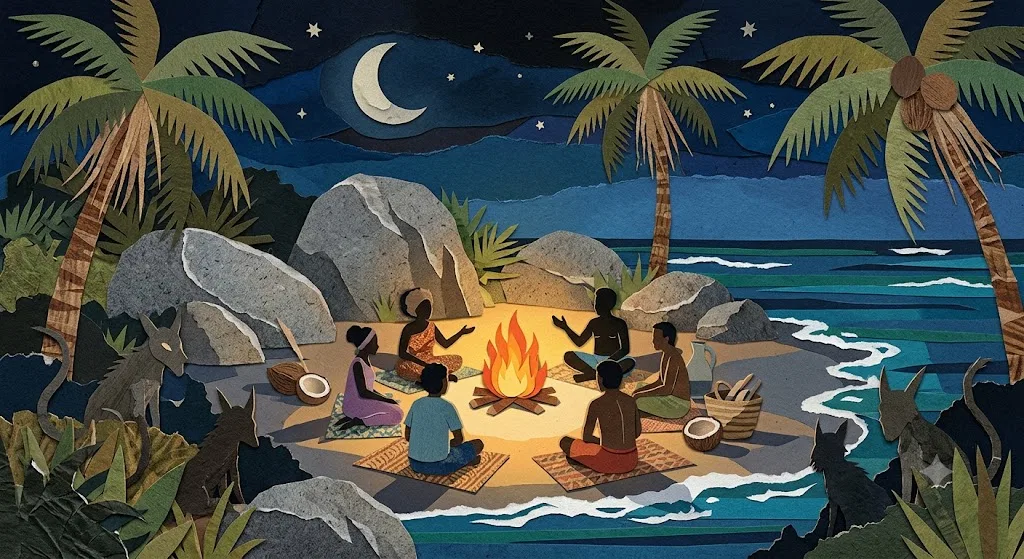
Seychellois folklore is best understood as island folklore made from movement: African, Malagasy, European, Indian Ocean and Creole influences carried by sailors, enslaved people, settlers, liberated Africans, migrant workers, songs, riddles and fireside storytelling.
Page outline Jump by section
Introduction
That makes Seychelles a particularly clear example of Creole folklore: stories did not simply survive unchanged from one homeland. They were renamed, reshaped and reinterpreted in a new island society. A creature that began as a hare in East African trickster traditions could become a half-human, half-animal mischief-maker; a Malagasy spirit could become a wolf-like figure; a dance born in the night-time world of plantation hardship could become nationally celebrated heritage.[Seychelles Research Journal]seychellesresearchjournal.comSeychelles Research JournalSeychelles Research Journal
Why Seychelles folklore feels different
The first thing to know is that Seychelles folklore is not built around one single mythology. It is a layered oral tradition, formed in an archipelago that became a Creole society under French and British colonial rule. The islands’ position in the western Indian Ocean matters: Seychelles sat within routes linking East Africa, Madagascar, Mauritius, Réunion, India and Europe, so its stories often have relatives elsewhere even when their Seychellois forms are local.[Seychelles Research Journal]seychellesresearchjournal.comSeychelles Research Journal
Folklorist Thérésia Penda Choppy describes Seychellois folktales as a “palimpsest” of cultural interchange, with characters that entered the islands through “island hopping” across the Indian Ocean. Her study of around 200 Seychellois folktales argues that monsters and mythical creatures in the tradition are both products of creolisation and clues to older networks of migration, slavery and trade.[Seychelles Research Journal]seychellesresearchjournal.comSeychelles Research Journal
This is why the tradition often resists neat labels. A Seychellois tale may look like an animal fable, a European fairy tale, an East African trickster story, a Malagasy spirit story or an Indian Ocean wonder tale, but the local version usually carries a specifically Seychellois social memory. The University of Seychelles folklore database frames the national repertoire in just this mixed way: trickster tales from Afro-Malagasy tradition, fairy-tale material from Indo-European tradition, and stories “locally concocted” around the realities of small-island life.[folklore.unisey.ac.sc]folklore.unisey.ac.scOpen source on unisey.ac.sc.
The trickster at the centre: Soungoula
The best-known figure in Seychellois folktales is Soungoula, a trickster who survives by wit, deception and nerve. In popular descriptions he is often imagined as something between a human and an animal, with pointed ears and a long tail. Some people take him to be monkey-like, but Choppy’s analysis traces his deeper ancestry to East African hare trickster traditions: the name is linked to words for “hare” in Yao and Swahili-related contexts, but in Seychelles that original meaning faded as the name moved into Creole storytelling.[Seychelles Research Journal]seychellesresearchjournal.comSeychelles Research Journal
That loss of meaning was creative. Because listeners no longer heard Soungoula simply as “hare”, he became something more mythic and more local: an ambiguous, half-animal figure who could make fools of authority. Choppy argues that this transformation matters because Seychellois Soungoula stories speak to slavery, adaptation and resistance. The trickster is not merely naughty; he is a small figure surviving in a world of power.[Seychelles Research Journal]seychellesresearchjournal.comSeychelles Research Journal
A useful concrete example is “Soungoula and Lion”, preserved in the University of Seychelles folklore database from the 1983 collection Contes, Devinettes et Jeux de Mots des Seychelles. In the summary, Soungoula pretends to teach Lion’s children, eats them, and then has to outwit Lion’s revenge. The database classifies the tale with international motif references, including the deceiver disguised as a scholar and the “sham dead” trick, and identifies its origin as East African.[folklore.unisey.ac.sc]folklore.unisey.ac.scsoungoula ek lyonsoungoula ek lyon
Soungoula therefore gives readers a good key to Seychellois folklore as a whole. He is imported and local, animal and human, comic and disturbing, entertaining and socially meaningful. He is also evidence that folklore can preserve old patterns while changing their emotional centre.
Monsters, wolves and vanishing women
Seychellois folklore includes a wider cast of strange beings, many of them connected to the same Indian Ocean routes as Soungoula. Choppy’s study highlights four especially important groups: Soungoula, the Bantu swallowing monster, Loulou and the vanishing woman. These figures are not all equally widespread, and some survive more clearly than others, but together they show how old story material was transformed in the islands.[Seychelles Research Journal]seychellesresearchjournal.comSeychelles Research Journal
Loulou is one of the clearest examples of transformation. Choppy argues that the figure reflects both a Malagasy malevolent spirit and a Bantu swallowing-monster tradition, but in Seychellois retelling it has often been rationalised into something closer to a wolf, partly through linguistic adaptation and partly through the influence of European “big bad wolf” story patterns. In newer stories, Loulou may appear less as an uncanny spirit and more as an ordinary animal character, a miscreant or a dupe.[Seychelles Research Journal]seychellesresearchjournal.comSeychelles Research Journal
Tizan is another important hero figure in the repertoire. In one University of Seychelles database tale, “Tizan and the Seven-Headed Monster”, Tizan saves a princess from a seven-headed beast, only for another man to try to take the credit. The pattern is familiar to readers of wonder tales worldwide, but its presence in Seychellois oral tradition shows how international heroic motifs became part of Creole storytelling.[folklore.unisey.ac.sc]folklore.unisey.ac.scOpen source on unisey.ac.sc.
The vanishing woman stories are more delicate to interpret because the evidence is thinner. Choppy notes that only a few such stories seem to have entered the Seychellois repertoire, and she is careful not to overstate their exact origins. Some may connect to Malagasy water-woman or taboo-wife traditions, while others may have Indian tale parallels. The important point is not that every story can be traced to one source, but that Seychelles folklore often preserves overlapping routes at once.[Seychelles Research Journal]seychellesresearchjournal.comSeychelles Research Journal
Oral tradition, riddles and the work of memory
Seychellois folklore survived primarily through oral performance: stories, songs, riddles, jokes, proverbs and social gatherings. Printed collections came later. One landmark is Zistwar ek Zedmo Sesel / Contes, Devinettes et Jeux de Mots des Seychelles, published in 1983 with Creole and French material; library records identify it as a book of Seychelles folklore and folk literature, and the University of Seychelles database repeatedly uses it as a source for individual tales.[nla.gov.au]nla.gov.auOpen source on nla.gov.au.
Older scholarship was already concerned with preservation. A 1979 study of Seychellois Creole tales described the collection and study of oral tradition as a way to safeguard a distinctive cultural heritage that was at risk of disappearing, while also recognising its scientific importance for understanding origins, themes and methods of interpretation.[Persée]persee.frPersée Les contes créoles seychelloisPersée Les contes créoles seychellois
Today, the University of Seychelles folklore database makes this tradition more visible to new readers. Its value is not only that it stores stories, but that it gives English summaries, source information, origins, character tags and motif classifications. That helps readers see the stories as living entertainment and as part of a wider map of world folklore.[folklore.unisey.ac.sc]folklore.unisey.ac.scOpen source on unisey.ac.sc.
Moutya: when folklore is danced, sung and remembered
Not all folklore is a story told in words. In Seychelles, one of the most important living traditions is Moutya, a drum, song and dance practice associated with enslaved Africans and plantation-era hardship. UNESCO describes it as brought by enslaved Africans who arrived with French settlers in the early eighteenth century, historically practised at night, away from plantation houses, and used as psychological comfort and a means of resisting servitude and social injustice.[ICH UNESCO]ich.unesco.orgICH UNESCOMoutyaICH UNESCOMoutya
Moutya is traditionally performed around a bonfire to drum rhythms, with singing and dancing that can be communal, spontaneous and emotionally direct. In 2021 it was inscribed on UNESCO’s Representative List of the Intangible Cultural Heritage of Humanity, a formal recognition that places it among the world’s protected living cultural traditions.[ICH UNESCO]ich.unesco.orgICH UNESCOMoutyaICH UNESCOMoutya
For folklore readers, Moutya matters because it shows how supernatural and legendary culture sits inside a broader expressive world. The same society that produced trickster tales and monster stories also used dance, rhythm and song to process suffering, social tension and identity. Moutya is not a mythic creature, but it is part of the cultural atmosphere in which Seychellois oral tradition makes sense.
Ghosts, charms and magical belief
Seychelles also has a living reputation for ghost stories, charms and magical belief, though this area needs careful handling because public sources are uneven. Travel writing often exaggerates “haunted island” material, while community memories are more fragmentary and private. Still, several credible sources show that folk belief in spirits, sorcery and protective or harmful magic forms part of Seychellois cultural discussion.[Seychelles Nation]nation.scthe truth behind hauntingthe truth behind haunting
One important term is grigri, commonly used for charms, magic or witchcraft-related practices. Michael Palmyre’s doctoral thesis, Magic, Modernity, and Race in Seychelles: The Situation of Grigri in the Modern Creole Order, treats grigri not as a spooky tourist curiosity but as a serious lens on modernity, race and Creole identity. The thesis summary notes that witchcraft, or grigri, was excluded from the official Creole canon, which suggests a tension between celebrated heritage and more uncomfortable folk practice.[Curtin University Research Repository]curate.curtin.edu.auOpen source on edu.au.
Local journalism also records contemporary concern with haunting and possession stories: reports mention forest smells, apparitions, sleep-related attacks and old colonial houses associated with ghostly visitors. Such accounts should be read as belief narratives rather than verified events, but they show that supernatural storytelling did not disappear with modernity.[Seychelles Nation]nation.scthe truth behind hauntingthe truth behind haunting
Sacred and haunted places
Seychelles folklore is closely tied to landscape: forests, beaches, old houses, cemeteries, mountain paths and plantation ruins. The islands’ beauty can make this easy to miss. Tourist imagery often presents Seychelles as paradise, but folklore gives the same places a second layer: a forest may be a place of herbs, spirits or fear; a colonial ruin may recall slavery; a cemetery road may attract ghost stories.
The Mission Ruins of Venn’s Town on Mahé are a good example of a place where history and cultural memory meet. UNESCO’s tentative World Heritage description presents the site as a reference point for the history of slavery in Seychelles, especially for liberated African children who were brought together there and who became ancestors of part of the present population. This is not a “haunted place” in the cheap sense, but it is a landscape of memory, and such places often become magnets for story.[UNESCO World Heritage Centre]whc.unesco.orgOpen source on unesco.org.
Cemeteries and roads also appear in modern ghost lore. One online community account, for instance, recalls a vanishing female hitchhiker associated with La Misere and Bel Air cemetery. A Reddit anecdote is not strong evidence for an old tradition, but it is useful evidence for internet-era folklore: a local legend form, familiar around the world, being adapted to Seychellois roads and place names.[Reddit]reddit.comOpen source on reddit.com.
What is old, what is collected, and what is modern?
A reader should be cautious with Seychelles folklore because different kinds of material often get mixed together. Some tales are old oral traditions recorded in collections. Some are scholarly reconstructions of routes and motifs. Some are modern retellings for schools, tourism or social media. Some are recent ghost stories that may be localised versions of global urban legends.
A practical way to read the tradition is to ask four questions:
- Is the story documented in a collection or archive? Tales in the University of Seychelles database or in older collections such as the 1983 Creole-French volume have a clearer evidential trail.[National Library of Australia]nla.gov.auOpen source on nla.gov.au.
- Does it have known relatives elsewhere? Soungoula, Loulou and vanishing-woman material all make more sense when compared with East African, Malagasy and Indian Ocean parallels.[Seychelles Research Journal]seychellesresearchjournal.comSeychelles Research Journal
- Has the meaning changed in Seychelles? This is often the most interesting part. Soungoula’s shift from hare-trickster to half-human creature is a stronger cultural clue than a simple claim of “African origin”.[Seychelles Research Journal]seychellesresearchjournal.comSeychelles Research Journal
- Is the source tourism, scholarship, local memory or social media? A hotel blog, a Reddit story and a peer-reviewed article can all be useful, but they do not carry the same weight.
This does not mean modern folklore is worthless. It means it should be labelled honestly. A vanishing hitchhiker story on a Seychellois road may not prove an ancient ghost tradition, but it does show how folklore keeps finding new settings.
How Seychelles folklore is understood today
Today, Seychelles folklore sits between preservation, education, national identity and popular retelling. Institutions such as the University of Seychelles and the Creole Language and Culture Research Institute have helped document and study oral traditions, while UNESCO recognition of Moutya has raised the profile of living heritage.[unisey.ac.sc]unisey.ac.scMs. Cindy MokaMs. Cindy Moka
At the same time, some parts of belief culture remain less publicly celebrated. Trickster tales and Moutya can be framed proudly as national heritage; grigri and witchcraft beliefs are more likely to be treated with unease, humour, secrecy or scepticism. That split is itself revealing. Folklore is not only what a country puts on stage for visitors. It is also what families half-believe, what children are warned about, what old people remember, and what modern citizens debate or reject.[Curtin University Research Repository]curate.curtin.edu.auOpen source on edu.au.
The most grounded way to describe Seychelles folklore, then, is as a Creole island tradition of transformation. Its tales carry East African, Malagasy, European and Indian Ocean traces, but their importance lies in what Seychelles did with them. Soungoula became a local trickster of survival. Loulou shifted between spirit, monster and wolf. Moutya turned suffering into rhythm and collective memory. Ghost and magic stories continue to attach themselves to roads, forests and houses. Together, they make Seychelles folklore less a fixed mythology than a living archive of how island people remembered, adapted and made meaning.
Amazon book picks
Further Reading
Books and field guides related to What Makes Seychelles Folklore So Strange?. Use these as the next step if you want deeper reading beyond the article.
The Annotated African American Folktales
Demonstrates how oral traditions evolve through diaspora communities.
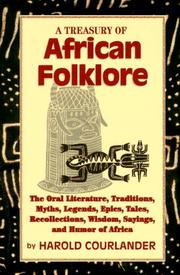
A treasury of African folklore
Provides comparative material for many motifs found in Seychelles.
The Creole Folktales of Seychelles
Focuses specifically on stories and traditions from Seychelles.
eBay marketplace picks
Marketplace Samples
Live-tested eBay searches with available results related to this page.


Endnotes
1.
Source: academic.oup.com
Title: Academic History of the Seychelles
Link:https://academic.oup.com/edited-volume/61663/chapter/553412868?searchresult=1
Source snippet
An act of Parliament permitted legally held slaves to be transferred from the Seychelles to Mauritius. Royal...Read more...
2.
Source: seychellesresearchjournal.com
Title: Seychelles Research Journal
Link:https://seychellesresearchjournal.com/wp-content/uploads/2023/07/monsters_mythical_creatures_and_island_hopping_in_seychellois_folktales-theresia_penda_choppy-seychelles_research_journal-5-2.pdf
3.
Source: ich.unesco.org
Title: ICH UNESCOMoutya
Link:https://ich.unesco.org/en/RL/moutya-01690
4.
Source: folklore.unisey.ac.sc
Link:https://folklore.unisey.ac.sc/
5.
Source: folklore.unisey.ac.sc
Title: soungoula ek lyon
Link:https://folklore.unisey.ac.sc/story/soungoula-ek-lyon/
6.
Source: search.worldcat.org
Link:https://search.worldcat.org/title/Zistwar-ek-zedmo-sesel-Contes-devinettes-et-jeux-de-mots-des-Seychelles/oclc/85914536
7.
Source: unesco.org
Title: Moutya | Intangible Heritage
Link:https://www.unesco.org/archives/multimedia/document-4933
8.
Source: nation.sc
Link:https://www.nation.sc/articles/11777/moutya-added-to-unesco-list-of-intangible-cultural-heritage
9.
Source: nation.sc
Title: the truth behind haunting
Link:https://www.nation.sc/archive/231925/the-truth-behind-haunting
10.
Source: whc.unesco.org
Link:https://whc.unesco.org/en/tentativelists/5796/
11.
Source: reddit.com
Link:https://www.reddit.com/r/Seychelles/comments/nb6w4s/grigri_the_witchcraft_of_the_white_sand/
12.
Source: unisey.ac.sc
Title: Ms. Cindy Moka
Link:https://unisey.ac.sc/personnel/ms-cindy-moka/
13.
Source: reddit.com
Link:https://www.reddit.com/r/Seychelles/comments/1h6mvvo/witchcraft_in_the_seychelles/
14.
Source: unisey.ac.sc
Link:https://unisey.ac.sc/wp-content/uploads/2025/11/Dr.-Penda-Choppy-Publications.pdf
15.
Source: unisey.ac.sc
Title: CLCRI PUBLICATIONS
Link:https://unisey.ac.sc/wp-content/uploads/2025/11/CLCRI-PUBLICATIONS.pdf
16.
Source: unisey.ac.sc
Title: CLCRI publications July 2024.docx
Link:https://unisey.ac.sc/wp-content/uploads/2024/06/CLCRI-publications-July-2024.docx
Published: July 2024
17.
Source: ich.unesco.org
Title: 40463 EN
Link:https://ich.unesco.org/doc/src/40463-EN.pdf
18.
Source: ich.unesco.org
Link:https://ich.unesco.org/doc/src/Signed%20periodic%20report%20-%20Periodic%20report-63297.pdf
19.
Source: ich.unesco.org
Title: search 00795
Link:https://ich.unesco.org/en/search-00795?call=film&id=58175&include=film_inc.php&width=700
20.
Source: ich.unesco.org
Title: 48460 EN
Link:https://ich.unesco.org/doc/src/48460-EN.pdf
21.
Source: ich.unesco.org
Link:https://ich.unesco.org/en/video/58175
22.
Source: ich.unesco.org
Title: seychelles SC
Link:https://ich.unesco.org/en/state/seychelles-SC?call=film&id=58175&include=film_inc.php&width=700
23.
Source: ich.unesco.org
Title: 42920 EN.doc
Link:https://ich.unesco.org/doc/src/42920-EN.doc
24.
Source: ich.unesco.org
Title: 10b representative list 01098
Link:https://ich.unesco.org/en/10b-representative-list-01098?id=01487&include=slideshow_inc.php
25.
Source: unesco.org
Link:https://www.unesco.org/en/articles/family-archives-and-oral-histories-how-alula-community-members-preserve-audiovisual-heritage
26.
Source: seychelles.com
Title: echoes freedom soulful rhythm seychelles moutya
Link:https://www.seychelles.com/blog-details/13606/highlights/echoes-freedom-soulful-rhythm-seychelles-moutya
27.
Source: seychelles.com
Link:https://seychelles.com/blog-details/1758/highlights/strolling-through-seychelles-heritage
28.
Source: seychelles.com
Link:https://www.seychelles.com/special_interest/culture
29.
Source: folktales.africa
Link:https://folktales.africa/category/african-folktales/east-african-folktales/seychellois-folktales/
30.
Source: nation.sc
Title: seychelles marks four years of moutyas unesco recognition
Link:https://www.nation.sc/articles/28610/seychelles-marks-four-years-of-moutyas-unesco-recognition
31.
Source: nation.sc
Title: exhibition showcases history of slavery in seychelles
Link:https://www.nation.sc/articles/7073/exhibition-showcases-history-of-slavery-in-seychelles
32.
Source: indian-ocean.com
Link:https://www.indian-ocean.com/seychellois-culture/
33.
Source: nla.gov.au
Link:https://nla.gov.au/nla.cat-vn2677288
34.
Source: seychellesresearchjournal.com
Link:https://seychellesresearchjournal.com/archive-5-2/
35.
Source: persee.fr
Title: Persée Les contes créoles seychellois
Link:https://www.persee.fr/doc/ecreo_0708-2398_1979_num
36.
Source: curate.curtin.edu.au
Link:https://curate.curtin.edu.au/articles/thesis/Magic_Modernity_and_Race_in_Seychelles_The_Situation_of_Grigri_in_the_Modern_Creole_Order/31732483
37.
Source: Wikipedia
Link:https://en.wikipedia.org/wiki/Seychelles
38.
Source: seyvillas.com
Link:https://www.seyvillas.com/en/guide/at-a-glance/history
39.
Source: seychellesresearchjournal.com
Link:https://seychellesresearchjournal.com/wp-content/uploads/2021/01/new_ways_of_finding_a_voice-oral_tradition_and_hybridity_in_seychelles_literature-anne-berenike_rothstein-srj-3-1.pdf
40.
Source: seychellesnationalmuseums.org
Link:https://seychellesnationalmuseums.org/
41.
Source: facebook.com
Link:https://www.facebook.com/groups/252481675954771/posts/1393750951827832/
42.
Source: library.gov.au
Title: oral history and folklore
Link:https://www.library.gov.au/discover/what-we-collect/oral-history-and-folklore
43.
Source: exploreseychelles.wordpress.com
Title: seychelles folklore
Link:https://exploreseychelles.wordpress.com/seychelles-overview-2/culture/seychelles-folklore/
Additional References
44.
Source: youtube.com
Title: 16 Shocking Facts About The Seychelles You’ve Never Heard Before
Link:https://www.youtube.com/watch?v=Z6QlwzH29Hk
Source snippet
Seychelles Explained Through 13 Fascinating Facts...
45.
Source: seychellesnewsagency.com
Link:https://www.seychellesnewsagency.com/public/articles/20762/abdourahamane-diallo-publishes-book-on-seychelles-old-lullabies-and-moutya-songs
46.
Source: calameo.com
Link:https://www.calameo.com/books/0049741130c49a1f05162
47.
Source: facebook.com
Link:https://www.facebook.com/todayinsey/posts/celebrating-170-years-of-st-michael-catholic-church-in-anse-aux-pinsthe-st-micha/787431603390087/
48.
Source: fnac.com
Link:https://www.fnac.com/a264646/Zistwar-Ek-Zedmo-Sesel-Contes-devinettes-et-jeux-de-mots-des-Seychelles
49.
Source: dokumen.pub
Link:https://dokumen.pub/creole-cultures-vol-1-safeguarding-creole-intangible-cultural-heritage-3031242742-9783031242748.html
50.
Source: creoletravelservices.com
Link:https://www.creoletravelservices.com/about-seychelles/culture/
51.
Source: enchantingtravels.com
Link:https://www.enchantingtravels.com/destinations/africa/seychelles/seychelles-culture/
52.
Source: worldradiohistory.com
Link:https://www.worldradiohistory.com/UK/World-Radio/World-Radio-1931-11-27-S-OCR.pdf
53.
Source: facebook.com
Link:https://www.facebook.com/seychellesnewsagency/posts/dr-penda-choppys-thesis-creativity-creolisation-and-identity-in-seychellois-creo/943413181129993/
Topic Tree
Follow this branch
Related pages 192
- Afghan Folklore
- Albanian Folklore
- Algerian Folklore
- Australian Folklore
- Azerbaijan Folklore
- +187 more in sidebar