Within Russian Folklore
How Did Russian Fairy Tales Reach the World?
The Russian fairy tales many readers know were shaped by collectors, translators and scholars as much as by oral tradition.
On this page
- Afanasyev and the printed tale archive
- Translation, illustration and international readers
- Propp and the structure of wonder tales
Page outline Jump by section
Introduction
Many of the “Russian fairy tales” known around the world today are not direct windows into village storytelling. They are the result of a long process of collecting, editing, publishing, translating and analysing oral traditions. Two figures stand at the centre of that process: Aleksandr Afanasyev, the nineteenth-century collector whose vast archive preserved hundreds of tales, and Vladimir Propp, the twentieth-century scholar who transformed the way people study fairy tales by examining their underlying structure. Together, they helped turn local storytelling traditions into one of the most influential bodies of folklore in the modern world.[Wikipedia]WikipediaAlexander AfanasyevJune 7, 2025 — Alexander Nikolayevich Afanasyev was a Russian Slavist and ethnographer best known for publishing nearly 600 East Slavic a…
Understanding Russian fairy tales therefore means understanding not only the stories themselves, but also how they were recorded, reshaped and interpreted. The familiar adventures of Baba Yaga, the Firebird, magical helpers and questing heroes reached international readers through books and translations, while scholars such as Propp used those same tales to develop theories that influenced folklore studies, literary criticism and even modern screenwriting.[PenguinRandomhouse.com]penguinrandomhouse.comaleksandr afanasevAleksandr Afanas'evALEKSANDR AFANAS'EV (1826-1871) published his groundbreaking collection of Russian folktales and fairy tales in eight…
Afanasyev and the Printed Tale Archive
Before the nineteenth century, most Russian fairy tales existed primarily as oral performances. Stories changed from village to village and from one storyteller to another. There was no single authorised version of a tale about a magical bride, a forest witch or a heroic quest.
Aleksandr Afanasyev (1826–1871) changed that situation dramatically. Inspired by the collecting work of the Brothers Grimm in Germany, he gathered tales from manuscripts, correspondents and ethnographic records, eventually publishing a monumental collection between the 1850s and 1860s. The resulting archive contained nearly 600 tales, making it one of the largest folklore collections assembled anywhere in Europe.[Wikipedia]WikipediaRussian Fairy TalesFebruary 8, 2026 — Russian Fairy Tales is a collection of nearly 600 fairy and folktales, collected and published by Alexander Afanasyev…
The importance of Afanasyev’s work lies not only in its size but in its timing. Russia was undergoing intense debates about national identity, language and popular culture. Folklore collectors increasingly viewed stories told by ordinary people as evidence of a distinctive national heritage. Afanasyev’s publications presented folk narratives as a cultural treasure worthy of preservation and study.[Inquiries Journal]inquiriesjournal.comethnography folklore afanasev and russian self identityInquiries JournalEthnography, Folklore, Afanasev, and Russian Self-Identityby MR Devlin · 2021 · Cited by 1 — Afanasev's editing of his f…
His collection also fixed many stories into forms that later readers came to regard as “traditional”. Tales featuring Baba Yaga, Vasilisa the Beautiful, the Frog Princess, Koschei the Deathless and the Firebird became widely known because they appeared in printed editions that could be copied, translated and republished. What had once been flexible oral traditions became a recognised literary corpus.[Project Gutenberg]gutenberg.orgProject GutenbergRussian Folk-Tales by A. N. Afanas'ev18 Oct 2024 — "Russian Folk-Tales" by A. N. Afanas'ev is a collection of nearly 600…
Preservation and Transformation
Afanasyev is often celebrated as a preserver of folklore, but preservation inevitably involved transformation.
Oral storytelling includes voice, gesture, local dialect, audience interaction and improvisation. A printed text cannot fully capture those elements. By selecting versions, arranging them for publication and presenting them as part of a coherent collection, Afanasyev helped create the modern idea of a body of “Russian fairy tales”.[Inquiries Journal]inquiriesjournal.comethnography folklore afanasev and russian self identityInquiries JournalEthnography, Folklore, Afanasev, and Russian Self-Identityby MR Devlin · 2021 · Cited by 1 — Afanasev's editing of his f…
This does not make the tales inauthentic. Rather, it shows that folklore survives through adaptation. The printed archive preserved stories that might otherwise have disappeared, while also changing the way future generations encountered them.
Translation, Illustration and International Readers
Afanasyev’s collections were originally intended for a Russian-speaking audience, but their influence expanded enormously through translation.
By the early twentieth century, English-language editions were introducing foreign readers to Russian fairy tales as a distinct literary tradition. These translations presented stories that felt both familiar and strange: they shared motifs with European fairy tales yet featured uniquely Russian settings, characters and imagery.[Standard Ebooks]standardebooks.orgStandard EbooksRussian Folktales, by A. N. Afanasyev. Translated…A collection of folktales in the Russian language, collected and edit…
Illustration played an equally important role. Artists such as Ivan Bilibin created richly decorative images inspired by medieval art, folk ornament and traditional architecture. For many readers, these illustrations became inseparable from the stories themselves. The visual style helped define what “Russian fairy tales” looked like in the popular imagination.[Google Books]books.google.comBooks Russian Fairy TalesGoogle BooksRussian Fairy Tales - Alexander AfanasyevThis richly illustrated collection includes five popular Russian folk tales: Vasilis…
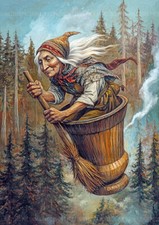
As translations multiplied, Russian fairy tales entered children’s literature, theatre, opera, animation and popular culture. Figures such as Baba Yaga became international folklore characters rather than exclusively Russian ones. The stories travelled far beyond the communities where they had originally been told.[PenguinRandomhouse.com]penguinrandomhouse.comaleksandr afanasevAleksandr Afanas'evALEKSANDR AFANAS'EV (1826-1871) published his groundbreaking collection of Russian folktales and fairy tales in eight…
What International Readers Often Miss
The global success of these tales sometimes obscures their origins.
Many English-language editions present the stories as timeless classics, but they are actually products of several layers of transmission:
- Oral storytelling traditions.
- Nineteenth-century collection and editing.
- Translation into other languages.
- Illustration and adaptation for new audiences.
- Modern retellings in books, films and games.
Recognising these layers helps explain why there is often no single definitive version of a Russian fairy tale. Different editions may preserve different variants of the same story while claiming equal legitimacy as folklore.[Standard Ebooks]standardebooks.orgStandard EbooksRussian Folktales, by A. N. Afanasyev. Translated…A collection of folktales in the Russian language, collected and edit…
Why Propp Looked Beyond Characters
If Afanasyev preserved the stories, Vladimir Propp (1895–1970) changed how people understood them.
Working with Russian wonder tales, many drawn from Afanasyev’s collection, Propp asked a question that seemed simple but proved revolutionary: what do these stories actually have in common? Rather than focusing on characters such as witches, dragons or magical birds, he examined the actions that drive the plot.[DIVA Portal]diva-portal.orgTales, texts representing the subcategory of fairy tales (Propp…Read more…
The result was his landmark study Morphology of the Folktale. Propp argued that fairy tales share recurring narrative functions that tend to appear in a predictable sequence. The specific characters may change, but the underlying structure often remains remarkably similar.[Chicago Journals]journals.uchicago.eduChicago JournalsVladimir Yakovlevich Propp (1895–1970): Formal Analysis…Early in Morphology of the Folk Tale, Propp argued that a clea…
A monster may kidnap a princess in one tale, while a supernatural force causes another problem elsewhere. For Propp, the important point was not the identity of the villain but the narrative role performed. This shifted attention from the surface details of a story to its deeper architecture.[bactra.org]bactra.orgReview of VI. Propp, Morphology of the FolktalePropp set out to identify the basic elements of the plots of Russian fairy tales, working at a level…
Propp and the Structure of Wonder Tales
Propp’s analysis identified thirty-one recurring narrative functions and a limited set of character roles. Not every tale contains every function, but he argued that the sequence follows recognisable patterns.[billstifler.org]billstifler.orgVladimir Propp: 31 Functions of the Fairy Tale - Bill Stifler's Web22 Sept 2025 — In Morphology of the Folktale, Propp focused on common…
A typical Russian wonder tale might include:
- A problem or lack that disrupts ordinary life.
- A journey or quest.
- Tests imposed by a supernatural figure.
- Acquisition of magical aid.
- Confrontation with an antagonist.
- Return and recognition.
- Resolution and reward.
The specific details may vary enormously. The helper could be Baba Yaga, a talking animal or a magical object. The villain could be a dragon, a sorcerer or Koschei the Deathless. Yet the narrative pattern remains recognisable.[billstifler.org]billstifler.orgVladimir Propp: 31 Functions of the Fairy Tale - Bill Stifler's Web22 Sept 2025 — In Morphology of the Folktale, Propp focused on common…
Propp’s work became influential far beyond Russian folklore. Scholars applied his methods to myths, legends, literature, film and popular culture. His ideas helped lay foundations for structural approaches to storytelling that continue to influence narrative theory today.[Google Books]books.google.comGoogle BooksMorphology of the Folktale: Second EditionMorphology will in all probability be regarded by future generations as one of the…
The Limits of Propp’s Approach
Propp’s model is powerful, but it is not the whole story.
Critics note that focusing on structure can downplay performance, regional variation, symbolism and social context. A tale told in a northern Russian village may carry meanings connected to local beliefs, landscapes or customs that cannot be reduced to narrative functions alone.[ResearchGate]researchgate.netResearchGate(PDF) The Thirty-One Functions in Vladimir Propp's…8 Jan 2020 — In this paper we look at Morphology of the Folktale, by ou…
Even so, Propp’s achievement remains significant because he demonstrated that fairy tales could be analysed systematically without treating them merely as children’s stories or literary curiosities. His work showed that folklore possessed its own complex forms and patterns.[Chicago Journals]journals.uchicago.eduChicago JournalsVladimir Yakovlevich Propp (1895–1970): Formal Analysis…Early in Morphology of the Folk Tale, Propp argued that a clea…

How Russian Fairy Tales Reached the World
The worldwide image of Russian fairy tales emerged through a partnership between oral tradition, collectors, publishers, translators, illustrators and scholars.
Afanasyev provided the archive that preserved hundreds of stories and made them available to later generations. Translators and artists transformed those texts into books that could travel internationally. Propp then used the same body of material to reveal patterns that influenced folklore studies across the globe.[wikipedia.org]WikipediaAlexander AfanasyevJune 7, 2025 — Alexander Nikolayevich Afanasyev was a Russian Slavist and ethnographer best known for publishing nearly 600 East Slavic a…
As a result, many readers encounter Russian folklore through stories that are simultaneously traditional and modern: rooted in oral storytelling, yet shaped by nineteenth-century collecting and twentieth-century scholarship. The famous tales of Baba Yaga, magical quests and enchanted kingdoms survived because they were written down, but they became globally influential because people continued to reinterpret them. In that sense, the making of Russian fairy tales is itself one of Russia’s most important folklore stories.[gutenberg.org]gutenberg.orgProject GutenbergRussian Folk-Tales by A. N. Afanas'ev18 Oct 2024 — "Russian Folk-Tales" by A. N. Afanas'ev is a collection of nearly 600…
Amazon book picks
Further Reading
Books and field guides related to How Did Russian Fairy Tales Reach the World?. Use these as the next step if you want deeper reading beyond the article.
Russian Fairy Tales (Illustrated by Ivan Bilibin)
Directly matches Afanasyev, printed tale collections, Baba Yaga, Firebird and Russian wonder tales.
The Hero with a Thousand Faces
Pairs well with Propp for readers interested in how traditional tales are structured.
Baba Yaga
Focuses on one of the major Russian tale figures transmitted through collections and translation.
Morphology of the Folktale
Directly addresses Propp’s structural analysis of Russian fairy tales.
eBay marketplace picks
Marketplace Samples
Live-tested eBay searches with available results related to this page.


Endnotes
1.
Source: Wikipedia
Title: Alexander Afanasyev
Link:https://en.wikipedia.org/wiki/Alexander_Afanasyev
Source snippet
June 7, 2025 — Alexander Nikolayevich Afanasyev was a Russian Slavist and ethnographer best known for publishing nearly 600 East Slavic a...
Published: June 7, 2025
2.
Source: gutenberg.org
Link:https://www.gutenberg.org/ebooks/62509
Source snippet
Project GutenbergRussian Folk-Tales by A. N. Afanas'ev18 Oct 2024 — "Russian Folk-Tales" by A. N. Afanas'ev is a collection of nearly 600...
3.
Source: penguinrandomhouse.com
Title: aleksandr afanasev
Link:https://www.penguinrandomhouse.com/authors/191/aleksandr-afanasev/
Source snippet
Aleksandr Afanas'evALEKSANDR AFANAS'EV (1826-1871) published his groundbreaking collection of Russian folktales and fairy tales in eight...
4.
Source: Wikipedia
Title: Russian Fairy Tales
Link:https://en.wikipedia.org/wiki/Russian_Fairy_Tales
Source snippet
February 8, 2026 — Russian Fairy Tales is a collection of nearly 600 fairy and folktales, collected and published by Alexander Afanasyev...
Published: February 8, 2026
5.
Source: books.google.com
Title: Books Russian Fairy Tales
Link:https://books.google.com/books/about/Russian_Fairy_Tales.html?id=1qxGnQEACAAJ
Source snippet
Google BooksRussian Fairy Tales - Alexander AfanasyevThis richly illustrated collection includes five popular Russian folk tales: Vasilis...
6.
Source: diva-portal.org
Link:https://www.diva-portal.org/smash/get/diva2%3A156802/FULLTEXT01.pdf
Source snippet
Tales, texts representing the subcategory of fairy tales (Propp...Read more...
7.
Source: bactra.org
Title: Review of V
Link:https://bactra.org/reviews/propp-morphology.html
Source snippet
I. Propp, Morphology of the FolktalePropp set out to identify the basic elements of the plots of Russian fairy tales, working at a level...
8.
Source: billstifler.org
Link:https://www.billstifler.org/myth/files/4D-004-Propp.htm
Source snippet
Vladimir Propp: 31 Functions of the Fairy Tale - Bill Stifler's Web22 Sept 2025 — In Morphology of the Folktale, Propp focused on common...
9.
Source: researchgate.net
Link:https://www.researchgate.net/publication/319293980_The_Thirty-One_Functions_in_Vladimir_Propp%27s_Morphology_of_the_Folktale_An_Outline_and_Recent_Trends_in_the_Applicability_of_the_Proppian_Taxonomic_Model
Source snippet
ResearchGate(PDF) The Thirty-One Functions in Vladimir Propp's...8 Jan 2020 — In this paper we look at Morphology of the Folktale, by ou...
10.
Source: plottr.com
Title: propp folktale plot structure
Link:https://plottr.com/propp-folktale-plot-structure/
Source snippet
Deeper Fairy Tales and...13 May 2024 — This plot structure consists of four phases and thirty-one structural elements, or what Propp cal...
Published: May 2024
11.
Source: books.google.com
Link:https://books.google.com/books/about/Morphology_of_the_Folktale.html?id=cyc7AQAAIAAJ
Source snippet
Google BooksMorphology of the Folktale: Second EditionMorphology will in all probability be regarded by future generations as one of the...
12.
Source: Wikipedia
Title: Vladimir (TV series)
Link:https://en.wikipedia.org/wiki/Vladimir_%28TV_series%29
Source snippet
Vladimir (TV series)Vladimir is an American comedy drama television limited series starring Rachel Weisz and Leo Woodall. It is an ada...
13.
Source: researchgate.net
Title: 387416447 Myth and Immortality in Russian Folktales
Link:https://www.researchgate.net/publication/387416447_Myth_and_Immortality_in_Russian_Folktales
Source snippet
(PDF) Myth and Immortality in Russian Folktales16 Dec 2024 — In this article, we will study the idea of immortality that can be found in...
14.
Source: books.google.com
Title: Russian Fairy Folk Tales
Link:https://books.google.com/books/about/Russian_Fairy_Folk_Tales.html?id=19WIvgEACAAJ
Source snippet
Fairy Folk Tales - Alexander Afanasyev8 Nov 2018 — "Russian Fairy Folk Tales" by Alexander Afanasyev is the most comprehensive collection...
15.
Source: archive.org
Link:https://archive.org/details/the-three-kingdoms-russian-folk-tales-from-alexander-afanasievs-collection-raduga-1985
Source snippet
The Three Kingdoms Russian Folk Tales From Alexander...2 Jul 2024 — The Three Kingdoms Russian Folk Tales From Alexander Afanasiev's Col...
16.
Source: journals.uchicago.edu
Link:https://www.journals.uchicago.edu/doi/10.1086/704846
Source snippet
Chicago JournalsVladimir Yakovlevich Propp (1895–1970): Formal Analysis...Early in Morphology of the Folk Tale, Propp argued that a clea...
17.
Source: inquiriesjournal.com
Title: ethnography folklore afanasev and russian self identity
Link:https://www.inquiriesjournal.com/articles/1896/ethnography-folklore-afanasev-and-russian-self-identity
Source snippet
Inquiries JournalEthnography, Folklore, Afanasev, and Russian Self-Identityby MR Devlin · 2021 · Cited by 1 — Afanasev's editing of his f...
18.
Source: standardebooks.org
Link:https://standardebooks.org/ebooks/a-n-afanasyev/russian-folktales/leonard-a-magnus
Source snippet
Standard EbooksRussian Folktales, by A. N. Afanasyev. Translated...A collection of folktales in the Russian language, collected and edit...
19.
Source: fairytale.fandom.com
Title: Russian Fairy Tales
Link:https://fairytale.fandom.com/wiki/Russian_Fairy_Tales
Source snippet
Fairy Tales - Fairytale Wiki - FandomA collection of Russian fairy tales, collected by Alexander Afanasyev and published by him between 1...
Additional References
20.
Source: reddit.com
Link:https://www.reddit.com/r/RussianLiterature/comments/1nnd1og/is_there_a_complete_english_translation_of/
Source snippet
Is there a complete English translation of Alexander...I've been looking but I haven't found a complete translation of Afanasyev's...
21.
Source: amazon.co.uk
Link:https://www.amazon.co.uk/Russian-Fairy-Tales-Alexander-Afanasyev/dp/1909115592?tag=searcht-20
Source snippet
Russian Fairy TalesThis richly illustrated collection includes five popular Russian folk tales: Vasilisa the Beautiful; Maria Morevna; Th...
22.
Source: hypocritereader.com
Link:https://hypocritereader.com/15/vladimir-propp
Source snippet
The Lonely World of Vladimir Propp | Emily BalsamoIn this text, Propp's aim was to break down the narrative structures of a corpus of Rus...
23.
Source: goodreads.com
Link:https://www.goodreads.com/en/book/show/164695.Russian_Fairy_Tales
24.
Source: youtube.com
Link:https://www.youtube.com/watch?v=30GdueOlJkI
Source snippet
Vladimir Propp's Morphology Of The Folk TaleChapter 4.5: Vladimir Propp, the structure of fairy tales. Leiden University - Faculty of Hum...
25.
Source: thehousecarpenter.wordpress.com
Title: thoughts on morphology of the folktale by vladimir propp
Link:https://thehousecarpenter.wordpress.com/2015/10/04/thoughts-on-morphology-of-the-folktale-by-vladimir-propp/
Source snippet
on “Morphology of the Folktale”, by Vladimir Propp4 Oct 2015 — It displays one of the hallmarks of a formalist approach: the development...
26.
Source: ebay.co.uk
Title: Russian Fairy Tales, Paperback by Afanasyev, Aleksandr
Link:https://www.ebay.co.uk/itm/388984807956?mkevt=1&mkcid=1&mkrid=710-53481-19255-0&campid=5339151051&customid=endnote-source&toolid=10001
Source snippet
fairy tales collected by the nineteenth-century ethnologist, Aleksandr Afanas'ev.... Louis Globe-Democrat "The oral folk tradition in Ru...
27.
Source: media-studies.com
Title: Media Studies Vladimir Propp’s Narrative Functions
Link:https://media-studies.com/narrative-functions/
Source snippet
Vladimir Propp's Narrative Functions - Media StudiesPropp's division of the folk tales into 7 spheres of action and 31 narrative function...
28.
Source: etsy.com
Link:https://www.etsy.com/listing/4318549364/vintage-soviet-book-collection-of
Source snippet
Vintage Soviet Book, Collection of Russian Folk Tales...10 Jun 2025 — Vintage Russian Folk Tales by A. Afanasyev, Interesting Fairy Tale...
29.
Source: almabooks.com
Title: tales from russian folklore
Link:https://almabooks.com/product/tales-from-russian-folklore/
Source snippet
Alexander Afanasyev (1826–71) was a Russian Slavist and ethnographer. He is best remembered today for his monumental Tales from Russian F...
Topic Tree