Where Ethiopia's Legends Still Live
Ethiopian folklore is not a single set of fireside tales. It is a layered tradition shaped by ancient Christian kingdoms, Islamic and Jewish communities, Oromo, Amhara, Tigrayan, Gurage, Sidama, Somali and many other regional cultures, and a long history of oral storytelling.
Page outline Jump by section
Why Ethiopian folklore feels different from a simple “mythology”
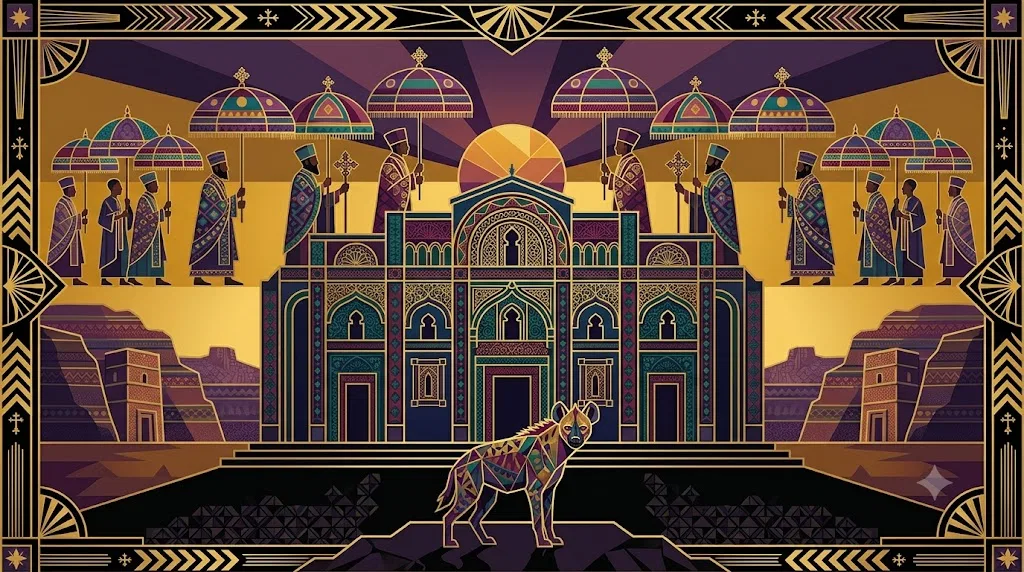
A useful way to approach Ethiopian folklore is to start with its diversity. Ethiopia is often described as a multi-ethnic country with more than 80 ethnic groups, and its story traditions reflect that range rather than forming one neat national mythology. Courtly legends, Orthodox Christian sacred history, Muslim local traditions, Jewish Ethiopian memory, Oromo oral institutions, Gurage riddles and folktales, highland spirit beliefs and animal stories all sit beside one another.[openfactbook.org]openfactbook.orgOpen Fact Book EthiopiaOpen Fact Book Ethiopia
That makes Ethiopia different from countries where “mythology” is usually presented as a finished body of ancient gods. Ethiopian traditions often blur categories: a story may be part religious teaching, part political charter, part pilgrimage explanation and part folk memory. The Queen of Sheba cycle is a good example. It is a sacred and literary story, but it also worked historically as a dynastic origin myth. The belief that the Ark of the Covenant came to Ethiopia is not merely a tale about a lost biblical object; it helps explain why certain places, especially Aksum, are treated as spiritually central.[World History Encyclopedia]worldhistory.orgWorld History Encyclopedia Queen of ShebaWorld History Encyclopedia Queen of Sheba
This also means that Ethiopian folklore cannot be separated cleanly from performance. Festivals, processions, church chants, ritual healing, riddling, proverbs and storytelling all carry traditional knowledge. Some of these forms are now protected or recognised as intangible cultural heritage, while others remain fragile because they depend on local language, memory and transmission between generations.[unesco.org]ich.unesco.orgOpen source on unesco.org.
The Queen of Sheba, Solomon and Ethiopia’s great national legend
The most famous Ethiopian legendary cycle tells how the Queen of Sheba travelled to King Solomon, bore a son, and became linked to the sacred destiny of Ethiopia. In the Ethiopian version, the son, Menelik, later brings the Ark of the Covenant from Jerusalem to Ethiopia. This story is central to the Kebra Nagast, a medieval work that became one of the great textual anchors of Ethiopian royal and religious imagination. The Metropolitan Museum of Art describes the Queen of Sheba story as part of Ethiopia’s national saga and notes that it has been represented in Ethiopian painting through long sequences of narrative scenes.[The Metropolitan Museum of Art]metmuseum.orgThe Metropolitan Museum of Art The Story of the Queen of ShebaThe Metropolitan Museum of Art The Story of the Queen of Sheba
For readers new to the subject, the important point is not whether every event in the story can be treated as modern history. The Queen of Sheba appears in biblical tradition, later Jewish, Islamic and Ethiopian retellings, and medieval Ethiopian royal ideology. World History Encyclopedia notes that there is no archaeological inscription or object that independently proves her existence outside textual traditions, while Ethiopian tradition gives her a much fuller role as a founding mother of sacred kingship.[World History Encyclopedia]worldhistory.orgWorld History Encyclopedia Queen of ShebaWorld History Encyclopedia Queen of Sheba
The Kebra Nagast matters because it turned a story into a charter. It gave the Solomonic monarchy a sacred genealogy reaching back to Solomon, and it tied Ethiopian kingship to biblical time. That is why the legend remained powerful long after the medieval period. Even when historians read it as a politically meaningful medieval text rather than a literal record of the tenth century BCE, it still reveals what Ethiopian rulers, clergy and artists wanted the kingdom to be: a Christian realm with ancient biblical legitimacy and a unique guardianship of sacred history.[York University]yorku.caOpen source on yorku.ca.
The story also lives through place. Aksum’s Chapel of the Tablet is said in Ethiopian Orthodox tradition to be the resting place of the Ark of the Covenant, brought by Menelik, the legendary son of Solomon and the Queen of Sheba. Whether approached as faith, legend, heritage or contested history, this belief helps explain Aksum’s deep importance as a pilgrimage centre and symbolic heart of Ethiopian sacred geography.[Visit Ethiopia]visitethiopia.etOpen source on visitethiopia.et.
Sacred landscapes: where legend is built into stone, water and pilgrimage
Ethiopian folklore is unusually place-based. Stories are not only told about heroes and spirits; they are attached to churches, lakes, mountains, caves, royal cities and pilgrimage routes. Lalibela is the clearest example. UNESCO describes its 11 medieval rock-hewn churches as a thirteenth-century “New Jerusalem” and a high place of Ethiopian Christianity that remains a place of pilgrimage and devotion.[UNESCO World Heritage Centre]whc.unesco.orgOpen source on unesco.org.
The legendary layer is just as important as the architecture. The king’s hagiography says that Lalibela carved the churches over 24 years with the assistance of angels. The World Monuments Fund similarly summarises the tradition that Christ directed Lalibela to build a second Jerusalem in Ethiopia and that angels assisted the divine task. These are not just decorative miracle stories. They explain how a physically astonishing site became meaningful as sacred geography: Ethiopia could contain its own Jerusalem, carved into its own land.[The Metropolitan Museum of Art]metmuseum.orgThe Metropolitan Museum of Art The Rock-hewn Churches of LalibelaThe Metropolitan Museum of Art The Rock-hewn Churches of Lalibela
Lake Tana has a different kind of legendary power. Its island monasteries are associated with Ethiopian Orthodox learning, manuscripts, sacred art and the political-spiritual life of the medieval empire. UNESCO’s tentative-list entry for Lake Tana Island Monasteries and the adjacent wetlands presents the area as both a natural and cultural heritage landscape, while recent Ethiopian heritage reporting has highlighted the monasteries as repositories of rare manuscripts and sacred art.[UNESCO World Heritage Centre]whc.unesco.orgOpen source on unesco.org.
These places show a key feature of Ethiopian belief culture: sacred stories often make landscapes readable. A church is not just old stone; it is a sign of angelic labour, royal devotion or divine instruction. A city is not just an archaeological site; it is a possible home of the Ark. A lake monastery is not just remote; it is a guarded vessel of memory. This is why tourism retellings can be both useful and risky: they make the stories accessible, but they can flatten complex living traditions into a few dramatic legends.
Spirits, evil eyes and were-hyenas
Ethiopian supernatural folklore is not limited to heroic sacred history. Some of its most striking traditions concern danger, envy, illness, marginality and transformation. Among the best documented is the belief often discussed in English as the evil eye. In Amhara contexts, the harmful power is associated in older ethnographic writing with people believed to possess a dangerous gaze or occult force. Ronald Reminick’s study of evil-eye belief among the Amhara describes the idea that such people may transform into hyenas and roam at night, concealing their human identity while attacking victims.[Rights in Exile]rightsinexile.orgOpen source on rightsinexile.org.
This is where the Ethiopian were-hyena tradition becomes more than a monster story. Scholarship on these beliefs repeatedly shows that they are entangled with social suspicion. Blacksmiths, craft specialists and Beta Israel communities were sometimes accused by neighbours of possessing dangerous powers. Hagar Salamon’s study of Ethiopian Jews in Christian Ethiopia examines the prejudice in which Jews were imagined as “hyena people”, while Marcus Baynes-Rock argues that accounts of Ethiopian were-hyenas should not be reduced only to evil-eye belief because the hyena transformation itself is central to the social imagination.[archive.org]archive.orgOpen source on archive.org.
For modern readers, this is one of the places where folklore needs careful handling. The were-hyena may look like a thrilling creature from monster lore, but the belief has also been used to stigmatise real communities. A responsible account should therefore treat it as a tradition about fear, envy, craft, bodies, night and social boundaries, not simply as a colourful Ethiopian “werewolf”.[Rights in Exile]rightsinexile.orgOpen source on rightsinexile.org.
Spirit-possession traditions add another layer. The possession complex commonly known as zar has been studied in Ethiopia and across the Red Sea region. Medical and anthropological studies describe it as a culturally patterned form of spirit affliction, trance, ritual healing and social expression, with Ethiopian cases also appearing in studies of migration and mental health among Ethiopian communities abroad.[PMC]pmc.ncbi.nlm.nih.govPMCZār Spirit Possession in Iran and African CountriesPMCZār Spirit Possession in Iran and African Countries
Again, the key is not to ask whether the spirits are “real” in a paranormal sense. The better question is what the tradition does. It gives language to suffering, offers ritual frameworks for healing, and provides a way to understand distress in relation to family, gender, community and invisible agency. In folklore terms, it shows how supernatural narratives can become practical social tools.
Folktales, riddles and animal wisdom
Ethiopia’s oral storytelling tradition is broader than its famous royal and religious legends. Collections such as Harold Courlander and Wolf Leslau’s The Fire on the Mountain, and Other Ethiopian Stories and Wolf Leslau’s Gurage Folklore: Ethiopian Folktales, Proverbs, Beliefs, and Riddles preserve examples of Ethiopian tales in which animals, clever humans, moral tests and comic reversals carry social lessons.[Internet Archive]archive.orgOpen source on archive.org.
These tales matter because they show everyday folklore at work. A royal epic tells people where a kingdom came from; a folktale may tell a child how greed backfires, why cleverness can defeat strength, or how a community thinks about marriage, hunger, work, kinship and justice. Riddles and proverbs are especially important because they compress knowledge into memorable form. They also belong to performance: the force of a proverb depends on who says it, when, and in what dispute or conversation.[Unisa Press Journals]unisapressjournals.co.zaOpen source on unisapressjournals.co.za.
A study of folklore in Ethiopian conflict prevention argues that oral narratives, proverbs, myths, legends, rituals and material objects can have cohesive, mediating and compensatory functions among groups including Amhara, Tigray, Oromo and Issa communities. That does not mean folklore magically solves conflict. It means traditional speech can give elders, mediators and communities a shared language for restraint, reconciliation and memory.[Unisa Press Journals]unisapressjournals.co.zaOpen source on unisapressjournals.co.za.
Oromo oral traditions are another important branch. Research on Oromo folklore has examined oral tradition in relation to identity formation, and UNESCO’s description of the Oromo Gada system stresses the role of knowledge transmitted over generations. Although Gada is a governance system rather than a folktale, its oral historians, ceremonial knowledge and moral teaching place it firmly within Ethiopia’s wider traditional culture.[Vrije Universiteit Amsterdam]research.vu.nlVrije Universiteit Amsterdamcomplete+dissertation.pdfVrije Universiteit Amsterdamcomplete+dissertation.pdf
Festivals where sacred story becomes public drama
Some Ethiopian traditions are easiest to understand not as stories told in words, but as stories performed in public. Meskel, the commemoration of the finding of the True Cross, is celebrated across Ethiopia on 26 September according to UNESCO’s intangible heritage listing. It centres on a Christian legend of discovery, fire and revelation, culminating in the burning of a large bonfire.[UNESCO ICH]ich.unesco.orgOpen source on unesco.org.
Timkat, Ethiopian Epiphany, is another major example. UNESCO describes it as a colourful festival commemorating the baptism of Jesus Christ, while its multimedia archive notes that the celebration begins on the eve of the main festival, when parish church sacred tablets are escorted to water, followed by prayers, hymns and processions. Associated Press reporting from 2026 described large crowds, priests in colourful robes, sacred replicas of the Ark of the Covenant carried to public spaces, and pilgrims immersing themselves in blessed waters.[UNESCO]unesco.orgdocument 4930document 4930
These festivals are folklore in the broadest sense: not invented fantasy, but inherited public culture. They combine theology, legend, music, costume, water, fire, procession and communal memory. They also show how an ancient or medieval story can remain visible in the present without becoming merely a museum object. The sacred narrative is renewed because people walk it, sing it, light it and gather around it.[UNESCO]unesco.orgmessage ethiopian timkatmessage ethiopian timkat
The Gada system of the Oromo, inscribed by UNESCO in 2016, belongs to a different but related kind of living tradition. UNESCO describes it as a traditional system of governance that regulates political, economic, social and religious activity, enforces moral conduct, builds community cohesion and expresses culture. For folklore readers, its importance lies in how law, memory, ritual and oral teaching can form one inherited system rather than separate “politics” and “story”.[UNESCO ICH]ich.unesco.orgOpen source on unesco.org.
Manuscripts, art and the problem of “how old is it?”
One of the strongest features of Ethiopian tradition is that some folklore has a manuscript and artistic record. The Queen of Sheba cycle is not known only from oral memory; it appears in the Kebra Nagast, in later manuscripts, and in Ethiopian paintings that turn the story into visual sequence. The British Library holds an eighteenth-century manuscript of the Kebra Nagast, while the Metropolitan Museum of Art preserves a painted Queen of Sheba narrative arranged in 44 vignettes.[The Prince and the Plunder]theprinceandtheplunder.coman 18th century manuscript of the kebra nagast or the glory of the kings or 818an 18th century manuscript of the kebra nagast or the glory of the kings or 818
That does not make every detail ancient in the same way. A tradition can contain biblical motifs, older oral material, medieval political needs, later church interpretation and modern national meaning all at once. The Kebra Nagast is often dated in its existing form to the medieval period, and scholarship commonly treats it as a text that helped legitimise Solomonic kingship rather than as a straightforward ancient chronicle.[York University]yorku.caOpen source on yorku.ca.
The same caution applies to places. Lalibela’s churches are medieval and physically real, but the angelic-building legend belongs to hagiography and devotional explanation. Aksum is historically ancient, but claims about the Ark are matters of Ethiopian Orthodox tradition rather than archaeological proof. Lake Tana’s monasteries preserve real manuscripts and sacred art, but each monastery’s local legends need to be handled case by case.[unesco.org]whc.unesco.orgOpen source on unesco.org.
This mixture is not a weakness. It is exactly what makes Ethiopian folklore rich. The evidence ranges from stone churches and painted canvases to oral performance, ethnographic interviews, ritual practice and inherited belief. The careful reader should ask: is this claim a manuscript tradition, a church teaching, a local oral story, a tourist retelling, an academic interpretation or a recent internet simplification?
How Ethiopian folklore is changing today
Ethiopian folklore today lives in a tension between preservation and change. UNESCO recognition has brought international attention to traditions such as Meskel, Timkat and the Gada system. Heritage tourism has made Lalibela, Aksum and Lake Tana familiar to global audiences. Museum collections and digitised books make some Ethiopian stories easier to access outside Ethiopia than ever before.[unesco.org]ich.unesco.orgOpen source on unesco.org.
At the same time, oral storytelling is vulnerable. Ethiopian journalism has reported concern that older storytelling habits have declined, especially as publishing patterns, schooling, media and urban life change. That kind of decline is hard to measure neatly, but the worry is plausible: oral traditions depend on time, language, listeners and community settings, not just archives.[The Reporter Ethiopia]thereporterethiopia.comThe Reporter Ethiopia The Vanishing Oral Storytelling CultureThe Reporter Ethiopia The Vanishing Oral Storytelling Culture
Digital culture creates another shift. Folklore creatures such as the were-hyena can now travel online as “monster mythology”, detached from the social history of stigma around artisans or Beta Israel communities. Sacred sites may be marketed through simplified miracle stories. Festivals may be photographed as spectacle while their theological and communal meanings are underexplained. These changes do not make modern retellings worthless, but they do require care: the most memorable version is not always the most faithful one.[The Hebrew University of Jerusalem]cris.huji.ac.ilOpen source on huji.ac.il.
The most balanced way to understand Ethiopian folklore today is to see it as a living archive. Some of it is written in manuscripts, some carved into sacred landscapes, some sung in church, some performed in festivals, some remembered in family stories, and some debated by scholars. Its deepest value lies not in proving supernatural claims, but in showing how Ethiopians across regions and generations have explained power, danger, holiness, identity, illness, justice and belonging.
eBay marketplace picks
Marketplace Samples
Live-tested eBay searches with available results related to this page.



Endnotes
1.
Source: whc.unesco.org
Link:https://whc.unesco.org/en/list/18/
2.
Source: archive.org
Link:https://archive.org/details/guragefolkloreet0000lesl
3.
Source: openfactbook.org
Title: Open Fact Book Ethiopia
Link:https://openfactbook.org/countries/ethiopia/
4.
Source: unesco.org
Title: document 4375
Link:https://www.unesco.org/archives/multimedia/document-4375
5.
Source: ich.unesco.org
Link:https://ich.unesco.org/en/RL/commemoration-feast-of-the-finding-of-the-true-holy-cross-of-christ-00858
6.
Source: unesco.org
Title: message ethiopian timkat
Link:https://www.unesco.org/en/articles/unesco-message-ethiopian-timkat
7.
Source: whc.unesco.org
Link:https://whc.unesco.org/en/tentativelists/6580/
8.
Source: archive.org
Link:https://archive.org/details/hyenapeopleethio0000sala
9.
Source: researchgate.net
Title: Research Gate Ethiopian Buda as Hyenas: Where the Social is More than
Link:https://www.researchgate.net/publication/290474849_Ethiopian_Buda_as_Hyenas_Where_the_Social_is_More_than_Human
10.
Source: archive.org
Link:https://archive.org/details/fireonmountainot00cour
11.
Source: unesco.org
Link:https://www.unesco.org/en/articles/ethiopia-celebrated-two-intangible-cultural-heritage-festivals-first-month-its-new-year-2012-ec
12.
Source: unesco.org
Title: document 4930
Link:https://www.unesco.org/archives/multimedia/document-4930
13.
Source: ich.unesco.org
Link:https://ich.unesco.org/en/RL/gada-system-an-indigenous-democratic-socio-political-system-of-the-oromo-01164
14.
Source: ich.unesco.org
Title: ethiopian epiphany 01491
Link:https://ich.unesco.org/en/RL/ethiopian-epiphany-01491
15.
Source: ich.unesco.org
Link:https://ich.unesco.org/doc/src/41358.pdf
16.
Source: ich.unesco.org
Link:https://ich.unesco.org/doc/src/30581.pdf
17.
Source: ich.unesco.org
Link:https://ich.unesco.org/doc/src/30580.pdf
18.
Source: ich.unesco.org
Link:https://ich.unesco.org/en/decisions/14.COM/10.B.11
19.
Source: ich.unesco.org
Link:https://ich.unesco.org/en/Decisions/11.COM/10.b.11
20.
Source: ich.unesco.org
Link:https://ich.unesco.org/en/video/36648
21.
Source: ich.unesco.org
Link:https://ich.unesco.org/doc/src/16404.pdf
22.
Source: ich.unesco.org
Link:https://ich.unesco.org/doc/src/39370.pdf
23.
Source: whc.unesco.org
Link:https://whc.unesco.org/en/tentativelists/%3F%26%26action%3Dlisttentative%26pattern%3Dethiopia%26state%3D%26t
24.
Source: whc.unesco.org
Link:https://whc.unesco.org/en/activities/157/
25.
Source: whc.unesco.org
Link:https://whc.unesco.org/en/documents/6422
26.
Source: unesdoc.unesco.org
Link:https://unesdoc.unesco.org/ark%3A/48223/pf0000099706
27.
Source: researchgate.net
Link:https://www.researchgate.net/publication/373632601_The_Trickster_Archetype_in_Oral_Literature_Unravelling_Universality_and_Pedagogical_Power_across_World_Cultures
28.
Source: researchgate.net
Link:https://www.researchgate.net/publication/249014322_Ethiopian_evil_eye_belief_and_the_magical_symbolism_of_iron_working
29.
Source: researchgate.net
Link:https://www.researchgate.net/publication/388299171_Zar_Cultural_beliefs_symptoms_and_healing_ritual_anthropological_study_of_a_cultural_mental_disorder
30.
Source: researchgate.net
Link:https://www.researchgate.net/publication/269423975_The_Hyena_People_Ethiopian_Jews_in_Christian_Europe_Book_Review
31.
Source: researchgate.net
Title: 256053930 Ethnogrpahic History of Oromo Folklore Study Ethiopia
Link:https://www.researchgate.net/publication/256053930_Ethnogrpahic_History_of_Oromo_Folklore_Study_Ethiopia
32.
Source: researchgate.net
Link:https://www.researchgate.net/publication/401186506_Saint_Yared%27s_Cosmic_Harmony_Music_Astronomy_and_Philosophy_in_6th-Century_Ethiopia
33.
Source: archive.org
Link:https://archive.org/details/treasuryofafrica00cour
34.
Source: archive.org
Link:https://archive.org/details/kebranagast
35.
Source: archive.org
Link:https://archive.org/download/ethiopiacountrys00ofca/ethiopiacountrys00ofca.pdf
36.
Source: metmuseum.org
Title: The Metropolitan Museum of Art The Story of the Queen of Sheba
Link:https://www.metmuseum.org/art/collection/search/771516
37.
Source: rightsinexile.org
Link:https://rightsinexile.org/wp-content/uploads/2023/04/Reminick-TheEvilEyeBeliefAmongAmharaEthiopia_again.pdf
38.
Source: worldhistory.org
Title: World History Encyclopedia Queen of Sheba
Link:https://www.worldhistory.org/Queen_of_Sheba/
39.
Source: visitethiopia.et
Link:https://visitethiopia.et/space/aksum
40.
Source: unisapressjournals.co.za
Link:https://unisapressjournals.co.za/index.php/SAJFS/article/download/1615/796/7171
41.
Source: yorku.ca
Link:https://www.yorku.ca/inpar/kebra_budge.pdf
42.
Source: metmuseum.org
Title: The Metropolitan Museum of Art The Rock-hewn Churches of Lalibela
Link:https://www.metmuseum.org/essays/the-rock-hewn-churches-of-lalibela
43.
Source: cris.huji.ac.il
Link:https://cris.huji.ac.il/en/publications/the-hyena-people-ethiopian-jews-in-christian-ethiopia
44.
Source: pmc.ncbi.nlm.nih.gov
Title: PMCZār Spirit Possession in Iran and African Countries
Link:https://pmc.ncbi.nlm.nih.gov/articles/PMC4801492/
45.
Source: pubmed.ncbi.nlm.nih.gov
Link:https://pubmed.ncbi.nlm.nih.gov/8883974/
46.
Source: research.vu.nl
Title: Vrije Universiteit Amsterdamcomplete+dissertation.pdf
Link:https://research.vu.nl/ws/portalfiles/portal/42153299/complete%2Bdissertation.pdf
47.
Source: theprinceandtheplunder.com
Title: an 18th century manuscript of the kebra nagast or the glory of the kings or 818
Link:https://www.theprinceandtheplunder.com/2024/02/26/an-18th-century-manuscript-of-the-kebra-nagast-or-the-glory-of-the-kings-or-818/
48.
Source: thereporterethiopia.com
Title: The Reporter Ethiopia The Vanishing Oral Storytelling Culture
Link:https://www.thereporterethiopia.com/2989/
49.
Source: Wikipedia
Link:https://en.wikipedia.org/wiki/Ethiopia
50.
Source: Wikipedia
Title: Kebra Nagast
Link:https://en.wikipedia.org/wiki/Kebra_Nagast
51.
Source: Wikipedia
Link:https://en.wikipedia.org/wiki/Meskel
52.
Source: Wikipedia
Link:https://en.wikipedia.org/wiki/Lalibela
53.
Source: Wikipedia
Title: Harold Courlander
Link:https://en.wikipedia.org/wiki/Harold_Courlander
54.
Source: worldhistory.org
Link:https://www.worldhistory.org/disambiguation/Kebra_Nagast/
55.
Source: pmc.ncbi.nlm.nih.gov
Link:https://pmc.ncbi.nlm.nih.gov/articles/PMC7765435/
56.
Source: scribd.com
Link:https://www.scribd.com/document/779410046/Ethiopia-The-World-Factbook
57.
Source: scribd.com
Link:https://www.scribd.com/document/1034233525/Ethiopia-Ethnic-Groups-and-Languages-Britannica
58.
Source: edblogs.columbia.edu
Title: kebra nagast
Link:https://edblogs.columbia.edu/worldepics/project/kebra-nagast/
59.
Source: sk.sagepub.com
Link:https://sk.sagepub.com/ency/edvol/globalreligion/chpt/ethiopia
60.
Source: books.openedition.org
Link:https://books.openedition.org/cfee/pdf/1879
61.
Source: metmuseum.org
Link:https://www.metmuseum.org/perspectives/lalibela
62.
Source: actiontourethiopia.com
Title: Ark of the Covenant
Link:https://actiontourethiopia.com/ark-of-the-covenant/
63.
Source: visitethiopia.et
Link:https://visitethiopia.et/event/meskel-1
64.
Source: ena.et
Link:https://www.ena.et/web/eng/w/en_11235
65.
Source: study.com
Title: Ethiopia | Facts, Culture & Religion
Link:https://study.com/academy/lesson/ethiopia-religion-culture.html
66.
Source: data.bnf.fr
Link:https://data.bnf.fr/de/temp-work/11a1273fde92509b10351b4f2b7e94b1/pdf
67.
Source: openlibrary.org
Title: Ethiopian folktales
Link:https://openlibrary.org/books/OL25305382M/Ethiopian_folktales
68.
Source: dash.harvard.edu
Link:https://dash.harvard.edu/bitstreams/7312037c-6580-6bd4-e053-0100007fdf3b/download
69.
Source: boundlessethiopia.com
Link:https://boundlessethiopia.com/about-ethiopia/unesco-world-heritage-sites-of-ethiopia/
70.
Source: nigerianjournalsonline.org
Link:https://nigerianjournalsonline.org/index.php/JOLLC/article/download/4168/3912
Additional References
71.
Source: youtube.com
Title: Ethiopia’s Greatest Secret, Kebra Nagast Book of Glory of Kings
Link:https://www.youtube.com/watch?v=1L6nXKSdOOI
Source snippet
Human or Beast? The African Legends of the Fearsome Hyena-Men...
72.
Source: youtube.com
Title: The Ethiopian Snake King Who Ruled Ethiopia For 400 Years
Link:https://www.youtube.com/watch?v=46p_i6cB_MM
Source snippet
Ethiopia's Greatest Secret, Kebra Nagast Book of Glory of Kings...
73.
Source: youtube.com
Title: Human or Beast? The African Legends of the Fearsome Hyena-Men
Link:https://www.youtube.com/watch?v=4cI4xBPvbHo
Source snippet
The Forbidden Ark: Ethiopia's 3,000-Year Secret...
74.
Source: youtube.com
Title: The Forbidden Ark: Ethiopia’s 3,000-Year Secret
Link:https://www.youtube.com/watch?v=Q86jWhQ1GVk
Source snippet
Lalibela Churches Ethiopia | The Most Mysterious Ancient Wonder...
75.
Source: academia.edu
Link:https://www.academia.edu/123435321/An_Oromo_folktale_Ethiopia_
76.
Source: academia.edu
Link:https://www.academia.edu/55771687/Four_Trickster_Tales_from_Lwapula_Province_Zambia
77.
Source: academia.edu
Link:https://www.academia.edu/114567256/Tracing_Absence
78.
Source: romanicodigital.com
Link:https://www.romanicodigital.com/sites/default/files/2022-10/C37-28_Kupfer.pdf
79.
Source: ebay.com
Link:https://www.ebay.com/itm/377121914867?mkevt=1&mkcid=1&mkrid=710-53481-19255-0&campid=5339151051&customid=endnote-source&toolid=10001
80.
Source: journalijar.com
Link:https://www.journalijar.com/uploads/2025/12/6960d64a3eda4_IJAR-55454.pdf
Topic Tree
Follow this branch
Related pages 192
- Afghan Folklore
- Albanian Folklore
- Algerian Folklore
- Australian Folklore
- Azerbaijan Folklore
- +187 more in sidebar