Why Lithuanian Folklore Still Feels Alive
Lithuanian folklore is best understood as a living meeting point between old Baltic belief, village storytelling, Catholic custom, national revival culture and modern heritage work.
Page outline Jump by section
Why Lithuanian folklore feels unusually close to old Baltic religion
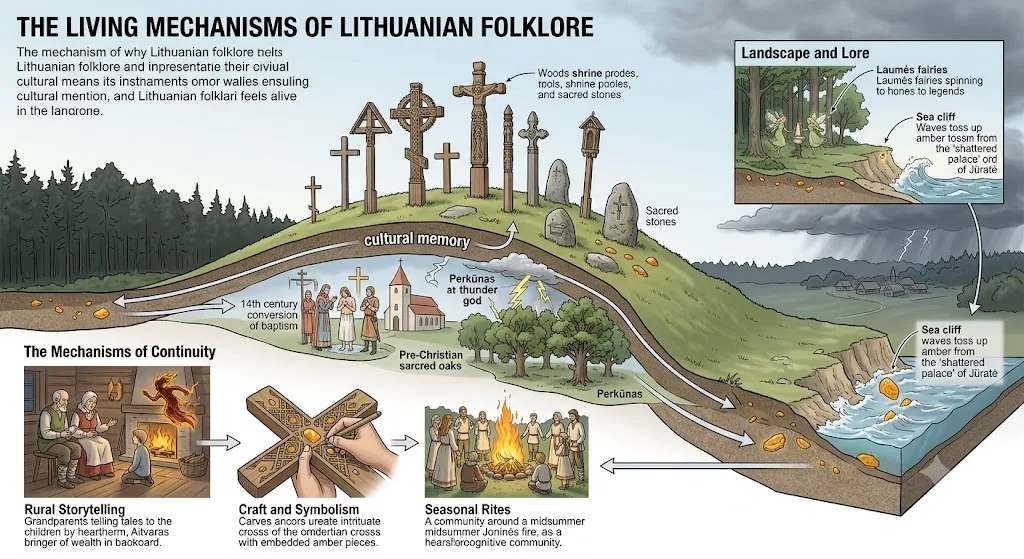
Lithuania is often described as Europe’s last officially pagan state, but that phrase needs care. It does not mean that every later custom is a pure survival from antiquity, or that modern retellings can be read as direct pagan scripture. It does mean that Lithuania’s late medieval conversion left unusually rich ground for later traditions in which thunder, sacred trees, snakes, stones, fire, fate, household luck and the dead remained culturally meaningful. Historian Darius Baronas notes that Lithuania’s pagan population officially converted to Roman Catholicism in 1387, while Samogitia converted later, in 1413–1417; later historians also stress that conversion was a process, not an overnight replacement of one worldview with another.[gs.elaba.lt]gs.elaba.ltOpen source on elaba.lt.
The most important figure in this older religious layer is Perkūnas, the thunder god. Recent scholarship describes him as one of the best documented pre-Christian Lithuanian deities, known through historical sources, folklore, language, place names and idioms. In folk narratives, he is not simply “the Lithuanian Thor”, though comparison with other Indo-European thunder gods can be useful. He appears as a force of storm, justice and order, often in conflict with Velnias, a devil-like figure whose name and role do not map neatly onto the Christian devil.[Folklore Fellows]folklorefellows.fiFolklore Fellows1Folklore Fellows1
That difficulty of translation is a recurring feature of Lithuanian folklore. A being may look Christian in one version, pre-Christian in another, comic in a children’s tale, dangerous in a legend and decorative in a tourist carving. The same figure can be a moral warning, a memory of older cosmology, a joke about greed or a way of explaining why lightning strikes a tree, why amber comes from the sea or why a hill is feared after dark.
The national legends readers meet first
The founding legend of Vilnius is the country’s most public city myth. In the story, Grand Duke Gediminas sleeps in the valley near what becomes Vilnius and dreams of an iron wolf howling with the force of many wolves. The seer Lizdeika interprets the dream: a capital should be founded there, and its fame will spread widely. The story is not treated as literal urban planning evidence, but it is central to how Vilnius imagines itself: a city born from a dream, a hill, a wild animal and a prophecy.[Orbis Lituaniae]ldkistorija.ltOrbis Lituaniae -The Lithuanian Chronicles' Tale of the Founding of VilniusOrbis Lituaniae -The Lithuanian Chronicles' Tale of the Founding of Vilnius
Eglė, the Queen of Serpents is a different kind of national story: intimate, frightening and tragic. The tale centres on a woman who marries a serpent or grass-snake husband, lives between the human world and an underwater or otherworldly realm, and finally transforms her children into trees after betrayal and violence. More than a hundred variants have been collected, and scholars have treated it as one of the richest Lithuanian tales for thinking about kinship, marriage, taboo, transformation and the boundary between human and non-human worlds. It became especially prominent in modern culture through literary and stage adaptations, including Salomėja Nėris’s poem and later Soviet-era theatrical productions.[Wikipedia]WikipediaEglė the Queen of SerpentsEglė the Queen of Serpents
Jūratė and Kastytis, by contrast, shows how a beloved “folk” legend can have a more literary-romantic history. The story tells of a sea goddess or queen who falls in love with a fisherman; the thunder god destroys her amber palace, and pieces of amber washing ashore become signs of her grief. It was first recorded in the nineteenth century and has since been adapted in poems, music, monuments and seaside tourism. Palanga’s Jūratė and Kastytis sculpture and local storytelling make the legend feel ancient and coastal, but source-aware accounts usually distinguish its modern literary shaping from older, broadly attested oral material.[Wikipedia]WikipediaJūratė and KastytisJūratė and Kastytis
Creatures, spirits and the everyday supernatural
Lithuanian folklore is not only about grand gods and national legends. Much of its texture lies in smaller beings who live close to the farm, forest, bathhouse, road, field or child’s bed. These figures often behave less like fixed “species” from fantasy fiction and more like flexible story roles. They explain luck, illness, bad behaviour, temptation, fear, sudden wealth or danger at the edge of the known world.
Laumės are among the most distinctive figures. They are often translated loosely as fairies, but that word can be misleading if it makes them sound tiny or harmless. In Lithuanian tradition they may be associated with women’s work, spinning, children, punishment, reward and liminal places. Research on child-frightening figures in Lithuanian tradition notes that laumės, devils and witches appear in fairy tales and legends used around children, sometimes not as direct claims of danger but as controlled, aesthetic experiences of fear.[Academy's Library Repository]real.mtak.huAcademy's Library Repository Child-threatening Mythical Creatures in TraditionalAcademy's Library Repository Child-threatening Mythical Creatures in Traditional
Aitvaras is another memorable figure: a flying or fiery household being often connected with wealth. In some accounts it brings goods to its owner, but the benefit is morally dangerous because the wealth may be stolen or uncanny. Kaukas is closer to a brownie-like household spirit, while the Lithuanian devil figure can be foolish, crafty, dangerous or comic depending on the genre. Folklore specialists caution that only some Lithuanian beings are strongly distinctive to Lithuania; many have analogues across Christian and Baltic regions, which is exactly what one would expect from centuries of shared storytelling, translation and religious change.[Deep Baltic]deepbaltic.comOpen source on deepbaltic.com.
Witches also belong to both story and landscape. Lithuanian and Latvian traditions share the word ragana for a witch, and scholarship on Baltic fairy tales has examined how names and roles for witches vary across the region. In Lithuanian belief culture, witches are not confined to fairy-tale cottages. They gather on hills, appear in trial records, threaten children, disturb households and become part of local place memory.[KU]www1.ku.deOpen source on ku.de.
Sacred landscapes: hills, crosses, forests and the sea
Lithuanian folklore is strongly place-based. A hill is rarely only a hill; it may be a former hillfort, a sacred place, a witch-gathering site, a burial memory, a tourist destination or all of these at once. Vykintas Vaitkevičius’s work on ancient sacred places stresses the crossroads between geography, archaeology and folklore, including hills and other natural sites remembered through stories and belief. One striking example is Šatrija Hill in Samogitia, described in research as a historical site that developed from an Iron Age hillfort into a legendary place of witches’ gatherings.[Klaipėdos Universitetas]e-journals.ku.ltOpen source on ku.lt.
The Hill of Crosses near Šiauliai shows a later but equally powerful form of sacred landscape. It is not a pagan shrine in any simple sense; it is a Catholic and national site, famous for thousands of crosses and for its survival through periods of suppression. Lithuania Travel describes it as a sacral place covered with about 200,000 crosses and connected with faith, hope and resilience, while UNESCO recognises Lithuanian cross-crafting and its symbolism as intangible cultural heritage.[Lithuania Travel]lithuania.travelOpen source on lithuania.travel.
Cross-crafting is especially important because it shows how Lithuanian tradition often works through blending rather than replacement. UNESCO defines it as the making of crosses and altars, together with their consecration and associated rituals. Lithuanian cultural accounts describe the tradition as a fusion of Christian devotion, woodcraft, roadside memory, village protection and older symbolic ornament. A cross could stand by a road, near a home, in a graveyard or at a crossroads; it could mark grief, gratitude, danger, prayer or communal identity.[Intangible Cultural Heritage]ich.unesco.orgOpen source on unesco.org.
The sea has its own legendary charge, especially through amber. The Jūratė and Kastytis story turns Baltic amber into emotional evidence: the sea throws up fragments of a shattered palace or tears of a grieving goddess. That is not geology, of course, but it is a good example of how folklore turns a local material into a story people can carry, sell, sculpt, sing and remember.[Palangos turizmo informacijos centras]visit-palanga.ltOpen source on visit-palanga.lt.
Seasonal customs keep folklore visible
Lithuanian folklore is still encountered most easily through the ritual calendar: winter masking, spring renewal, midsummer fires, harvest customs, cemetery visits and family rites. These customs are not museum pieces. They are performed, adapted, taught to children, staged at festivals, filmed for visitors and debated by people who care about authenticity.
Midsummer, often associated with Joninės or Rasos, is one of the clearest examples. Modern descriptions emphasise bonfires, wreaths, singing, dancing, herbs, water and the search for a magical fern blossom. Some elements are linked to older nature-centred belief, while the Christian calendar connects the celebration with Saint John. The result is not a neat pagan-versus-Christian split, but a layered holiday where romance, fertility, luck, summer light and national tradition overlap.[izzigo.eu]izzigo.euMidsummer Celebration – Joninės / RasosMidsummer Celebration – Joninės / Rasos
Sutartinės, Lithuanian multipart songs, show how folklore can be both local and internationally recognised. UNESCO describes them as a form of polyphonic music performed by female singers in north-east Lithuania, with simple melodies of two to five pitches. They were inscribed on UNESCO’s Representative List in 2010 and are now sustained by ensembles, festivals and cultural education even though their older village setting has changed.[Intangible Cultural Heritage]ich.unesco.orgOpen source on unesco.org.
Lithuania’s intangible heritage is broader than one song style. UNESCO lists several Lithuanian or Baltic traditions, including cross-crafting, sutartinės, Baltic song and dance celebrations, and straw garden making. This matters for folklore because it shows how oral tradition, craft, music and ritual are now safeguarded through institutions as well as through families and villages.[Intangible Cultural Heritage]ich.unesco.orgIntangible Cultural Heritage LithuaniaIntangible Cultural Heritage Lithuania
Archives, collectors and the problem of “how old is it?”
For readers, the hardest question is often “Is this really ancient?” The honest answer is: sometimes partly, sometimes not, and often the evidence is layered. Lithuanian folklore has deep roots, but many familiar versions were written down in the nineteenth and twentieth centuries, shaped by collectors, national revival writers, schoolbooks, theatre, Soviet cultural policy and tourism.
The Institute of Lithuanian Literature and Folklore is central here. Its work includes fundamental publications of Lithuanian folk songs, fairy tales, legends, proverbs and sayings, as well as research into mythology, traditional culture and contemporary folklore. Its Department of Folk Narrative is tied to the Lithuanian Folklore Archive, whose collections go back through major twentieth-century institutions and continue to be published and studied.[llti.lt]llti.ltOpen source on llti.lt.
Jonas Basanavičius is one of the key collector-intellectuals in this story. The National Museum of Lithuania notes that his birthplace displays his publications on Lithuanian folklore and mythology, and recent museum writing describes his interest in customs, folklore, mythology and folk-art monuments such as crosses and shrine poles. He belongs to the period when folklore collection was closely connected with national identity: recording songs, tales and beliefs was not only antiquarian work, but also a way of arguing that Lithuanian language and culture had depth, dignity and continuity.[lnm.lt]lnm.ltOpen source on lnm.lt.
This archival background helps separate old tradition from modern invention. Eglė has many collected variants and a strong place in Lithuanian tale tradition; Jūratė and Kastytis is famous but more visibly shaped by nineteenth-century literary Romanticism; the Iron Wolf is a chronicle-linked city legend used in modern civic identity; and the Hill of Witches at Juodkrantė is a modern sculpture trail that deliberately stages older legendary beings through twentieth-century folk art.[wikipedia.org]WikipediaEglė the Queen of SerpentsEglė the Queen of Serpents

Regional traditions make Lithuania more than one folklore map
A country-level view is useful, but Lithuanian folklore is not uniform. Lithuania is commonly divided into five ethnographic regions: Aukštaitija, Samogitia, Dzūkija, Suvalkija and Lithuania Minor. Lithuania Travel describes these as distinct regions with their own character and traditions, while other cultural material links regional identity to dialect, costume, song, architecture, livelihood and landscape.[Lithuania Travel]lithuania.travelOpen source on lithuania.travel.
This matters because stories and songs often make more sense when placed in their local environment. Dzūkija’s forest culture, for example, gives a different feel to tales, songs and seasonal practices than the coastal world of Lithuania Minor or the hillfort landscapes of Samogitia. North-east Lithuania is especially associated with sutartinės, while Samogitia carries strong associations with later Christianisation, hill legends and places such as Šatrija.[lb.lt]lb.ltskrajute EN www (1skrajute EN www (1
Regional variation also prevents a common mistake: treating “Lithuanian mythology” as a single tidy pantheon. Folklore is messier than that. A creature’s name, moral role or appearance may shift from district to district; Christian figures may replace older ones in some stories; a fairy-tale witch may become a local witch of a named hill; and a household spirit may be remembered as harmless, useful, frightening or morally suspect depending on who tells the story.
Folklore today: museums, trails, festivals and popular culture
Modern Lithuania does not keep folklore only in books. The National Museum of Lithuania, local museums, folk ensembles, heritage centres and festivals all turn older traditions into public culture. The National Museum has recently advertised guided tours and educational activities on Lithuanian mythology and mythical beings, showing how folklore is presented to families, visitors and urban audiences rather than only to specialists.[lnm.lt]lnm.ltWhen Museums Stay Awake: A Night at the NationalWhen Museums Stay Awake: A Night at the National
The Hill of Witches at Juodkrantė is one of the clearest examples of folklore turned into public art. It is an open-air trail of more than 80 wooden sculptures depicting devils, witches, spirits and legendary characters. It is not an untouched ancient cult site; it is a modern artistic landscape that began with sculpture camps in the late twentieth century. Yet it succeeds because it gives physical form to a story-world many Lithuanians recognise: trickster devils, frightening witches, enchanted forests, sea legends and midsummer night strangeness.[ltfai.org]ltfai.orgOpen source on ltfai.org.
Popular culture continues the same process. Eglė has moved through print, poetry, ballet and theatre; Jūratė and Kastytis through monuments and seaside identity; the Iron Wolf through tourism, public art and city branding. These modern versions are not fake merely because they are modern. They are part of how folklore survives: by being retold in the forms each generation actually uses.[openjournals.ge]cils.openjournals.geOpen source on openjournals.ge.
What to remember about Lithuanian folklore
Lithuanian folklore is most rewarding when read as a layered tradition rather than a lost pagan manual. It preserves traces of Baltic religion, but it also carries Catholic devotion, village humour, children’s fear, regional identity, national revival politics, Soviet-era adaptation and twenty-first-century heritage work. Its most memorable stories are not isolated curiosities: the Iron Wolf explains a capital, Eglė turns family betrayal into tree-transformation, Jūratė turns amber into grief, Perkūnas turns thunder into justice, and cross-crafting turns wood, road and prayer into a public landscape of memory.
The strongest evidence for this tradition comes from a mixture of sources: collected oral variants, folk-song archives, place legends, museum collections, UNESCO heritage files, scholarly studies and living performance. That mix is exactly why Lithuania’s folklore still feels vivid. It is old enough to carry the atmosphere of sacred groves, thunder and household spirits, but active enough to appear in festivals, trails, schools, museums, songs and the stories visitors hear when they stand on a hill above Vilnius or pick up amber beside the Baltic Sea.
Amazon book picks
Further Reading
Books and field guides related to Why Lithuanian Folklore Still Feels Alive. Use these as the next step if you want deeper reading beyond the article.
eBay marketplace picks
Marketplace Samples
Live-tested eBay searches with available results related to this page.
Endnotes
1.
Source: gs.elaba.lt
Link:https://gs.elaba.lt/object/elaba%3A21301696/21301696.pdf
2.
Source: llti.lt
Link:https://www.llti.lt/en/folklore/
3.
Source: ich.unesco.org
Title: Intangible Cultural Heritage Lithuania
Link:https://ich.unesco.org/en/state/lithuania-LT
4.
Source: Wikipedia
Title: Eglė the Queen of Serpents
Link:https://en.wikipedia.org/wiki/Egl%C4%97_the_Queen_of_Serpents
5.
Source: cils.openjournals.ge
Link:https://cils.openjournals.ge/index.php/cils/article/view/7553/7528
6.
Source: Wikipedia
Title: Jūratė and Kastytis
Link:https://en.wikipedia.org/wiki/J%C5%ABrat%C4%97_and_Kastytis
7.
Source: lithuania.travel
Link:https://lithuania.travel/en/where-to-visit/regions/zemaitija-en/the-hill-of-crosses
8.
Source: ich.unesco.org
Link:https://ich.unesco.org/en/RL/cross-crafting-and-its-symbolism-00013
9.
Source: izzigo.eu
Title: Midsummer Celebration – Joninės / Rasos
Link:https://izzigo.eu/country-fact/midsummer-celebration-jonines-rasos/
10.
Source: ich.unesco.org
Link:https://ich.unesco.org/en/RL/sutartins-lithuanian-multipart-songs-00433
11.
Source: llti.lt
Link:https://www.llti.lt/en/department_of_folk_narrative/
12.
Source: lnm.lt
Link:https://lnm.lt/en/museums/jonas-basanavicius-birthplace/
13.
Source: lnm.lt
Link:https://lnm.lt/en/news/for-jonas-basanavicius-175th-anniversary-sculptor-mykolas-sauka-unveils-koplytstulpis-shrine-pole/
14.
Source: ltfai.org
Link:https://ltfai.org/the-hill-of-witches/
15.
Source: lithuania.travel
Link:https://lithuania.travel/en/where-to-visit/regions
16.
Source: lnm.lt
Title: When Museums Stay Awake: A Night at the National
Link:https://lnm.lt/en/news/when-museums-stay-awake-a-night-at-the-lithuanian-national-museum-opens-history-to-all-the-senses/
17.
Source: lnm.lt
Title: the house of histories launches family weekend season with an ainu adventure
Link:https://lnm.lt/en/news/the-house-of-histories-launches-family-weekend-season-with-an-ainu-adventure/
18.
Source: Wikipedia
Title: List of Lithuanian gods and mythological figures
Link:https://en.wikipedia.org/wiki/List_of_Lithuanian_gods_and_mythological_figures
19.
Source: Wikipedia
Link:https://en.wikipedia.org/wiki/Aitvaras
20.
Source: Wikipedia
Title: Hill of Crosses
Link:https://en.wikipedia.org/wiki/Hill_of_Crosses
21.
Source: Wikipedia
Title: Cultural regions of Lithuania
Link:https://en.wikipedia.org/wiki/Cultural_regions_of_Lithuania
22.
Source: Wikipedia
Title: Christianization of Lithuania
Link:https://en.wikipedia.org/wiki/Christianization_of_Lithuania
23.
Source: lnm.lt
Link:https://lnm.lt/en/news/on-saturday-night-culture-in-vilnius-wont-sleep-the-national-museum-of-lithuania-opens-its-doors-for-free/
24.
Source: lnm.lt
Link:https://lnm.lt/en/news/the-national-museum-of-lithuania-celebrates-its-170th-anniversary-and-invites-you-on-a-grand-birthday-adventure/
25.
Source: llti.lt
Link:https://www.llti.lt/en/department_of_folklore_archive_/
26.
Source: llti.lt
Link:https://www.llti.lt/failai/Leonardas%20Sauka%2C%20Along%20the%20path%20of%20folklore%20research.pdf
27.
Source: llti.lt
Link:https://www.llti.lt/failai/program%203.pdf
28.
Source: llti.lt
Link:https://www.llti.lt/failai/04%20Foreword.pdf
29.
Source: archyvas.llti.lt
Link:https://archyvas.llti.lt/failai/YoFo2024_Abstract%20book%281%29.pdf
30.
Source: llti.lt
Link:https://www.llti.lt/failai/04_Foreword%286%29.pdf
31.
Source: llti.lt
Link:https://www.llti.lt/failai/Lietuviu%20misles_Riinktine_Kensminiene%20Aelita%20sud.pdf
32.
Source: llti.lt
Link:https://www.llti.lt/failai/03_Foreword.pdf
33.
Source: llti.lt
Link:https://www.llti.lt/failai/04%20Foreword%282%29.pdf
34.
Source: llti.lt
Link:https://www.llti.lt/failai/laime%281%29.pdf
35.
Source: ich.unesco.org
Link:https://ich.unesco.org/en/projects/the-safeguarding-and-revitalization-of-lithuanian-cross-crafting-and-its-symbolism-phase-i-of-the-action-plan-00002
36.
Source: unesco.lt
Link:https://unesco.lt/wp-content/uploads/2026/03/cross-crafting_CandidatureFile.pdf
37.
Source: archive.org
Title: gimbutas ancient symbolism in lithuanian folk art 1958
Link:https://archive.org/details/gimbutas-ancient-symbolism-in-lithuanian-folk-art-1958
38.
Source: youtube.com
Title: Lithuanian Mythology Part 1: The Cosmic Egg
Link:https://www.youtube.com/watch?v=SOyXkhhUPfA
Source snippet
Jūratė and Kastytis - Love Story from Baltic Mythology...
39.
Source: youtube.com
Title: Jūratė and Kastytis
Link:https://www.youtube.com/watch?v=NGzqpA2sCq4
Source snippet
Baltic paganism and Lithuanian mythology...
40.
Source: folklorefellows.fi
Title: Folklore Fellows1
Link:https://www.folklorefellows.fi/wp-content/uploads/FFC-327-Laurinkiene-Introduction.pdf
41.
Source: ldkistorija.lt
Title: Orbis Lituaniae -The Lithuanian Chronicles’ Tale of the Founding of Vilnius
Link:https://www.ldkistorija.lt/the-lithuanian-chronicles-tale-of-the-founding-of-vilnius-myth-or-history/
42.
Source: visit-palanga.lt
Link:https://www.visit-palanga.lt/en/sightseeing-places/skulptura-jurate-ir-kastytis/
43.
Source: real.mtak.hu
Title: Academy’s Library Repository Child-threatening Mythical Creatures in Traditional
Link:https://real.mtak.hu/128222/1/article-p425.pdf
44.
Source: deepbaltic.com
Link:https://deepbaltic.com/2021/12/07/mapping-folklore-mythical-creatures-of-the-baltics-and-beyond/
45.
Source: www1.ku.de
Link:https://www1.ku.de/SLF/EngluVglSW/gliwa1031.pdf
46.
Source: e-journals.ku.lt
Link:https://e-journals.ku.lt/journal/AB/article/1694/file/pdf
47.
Source: lb.lt
Title: skrajute EN www (1)
Link:https://www.lb.lt/uploads/documents/files/skrajute_EN_www%20%281%29.pdf
48.
Source: facebook.com
Link:https://www.facebook.com/AglajaRay/posts/egl%C4%97-the-queen-of-serpents-most-famous-lithuanian-fairytale-from-the-different-a/2271657159550938/
49.
Source: publicera.kb.se
Link:https://publicera.kb.se/arv/article/view/48457
50.
Source: publicera.kb.se
Link:https://publicera.kb.se/arv/article/view/48457/50728
51.
Source: journals.vu.lt
Link:https://www.journals.vu.lt/knygotyra/en/article/view/1370
52.
Source: lb.lt
Link:https://www.lb.lt/en/flyers/dzukija-en
53.
Source: traditionarchives.org
Link:https://www.traditionarchives.org/archives/lithuania
54.
Source: lituanistika.lt
Link:https://www.lituanistika.lt/content/78964
55.
Source: siauliurajonas.lt
Title: Hill of Crosses
Link:https://www.siauliurajonas.lt/en/info/hill-of-crosses-2/
56.
Source: warriorsofmyth.fandom.com
Link:https://warriorsofmyth.fandom.com/wiki/Aitvaras
57.
Source: europeisnotdead.com
Link:https://europeisnotdead.com/lithuania-egle-the-queen-of-serpents/
58.
Source: berezokmedia.lt
Title: “Lithuanian folklore and mythology”
Link:https://berezokmedia.lt/lithuanian-folklore-and-mythology-2024
Additional References
59.
Source: youtube.com
Title: The most beautiful Lithuanian fairy tale. Egle The Queen Of Grass Snakes
Link:https://www.youtube.com/watch?v=WZSeK_TZArE
Source snippet
Baltic Mythology's Most Powerful Gods and Goddesses...
60.
Source: raganukalnas.lt
Link:https://www.raganukalnas.lt/en/sculptures/-aitvarai-a-magic-creatures-of-lithuanian-mythology-/67
61.
Source: academia.edu
Link:https://www.academia.edu/93934833/Ancient_Sacred_Places_in_Lithuania_Crossroads_of_Geography_Archaeology_and_Folklore
62.
Source: academia.edu
Link:https://www.academia.edu/128576313/Folk_Tale_Egl%C4%97the_Queen_of_Serpents_Egl%C4%97%C5%BDal%C4%8Di%C5%B3_Karalien%C4%97_on_the_Soviet_Stage_as_a_Representation_of_Lithuanian_Culture
63.
Source: academia.edu
Link:https://www.academia.edu/693355/Studies_into_the_Balts_Sacred_Places
64.
Source: researchgate.net
Link:https://www.researchgate.net/publication/338834796_Lithuanian_Mythological_Creatures_Laumes_and_their_Equivalents_in_Russian_and_English
65.
Source: researchgate.net
Link:https://www.researchgate.net/publication/339501830_Christians_in_Late_Pagan_and_Pagans_in_Early_Christian_Lithuania_The_Fourteenth_and_Fifteenth_Centuries
66.
Source: pinigumuziejus.lt
Link:https://www.pinigumuziejus.lt/en/news/ancient-baltic-deities-that-brought-fortune-to-people
67.
Source: prussia.online
Link:https://prussia.online/Data/Book/an/ancient-symbolism-in-lithuanian-folk-art/Gimbutas%20M.%20Ancient%20Symbolism%20in%20Lithuanian%20Folk%20Art%20%281958%29%20archive.org%2C%20OCR.pdf
68.
Source: instagram.com
Link:https://www.instagram.com/reel/DChUA07tzw5/
Topic Tree
Follow this branch
Related pages 192
- Afghan Folklore
- Albanian Folklore
- Algerian Folklore
- Australian Folklore
- Azerbaijan Folklore
- +187 more in sidebar