Within Canada Folklore
Why These Stories Are Living Knowledge
Indigenous oral traditions carry histories, teachings, sacred responsibilities, and beings that should not be flattened into monster lore.
On this page
- Oral tradition as history and teaching
- Sacred stories, timing, and community responsibility
- What popular retellings often lose
Page outline Jump by section
Introduction
Canada’s oldest and deepest story traditions are Indigenous oral traditions, but describing them simply as “myths” or “folklore” can be misleading. Across First Nations, Inuit, and Métis communities, oral traditions are not merely tales from the distant past. They are living systems of knowledge that carry history, law, ethics, spiritual teachings, environmental understanding, family memory, and community identity. Stories are often linked to particular places, seasons, ceremonies, languages, and responsibilities. They continue to be told, interpreted, and protected today.[ubc.ca]indigenousfoundations.arts.ubc.caIndigenous FoundationsOral Traditions | indigenousfoundationsOral traditions form the foundation of Aboriginal societies, connecting spea…

For readers exploring Canadian folklore, this distinction matters. Many famous figures that appear in popular books or internet lists of “Canadian monsters” originally come from Indigenous knowledge traditions. Removed from their cultural context, they can look like supernatural curiosities. Within their communities, however, they often serve as teachings about relationships, conduct, survival, spirituality, and responsibility.[Indigenous Peoples Atlas of Canada]indigenouspeoplesatlasofcanada.caIndigenous Peoples Atlas of CanadaOral TraditionIf you retell a Métis story, you must obtain the permission from the storyteller who told…
Oral Tradition as History and Teaching
A common misunderstanding is that oral tradition exists because Indigenous peoples lacked written records. Indigenous scholars and educators have repeatedly challenged this assumption. Oral traditions are not failed versions of written history; they are distinct ways of preserving and transmitting knowledge. They connect generations through storytelling, songs, ceremonies, performances, place names, and collective memory.[ubc.ca]indigenousfoundations.arts.ubc.caIndigenous FoundationsOral Traditions | indigenousfoundationsOral traditions form the foundation of Aboriginal societies, connecting spea…
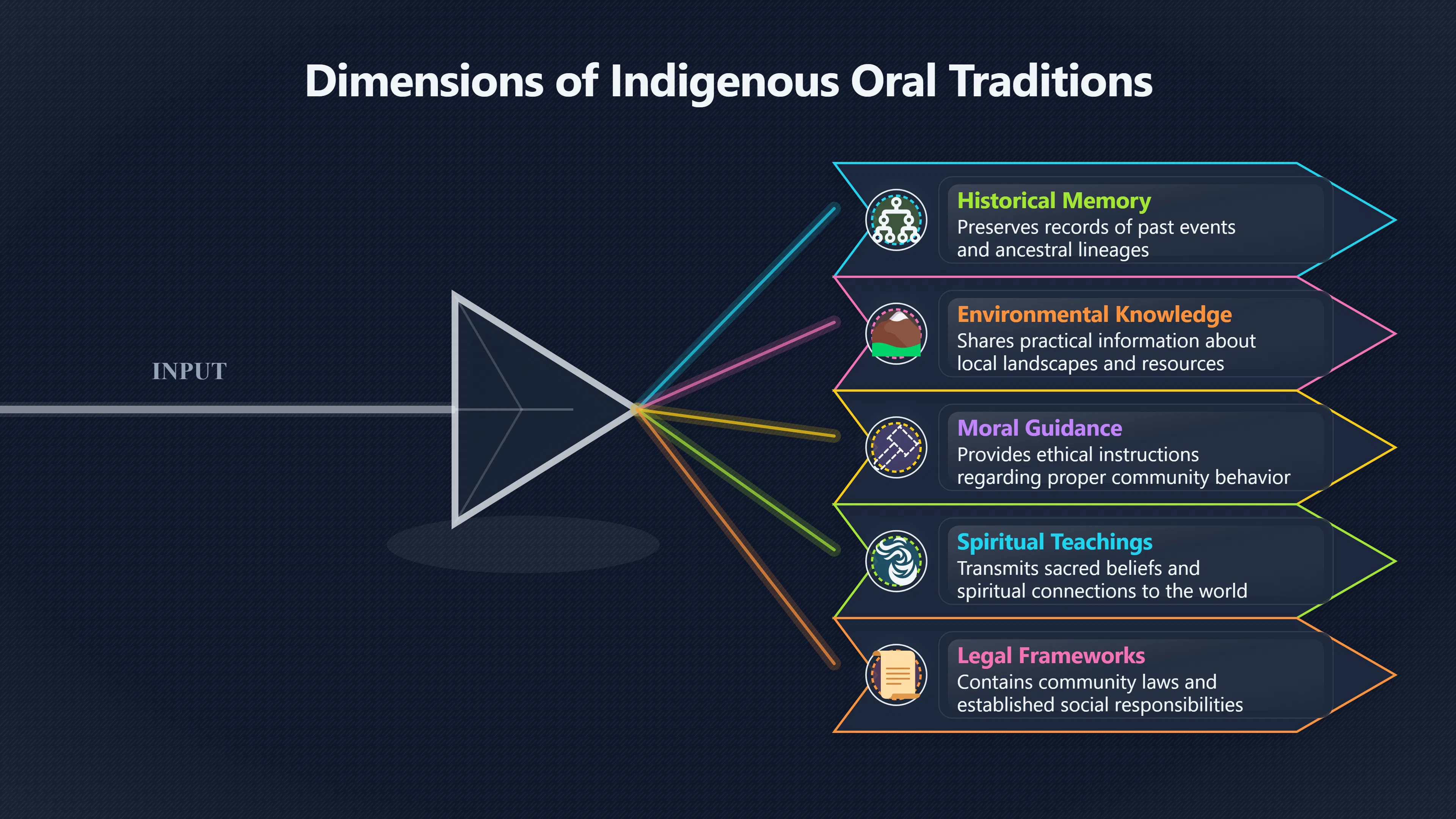
In many Indigenous communities, stories teach multiple lessons at once. A narrative may contain:
- Historical memory about a place or event.
- Practical knowledge about the environment.
- Moral guidance about proper behaviour.
- Spiritual teachings.
- Community laws and responsibilities.
- Family or kinship histories.[thecanadianencyclopedia.ca]thecanadianencyclopedia.caindigenous oral histories and primary sourcesThey transmit important histories, stories and teachings to new generations.Read more…
Listeners are often expected to return to the same story repeatedly over a lifetime. Meanings that seem simple to a child may reveal deeper layers to an adult. This layered quality is one reason many Indigenous knowledge keepers emphasise that stories are not merely entertainment.[indigenouspeoplesatlasofcanada.ca]indigenouspeoplesatlasofcanada.caIndigenous Peoples Atlas of CanadaOral TraditionIf you retell a Métis story, you must obtain the permission from the storyteller who told…
The relationship between story and land is especially important. Across many Indigenous cultures in Canada, knowledge is tied to specific rivers, coastlines, mountains, lakes, migration routes, and harvesting areas. Stories help people remember how to live within those landscapes and maintain reciprocal relationships with them.[cass.ab.ca]cass.ab.caLearning from the Land | CASS AlbertaLeroy Littlebear says that “The land is a sacred trust from the Creator. The land is the giver of li…
Why Stories Are Not All the Same
Non-Indigenous readers often expect every traditional story to be publicly available. Indigenous traditions frequently operate differently.
Many communities distinguish between different categories of knowledge. Some stories may be widely shared and suitable for public audiences. Others are sacred, ceremonial, family-owned, seasonally restricted, or intended only for people with particular responsibilities. Certain narratives may be told only during specific times of year or under specific circumstances.[Indigenous Peoples Atlas of Canada]indigenouspeoplesatlasofcanada.caIndigenous Peoples Atlas of CanadaOral TraditionIf you retell a Métis story, you must obtain the permission from the storyteller who told…
This means that a complete public catalogue of Indigenous stories does not exist and, in many cases, should not exist. Knowledge may be protected not because it is secret in a modern commercial sense, but because its meaning depends on proper relationships, context, and responsibility.[Indigenous Peoples Atlas of Canada]indigenouspeoplesatlasofcanada.caIndigenous Peoples Atlas of CanadaOral TraditionIf you retell a Métis story, you must obtain the permission from the storyteller who told…
The idea of ownership can also differ from mainstream assumptions. The Indigenous Peoples Atlas of Canada notes that in some Métis storytelling traditions, permission from the storyteller may be required before a story is retold. The right to tell a story can carry obligations as well as privileges.[Indigenous Peoples Atlas of Canada]indigenouspeoplesatlasofcanada.caIndigenous Peoples Atlas of CanadaOral TraditionIf you retell a Métis story, you must obtain the permission from the storyteller who told…
Sacred Stories, Timing, and Community Responsibility
One of the most important things popular retellings often miss is that storytelling can be an act of responsibility.
In many Indigenous cultures, Elders, knowledge keepers, and recognised storytellers do not simply repeat narratives from memory. They carry responsibilities for accuracy, context, and appropriate transmission. The storyteller is often part of the teaching itself. Authority comes not only from knowing a story but from understanding when, why, and to whom it should be told.[Building Brains Together]buildingbrains.caBuilding Brains TogetherOral Traditions and Storytelling of the Indigenous PeopleJanuary 27, 2022 — 27 Jan 2026 — Oral stories from cerem…
Timing matters as well. Certain stories are associated with winter storytelling seasons, ceremonial gatherings, or particular social settings. The restriction is not arbitrary. It helps maintain the relationship between the story, the community, and the world it describes.[Indigenous Peoples Atlas of Canada]indigenouspeoplesatlasofcanada.caIndigenous Peoples Atlas of CanadaOral TraditionIf you retell a Métis story, you must obtain the permission from the storyteller who told…
This perspective can be difficult for audiences accustomed to books, films, or websites where stories are treated as freely transferable content. Within many Indigenous traditions, a story is not just information. It is part of a living network of relationships among people, ancestors, communities, languages, and lands.[Indigenous Foundations]indigenousfoundations.arts.ubc.caIndigenous FoundationsOral Traditions | indigenousfoundationsOral traditions form the foundation of Aboriginal societies, connecting spea…
Living Knowledge in the Present, Not the Past
Another misconception is that oral traditions belong to a vanished world. In reality, they remain active across Canada.
Storytelling continues through family gatherings, community events, language revitalisation programmes, schools, cultural centres, digital projects, oral-history initiatives, and the work of Elders and knowledge keepers. Oral traditions are also central to contemporary Indigenous identity and cultural resurgence.[metisgathering.ca]metisgathering.caStorytellingThrough oral tradition, our Métis worldview, history, and cultural teachings are preserved for future generations. Our storie…
Modern oral traditions can address present-day concerns as well as ancestral knowledge. Communities continue to create, adapt, interpret, and transmit stories while maintaining connections to older teachings. This continuity reflects a common feature of folklore worldwide: traditions survive because they remain useful. Indigenous traditions in Canada demonstrate this process particularly clearly because storytelling remains embedded in community life rather than existing solely as historical heritage.[metisgathering.ca]metisgathering.caStorytellingThrough oral tradition, our Métis worldview, history, and cultural teachings are preserved for future generations. Our storie…
Métis storytelling provides a useful example. The Indigenous Peoples Atlas of Canada describes how Métis oral traditions combine influences from Indigenous and European ancestors while preserving distinct Métis perspectives, histories, and teachings. Rather than being frozen in time, the tradition reflects adaptation and cultural continuity.[Indigenous Peoples Atlas of Canada]indigenouspeoplesatlasofcanada.caIndigenous Peoples Atlas of CanadaAdaptive NatureMétis storytelling blends Algonquian creation, trickster and cannibal stories with Frenc…
What Popular Retellings Often Lose
When Indigenous stories enter popular culture, important context can disappear.
A recurring pattern in Canadian folklore writing is the extraction of individual beings or narratives from larger knowledge systems. A figure that originally functioned as a moral teaching, spiritual warning, or cultural lesson may be repackaged as a monster, cryptid, horror villain, or fantasy character. The result is often entertaining, but it can obscure the original meaning.[Indigenous Peoples Atlas of Canada]indigenouspeoplesatlasofcanada.caIndigenous Peoples Atlas of CanadaOral TraditionIf you retell a Métis story, you must obtain the permission from the storyteller who told…
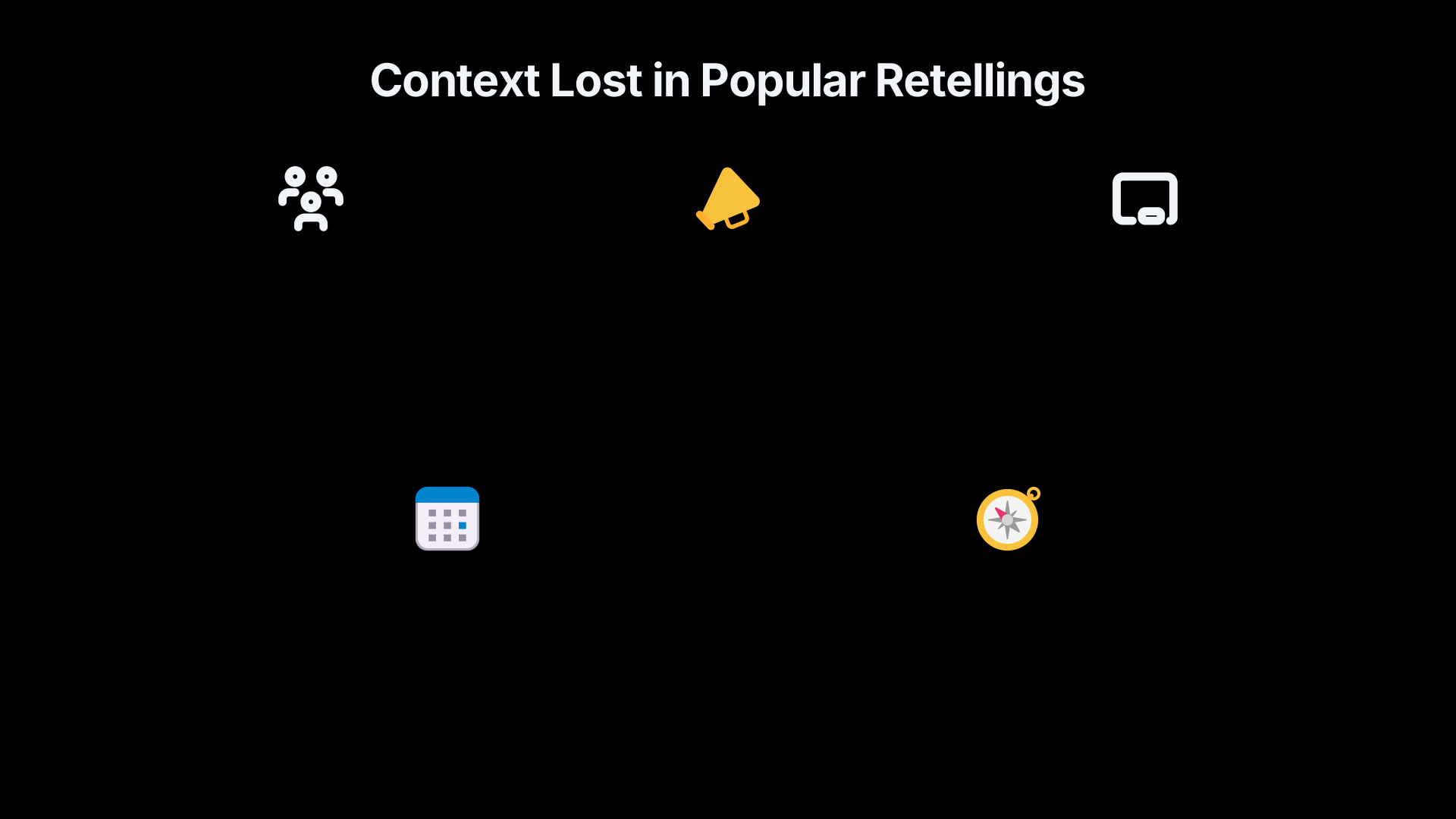
Several kinds of information are commonly lost:
- The community from which the story originates.
- The language in which it was traditionally told.
- The teaching purpose of the narrative.
- Seasonal or ceremonial restrictions.
- Connections to specific places and landscapes.
- The authority of Elders and knowledge keepers.[ubc.ca]indigenousfoundations.arts.ubc.caIndigenous FoundationsOral Traditions | indigenousfoundationsOral traditions form the foundation of Aboriginal societies, connecting spea…
This does not mean Indigenous stories cannot be shared publicly. Many communities actively publish, teach, and celebrate their traditions. The key issue is whether the story remains connected to its cultural context or is reduced to a detached piece of supernatural entertainment.[cangeoeducation.ca]cangeoeducation.caIndigenous Peoples Atlas of CanadaThis resource will assist you and your students in understanding the past, present and future of Indige…
Oral Traditions, Reconciliation, and Historical Evidence
Indigenous oral traditions are increasingly recognised in Canada not only as cultural expressions but also as legitimate sources of historical knowledge.
The Truth and Reconciliation Commission emphasised the importance of Indigenous oral histories, knowledge systems, laws, and connections to land in understanding Canada’s past and building reconciliation. Oral testimony from residential-school survivors became a crucial part of documenting experiences that had often been ignored or minimised in official records.[web-trc.ca]web-trc.caTheir knowledge systems, oral histories, laws, and connections to the land have…
Educational initiatives across Canada now use oral histories and community narratives to challenge older assumptions that written colonial records are automatically more authoritative than Indigenous accounts. Oral traditions are increasingly treated as primary sources that preserve perspectives unavailable elsewhere.[thecanadianencyclopedia.ca]thecanadianencyclopedia.caindigenous oral histories and primary sourcesThey transmit important histories, stories and teachings to new generations.Read more…
For folklore readers, this is an important reminder that Indigenous stories are not only about supernatural beings or distant origins. They also preserve memories of real experiences, social relationships, legal traditions, environmental knowledge, and historical events.[thecanadianencyclopedia.ca]thecanadianencyclopedia.caindigenous oral histories and primary sourcesThey transmit important histories, stories and teachings to new generations.Read more…
Understanding Indigenous Stories on Their Own Terms
The most useful way to approach Indigenous oral traditions in Canada is to recognise that they belong to living cultures rather than vanished mythologies. They are dynamic systems of knowledge maintained by communities, not relics preserved behind museum glass. Stories may be sacred, practical, historical, humorous, educational, or spiritual, often all at once.[ubc.ca]indigenousfoundations.arts.ubc.caIndigenous FoundationsOral Traditions | indigenousfoundationsOral traditions form the foundation of Aboriginal societies, connecting spea…
For anyone exploring Canadian folklore, this perspective changes the picture considerably. Indigenous traditions are not simply the oldest layer beneath later legends. They remain active voices in the present, continuing to shape identity, memory, language, relationships to land, and understandings of the past across Canada today.[metisgathering.ca]metisgathering.caStorytellingThrough oral tradition, our Métis worldview, history, and cultural teachings are preserved for future generations. Our storie…

Amazon book picks
Further Reading
Books and field guides related to Why These Stories Are Living Knowledge. Use these as the next step if you want deeper reading beyond the article.
The Truth about Stories
Directly examines how stories shape identity, history, and understanding.
Indigenous Writes
Helps explain Indigenous perspectives often lost in simplified retellings.
Braiding Sweetgrass
Explores Indigenous knowledge, storytelling, responsibility, and relationships to place.
The Inconvenient Indian
Provides historical and cultural context for understanding living traditions.
eBay marketplace picks
Marketplace Samples
Live-tested eBay searches with available results related to this page.

Endnotes
1.
Source: fb.historicacanada.ca
Link:https://fb.historicacanada.ca/education/english/voices-from-here/4/
Source snippet
Voices From HereOral Traditions encompass methods of verbally communicating worldviews, teachings, histories, values, laws, and family kn...
2.
Source: fernwoodpublishing.ca
Link:https://fernwoodpublishing.ca/books/aboriginal-oral-traditions?srsltid=AfmBOopF8bBdrl-OGI9Bsf7KNEYY_sGdfXUGwe8FEivXuCznlTbrGe7C
Source snippet
Aboriginal Oral TraditionsOral traditions are a distinct way of knowing and the means by which knowledge is reproduced, preserved and tra...
3.
Source: firstnationspedagogy.ca
Link:https://firstnationspedagogy.ca/storytelling.html
Source snippet
ion through oral traditions, including storytelling...
4.
Source: metisgathering.ca
Link:https://metisgathering.ca/history-culture/storytelling/
Source snippet
StorytellingThrough oral tradition, our Métis worldview, history, and cultural teachings are preserved for future generations. Our storie...
5.
Source: cass.ab.ca
Link:https://cass.ab.ca/indigenous-education/learning-from-the-land/
Source snippet
Learning from the Land | CASS AlbertaLeroy Littlebear says that “The land is a sacred trust from the Creator. The land is the giver of li...
6.
Source: lib.sfu.ca
Link:https://www.lib.sfu.ca/about/reach-us/library-blog/oral-traditions
Source snippet
SFU LibraryProject 57 Week 52: Oral Traditions - SFU Library30 Apr 2025 — Oral Traditions play an important role among many Indigenous co...
7.
Source: historicacanada.ca
Link:https://www.historicacanada.ca/en/productions/guides/voices-from-here-education-guide
Source snippet
Voices from Here Education GuideVoices from Here is an oral history project that shares the stories and experiences of Indigenous Peoples...
8.
Source: cangeoeducation.ca
Link:https://cangeoeducation.ca/en/maps/indigenous-peoples-atlas-of-canada/
Source snippet
Indigenous Peoples Atlas of CanadaThis resource will assist you and your students in understanding the past, present and future of Indige...
9.
Source: web-trc.ca
Link:https://web-trc.ca/
Source snippet
Their knowledge systems, oral histories, laws, and connections to the land have...
10.
Source: pmc.ncbi.nlm.nih.gov
Link:https://pmc.ncbi.nlm.nih.gov/articles/PMC7273385/
Source snippet
Witnessing at the Truth and Reconciliation Commission...by R Nagy · 2020 · Cited by 51 — The TRC embedded these possibilities through th...
11.
Source: canada.ca
Title: towards truth and reconciliation
Link:https://www.canada.ca/en/department-national-defence/corporate/reports-publications/towards-truth-and-reconciliation.html
Source snippet
A Learning Resource...13 Feb 2025 — The Guide was developed to help center and support Indigenous learning and reconciliation within the...
12.
Source: education.historicacanada.ca
Link:https://education.historicacanada.ca/files/666/Voices_from_Here_Education_Guide_FINAL.pdf
Source snippet
Truth and Reconciliation Commission of...
13.
Source: indigenousfoundations.arts.ubc.ca
Link:https://indigenousfoundations.arts.ubc.ca/oral_traditions/
Source snippet
Indigenous FoundationsOral Traditions | indigenousfoundationsOral traditions form the foundation of Aboriginal societies, connecting spea...
14.
Source: thecanadianencyclopedia.ca
Title: indigenous oral histories and primary sources
Link:https://thecanadianencyclopedia.ca/en/article/indigenous-oral-histories-and-primary-sources
Source snippet
They transmit important histories, stories and teachings to new generations.Read more...
15.
Source: indigenouspeoplesatlasofcanada.ca
Link:https://indigenouspeoplesatlasofcanada.ca/article/oral-tradition/
Source snippet
Indigenous Peoples Atlas of CanadaOral TraditionIf you retell a Métis story, you must obtain the permission from the storyteller who told...
16.
Source: buildingbrains.ca
Link:https://www.buildingbrains.ca/blog/oral-traditions-and-storytelling-of-the-indigenous-people
Source snippet
Building Brains TogetherOral Traditions and Storytelling of the Indigenous PeopleJanuary 27, 2022 — 27 Jan 2026 — Oral stories from cerem...
Published: January 27, 2022
17.
Source: indigenouspeoplesatlasofcanada.ca
Link:https://indigenouspeoplesatlasofcanada.ca/article/adaptive-nature/
Source snippet
Indigenous Peoples Atlas of CanadaAdaptive NatureMétis storytelling blends Algonquian creation, trickster and cannibal stories with Frenc...
18.
Source: indigenouspeoplesatlasofcanada.ca
Link:https://indigenouspeoplesatlasofcanada.ca/
Source snippet
Indigenous Peoples Atlas of CanadaIn this atlas, you will find outstanding reference maps of Indigenous Canada, as well as a section devo...
19.
Source: humanrights.ca
Link:https://humanrights.ca/education-resources/record/262c90fa-f116-4470-952a-4c965e70f1e5/
20.
Source: sites.google.com
Title: indigenous peoples atlas of canada
Link:https://sites.google.com/sd63.bc.ca/sd63indigenoused/indigenous-peoples-atlas-of-canada
Source snippet
Peoples Atlas of CanadaImportant topics such as treaties and residential schools are covered in-depth, as well as the contributions of In...
21.
Source: biblio.laurentian.ca
Link:https://biblio.laurentian.ca/guides/indigenous-peoples-atlas-canada
Source snippet
Peoples Atlas of Canada | Library and ArchivesProduced in partnership with the Assembly of First Nations, Inuit Tapiriit Kanatami, the Mé...
22.
Source: communitydata.ca
Title: Learning Resource
Link:https://communitydata.ca/content/learning-resource-indigenous-peoples-atlas-canada
Source snippet
Indigenous Peoples Atlas of CanadaThe Indigenous Peoples Atlas of Canada, a learning resournce on Indigenous lands, languange and culture...
Additional References
23.
Source: merriam-webster.com
Link:https://www.merriam-webster.com/dictionary/indigenous
Source snippet
INDIGENOUS Definition & Meaning4 days ago — native, indigenous, endemic, aboriginal mean belonging to a locality. native implies birth or...
24.
Source: idac.agency
Link:https://www.idac.agency/reconciliation
Source snippet
Reconciliation — Indigenous Dental Association of CanadaThe TRC of Canada was established as a result of the Indian Residential Schools S...
25.
Source: fnesc.ca
Link:https://www.fnesc.ca/wp/wp-content/uploads/2023/06/5.-BC-First-Peoples-12-Teacher-Resource-Guide-2022-final-R-Story-and-Story-Telling.pdf
Source snippet
Unit 2 Story and Storytelling14 Jun 2023 — Indigenous Foundations Oral Traditions web page, “Aboriginal oral histories within a legal con...
26.
Source: metismuseum.ca
Link:https://www.metismuseum.ca/media/document.php/00747.Traditional%20M%C3%A9tis%20Stories.pdf
Source snippet
These stories can only be told if the teller has permission from the story's original owner...
27.
Source: winnipegsd.ca
Title: The Indigenous Peoples Atlas of Canada Map
Link:https://www.winnipegsd.ca/the-indigenous-peoples-atlas-of-canada-map-an-interactive-learning-journey.37285
Source snippet
May 7, 2026 — It marks Indigenous communities around Canada and teaches on topics such as residential schools, reserves, languages, and h...
Published: May 7, 2026
28.
Source: youtube.com
Title: Lori Campbell | Ep 8 | Oral History | Voices From Here
Link:https://www.youtube.com/watch?v=Gzrtm99CXQ0
Source snippet
This collection provides direct insights from Indigenous elders, knowledge keepers, and communities in Canada, illustrating how oral trad...
29.
Source: facebook.com
Link:https://www.facebook.com/melanie.joly.965/posts/it-gives-me-great-pleasure-to-be-here-at-the-home-of-the-royal-canadian-geograph/1844038915905631/
Source snippet
This beautifully designed educational tool has been...
30.
Source: truthcommissions.humanities.mcmaster.ca
Title: TC Backgrounder Mary Isaac Canada
Link:https://truthcommissions.humanities.mcmaster.ca/wp-content/uploads/2021/07/TC-Backgrounder_Mary-Isaac_Canada.pdf
Source snippet
Response to the Legacy of Indigenous Residential Schools7 Jul 2021 — The Commission prioritized cultural revitalization, oral histories...
31.
Source: ictinc.ca
Link:https://www.ictinc.ca/blog/11-things-you-should-know-about-aboriginal-oral-traditions
Source snippet
on from one generation to the next.Read more...
32.
Source: youtube.com
Title: Indigenous Peoples In Canada
Link:http://www.youtube.com/watch?v=Z3Fjw2o4KSA
Source snippet
Wes FineDay | Ep 1 | Oral History | Voices From Here...
Topic Tree