Why Georgia's Old Stories Still Feel Alive
Georgia’s folklore is a mountain-and-crossroads tradition: part heroic epic, part fairy tale, part village ritual, part Christian folk religion, and part older belief world surviving inside songs, shrines and seasonal customs.
Page outline Jump by section
Introduction
The key to understanding Georgian folklore is not to treat it as a neat ancient “pantheon”. Much of it is regional, oral and changeable. A Svan hunting story, a Mingrelian forest-spirit account, a Kakhetian masquerade and a Christian legend about Saint George may all feel recognisably Georgian, yet they come from different landscapes and social worlds. Georgia’s position in the Caucasus, between eastern and western cultural zones, also helped its tales absorb, reshape and localise travelling story patterns.[geofolk.ge]geofolk.geGeorgian Folk Tales (A Brief OverviewGeorgian Folk Tales (A Brief Overview
Why Georgian folklore feels so local
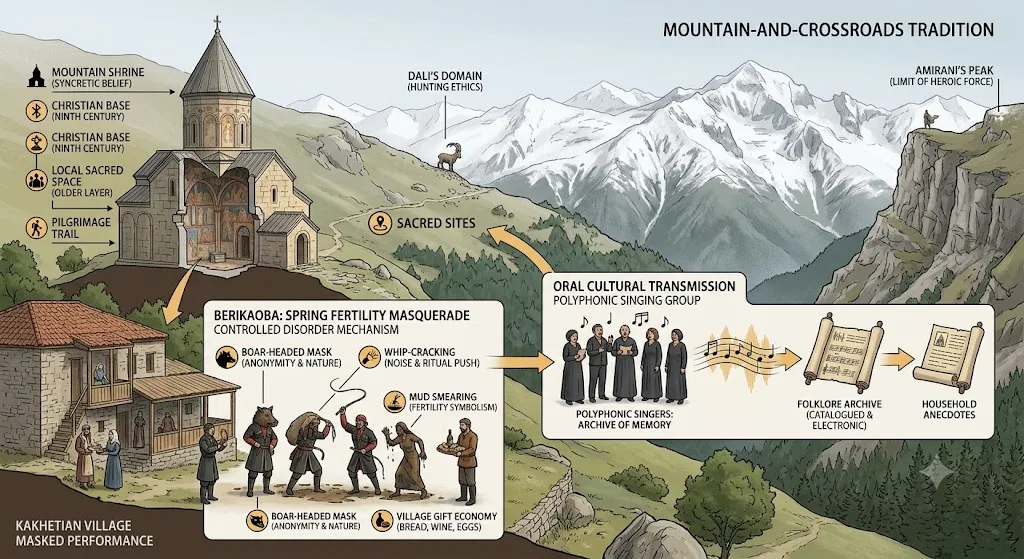
Georgian folklore is strongly tied to place. The high mountains of Svaneti, the villages of Kakheti, the Black Sea-facing west, and the old religious centres of eastern Georgia do not simply provide scenery; they shape the beings, dangers and rituals of the stories. A hunting goddess belongs naturally to cliffs and ibex trails. A spring fertility masquerade makes sense in farming villages. A church on a hill may be both a Christian shrine and a holder of older local memory.
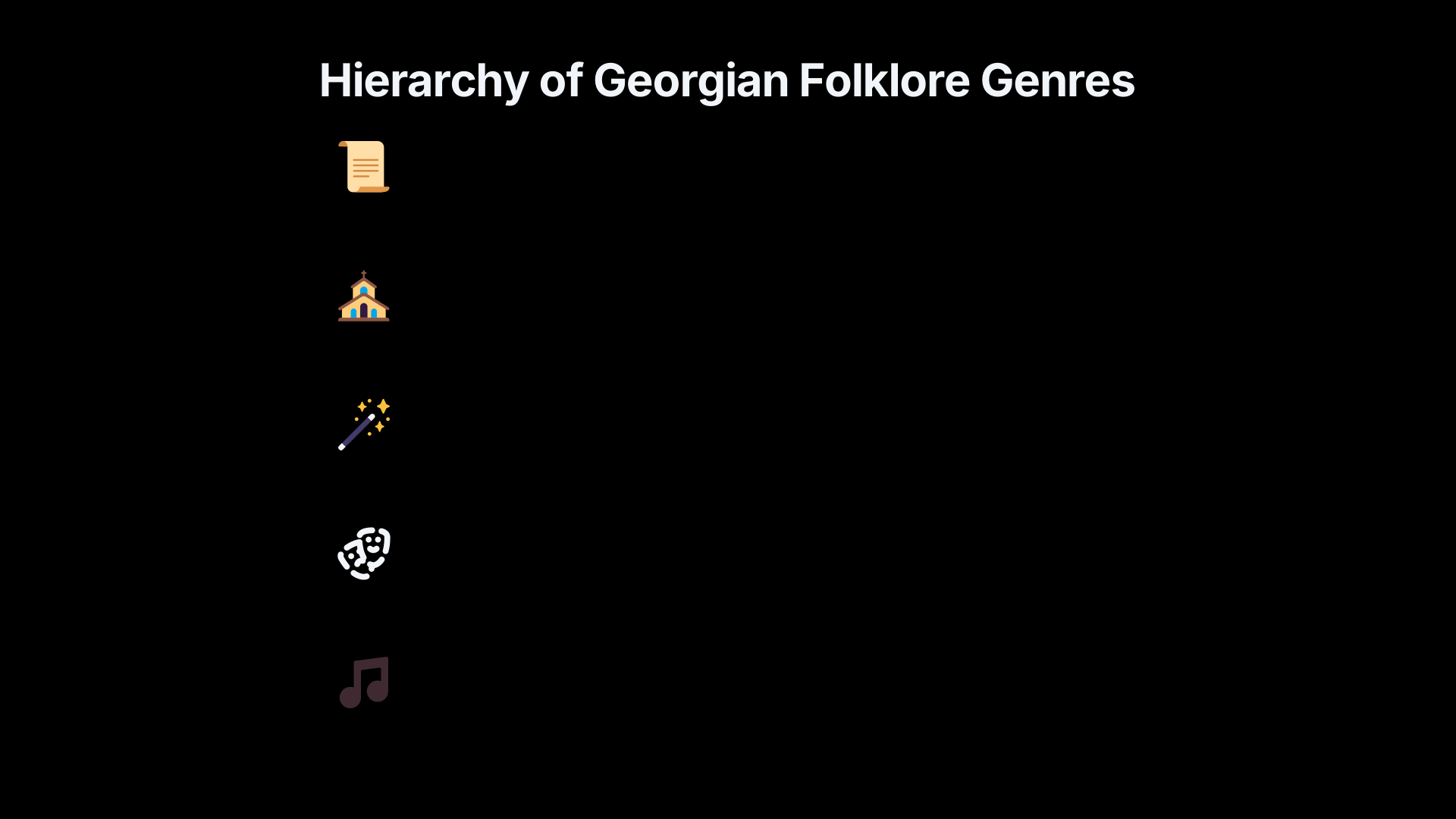
This is why broad summaries of “Georgian mythology” can be misleading. The tradition is not just a list of gods and monsters. It is an accumulation of oral genres: heroic epic, fairy tale, legend, ritual drama, song, saintly miracle story, household anecdote and local belief narrative. Georgian Folklore Magazine distinguishes fairy tales from heroic stories and legends, noting that fairy tales are highly international in their motifs while legends and heroic narratives tend to be more entangled with remembered place and history.[geofolk.ge]geofolk.geGeorgian Folk Tales (A Brief OverviewGeorgian Folk Tales (A Brief Overview
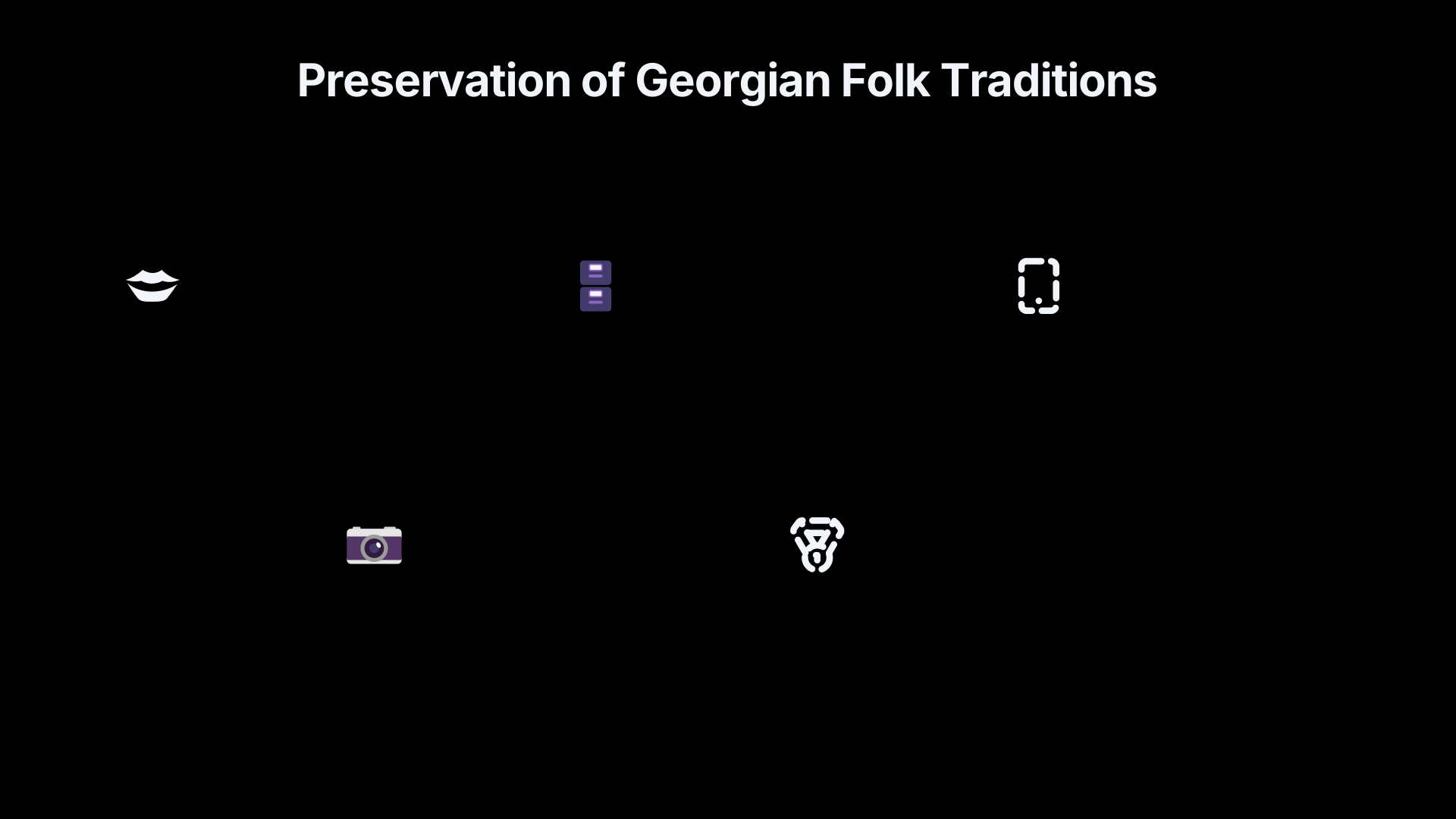
The country’s folklore also has an unusually visible archival life. The Archives of Georgian Folklore trace their institutional roots to 1932, with later electronic cataloguing and database work, while the National Archives of Georgia hosts a Georgian fairytales collection and related audio material. That matters because many Georgian traditions are not just tourist retellings: they have been collected, catalogued, translated and studied, even when individual beliefs remain difficult to date precisely.[Folktreasury]folktreasury.geOpen source on folktreasury.ge.
Amirani: Georgia’s chained hero
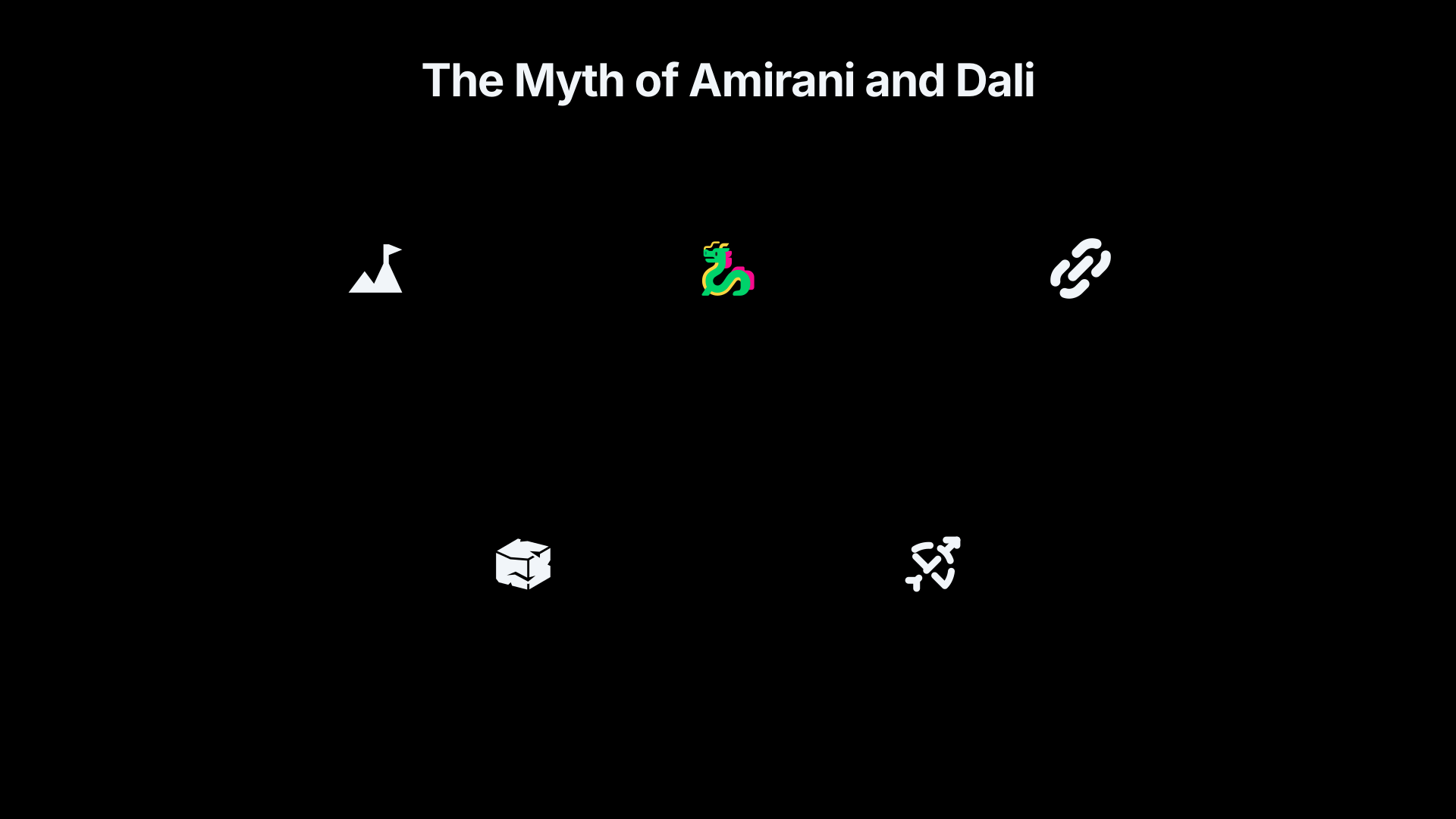
Amirani is the central hero of the Georgian folk epic and the figure most likely to surprise readers who know the Greek story of Prometheus. In many versions, Amirani is born in extraordinary circumstances, grows with impossible strength, fights monsters and eventually challenges divine order. His punishment is not a quick death but an endless ordeal: he is chained, tested and made to endure. Georgian Folklore Magazine describes the Epic of Amirani as orally transmitted in many versions, with the basic pattern recurring across regions even as details change locally.[geofolk.ge]geofolk.geAmirani — the hero of the Georgian folk epicAmirani — the hero of the Georgian folk epic
The comparison with Prometheus is useful but should not flatten the Georgian story. Dodona Kiziria’s study of Amirani notes that the Soviet scholar Mikhail Chikovani’s major work gathered sixty-eight versions of the legend recorded in different Georgian regions between 1848 and 1945, and explored possible links with the Greek Prometheus myth. That makes Amirani both ancient-feeling and well-attested in modern collection history: the story survives not as a single fixed scripture, but as a cluster of oral variants.[IUScholarWorks]scholarworks.iu.eduScholar Works AMIRANI, A GEORGIAN FOLK HEROScholar Works AMIRANI, A GEORGIAN FOLK HERO
One of the most striking features of Amirani is his parentage. In Svan variants, his mother is Dali, the hunting goddess, and his father is a hunter who encounters her in a remote place. Some versions describe Amirani as taken prematurely from his mother and completed in the bodies of animals, a birth motif that marks him as more than human from the start.[geofolk.ge]geofolk.geAmirani — the hero of the Georgian folk epicAmirani — the hero of the Georgian folk epic
The epic also contains familiar wonder-tale drama: fights with ogres or demons, a dragon, a dangerous bride quest, impossible strength and divine gifts. Yet its emotional centre is not only victory. Amirani’s story asks what happens when heroic force pushes beyond its proper limit. He is admired, but his punishment warns that even a culture hero can overreach.[geofolk.ge]geofolk.geAmirani — the hero of the Georgian folk epicAmirani — the hero of the Georgian folk epic
Dali and the dangerous ethics of the hunt
Dali is one of the most vivid beings in Georgian mythic tradition, especially in Svan material from the high mountains of north-western Georgia. She is usually described as a radiant female patron of wild horned animals, especially ibex and other mountain game. Kevin Tuite’s study of the South Caucasian goddess of game animals describes her as one of the most popular figures in Svan poetry and song, dwelling high in the mountains and guarding herds as a human shepherd guards domestic animals.[Academia]academia.eduOpen source on academia.edu.
Dali stories are not simply “goddess of hunting” tales in the decorative sense. They encode rules. Hunters may receive success if they respect limits, but they risk punishment if they break taboos: taking too much, targeting special animals, or betraying a secret encounter with the goddess. In this way, Dali is both alluring and dangerous. She represents abundance, beauty and wild nature, but also the cost of greed and broken promises.[Academia]academia.eduOpen source on academia.edu.
Her role also shows how Georgian folklore changed after Christianisation. Some later interpretations place older beings in relation to Christian saints, especially Saint George, rather than leaving them in a separate pre-Christian world. Research on Georgian highland belief notes that regions such as Svaneti preserve strongly local forms of Christianity in which saints and non-Christian figures can be intertwined, producing a syncretic folk worldview rather than a clean replacement of one religion by another.[architectureandasceticism.exeter.ac.uk]architectureandasceticism.exeter.ac.ukOpen source on exeter.ac.uk.
Dali’s importance in the Amirani cycle gives her more than regional curiosity value. A 2022 comparative study of 220 Amirani texts from 17 historical-geographical regions of Georgia identifies the hero’s birth from Dali, his exploits and his punishment as major cycles in the epic. That is a good example of how a local mountain figure can become part of a national mythic structure.[literaryresearches.litinstituti.ge]literaryresearches.litinstituti.geOpen source on litinstituti.ge.
Ogres, dragons and the wonder-tale world
Georgia’s fairy-tale tradition contains many familiar international motifs: clever youngest sons, magical transformations, dangerous step-relatives, talking animals, impossible tasks, serpents, ogres and rescued brides. But the local flavour comes through in recurring beings and settings, especially the many-headed ogre or demon often called a devi in English-language summaries of Georgian tales. Marjory Wardrop’s 1894 collection, Georgian Folk Tales, includes stories in which multi-headed ogres threaten, boast, regenerate danger and are defeated by brave or cunning heroes.[Project Gutenberg]gutenberg.orgOpen source on gutenberg.org.
Wardrop’s collection is important because it made Georgian oral tales accessible to English readers in the late nineteenth century. It includes Georgian, Mingrelian and Gurian material, showing that “Georgian folk tale” is itself a regional mixture rather than a single uniform body of stories. Project Gutenberg’s edition identifies the book as a collection of traditional stories translated by Wardrop, while the Internet Archive record gives the original publication context as London, 1894.[Internet Archive]archive.orgOpen source on archive.org.
The many-headed monster is not unique to Georgia, and that is part of the point. Georgian tales belong to the wider circulation of Eurasian wonder tales, where plots and motifs travel across languages. Georgian Folklore Magazine explicitly notes that fairy-tale plots spread quickly and widely, and that Georgia’s Caucasian position exposed it to Greco-Roman, Iranian-Arab and other cultural connections.[geofolk.ge]geofolk.geGeorgian Folk Tales (A Brief OverviewGeorgian Folk Tales (A Brief Overview
What makes the Georgian versions memorable is not only the monster but the moral rhythm: bravery, cleverness, hospitality, betrayal, fate and divine help recur again and again. In some stories the hero wins by strength; in others, survival depends on knowing when to disguise oneself, when to listen, when to keep a promise and when to outwit a supernatural enemy.
Forest and water spirits in western Georgia
Western Georgian traditions, especially Mingrelian material, preserve a rich set of nature-spirit narratives. Research on Mingrelian belief describes forest and water beings as appearing in tales, legends and hunting stories, with hunters’ fates depending on their dealings with such spirits. The same research notes that some beings are associated with forests, water, houses or particular areas, making the supernatural map of the region highly local.[isfnr.org]isfnr.orgOpen source on isfnr.org.
One important figure is the forest queen or forest mistress often discussed in relation to Dali-like traditions. English summaries describe her as a beautiful, long-haired being who tempts or tests hunters; some accounts say hunters who reveal a secret relationship may be turned to stone with their dogs. Such stories overlap with Dali’s world but should not be treated as identical everywhere: names, functions and moral emphasis vary by region.[proceedings.taas.ge]proceedings.taas.geOpen source on taas.ge.
This part of Georgian folklore is especially useful for understanding how belief changes today. Conference material on nature spirits in western Georgia records younger respondents treating figures such as forest spirits and Dali as fairy-tale characters, while older accounts preserve a stronger sense of lived belief. One striking modern explanation given in the material is that street lights and internet cables drove such beings away from human settlements — a perfect example of folklore adapting to modern technology without losing its old logic.[isfnr.org]isfnr.orgOpen source on isfnr.org.
That does not mean people today literally believe these stories in one uniform way. Some do, some do not, and many enjoy them as heritage, family memory or regional identity. The important point is that Georgian supernatural tradition is not frozen in the past. It continues to explain why the forest feels watched, why hunters should show restraint, and why the modern village still imagines itself in relation to unseen neighbours.
Berikaoba: when folklore becomes a village performance
Berikaoba is one of Georgia’s most vivid surviving folk customs: a spring masquerade of masks, mud, whips, noise, food, mock combat and improvised theatre. Today it is most strongly associated with a small number of villages in Kakheti, especially Didi Chailuri and Patara Chailuri. Recent reporting from OC Media describes it as a centuries-old tradition once more widespread but now preserved in only a handful of eastern Georgian villages.[OC Media]oc-media.orgOpen source on oc-media.org.
The festival’s power lies in controlled disorder. Masked performers become anonymous beings who can shout, chase, smear mud, crack whips and demand gifts, while villagers respond with bread, eggs, wine and hospitality. Atlas Obscura’s account, drawing on local and museum voices, presents Berikaoba as a pre-Christian spring rite linked to farming fertility, later reshaped after Christianity and now consciously preserved as cultural heritage rather than simply “paganism”.[Atlas Obscura]atlasobscura.comAtlas Obscura In Ancient Georgia, Spring Arrived With Wine, Whips, and MudAtlas Obscura In Ancient Georgia, Spring Arrived With Wine, Whips, and Mud
The theatre matters as much as the masks. OC Media notes that historical studies record more than a hundred variations of Berikaoba and the related Keenoba tradition, with performances reflecting Georgian history, satire and social memory. Modern Didi Chailuri versions may include a boar-headed beast, a bride and groom, or an antagonist representing an invader; in earlier and later versions, the target of mockery could shift with politics, including Soviet-era anti-clerical satire.[OC Media]oc-media.orgOpen source on oc-media.org.
Berikaoba also shows how folklore survives by changing. Some older erotic elements have been softened to make the festival more family-friendly, while social media, school involvement and visitors help keep it visible. That makes it neither a museum fossil nor a modern invention. It is a living tradition negotiating between memory, performance, tourism, local pride and contemporary taste.[Atlas Obscura]atlasobscura.comAtlas Obscura In Ancient Georgia, Spring Arrived With Wine, Whips, and MudAtlas Obscura In Ancient Georgia, Spring Arrived With Wine, Whips, and Mud
Christian saints, older powers and sacred landscapes
Georgia adopted Christianity in late antiquity, but folk religion did not simply erase older patterns. In many places, Christian saints became protectors of landscapes, households, animals and communities in ways that resemble older local patronage systems. Research on Georgian highland religion describes continuing debate over whether some traditions are essentially older religious systems with a Christian layer, or Christian systems deeply coloured by older local belief.[architectureandasceticism.exeter.ac.uk]architectureandasceticism.exeter.ac.ukOpen source on exeter.ac.uk.
Saint George is especially important in Georgian religious folklore. He is not a mythological figure in the same sense as Dali or Amirani, but stories, icons, battle legends, feast days and local shrines give him a powerful folk presence. Academic work on Saint George in Georgian mythological, religious and musical traditions notes his wide importance across the country and his role as a warrior-protector figure in Georgian historical memory.[Academia]academia.eduPDF) St. George in Georgian Mythology and Folk MusicPDF) St. George in Georgian Mythology and Folk Music
Svaneti offers some of the clearest examples of sacred landscape. Lamaria, the Ushguli Mother of God Church, stands on a hill in one of Georgia’s most famous highland communities. Georgia’s national tourism site dates the basilica-type structure to the ninth or tenth century and notes its frescoes, wall inscriptions and annual Dormition celebration. Local retellings add further legend, including claims about Queen Tamar, though such claims should be treated as tradition rather than verified history.[Georgia Travel]georgia.travelTravel Lamaria (Ushguli Mother of God Church) | Georgia TravelTravel Lamaria (Ushguli Mother of God Church) | Georgia Travel
For folklore readers, places such as Lamaria matter because they show how story, worship and landscape bind together. A church is not only an architectural monument. It can be a pilgrimage site, a local memory bank, a ritual destination, a tourist landmark and a place where older names and meanings continue to echo beneath Christian dedication.
Song and oral memory
No account of Georgian folklore is complete without song. Georgian polyphonic singing is not “mythology” in the narrow sense, but it is one of the country’s most important vehicles of oral memory, ritual feeling and regional identity. UNESCO lists Georgian polyphonic singing as intangible cultural heritage, and Georgian cultural sources emphasise that songs have accompanied work, feasting, healing, Christmas customs and communal life.[Intangible Cultural Heritage]ich.unesco.orgOpen source on unesco.org.
This matters for legend because oral tradition is not only spoken prose. Epic, ritual and belief often survive through performance: sung fragments, feast songs, laments, church chant, work songs and seasonal repertoires. Svaneti is particularly famous for archaic-sounding vocal traditions, and Georgian chant scholarship describes Upper Svaneti as a region whose isolation helped preserve distinctive customs, towers, moral codes and religious practices.[Georgian Chant]georgianchant.orgGeorgian Chant Svanetian ChantGeorgian Chant Svanetian Chant
Song also complicates the boundary between sacred and secular. Georgian polyphony can be heard at feasts, in churches, in village gatherings and on concert stages. Once a tradition moves into staged performance, it changes audience and setting, but not necessarily meaning. For many Georgians, the sound itself carries ancestral authority: a way of remembering place, kinship, loss, courage and devotion without turning them into a written doctrine.
How old are these traditions?
The honest answer is: some are old, but not all can be dated with precision. Amirani is deeply rooted in oral epic and was collected in numerous regional versions in the nineteenth and twentieth centuries, but that does not mean every detail can be projected unchanged into remote antiquity. Dali appears in Svan oral literature and has strong links to hunting life and mountain ecology, but individual stories vary and have been reshaped by Christian and literary interpretation.[IUScholarWorks]scholarworks.iu.eduScholar Works AMIRANI, A GEORGIAN FOLK HEROScholar Works AMIRANI, A GEORGIAN FOLK HERO
Berikaoba is often described as ancient or pre-Christian, and its fertility symbolism makes that plausible, but the safest wording is that it preserves elements associated with early agrarian spring rites while the exact origin is lost. Modern accounts also show how much the festival has been revived, curated and adapted in recent decades.[Atlas Obscura]atlasobscura.comAtlas Obscura In Ancient Georgia, Spring Arrived With Wine, Whips, and MudAtlas Obscura In Ancient Georgia, Spring Arrived With Wine, Whips, and Mud
Fairy tales are even harder to date in simple terms. A tale collected in the nineteenth century may contain very old motifs, recent borrowings, local jokes and a translator’s choices all at once. Georgian Folklore Magazine’s warning that fairy-tale plots travel widely is useful here: age is not always the most interesting question. Often the better question is how a travelling plot became Georgian through names, landscapes, moral emphasis and performance style.[geofolk.ge]geofolk.geGeorgian Folk Tales (A Brief OverviewGeorgian Folk Tales (A Brief Overview
What modern readers often misunderstand
The first misunderstanding is that Georgian folklore is a lost pagan religion waiting to be reconstructed. Some traditions certainly preserve pre-Christian elements, but the living record is mixed: Christian saints, local shrines, oral tales, Soviet-era performance, modern tourism and academic collection all shape what survives.[architectureandasceticism.exeter.ac.uk]architectureandasceticism.exeter.ac.ukOpen source on exeter.ac.uk.
The second misunderstanding is that “mythology” means only gods. In Georgia, some of the strongest folklore lives in heroic epic, fairy tale, ritual theatre, song and place legend. A masked spring performer, a many-headed ogre, a sacred hill church and a hunting taboo can all be equally important parts of the legendary landscape.
The third misunderstanding is that modern reinterpretation makes a tradition fake. Berikaoba’s revival through schools, visitors and media does not erase its folk value; it shows how communities keep a fragile custom alive. Likewise, younger people treating spirits as fairy-tale characters does not end the tradition. It changes the mode from belief to story, joke, heritage, art or regional identity.[isfnr.org]isfnr.orgOpen source on isfnr.org.
Georgia’s folklore in one view
Georgia’s folklore is best understood as a living layered tradition. At its heroic centre stands Amirani, the overreaching champion chained for challenging divine limits. In the high mountains, Dali guards wild animals and punishes hunters who break the ethics of the hunt. In fairy tales, many-headed ogres, dragons and clever heroes carry Georgian versions of wider Eurasian story patterns. In western regions, forest and water spirits reveal a local supernatural ecology. In Kakheti, Berikaoba turns spring renewal into mud, masks, food, satire and theatre. In churches and shrines, Christian saints and older local powers meet in sacred landscapes.
What holds these traditions together is not a single doctrine but a shared way of imagining the world: nature is alive with agency, strength must respect limits, guests and hosts are morally bound to each other, memory belongs to places, and old stories survive by being retold in new forms.
Amazon book picks
Further Reading
Books and field guides related to Why Georgia's Old Stories Still Feel Alive. Use these as the next step if you want deeper reading beyond the article.
Mythology
Rating: 2.5/5 from 14 Google Books ratings
Provides comparative mythological background useful for readers of Georgian legends.
The Golden Fleece and The Heroes Who Lived Before Achilles
Connects Georgia to one of the most famous mythic landscapes.
eBay marketplace picks
Marketplace Samples
Example marketplace items related to this page. Use the search link to explore similar finds on eBay.

Endnotes
1.
Source: geofolk.ge
Title: Amirani — the hero of the Georgian folk epic
Link:https://geofolk.ge/en/article/amirani–qartuli-khalkhuri-eposis-gmiri/148
2.
Source: gutenberg.org
Link:https://www.gutenberg.org/files/44536/44536-h/44536-h.htm
3.
Source: academia.edu
Link:https://www.academia.edu/503876/THE_MEANING_OF_D%C3%86L_SYMBOLIC_AND_SPATIAL_ASSOCIATIONS_OF_THE_SOUTH_CAUCASIAN_GODDESS_OF_GAME_ANIMALS
4.
Source: geofolk.ge
Title: Georgian Folk Tales (A Brief Overview)
Link:https://geofolk.ge/en/article/qartuli-khalkhuri-zghapris-zhanrebi-mokle-mimokhilva/105
5.
Source: architectureandasceticism.exeter.ac.uk
Link:https://architectureandasceticism.exeter.ac.uk/exhibits/show/continuityandchangeinthegeorgi/continuity-and-change
6.
Source: folktreasury.ge
Link:https://folktreasury.ge/
7.
Source: literaryresearches.litinstituti.ge
Link:https://literaryresearches.litinstituti.ge/index.php/literaryresearches/article/view/6491
8.
Source: archive.org
Title: Wardrop Georgian Folktales
Link:https://archive.org/details/WardropGeorgianFolktales
9.
Source: archive.org
Link:https://archive.org/details/cu31924029936006
10.
Source: gutenberg.org
Link:https://www.gutenberg.org/ebooks/44536
11.
Source: isfnr.org
Link:https://www.isfnr.org/files/ABSTRACTS.pdf
12.
Source: isfnr.org
Link:https://www.isfnr.org/files/Nature_spirits_Zugdidi.pdf
13.
Source: proceedings.taas.ge
Link:https://proceedings.taas.ge/index.php/taas/article/view/5238
14.
Source: oc-media.org
Link:https://oc-media.org/monstrous-costumes-and-cracking-whips-the-georgian-village-preserving-the-spirit-of-berikaoba/
15.
Source: academia.edu
Title: (PDF) St. George in Georgian Mythology and Folk Music
Link:https://www.academia.edu/38128524/St_George_in_Georgian_Mythology_and_Folk_Music
16.
Source: georgia.travel
Title: Travel Lamaria (Ushguli Mother of God Church) | Georgia Travel
Link:https://georgia.travel/lamaria-ushguli-mother-of-god-church
17.
Source: ich.unesco.org
Link:https://ich.unesco.org/en/RL/georgian-polyphonic-singing-00008
18.
Source: scholarworks.iu.edu
Title: Scholar Works AMIRANI, A GEORGIAN FOLK HERO
Link:https://scholarworks.iu.edu/dspace/bitstreams/89696bd5-4ab3-461e-9619-12ebe24ab85b/download
19.
Source: atlasobscura.com
Title: Atlas Obscura In Ancient Georgia, Spring Arrived With Wine, Whips, and Mud
Link:https://www.atlasobscura.com/articles/berikaoba-georgia-fertility-festival
20.
Source: georgianchant.org
Title: Georgian Chant Svanetian Chant
Link:https://www.georgianchant.org/svan-chant-intro/
Additional References
21.
Source: youtube.com
Title: Living in the Caucasian Mountains
Link:https://www.youtube.com/watch?v=cFsKwSHZ4vc
Source snippet
GEORGIA: 8,000 Year Old Hidden Gem of the World | 4K Travel Documentary...
22.
Source: youtube.com
Title: Vultures, Nature’s Unsung Hero
Link:https://www.youtube.com/watch?v=6HqVHvR-qVs
Source snippet
Living in the Caucasian Mountains - Like an Animal [FILM]...
23.
Source: youtube.com
Link:https://www.youtube.com/watch?v=_x64Wn6PAoo
Source snippet
Vultures, Nature's Unsung Hero - "Vanishing Sky Lords" [FILM]...
24.
Source: europeanheritagedays.com
Link:https://www.europeanheritagedays.com/European-Heritage-Makers-Week/6379b/Georgian-Polyphony
25.
Source: mapageweb.umontreal.ca
Link:https://mapageweb.umontreal.ca/tuitekj/publications/Tuite-2000-Dali.pdf
26.
Source: youtube.com
Title: The Tragic Legend of Amirani
Link:https://www.youtube.com/watch?v=fkLFLu0XndM
Source snippet
Exploring a Mythology You've Never Heard of...
27.
Source: youtube.com
Title: GEORGIA: 8,000 Year Old Hidden Gem of the World | 4K Travel Documentary
Link:https://www.youtube.com/watch?v=gJB-jsLynm0
28.
Source: archive.gov.ge
Title: საქართველოს ეროვნული არქივიGeorgian Fairytales
Link:https://archive.gov.ge/en/kartuli-zghaprebi
29.
Source: eurasia.travel
Title: Travel Lamaria church in Ushguli
Link:https://eurasia.travel/georgia/ushguli/lamaria-church/
30.
Source: allgeo.org
Title: All Geo Georgian Mythology
Link:https://www.allgeo.org/index.php/en/1865-georgian-mythology-key-characters-and-concepts
Topic Tree
Follow this branch
Related pages 192
- Afghan Folklore
- Albanian Folklore
- Algerian Folklore
- Australian Folklore
- Azerbaijan Folklore
- +187 more in sidebar