Where Albanian Legends Still Haunt the Landscape
Albanian folklore is not a tidy pantheon of gods with one official story. It is a living body of oral tales, mountain epics, household beliefs, sacred landscapes, seasonal customs, heroic ballads, fairy encounters, witches, dragons and moral stories about keeping one’s word.
Page outline Jump by section
Introduction
What makes Albanian folklore especially distinctive is the way it joins landscape, oath, kinship and supernatural danger. Mountains are not just scenery; castles are not just ruins; songs are not just entertainment. They are places and performances where older ideas about honour, protection, fertility, danger and memory remain visible, even when retold today for schoolbooks, tourism, literature or popular culture.
What makes Albanian folklore distinctive?
Albanian folklore is strongest when understood as oral culture: stories and songs remembered, performed, adapted and passed on. Robert Elsie’s work on Albanian tales stresses that Albanian folk narrative includes not only fairy tales but also legends based on historical or mythological events, while his introduction to the tradition describes a familiar moral core: the struggle between good and evil, filtered through local social values.[Elsie's Books]books.elsie.des Books Albanian folktales and legendss Books Albanian folktales and legends
That oral foundation explains why the same figure may look different from one region or telling to another. A supernatural woman may be a fairy in one tale, a dangerous helper in another, and a remnant of an older earth or fertility figure in later interpretation. A dragon may be a monster of drought, storm and blocked water, but it also belongs to a broader symbolic world in which weather, landscape and moral order are linked. The Albanian Register of Intangible Cultural Heritage reflects this breadth: it includes categories for oral traditions and language, performing arts, rituals and festive events, traditional craftsmanship, foodways, and knowledge of nature.[Trashegimia Kulturore Jomateriale]regjistritkj.alOpen source on regjistritkj.al.
The country’s folklore also carries the marks of religious layering. Albania has long contained Muslim, Orthodox, Catholic and Bektashi communities, but many stories and customs are not simply “Islamic” or “Christian”. They often preserve older motifs that were later reinterpreted through religious language. Mount Tomorr, for instance, is associated in folk belief with a mountain figure, in Bektashi devotion with Abbas Ali, and in Christian practice with pilgrimage connected to the Virgin Mary.[Wikipedia]WikipediaOpen source on wikipedia.org.
The great stories Albanians still recognise
Rozafa: why a castle became a story about sacrifice
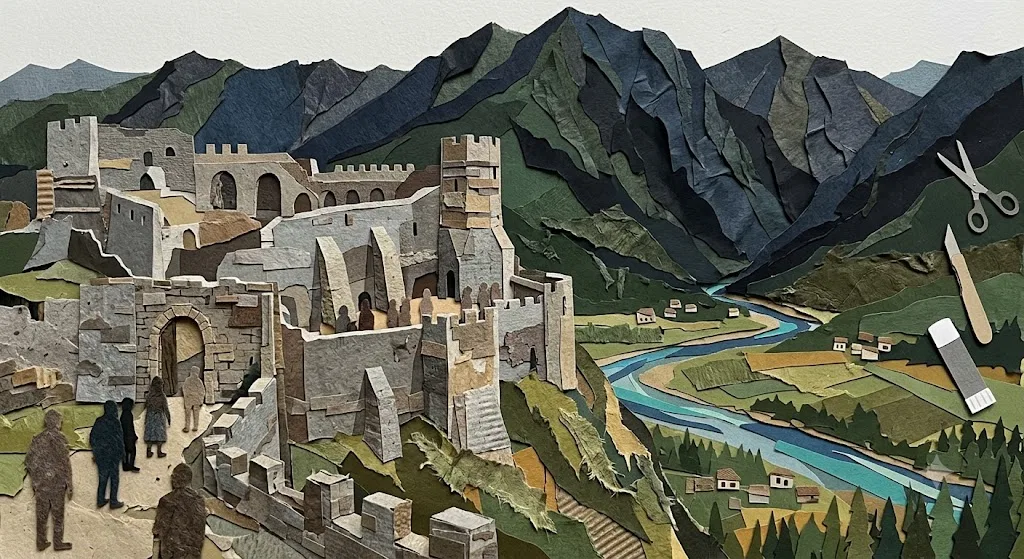
Rozafa Castle, above Shkodër in northern Albania, is one of the clearest examples of folklore tied to a real place. Albania’s official tourism site describes the castle as an important historical monument with origins in the Illyrian period and later Roman, Byzantine, Venetian and Ottoman phases. It also identifies the Legend of Rozafa as one of the most famous stories of Albanian folklore, turning the site into a symbol of Shkodër’s cultural identity as well as a historic attraction.[Faqja Zyrtare e Turizmit]akt.gov.alFaqja Zyrtare e Turizmit Rozafa CastleFaqja Zyrtare e Turizmit Rozafa Castle
The legend tells of three brothers trying to build a castle whose walls collapse each night. The solution, in the story’s grim logic, is that one of their wives must be immured in the wall. The youngest brother keeps the oath not to warn his wife; she arrives with food and accepts her fate, asking that one breast, one arm and one eye remain free so she can nurse, hold and watch her child. The tale belongs to a wider Balkan family of “immurement” legends, but its Albanian version is especially remembered through the image of the mother who continues to nourish life from within the stone.[Wikipedia]WikipediaRozafa CastleRozafa Castle
For readers today, Rozafa is not best treated as a report of an actual event. Its power lies in what it dramatises: the cost of building something that lasts, the danger of oaths, the idealisation of maternal self-sacrifice, and the way a place can become morally charged through story. It is also a good example of how folklore changes audience: a local legend becomes a national school story, a tourist narrative and a literary symbol.
Constantin and Doruntine: the oath stronger than death
Another central Albanian legend is the ballad of Constantin and Doruntine, also known through the theme of the sacred oath. In the story, a brother promises his mother that he will bring his married sister home when needed. After he dies, the promise remains so binding that he rises from the grave, rides to fetch Doruntine, and fulfils his word.[Wikipedia]WikipediaConstantin and DoruntinëConstantin and Doruntinë
The story matters because it turns an ethical value into a supernatural event. The dead brother is not simply a ghost for horror’s sake; he is the embodiment of an obligation that cannot be cancelled even by death. This is why the tale has continued to attract literary retelling, most famously in Ismail Kadare’s novel based on the old legend.[Wikipedia]WikipediaDoruntine (novelDoruntine (novel
Modern adaptations often shift the emphasis. Traditional versions centre the brother’s oath and the mother’s curse; more recent reinterpretations may ask what the story says about women, family pressure, migration and duty. A 2021 UNDP Albania account of a contemporary retelling, for example, describes a version that gives the oath-bearing role to Doruntine herself, showing how old legends can be reworked for modern gender questions without losing their recognisable core.[UNDP]undp.orgdoruntinas tale through lens 21st century womendoruntinas tale through lens 21st century women
The Earthly Beauty and the underworld quest
One of the most striking figures in Albanian fairy tradition is the Earthly Beauty, a supernatural woman who appears in many quest tales. In summaries of the tradition, she is described as a popular and frequent motif: the hero must search for, rescue or win her, sometimes by travelling into an underworld palace guarded by dangerous beings.[Wikipedia]WikipediaE Bukura e DheutE Bukura e Dheut
She is not merely a “princess” in the modern fairy-tale sense. Depending on the tale and interpretation, she can be a fairy, a chthonic or earth-associated figure, a helper, a danger, or the almost impossible object of a hero’s quest. That complexity is important. Albanian fairy tales often place beauty, danger and wisdom together, so the hero’s journey is not just romantic; it is a test of courage, patience, luck and moral endurance.
This figure also shows why Albanian folklore should not be flattened into a list of monsters. Many beings are ambiguous. They can bless, deceive, test, punish or transform. Their meaning depends on the story being told.
Fairies, witches and dragons
Albanian supernatural tradition includes a rich set of beings, but three clusters help a new reader find their bearings: mountain and nature spirits, household or night terrors, and cosmic weather enemies.
The mountain fairy is one of the best-known figures. Elsie’s account of Albanian tales describes the zana as a courageous and formidable mountain fairy of Albanian oral literature and notes that her name has been linked to Diana, the Roman goddess.[Elsie]elsie.deAlbanian TalesAlbanian Tales In epic and fairy-tale contexts, such beings may guard wild places, aid heroes, punish disrespect or appear as powerful women outside ordinary village control. They are not simply delicate “fairies” in the Victorian sense; they belong to a harsher mountain imagination.
The shtriga is darker: a witch-like or vampiric figure associated in folklore with attacking infants at night. Accounts of the tradition describe her as a being who drains children and may transform into an insect; only the shtriga herself can cure the victim in some versions. The figure has also travelled into modern fantasy and horror media, where it is often simplified into a generic monster.[Wikipedia]WikipediaOpen source on wikipedia.org.
The storm-dragon complex is more mythic in scale. The kulshedra or kuçedra is usually described as a monstrous serpent or dragon connected with storm, drought, fire, flood and blocked water. Against it stands the drangue, a heroic, semi-human dragon-fighter associated with thunder, lightning and protection. In this tradition, violent weather may be imagined as the result of their battles.[Wikipedia]WikipediaOpen source on wikipedia.org.
These figures reveal a practical side of folklore. They make sense of danger: infant illness, storms, drought, mountains, envy, infertility, bad luck, wild places and social fear. They also give danger a story-shape. A drought is not only weather; a child’s wasting illness is not only illness; a mountain spring is not only water. In traditional imagination, each may sit inside a moral and supernatural world.
Sacred places where folklore meets landscape
Albania’s legendary geography is unusually vivid. Mountains, castles, rivers and shrines carry stories that make them more than landmarks.
Mount Tomorr is one of the most important examples. It is described as a holy mountain for Albanians and a major site of pilgrimage. Folk belief associates it with a mountain figure often imagined as an old giant with a white beard, while Bektashi tradition connects it with Abbas Ali and annual pilgrimage in late August. Christian pilgrimage associations also exist, especially around the Assumption.[Wikipedia]WikipediaOpen source on wikipedia.org.
This layering matters because it shows how sacred landscapes survive change. A mountain can be read through older folk belief, Bektashi devotion, Christian practice, national poetry and modern heritage tourism. The point is not that all these meanings are identical, but that the place has remained a focus for awe, oath, pilgrimage and identity.
Rozafa Castle works differently. Its sacredness is not primarily a pilgrimage cult but a narrative charge. The stones are interpreted through the walled bride; the view over Shkodër becomes inseparable from the story of sacrifice. Official tourism now presents Rozafa as both a historical monument and a cultural-symbolic site, which is a modern form of folklore transmission in itself.[Faqja Zyrtare e Turizmit]akt.gov.alFaqja Zyrtare e Turizmit Rozafa CastleFaqja Zyrtare e Turizmit Rozafa Castle
Songs, epics and performance as living folklore
Albanian folklore is not only told; it is sung, danced and performed. That matters because performance preserves memory differently from written text. A singer, a dance group, a wedding gathering or a regional festival can keep a tradition active even as the social world around it changes.
The northern epic tradition is closely associated with the lahuta, a one-stringed instrument used to accompany heroic songs. UNESCO describes the lahuta as a single-stringed wooden instrument with a leather-covered sound box, made, played and sung with by rural communities of northern and north-western Albania, especially on family and community occasions such as weddings and festivals.[UNESCO Intangible Cultural Heritage]ich.unesco.orgOpen source on unesco.org. The songs connected with this world include heroic narratives of frontier warriors, honour, conflict, kinship and supernatural assistance.
Southern Albania is internationally known for folk iso-polyphony, a multipart singing tradition. UNESCO’s description characterises Albanian iso-polyphony as music with two solo parts, a melody and countermelody, supported by a choral drone.[UNESCO Intangible Cultural Heritage]ich.unesco.orgOpen source on unesco.org. Although not every polyphonic song is a mythic tale, the tradition belongs to the same cultural ecology as laments, ritual songs, regional memory and performed identity.
The Gjirokastër National Folklore Festival is especially important in modern preservation. Albania’s intangible heritage register lists it among the country’s major folklore institutions and events, and UNESCO-related reporting describes it as a major event celebrating intangible cultural heritage since 1968.[Trashegimia Kulturore Jomateriale]regjistritkj.alOpen source on regjistritkj.al. Such festivals can protect traditions, but they also change them: a song once tied to a household, village or ritual moment may become a staged performance for national audiences, tourists and cameras.
Rituals, costume and the protective imagination
Folklore also lives in objects, gestures and seasonal practice. The xhubleta, the bell-shaped highland women’s garment of northern Albania, is a good example of how material culture can carry symbolic meaning. UNESCO lists the xhubleta’s skills, craftsmanship and forms of usage as an element in need of urgent safeguarding, and describes it as a handcrafted garment worn by highland women and girls in northern Albania, known for its distinctive undulating bell form.[UNESCO Intangible Cultural Heritage]ich.unesco.orgOpen source on unesco.org.
For folklore readers, the xhubleta matters because dress is not only fashion. In traditional societies, costume can mark region, age, status, ceremony, gendered identity and protection. Some accounts of the garment emphasise geometric and symbolic ornament, including motifs connected with the sun, moon, stars, birds or serpents. These should be handled carefully: not every pattern can be decoded with certainty, but the broader point is secure — traditional dress often works as a visible map of belonging and inherited meaning.[Wikipedia]WikipediaOpen source on wikipedia.org.
The same is true of rituals around the evil eye, healing, childbirth, pilgrimage, weddings and death. Albania’s heritage inventory includes social practices, rituals and festive events as a formal category, alongside oral traditions and nature-related knowledge.[Trashegimia Kulturore Jomateriale]regjistritkj.alOpen source on regjistritkj.al. This is a useful reminder that folklore is not just “stories about strange beings”. It includes the practical ways people try to manage uncertainty: blessing, singing, swearing, mourning, protecting children, honouring ancestors and marking the dangerous thresholds of life.
How old is Albanian folklore?
The honest answer is: some motifs are old, but most exact forms are difficult to date. Albania’s folklore was transmitted largely through oral tradition, which preserves deep structures while constantly reshaping wording, emphasis and detail. A dragon-fight motif may have ancient Indo-European parallels; a mountain cult may preserve pre-Christian features; a fairy’s name may point to Roman or older Balkan layers. But the version known today may have passed through medieval, Ottoman, Christian, Muslim, Bektashi, nationalist, communist and post-communist filters.
This is why careful language matters. It is reasonable to say that Albanian folklore contains old pre-Christian motifs and that some beings have been interpreted as survivals or transformations of older religious ideas. It is less safe to claim that a modern tale is a direct, unchanged survival from Illyrian religion. Sources on figures such as the kulshedra and drangue often discuss broad Indo-European or paleo-Balkan parallels, but parallels are not the same as proof of an unbroken ancient cult.[Wikipedia]WikipediaOpen source on wikipedia.org.
Written collection is also relatively recent compared with the age claimed for many motifs. The Rozafa immurement legend, for instance, is associated with early modern and later written attestations, while 19th- and 20th-century collectors, travellers and scholars helped fix versions that had previously circulated orally.[Wikipedia]WikipediaRozafa CastleRozafa Castle
The best way to read Albanian folklore is therefore layered rather than literal-minded. A tale may contain an old motif, a local place-name, a family ethic, a later religious interpretation and a modern nationalist reading all at once.
How folklore changed in modern Albania
Modern Albania has not simply “preserved” folklore; it has repeatedly reframed it. National revival writers used folklore to express cultural identity. Communist-era institutions staged folk performance as national culture. Post-communist Albania has turned castles, festivals, songs and costumes into heritage assets, tourist experiences and UNESCO nominations. Diaspora communities have also carried and reshaped traditions outside the country.
The Albanian Register of Intangible Cultural Heritage is a recent example of formal heritage-making. It states that the inventory contains more than 90 elements from Shkodra, Gjirokastra and Korça, selected and documented with community participation and institutional support.[Trashegimia Kulturore Jomateriale]regjistritkj.alOpen source on regjistritkj.al. That kind of project can give visibility to local traditions, but it also changes their status: a song or costume becomes an “element”, a festival becomes a preservation tool, and community memory becomes searchable public culture.
Literature has played a different role. Ismail Kadare’s work often drew on Albanian legend, ballad and mythic atmosphere, bringing traditional material into modern novels read far beyond Albania. His treatment of the Doruntine legend is a good example: an old supernatural ballad becomes a literary investigation into oath, state power, belief and identity.[Wikipedia]WikipediaDoruntine (novelDoruntine (novel
Popular culture can simplify older figures. The shtriga, for instance, has appeared in international fantasy television and horror contexts, where the Albanian social and ritual background is often stripped away.[Wikipedia]WikipediaOpen source on wikipedia.org. This is not necessarily wrong — folklore has always travelled — but it creates a difference between a creature as a living belief, a literary motif, and a media monster.

What readers often misunderstand
One common mistake is to treat Albanian folklore as a fixed “mythology” like a classical handbook. Albania does have mythic beings and divine-seeming figures, but much of the tradition survives as tale, song, custom and local belief rather than as an authorised theology.
Another mistake is to assume that every old-looking motif is uniquely Albanian. Rozafa belongs to a wider Balkan and European family of construction-sacrifice legends. Dragon-fighting myths have broad Indo-European parallels. What is distinctively Albanian is often not the bare motif but the local setting, language, moral emphasis, performance style and continuing cultural use.[Albanian Literature]albanianliterature.netAlbanian Literature The Legend of Rozafat CastleAlbanian Literature The Legend of Rozafat Castle
A third mistake is to separate folklore too sharply from everyday life. In Albania, folklore has been tied to household ethics, regional identity, mourning, marriage, pilgrimage, costume, music and landscape. The supernatural beings are memorable, but the deeper subject is how communities explained danger, obligation, beauty, fertility, honour and survival.
Finally, modern heritage recognition should not be confused with the beginning of a tradition. UNESCO listings and national inventories are important because they document, protect and publicise living practices; they do not create those practices from nothing. The lahuta, iso-polyphony and xhubleta all had community histories before international recognition made them more visible.[UNESCO Intangible Cultural Heritage]ich.unesco.orgOpen source on unesco.org.
Why Albanian folklore still matters
Albanian folklore still matters because it gives readers a way into the country’s cultural imagination. Rozafa explains why a castle can feel like a moral monument. Constantin and Doruntine show how an oath can become stronger than death. The Earthly Beauty reveals a fairy-tale world where desire and danger are intertwined. The shtriga, kulshedra and drangue turn illness, storm and drought into stories of threat and protection. Mount Tomorr shows how a landscape can gather pagan memory, religious devotion and national symbolism into one place.
The tradition is also valuable because it is not frozen. It survives through archives, festivals, family memory, school retellings, tourism, scholarship, music, craft, fiction and online reinterpretation. Some forms are endangered; others are being revived or repackaged. The most responsible way to read them is neither to dismiss them as superstition nor to present them as proven supernatural fact, but to treat them as cultural narratives that have helped Albanians imagine the world, remember the past and argue about what should be honoured in the present.
Amazon book picks
Further Reading
Books and field guides related to Where Albanian Legends Still Haunt the Landscape. Use these as the next step if you want deeper reading beyond the article.
Albanian Folktales and Legends
Broad coverage of legends, heroes, supernatural beings and oral tradition.

The Dictionary of Albanian Religion, Mythology and Folk Culture
First published 2000. Subjects: Dictionaries, Social life and customs, Albania, Folklore, Religious life and customs.
European Folk Tales
Places Albanian tales within wider European storytelling traditions.
eBay marketplace picks
Marketplace Samples
Live-tested eBay searches with available results related to this page.
Endnotes
1.
Source: books.elsie.de
Title: ‘s Books Albanian folktales and legends
Link:https://books.elsie.de/2004-1986/b23.html
2.
Source: Wikipedia
Link:https://en.wikipedia.org/wiki/Kulshedra
3.
Source: Wikipedia
Link:https://en.wikipedia.org/wiki/Tomorr
4.
Source: Wikipedia
Title: Rozafa Castle
Link:https://en.wikipedia.org/wiki/Rozafa_Castle
5.
Source: Wikipedia
Title: Constantin and Doruntinë
Link:https://en.wikipedia.org/wiki/Constantin_and_Doruntin%C3%AB
6.
Source: Wikipedia
Title: Doruntine (novel)
Link:https://en.wikipedia.org/wiki/Doruntine_%28novel%29
7.
Source: elsie.de
Link:https://www.elsie.de/pdf/reviews/R1987KadareDoruntine.pdf
8.
Source: undp.org
Title: doruntinas tale through lens 21st century women
Link:https://www.undp.org/albania/press-releases/doruntinas-tale-through-lens-21st-century-women
9.
Source: Wikipedia
Title: E Bukura e Dheut
Link:https://en.wikipedia.org/wiki/E_Bukura_e_Dheut
10.
Source: elsie.de
Title: Albanian Tales
Link:https://www.elsie.de/pdf/articles/A2008AlbFolktalesGreenwood.pdf
11.
Source: Wikipedia
Link:https://en.wikipedia.org/wiki/Shtriga
12.
Source: Wikipedia
Link:https://en.wikipedia.org/wiki/Drangue
13.
Source: ich.unesco.org
Link:https://ich.unesco.org/en/USL/art-of-playing-singing-and-making-the-lahuta-02310
14.
Source: ich.unesco.org
Link:https://ich.unesco.org/en/RL/albanian-folk-iso-polyphony-00155
15.
Source: ich.unesco.org
Title: Intangible Cultural Heritage Albania
Link:https://ich.unesco.org/en/state/albania-AL?info=projects
16.
Source: ich.unesco.org
Link:https://ich.unesco.org/en/USL/xhubleta-skills-craftsmanship-and-forms-of-usage-01880
17.
Source: Wikipedia
Link:https://en.wikipedia.org/wiki/Xhubleta
18.
Source: unesco.org
Link:https://www.unesco.org/en
19.
Source: ich.unesco.org
Link:https://ich.unesco.org/en/video/76289
20.
Source: ich.unesco.org
Title: albania AL
Link:https://ich.unesco.org/en/state/albania-AL?info=periodic-reporting
21.
Source: ich.unesco.org
Link:https://ich.unesco.org/en/video/62331
22.
Source: ich.unesco.org
Title: albania AL
Link:https://ich.unesco.org/en/state/albania-AL
23.
Source: Wikipedia
Title: E Bukura e Detit
Link:https://en.wikipedia.org/wiki/E_Bukura_e_Detit
24.
Source: Wikipedia
Title: The Twins (folktale)
Link:https://en.wikipedia.org/wiki/The_Twins_%28folktale%29
25.
Source: Wikipedia
Title: Kângë Kreshnikësh
Link:https://en.wikipedia.org/wiki/K%C3%A2ng%C3%AB_Kreshnik%C3%ABsh
26.
Source: Wikipedia
Link:https://en.wikipedia.org/wiki/UNESCO
27.
Source: Wikipedia
Title: Albanian paganism
Link:https://en.wikipedia.org/wiki/Albanian_paganism
28.
Source: Wikipedia
Title: Zana (mythology)
Link:https://en.wikipedia.org/wiki/Zana_%28mythology%29
29.
Source: Wikipedia
Title: List of Intangible Cultural Heritage elements in Albania
Link:https://en.wikipedia.org/wiki/List_of_Intangible_Cultural_Heritage_elements_in_Albania
30.
Source: books.elsie.de
Title: de Albanian folktales and legends
Link:https://books.elsie.de/2004-1986/b09.html
31.
Source: change.org
Title: Petition · Lahuta is Albanian Cultural Heritage
Link:https://www.change.org/p/dardania-sacra-lahuta-%C3%ABsht%C3%AB-shqiptare
32.
Source: regjistritkj.al
Link:https://regjistritkj.al/en/
33.
Source: akt.gov.al
Title: Faqja Zyrtare e Turizmit Rozafa Castle
Link:https://akt.gov.al/en/atraksionet/kalaja-e-rozafes/
34.
Source: albanianliterature.net
Title: Albanian Literature The Legend of Rozafat Castle
Link:https://www.albanianliterature.net/legends/legend_06.html
35.
Source: albanianliterature.net
Link:https://www.albanianliterature.net/oralverse/verse_04.html
36.
Source: the-demonic-paradise.fandom.com
Link:https://the-demonic-paradise.fandom.com/wiki/Shtriga
37.
Source: the-demonic-paradise.fandom.com
Link:https://the-demonic-paradise.fandom.com/wiki/Kulshedra
38.
Source: albaniavisit.com
Title: The Lahuta
Link:https://albaniavisit.com/sq/lahuta-albanian-epic-singing-unesco/
39.
Source: albaniavisit.com
Title: The Lahuta
Link:https://albaniavisit.com/lahuta-albanian-epic-singing-unesco/
40.
Source: markberepeterson.com
Link:https://markberepeterson.com/2021/04/24/shtriga/
41.
Source: ambasadat.gov.al
Title: lahuta shqiptare pranohet ne unesco
Link:https://ambasadat.gov.al/unesco/en/newsroom/lahuta-shqiptare-pranohet-ne-unesco/
42.
Source: ambasadat.gov.al
Link:https://ambasadat.gov.al/israel/en/kultura/
43.
Source: ambasadat.gov.al
Link:https://ambasadat.gov.al/unov-osbe/en/kultura/
44.
Source: albanianliterature.net
Link:https://www.albanianliterature.net/folktales/
45.
Source: sondortravel.com
Title: rozafa castle
Link:https://sondortravel.com/guides-and-tips/rozafa-castle/
Additional References
46.
Source: youtube.com
Link:http://www.youtube.com/watch?v=CLnBDDDXAsk
Source snippet
Albanian folklore mythology legends kreshniks Fall Asleep To The ENTIRE Story of Albanian Mythology | The ENTIRE Story of Albanian Explai...
47.
Source: youtube.com
Title: Unveiling Rozafa Castle | Albania’s Stone Sentinel of Legend & Beauty
Link:http://www.youtube.com/watch?v=J7HhFRvENR0
Source snippet
Rozafa Castle: Albania’s Heartbreaking Legend of Sacrifice...
48.
Source: youtube.com
Title: “Rozafa Castle in Albania – Where legend lives forever.”
Link:http://www.youtube.com/watch?v=UzuMjO11wTQ
Source snippet
Unveiling Rozafa Castle | Albania's Stone Sentinel of Legend & Beauty...
49.
Source: youtube.com
Title: Europe’s Albania Mythical [Creatures]({{ ‘creatures/’ | relative_url }})
Link:http://www.youtube.com/watch?v=2CGZBVy4SOc
Source snippet
4+ HOURS of Zana, Kulshedra & Besa: Untold Albanian Myths To Fall Asleep To – Full Documentary...
50.
Source: albaniannight.com
Link:https://albaniannight.com/3-spiritual-albanian-sites-famous-for-mythical-natural-beauty/
51.
Source: albaniannight.com
Link:https://albaniannight.com/3-unesco-world-heritage-items-to-experience-at-albanian-night/
52.
Source: pinterest.com
Link:https://www.pinterest.com/roshelldark5/albanian-mythology/
53.
Source: linkedin.com
Link:https://www.linkedin.com/posts/alb-connection_unesco-lahuta-albanianheritage-activity-7404539144607199233-d-RR
54.
Source: scribd.com
Link:https://www.scribd.com/document/442136188/ALBANIAN-FOLK-BELIEFS-ENGLISH-ALBI-2019-docx
55.
Source: scribd.com
Link:https://www.scribd.com/doc/246210693/Albanian-Folktales-and-Legends
Topic Tree
Follow this branch
Related pages 192
- Afghan Folklore
- Algerian Folklore
- Australian Folklore
- Azerbaijan Folklore
- Belarus Folklore
- +187 more in sidebar