Many-Sided Folklore of Angola
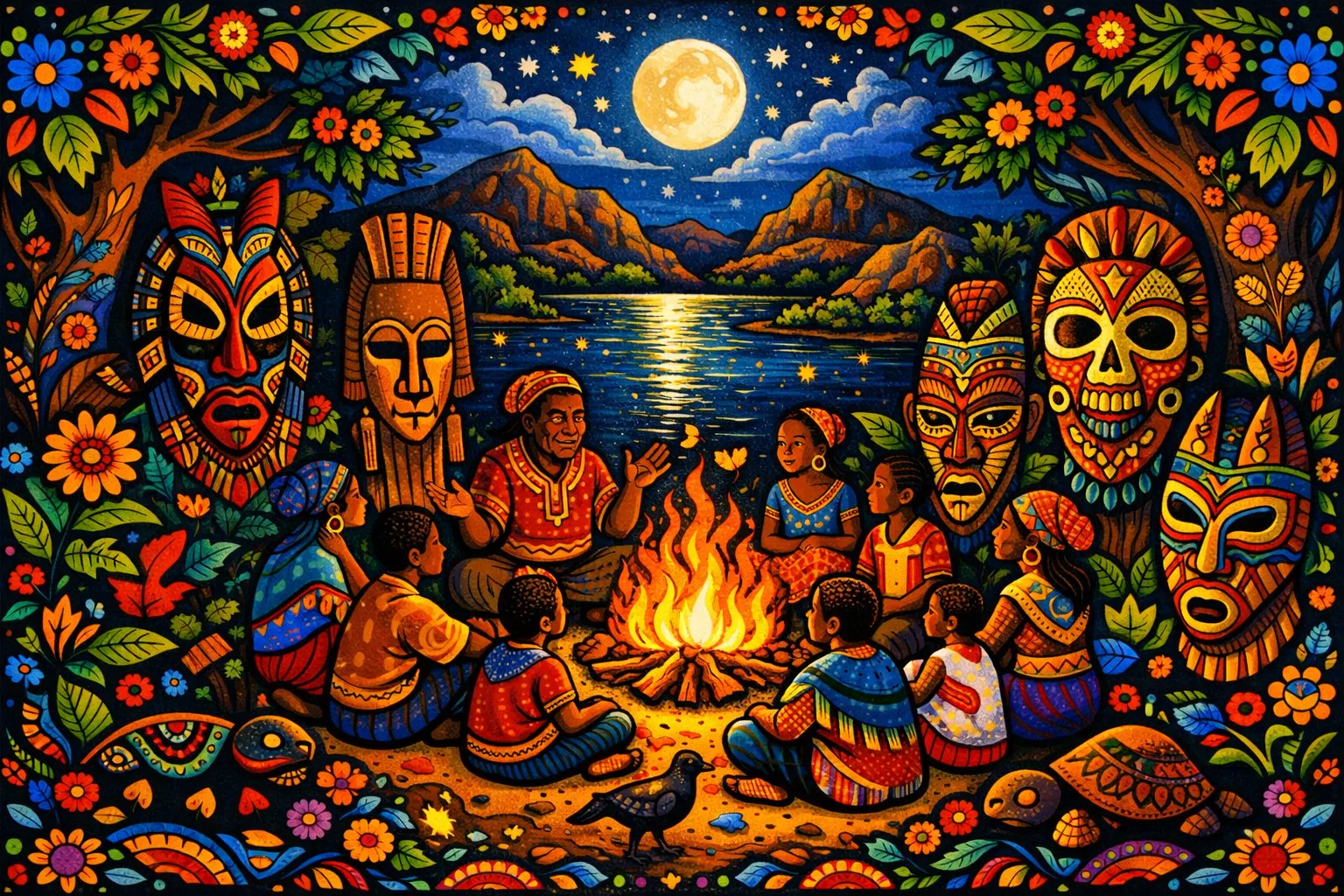
Angola’s folklore is best understood not as a single national mythology, but as a living field of oral stories, ancestral beliefs, spirit traditions, masquerades, sacred landscapes and modern retellings shaped by many peoples and languages.
Page outline Jump by section
Introduction
Angola’s traditions matter because they show how stories do more than entertain. They teach caution, explain misfortune, connect the living with ancestors, encode environmental knowledge, mark initiation, and preserve regional identities within a modern country whose culture has been shaped by Bantu-speaking societies, Portuguese colonialism, Christianity, the Atlantic slave trade, civil war, migration and urban life. Any honest account must also admit that the evidence is uneven: some traditions were recorded in detail, some survive mainly through ritual objects and museum descriptions, and many remain local, oral, changing and only partly visible to outsiders.[archive.org]archive.orgOpen source on archive.org.
Angola has many folklore regions, not one neat pantheon
The first trap in writing about Angolan folklore is to flatten it into a list of “gods and monsters”. Angola is home to many cultural regions, including Kimbundu-speaking Mbundu traditions around Luanda and the north-western interior, Ovimbundu traditions in the central highlands, Chokwe and Lunda-Cokwe traditions in the east, Kongo-related traditions in the north and Cabinda, and southern communities with their own ritual and oral histories. Older sources repeatedly stress that indigenous religious systems varied by group and locality, even where they shared broad patterns such as ancestor veneration, nature spirits, divination and ideas about witchcraft or sorcery.[Wikipedia]WikipediaReligion in AngolaReligion in Angola
This means that the best Angolan folklore pages should be organised around specific traditions rather than a single master myth. A river spirit from Kimbundu-speaking areas, a Chokwe initiation mask, a Kongo power object, a Lunda-Cokwe sand drawing and a modern novel about Queen Njinga all belong within Angolan legendary culture, but they do not come from one tidy system. They come from different communities, periods and kinds of evidence.[archive.org]archive.orgOpen source on archive.org.
The older record is also shaped by outsiders. One of the most important published collections, Héli Chatelain’s Folk-tales of Angola, appeared in 1894 and presented fifty tales with Kimbundu text, English translation, introduction and notes. It is invaluable because it preserves story material and language, but it is also a colonial-era scholarly collection, produced through translation, payment, selection and the assumptions of its time. Chatelain himself noted that he had gathered far more material than the first volume contained, including proverbs, riddles and songs, and that persuading local narrators to share stories with a stranger was difficult.[Internet Archive]archive.orgOpen source on archive.org.
The classic Kimbundu tale collection shows a world of animals, spirits and warnings
Chatelain’s collection remains one of the clearest entry points into Angolan folktales because it gives readers actual narratives rather than only descriptions of belief. The tales include animal stories, trickster-like reversals, encounters with dangerous beings, songs inside the story, and moral tests. Chatelain explicitly connected some Angolan animal tales with wider African and Afro-diasporic variants, noting that readers familiar with African American animal tales would recognise parallels. That does not make the Angolan stories derivative; it shows how tale-types travel, change and become local.[Internet Archive]archive.orgOpen source on archive.org.
One memorable group of tales involves the Ma-kishi, translated in the collection as powerful or uncanny beings who may dance, threaten, deceive or devour. In “The Girls and the Ma-kishi”, the danger is not a simple monster attack. The suspense turns on wakefulness, song, hunger, bargaining and escape: a young girl keeps herself and her companions alive by answering the Ma-kishi through repeated song while the others sleep. The tale has the feel of a night-time warning story: do not be careless, listen when others ignore danger, and use wit before force.[Internet Archive]archive.orgOpen source on archive.org.
Water beings also appear in the older Kimbundu record. Chatelain’s notes describe Kiximbi as a spirit or “genius” associated with a river or lagoon, and say that in Luanda related names included Kianda and Kituta. That small note is important because it points to a wider Angolan pattern: spirits are often not abstract figures in a remote heaven, but presences linked with rivers, lagoons, trees, rocks, wind, lightning, local places and family histories.[Internet Archive]archive.orgOpen source on archive.org.
These tales should not be read as children’s fantasy in the narrow modern sense. They are entertainment, but they also dramatise practical anxieties: strangers, night travel, hunger, marriage, jealousy, illness, debt, social promises and the danger of failing to recognise hidden power. In this sense, Angolan folktales resemble many oral traditions around the world: they carry humour and fear at the same time, and they teach through memorable situations rather than direct preaching.[Internet Archive]archive.orgOpen source on archive.org.
Ancestors, spirits and diviners explain why folklore was part of everyday life
Traditional Angolan belief systems often place ancestors and nature spirits closer to daily life than a remote creator deity. The Library of Congress country study describes a widespread pattern in which ancestral spirits are linked to the welfare of descent groups, while nature spirits are associated with particular places or forces. Misfortunes such as illness, crop failure or personal loss could be interpreted through failures of ritual, offended spirits, witchcraft, sorcery or other hidden causes.[Wikipedia]WikipediaReligion in AngolaReligion in Angola
This matters for folklore because stories about spirits were not merely “old myths” detached from social life. They helped people think about why things happened. A sudden illness, a death, a failed harvest or a conflict inside a family might raise the question of agency: who or what has caused this? In that worldview, misfortune was often investigated rather than treated as random.[Country Studies]countrystudies.usCountry Studies AngolaCountry Studies Angola
The figure of the kimbanda, a diviner or healer, is central here. The country study describes the kimbanda as someone believed to communicate with spirits, sometimes after illness or possession by a specific spirit, and often also as a person with knowledge of herbal medicine. The kimbanda’s role could therefore sit between healing, counselling, diagnosis, ritual and social interpretation.[Country Studies]countrystudies.usCountry Studies AngolaCountry Studies Angola
For a modern reader, the key is to avoid two mistakes. One is to dismiss such traditions as “superstition” and miss their social meaning. The other is to present them as proof of supernatural facts. A grounded account treats them as belief systems and narrative frameworks: ways communities have explained danger, repaired relationships, remembered the dead and negotiated responsibility.[Wikipedia]WikipediaReligion in AngolaReligion in Angola
Chokwe masks make spirits visible
Among the most internationally recognisable Angolan folklore traditions are Chokwe masks and masquerades. Museum records describe Chokwe ancestral spirit masks as more than carved objects: in performance, ancestral spirits known as makishi return as animate presences who instruct the living, especially in initiation contexts. A High Museum object note says such masks transmit knowledge from generation to generation and may still appear beyond initiation, including at political events and community settings.[High Museum of Art]high.orgOpen source on high.org.
The Mwana pwo mask is a particularly clear example of how beauty, ancestry and ritual overlap. The Detroit Institute of Arts describes it as a Chokwe mask used in initiation ceremonies, worn by men but representing female ancestors and admired qualities associated with young women. In performance, the dancer’s costume and gestures evoke femininity and fertility, so the mask is not a portrait in the ordinary sense but a performed ancestral ideal.[Detroit Institute of Arts]dia.orgDetroit Institute of Arts Mask (Mwana pwo) | Detroit Institute of Arts MuseumDetroit Institute of Arts Mask (Mwana pwo) | Detroit Institute of Arts Museum
For readers used to thinking of folklore as “stories told aloud”, Chokwe masks widen the frame. Here folklore is carried by wood, fibre, pigment, dance, music, costume, secrecy, initiation and spectatorship. The story is not only narrated; it appears. A mask in a museum case is therefore only part of the evidence. Its fuller meaning belongs to performance, ritual timing, community memory and rules about who may see or wear it.[High Museum of Art]high.orgOpen source on high.org.
This also explains why museum collections can be both valuable and incomplete. Museums in Luanda and abroad preserve masks, instruments and ritual objects, but many were collected under colonial conditions or separated from the performances that gave them meaning. Angola’s National Museum of Anthropology in Luanda is described as including a mask room connected with Bantu ritual symbols, while the history of objects removed from Angola, including Chokwe works linked with the Dundo Museum, raises questions of loss, documentation and return.[Music In Africa]musicinafrica.netOpen source on musicinafrica.net.
Sona sand drawings turn stories into geometry
One of Angola’s most distinctive recognised traditions is Sona, a practice of drawing geometric figures in sand. UNESCO describes Sona as practised by the Lunda Cokwe and neighbouring peoples in eastern Angola and identifies it as a form of expression involving drawings and geometric figures. It was inscribed on UNESCO’s Representative List of the Intangible Cultural Heritage of Humanity in 2023.[UNESCO Intangible Cultural Heritage]ich.unesco.orgOpen source on unesco.org.
Sona matters because it breaks the common assumption that oral tradition is only spoken words. In this tradition, a storyteller draws a continuous pattern, often around a grid of points, while telling or recalling a proverb, fable, riddle, game or animal story. The drawing may be erased by wind or footsteps, but the knowledge lies in memory, performance and the ability to reproduce the pattern correctly.[Natureglo's MathArt Library]hascmathart.weebly.comNatureglo's Math Art Library SONA Sand Drawings from AfricaNatureglo's Math Art Library SONA Sand Drawings from Africa
For folklore readers, Sona is especially valuable because it joins art, mathematics and narrative. A pattern can be beautiful, but it can also be a memory device and a proof of skill. The storyteller must know the story, the rule of the line and the social setting in which the drawing makes sense. That makes Sona one of the clearest examples of Angolan folklore as intellectual culture, not merely quaint custom.[Natureglo's MathArt Library]hascmathart.weebly.comNatureglo's Math Art Library SONA Sand Drawings from AfricaNatureglo's Math Art Library SONA Sand Drawings from Africa
Its modern recognition also shows how traditions change status. A practice once learned locally in sand can become a heritage emblem, a school resource, a museum subject and an international cultural reference. That can help preservation, but it can also simplify a living practice into a logo unless the stories, performers and communities remain central.[UNESCO Intangible Cultural Heritage]ich.unesco.orgOpen source on unesco.org.
Sacred and ancient landscapes add a deeper time layer
Not all Angolan legendary culture is attached to named spirits or recorded tales. Some of it gathers around landscapes: rocks, rivers, caves, hills and archaeological sites that invite stories because they look marked, powerful or old. The south-western rock-art complex of Tchitundu-Hulu in Namibe Province is a strong example. The British Museum’s African rock art resource describes it as a group of four rock-art sites in the south-west corner of Angola, while other summaries emphasise its geometric engravings and painted shelters.[African Rock Art]africanrockart.britishmuseum.orgAfrican Rock Art Tchitundu HuluAfrican Rock Art Tchitundu Hulu
Tchitundu-Hulu should be handled carefully. It is an archaeological and cultural heritage site, not a simple “haunted place” to be turned into paranormal entertainment. The age, authorship and meanings of the art are debated, and rock art can easily be overinterpreted by outsiders. Still, the site belongs in a folklore-oriented account because sacred hills, ancient images and marked stones often become part of local memory, tourist storytelling and national heritage.[Wikipedia]WikipediaOpen source on wikipedia.org.
The same caution applies to claims that particular paintings show “mythical animals” or that a site has one fixed sacred meaning. Such claims may be locally meaningful, archaeologically plausible or tourist shorthand, but they need careful sourcing. What can be said with confidence is that Angola’s folklore landscape includes places where the material past and narrative imagination meet: a rock shelter is not just a site on a map, but a prompt for questions about who made marks, who remembered them, and what later communities believed about them.[Trust For African Rock Art]africanrockart.orgTrust For African Rock Art AngolaTrust For African Rock Art Angola

Queen Njinga is history, legend and national memory at once
Queen Njinga of Ndongo and Matamba is not a folktale character in the simple sense. She was a seventeenth-century ruler, diplomat and military leader in the region now associated with Angola. The Dictionary of African Christian Biography describes her as Angola’s most famous precolonial ruler, living from 1582 to 1663 and struggling to maintain Ndongo’s independence against Portuguese aggression.[African Christian Biography]dacb.orgOpen source on dacb.org.
Yet Njinga also belongs to folklore and legend because her public memory has grown far beyond documentary biography. Oxford’s African history reference describes how, in the twentieth century, her memory was transformed into a symbol of nationalist resistance; she became a national heroine in independent Angola and is also remembered in folk traditions among peoples of African descent in the Americas.[OUP Academic]academic.oup.comAcademic Njinga of Ndongo and MatambaAcademic Njinga of Ndongo and Matamba
Modern retellings complicate the picture. Academic work on Njinga’s movement “from story to myth” notes that fictional and historical narratives have repeatedly used her as a myth of postcolonial Angolan identity, often emphasising resistance to European invaders and national affirmation. Films, novels, comics and public monuments can make Njinga more accessible, but they also choose which parts of her life to emphasise and which to soften.[Revistas UCP]revistas.ucp.ptOpen source on ucp.pt.
For folklore readers, Njinga is a useful lesson in the difference between legend and invention. The legend has a historical core, but each era remakes her: anti-colonial symbol, national mother, warrior queen, diplomatic strategist, Christian convert, Atlantic-world memory figure. The responsible approach is not to strip away the legend as “false”, but to ask what each retelling is doing and why Angolans and the wider diaspora have found her so powerful to remember.[OUP Academic]academic.oup.comAcademic Njinga of Ndongo and MatambaAcademic Njinga of Ndongo and Matamba
Kongo and Atlantic-world traditions connect Angola to the wider diaspora
Northern Angola and Cabinda sit within the wider Kongo cultural world, which has had enormous influence across the Atlantic. Kongo-related traditions include ideas about spirit-containing objects, ritual specialists, healing, protection and witchcraft accusation. Sources on nkisi describe these as spirits or objects inhabited by spirits, especially associated with the Congo Basin and Cabinda, and note that related concepts travelled through the Atlantic slave trade to the Americas.[Wikipedia]WikipediaOpen source on wikipedia.org.
This does not mean every Afro-Atlantic religion can be casually labelled “Angolan folklore”. It means that Angola is part of a broader Central African zone whose beliefs, ritual vocabulary and sacred technologies were carried, transformed and recombined in places such as Brazil, Cuba and the Caribbean. The connection is historically important, but it should be made with precision rather than by treating all African diaspora practices as interchangeable.[SHS Cairn.info]shs.cairn.infoOpen source on cairn.info.
The same point applies to witchcraft traditions. In many Angolan and Kongo-related settings, “witch” is not best understood as a Halloween figure. It is often a serious social accusation about hidden harm, envy, illness, death or broken relations. The Library of Congress account of Angola notes that distinctions between witchcraft and sorcery vary by society and that diviners may be involved in diagnosing the causes of affliction.[Wikipedia]WikipediaReligion in AngolaReligion in Angola
For a public folklore page, this is where tone matters most. These beliefs should be explained without ridicule and without sensationalism. They involve fear, moral reasoning, healing, social control and sometimes real danger for accused people. Folklore here is not a harmless monster story; it can affect reputations, families and community life.[UPR Info]upr-info.orgUPR Info Institute on Religion and Public Policy Report: ReligiousUPR Info Institute on Religion and Public Policy Report: Religious
Modern Angolan literature keeps oral tradition in motion
Angolan folklore did not end when stories were written down or when people moved to cities. Modern Angolan writers have repeatedly drawn on oral tradition, myth, proverb, memory and legendary figures to rethink history and identity. A 2022 article in the Journal of the British Academy describes the symbolic capital of oral Angolan tradition and studies the closeness between orality and writing in the fiction of Boaventura Cardoso.[The British Academy]thebritishacademy.ac.ukJBA 10s6 05 Ferreirado NascimentoJBA 10s6 05 Ferreirado Nascimento
Pepetela is one of the major examples. Scholarly work on his fiction has examined how folklore supports Angolan historiography, and other sources describe him as a creator of myths and epics that sustain Angolan identity in symbolic form. Novels about figures such as Lueji and Njinga show how oral memory, political history and literary imagination can merge.[jstor.org]jstor.orgThe Role of Folklore in Pepetela's Historiography of AngolaThe Role of Folklore in Pepetela's Historiography of Angola
This modern literary layer is important because many readers meet folklore through books, films and school materials rather than through village storytelling. A modern novel may preserve an old motif, but it may also reshape it for nationalist, anti-colonial, feminist, diasporic or artistic purposes. That does not make it less important; it makes it a different kind of folklore evidence.[Revistas UCP]revistas.ucp.ptOpen source on ucp.pt.
The safest distinction is simple: oral tradition is not automatically the same as literary retelling. A folktale collected from Kimbundu narrators in the nineteenth century, a Chokwe mask performance, a Sona drawing, a museum label and a twenty-first-century novel can all illuminate Angola’s folklore, but each must be read according to its own medium and context.[archive.org]archive.orgOpen source on archive.org.
What is best attested, and what should be treated cautiously?
The strongest evidence for Angolan folklore comes from a few well-defined areas. Kimbundu tales are unusually accessible because Chatelain’s 1894 volume preserves texts, translations and notes. Chokwe masquerade traditions are well represented through museum collections and scholarship on masks. Sona has recent UNESCO recognition as intangible heritage. Indigenous religious patterns involving ancestors, spirits and diviners are described in country studies and ethnographic summaries. Njinga’s transformation from ruler to national myth is supported by historical and literary scholarship.[archive.org]archive.orgOpen source on archive.org.
More caution is needed with internet lists of “Angolan monsters” or neat pantheons. Some may be based on real terms, but many online summaries blur Angola with neighbouring countries, translate ritual beings into generic fantasy creatures, or detach names from the communities that used them. If a creature or spirit is not tied to a source, language, region, ritual or tale, it should be treated as unverified rather than repeated as fact.[Internet Archive]archive.orgOpen source on archive.org.
The same caution applies to haunted-place claims and tourist legends. Angola certainly has sacred landscapes, old battle sites, colonial ruins, cemeteries, churches, rock-art shelters and places associated with war memory. But a folklore account should distinguish documented local belief from modern travel writing, social-media atmosphere and invented ghost stories. The more dramatic the claim, the more important the source.[Wikipedia]WikipediaOpen source on wikipedia.org.
A good reader’s rule is to ask four questions: Who tells the story? Where is it located? What is the evidence? What has changed in retelling? Those questions keep Angolan folklore vivid without turning it into either dry anthropology or unsupported creepypasta.

Why Angola’s folklore still feels alive
Angola’s folklore remains compelling because it is not confined to the past. It survives in stories, ritual arts, museum collections, school heritage projects, literary fiction, family memory, public monuments, music and diaspora religion. A Chokwe mask may appear in an art museum, but its meaning still points back to initiation, ancestry and performance. A Sona drawing may be erased from sand, but its pattern can enter UNESCO heritage lists and mathematics classrooms. Njinga may be studied by historians, but she also lives as a national symbol and mythic figure of resistance.[high.org]high.orgOpen source on high.org.
The deepest pattern across these traditions is relationship. Angolan folklore repeatedly asks how the living relate to the dead, how humans relate to rivers and rocks, how young people learn from elders, how communities diagnose misfortune, how beauty and power are performed, and how historical trauma becomes story. That is why the subject cannot be reduced to monsters or myths alone. It is a broad cultural language for memory, danger, wisdom and identity.[wikipedia.org]WikipediaReligion in AngolaReligion in Angola
Amazon book picks
Further Reading
Books and field guides related to What Makes Angola's Folklore So Many-Sided?. Use these as the next step if you want deeper reading beyond the article.
African Folklore
Covers traditions, beliefs and storytelling across Africa including relevant cultural contexts.
Folk-Tales of Angola - Fifty Tales, with Ki-Mbundu Text Liter...
Many of the earliest books, particularly those dating back to the 1900s and before, are now extremely scarce and increasingly expensive....
African Religions and Philosophy
Explains themes recurring in many Angolan traditions.
eBay marketplace picks
Marketplace Samples
Live-tested eBay searches with available results related to this page.
Endnotes
1.
Source: archive.org
Link:https://archive.org/stream/folktalesofangol00chat/folktalesofangol00chat_djvu.txt
2.
Source: ich.unesco.org
Link:https://ich.unesco.org/en/RL/sona-drawings-and-geometric-figures-on-sand-01994
3.
Source: Wikipedia
Title: Religion in Angola
Link:https://en.wikipedia.org/wiki/Religion_in_Angola
4.
Source: high.org
Link:https://high.org/collection/mask-31/
5.
Source: ich.unesco.org
Link:https://ich.unesco.org/en/decisions/18.COM/8.B.15
6.
Source: Wikipedia
Link:https://en.wikipedia.org/wiki/Tchitundu-Hulu
7.
Source: academic.oup.com
Title: Academic Njinga of Ndongo and Matamba
Link:https://academic.oup.com/edited-volume/61663/chapter/553417928?searchresult=1
8.
Source: revistas.ucp.pt
Link:https://revistas.ucp.pt/index.php/jsta/article/view/7325/7105
9.
Source: unesdoc.unesco.org
Link:https://unesdoc.unesco.org/ark%3A/48223/pf0000230103
10.
Source: Wikipedia
Link:https://en.wikipedia.org/wiki/Nkisi
11.
Source: shs.cairn.info
Link:https://shs.cairn.info/journal-archives-de-sciences-sociales-des-religions-2002-1-page-59?lang=en
12.
Source: upr-info.org
Title: UPR Info Institute on Religion and Public Policy Report: Religious
Link:https://upr-info.org/sites/default/files/documents/2013-07/irppupragos072010instituteonreligionandpublicpolicye.pdf
13.
Source: jstor.org
Title: The Role of Folklore in Pepetela’s Historiography of Angola
Link:https://www.jstor.org/stable/23358976
14.
Source: academic.oup.com
Link:https://academic.oup.com/edited-volume/61663/chapter-abstract/553452056?redirectedFrom=fulltext
15.
Source: Wikipedia
Title: Njinga of Angola: Africa’s Warrior Queen
Link:https://en.wikipedia.org/wiki/Njinga_of_Angola%3A_Africa%27s_Warrior_Queen
16.
Source: Wikipedia
Title: Sona (Muster)
Link:https://de.wikipedia.org/wiki/Sona_%28Muster%29
17.
Source: Wikipedia
Link:https://en.wikipedia.org/wiki/Quimbanda
18.
Source: Wikipedia
Title: Nzinga of Ndongo and Matamba
Link:https://en.wikipedia.org/wiki/Nzinga_of_Ndongo_and_Matamba
19.
Source: Wikipedia
Title: Palo (religion)
Link:https://en.wikipedia.org/wiki/Palo_%28religion%29
20.
Source: Wikipedia
Title: Kongo religion
Link:https://en.wikipedia.org/wiki/Kongo_religion
21.
Source: ich.unesco.org
Title: angola AO
Link:https://ich.unesco.org/en/state/angola-AO?call=film&id=68950&include=film_inc.php&width=700
22.
Source: unesco.org
Title: honours africas rich documentary heritage new inscriptions memory world register
Link:https://www.unesco.org/en/articles/unesco-honours-africas-rich-documentary-heritage-new-inscriptions-memory-world-register
23.
Source: unesdoc.unesco.org
Link:https://unesdoc.unesco.org/ark%3A/48223/pf0000388221
24.
Source: unesco.org
Title: memory world
Link:https://www.unesco.org/en/articles/memory-world
25.
Source: unesco.org
Title: memory world unesco launches first book african documentary heritage
Link:https://www.unesco.org/en/articles/memory-world-unesco-launches-first-book-african-documentary-heritage
26.
Source: archive.org
Link:https://archive.org/download/folktalesofangol00chat/folktalesofangol00chat.pdf
27.
Source: folktales.africa
Link:https://folktales.africa/sona-the-sand-drawings-of-wisdom/
28.
Source: youtube.com
Link:https://www.youtube.com/watch?v=rnS9ldfV1cs
Source snippet
This Angolan Monster Has a Secret Face on the Back of Its Head...
29.
Source: countrystudies.us
Title: Country Studies Angola
Link:https://countrystudies.us/angola/79.htm
30.
Source: thebritishacademy.ac.uk
Title: JBA 10s6 05 Ferreirado Nascimento
Link:https://www.thebritishacademy.ac.uk/documents/4377/JBA-10s6-05-FerreiradoNascimento.pdf
31.
Source: musicinafrica.net
Link:https://www.musicinafrica.net/fr/node/3724
32.
Source: dia.org
Title: Detroit Institute of Arts Mask (Mwana pwo) | Detroit Institute of Arts Museum
Link:https://dia.org/collection/mask-mwana-pwo-37859
33.
Source: hascmathart.weebly.com
Title: Natureglo’s Math Art Library SONA Sand Drawings from Africa
Link:https://hascmathart.weebly.com/uploads/7/6/8/7/7687070/sona_african_sand_drawing_ebooklet_2.pdf
34.
Source: africanrockart.britishmuseum.org
Title: African Rock Art Tchitundu Hulu
Link:https://africanrockart.britishmuseum.org/country/angola/tchitundu-hulu/
35.
Source: africanrockart.org
Title: Trust For African Rock Art Angola
Link:https://africanrockart.org/angola/
36.
Source: dacb.org
Link:https://dacb.org/stories/angola/njinga/
37.
Source: 101lasttribes.com
Title: AFRIC A | 101 Last Tribes
Link:https://www.101lasttribes.com/tribes/kongo.html
38.
Source: hoteisangola.com
Title: National Museum of Anthropology
Link:https://www.hoteisangola.com/inner.php/en/nao-perder/luanda/museu-nacional-antropologia.html?print=1
39.
Source: visiteluanda.com
Title: National Museum of Anthropology
Link:https://visiteluanda.com/en/locais-interesse/museu-nacional-antropologia.html
Additional References
40.
Source: arxiv.org
Link:https://arxiv.org/abs/1907.03969
41.
Source: scribd.com
Link:https://www.scribd.com/document/624298380/The-Cult-of-Ancestors-in-African-Traditional-Religion
42.
Source: academia.edu
Link:https://www.academia.edu/74876364/Lusophone_Southern_African_Literature_Angola_Mozambique_
43.
Source: researchgate.net
Link:https://www.researchgate.net/publication/254939330_The_Role_of_Folklore_in_Pepetela%27s_Historiography_of_Angola/download
44.
Source: researchgate.net
Link:https://www.researchgate.net/publication/317449743_Rethinking_religion_magic_and_witchcraft_in_South_Africa_From_colonial_coherence_to_postcolonial_conundrum
45.
Source: researchgate.net
Link:https://www.researchgate.net/publication/398985723_Retrieving_African_Traditional_Religion_from_the_Fringes_Umbanda_and_the_Brazilian_Traditions_as_a_Source
46.
Source: researchgate.net
Link:https://www.researchgate.net/publication/403826284_Supernatural_beings_as_symbols_in_masquerades_and_traditional_oral_tales_in_Ogba
47.
Source: facebook.com
Link:https://www.facebook.com/DoestPhoto/photos/a-traditional-mask-from-southeastern-angola-is-displayed-at-the-national-anthrop/1562425775443936/
48.
Source: instagram.com
Link:https://www.instagram.com/p/DY4hwB1IMc0/
49.
Source: facebook.com
Link:https://www.facebook.com/groups/269202760462518/posts/401587407224052/
Topic Tree
Follow this branch
Related pages 192
- Afghan Folklore
- Albanian Folklore
- Algerian Folklore
- Australian Folklore
- Azerbaijan Folklore
- +187 more in sidebar