Why Croatia's Legends Are So Regional
Croatian folklore is not a single neat mythology with one authorised cast of gods and monsters. It is a layered tradition shaped by the Adriatic coast, Istria, the Dinaric hinterland, the Pannonian plains, Catholic ritual life, South Slavic oral storytelling, Mediterranean contacts and Central European neighbours.
Page outline Jump by section
Why Croatian folklore is so regional
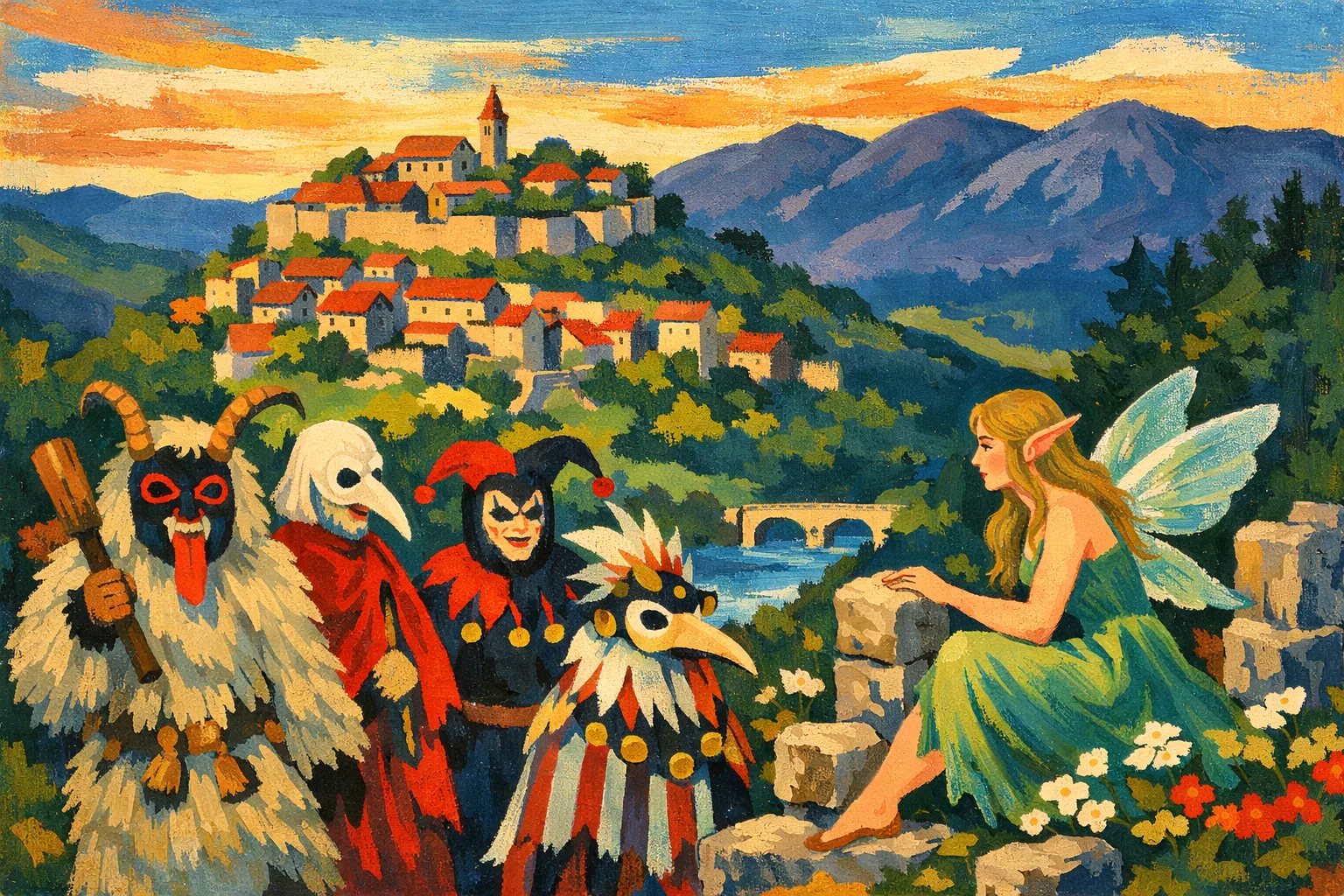
A first-time reader may expect Croatian folklore to behave like a national pantheon. It rarely does. The country’s traditions come from landscapes and borderlands: island processions, Istrian hill towns, Dalmatian villages, northern gingerbread fairs, carnival routes around Kastav, and inland story worlds around rivers, forests and mountains. Maja Bošković-Stulli, one of Croatia’s major folklorists, described Croatian oral literature through Dinaric, Adriatic-Mediterranean, Pannonian and Central European areas, stressing historical contacts, migrations, bilingual border communities and neighbouring influences rather than a single sealed-off “ethnic” folklore system.[Hrčak]hrcak.srce.hrHrčak REGIONAL FEATURES OF THE CROATIAN ORAL LITERATUREHrčak REGIONAL FEATURES OF THE CROATIAN ORAL LITERATURE
That regional quality is part of the appeal. Istria is especially rich in tales of witches, vampire-like beings and giants. The Dalmatian hinterland has been central to recent fieldwork on belief in fairies, witches, werewolves and night spirits. Islands preserve religious and carnival practices with a strong sense of local ownership. Northern Croatia has craft and fairground traditions, including decorated gingerbread hearts, that belong more to ritual gift culture and festive identity than to monster lore. UNESCO’s Croatia page lists 23 intangible heritage elements, showing how much of the country’s living tradition sits in performance, craft, procession, song and seasonal custom rather than in written myth alone.[ICH UNESCO]ich.unesco.orgcroatia HRCroatia2025: Community safeguarding and documenting of the 'Lastovo Poklad' carnival custom (Art18) · 2024: Art of dry stone co…
Fairies, witches and night fears
The most useful way to approach Croatian supernatural beings is through “belief legends”: short narratives told as things that happened, might have happened, or were once believed to happen in a named place. Luka Šešo’s research on Croatian belief legends highlights witches, fairies and werewolves as figures that have moved from frightening village talk into festivals, tourism and public heritage events. He argues that modern events often turn older fears into controlled experiences: visitors meet the frightening figure, but in a safe setting where fear becomes entertainment, local identity and cultural education.[ZRC SAZU]ojs.zrc-sazu.siThe Supernatural Beings of Belief Legends – Old Fears in a New Context | Studia mythologica Slavica…
Fairies in Croatian tradition are not simply tiny, harmless storybook figures. In South Slavic and Croatian regional belief, they may appear as powerful female beings connected with mountains, waters, forests, dancing circles, healing, seduction or danger. They can bless, punish, enchant or help heroes, depending on the story. Older collectors and later folklorists noted that such beings were becoming less common in everyday rural narration by the nineteenth and twentieth centuries, yet Šešo’s fieldwork suggests that knowledge of them has not vanished completely; it survives unevenly among people and communities willing to speak about supernatural traditions.[ResearchGate]researchgate.netOpen source on researchgate.net.
Witches and related figures are similarly localised. In Istrian and Dalmatian contexts, the feared person may be imagined not just as a spell-caster but as someone whose hidden power affects illness, cattle, sleep, harvest or death. The important point is not whether people today “believe” in witches in a simple yes-or-no way, but how such stories worked: they gave language to misfortune, social suspicion, illness, envy and the feeling that danger might be close to home.[ZRC SAZU SMS]sms.zrc-sazu.siOpen source on zrc-sazu.si.
Croatia’s vampire story begins in Istria
The most internationally recognisable Croatian supernatural figure is Jure Grando of Kringa in Istria. Croatian tourism materials present him as one of Europe’s earliest documented vampire-like figures, while scholarly and local accounts usually describe him more carefully as an Istrian “warlock” or revenant figure whose story was recorded in early modern writing and later reshaped by vampire literature and tourism.[Hrvatska Puna Života]croatia.hrHrvatska Puna Života The Legend Of Jure GrandoHrvatska Puna Života The Legend Of Jure Grando
The legend says that after Grando died in 1656, he returned at night, knocked on doors, frightened villagers and visited his widow. Villagers eventually opened his grave and destroyed the body, after which the haunting ceased. The story is often linked to Johann Weikhard von Valvasor’s seventeenth-century writing, which helped give the tale a documentary aura unusual for local vampire legends. That does not make the events factual; it means the story entered written circulation early enough to become a key reference point in the European history of vampire narratives.[Wikipedia]WikipediaJure GrandoJure Grando
Modern Kringa and Istria have turned the tale into a heritage and tourism asset. This is a good example of how Croatian folklore changes form: a feared local dead person becomes a regional legend, then a literary curiosity, then a tourist story. The shift does not make the tradition fake, but it does change its function. In the village setting it explained fear, death and social disruption; in modern culture it helps Istria tell a distinctive story about itself.[Istra]istra.hrOpen source on istra.hr.
Giants, fairytale landscapes and literary reinvention
Croatia’s giants show how oral legend and literature can merge. Istria has a strong giant tradition, especially around Motovun and the Mirna valley. Local retellings describe giants as ancient builders and labourers connected with hill towns, rivers and fields. The best-known figure is Veli Jože, the giant popularised by Vladimir Nazor’s 1908 story. In that literary version, the giant becomes more than a wonder tale: he represents freedom, exploitation and the dignity of Istria under outside rule.[Wikipedia]WikipediaVeli JožeVeli Jože
This matters because some “folk” figures reach readers through authored literature rather than direct oral collection. Veli Jože is rooted in Istrian giant lore, but most modern readers encounter him through Nazor’s literary shaping. That makes him a hybrid: part local legend, part national literature, part regional symbol. The same pattern appears elsewhere in Croatia, especially in Ogulin, the birthplace of Ivana Brlić-Mažuranić, whose 1916 collection Croatian Tales of Long Ago created new fairy tales inspired by Slavic mythic motifs and Croatian folk imagination.[Project Gutenberg]gutenberg.orgOpen source on gutenberg.org.
Ogulin has embraced that legacy as a “homeland of fairy tales”, using landscape, storytelling and Brlić-Mažuranić’s reputation to shape town identity and cultural tourism. This is not simply old oral tradition preserved unchanged. It is a modern cultural landscape built from literature, local pride, children’s culture, festivals and the idea that a real place can be read through fairy-tale imagination.[Muze.hr]muze.hrOpen source on muze.hr.
Haunted and sacred places
Croatian legends often cling to places that visitors can still see. Plitvice Lakes, for example, has the legend of the Black Queen, who is said in local and tourist retellings to have answered the prayers of a drought-stricken people and brought the waters that created the lakes. The National Park presents the story explicitly as legend, not geology, which is the right distinction: the lakes have a natural explanation, while the story gives the landscape moral and emotional meaning.[Nacionalni park "Plitvička jezera"]np-plitvicka-jezera.hrthe legend of the black queenthe legend of the black queen
Pula’s Roman amphitheatre has also attracted legendary explanation. One popular Istrian retelling says fairies built the Arena at night, carrying stones and working until dawn. Historically, the monument is Roman; folklorically, the fairy-building legend turns an imposing ancient ruin into something intimate and local. The point is not to replace archaeology with fantasy, but to show how communities attach wonder to structures whose real builders feel distant.[Total Croatia]total-croatia-news.comTotal Croatia Legends of Istria: Pula Arena, Built by Fairies in the NightTotal Croatia Legends of Istria: Pula Arena, Built by Fairies in the Night
Such stories are common in landscape folklore. A natural formation, ruin, cave, bridge, hill or lake becomes memorable because a story gives it agency: a queen takes pity, fairies build, giants dig rivers, witches gather on a mountain. Croatia’s folklore is especially rich in this kind of place-making because its regions have such visually distinct landscapes, from karst lakes and Adriatic islands to Istrian hill towns and inland forests.
Carnival as controlled chaos
Some of Croatia’s most vivid folklore is not a tale but a public act. The annual carnival bell-ringers’ pageant from the Kastav area, inscribed by UNESCO in 2009, involves groups moving through north-west Croatian villages during the January carnival period. UNESCO describes bell ringers marching through the villages of the Kastav region; local descriptions emphasise sheepskins, bells, masks, set routes and the driving away of winter as spring approaches.[ICH UNESCO]ich.unesco.orgOpen source on unesco.org.
The bell-ringers show how folklore can be noisy, physical and communal. Their masks and bells make the supernatural almost practical: evil, winter and disorder are not debated in abstract terms, but chased through sound, movement and repetition. Local legend even explains some groups as descendants of people who frightened off invaders with animal skins, masks and bells, a story that fuses seasonal ritual with historical memory.[khz.hr]khz.hrOpen source on khz.hr.
The Lastovo carnival is another powerful example. UNESCO’s 2025 recognition of community safeguarding and documenting of the Lastovo Poklad custom highlights an annual event running from 17 January to Ash Wednesday, with circle dance and other community performances. Recent Croatian reporting describes the climactic humiliation and burning of the carnival effigy, rooted in a local legend involving an enemy messenger and island resistance.[ICH UNESCO]ich.unesco.orgOpen source on unesco.org.

Religion, ritual and folk culture
Croatian folklore is not only pre-Christian survival or supernatural fear. Catholic ritual life is deeply woven into local tradition, especially on islands and in older communities where procession, song and vow preserve identity. The Hvar procession known as “Following the Cross” was inscribed by UNESCO in 2009 and is described by UNESCO as a long-established part of Hvar’s religious and cultural identity, connecting the island’s communities with one another and the wider Catholic world.[UNESCO]unesco.orgdocument 328document 328
Local accounts describe the Hvar procession as a roughly 500-year-old Maundy Thursday night event passing through six settlements in the centre of the island. It is religious devotion, but it also belongs to folklore in the broader sense: repeated communal performance, inherited roles, sacred song, route, memory and place.[Visit Jelsa]visitjelsa.hrOpen source on visitjelsa.hr.
This helps correct a common misunderstanding. Folklore is not only “pagan mythology” or monsters. In Croatia, as in much of Europe, folk religion includes processions, vows, saints, protective objects, mourning songs, seasonal fasts, blessings and local miracle stories. These practices may be fully Christian and still folkloric because they are transmitted and shaped by communities over time.
Oral tradition, archives and collectors
Croatian folklore is unusually well served by institutional research. The Institute of Ethnology and Folklore Research in Zagreb was founded in 1948 as the Institute for Folk Art and later became an interdisciplinary centre for ethnology, cultural anthropology, folklore studies, ethnomusicology and related fields. Its collections include manuscripts, audio and video recordings, photographs and films about traditional Croatian culture of the twentieth and twenty-first centuries.[ief.hr]ief.hrAbout us|The Institute of Ethnology and Folklore ResearchAbout us|The Institute of Ethnology and Folklore Research
That archival base matters because oral tradition is fragile. Stories change with each telling; some disappear when the last good narrator dies; others survive only because a collector wrote them down, recorded them or later republished them. The Institute’s own history shows a shift away from treating tradition as a frozen peasant inheritance and towards studying culture as something continually changing in everyday life, festivals, media, identity and popular culture.[ief.hr]ief.hrAbout us|The Institute of Ethnology and Folklore ResearchAbout us|The Institute of Ethnology and Folklore Research
Maja Bošković-Stulli’s work remains central because she treated Croatian oral literature as both local and connected. Her writing on regional features shows that Croatian tales cannot be understood without neighbouring traditions, migrations, borderlands, bilingual informants and the different styles of epic, lyric and prose storytelling.[Hrčak]hrcak.srce.hrHrčak REGIONAL FEATURES OF THE CROATIAN ORAL LITERATUREHrčak REGIONAL FEATURES OF THE CROATIAN ORAL LITERATURE
What is old, what is invented, and what is modern?
A careful reader should not divide Croatian folklore into “authentic old belief” and “fake tourist invention” too quickly. The reality is more interesting. Some practices, such as long-running processions or carnival routes, have strong community continuity. Some figures, such as fairies and witches, belong to older belief legends but are now often encountered through festivals, museum displays, local storytelling events and tourism. Some famous characters, such as Veli Jože, are literary transformations of regional legend. Others, such as the Black Queen of Plitvice, are best understood as place legends that help visitors imagine a landscape.[zrc-sazu.si]ojs.zrc-sazu.siZRC SAZUThe Supernatural Beings of Belief Legends – Old Fears in a New Context | Studia mythologica Slavica…
Šešo’s work on modern Croatian festivals is especially useful here because it treats “invention of tradition” not as a simple accusation, but as a cultural process. Communities revive, adapt and stage supernatural beings because these figures still do work: they entertain, teach, frighten gently, distinguish one town from another and turn local memory into something shareable.[ZRC SAZU]ojs.zrc-sazu.siThe Supernatural Beings of Belief Legends – Old Fears in a New Context | Studia mythologica Slavica…
The same is true of UNESCO heritage. Inscription can help safeguard a custom, but it can also change how a community performs and explains that custom to outsiders. A bell-ringer route, a cross procession or a carnival effigy may remain locally meaningful while also becoming part of Croatia’s national and international cultural image.[ICH UNESCO]ich.unesco.orgcroatia HRCroatia2025: Community safeguarding and documenting of the 'Lastovo Poklad' carnival custom (Art18) · 2024: Art of dry stone co…
The best way to understand Croatian folklore
The best starting point is not to ask, “What is Croatia’s mythology?” but “Which region, which community and which kind of tradition?” Istria offers vampire-like revenants, witches and giants. The Kastav area gives carnival bell-ringers. Hvar preserves a major devotional procession. Lastovo has a dramatic carnival effigy tradition. Plitvice and Pula show how landscape and monuments gather legends. Ogulin shows how literature, local identity and fairy-tale tourism can reshape folklore for modern audiences.
Taken together, Croatian folklore is a living map of the country’s cultural zones. It is old in its roots, mixed in its influences, local in its strongest forms and modern in its presentation. Its creatures and customs are most powerful when read not as isolated curiosities, but as ways Croatians have explained danger, weather, illness, freedom, sacred duty, landscape, community and belonging.
Amazon book picks
Further Reading
No matched book cards were available for Why Croatia's Legends Are So Regional, so this fallback keeps a direct Amazon reading path visible.
Topical books
UNESCO Croatia guide
Browse books, explainers and reference titles related to this topic.
Search AmazonRelated search
Croatian folklore guide
Browse books, explainers and reference titles related to this topic.
Search AmazonRelated search
Maja Bošković Stulli guide
Browse books, explainers and reference titles related to this topic.
Search AmazonAmazon book picks
Further Reading
Books and field guides related to Why Croatia's Legends Are So Regional. Use these as the next step if you want deeper reading beyond the article.
Croatian Tales of Long Ago
Introduces readers to Croatian legendary motifs and mythic storytelling.
The Hero with a Thousand Faces
Provides tools for understanding recurring folk motifs across regions.
Lonely Planet Croatia
Connects regional landscapes and heritage sites to local traditions.

The Penguin Book of Dragons
Showcases European legendary traditions comparable to Croatian folklore.
eBay marketplace picks
Marketplace Samples
Live-tested eBay searches with available results related to this page.




Endnotes
1.
Source: ief.hr
Title: About us|The Institute of Ethnology and Folklore Research
Link:https://www.ief.hr/en/about-us/
2.
Source: ich.unesco.org
Title: croatia HR
Link:https://ich.unesco.org/en/state/croatia-HR
Source snippet
Croatia2025: Community safeguarding and documenting of the 'Lastovo Poklad' carnival custom (Art18) · 2024: Art of dry stone co...
3.
Source: ich.unesco.org
Link:https://ich.unesco.org/en/RL/gingerbread-craft-from-northern-croatia-00356
4.
Source: ojs.zrc-sazu.si
Title: ZRC SAZU
Link:https://ojs.zrc-sazu.si/sms/article/view/9031
Source snippet
The Supernatural Beings of Belief Legends – Old Fears in a New Context | Studia mythologica Slavica...
5.
Source: researchgate.net
Link:https://www.researchgate.net/publication/346048031The_Supernatural_Beings_of_Belief_Legends-_Old_Fears_in_a_New_Context
6.
Source: sms.zrc-sazu.si
Link:https://sms.zrc-sazu.si/pdf/14/sms-14-08_seso.pdf
7.
Source: croatia.hr
Title: Hrvatska Puna Života The Legend Of Jure Grando
Link:https://croatia.hr/en-gb/culture-and-arts/legends/jure-grando-the-first-real-person-described-as-a-vampire-in-europe
8.
Source: Wikipedia
Title: Jure Grando
Link:https://en.wikipedia.org/wiki/Jure_Grando
9.
Source: istra.hr
Link:https://www.istra.hr/en/home/istria-top-5/908
10.
Source: Wikipedia
Title: Veli Jože
Link:https://en.wikipedia.org/wiki/Veli_Jo%C5%BEe
11.
Source: istra.hr
Title: Top 5 Scariest Istrian Legends | Experiences in Istria
Link:https://www.istra.hr/en/experience/culture/top-5-scariest-istrian-legends
12.
Source: gutenberg.org
Link:https://www.gutenberg.org/ebooks/60095
13.
Source: muze.hr
Link:https://muze.hr/en/projects/ogulin-the-homeland-of-fairy-tales/
14.
Source: ich.unesco.org
Link:https://ich.unesco.org/en/RL/annual-carnival-bell-ringers-pageant-from-the-kastav-area-00243
15.
Source: khz.hr
Link:https://khz.hr/en/the-halubje-bell-ringers/
16.
Source: ich.unesco.org
Link:https://ich.unesco.org/en/BSP/community-safeguarding-and-documenting-of-the-lastovo-poklad-carnival-custom-02314
17.
Source: unesco.org
Title: document 328
Link:https://www.unesco.org/archives/multimedia/document-328
18.
Source: ich.unesco.org
Link:https://ich.unesco.org/en/decisions/4.COM/13.33
19.
Source: croatia.hr
Link:https://croatia.hr/en-gb/unesco/procession-za-krizen-following-cross-island-hvar
20.
Source: Wikipedia
Link:https://en.wikipedia.org/wiki/Croatia
21.
Source: Wikipedia
Link:https://zh.wikipedia.org/zh-tw/%E5%85%8B%E7%BD%97%E5%9C%B0%E4%BA%9A
22.
Source: Wikipedia
Title: List of Intangible Cultural Heritage elements in Croatia
Link:https://en.wikipedia.org/wiki/List_of_Intangible_Cultural_Heritage_elements_in_Croatia
23.
Source: Wikipedia
Title: Krsnik (vampire hunter)
Link:https://en.wikipedia.org/wiki/Krsnik_%28vampire_hunter%29
24.
Source: Wikipedia
Link:https://en.wikipedia.org/wiki/Kikimora
25.
Source: Wikipedia
Title: Croatian Tales of Long Ago
Link:https://en.wikipedia.org/wiki/Croatian_Tales_of_Long_Ago
26.
Source: Wikipedia
Title: Maja Bošković Stulli
Link:https://en.wikipedia.org/wiki/Maja_Bo%C5%A1kovi%C4%87-Stulli
27.
Source: Wikipedia
Link:https://en.wikipedia.org/wiki/Zvon%C4%8Dari
28.
Source: Wikipedia
Title: Za križen
Link:https://en.wikipedia.org/wiki/Za_kri%C5%BEen
29.
Source: ief.hr
Link:https://www.ief.hr/en/research/genoloski-aspekti-usmene-i-pucke-tradicije/
30.
Source: ief.hr
Link:https://www.ief.hr/en/research/folklor-knjizevnost-i-kultura-predaja-bajka-maska-i-mit/
31.
Source: ich.unesco.org
Title: croatia HR
Link:https://ich.unesco.org/en/state/croatia-HR?info=elements-on-the-lists
32.
Source: whc.unesco.org
Link:https://whc.unesco.org/en/statesparties/hr
33.
Source: ich.unesco.org
Title: procession za krizen following the cross on the island of hvar 00242
Link:https://ich.unesco.org/en/RL/procession-za-krizen-following-the-cross-on-the-island-of-hvar-00242
34.
Source: ich.unesco.org
Title: photo pop up 00973
Link:https://ich.unesco.org/en/photo-pop-up-00973?photoID=01238
35.
Source: croatia.hr
Link:https://croatia.hr/en-gb/culture-and-arts/legends
36.
Source: croatia.hr
Title: full of life
Link:https://croatia.hr/en-gb
37.
Source: croatia.hr
Link:https://croatia.hr/en-gb/unesco/annual-carnival-bell-ringers-pageant-kastav-area
38.
Source: visitlastovo.croatia.hr
Link:https://visitlastovo.croatia.hr/en-gb/events/lastovo-carnival
39.
Source: visitviskovo.croatia.hr
Link:https://visitviskovo.croatia.hr/en-gb/unesco/on-the-trail-of-the-halubajski-zvoncari-bell-ringers
40.
Source: researchgate.net
Link:https://www.researchgate.net/publication/333723310_What_is_Real_in_Believing_in_Supernatural_Beings_The_Informant%27s_Cut_Sto_je_stvarno_u_vjerovanju_u_nadnaravna_bica_Kazivaceva_verzijabr
41.
Source: researchgate.net
Link:https://www.researchgate.net/publication/376777429_Istrian_Narrative_Folklore_in_Studies_by_Maja_Boskovic-Stulli_and_Milko_Maticetov
42.
Source: ojs.folklore.ee
Title: ee A HIDDEN POT OF CHARM SCHOLARSHIP
Link:https://ojs.folklore.ee/incantatio/article/download/74/118/187
43.
Source: croatia.eu
Link:https://croatia.eu/
44.
Source: hrcak.srce.hr
Title: Hrčak REGIONAL FEATURES OF THE CROATIAN ORAL LITERATURE
Link:https://hrcak.srce.hr/clanak/53189
45.
Source: total-croatia-news.com
Title: Total Croatia Legends of Istria
Link:https://total-croatia-news.com/lifestyle/jure-grando/
46.
Source: np-plitvicka-jezera.hr
Title: the legend of the black queen
Link:https://np-plitvicka-jezera.hr/en/the-legend-of-the-black-queen/
47.
Source: total-croatia-news.com
Title: Total Croatia Legends of Istria: Pula Arena, Built by Fairies in the Night
Link:https://total-croatia-news.com/lifestyle/legends-of-istria-pula-arena-built-by-fairies-in-the-night/
48.
Source: visitjelsa.hr
Link:https://visitjelsa.hr/en/11918/procesija-za-krizen/
49.
Source: ogulintales.com
Title: Ivana Brlić-Mažuranić
Link:https://ogulintales.com/ivana-brlic-mazuranic-tales-of-long-ago/
50.
Source: cryptidz.fandom.com
Title: Jure Grando
Link:https://cryptidz.fandom.com/wiki/Jure_Grando
51.
Source: hrcak.srce.hr
Link:https://hrcak.srce.hr/file/221974
52.
Source: hrcak.srce.hr
Title: hr REGIONA L FEATURES OF THE CROATIAN ORAL
Link:https://hrcak.srce.hr/en/clanak/53189
53.
Source: hrcak.srce.hr
Link:https://hrcak.srce.hr/file/113874
54.
Source: plitvice-etnogarden.com
Title: the legend of the black queen
Link:https://www.plitvice-etnogarden.com/the-legend-of-the-black-queen/
55.
Source: travelnhistory.com
Title: Croatian Folklore
Link:https://travelnhistory.com/legends/croatian-folklore/
56.
Source: scribd.com
Title: Jure Grando
Link:https://www.scribd.com/document/269394253/Jure-Grando
57.
Source: facebook.com
Link:https://www.facebook.com/groups/639757909742696/posts/2706152343103232/
58.
Source: facebook.com
Link:https://www.facebook.com/croatia.hr/photos/if-you-visit-ogulin-this-weekend-you-will-feel-like-youre-in-a-fairy-tale-the-17/10160646127891929/
59.
Source: youtube.com
Title: UNESC O
Link:https://www.youtube.com/watch?v=zQtrSXQkW10
60.
Source: vanderveldeboeken.nl
Title: Croatian Tales of Long Ago
Link:https://www.vanderveldeboeken.nl/a/ivana-brlic-mazuranic/croatian-tales-of-long-ago/9781789872750
61.
Source: total-croatia-news.com
Title: Germans are Returning to the Croatian Property Market
Link:https://total-croatia-news.com/news/germans-croatian-property-market/
62.
Source: total-croatia-news.com
Title: exploring croatia s intangible unesco heritage za krizen on hvar
Link:https://total-croatia-news.com/lifestyle/exploring-croatia-s-intangible-unesco-heritage-za-krizen-on-hvar/
63.
Source: total-croatia-news.com
Title: legends of istria giants of mirna valley
Link:https://total-croatia-news.com/lifestyle/legends-of-istria-giants-of-mirna-valley/
64.
Source: istratourism.com
Title: Istria, the land of Giants
Link:https://istratourism.com/istria-the-land-of-giants/
65.
Source: everythingcroatia.weebly.com
Link:https://everythingcroatia.weebly.com/folklore.html
66.
Source: baltictravelcompany.com
Title: unesco world heritage sites in croatia complete list guide
Link:https://www.baltictravelcompany.com/blog/index.php/balkans/unesco-world-heritage-sites-in-croatia-complete-list-guide/
67.
Source: kids.nationalgeographic.com
Link:https://kids.nationalgeographic.com/geography/countries/article/croatia
Additional References
68.
Source: youtube.com
Title: Div (Croatian mythology)
Link:https://www.youtube.com/watch?v=H2Ue2HbpTUM
Source snippet
Vodenjak (Croatian mythology) - water spirit, sometimes helpful, sometimes dangerous...
69.
Source: youtube.com
Title: Vodenjak (Croatian mythology)
Link:https://www.youtube.com/watch?v=L2ipdzdVhFg
Source snippet
Krsnik (Croatian mythology) - mythical hero, defender against evil forces...
70.
Source: youtube.com
Title: Krsnik (Croatian mythology)
Link:https://www.youtube.com/watch?v=muy05V3Hxik
Source snippet
Was Jure Grando The First Reported Case Of A Real-Life Vampire?...
71.
Source: youtube.com
Title: Was Jure Grando The First Reported Case Of A Real-Life Vampire?
Link:https://www.youtube.com/watch?v=9P3-gOSN9wk
Source snippet
Annual carnival bell ringers pageant from the Kastav area...
72.
Source: academia.edu
Link:https://www.academia.edu/111896553/RECORDS_AND_RECORDERS_OF_KRI%C5%BDEVCI_ORAL_LITERATURE_IN_THE_20th_AND_21st_CENTURY
73.
Source: scribd.com
Link:https://www.scribd.com/document/658075580/Palgrave-Historical-Studies-in-Witchcraft-and-Magic-Willem-de-Blecourt-editor-Werewolf-Histories-Palgrave-Macmillan-2015
74.
Source: facebook.com
Link:https://www.facebook.com/groups/slavic.mythology/posts/10164650681420360/
75.
Source: visitviskovo.hr
Link:https://visitviskovo.hr/en/viskovo/unesco/godisnji-pokladni-ophod-zvoncari/
76.
Source: instagram.com
Link:https://www.instagram.com/p/DEXOy4zCI9B/
77.
Source: croris.hr
Link:https://www.croris.hr/crosbi/publikacija/resolve/croris/733763
Topic Tree
Follow this branch
Related pages 192
- Afghan Folklore
- Albanian Folklore
- Algerian Folklore
- Australian Folklore
- Azerbaijan Folklore
- +187 more in sidebar