Within Tuvalu Folklore
How Did Names Win an Island?
Nanumea's stories of Tefolaha, Pai and Vau link naming, trickery, migration and land rights in one island foundation tale.
On this page
- Tefolaha, Pai and Vau
- Names, rank and belonging
- Islets, sand baskets and local memory
Page outline Jump by section
Introduction
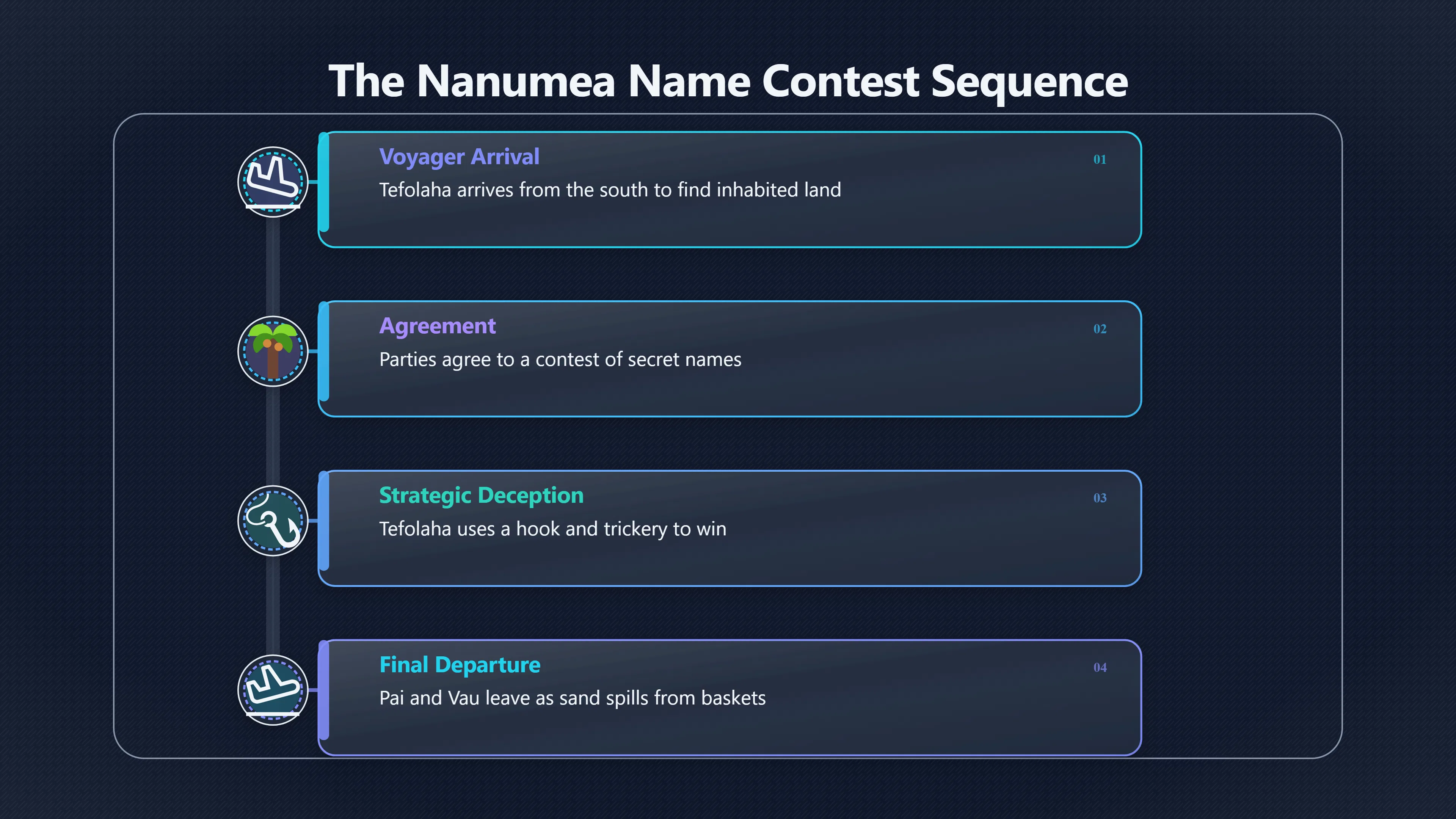
Among the many island-founding stories of Tuvalu, the legends of Nanumea are especially striking because they turn a simple question—“What is your name?”—into a struggle over land, authority and belonging. According to Nanumean tradition, the atoll’s founding ancestor, Tefolaha, arrived from the south and encountered two women, Pai and Vau, who already occupied the island. Rather than fighting for possession, the rivals entered a contest of names. By learning the women’s names while keeping his own secret, Tefolaha won the right to remain, and Pai and Vau departed. Their leaving, the story says, created some of the smaller islets around Nanumea when sand spilled from their baskets.[Wikipedia]WikipediaOpen source on wikipedia.org.

The tale is more than an entertaining trickster story. It links migration, ancestry, land tenure, social rank and local geography into a single narrative. In Nanumea, the legend has long functioned as a cultural charter explaining who belongs to the island, how leading lineages trace their origins, and why particular places are remembered in the landscape.[National Library of Australia Catalogue]catalogue.nla.gov.auOpen source on nla.gov.au.
Tefolaha, Pai and Vau
Nanumean oral traditions describe Tefolaha as a voyager and warrior who came from elsewhere in Polynesia. Different versions place his origins in Samoa or Tonga, reflecting the wider network of migration memories that connect Tuvalu with neighbouring island groups.[Wikipedia]WikipediaOpen source on wikipedia.org.
When Tefolaha reached Nanumea, he did not find an empty island. Instead, Pai and Vau were already there. In some tellings, they were not merely residents but creators of the island itself, having formed it from baskets of sand. This detail immediately gives them a special status: they are linked to the land in a way that later arrivals are not.[Wikipedia]WikipediaOpen source on wikipedia.org.
The dispute that follows is unusual. Instead of a battle of weapons, it becomes a contest of knowledge. The agreement is simple: if Tefolaha can discover the names of Pai and Vau, while they fail to discover his, the island will become his. Through trickery—often described as involving a palm tree, a hook and a carefully staged deception—he persuades the women to reveal their identities. They cannot learn his name in return, and by the terms of the contest they must leave.[Wikipedia]WikipediaOpen source on wikipedia.org.
To modern readers, this may seem an odd wager. Within a Polynesian cultural context, however, names are not merely labels. They are tied to identity, genealogy and social standing. The story therefore treats knowledge of a name as a form of power rather than a trivial fact.[Wikipedia]WikipediaOpen source on wikipedia.org.
Why Names Matter More Than Force
The most memorable feature of the legend is that Tefolaha wins through intelligence rather than military strength. This does not mean the story rejects power. Instead, it presents power as something rooted in knowledge, social understanding and legitimacy.
Across Polynesia, genealogy has traditionally been central to rank and authority. A person’s place within a chain of ancestors could determine rights, obligations and prestige. Knowing who someone was—and where they came from—carried practical importance. The Nanumea story compresses those ideas into a dramatic encounter centred on names.[National Library of Australia Catalogue]catalogue.nla.gov.auOpen source on nla.gov.au.
The contest also reflects a common feature of foundation legends worldwide: the need to explain how newcomers gain authority over a place. Tefolaha is remembered as an arriving founder, yet Pai and Vau represent an earlier connection to the island. The narrative resolves that tension by portraying Tefolaha as legitimately winning possession according to agreed rules rather than simply seizing it.[Wikipedia]WikipediaOpen source on wikipedia.org.
For Nanumeans, the story historically carried implications beyond folklore. Descendants of Tefolaha are associated with the island’s chiefly lines and leading families, making the legend part of a broader framework through which social relationships and claims of descent were understood.[Wikipedia]WikipediaOpen source on wikipedia.org.
Islets, Sand Baskets and Local Memory
The departure of Pai and Vau is as important as the contest itself. According to tradition, as the women left Nanumea, sand spilled from their baskets. The scattered sand became nearby islets, including Motu Foliki, Lafogaki and Te Afua-a-Taepoa.[Wikipedia]WikipediaOpen source on wikipedia.org.
This is a classic example of what folklorists often call a landscape-origin story: a narrative that explains visible features of the environment through memorable events. On a low coral atoll, where small changes in sand and reef can create distinct islands, such stories provide a cultural map alongside a physical one.
The legend transforms geography into memory:
- The island itself becomes linked to Pai and Vau’s creative power.
- The surrounding islets become traces of their departure.
- The route of movement across the landscape becomes part of local tradition.
- Place and ancestry become inseparable.[Wikipedia]WikipediaOpen source on wikipedia.org.
Because the story is attached to specific locations rather than abstract mythology, it remains closely tied to Nanumea’s sense of place. The landscape is not merely scenery; it is evidence of remembered events within the oral tradition.
From Founding Ancestor to Living Identity
The legend did not remain frozen in the distant past. Over generations, Tefolaha became more than a founding figure. Nanumean communities came to describe themselves as the “children of Tefolaha”, a phrase still used in cultural contexts and community memory today.[A Website for Nanumea, Tuvalu]nanumea.netA Website for Nanumea, TuvaluA Website for Nanumea, Tuvalu | Discover Nanumea…This website is for all Nanumeans, the Children of Tefol…
The founder’s importance can also be seen in traditions surrounding the spear Kaumaile, said to have been brought by Tefolaha and inherited through successive generations. Whether viewed as history, symbol or sacred heirloom, the spear reinforces the connection between the founding narrative and later social authority.[Wikipedia]WikipediaOpen source on wikipedia.org.
Even after Christianity transformed religious life in Tuvalu, Tefolaha remained a central cultural figure. Nanumea’s annual celebration known as Te Po o Tefolaha preserves his memory within a largely Christian framework, illustrating how older ancestral traditions and newer religious identities became intertwined rather than entirely replacing one another.[Wikipedia]WikipediaTe Po o TefolahaTe Po o Tefolaha
How Historians and Anthropologists Read the Story
Researchers generally do not treat the legend as a literal historical record. Instead, they examine what it reveals about migration memories, social organisation and local concepts of legitimacy. Anthropological studies of Nanumea have shown that historical traditions remain influential in community life and have often been used to explain political relationships and social order.[National Library of Australia Catalogue]catalogue.nla.gov.auOpen source on nla.gov.au.
The uncertainty surrounding Tefolaha’s homeland is a good example. Some traditions point toward Tonga, others toward Samoa. Rather than seeing this as a flaw, scholars often view such variations as evidence of the complex networks that linked Polynesian islands through voyaging, marriage and exchange.[Wikipedia]WikipediaOpen source on wikipedia.org.
What remains remarkably consistent is the core structure of the story: an arriving founder, two earlier inhabitants, a contest centred on names, and a landscape marked by the consequences of that encounter. Those elements have endured because they address enduring questions about who belongs, how authority is established, and how people connect themselves to place.
What Nanumea preserves for later generations
The story of Tefolaha, Pai and Vau survives because it works on several levels at once. It is a migration tale, a trickster narrative, a genealogy, a land-rights charter and a landscape explanation. Most importantly, it expresses a distinctly Nanumean idea that identity and territory are bound together through memory and naming.[National Library of Australia Catalogue]catalogue.nla.gov.auOpen source on nla.gov.au.
In a country where oral tradition has long preserved history alongside mythology, the legend remains one of Tuvalu’s clearest examples of how a founding story can explain both a physical place and a social world. The contest of names is not a minor detail. It is the heart of the narrative, demonstrating that in Nanumean tradition, knowing who someone is can matter as much as possessing the land itself.[Wikipedia]WikipediaOpen source on wikipedia.org.
Amazon book picks
Further Reading
Books and field guides related to How Did Names Win an Island?. Use these as the next step if you want deeper reading beyond the article.
Polynesian Mythology
Includes themes of ancestry, status and origin stories found across Polynesia.
On the Road of the Winds
Provides historical and archaeological context for island-founding traditions.
eBay marketplace picks
Marketplace Samples
Live-tested eBay searches with available results related to this page.



Endnotes
1.
Source: Wikipedia
Link:https://en.wikipedia.org/wiki/Tefolaha
2.
Source: Wikipedia
Link:https://en.wikipedia.org/wiki/Nanumea
3.
Source: Wikipedia
Title: Tuvaluan mythology
Link:https://en.wikipedia.org/wiki/Tuvaluan_mythology
Source snippet
Tuvaluan mythologyTuvaluan mythology tells stories of the creation of the islands of Tuvalu and of the founding ancestors of each isla...
4.
Source: Wikipedia
Link:https://en.wikipedia.org/wiki/Kaumaile
5.
Source: nanumea.net
Link:https://www.nanumea.net/
Source snippet
A Website for Nanumea, TuvaluA Website for Nanumea, Tuvalu | Discover Nanumea...This website is for all Nanumeans, the Children of Tefol...
6.
Source: Wikipedia
Title: Te Po o Tefolaha
Link:https://en.wikipedia.org/wiki/Te_Po_o_Tefolaha
7.
Source: catalogue.nla.gov.au
Link:https://catalogue.nla.gov.au/catalog/3282763
Additional References
8.
Source: alluringworld.com
Link:https://www.alluringworld.com/nanumea-atoll/
Source snippet
Nanumea AtollThe culture of Nanumea is based on oral traditions relating how Nanumea came into existence thanks to its ancestral forebear...
9.
Source: bliptext.com
Link:https://bliptext.com/articles/nanumea
Source snippet
NanumeaTefolaha, traditional accounts say, found the island of Nanumea populated by two women, Pai and Vau, whom it was believed had form...
10.
Source: kids.kiddle.co
Link:https://kids.kiddle.co/Nanumea
Source snippet
Facts for KidsTefolaha found the island inhabited by two women, Pai and Vau, who were believed to have created the island from baskets of...
11.
Source: facebook.com
Link:https://www.facebook.com/100050990597130/posts/a-little-flashback-to-the-100th-anniversary-of-te-po-tefolaha-nanumea-island-enj/706287717477954/
Source snippet
n the Bay have connections to places in other parts of...Read more...
12.
Source: facebook.com
Link:https://www.facebook.com/naema.pita/posts/the-migration-from-tonga-and-the-first-people-of-tuvalutuvalu-consists-of-nine-i/10234140802565130/
Source snippet
ey claimed to have created Nanumea from baskets of sand.Read more...
13.
Source: facebook.com
Link:https://www.facebook.com/AusHCfnfu/posts/high-commissioner-2nd-secretary-aditi-and-spm-lilia-were-honoured-to-join-the-na/1270913065084296/
Source snippet
rant and brand new clothing, sharing...Read more...
14.
Source: adaptation-undp.org
Title: nma detaileddesign r1.00wapps
Link:https://www.adaptation-undp.org/sites/default/files/resources/nma_detaileddesign_r1.00wapps.pdf
Source snippet
Nanumea Detailed Design Report19 Mar 2021 — The atoll has three major sand islands named Nanumea, Temotufoliki and Lakena. Nanumea is the...
15.
Source: youtube.com
Link:https://www.youtube.com/watch?v=MxbBDvMm4wY
Source snippet
Tuvalu Explained in 9 Minutes (History And Culture)...
16.
Source: youtube.com
Title: TUVALU Shocking History and Culture That Will Leave You Questioning?
Link:https://www.youtube.com/watch?v=tZgGpwNFdQw
Source snippet
The Forgotten Sea Goddess of Tuvalu Who Sank Ships...
17.
Source: whc.unesco.org
Link:https://whc.unesco.org/en/tentativelists/6707/
Source snippet
Pacific atoll-island cultural landscape of Tuvalu24 Jan 2024 — Water rights are inherent in land tenure in Tuvalu, while rainwater is har...
Topic Tree