Within Lesotho Folklore
When Water Becomes a Dangerous Bridegroom
Basotho water-snake stories turn rain, fertility, marriage, and drought into a tense bargain between people and supernatural power.
On this page
- Monyohe, drought, and the bride demanded by water
- Rain, fertility, and sacred power in older Basotho religion
- Why the snake is life giving as well as frightening
Page outline Jump by section
Introduction
Among the most powerful traditions in Lesotho’s folklore are stories about the water snake, a supernatural being linked to rain, fertility, rivers, deep pools, and the survival of entire communities. These tales are not simply monster stories. They explain a difficult truth that shaped life in a drought-prone landscape: water is life, but access to water may demand sacrifice. In many Basotho narratives, the water snake controls springs and rivers, withholds rain during times of drought, and sometimes demands a human bride in exchange for restoring water. The result is a body of folklore in which marriage becomes a bargain between human society and supernatural power.[wikipedia.org]WikipediaMonyohe (SothoMonyohe (Sotho

The best-known figure in these stories is often called Monyohe, a snake-like being associated with deep water and rainmaking. He can appear terrifying, yet he is also a source of fertility, abundance, and renewed life. This combination of fear and blessing lies at the heart of Basotho water-snake traditions.[Wikipedia]WikipediaMonyohe (SothoMonyohe (Sotho
Monyohe, Drought, and the Bride Demanded by Water
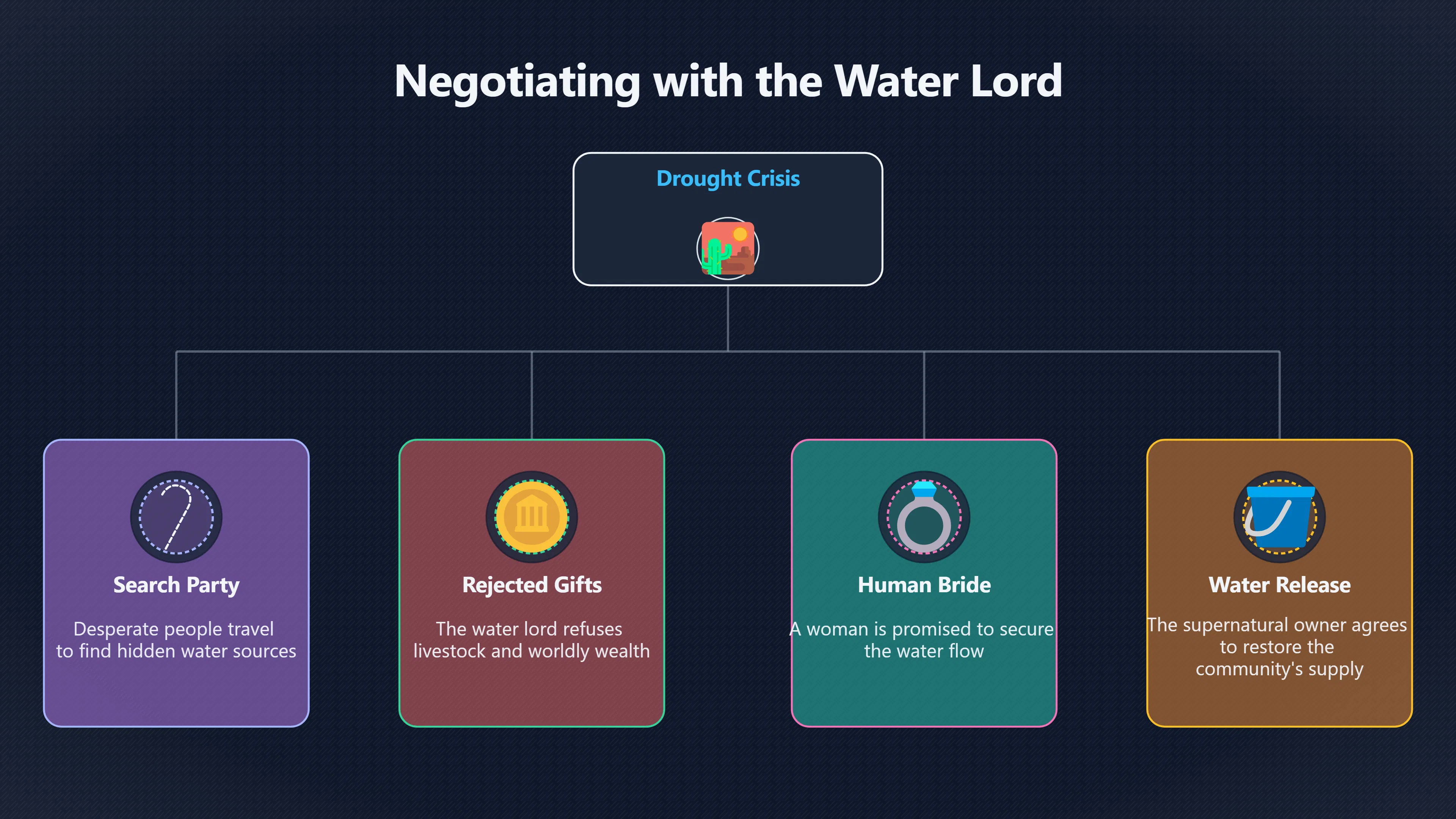
One of the most striking Basotho narratives begins during a devastating drought. Rivers and springs fail, people grow desperate, and a search party travels in search of water. When they finally discover a promising pool, they learn that it belongs to a supernatural master of the waters. Human survival now depends on negotiation with a being that controls access to life itself.[Wikipedia]WikipediaMonyohe (SothoMonyohe (Sotho
In versions recorded by the missionary-folklorist Édouard Jacottet in the early twentieth century, the water lord refuses ordinary gifts. Livestock, wealth, and even multiple wives are rejected. Eventually a young woman—often a chief’s daughter or a hunter’s sister—is promised as a bride. Only then does the supernatural owner of the waters agree to release water to the suffering community.[Wikipedia]WikipediaMonyohe (SothoMonyohe (Sotho
The moral tension is obvious. The community survives because one woman is handed over to a mysterious and frightening husband. From a modern perspective the arrangement can seem cruel, but within the story it expresses a larger idea: human beings cannot simply command nature. Water exists within a relationship of obligation, respect, and balance. When people want life-giving rain, they must acknowledge powers greater than themselves.[Wikipedia]WikipediaMonyohe (SothoMonyohe (Sotho
In some versions, the bride discovers that her terrifying husband is actually a transformed chief’s son hidden beneath a snake form. In others, the snake remains an unsettling supernatural being. The stories often end with a revelation, a ritual transformation, or the restoration of water to the community.[Wikipedia]WikipediaMonyohe (SothoMonyohe (Sotho
Rain, Fertility, and Sacred Power in Older Basotho Religion
The marriage stories make more sense when placed alongside older Basotho beliefs about rain and sacred water. Scholars of Basotho religion have noted that the water snake was not merely a folktale creature. It was closely connected with rainmaking traditions, sacred pools, and rituals intended to ensure agricultural fertility.[jstor.org]jstor.orgTraces of Snake Worship in Basotho CultureTraces of Snake Worship in Basotho CultureJuly 6, 2008 — by FCL Rakotsoane · 2008 · Cited by 10 — Among the Togos in Africa (a giant…
The being known as the water snake, sometimes referred to as the owner of water, was believed to inhabit deep pools, springs, lakes, and underground water sources. Such places were often treated with caution and reverence. Taboos discouraged unnecessary disturbance of sacred pools, and some traditions warned that disrespecting these places could cause water to disappear or bring misfortune.[Academia]academia.eduThe 'Water Snake' and its Place in Basotho Traditional…Noha ea Metsi, or the water snake, is believed to control water and fer…
Rainmaking rituals reinforced the same connection. Research on Basotho religious traditions describes prayers and ceremonies directed toward powers associated with rain-bearing water snakes. The snake was understood not simply as an animal but as a force linking water, weather, fertility, and the wellbeing of the community.[jstor.org]jstor.orgTraces of Snake Worship in Basotho CultureTraces of Snake Worship in Basotho CultureJuly 6, 2008 — by FCL Rakotsoane · 2008 · Cited by 10 — Among the Togos in Africa (a giant…
This helps explain why marriage appears so often in the stories. Fertility in traditional societies meant more than childbirth. It included healthy livestock, successful crops, flowing springs, and the continuation of the community itself. The bride who joins the water snake symbolically links human fertility with the fertility of the landscape.[Wikipedia]WikipediaMonyohe (SothoMonyohe (Sotho

Why the Snake Is Life-Giving as Well as Frightening
Modern readers often expect folklore creatures to fit neatly into categories of good or evil. Monyohe does not.
The water snake is dangerous. People fear its deep pools. Stories warn that it can seize victims, cause illness, or lure people into forbidden waters. Folklore and religious traditions alike describe an atmosphere of awe around places believed to be inhabited by such beings.[Academia]academia.eduThe 'Water Snake' and its Place in Basotho Traditional…Noha ea Metsi, or the water snake, is believed to control water and fer…
Yet the same creature also brings rain. It restores rivers during drought. It grants fertility. It can even appear as a protector or benefactor. Scholars have repeatedly noted this dual nature: the water snake is both feared and desired, a terrifying presence that nevertheless sustains life.[wikipedia.org]WikipediaMonyohe (SothoMonyohe (Sotho
This ambiguity is one reason the stories remained culturally important. They reflect the reality of water itself. Floods can kill, but without water there is no life. Rivers nourish communities, yet deep pools can be dangerous. The water snake embodies these contradictions in a memorable mythical form.[Academia]academia.eduThe 'Water Snake' and its Place in Basotho Traditional…Noha ea Metsi, or the water snake, is believed to control water and fer…
From Sacred Pools to Modern Lesotho
Water-snake traditions did not disappear with Christianity, modern education, or large engineering projects. Elements of the belief remain part of cultural memory in Lesotho today. Researchers have documented modern stories linking drought, storms, or environmental disturbances to the anger or movement of the water snake. During the construction of major water infrastructure projects, some local residents interpreted unusual weather or environmental changes through this traditional framework.[Academia]academia.eduThe 'Water Snake' and its Place in Basotho Traditional…Noha ea Metsi, or the water snake, is believed to control water and fer…
The folklore also survives through storytelling collections, academic studies, and cultural discussions about Basotho identity. Monyohe continues to appear as one of the most recognisable supernatural beings in Basotho narrative tradition, standing alongside other famous legendary figures.[Wikipedia]WikipediaMonyohe (SothoMonyohe (Sotho
What makes these tales memorable is not merely the image of a giant serpent demanding a bride. The deeper theme is the relationship between people and the forces that sustain them. In Basotho tradition, drought is never just a weather event. It becomes a moral and spiritual crisis. The water snake stands at the centre of that crisis, embodying both the fear of scarcity and the hope that life-giving rain will return.[wikipedia.org]WikipediaMonyohe (SothoMonyohe (Sotho
Amazon book picks
Further Reading
Books and field guides related to When Water Becomes a Dangerous Bridegroom. Use these as the next step if you want deeper reading beyond the article.
The Hero with an African Face
Explores African mythic patterns relevant to water-spirit narratives.
African Mythology: Tales, Epics, and Legends of a Continent
Covers recurring themes of serpent spirits, fertility and sacred power.
Basutoland Tales
Strong match for traditional narratives involving supernatural beings and water.
eBay marketplace picks
Marketplace Samples
Live-tested eBay searches with available results related to this page.



Endnotes
1.
Source: Wikipedia
Title: Monyohe (Sotho)
Link:https://en.wikipedia.org/wiki/Monyohe_%28Sotho%29
2.
Source: academia.edu
Link:https://www.academia.edu/9115526/New_Perspectives_in_Indigenous_Knowledge_The_Water_Snake_and_its_Place_in_Basotho_Traditional_Religion
Source snippet
The 'Water Snake' and its Place in Basotho Traditional...Noha ea Metsi, or the water snake, is believed to control water and fer...
3.
Source: jstor.org
Title: Traces of Snake Worship in Basotho Culture
Link:https://www.jstor.org/stable/24764035
Source snippet
Traces of Snake Worship in Basotho CultureJuly 6, 2008 — by FCL Rakotsoane · 2008 · Cited by 10 — Among the Togos in Africa (a giant...
Published: July 6, 2008
4.
Source: blackdrago.com
Link:https://www.blackdrago.com/fame/monyohe.htm
Source snippet
Monyohe | Dragons of FameSo they asked her to marry her son, Monyohe. She had heard of this Monyohe, the water snake, but she went to his...
Additional References
5.
Source: researchgate.net
Title: 272448721 Traces of Snake Worship in Basotho Culture
Link:https://www.researchgate.net/publication/272448721_Traces_of_Snake_Worship_in_Basotho_Culture
Source snippet
Basotho myths, this water snake isnot only the source or the giver of water but it also gives fertility to women. Asthe giver of rain, th...
6.
Source: open.uct.ac.za
Link:https://open.uct.ac.za/bitstreams/6132021c-0558-42b9-84af-896b7b89724c/download
Source snippet
UCTReligions Ancient Basotho with Special Reference to "...by FLC Rakotsoane · 1996 · Cited by 19 — Now in the myths, Monyohe is pre...
7.
Source: instagram.com
Link:https://www.instagram.com/p/DOk6XhjCOJW/
Source snippet
face this snake and survive are known to be fearless...Read more...
8.
Source: sundestinations.co.za
Link:https://sundestinations.co.za/water-in-the-wild-the-myths-of-rain-and-ritual-in-african-folklore/
Source snippet
Water in the Wild: The Myths of Rain and Ritual in African...11 Sept 2025 — Life in the wild is dependant on water...
9.
Source: researchgate.net
Link:https://www.researchgate.net/publication/364820460_Rain_snakes_and_water-bulls_a_comparative_analysis_of_rainmaking_scenes_in_the_south-eastern_Maloti-Drakensberg_Mountains_Lesotho
Source snippet
the south-eastern Maloti-Drakensberg Mountains, Lesotho June 2021...
Published: June 2021
10.
Source: dokumen.pub
Title: tales from the basotho 9781477301708
Link:https://dokumen.pub/tales-from-the-basotho-9781477301708.html
Source snippet
Monyohe climbed out of the skin of the water snake. But it was not a snake that climbed out, it was a man! Round his. Maliane and the Wat...
11.
Source: oriire.com
Title: monyohe a south african folktale
Link:https://oriire.com/article/monyohe-a-south-african-folktale
Source snippet
Monyohe: A South African Folktale29 Mar 2026 — They went and hunted for game, but they did not get any rain. Many months passed on withou...
12.
Source: diva-portal.org
Title: It will transform at.Read more
Link:https://www.diva-portal.org/smash/get/diva2%3A1350758/FULLTEXT02.pdf
Source snippet
DIVA PortalRainbows, pythons and waterfallsby Y TH · Cited by 15 — In rain-making or rain-control the snake, or water serpent, is often t...
13.
Source: youtube.com
Title: NOMHOYI an Ancestral Water & Fertility Spirit
Link:https://www.youtube.com/watch?v=SLwK9Xh-3Zg
Source snippet
Inkanyamba - The Dangerous Serpent of African Waterfalls - African Creatures...
14.
Source: youtube.com
Title: Metsi | Written by Maphomane C. Nelane | khaya TV Studios
Link:https://www.youtube.com/watch?v=vZ0kLKYOjCE
Source snippet
Episode 15: Legendary Serpents of South Africa...
Topic Tree