Where Guyana's Rivers Become Story
Guyana’s folklore is best understood as a meeting place: Indigenous stories from the interior, African-Caribbean trickster tales, plantation-era ghost lore, East Indian spirit traditions, Christian ideas about the dead, and modern literary retellings all live beside one another.
Page outline Jump by section
Why Guyanese folklore feels different
Guyana is geographically South American but culturally tied to the Anglophone Caribbean, and its folklore reflects both realities. The country’s coastlands, plantations, villages and urban spaces produced ghost stories shaped by slavery, indenture, Christianity, African-derived spirit beliefs and everyday village discipline. Its interior, meanwhile, holds Indigenous oral traditions connected to rivers, mountains, animals, ancestral beings, shamanic power and named landscapes. That mixture gives Guyanese folklore a distinctive range: a child might hear about Anansi and the old higue at home, learn the legend of Kaieteur Falls at school, and later encounter kanaima or bush spirits in stories about the interior.[moaa.gov.gy]moaa.gov.gyOpen source on moaa.gov.gy.
This does not mean every story has the same age, origin or authority. Some traditions are deep oral inheritances within Indigenous communities; some were reshaped under plantation rule; some passed through books, radio, theatre and school performance; and some are modern explanations or creative reconstructions of older motifs. That distinction matters because Guyanese folklore is often presented online as a list of “scary creatures”, when the more interesting truth is that these beings carry memories of work, fear, land ownership, medical uncertainty, colonial control and cultural survival.[Stabroek News]stabroeknews.comstrong oral literature has helped preserve indigenous culturestrong oral literature has helped preserve indigenous culture
Indigenous stories and the living landscape
Guyana’s Indigenous story traditions are not simply old tales preserved in isolation. The Ministry of Amerindian Affairs identifies nine Indigenous Nations in Guyana, and wider accounts of Indigenous peoples in the country distinguish coastal groups such as the Warao, Arawak or Lokono and Carib or Kalina from interior peoples including the Wapishana, Arekuna, Makushi, Wai Wai, Patamona and Akawaio. This matters for folklore because many stories are tied to specific languages, places and communities rather than to “Guyana” in the abstract.[moaa.gov.gy]moaa.gov.gyOpen source on moaa.gov.gy.
A useful modern example is 33 Amerindian Tales from the North Rupununi, Guyana, a collection linked to the Pantani digital storytelling project. Its editors describe oral storytelling as a traditional vehicle for transmitting beliefs in North Rupununi Indigenous communities, while also noting that the lack of written transmission can make such values vulnerable over time. Stabroek News has also treated the volume as evidence that Indigenous oral literature remains active, not merely historical, because the stories were still circulating among Guyanese Amerindian communities when collected.[Cobra Collective]cobracollective.orgCobra Collective33Amerindian TalesCobra Collective33Amerindian Tales
These tales often explain how places came to have names, why animals behave as they do, how people should treat one another, and what dangers exist in the forest, river or savannah. For a mainstream reader, the key point is that “myth” here does not mean a false story. It is a way of organising memory, ethics and environmental knowledge in narrative form. A creek, bird, hill, waterfall or animal may be part of a story because the landscape itself is a living archive.
Kaieteur Falls and the story of Old Kai
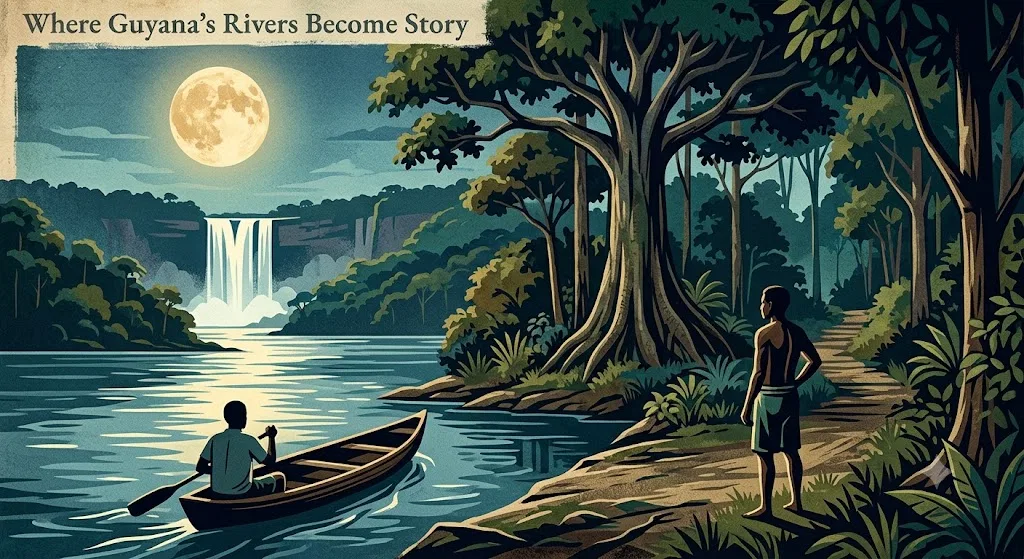
Kaieteur Falls is Guyana’s most famous legendary landscape. The National Trust of Guyana presents two Amerindian legends linked to the name: one tells of a chief who paddled over the falls as a sacrifice to save his people from a powerful spirit; the other tells of an unpleasant old man whose family placed him in a boat and let the current carry him over the drop, producing an “old man falls” explanation. The Protected Areas Trust also stresses that Kaieteur is home to the Patamona people and remains important to local livelihoods, culture and traditions.[ntg.gov.gy]ntg.gov.gykaieteur fallskaieteur falls
The legend’s power comes from the way it joins spectacle and sacrifice. Kaieteur is not just a dramatic waterfall on the Potaro River; in the best-known telling, it is a place where leadership, danger and spiritual negotiation meet. That helps explain why tourist retellings often focus on the image of a chief in a canoe approaching the edge. Yet the existence of multiple versions is important. Folklore is not weakened by variant accounts; variation is one of the signs that a story has lived in oral circulation rather than being fixed by a single author.
As a national symbol, Kaieteur also shows how folklore enters public heritage. The falls are protected within Kaieteur National Park, established in 1929 to preserve natural scenery, fauna and flora, and the site is now one of the country’s most recognisable attractions. Its legend therefore operates on several levels at once: Indigenous sacred geography, schoolroom national story, tourist narrative and emblem of Guyanese natural identity.[pac.gov.gy]pac.gov.gyOpen source on pac.gov.gy.
Jumbies, old higue and the coastland night
In Guyanese usage, “jumbie” often works as a broad word for a spirit, ghost or supernatural presence, especially in stories told to children or attached to frightening places. It is not one single creature. A jumbie might be a dead person, a troubling presence, a plantation ghost, or a named being with a more specific set of behaviours. That flexible word helps Guyanese folklore hold together African-Caribbean, European, Indigenous and Indo-Caribbean elements without needing them to fit one formal theology.[Stabroek News]stabroeknews.comStabroek News How Michael Khan found and embodied 'Ole Man PappieStabroek News How Michael Khan found and embodied 'Ole Man Pappie
The old higue is one of the best-known figures. In Guyanese and wider Caribbean tradition, she is usually imagined as an old woman who sheds her skin at night, becomes fiery or otherwise transformed, enters homes and harms babies. Popular descriptions often say she can be delayed by scattering rice, which she must count. Folklorist and performer Wordsworth McAndrew helped fix the old higue in modern Guyanese cultural memory through his celebrated poem “Ol Higue”, and later tributes describe him as a major collector and performer of Guyanese folklore.[stabroeknews.com]stabroeknews.comwordsworth mcandrew left guyana a golden collection of folklorewordsworth mcandrew left guyana a golden collection of folklore
The old higue is frightening, but she also reveals a social history. Storyteller and folklore researcher Michael Khan links the figure to post-emancipation village life and high child mortality, arguing that communities without adequate medical care could explain infant death through the image of a harmful supernatural woman. Whether or not every detail of that interpretation can be proved, it is a useful reminder that folk monsters often grow around real anxieties: illness, childbirth, night-time vulnerability, suspicion of neighbours and the fragile boundary between ordinary life and unseen danger.[Stabroek News]stabroeknews.comStabroek News How Michael Khan found and embodied 'Ole Man PappieStabroek News How Michael Khan found and embodied 'Ole Man Pappie
Bacoo, moongazer and other village warnings
The bacoo is usually described as a small, troublesome spirit, sometimes associated with bottles, wealth, milk and bananas. Kaieteur News, in a discussion of jumbies, describes the bacoo as a small spirit said to pelt stones, move objects inside houses and live on bananas and milk. Michael Khan’s interpretation links the bacoo to stories about Dutch plantation wealth, hidden gold and the guarding of property, making it a folklore figure that speaks to secrecy, colonial wealth and unexplained prosperity.[Kaieteur News]kaieteurnewsonline.coma study into jumbiesa study into jumbies
The moongazer is different: a tall figure associated with moonlit nights, long legs and dangerous encounters on roads or near cane fields. Khan argues that the moongazer may have functioned as a warning designed to keep enslaved people away from cane fields at night, especially when hunger drove them to suck cane. Even if this is partly interpretive, the pattern makes cultural sense: a frightening night-walker becomes a story about movement, surveillance, hunger and control in the plantation landscape.[Stabroek News]stabroeknews.comStabroek News How Michael Khan found and embodied 'Ole Man PappieStabroek News How Michael Khan found and embodied 'Ole Man Pappie
Other figures often named in Guyanese folklore include the white lady, Dutch jumbie, water people, bush spirits and “coolie jumbie” or East Indian spirit figures. The names themselves reveal Guyana’s plural society. A ghost may be marked by ethnicity, occupation, landscape or colonial memory. This is one reason a simple monster list misses the point: the beings are part of a social map. They tell readers who lived where, what dangers were imagined there, and how communities explained misfortune.
Kanaima is not just a monster story
Kanaima is among the most serious and easily misunderstood traditions associated with Guyana and the wider Guiana Shield. In simplified online retellings, kanaima may appear as a kind of forest demon or supernatural assassin. In more careful discussions, it is tied to Indigenous ideas of assault sorcery, revenge, secrecy and social fear. Stabroek News summarises the lore as involving trained, dangerous figures who live anonymously among ordinary people and carry out vendettas in mysterious ways.[Stabroek News]stabroeknews.comStabroek News The lore of Kanaima in Amerindian cultureStabroek News The lore of Kanaima in Amerindian culture
Academic work treats kanaima as more than a scary tale. Neil Whitehead’s analysis of kanaima in the Guiana region argues that colonial and national cultures often turned it into a symbol of “savagery”, using Indigenous shamanic traditions to construct a demonised image of Amazonia. Later scholarship has also examined kanaima through travel writing, Indigenous accounts and the literary geography of the Guiana Shield. The important reader-facing point is that kanaima should not be flattened into a horror creature detached from Indigenous history. It belongs to a contested field of belief, accusation, colonial imagination and local social order.[OpenEdition Journals]journals.openedition.orgOpen source on openedition.org.
This is also where careful wording matters. It is fair to say that stories of kanaima are part of Guyanese and Guiana Shield folklore. It is not fair to present them as proof that a secret supernatural class exists. Nor is it fair to dismiss the tradition as mere superstition. For some communities, such narratives have helped express fears about violence, revenge, illness and the hidden causes of death; for outsiders, they have too often been used to exoticise Indigenous people.
Rivers, creeks and beings of the interior
The interior of Guyana gives folklore a different atmosphere from the coast. Gold mining, pork-knocking, river travel, dense forest and encounters between coastal workers and Indigenous communities all shaped stories about water beings, bush spirits and dangerous places. Michael Khan links figures such as the massacooraman, watermooma and bush dai-dai to the mining interior and to the need to mark territory, frighten rivals or explain danger in unfamiliar landscapes.[Stabroek News]stabroeknews.comStabroek News How Michael Khan found and embodied 'Ole Man PappieStabroek News How Michael Khan found and embodied 'Ole Man Pappie
The massacooraman is often described in Guyanese retellings as a water-dwelling creature of rivers and creeks, sometimes imagined as powerful, hairy or man-like. The watermooma, as the name suggests, belongs to water lore and overlaps with wider Caribbean and South American traditions of river mothers, mermaid-like beings or female water spirits. These figures make sense in a country where rivers are roads, borders, food sources and hazards. A dangerous creek in folklore is rarely just scenery; it is a place where livelihood and risk meet.
Bush spirits such as the bush dai-dai are especially revealing because they blur moral and territorial boundaries. In Khan’s account, pork-knockers could use such stories to protect a gold strike while they left the site to sell gold. Whether the being is believed in, joked about or strategically invoked, the story does cultural work: it warns outsiders, explains fear in the forest and turns a practical problem of ownership into supernatural language.[Stabroek News]stabroeknews.comStabroek News How Michael Khan found and embodied 'Ole Man PappieStabroek News How Michael Khan found and embodied 'Ole Man Pappie
Anansi and the art of surviving by wit
Anansi, the spider trickster, is not unique to Guyana, but he is central to the wider African-Caribbean storytelling world that shaped Guyanese oral culture. In Caribbean contexts, Anansi stories travelled through the Atlantic slave trade and were reshaped in plantation societies, where the trickster’s small size and quick wit made him a figure of survival under unequal power. Michael Khan, discussing Brer Anancy in Guyana and the Caribbean, links Anancy’s changing personality to the experience of enslaved Africans who imagined a free spirit able to outsmart masters.[Stabroek News]stabroeknews.comStabroek News How Michael Khan found and embodied 'Ole Man PappieStabroek News How Michael Khan found and embodied 'Ole Man Pappie
In Guyanese storytelling, Anansi sits beside local animals, village humour, moral lessons and comic exaggeration. He is not simply a children’s character. Trickster tales allow a community to laugh at greed, foolishness and authority while also admitting that cleverness can be morally ambiguous. Anansi wins because he talks well, schemes quickly and knows how to turn weakness into leverage. That makes him one of the most portable figures in Guyanese folklore, especially in diaspora storytelling where humour, speech rhythm and family memory keep the tales alive.[Wendy Shearer]wendyshearer.co.ukWendy Shearer Guyanese folklore stories in Crouch EndWendy Shearer Guyanese folklore stories in Crouch End
East Indian ghost traditions in Guyana
Guyanese folklore is also shaped by Indian indenture and Indo-Guyanese village life. Stabroek News has noted that Guyanese East Indian oral literature is less often heard about and may be struggling to survive, while discussing a rare story collected through University of Guyana-linked research. This is an important corrective to the tendency to treat Guyanese folklore as only African-Caribbean or Indigenous.[Stabroek News]stabroeknews.comStabroek News Treasures in Guyanese oral traditionsStabroek News Treasures in Guyanese oral traditions
Figures such as the choorile or churail, soukanti and Indian jumbie show how South Asian ghost motifs entered Guyanese settings and changed there. Khan describes the choorile as the ghost of a woman who died in childbirth, or of mother and child dying in childbirth, wandering and wailing in search of the lost child. He also connects the soukanti to East Indian logie life, mortality and protective domestic practice. These stories carry pain as well as fear: childbirth, migration, cramped estate housing, religious protection, women’s suffering and the vulnerability of children.[Stabroek News]stabroeknews.comStabroek News How Michael Khan found and embodied 'Ole Man PappieStabroek News How Michael Khan found and embodied 'Ole Man Pappie
The point is not that every Indo-Guyanese family told the same stories in the same way. As with all oral tradition, versions vary by village, religion, family and generation. The larger pattern is clear, however: Guyana’s supernatural world absorbed the experiences of indentured labour and their descendants, creating spirit traditions that are both recognisably connected to South Asian motifs and locally Guyanese.
Folklore on stage, radio, page and screen
Guyanese folklore did not remain only in fireside or yard storytelling. It entered broadcasting, poetry, theatre, school performances, visual art, museum events and diaspora culture. Wordsworth McAndrew is one of the major names here: tributes describe him as “Mr Folklore”, a collector, performer and broadcaster whose work helped Guyanese audiences hear their own speech, spirits and comic textures as cultural treasures.[stabroeknews.com]stabroeknews.comwordsworth mcandrew left guyana a golden collection of folklorewordsworth mcandrew left guyana a golden collection of folklore
Modern artists continue that work in new forms. Stabroek News reported that artist and playwright Harold Bascom created graphics of Guyanese mythological figures including old higue, jumbie, moongazer, bacoo, kanaima and water people, and discussed a graphic novel inspired by a Guyanese jumbie story. Michael Khan’s Ole Man Pappie persona also shows how folklore can become performance, education and heritage activism rather than simply entertainment.[Stabroek News]stabroeknews.comStabroek News Award winning creative Harold Bascom thrives on pushingStabroek News Award winning creative Harold Bascom thrives on pushing
Institutions have played a role too. The Walter Roth Museum of Anthropology has hosted events on myths, legends and oral traditions of Guyana, including storytelling, poetry, dance, art and craft-making for students and teachers. Its collections and publications matter because folklore is linked to material culture: masks, baskets, cassava tools, ceremonial objects and everyday artefacts can all help explain the worlds from which stories emerge.[dpi.gov.gy]dpi.gov.gyOpen source on dpi.gov.gy.
What is old tradition, and what is modern retelling?
A reader searching for Guyanese folklore will find a mixture of oral memory, newspaper features, museum programming, literary works, school material, social media posts and recent horror-style summaries. These should not all be treated as equal evidence. Older oral traditions may be well attested but hard to date precisely. Newspaper interviews can preserve valuable local interpretation but may reflect one researcher’s theory. Social media posts show living memory and popular belief but often repeat claims without sources. Literary poems and plays may preserve folklore while also reshaping it for art.
The safest way to read Guyanese folklore is to ask three questions. First, who is telling the story: an elder, performer, scholar, tourist guide, journalist, novelist or anonymous internet writer? Second, where is the story located: coastland village, plantation, Georgetown, Indigenous community, mining creek, Kaieteur, Rupununi or diaspora home? Third, what does the story do: frighten children, explain death, protect land, entertain, preserve language, criticise power, or turn heritage into public performance?
This approach does not make the stories less magical. It makes them more interesting. The old higue becomes not only a night vampire but a figure of infant mortality and neighbourly suspicion. The bacoo becomes not only a bottle spirit but a story about wealth and hidden colonial property. Kanaima becomes not only a feared assassin but a contested Indigenous and colonial category. Kaieteur becomes not only a waterfall with a legend but a national place where sacred geography, tourism and heritage meet.

How Guyana’s folklore survived in retelling
Guyanese folklore remains important because it holds together a country often described through politics, oil, cricket, migration or rainforest tourism, but less often through everyday imagination. It records how people warned children, explained danger, remembered injustice, laughed at cunning, marked sacred landscapes and carried village speech across generations. In diaspora settings, these stories can become a way of remembering Guyana through a grandparent’s warning, a school poem, a frightening bedtime tale or a joke about what not to do after dark.[Wendy Shearer]wendyshearer.co.ukWendy Shearer Guyanese folklore stories in Crouch EndWendy Shearer Guyanese folklore stories in Crouch End
There is also an urgent preservation question. Guyanese cultural commentators have argued for stronger safeguarding of intangible cultural heritage such as storytelling, ring games, wakes and masquerade, while UNESCO-linked discussions in 2025 stressed the value of ratifying the 2003 Convention for the Safeguarding of the Intangible Cultural Heritage. Folklore survives best when it is not frozen as museum material only, but also retold, taught, performed, recorded and respected in the communities that carry it.[Stabroek News]stabroeknews.commaking a case for preserving guyanas intangible cultural heritagemaking a case for preserving guyanas intangible cultural heritage
For curious readers, the best entry point is therefore not a single “official” list of Guyanese monsters. It is the living network of stories: Indigenous tales from the Rupununi and Pakaraima landscapes, Kaieteur’s sacrificial legend, Anansi’s cleverness, the jumbie-haunted coast, Indo-Guyanese ghost traditions, and modern artists who keep turning old fears into poems, performances, drawings and new fiction. Guyana’s folklore is not just about what people feared. It is about how they made meaning.
Amazon book picks
Further Reading
Books and field guides related to Where Guyana's Rivers Become Story. Use these as the next step if you want deeper reading beyond the article.
Anansi the Spider
Anansi stories are deeply connected to Guyanese storytelling culture.
Caribbean Folk Tales: Stories from the Islands and the Windwa...
Strong overview for readers exploring Guyanese folklore.
A Treasury of Caribbean Folklore
Covers legends, ghosts and oral traditions relevant to Guyana.
eBay marketplace picks
Marketplace Samples
Live-tested eBay searches with available results related to this page.
Endnotes
1.
Source: dpi.gov.gy
Link:https://dpi.gov.gy/myths-legends-and-oral-traditions-an-appreciation-in-archaeology-indigenous-culture/
2.
Source: moaa.gov.gy
Link:https://moaa.gov.gy/amerindian-nations/
3.
Source: iwgia.org
Link:https://iwgia.org/en/guyana/4669-iw-2022-guyana.html
4.
Source: ntg.gov.gy
Title: kaieteur falls
Link:https://ntg.gov.gy/monument/kaieteur-falls/
5.
Source: pac.gov.gy
Link:https://www.pac.gov.gy/kaieteur-national-park/
6.
Source: journals.openedition.org
Link:https://journals.openedition.org/cal/7271?lang=en
7.
Source: ich.unesco.org
Link:https://ich.unesco.org/en/lists
8.
Source: ich.unesco.org
Link:https://ich.unesco.org/es/00555
9.
Source: ich.unesco.org
Link:https://ich.unesco.org/en/decisions/7.COM/8.2
10.
Source: ich.unesco.org
Link:https://ich.unesco.org/
11.
Source: iwgia.org
Link:https://iwgia.org/en/guyana.html
12.
Source: moaa.gov.gy
Link:https://moaa.gov.gy/
13.
Source: archive.org
Link:https://archive.org/details/additionalstudie00roth
14.
Source: ggmc.gov.gy
Title: ministry of amerindian affairs
Link:https://www.ggmc.gov.gy/agencies/ministry-of-amerindian-affairs/
15.
Source: youtube.com
Title: Guyanese Folklore
Link:https://www.youtube.com/watch?v=ShsHx0rrvTU
Source snippet
Bush Dai Dai...
16.
Source: youtube.com
Title: Guyanese Folklore
Link:https://www.youtube.com/watch?v=gAaRemt5uVI
Source snippet
The Supernatural Hag of Guyana...
17.
Source: youtube.com
Title: The Supernatural Hag of Guyana
Link:https://www.youtube.com/watch?v=h0jmKzhnyyc
Source snippet
Guyanese Folklore - Kanaima...
18.
Source: youtube.com
Title: Guyanese Folklore
Link:https://www.youtube.com/watch?v=Q-Io7dBsx4E
19.
Source: youtube.com
Title: Guyanese Folklore
Link:https://www.youtube.com/watch?v=6pEmYqttgsY
20.
Source: stabroeknews.com
Title: Stabroek News How Michael Khan found and embodied ‘Ole Man Pappie’
Link:https://www.stabroeknews.com/2025/06/15/sunday/how-michael-khan-found-and-embodied-ole-man-pappie/
21.
Source: stabroeknews.com
Title: strong oral literature has helped preserve indigenous culture
Link:https://www.stabroeknews.com/2021/09/12/sunday/arts-on-sunday/strong-oral-literature-has-helped-preserve-indigenous-culture/
22.
Source: cobracollective.org
Link:https://cobracollective.org/news/pantani-book-33-amerindian-tales-from-the-north-rupununi-guyana.php
23.
Source: stabroeknews.com
Title: wordsworth mcandrew left guyana a golden collection of folklore
Link:https://www.stabroeknews.com/2018/04/26/opinion/letters/wordsworth-mcandrew-left-guyana-a-golden-collection-of-folklore/
24.
Source: stabroeknews.com
Title: making a case for preserving guyanas intangible cultural heritage
Link:https://www.stabroeknews.com/2025/04/27/sunday/making-a-case-for-preserving-guyanas-intangible-cultural-heritage/
25.
Source: cobracollective.org
Title: Cobra Collective33Amerindian Tales
Link:https://cobracollective.org/wp-content/uploads/2018/12/33_amerindian_tales_low.pdf
26.
Source: kaieteurnewsonline.com
Title: a study into jumbies
Link:https://kaieteurnewsonline.com/2008/06/08/a-study-into-jumbies/
27.
Source: caribbeanpress.org
Link:https://caribbeanpress.org/wp-content/uploads/2014/10/Wordsworth-McAndrew-Vol-1-Complete-Text.pdf
28.
Source: stabroeknews.com
Title: Stabroek News The lore of Kanaima in Amerindian culture
Link:https://www.stabroeknews.com/2021/09/19/sunday/arts-on-sunday/the-lore-of-kanaima-in-amerindian-culture/
29.
Source: wendyshearer.co.uk
Title: Wendy Shearer Guyanese folklore stories in Crouch End
Link:https://wendyshearer.co.uk/2015/06/guyanese-folklore-crouch-end/
30.
Source: stabroeknews.com
Title: Stabroek News Treasures in Guyanese oral traditions
Link:https://www.stabroeknews.com/2017/01/08/sunday/arts-on-sunday/treasures-guyanese-oral-traditions/
31.
Source: stabroeknews.com
Title: Stabroek News Award winning creative Harold Bascom thrives on pushing
Link:https://www.stabroeknews.com/2023/12/03/sunday/award-winning-creative-harold-bascom-thrives-on-pushing-literary-boundaries/
32.
Source: boisestate.edu
Link:https://www.boisestate.edu/anthropology/research/walter-roth-museum-of-anthropology-publications/
33.
Source: facebook.com
Link:https://www.facebook.com/groups/338885306302636/posts/2877475685776906/
34.
Source: Wikipedia
Title: Kaieteur Falls
Link:https://en.wikipedia.org/wiki/Kaieteur_Falls
35.
Source: cobracollective.org
Link:https://cobracollective.org/projects/pantani-blog.php
36.
Source: linkedin.com
Link:https://www.linkedin.com/posts/geraud-de-ville_pantani-book-33-amerindian-tales-from-the-activity-6480185265968291840-BOGW?trk=public_profile_like_view
37.
Source: caribbeanpress.org
Title: Mih Buddybo Mac
Link:https://caribbeanpress.org/wp-content/uploads/2014/10/Wordsworth-McAndrew-Volume-1-jacket.pdf
38.
Source: caribbeanpress.org
Title: KY K-OVER-AL Volume 1 Issues 1-3
Link:https://caribbeanpress.org/wp-content/uploads/2014/05/Kyk-Volume-1-Issues-1-3-with-dedication.pdf
39.
Source: caribbeanpress.org
Title: KY K-OVER-AL Volume 2 Issues 8-10
Link:https://caribbeanpress.org/wp-content/uploads/2014/05/Kyk-Volume-2-issues-8-10-with-dedication.pdf
40.
Source: ecaroh.com
Title: Wordsworth Mc Andrew
Link:https://www.ecaroh.com/bmp/articles/wordsworth_mcandrew.htm
41.
Source: ulule.com
Link:https://www.ulule.com/pantani-book/
42.
Source: guyaneseonline.wordpress.com
Title: ol higue
Link:https://guyaneseonline.wordpress.com/tag/ol-higue/
43.
Source: amazon.com
Link:https://www.amazon.com/Literature-Fiction-Guyana-Books/s?rh=n%3A17%2Cp_28%3AGuyana&tag=searcht-20
44.
Source: guyanago.org
Title: Walter Roth Museum of Anthropology
Link:https://guyanago.org/things-to-do/walter-roth-museum
45.
Source: thingsguyana.com
Link:https://thingsguyana.com/moongazer/
Additional References
46.
Source: facebook.com
Link:https://www.facebook.com/groups/1594883130589796/posts/4839859999425410/
47.
Source: courtauld.ac.uk
Link:https://courtauld.ac.uk/research/research-resources/publications/courtauld-books-online/apocalypse/apocalyptic-themes-in-guyanese-art/
48.
Source: facebook.com
Link:https://www.facebook.com/groups/Guyana.Pictures.Group/posts/1745953753069113/
49.
Source: flickr.com
Link:https://www.flickr.com/photos/eliciaire/3528802193
50.
Source: facebook.com
Link:https://www.facebook.com/demwaves/posts/the-united-nations-educational-scientific-and-cultural-organisation-unesco-on-we/687068777408919/
51.
Source: facebook.com
Link:https://www.facebook.com/gotoguyana/posts/do-you-know-how-kaieteur-got-its-name-watch-to-find-out-dm-us-for-tour-recommend/900477585584869/
52.
Source: indigenousnavigator.org
Link:https://indigenousnavigator.org/indigenous-data/countries/guyana
53.
Source: reddit.com
Link:https://www.reddit.com/r/Guyana/comments/145qbgf/guyana_folk_lore_ghost_stories/
54.
Source: reddit.com
Link:https://www.reddit.com/r/Guyana/comments/194ag34/guyanese_childrens_folk_tales/
55.
Source: scribd.com
Link:https://www.scribd.com/presentation/260562394/Guyanese-Folklore
Topic Tree
Follow this branch
Related pages 192
- Afghan Folklore
- Albanian Folklore
- Algerian Folklore
- Australian Folklore
- Azerbaijan Folklore
- +187 more in sidebar