Where Grenada's Spirits Meet the Street
Grenada’s folklore is not best understood as a cabinet of monsters. It is a living story-world shaped by Indigenous memory, African ancestry, French and British colonial rule, slavery, emancipation, Catholic and Protestant influence, Carnival, village ritual, and migration.
Page outline Jump by section
Introduction
Grenadian folklore therefore sits at the meeting point between frightening night stories and public cultural pride. A child might hear warnings about a beautiful woman with a hidden hoof or an old woman who flies as fire; a visitor might see Jab Jab bodies, chains and horns at dawn and mistake the scene for something demonic. In Grenadian cultural context, however, these images often carry a deeper meaning: survival, satire, ancestral presence and the refusal to let plantation history be forgotten.[grenadanationaltrust.org]grenadanationaltrust.orgjab jabjab jab
Why Grenadian folklore feels so close to performance
Grenada’s legendary culture is unusually visible because so much of it is performed. Carnival is not just entertainment; it is one of the main public stages on which Grenadians dramatise history, mock power and remember emancipation. The Embassy of Grenada describes Carnival Monday as beginning at dawn, with traditional masqueraders in the streets depicting Jab Jabs and Ole Mas, while spectators and performers move through the towns to steel bands, DJs and Carnival songs.[Grenada Embassy]gndembassyprc.mofa.gov.gdGrenada Embassy Public Holidays and EventsGrenada Embassy Public Holidays and Events
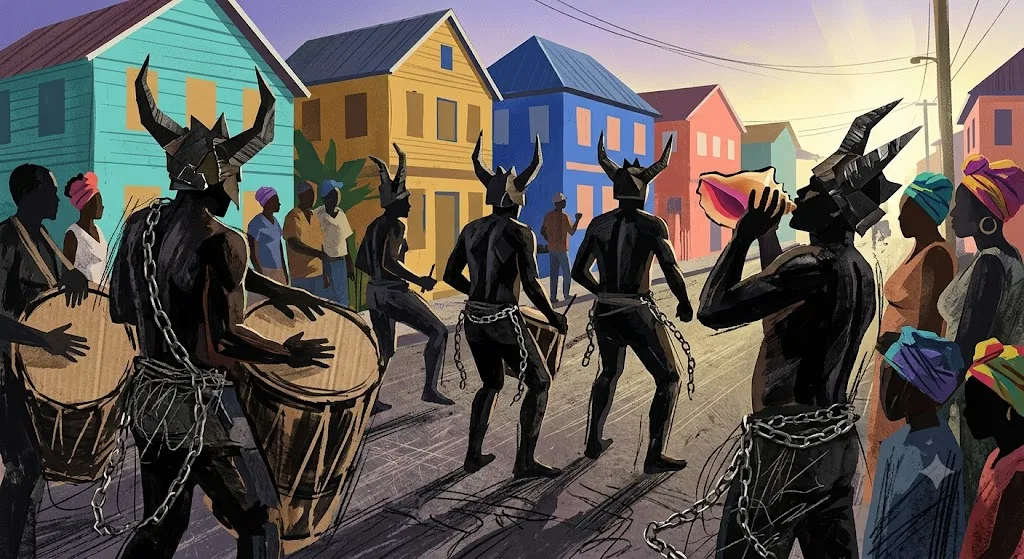
That matters because Grenadian folklore is often embodied rather than simply narrated. A Jab Jab is not just a “devil” character in the abstract. It is a moving, noisy, oil-darkened masquerade presence, often carrying chains, blowing conch shells, beating drums and using satire to turn symbols of enslavement into symbols of release. Grenada’s tourism authority describes Jab Jab as one of the standout experiences of Spicemas, with masqueraders covered in black oil or charcoal, wearing horned helmets and carrying chains.[Grenada Tourism Authority]puregrenada.comOpen source on puregrenada.com.
This is also why outsiders sometimes misread Grenadian tradition. The word “Jab” is connected to the French word for devil, and the costume can look deliberately frightening. But the Grenada National Trust describes Djab-Djab as a traditional masquerade that originated during slavery, while modern cultural interpreters stress its satirical and emancipatory meaning rather than treating it as devil worship.[Grenada National Trust]grenadanationaltrust.orgjab jabjab jab
Jab Jab: the “devil” who remembers slavery
Jab Jab is the Grenadian folk figure most likely to be seen by people who know little else about the island’s folklore. It appears during Spicemas, Grenada’s August Carnival, especially around J’Ouvert, the pre-dawn street celebration. The figure is often described as blackened with oil, charcoal or molasses-like darkness, fitted with horns, dragging chains and moving in groups through the streets.[Grenada Tourism Authority]puregrenada.comOpen source on puregrenada.com.
The danger in describing Jab Jab too quickly is that the visual surface can hide the cultural point. The “devil” here is not simply a monster. In many Grenadian explanations, Jab Jab is street theatre born from the world of slavery and emancipation. Essence’s reporting on Grenada’s Jab Jab tradition quotes cultural organiser Ian Charles describing Jab Jab as “freedom” and a post-emancipation masquerade, connected to 1834, when slavery was abolished across the English-speaking Caribbean.[Essence]essence.comroots in resistance grenada jab jabroots in resistance grenada jab jab
The chains are especially important. In a horror image, a chain might suggest punishment or menace. In Jab Jab, it often becomes a sign of bondage turned into noise, motion and public defiance. The body is blackened not to celebrate evil but to invert colonial shame, exaggerate the planter’s fear of the enslaved and make liberation impossible to ignore. This is why descriptions of Jab Jab as merely “demonic” flatten the tradition. A better reading is that Jab Jab uses a devil mask to accuse the real devils of history.
Jab Jab also changes. Contemporary performers may bring in current events, social commentary and global Black cultural references. That is not a break with tradition so much as part of Carnival’s logic: the masquerade is a vehicle for old memory and new commentary at the same time. Spicemas itself presents traditional mas as part of a living Grenadian cultural festival rather than a museum piece.[Spicemas]spicemasgrenada.comOpen source on spicemasgrenada.com.
Carriacou’s Big Drum: folklore as ancestral memory
If Jab Jab is Grenada’s most dramatic public masquerade, Carriacou’s Big Drum is one of its deepest ritual traditions. Carriacou, part of the state of Grenada, lies in the Grenadines, and its cultural life has long been recognised as distinctive. Smithsonian Folkways describes the Big Drum Dance as one of the most significant musical rituals on Carriacou, prepared for occasions such as marriage ceremonies, tombstone raisings, fishing boat launchings, ill-health and misfortune. In each case, the focus is remembering lineage and respecting ancestors.[Smithsonian Folkways Recordings]folkways.si.eduOpen source on si.edu.
The 1956 Folkways notes by Andrew C. Pearse are especially valuable because they record how Carriacouans maintained a sense of African “nationhood” and ancestral power. Pearse wrote that Carriacouans could identify African nations traced through family classification, and that the Big Drum Dance was given as a sign of respect to deceased ancestors and as a way of ensuring safety from their displeasure.[Folkways Media]folkways-media.si.eduFolkways Media
Big Drum is therefore folklore in a fuller sense than “old stories”. It includes music, dance, food, family obligation, dreams, ritual space and the idea that the dead remain socially present. Pearse recorded occasions for Big Drum including the eve of marriage, the raising of a tombstone, the launching of a schooner and cases of illness or misfortune, sometimes prompted by a dream in which an ancestor appears to want the ceremony.[Folkways Media]folkways-media.si.eduFolkways Media
For a general reader, the key point is this: Big Drum is not a performance about ancestors; it is a performance for ancestors, with the community gathered around that relationship. This helps explain why Carriacou has become so important in discussions of Grenadian folklore. It preserves a ritual imagination in which memory is sung, danced, fed and physically placed in the yard.
Shakespeare Mas: when folklore speaks in borrowed words
Carriacou’s Shakespeare Mas shows another side of Grenadian tradition: folklore does not have to look ancient to be culturally deep. In 2024, UNESCO inscribed Shakespeare Mas, a traditional component of Carriacou’s annual Carnival, on the Representative List of the Intangible Cultural Heritage of Humanity. UNESCO describes it as combining speechmaking, costume design and public theatre, with performers known as “kings” competing by reciting passages from Shakespeare’s Julius Caesar, historical texts, Bible verses and boasts. Errors are met with a symbolic lash on a padded headpiece.[Intangible Cultural Heritage]ich.unesco.orgOpen source on unesco.org.
At first glance, Shakespeare Mas might seem literary rather than folkloric. Its power lies in the opposite: it turns elite written culture into oral combat, village theatre and Carnival rivalry. The performer’s memory, voice, costume and courage matter as much as the text. The result is not a classroom recitation but a Creole public art in which European words are transformed into Carriacou performance.[The United Nations in the Caribbean]caribbean.un.orgOpen source on un.org.
The Grenada National Trust describes Shakespeare Mas as unique to Carriacou while deriving from Grenada’s speech-mas tradition and stick fighting. That combination is important: speech becomes contest, costume becomes identity, and a literary canon becomes local Carnival property.[Grenada National Trust]grenadanationaltrust.orgshakespeare masshakespeare mas
For Grenadian folklore, Shakespeare Mas is a reminder that tradition is not only about pre-colonial survivals or African retentions. It is also about creative capture: taking what colonial society valued, bending it into local form, and making it answer to the street.
Anansi and the trickster mind
Anansi, the spider trickster, belongs to a wider West African and Caribbean story world, but he is part of Grenadian oral tradition too. Anansi stories travelled through the Atlantic world with enslaved Africans and became central to Caribbean storytelling. The figure is associated with wit, mischief, survival and the ability of the small or weak to outsmart the powerful.[Wikipedia]WikipediaOpen source on wikipedia.org.
In Grenada, as elsewhere in the region, Anansi’s importance is not just that he is amusing. Trickster tales teach listeners to admire cleverness, distrust arrogance and recognise that power can be beaten indirectly. In societies shaped by plantation hierarchy, that lesson had obvious emotional force. The trickster is not always morally pure; he lies, cheats and schemes. But his stories keep alive the possibility that intelligence can slip through systems built to crush it.
Anansi also connects Grenada to neighbouring Caribbean islands without erasing local difference. He is shared, portable and adaptable. A Grenadian Anansi tale may sit beside stories from Jamaica, Trinidad, St Lucia or Guyana, but it is shaped by local speech, local humour and the storyteller’s audience. That is how oral tradition works: the character travels, but each telling belongs to the room, yard or village where it is performed.
Night spirits: La Diablesse, soucouyants, jumbies and douens
Grenada shares many supernatural figures with the wider eastern Caribbean. These are the beings often remembered from childhood warnings: do not wander at night, do not follow a stranger, do not mock old people, do not ignore signs in the dark. The details vary by island, storyteller and family, but several figures recur.
La Diablesse is usually imagined as a beautiful woman who lures people, especially men, off safe roads and into danger. Her hidden sign is often a hoof beneath her long dress, and her beauty masks something skeletal, demonic or deathly. Caribbean retellings commonly place her on moonlit roads, at village edges or near forested paths.[Findyello]findyello.comfrom soucouyants to douens lets explore our rich caribbean folklore 4from soucouyants to douens lets explore our rich caribbean folklore 4
The soucouyant is often described as an old woman by day who sheds her skin at night and flies as a ball of fire to feed on victims. The image is widespread in Caribbean folklore and has often been used to express fears about hidden malice, social suspicion, ageing women, and the unseen draining of life or luck.[J.A. Hernandez]jahernandez.comsoucouyant of caribbean folkloresoucouyant of caribbean folklore
Jumbies are a broad class of spirits or ghosts rather than one fixed creature. In Caribbean usage, the word can cover the restless dead, haunting presences or frightening beings encountered after dark. Grenadian-born storyteller Richardo Keens-Douglas helped carry such figures into literary and performance settings, including stories that reference jumbies and La Diablesse.[Encyclopedia.com]encyclopedia.comkeens douglas richardo 1953keens douglas richardo 1953
Douens are often described in Caribbean folklore as lost or backward-footed child spirits who lure children away. The figure is better documented in some neighbouring islands than in Grenada-specific sources, so it is safest to treat douens as part of the regional supernatural vocabulary that Grenadians may recognise rather than as a uniquely Grenadian creature.[Findyello]findyello.comfrom soucouyants to douens lets explore our rich caribbean folklore 4from soucouyants to douens lets explore our rich caribbean folklore 4
These night spirits matter because they are social stories, not just scares. They police behaviour, encode danger, dramatise suspicion and make the landscape morally charged. A lonely road, a riverbank, a forest edge or a stranger’s beauty becomes a place where ordinary caution and supernatural imagination meet.

Indigenous memory: petroglyphs and Leapers’ Hill
Grenada’s folklore is often dominated by Afro-Caribbean traditions, but Indigenous memory also matters. The island has pre-Columbian rock art, including the Mt Rich petroglyphs in St Patrick Parish. The Mt Rich Carib Stone Interpretation Center describes the site as a collection of more than 60 Amerindian carvings on four boulders along the St Patrick River. Archaeological work nearby at Montreuil found ceramics and radiocarbon evidence indicating occupation during the Troumassoid period of the Late Ceramic Age, beginning around AD 750–900.[Mycedo]mycedo.orgOpen source on mycedo.org.
The meaning of the petroglyphs is not known with certainty, and good interpretation should be careful here. The Petroglyph Path project explains that Caribbean petroglyphs often occur near water and range from geometric forms to human-like and animal-like figures. It also notes the dominant archaeological interpretation that such carvings may mark places where spirits gathered, within an animist worldview in which rocks, trees, animals and other beings had spiritual presence.[Grenada Archaeology]grenadaarchaeology.comGrenada Archaeology Petroglyph Path- Rock Art of GrenadaGrenada Archaeology Petroglyph Path- Rock Art of Grenada
Leapers’ Hill, also known as Carib’s Leap, is another charged site. It is associated with the story of Indigenous people jumping from the cliffs near Sauteurs rather than being captured by French colonists. Grenada Archaeology frames it as a “legend” linked to seventeenth-century accounts, which is a useful caution: the site carries historical trauma and local memory, but the dramatic form of the story has been shaped through retelling.[Grenada Archaeology]grenadaarchaeology.comGrenada Archaeology Learning the true story of Leapers' HillGrenada Archaeology Learning the true story of Leapers' Hill
For folklore readers, the important distinction is between archaeology and legend. Petroglyphs are material evidence of Indigenous presence; Leapers’ Hill is a historical-memory site where fact, violence, colonial record and nationalist retelling meet. Both remind readers that Grenada’s story-world did not begin with European settlement or African enslavement, even though those later histories profoundly reshaped the island.
Folklore in books, archives and modern retellings
Grenadian folklore has not remained only in oral performance. It appears in recordings, children’s literature, novels, museums, heritage work and online culture. Smithsonian Folkways’ recordings of Carriacou’s Big Drum, first issued in the 1950s and later documented again by scholars such as Donald R. Hill, are crucial archival sources because they preserve sound, sequence and interpretation, not just descriptions.[Folkways Media]folkways-media.si.eduFolkways Media
Literary retellings also matter. Richardo Keens-Douglas, born in Grenada and widely associated with Caribbean storytelling, brought figures such as La Diablesse into children’s literature and performance. His La Diablesse and the Baby is described as drawn from West Indian storytelling tradition, with the hoof-footed female figure roaming in search of children.[Encyclopedia.com]encyclopedia.comkeens douglas richardo 1953keens douglas richardo 1953
Paule Marshall’s 1983 novel Praisesong for the Widow made Carriacou’s Big Drum important to a wider literary audience. The novel follows an African American woman’s journey through Grenada and Carriacou toward ancestral reconnection, with Big Drum functioning as a ritual of memory and return. Modern criticism often treats the novel as a major diaspora text about heritage, displacement and recovery.[Wikipedia]WikipediaPraisesong for the WidowPraisesong for the Widow
Modern tourism and digital media add another layer. Spicemas promotions, heritage websites and social media clips can make Grenadian traditions more visible, but they can also flatten them into spectacle. The strongest public interpretation keeps the excitement while explaining the history: Jab Jab is visually powerful because it is historically loaded; Big Drum is musically compelling because it is ritually serious; Shakespeare Mas is entertaining because it preserves a demanding oral art.
What is old, what is shared, and what is still changing?
A fair account of Grenadian folklore has to avoid two mistakes. The first is treating every story as ancient and unchanged. The second is treating living tradition as fake because it changes. Grenadian folklore is old, regional, adaptive and modern all at once.
Some elements are strongly rooted in documented tradition. Big Drum has mid-twentieth-century recordings and detailed notes, and the practice itself clearly reaches back into older Carriacou systems of ancestry, nationhood and ritual obligation. Shakespeare Mas is now internationally recognised as intangible cultural heritage, but its force comes from continuing practice, not from being frozen in time.[si.edu]folkways-media.si.eduFolkways MediaFolkways Media
Some figures are shared across the Caribbean rather than uniquely Grenadian. La Diablesse, soucouyants, jumbies, douens and Anansi belong to overlapping island traditions, carried by migration, slavery, language, religion, publishing and family storytelling. That does not make them irrelevant to Grenada. It means Grenada participates in a regional folklore system, with local accents and local favourites.
Some forms are openly changing. Jab Jab today includes contemporary music, new political references, organised mas bands and international attention. Yet its core still turns on emancipation memory, satire and the transformation of frightening images into communal energy. That is exactly how a living folk form survives: by remembering enough to remain recognisable and changing enough to remain necessary.
Why Grenadian folklore still matters
Grenadian folklore matters because it gives public form to histories that could otherwise become abstract: enslavement, emancipation, ancestral memory, Indigenous loss, village belonging, migration, gendered fear, moral caution and cultural pride. It does not preserve these themes as dry lessons. It turns them into bodies in the street, drums in the yard, recited lines, hoofed women, flying fire, spider tricks and cliff-edge legends.
For curious readers, Grenada’s folklore is most rewarding when approached as a living cultural map. Jab Jab points to Carnival and emancipation. Big Drum points to Carriacou and the ancestors. Shakespeare Mas points to memory, speech and performance. Anansi points to wit as survival. La Diablesse and the soucouyant point to the moral imagination of night-time village life. The petroglyphs and Leapers’ Hill point further back, towards Indigenous presence and the difficulty of separating history from legend.
The result is a folklore tradition that is lively without being lightweight. Grenada’s story-world can frighten, amuse and dazzle, but its deeper work is remembrance: keeping the past audible, visible and arguable in the present.
Amazon book picks
Further Reading
Books and field guides related to Where Grenada's Spirits Meet the Street. Use these as the next step if you want deeper reading beyond the article.
The Jumbies
Introduces readers to jumbies and related supernatural traditions familiar across the Caribbean.
Anansi the Spider
Anansi stories form part of the wider folklore world referenced in Grenadian culture.

Rise of the Jumbies
First published 2017. Subjects: Children's fiction, Missing persons, fiction, Blacks, fiction, Caribbean area, fiction, Horror stories.
Caribbean Folklore
Provides broad context for spirits, folklore, masquerade and oral traditions across the Caribbean, including themes found in Grenada.
eBay marketplace picks
Marketplace Samples
Live-tested eBay searches with available results related to this page.

Endnotes
1.
Source: ich.unesco.org
Link:https://ich.unesco.org/en/RL/shakespeare-mas-a-traditional-component-of-carriacou-s-annual-carnival-02138
2.
Source: essence.com
Title: roots in resistance grenada jab jab
Link:https://www.essence.com/culture/roots-in-resistance-grenada-jab-jab/
3.
Source: 1997-2001.state.gov
Title: grenada 0400 bgn
Link:https://1997-2001.state.gov/background_notes/grenada_0400_bgn.html
4.
Source: folkways-media.si.edu
Title: Folkways Media
Link:https://folkways-media.si.edu/docs/folkways/artwork/FW04011.pdf
5.
Source: unesco.org
Title: document 6899
Link:https://www.unesco.org/archives/multimedia/document-6899
6.
Source: Wikipedia
Link:https://en.wikipedia.org/wiki/Anansi
7.
Source: findyello.com
Title: from soucouyants to douens lets explore our rich caribbean folklore 4
Link:https://www.findyello.com/tip/grenada/from-soucouyants-to-douens-lets-explore-our-rich-caribbean-folklore-4/
8.
Source: encyclopedia.com
Title: keens douglas richardo 1953
Link:https://www.encyclopedia.com/children/scholarly-magazines/keens-douglas-richardo-1953
9.
Source: mycedo.org
Link:https://www.mycedo.org/
10.
Source: Wikipedia
Title: Leapers’ Hill
Link:https://en.wikipedia.org/wiki/Leapers%27_Hill
11.
Source: Wikipedia
Title: Praisesong for the Widow
Link:https://en.wikipedia.org/wiki/Praisesong_for_the_Widow
12.
Source: Wikipedia
Title: La Diablesse
Link:https://en.wikipedia.org/wiki/La_Diablesse
13.
Source: Wikipedia
Title: Big Drum
Link:https://en.wikipedia.org/wiki/Big_Drum
14.
Source: Wikipedia
Title: Mt. Rich Petroglyphs
Link:https://en.wikipedia.org/wiki/Mt._Rich_Petroglyphs
15.
Source: Wikipedia
Title: Carriacou and Petite Martinique
Link:https://en.wikipedia.org/wiki/Carriacou_and_Petite_Martinique
16.
Source: Wikipedia
Link:https://en.wikipedia.org/wiki/Grenada
17.
Source: ich.unesco.org
Title: 67021 EN
Link:https://ich.unesco.org/doc/src/67021-EN.pdf?v=1733194269
18.
Source: ich.unesco.org
Title: LHE 22 17.CO M 7.b Rev Add.2 EN.docx
Link:https://ich.unesco.org/doc/src/LHE-22-17.COM-7.b_Rev_Add.2-EN.docx
19.
Source: ich.unesco.org
Title: grenada GD
Link:https://ich.unesco.org/en/state/grenada-GD?call=film&id=66615&include=film_inc.php&width=700
20.
Source: ich.unesco.org
Link:https://ich.unesco.org/en/lists
21.
Source: ich.unesco.org
Link:https://ich.unesco.org/doc/src/49332.pdf?t=1602752815
22.
Source: ich.unesco.org
Link:https://ich.unesco.org/en/news/caribbean-small-island-developing-states-exchange-experiences-on-preparing-nominations-13554
23.
Source: ich.unesco.org
Title: LHE 25 20.CO M 4 EN.docx
Link:https://ich.unesco.org/doc/src/LHE-25-20.COM-4_EN.docx
24.
Source: ich.unesco.org
Title: 7b representative list 01370
Link:https://ich.unesco.org/en/7b-representative-list-01370
25.
Source: ich.unesco.org
Title: shakespeare mas a traditional component of carriacou s annual carnival 02138
Link:https://ich.unesco.org/en/RL/shakespeare-mas-a-traditional-component-of-carriacou-s-annual-carnival-02138?call=film&id=72514&include=film_inc.php&width=700
26.
Source: ich.unesco.org
Title: grenada GD
Link:https://ich.unesco.org/en/state/grenada-GD
27.
Source: ich.unesco.org
Link:https://ich.unesco.org/en/decisions/19.COM/7.B.40
28.
Source: ich.unesco.org
Link:https://ich.unesco.org/en/video/72514
29.
Source: 2009-2017.state.gov
Link:https://2009-2017.state.gov/outofdate/bgn/grenada/97707.htm
30.
Source: enslaved.org
Link:https://enslaved.org/fullStory/16-23-126807/
31.
Source: gndembassyprc.mofa.gov.gd
Title: Grenada Embassy Public Holidays and Events
Link:https://gndembassyprc.mofa.gov.gd/public-holidays-and-events/
32.
Source: folkways.si.edu
Link:https://folkways.si.edu/the-big-drum-dance-of-carriacou/caribbean-world/music/album/smithsonian
33.
Source: grenadanationaltrust.org
Title: jab jab
Link:https://grenadanationaltrust.org/jab-jab/
34.
Source: grenadaembassyusa.org
Link:https://grenadaembassyusa.org/about-grenada/
35.
Source: puregrenada.com
Link:https://www.puregrenada.com/spicemas/
36.
Source: spicemasgrenada.com
Link:https://spicemasgrenada.com/
37.
Source: caribbean.un.org
Link:https://caribbean.un.org/en/285862-cultural-expressions-grenada-and-jamaica-recognized-intangible-cultural-heritage-humanity
38.
Source: grenadanationaltrust.org
Title: shakespeare mas
Link:https://grenadanationaltrust.org/shakespeare-mas/
39.
Source: jahernandez.com
Title: soucouyant of caribbean folklore
Link:https://www.jahernandez.com/posts/soucouyant-of-caribbean-folklore
40.
Source: grenadaarchaeology.com
Title: Grenada Archaeology Petroglyph Path- Rock Art of Grenada
Link:https://www.grenadaarchaeology.com/PetroglyphPath/home.html
41.
Source: grenadaarchaeology.com
Title: Grenada Archaeology Learning the true story of Leapers’ Hill
Link:https://www.grenadaarchaeology.com/TeacherKits/Assets/Lessons%20HTML/13_FieldTripGuide_LeapersHill.htm
42.
Source: folkways.si.edu
Link:https://folkways.si.edu/the-big-drum-and-other-ritual-and-social-music-of-carriacou/caribbean-world/music/album/smithsonian
43.
Source: facebook.com
Link:https://www.facebook.com/groups/269202760462518/posts/1269012603814857/
44.
Source: youtube.com
Title: Richardo Keens-Douglas
Link:https://www.youtube.com/watch?v=JrRQFbhZtEo
45.
Source: gndembassyprc.mofa.gov.gd
Link:https://gndembassyprc.mofa.gov.gd/about/
46.
Source: sova.si.edu
Link:https://sova.si.edu/search/all?n=10&q=Big+Drum&s=10&t=A
47.
Source: folkways.si.edu
Link:https://folkways.si.edu/catalog
48.
Source: ebsco.com
Link:https://www.ebsco.com/research-starters/geography-and-cartography/grenada
49.
Source: wendyshearer.co.uk
Title: la diablesse
Link:https://wendyshearer.co.uk/2020/04/la-diablesse/
50.
Source: caribbeanfolkloremonth.wordpress.com
Title: la diablesse
Link:https://caribbeanfolkloremonth.wordpress.com/2025/09/07/la-diablesse/
51.
Source: rcc.cimh.edu.bb
Link:https://rcc.cimh.edu.bb/files/2021/08/WW-GRENADA_V3.pdf
52.
Source: grenadanationaltrust.org
Title: grenadas forgotten heritage
Link:https://grenadanationaltrust.org/grenadas-forgotten-heritage/
53.
Source: puregrenada.com
Link:https://www.puregrenada.com/product/carriacou-carnival/
54.
Source: supersummary.com
Title: Praisesong For The Widow
Link:https://www.supersummary.com/praisesong-for-the-widow/summary/
Additional References
55.
Source: youtube.com
Title: Why Playing Jab is A Protest | History & Traditions of Grenada’s Real Jab Jab
Link:https://www.youtube.com/watch?v=x2dXfTJ-nBY
Source snippet
G.B.T.V. CultureShare ARCHIVES 1994: CARRIACOU BIG DRUM DANCERS...
56.
Source: youtube.com
Link:https://www.youtube.com/watch?v=nLqJ1JpMP00
Source snippet
Folk Music Of Carriacou [Full Album] - Various Artists...
57.
Source: youtube.com
Title: The Caribbean tradition of Jab Jab
Link:https://www.youtube.com/watch?v=33vaMyn_JAw
Source snippet
Why Playing Jab is A Protest | History & Traditions of Grenada's Real Jab Jab...
58.
Source: instagram.com
Link:https://www.instagram.com/p/CapnPxJOoGQ/
59.
Source: mindtrip.ai
Link:https://mindtrip.ai/attraction/victoria-grenada/amerindian-petroglyph/at-SZyAlAGt
60.
Source: orijinculture.com
Link:https://orijinculture.com/community/anansi-stories-west-africa-caribbean/
61.
Source: researchgate.net
Link:https://www.researchgate.net/publication/250305635_Anansi_an_African_Legacy_Bridging_Time_Spaces_and_Spirits
62.
Source: scribd.com
Link:https://www.scribd.com/document/853727121/yr-1-wk-3-english-b
63.
Source: facebook.com
Link:https://www.facebook.com/groups/269202760462518/posts/844069192975869/
64.
Source: culturalequity.org
Link:https://www.culturalequity.org/bigdrumfilm
Topic Tree
Follow this branch
Related pages 192
- Afghan Folklore
- Albanian Folklore
- Algerian Folklore
- Australian Folklore
- Azerbaijan Folklore
- +187 more in sidebar