Within Montenegro Folklore
Why Montenegro Sings Its Legends
Montenegro's heroic gusle songs turn battles, honour and local heroes into a sung memory that feels half history and half legend.
On this page
- How gusle performance works
- Heroes, battles and clan memory
- Oral epic from village singer to archive
Page outline Jump by section
Introduction
Montenegro’s gusle songs are often described as heroic poetry, but for many generations they served a broader purpose: they were a living archive. Sung to the accompaniment of a one-stringed instrument, these epics preserved memories of battles, clan rivalries, migrations, sacrifices and local heroes long before most people had access to written histories. The result is a tradition that sits in the space between history and legend. A famous warrior might be based on a real person, yet the song about him could grow richer and more dramatic with each performance. UNESCO describes gusle singing as a centuries-old art centred on heroic epics and collective memory, performed by solo singers whose interaction with audiences helps keep the tradition alive.[ICH UNESCO]ich.unesco.orgSinging to the accompaniment of the GusleThe repertoire includes songs predominantly about mythical and historical heroes, even…
In Montenegro, where mountain communities often maintained strong local identities and oral traditions, gusle songs became one of the main ways people remembered the past. They did not simply record events. They interpreted them, turning history into stories that could be sung, remembered and passed on.
How gusle performance works
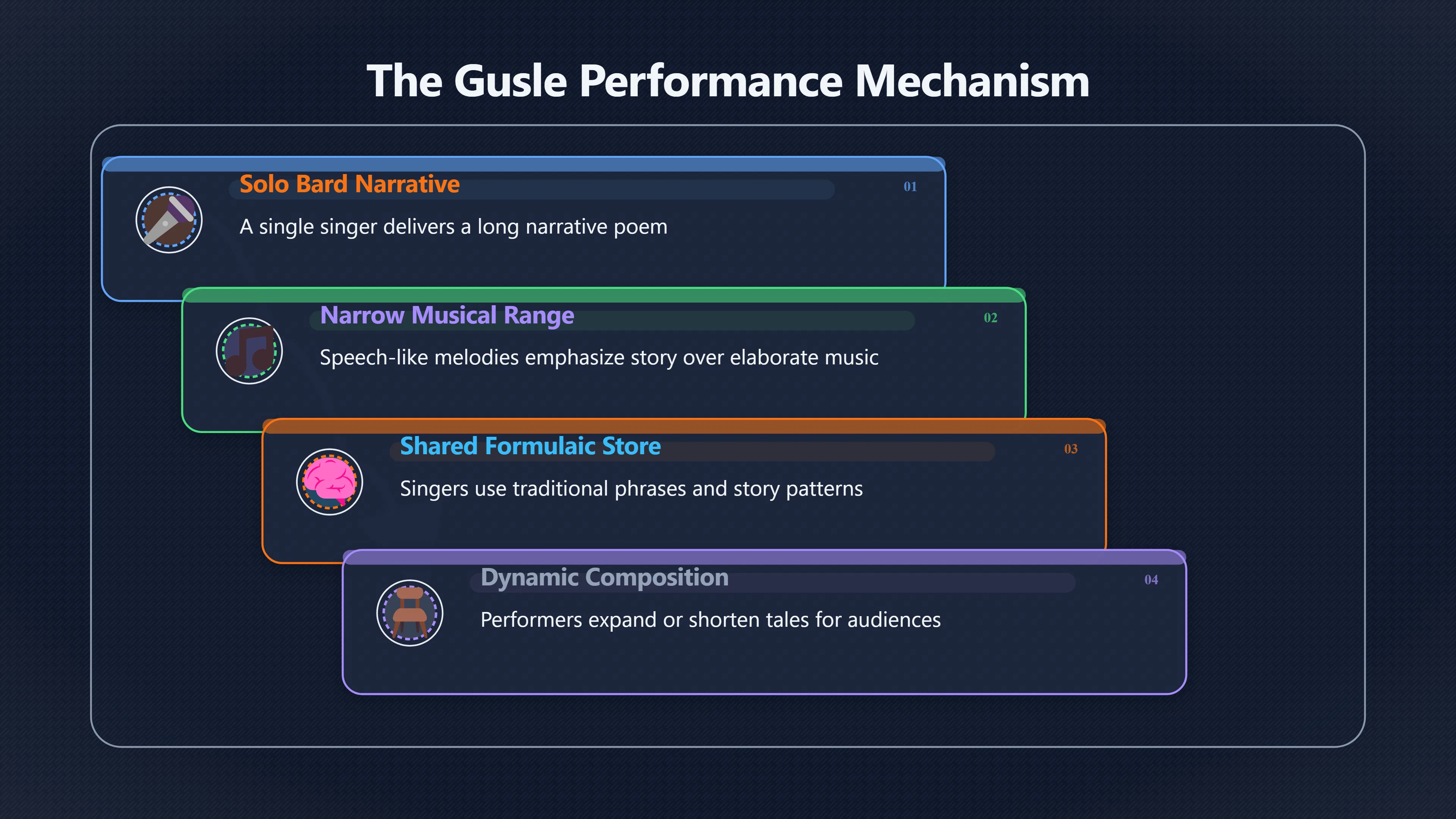
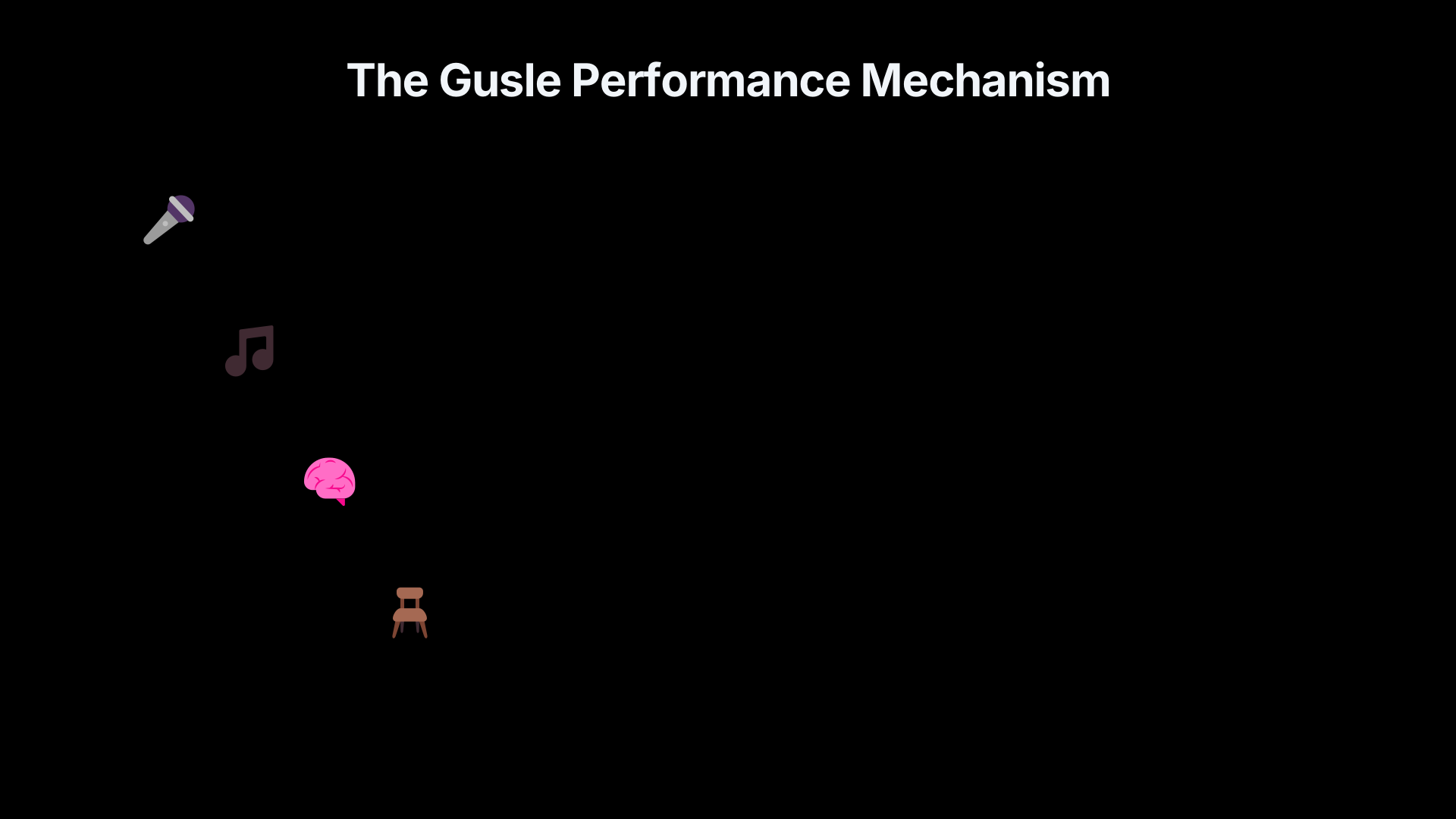
A gusle performance is usually built around a single singer, often called a bard or epic singer, who accompanies himself on the instrument while delivering a long narrative poem. The musical range is narrow and speech-like. The emphasis falls on the story, the characters and the emotional weight of the events being described rather than on elaborate melody.[Melodigging]melodigging.comGusle MusicGusle music is a South Slavic oral-epic singing tradition performed to the accompaniment of the gusle, a bowed, one…
What makes the tradition remarkable is that these songs were not normally recited from a fixed text. Instead, singers worked from a shared store of traditional phrases, story patterns and remembered episodes. Each performance could be slightly different. A skilled singer might shorten a tale for one audience and greatly expand it for another, adding detail, dialogue and description while remaining recognisably within the same tradition. Research on South Slavic epic traditions, including material from Montenegro and neighbouring regions, showed that oral singers could compose during performance using inherited formulas and themes rather than memorising every line word for word.[oraltradition.org]journal.oraltradition.orgOral Tradition Presentation Formulas in South Slavic Epic SongOral TraditionPresentation Formulas in South Slavic Epic SongFebruary 13, 2017 — by DF Elmer · 2009 · Cited by 21 — Ever since the pathfi…
This flexibility helps explain why gusle songs functioned as living memory rather than static records. The past was preserved, but it was preserved through continual retelling.
Heroes, battles and clan memory
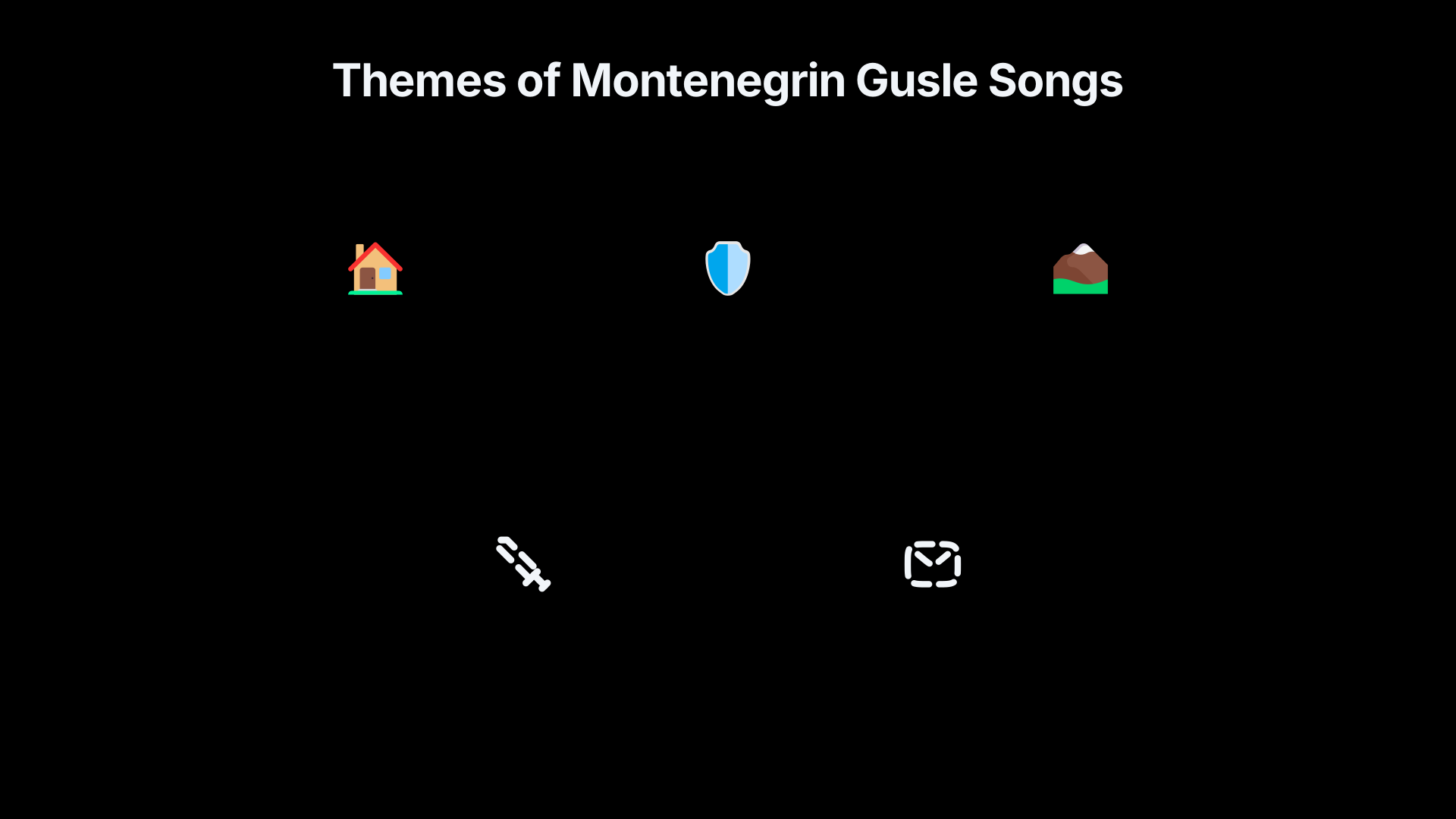
Many Montenegrin gusle songs focus on themes of honour, courage, loyalty, revenge, resistance and sacrifice. Historical conflicts, particularly struggles against powerful enemies, became central narrative material. The songs transformed military events into moral stories about how individuals and communities should behave.[ICH UNESCO]ich.unesco.orgSinging to the accompaniment of the GusleThe repertoire includes songs predominantly about mythical and historical heroes, even…
For listeners, the heroes in these epics were more than literary characters. They were often linked to family traditions, clan identities or local landscapes. A mountain pass, village or battlefield could become meaningful because it appeared in a famous song. In this way, geography and memory reinforced each other.
The songs also helped communities decide which events deserved remembrance. Not every historical incident entered the tradition. Those that did were usually reshaped around memorable themes:
- Loyalty to kin and community.
- Defence of honour and reputation.
- Endurance in hardship.
- Heroic resistance against overwhelming odds.
- The consequences of betrayal.
Because the songs emphasised values as much as facts, they often feel simultaneously historical and legendary. A listener may hear echoes of genuine events while also encountering idealised heroes whose actions embody cultural expectations.
Why the boundary between history and legend becomes blurred
Modern readers sometimes ask whether gusle songs should be treated as history or folklore. The answer is that they are partly both.
Many songs preserve details about real people, conflicts and social relationships. At the same time, oral performance encourages embellishment. A hero’s bravery may grow with each generation. Speeches become more dramatic. Victories become more symbolic. The aim is not necessarily factual precision but meaningful remembrance.
This blending of memory and imagination explains why gusle traditions occupy such an important place in Montenegrin folklore. They show how communities remember the past emotionally rather than simply chronologically. A battle survives because it represents courage. A hero survives because he embodies an ideal. A defeat survives because it teaches a lesson.
The result is a cultural memory that cannot be reduced either to myth or to documentary history. Instead, it operates in the space where collective identity is formed.
Oral epic from village singer to archive
The importance of gusle songs became internationally recognised in the twentieth century when scholars began recording South Slavic epic singers. The most influential work was carried out by the classicist Milman Parry and later Albert Lord, whose field research created one of the world’s most important archives of oral epic performance. Their recordings and transcriptions demonstrated that long narrative poems could be composed orally during performance rather than copied from written texts.[harvard.edu]library.harvard.eduHarvard LibraryMilman Parry Collection of Oral LiteratureSouth Slavic oral traditions, Lord's own collection of South Slavic materials ma…
The archive includes material from Montenegro and neighbouring regions and transformed the study of oral tradition worldwide. Scholars investigating ancient epics such as the Iliad suddenly had living examples of how an oral singer could produce lengthy and sophisticated narratives without a written manuscript.[scielo.org.mx]scielo.org.mxSouth Slavic Oral Epic and the Homeric Questionby JM Foley · 2005 · Cited by 8 — Milman Parry's epochal studies of the traditional nature…
One of the most famous singers associated with this research was Avdo Međedović, born in what is now Montenegro. His performances demonstrated the extraordinary scale that oral epic could achieve. A recorded version of The Wedding of Smailagić Meho exceeded twelve thousand lines, becoming one of the most celebrated examples of South Slavic oral poetry.[Wikipedia]WikipediaAvdo MeđedovićAvdo Međedović
These archives preserve voices that might otherwise have disappeared, allowing modern audiences to hear not only the stories but also the performance techniques that kept them alive.

Why the tradition still matters today
Although modern Montenegro no longer relies on oral epic as its primary means of preserving history, gusle songs remain powerful cultural symbols. Performances continue at festivals, cultural gatherings and heritage events, and recordings are increasingly preserved in museums, archives and digital collections. UNESCO’s recognition of the broader gusle tradition reflects its continuing significance as a form of intangible cultural heritage.[ICH UNESCO]ich.unesco.orgSinging to the accompaniment of the GusleThe repertoire includes songs predominantly about mythical and historical heroes, even…
For contemporary audiences, the value of the tradition is not simply nostalgia. Gusle songs reveal how communities create memory. They show how stories can preserve names, places and values across centuries even when written records are scarce. They also remind listeners that folklore is not only about fairies, ghosts or supernatural beings. In Montenegro, some of the most influential folklore takes the form of sung remembrance, where history becomes narrative and narrative becomes identity.
That is why gusle songs remain one of the clearest examples of living memory in Montenegrin culture. They are not merely performances about the past; they are part of the process through which the past continues to be remembered.
Amazon book picks
Further Reading
Books and field guides related to Why Montenegro Sings Its Legends. Use these as the next step if you want deeper reading beyond the article.
Slavic Folklore
Explains the cultural setting in which epic songs and oral traditions developed.
Epic Singers and Oral Tradition
Examines how singers create and transmit heroic narratives.
Balkan Ghosts
Provides historical and regional context for the collective memories preserved in epic song.
The Singer of Tales
Built directly from research on South Slavic epic singers and performance traditions.
eBay marketplace picks
Marketplace Samples
Live-tested eBay searches with available results related to this page.

Endnotes
1.
Source: ich.unesco.org
Link:https://ich.unesco.org/en/RL/singing-to-the-accompaniment-of-the-gusle-01377
Source snippet
Singing to the accompaniment of the GusleThe repertoire includes songs predominantly about mythical and historical heroes, even...
2.
Source: melodigging.com
Link:https://www.melodigging.com/genre/gusle-music
Source snippet
Gusle MusicGusle music is a South Slavic oral-epic singing tradition performed to the accompaniment of the gusle, a bowed, one...
3.
Source: library.harvard.edu
Link:https://library.harvard.edu/collections/milman-parry-collection-oral-literature
Source snippet
Harvard LibraryMilman Parry Collection of Oral LiteratureSouth Slavic oral traditions, Lord's own collection of South Slavic materials ma...
4.
Source: Wikipedia
Title: Milman Parry
Link:https://en.wikipedia.org/wiki/Milman_Parry
5.
Source: Wikipedia
Title: The Singer of Tales
Link:https://en.wikipedia.org/wiki/The_Singer_of_Tales
6.
Source: Wikipedia
Title: Avdo Međedović
Link:https://en.wikipedia.org/wiki/Avdo_Me%C4%91edovi%C4%87
7.
Source: Wikipedia
Title: The Wedding of Smailagić Meho
Link:https://en.wikipedia.org/wiki/The_Wedding_of_Smailagi%C4%87_Meho
8.
Source: Wikipedia
Link:https://en.wikipedia.org/wiki/Gusle
Source snippet
GusleThe gusle (Serbian Cyrillic: гусле) or lahuta is a bowed single-stringed musical instrument (and musical style) traditionally us...
9.
Source: journal.oraltradition.org
Title: Oral Tradition Presentation Formulas in South Slavic Epic Song
Link:https://journal.oraltradition.org/wp-content/uploads/files/articles/24i/03_24.1.pdf
Source snippet
Oral TraditionPresentation Formulas in South Slavic Epic SongFebruary 13, 2017 — by DF Elmer · 2009 · Cited by 21 — Ever since the pathfi...
Published: February 13, 2017
10.
Source: scielo.org.mx
Link:https://www.scielo.org.mx/scielo.php?pid=S0185-30822005000100004&script=sci_arttext
Source snippet
South Slavic Oral Epic and the Homeric Questionby JM Foley · 2005 · Cited by 8 — Milman Parry's epochal studies of the traditional nature...
11.
Source: publishing.cdlib.org
Link:https://publishing.cdlib.org/ucpressebooks/view?brand=ucpress&chunk.id=d0e1753&docId=ft2m3nb18b&toc.depth=100&toc.id=d0e1753
Source snippet
Oral Epic - UC Press E-Books CollectionMilman Parry and Albert Lord began their recording of oral traditional epic in the Stolac district...
Additional References
12.
Source: academia.edu
Link:https://www.academia.edu/86375530/South_Slavic_Epic_and_the_Philology_of_the_Border
Source snippet
(PDF) South Slavic Epic and the Philology of the BorderMilman Parry's fieldwork revealed oral composition techniques, where 25-50% of son...
13.
Source: facebook.com
Link:https://www.facebook.com/groups/1600136833533808/posts/2101418030072350/
Source snippet
Montenegrin gusle folk instrument and its significanceBalkan Slavic oral traditional epic singers are telling us of deeds of heroes of th...
14.
Source: oeaw.ac.at
Link:https://www.oeaw.ac.at/vlach/collections/bosniancroatianmontenegrinserbian/montenegrin/video-collection/songs
Source snippet
SongsGUSLE. Description: The videoclip contains an epic song from Montenegro and Herzegovina. The song was recorded in the rustic ambienc...
15.
Source: didaskalia.net
Link:https://www.didaskalia.net/issues/vol3no3/foley.html
Source snippet
The Performance of Homeric EpicSouth Slavic epic offers classicists ・ attend an actual performance by an oral epic singer. Milman Parry C...
16.
Source: njegos.org
Link:https://www.njegos.org/heritage/gusle.htm
17.
Source: youtube.com
Link:https://www.youtube.com/watch?v=DUSrOTtGV8k
Source snippet
Gusle – BCMS collectionSlavko Goranović performs an epic song from Montenegro and Herzegovina... The song is accompanied by the traditio...
18.
Source: worldbeatmagazine.com
Link:https://worldbeatmagazine.com/zh/genres/gusle-epic
Source snippet
Montenegro is tiny but its mountains kept these traditions alive for centuries. Voices...Read more...
19.
Source: jstor.org
Link:https://www.jstor.org/stable/41306745
Source snippet
Parry and Lord in Kijevo, Croatia, 24 September 1934by AP Tate · 2010 · Cited by 4 — Milman Parry and Albert Lord recorded an epic singer...
20.
Source: facebook.com
Link:https://www.facebook.com/61578731436591/posts/how-montenegro-stores-history-in-a-single-instrument-in-montenegro-the-gusle-car/122145500618957714/
Source snippet
story about Montenegrin music and folklore would be complete.Read more...
21.
Source: instagram.com
Link:https://www.instagram.com/reel/DSc1mddjGaF/?hl=en
Source snippet
Serbia, Kosovo, Albania, Montenegro, Bosnia-Herzegowina and Croatia...
Topic Tree