Antigua and Barbuda's Uncanny Folklore
Folklore in Antigua and Barbuda is best understood as a living Caribbean tradition rather than a sealed book of ancient myths. Its centre is oral culture: Anansi trickster tales, jumbie ghost stories, beliefs about obeah, masquerade figures from old Christmas customs and Carnival, and modern retellings in Antiguan literature and art.
Page outline Jump by section
Introduction
The evidence is uneven. Some Antiguan folklore was collected in written form, such as John H. Johnson’s Folklore from Antigua, British West Indies, while much more survives in family storytelling, schools, Carnival performance, local writing and community memory. Modern sources also show how these traditions are being reworked: jumbies appear in contemporary Antiguan art, Anansi remains a reference point for writers, and old masquerade figures have been folded into public heritage and tourism.[pressbooks.pub]pressbooks.pubStory Sources – Tiny Tales of AnansiStory Sources – Tiny Tales of Anansi…
What makes Antiguan and Barbudan folklore distinctive?
Antigua and Barbuda shares many folkloric figures with the wider English-speaking Caribbean, especially Anansi, jumbies, obeah workers, soucouyants and Carnival spirits. What gives the local tradition its shape is the country’s own history of plantation society, village life, seasonal celebration, maritime landscapes and national cultural work. In this setting, folklore often sits at the meeting point between entertainment and warning: a story told to children, a rumour about a haunted yard, a masquerade character in the street, or a memory attached to a tree, road, plantation ruin or old house.
The country’s official and heritage-facing sources tend to frame culture through Carnival, emancipation, built heritage and tourism. Antigua’s Carnival is promoted as a late July to early August celebration marking the abolition of slavery, with street parades, costumes, soca, calypso, J’ouvert and Panorama steelpan competition. That is not “folklore” in the narrow sense of a fireside tale, but it is central to the public survival of older masquerade, performance and freedom traditions.[Visit Antigua & Barbuda]visitantiguabarbuda.comOpen source on visitantiguabarbuda.com.
A separate but connected thread is place-memory. UNESCO describes the Antigua Naval Dockyard and related archaeological sites as Georgian naval structures built in a landscape shaped by imperial competition for the sugar-producing islands of the Eastern Caribbean. That kind of site is not automatically a “haunted place”, but it helps explain why local legends, ghost stories and heritage memories so often circle around slavery, colonial authority, ruins, work, punishment, resistance and survival.[UNESCO World Heritage Centre]whc.unesco.orgOpen source on unesco.org.
Anansi: the clever spider who survived the crossing
Anansi is one of the most important figures for understanding Antigua and Barbuda’s place in Caribbean folklore. He is an African-derived trickster, often linked to Akan storytelling traditions, who survived in the Caribbean through oral transmission. In Antiguan and wider Caribbean contexts, Anansi is not simply a spider in a children’s story. He is clever, greedy, comic, slippery and hard to defeat. His tales often show the small, weak or poor figure using language, cunning and timing against stronger opponents.
Antiguan literary and cultural sources continue to treat Anansi as a familiar inheritance. Antiguan writer Joanne C. Hillhouse describes Anansi as a West African trickster spider and a demi-god in African spirituality who became, for Caribbean children of her generation, “the one” attached to the stories they grew up hearing, including tales of how tiger stories became Anansi stories.[jhohadli]jhohadli.comCaribbean folklore | jhohadliCaribbean folklore | jhohadli…
The tradition is also documented through story collections. A bibliography for Tiny Tales of Anansi lists John H. Johnson’s Folklore from Antigua, British West Indies among its sources, alongside broader Caribbean and African diaspora Anansi collections. That matters because it places Antigua in a documented Anansi tradition rather than treating it as an internet-era borrowing.[Pressbooks]pressbooks.pubStory Sources – Tiny Tales of AnansiStory Sources – Tiny Tales of Anansi…
For a modern reader, the key is that Anansi stories work on two levels. On the surface, they are funny animal tales. Underneath, they preserve a worldview in which survival may depend on wit more than force. In societies shaped by slavery and colonial hierarchy, the trickster’s ability to talk his way through danger had obvious emotional and political resonance.
Jumbies: ghosts, spirits and the fear of what follows you home
Jumbies are among the most recognisable supernatural beings in Antiguan and wider Caribbean folklore. In ordinary usage, a jumbie is a spirit, ghost or troubling supernatural presence. The word can be used broadly, covering the dead, invisible mischief-makers, haunted places and frightening night encounters. Local and regional accounts often treat jumbie stories as the Caribbean equivalent of ghost stories, but with their own rules, voices and landscapes.
Hillhouse’s account of Antiguan and Caribbean literary folklore is useful because it shows how jumbie stories are remembered from inside the culture rather than merely catalogued from outside. She explains that “jumbie stories” were what ghost stories were called, and that jumbies are spirits. She also points to youth writing from Antigua and Barbuda in which haunted houses, late-night walks and “brushing up against the supernatural” become story material.[jhohadli]jhohadli.comCaribbean folklore | jhohadliCaribbean folklore | jhohadli…
A notable Antiguan development is the artistic idea of “jumbie vision”. The Antiguan photographer Mali Olatunji developed what was described as a “woodist jumbie aesthetic”, using the lines of wood and trees to extend photography beyond ordinary representation into the symbolic world of invisible meaning, colonial and postcolonial subjectivity, and African spiritual heritage.[Fusion Magazine]fusionmagazine.orgFusion Magazine Preface and Bio | FUSIONFusion Magazine Preface and Bio | FUSION A JSTOR listing for Olatunji’s work notes that, according to Antigua’s folklore, jumbies are often said to reside in trees.[JSTOR]jstor.orgOpen source on jstor.org.
That tree connection is especially important. It shows how jumbie belief is not only about a figure jumping out in the dark. It can be a way of imagining the landscape as inhabited by memory. A tree may be shade, property boundary, hiding place, witness, spiritual residence and artistic symbol all at once.
Obeah: taboo, law, healing and fear
Obeah is one of the most sensitive parts of Antiguan and Barbudan folklore because it sits between folk religion, healing, accusation, colonial law and modern stigma. It is often described in the Caribbean as a set of African-derived spiritual practices involving protection, harm, healing, divination, charms, spells or supernatural agency. It should not be treated as a single organised religion with one doctrine. It is better understood as a shifting category shaped by practitioners, believers, frightened neighbours, colonial authorities, Christian critics, police and courts.
The legal history matters. A Cambridge University Press article on obeah and religious freedom states that obeah remains proscribed in at least fourteen Anglophone Caribbean countries and territories, including Antigua and Barbuda. It explains that such laws were initially modelled on British statutes against vagrancy and witchcraft and that they reflect long-standing hierarchies that placed European-style theistic religion above African-derived practices involving spirits, divination and supernatural force.[Cambridge University Press & Assessment]cambridge.orgOpen source on cambridge.org.
Antigua and Barbuda’s own Obeah Act defines obeah in terms of witchcraft, spells and professed occult or supernatural power, showing how the state historically converted a broad cultural and spiritual category into a criminal one.[Laws of Antigua and Barbuda]laws.gov.agOpen source on laws.gov.ag. This is why folklore discussion should be careful: the word can refer to feared magic in village stories, but it also carries the burden of racialised colonial policing and religious stigma.
Modern Caribbean discussion increasingly distinguishes between obeah as demonised by colonial and Christian authority and obeah as a wider field of folk practice, including herbal knowledge, protection and spiritual agency. A recent Guardian explainer describes obeah as a syncretic Caribbean tradition with West African roots, blending spiritual and natural elements, and notes that it remains taboo and illegal in countries including Antigua and Barbuda.[The Guardian]theguardian.comThe Guardian Why does the often maligned Caribbean obeah tradition endure?The Guardian Why does the often maligned Caribbean obeah tradition endure?
In Antiguan storytelling, this ambiguity is visible. Hillhouse points to contemporary stories featuring an obeah woman, a “dealing woman”, and a children’s fantasy in which an obeah man is reimagined as a culturally relevant magical figure rather than simply a villain.[jhohadli]jhohadli.comCaribbean folklore | jhohadliCaribbean folklore | jhohadli… That shift is important: modern writers are not just repeating old fears; they are asking what was lost when African-derived spiritual knowledge was reduced to “evil” or “fraud”.
Soucouyants and dangerous women in night stories
The soucouyant is a night-flying, vampiric figure known across parts of the Caribbean, including Antiguan storytelling. In many versions, she appears by day as an ordinary old woman and by night removes her skin, travels as a ball of fire or uncanny presence, and preys on victims. The details vary by island and teller, but the core idea is the same: danger can wear a familiar face.
Antiguan literary references show that the figure is still active in modern imagination. Hillhouse mentions a story in which an old village woman may be an obeah practitioner or perhaps a soucouyant, and another youth-written story about a soucouyant hunt. She also preserves a remembered rule of the tradition: the soucouyant removes her skin at night, and salting the skin prevents her from returning to it.[jhohadli]jhohadli.comCaribbean folklore | jhohadliCaribbean folklore | jhohadli…
What makes the soucouyant powerful is not just horror. She reflects social anxieties about secrecy, age, female power, envy, unexplained illness and the danger of judging people by appearances. The figure can be cruelly used in gossip against older women, but it can also dramatise real community fears: Who is safe? Who is watching? What happens after dark? Why did illness strike this person and not another?
For a folklore page, the safest reading is not to claim that soucouyants are “believed everywhere” or that every Antiguan version is identical. The useful point is that the figure belongs to a shared Caribbean supernatural language, and Antiguan writers continue to adapt it into new stories.
Old Time Christmas, masquerade and the road to Carnival
Some of Antigua and Barbuda’s richest folklore is not found in a creature list but in performance. Before modern Carnival became dominant, Antigua had an Old Time Christmas tradition with music, dance and masquerade. The Department of Culture’s CPOISE platform has highlighted old Christmas masquerade characters such as Long Ghosts and John Bulls.[Cpoise]cpoise.gov.agCpoise Ole Time ChristmasCpoise Ole Time Christmas
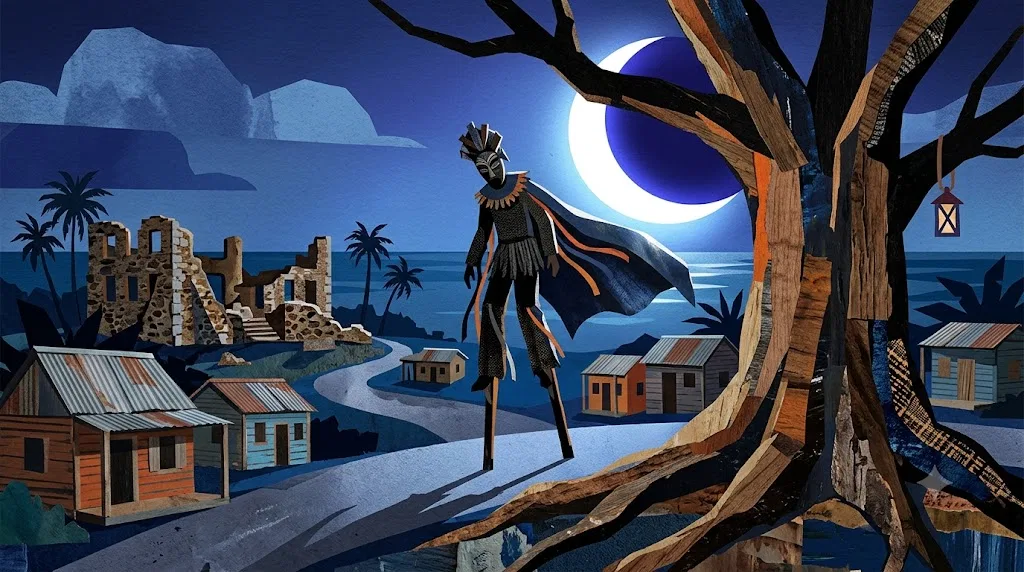
These figures mattered because they made folklore public. A jumbie story might be told at home, but a masquerade figure appears in the street, embodied by a performer, costume, rhythm and crowd reaction. Search results summarising Antigua’s Carnival history describe old Christmas elements such as Highland Fling dancers in Scottish-style costume, John Bull figures in banana leaves and animal horns, carol trees with lanterns, and stilt dancers known as Moko Jumbie, Jumpa-Ben or Long Ghosts. The Old Time Christmas Festival continued annually until 1957, when it was replaced by modern Carnival.[Wikipedia]WikipediaAntigua CarnivalAntigua Carnival
The Moko Jumbie is especially striking because the name combines height, spirit and protection. CPOISE states that the Moko Jumbie, or stilt walker, was introduced into Antiguan culture by Oscar Mason a few decades ago and later became a regular Carnival feature.[Cpoise]cpoise.gov.agCpoise Moko Jumbie TodayCpoise Moko Jumbie Today Across the Caribbean, Moko Jumbie performance is often linked to African-derived masquerade and the idea of a tall spirit able to see danger from far away.
Carnival therefore should not be treated only as entertainment for visitors. It is also a place where older symbols are remade. Antigua’s official tourism account emphasises Carnival as a celebration of abolition, freedom, unity and Caribbean spirit, with masquerade, music and street performance at its centre.[Visit Antigua & Barbuda]visitantiguabarbuda.comOpen source on visitantiguabarbuda.com.

Haunted landscapes and memory places
Antigua and Barbuda’s folklore is deeply connected to place, even when specific ghost stories are poorly documented online. Plantation ruins, old roads, trees, yards, cemeteries, dockyards and great houses all invite stories because they are visible reminders of unequal history. A haunted house story in a village does not need to be nationally famous to matter; it may preserve local ideas about danger, secrecy and past wrongdoing.
The Museum of Antigua and Barbuda offers one route into this historical memory. It was founded in 1985 and is housed in the former St John’s Courthouse, built in 1750 and described as one of the oldest buildings in the town.[Antigua Museums]antiguamuseums.netabout the museumabout the museum A Black and Asian history account of the museum notes that its interpretation includes plantation life, lists of enslaved people, punishments, slave-market financial accounts and pride in figures such as Prince Klaas, who led a 1736 rebellion against British rule.[Bristol Radical History Group]brh.org.ukthe national museum of antigua and barbudathe national museum of antigua and barbuda
Nelson’s Dockyard adds another layer. UNESCO frames the dockyard as a strategic British naval and colonial site tied to the sugar economy and imperial rivalry in the Eastern Caribbean.[UNESCO World Heritage Centre]whc.unesco.orgOpen source on unesco.org. In folklore terms, such places matter because they concentrate memory. They are not just scenic tourist stops; they are landscapes where stories about labour, fear, discipline, escape and freedom can attach themselves to stones, walls, paths and trees.
Barbuda’s folk landscape is less visible in mainstream web sources, but recent research on intangible and biocultural heritage notes that Barbudan cultural preferences and community forms differ from Antigua’s, and that resistance to slavery remains an enduring part of contemporary island culture. It also notes that some culinary traditions and rituals link back to African customs.[Ecology & Society]ecologyandsociety.orgEcology & Society Identifying intangible and biocultural heritage elementsEcology & Society Identifying intangible and biocultural heritage elements This suggests that any country-level folklore account should avoid letting Antigua’s more documented Carnival and heritage infrastructure completely overshadow Barbuda’s community memory.
How folklore survives today
Antiguan and Barbudan folklore survives because it keeps finding new forms. It appears in school storytelling, family warnings, Carnival mas, local literature, youth writing, tourist heritage, visual art and online cultural projects. The survival is not always neat. Some traditions are proudly celebrated; others remain half-whispered because they involve obeah, death, shame, illness or accusations against neighbours.
Wadadli Pen, founded in 2004 to nurture and showcase literary arts in Antigua and Barbuda, is one example of this living process. Hillhouse’s discussion of Caribbean folklore in local writing points to youth stories using jumbies, soucouyants, Anansi-like tales, obeah figures and late-night supernatural encounters.[jhohadli]jhohadli.comCaribbean folklore | jhohadliCaribbean folklore | jhohadli… This is folklore doing what folklore has always done: moving from mouth to page, from elder to child, from fear to art.
Mali Olatunji’s “woodist jumbie aesthetic” shows a more experimental form of survival. Rather than retelling a single ghost story, Olatunji turned the jumbie into a way of seeing: an invisible presence in trees, colonial memory and Black subjectivity.[Fusion Magazine]fusionmagazine.orgFusion Magazine Preface and Bio | FUSIONFusion Magazine Preface and Bio | FUSION That is a modern reinterpretation, but it depends on older belief.
Public heritage also reshapes the tradition. Carnival makes masquerade visible to visitors and younger Antiguans. The Museum of Antigua and Barbuda preserves historical context. UNESCO status brings international attention to colonial landscapes. Tourism pages package culture in friendly language. Each of these helps preserve memory, but each also changes it by selecting what is safe, attractive or marketable.
What is old, what is borrowed and what is modern?
A reader should be cautious about treating every online list of “Antigua and Barbuda monsters” as equally old or local. The country’s folklore includes old African-derived and Caribbean-wide figures, but not every version now circulating online can be traced to a specific Antiguan source.
A useful way to sort the material is this:
Well-rooted oral and regional traditions: Anansi, jumbies, obeah beliefs, soucouyants and masquerade figures all have strong connections to Caribbean oral culture and appear in Antiguan or Antigua-linked literary and heritage contexts.[Pressbooks]pressbooks.pubStory Sources – Tiny Tales of AnansiStory Sources – Tiny Tales of Anansi…
Public heritage traditions: Carnival, Old Time Christmas memories, John Bull, Long Ghosts and Moko Jumbie sit between folklore and performance heritage. They are embodied through costume, music, dance and festival rather than only through spoken stories.[cpoise.gov.ag]cpoise.gov.agCpoise Ole Time ChristmasCpoise Ole Time Christmas
Modern reinterpretations: Olatunji’s jumbie aesthetic, Wadadli Pen stories, children’s books and contemporary blog discussions are not “fake folklore”. They are modern cultural works drawing on folklore. The difference is that they should be presented as retellings or artistic uses, not as untouched ancient tradition.[jhohadli]jhohadli.comCaribbean folklore | jhohadliCaribbean folklore | jhohadli…
Thinly sourced internet claims: Short creature pages, unsourced social posts and generic Caribbean monster lists may be useful starting points, but they should not be the backbone of an account of Antigua and Barbuda’s folklore unless they can be tied back to local writers, archives, scholarship or community heritage.

Why it still matters
Antigua and Barbuda’s folklore matters because it keeps the country’s cultural memory active in forms ordinary people can recognise. Anansi teaches that intelligence can defeat force. Jumbie stories turn fear, grief and place-memory into narrative. Obeah traditions expose the tension between African-derived spirituality and colonial law. Soucouyants reveal anxieties about secrecy, illness and social suspicion. Masquerade and Carnival carry older street performance into a national celebration of emancipation.
The most important thing to understand is that these traditions are not separate from history. They grew in a society shaped by slavery, Christianity, African survival, colonial punishment, village intimacy, migration, tourism and independence-era cultural pride. That is why the same figure can be frightening, funny, political and artistic depending on who is telling the story.
Antiguan and Barbudan folklore is therefore not a museum shelf of monsters. It is a living set of stories, performances and beliefs through which people have explained danger, mocked power, guarded children, remembered the dead, celebrated freedom and turned inherited fear into cultural imagination.
Amazon book picks
Further Reading
Books and field guides related to What Haunts Antigua and Barbuda's Stories?. Use these as the next step if you want deeper reading beyond the article.
A Brief History of the Caribbean
Explains the historical forces behind Antiguan and wider Caribbean folk culture.

The Book of Negroes
Explores Atlantic slavery history that shaped Caribbean cultural memory and folklore.
African Myths of Origin
Provides African storytelling context behind many Caribbean folklore traditions.
The Illustrated Book of Negroes
Explores Atlantic slavery history that shaped Caribbean cultural memory and folklore.
eBay marketplace picks
Marketplace Samples
Live-tested eBay searches with available results related to this page.

Endnotes
1.
Source: pressbooks.pub
Title: Story Sources – Tiny Tales of Anansi
Link:https://pressbooks.pub/anansi/back-matter/story-sources/
Source snippet
Story Sources – Tiny Tales of Anansi...
2.
Source: jhohadli.com
Title: Caribbean folklore | jhohadli
Link:https://jhohadli.com/tag/caribbean-folklore/
Source snippet
Caribbean folklore | jhohadli...
3.
Source: whc.unesco.org
Link:https://whc.unesco.org/en/list/1499/
4.
Source: jstor.org
Link:https://www.jstor.org/stable/26758902
5.
Source: cambridge.org
Link:https://www.cambridge.org/core/journals/journal-of-law-and-religion/article/obeah-vagrancy-and-the-boundaries-of-religious-freedom-analyzing-the-proscription-of-pretending-to-possess-supernatural-powers-in-the-anglophone-caribbean/11EEE1AD5948F72F423FE174FFE61F87
6.
Source: Wikipedia
Title: Antigua Carnival
Link:https://en.wikipedia.org/wiki/Antigua_Carnival
7.
Source: Wikipedia
Title: Folklore of Antigua and Barbuda
Link:https://en.wikipedia.org/wiki/Folklore_of_Antigua_and_Barbuda
8.
Source: Wikipedia
Link:https://en.wikipedia.org/wiki/Anansi
9.
Source: Wikipedia
Link:https://en.wikipedia.org/wiki/Jumbee
10.
Source: Wikipedia
Link:https://en.wikipedia.org/wiki/Obeah
11.
Source: Wikipedia
Title: Nelson’s Dockyard
Link:https://en.wikipedia.org/wiki/Nelson%27s_Dockyard
12.
Source: ich.unesco.org
Title: antigua and barbuda AG
Link:https://ich.unesco.org/en/state/antigua-and-barbuda-AG
13.
Source: ich.unesco.org
Link:https://ich.unesco.org/en/projects/revitalisation-of-traditional-masquerade-performing-arts-and-costume-making-00094
14.
Source: articles.unesco.org
Title: EN Caribbean Cultural Resources
Link:https://articles.unesco.org/sites/default/files/medias/fichiers/2023/11/EN_Caribbean%20Cultural%20Resources.pdf
15.
Source: whc.unesco.org
Link:https://whc.unesco.org/document/115347
16.
Source: jhohadli.com
Title: my post for caribbean folklore month
Link:https://jhohadli.com/2021/10/01/my-post-for-caribbean-folklore-month/
17.
Source: jhohadli.com
Title: caribbean folklore in my own stories my other post for caribbean folklore month
Link:https://jhohadli.com/2021/10/13/caribbean-folklore-in-my-own-stories-my-other-post-for-caribbean-folklore-month/
18.
Source: jstor.org
Link:https://www.jstor.org/stable/26855622
19.
Source: youtube.com
Title: Moko Jumbie | Documentary | Full Movie | Caribbean Heritage
Link:https://www.youtube.com/watch?v=zZDpk8B5Zeg
Source snippet
Jumbie Jamberee Calypso Performed by Antigua Joe...
20.
Source: fusionmagazine.org
Title: Fusion Magazine Preface and Bio | FUSION
Link:https://www.fusionmagazine.org/preface/
21.
Source: visitantiguabarbuda.com
Link:https://www.visitantiguabarbuda.com/events_festivals/antiguas-carnival-the-caribbeans-greatest-summer-festival/
22.
Source: laws.gov.ag
Link:https://laws.gov.ag/wp-content/uploads/2018/08/cap-298.pdf
23.
Source: theguardian.com
Title: The Guardian Why does the often maligned Caribbean obeah tradition endure?
Link:https://www.theguardian.com/news/2026/jun/17/why-does-the-often-maligned-caribbean-obeah-tradition-endure
24.
Source: cpoise.gov.ag
Title: Cpoise Ole Time Christmas
Link:https://cpoise.gov.ag/2023/12/12/ole-time-christmas-traditions/
25.
Source: cpoise.gov.ag
Title: Cpoise Moko Jumbie Today
Link:https://cpoise.gov.ag/2022/10/18/moko-jumbie/
26.
Source: antiguamuseums.net
Title: about the museum
Link:https://www.antiguamuseums.net/portfolios/about-the-museum/
27.
Source: brh.org.uk
Title: the national museum of antigua and barbuda
Link:https://www.brh.org.uk/site/articles/the-national-museum-of-antigua-and-barbuda/
28.
Source: ecologyandsociety.org
Title: Ecology & Society Identifying intangible and biocultural heritage elements
Link:https://ecologyandsociety.org/vol30/iss1/art5/
29.
Source: sugarmills.blogs.bucknell.edu
Link:https://sugarmills.blogs.bucknell.edu/culture/
30.
Source: cpoise.gov.ag
Title: ag Legends Archives
Link:https://cpoise.gov.ag/tag/legends/
31.
Source: cpoise.gov.ag
Title: ag Culture Archives
Link:https://cpoise.gov.ag/category/culture/page/5/
32.
Source: anansi.lauragibbs.net
Link:https://anansi.lauragibbs.net/Anansi.pdf
33.
Source: lawcommission.gov.kn
Title: Ch 04 20 Obeah Act
Link:https://lawcommission.gov.kn/wp-content/documents/Act02and09TOC/Ch-04_20-Obeah-Act.pdf
34.
Source: jeromehandler.com
Link:https://jeromehandler.com/wp-content/uploads/Obeah_healing_Bilby-04.pdf
Additional References
35.
Source: youtube.com
Link:https://www.youtube.com/watch?v=d2D5aP-foJk
Source snippet
Antigua & Barbuda: Food, Culture & Adventures That Change You...
36.
Source: youtube.com
Title: Jumbie Jamberee Calypso Performed by Antigua Joe
Link:https://www.youtube.com/watch?v=jTZ5e2VGvvA
Source snippet
Antigua Panorama 2017 - Zahra Lake - Panache Steel Orchestra - Jumbie...
37.
Source: facebook.com
Link:https://www.facebook.com/plantationparkheightsurbanfarm/videos/anansi-folk-tales-trinidad-tobago-ancestors-connection-the-lost-tribe-culture-ca/203060190894247/
38.
Source: orijinculture.com
Link:https://orijinculture.com/community/anansi-stories-west-africa-caribbean/
39.
Source: immaterieelerfgoed.nl
Link:https://www.immaterieelerfgoed.nl/en/anansiverteltraditie
40.
Source: oas.org
Link:https://www.oas.org/en/sedi/DSD/Biodiversity/Sustainable_Cities/Sustainable_Communities/Events/SC%20Course%20Antigua%20and%20Barbuda%202016/Module%20VI/Presentations/Murphy%20Heritage%20of%20Antigua%20and%20Barbuda.pdf
41.
Source: oecs.int
Link:https://oecs.int/en/component/spproperty/property/15-antigua-and-barbuda-antigua-carnival?Itemid=286
42.
Source: facebook.com
Link:https://www.facebook.com/groups/269202760462518/posts/844069192975869/
43.
Source: facebook.com
Link:https://www.facebook.com/groups/191766699268/posts/10161716011744269/
44.
Source: river-stories.com
Link:https://river-stories.com/caribbean-folklore-folktales-fables-ananse/
Topic Tree
Follow this branch
Related pages 192
- Afghan Folklore
- Albanian Folklore
- Algerian Folklore
- Australian Folklore
- Azerbaijan Folklore
- +187 more in sidebar