Where Malta's Stones Become Stories
Malta’s folklore is not a single mythology with one neat cast of gods and monsters. It is a layered island tradition: giants explain prehistoric temples, caves collect tragic legends, village feasts turn religious devotion into public theatre, and old folktales preserve fears about witches, spirits, child-snatchers, curses, bad luck and the dead.
Page outline Jump by section
Introduction
The tradition matters because Malta is small, densely historic and unusually rich in named places where story and monument overlap. A sinkhole may become a divine punishment tale; a Neolithic temple becomes the work of a giantess; a cave becomes a doorway into Homeric myth. Scholars have long treated Maltese folklore as a broad field including folktales, proverbs, charms, saints’ customs, festivals, ghosts, witches, giants, nature lore, popular songs and family traditions, not just “myths” in the narrow sense.[L-Università ta' Malta]um.edu.mtL-Università ta' Malta
Why Maltese folklore feels so tied to place
Maltese legend often begins with a physical feature that asks to be explained: a huge temple wall, a cave above the sea, an unexplained hole in the ground, a chapel at a cliff edge, an ancient city, a harbour, a saint’s landing place. This is one reason Malta’s folklore is especially memorable for visitors. The island’s stories are not only told; they are pointed at.
The most famous examples are the megalithic temples. UNESCO lists seven temple sites across Malta and Gozo, describing the Gozo temples of Ġgantija as especially notable for their gigantic structures and the Malta sites of Ħaġar Qim, Mnajdra and Tarxien as architecturally exceptional given the limited resources of their builders.[UNESCO World Heritage Centre]whc.unesco.orgWorld Heritage Centre Megalithic Temples of MaltaWorld Heritage Centre Megalithic Temples of Malta Heritage Malta dates the Ġgantija structures to the Late Neolithic, between about 3,800 and 2,000 BC, and describes the site as standing in an important archaeological landscape on the Xagħra plateau in Gozo.[Heritage Malta]heritagemalta.mtHeritage MaltaĠgantija Archaeological ParkHeritage MaltaĠgantija Archaeological Park
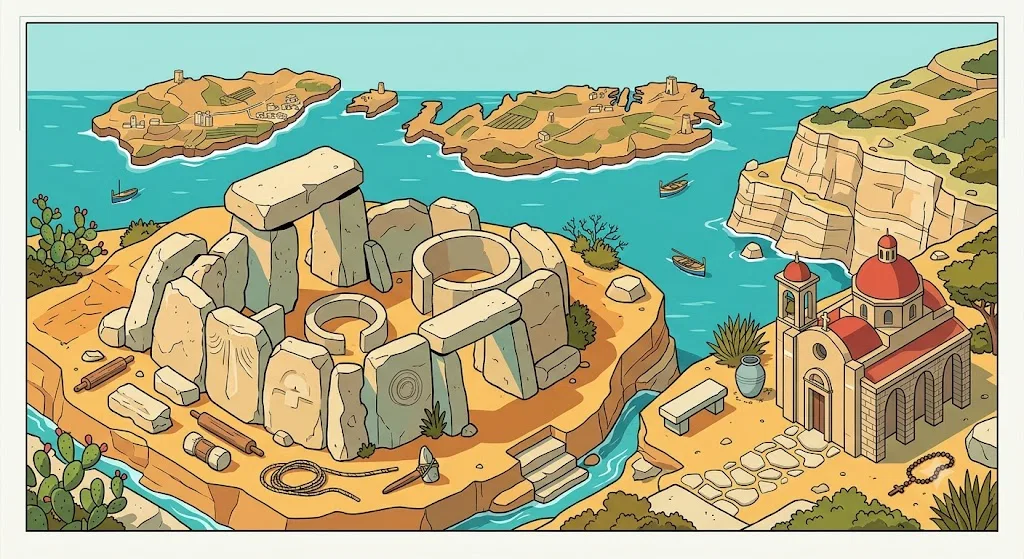
That archaeological reality helps explain the folk imagination around the temples. Before modern archaeology could offer a technical account of quarrying, transport and ritual architecture, the sheer scale of the stones invited a simpler answer: giants. The name Ġgantija itself has encouraged that reading for generations. A common Gozitan legend says the temples were built by a giantess, often called Sansuna, sometimes imagined carrying her child while moving massive stones. The value of the story is not that it explains the site scientifically; it shows how local people made sense of a monument that looked too large, too old and too strange to fit everyday human labour.
This pattern appears again at Għar Dalam, the cave and museum at Birżebbuġa. Heritage Malta describes the cave as containing remains of animals stranded in Malta and later extinct after the Last Glacial Maximum, and as preserving significant pottery connected with the earliest evidence of human settlement on the islands, about 7,400 years ago.[Heritage Malta]heritagemalta.mtHeritage Malta Għar Dalam Cave and MuseumHeritage Malta Għar Dalam Cave and Museum Bones, caves and deep time easily attract legendary thinking. Even when the official interpretation is archaeological rather than supernatural, the setting belongs to the same imaginative landscape as giant lore, hidden places and stories about the old island before living memory.
Giants, temples and the problem of ancient Malta
The giant is one of Malta’s most useful folk figures because it bridges awe and explanation. In Maltese tradition, giants are not merely monsters. They are a way of thinking about disproportion: stones too large for normal builders, caves too deep for ordinary history, and ruins too ancient for familiar memory.
Folklorist Ġużè Cassar Pullicino’s outline of Maltese folklore places giants alongside demons, witches, changelings, spirits, ghosts, water beings, supernatural places, hidden treasure and other mythological traditions.[L-Università ta' Malta]um.edu.mtL-Università ta' Malta That classification is helpful because it prevents a common misunderstanding. Malta’s giants are not isolated curiosities; they belong to a wider system of popular belief in which landscape, danger, morality and memory are connected.
Ġgantija is the clearest example. The archaeological site is real, carefully studied and conserved; the giantess is a traditional explanation and a memorable cultural afterlife. The two should not be confused. Saying “a giantess built Ġgantija” is folklore; saying “Late Neolithic communities built Ġgantija” is archaeology. The two statements do different jobs. Archaeology reconstructs human activity; folklore records how later communities imagined the humanly unbelievable.
This distinction is especially important in Malta because prehistoric monuments are central to national and tourism identity. Modern retellings can sometimes blur ancient evidence, local legend and promotional language. A careful reading keeps all three in view: the temples are among Malta’s most important material heritage sites; the giant stories are part of their oral and popular reception; and present-day tourism often repackages both into compact, visitor-friendly legend.
Caves, cliffs and stories of captivity
Malta and Gozo have many cave legends, but two of the best known show very different kinds of storytelling: Calypso’s Cave in Gozo and Għar Ħasan in Malta.
Calypso’s Cave overlooks Ramla Bay in Gozo. Visit Malta presents it as the cave that many people believe to be the one associated with Homer’s story of Calypso and Odysseus.[Visit Malta]visitmalta.comVisit Malta Calypso’s CaveVisit Malta Calypso’s Cave This is not a simple “Maltese myth” in the local oral-tradition sense. It is a classical literary association mapped onto a Gozitan place. In other words, the cave’s fame comes from the meeting of Homeric geography, later interpretation and local tourism. The story gives Gozo a role in the ancient Mediterranean imagination, but the identification of any real cave as Homer’s Ogygia remains a tradition rather than a settled historical fact.
Għar Ħasan is different. Visit Malta notes that the cave is linked to legends about Hasan, described as a Saracen who sought refuge there.[Visit Malta]visitmalta.comVisit Malta Għar ĦasanVisit Malta Għar Ħasan Popular versions usually turn the place into a tragic tale of abduction, pursuit and death: Hasan hides in the cave with a Maltese woman, the locals come after him, and one or both figures die at the cliff. The details vary, which is exactly what one expects from a strong local legend. The repeated core is more important than any single ending: the cave becomes a place of danger, forbidden desire, violence and boundary-crossing.
These cave stories show two routes by which folklore attaches itself to place. Calypso’s Cave draws Malta into a grand literary Mediterranean. Għar Ħasan localises fear, memory and identity in a named coastal cave. Both are meaningful, but they should be read differently. One is a classical claim adopted into local place-lore; the other behaves more like a local cautionary legend shaped by religion, conflict and the dramatic geography of the cliff.
The sinkhole that became a moral tale
Il-Maqluba, near Qrendi, is one of Malta’s most striking examples of a natural feature turned into moral folklore. The site is a large sinkhole, and modern accounts usually connect it with a legend in which a sinful or wicked village is swallowed by the earth, while a good woman or holy figure is spared. Some versions also connect the displaced earth with the formation of Filfla, the small island off Malta’s south-west coast. Guide-style retellings differ in detail, but the central pattern is consistent: landscape becomes a warning about sin, punishment and divine justice.[Guide Me Malta]guidememalta.comthe legend of il maqluba fact or fictionthe legend of il maqluba fact or fiction
The religious setting matters. Visit Malta describes the nearby Maqluba Chapel at Qrendi as dedicated to the Martyrdom of St Matthew and says its history dates back to the 13th century.[Visit Malta]visitmalta.comOpen source on visitmalta.com. A chapel beside a dramatic geological feature makes the place especially suitable for legend. The hole in the ground is not just a curiosity; it becomes a scene in a sacred moral geography.
Il-Maqluba also shows how Maltese folklore can preserve older explanatory habits while modern knowledge changes the frame. A contemporary reader may understand the site as a sinkhole, a conservation area or a visitor stop. The legend, however, tells us how such a place could be made socially legible before geological language was widespread: disaster was interpreted through morality, prayer and divine judgement.
Witches, ghosts and dangerous beings
Maltese supernatural folklore includes witches, ghosts, demons, child-frightening beings, monsters and other figures that do not always fit neatly into English categories such as “fairy” or “goblin”. Cassar Pullicino’s classification explicitly includes sorcery and witchcraft, talismans, charms, the evil eye, devils, demons, giants, ghosts, apparitions, changelings, water beings and haunted or supernatural places.[L-Università ta' Malta]um.edu.mtL-Università ta' Malta
This range matters because Maltese folklore is often reduced online to a few “creepy creatures”. The older field is broader and more social. Witchcraft beliefs were tied to illness, fear, love, rivalry, protection and accusation. Ghost stories were tied to death, place and unresolved memory. Child-scaring figures helped regulate behaviour around dangerous wells, streets, darkness or disobedience. Charms and prayers reveal how religion and magic could overlap in everyday life.
There is also historical evidence for fear of witchcraft as a social force, not merely a story motif. Research on seventeenth-century Malta before the Inquisition Tribunal examines accusations of witchcraft and argues that magic could function within patterns of social control.[SciSpace]scispace.comOpen source on scispace.com. That does not mean the supernatural claims were true. It means people acted as though such powers mattered, and institutions sometimes took those fears seriously enough to record them.
For readers interested in “monsters”, the most useful approach is to ask what a creature does in the culture. A well monster warns children away from danger. A night-roaming being polices behaviour after dark. A ghost marks a place as morally unfinished. A witch story explains misfortune, envy or feared female power. Maltese supernatural beings are most meaningful when read as part of family discipline, village memory, religious anxiety and the practical dangers of island life.
Saints, feasts and living ritual
Not all Maltese folklore is spooky. Some of the most important living traditions are festive, devotional and public. The Maltese village festa is now recognised by UNESCO as intangible cultural heritage; UNESCO describes it as an annual community event of religious origin held in village parishes across Malta and Gozo.[Intangible Cultural Heritage]ich.unesco.orgOpen source on unesco.org. Malta’s government also described the UNESCO recognition as honouring the festa’s community values, artistic promotion and inclusivity.[Government of Malta]gov.mtOpen source on gov.mt.
A festa is folklore in the living sense: not an old tale in a book, but a recurring performance of belonging. It includes processions, band clubs, fireworks, street decoration, food, family return visits, saintly devotion and local rivalry. It is religious, social and theatrical at once. The patron saint is the sacred centre, but the village is also celebrating itself.
Traditional song has similar importance. UNESCO inscribed Maltese folksong, known as għana, on the Representative List of the Intangible Cultural Heritage of Humanity in 2021.[Intangible Cultural Heritage]ich.unesco.orgl gana a maltese folksong tradition 01681l gana a maltese folksong tradition 01681 UNESCO’s archive description explains that the tradition includes rhymed folksong and that the best-known “quick-wit” form involves improvised sung duels, argument, repartee and reflection on shared history.[UNESCO]unesco.orgdocument 5631document 5631
These traditions show why folklore should not be treated as dead superstition. Malta’s folklore includes living arts: singing, debating, decorating, processing, feasting, remembering and gathering. Even when supernatural belief weakens, the social habits that carried folklore can remain powerful.

Folktales, collectors and the question of evidence
A reader looking for “old Maltese myths” quickly runs into a source problem. Some traditions are documented by scholars and collectors; others circulate in modern tourism articles, social media posts or unattributed lists. The difference matters.
Cassar Pullicino stressed that Maltese folklore had to be studied through collected and published material, and he warned that modern social change was pushing back older local folk culture while much documentation still remained to be done.[L-Università ta' Malta]um.edu.mtL-Università ta' Malta He also noted the role of earlier collectors and scholars, including Luigi Bonelli, Hans Stumme, Bertha Ilg and Fr Manwel Magri, in recording folktales, folksongs, proverbs and other material.[L-Università ta' Malta]um.edu.mtL-Università ta' Malta
Manwel Magri is especially important for Maltese folktales. A modern academic publication record describes him as having collected 62 tales, with variants, by visiting Maltese people and recording stories they told.[Masarykova univerzita | MUNI]muni.czOpen source on muni.cz. The University of Malta also notes that Hans Stumme collected 37 Maltese folktales, 12 dealing with magic, and that Magri and Bertha Ilg collected folktales involving magic as well.[L-Università ta' Malta]um.edu.mtL-Università ta' Malta Maltese Magic FolktalesL-Università ta' Malta Maltese Magic Folktales
This collector history gives Maltese folklore a firmer base than many internet summaries suggest. At the same time, it reminds us to be cautious. A creature named in a viral list may be traditional, but the exact description may be modernised. A legend attached to a tourist site may be old, but the neat version on a travel page may be simplified. A “myth” may be a classical association, a medieval-style legend, a children’s warning, a saint story or a recent retelling.
Nature lore and changing memory
Nature has always been one of the main engines of Maltese folklore. The sea, caves, weather, wells, trees, animals, stones and seasonal cycles all appear in the broader classification of folklore used by scholars.[L-Università ta' Malta]um.edu.mtL-Università ta' Malta This is unsurprising on small islands where weather, farming, fishing, travel and scarcity shaped daily life.
Heritage Malta’s recent exhibition “Nature in Maltese Folklore” makes the same point for contemporary audiences. Its description says nature runs through Maltese stories, beliefs, superstitions, food, remedies and pastimes, while modern economic change, technology, tourism, migration and globalisation have transformed everyday life and caused some traditions to evolve or fade.[Heritage Malta]heritagemalta.mtHeritage Malta Nature in Maltese FolkloreHeritage Malta Nature in Maltese Folklore
That is a useful summary of the current state of Maltese folklore. The tradition is not simply vanishing, but it is changing form. Oral tales once told in families or villages may now appear in museum displays, school projects, heritage trails, podcasts, Halloween articles or tourist walks. That shift can preserve stories, but it can also flatten them. A belief once embedded in a particular family, field, feast or fear may become a short “legend of Malta” paragraph detached from its local use.
For modern readers, the best way to approach Maltese folklore is therefore double vision. See the story, but also ask where it is being told now: in an archive, a village, a museum, a church procession, a tour script, a children’s book or an online list. The same legend can mean different things in each setting.
How Malta understands its folklore today
Today, Maltese folklore works in three main ways. First, it is heritage: something collected, archived, exhibited and protected as part of national culture. The Superintendence of Cultural Heritage and UNESCO-linked recognition of living traditions such as the festa and għana show how seriously intangible culture is now treated.[schmalta.mt]schmalta.mtOpen source on schmalta.mt.
Second, it is local identity. Village feasts, saint traditions, nicknames, songs, ghost stories and place legends help distinguish one locality from another. In a small country, tiny differences matter: one cave, one chapel, one band club, one procession route or one remembered tale can carry strong local meaning.
Third, it is public storytelling. Malta’s legends are now part of visitor culture, especially around Ġgantija, Calypso’s Cave, Għar Ħasan, Il-Maqluba, Mdina, the Three Cities and other atmospheric sites. This is not automatically a problem. Tourism can keep stories visible. But it does mean readers should distinguish between old oral tradition, scholarly collection, religious practice, archaeological fact and modern packaging.
The strongest Maltese folklore is memorable because it does not float free of the islands. It clings to limestone, chapels, harbours, processions, songs, family warnings and prehistoric stones. Its central question is rarely “Did this supernatural event happen?” A better question is: “What did this story help people explain, fear, remember or celebrate?” On Malta, the answer is often the island itself.
eBay marketplace picks
Marketplace Samples
Live-tested eBay searches with available results related to this page.

Endnotes
1.
Source: um.edu.mt
Title: L-Università ta’ Malta
Link:https://www.um.edu.mt/library/oar/bitstream/123456789/24200/1/The%20Field%20of%20Maltese%20Folklore.pdf
2.
Source: whc.unesco.org
Title: World Heritage Centre Megalithic Temples of Malta
Link:https://whc.unesco.org/en/list/132/
3.
Source: scispace.com
Link:https://scispace.com/pdf/witchcraft-beliefs-and-social-control-in-seventeenth-century-5bpwnr140c.pdf
4.
Source: ich.unesco.org
Link:https://ich.unesco.org/en/RL/maltese-village-festa-an-annual-community-celebration-01871
5.
Source: ich.unesco.org
Title: l gana a maltese folksong tradition 01681
Link:https://ich.unesco.org/en/RL/l-gana-a-maltese-folksong-tradition-01681
6.
Source: unesco.org
Title: document 5631
Link:https://www.unesco.org/archives/multimedia/document-5631
7.
Source: muni.cz
Link:https://www.muni.cz/en/research/publications/2222217
8.
Source: ich.unesco.org
Title: 48337 EN
Link:https://ich.unesco.org/doc/src/48337-EN.pdf
9.
Source: ich.unesco.org
Title: 43372 EN
Link:https://ich.unesco.org/doc/src/43372-EN.pdf
10.
Source: ich.unesco.org
Title: 49718 EN.docx
Link:https://ich.unesco.org/doc/src/49718-EN.docx
11.
Source: ich.unesco.org
Link:https://ich.unesco.org/en/video/66605
12.
Source: ich.unesco.org
Link:https://ich.unesco.org/en/decisions/16.COM/8.B.23
13.
Source: ich.unesco.org
Title: photo pop up 00973
Link:https://ich.unesco.org/en/photo-pop-up-00973?photoID=14785
14.
Source: ich.unesco.org
Title: search 00795
Link:https://ich.unesco.org/en/search-00795?call=film&id=66605&include=film_inc.php&width=700
15.
Source: ich.unesco.org
Title: l gana a maltese folksong tradition 01681
Link:https://ich.unesco.org/en/RL/l-gana-a-maltese-folksong-tradition-01681?call=film&id=58139&include=film_inc.php&width=700
16.
Source: heritagemalta.mt
Title: Heritage MaltaĠgantija Archaeological Park
Link:https://heritagemalta.mt/explore/ggantija-archaeological-park/
17.
Source: heritagemalta.mt
Title: Heritage Malta Għar Dalam Cave and Museum
Link:https://heritagemalta.mt/explore/ghar-dalam/
18.
Source: visitmalta.com
Title: Visit Malta Calypso’s Cave
Link:https://www.visitmalta.com/en/attraction/calypso-cave-natural-attraction-gozo-malta
19.
Source: visitmalta.com
Title: Visit Malta Għar Ħasan
Link:https://www.visitmalta.com/en/attraction/ghar-hassan-malta
20.
Source: guidememalta.com
Title: the legend of il maqluba fact or fiction
Link:https://www.guidememalta.com/en/the-legend-of-il-maqluba-fact-or-fiction
21.
Source: visitmalta.com
Link:https://www.visitmalta.com/en/attraction/maqluba-chapel-qrendi-malta
22.
Source: gov.mt
Link:https://www.gov.mt/en/Government/DOI/Press%20Releases/Pages/2023/12/06/pr231927en.aspx
23.
Source: um.edu.mt
Title: L-Università ta’ Malta Maltese Magic Folktales
Link:https://www.um.edu.mt/newspoint/events/um/2018/11/talkaboutmaltesemagicfolktales
24.
Source: heritagemalta.mt
Title: Heritage Malta Nature in Maltese Folklore
Link:https://heritagemalta.mt/whats-on/nature-in-maltese-folklore/
25.
Source: schmalta.mt
Link:https://schmalta.mt/intangible-cultural-heritage/
26.
Source: facebook.com
Link:https://www.facebook.com/HeritageMalta/posts/originally-serving-as-an-opportunity-of-great-indulgence-before-40-days-of-penan/10158365207369582/
27.
Source: visitmalta.com
Link:https://www.visitmalta.com/it/blog/beyond-the-postcard-unearthing-maltas-hidden-legends
28.
Source: maltatina.com
Link:https://www.maltatina.com/il-maqluba-the-natural-sinkhole-in-malta/
29.
Source: Wikipedia
Title: Maltese folklore
Link:https://en.wikipedia.org/wiki/Maltese_folklore
30.
Source: Wikipedia
Title: Għar Dalam
Link:https://en.wikipedia.org/wiki/G%C4%A7ar_Dalam
31.
Source: Wikipedia
Title: Għar Ħasan
Link:https://en.wikipedia.org/wiki/G%C4%A7ar_%C4%A6asan
32.
Source: heritagemalta.mt
Link:https://heritagemalta.mt/explore/dark-history-sites/
33.
Source: heritagemalta.mt
Link:https://heritagemalta.mt/news/accidental-find-at-ghar-dalam/
34.
Source: heritagemalta.mt
Link:https://heritagemalta.mt/whats-on/
35.
Source: schmalta.mt
Link:https://schmalta.mt/the-maltese-festa-is-officially-recognised-as-intangible-cultural-heritage-by-unesco/
36.
Source: guidememalta.com
Link:https://www.guidememalta.com/en/of-tempests-greek-mythology-the-legend-of-gozo-s-calypso-s-cave-in-homer-s-odyssey
37.
Source: um.edu.mt
Link:https://www.um.edu.mt/library/oar/handle/123456789/26221
38.
Source: tripadvisor.com
Link:https://www.tripadvisor.com/Attraction_Review-g1182441-d2250591-Reviews-Maqluba-Qrendi_Island_of_Malta.html
39.
Source: meta.wikimedia.org
Link:https://meta.wikimedia.org/wiki/Wiki_Loves_Living_Heritage/Intangible_Cultural_Heritage_of_Malta/list
40.
Source: ichmalta.gov.mt
Title: mt National Inventory Archives
Link:https://ichmalta.gov.mt/category/national-inventory/
41.
Source: maltacoe.gov.mt
Title: a taste of the maltese festa
Link:https://maltacoe.gov.mt/cultural-programme/a-taste-of-the-maltese-festa/
42.
Source: x.com
Link:https://x.com/UNESCO/status/1732306242956099693
Additional References
43.
Source: youtube.com
Title: The Mystery of Malta’s Ġgantija & the Giantess Sansuna
Link:https://www.youtube.com/watch?v=kIfJyaIsyAU
Source snippet
The UnXplained: The Cursed Megalithic Island of Malta...
44.
Source: youtube.com
Title: Most Mysterious Mythical Creatures Of Malta Explained
Link:https://www.youtube.com/watch?v=ZgIN64T316w
Source snippet
The Mystery of Malta's Ġgantija & the Giantess Sansuna...
45.
Source: maltadirect.com
Link:https://www.maltadirect.com/all-things-malta
46.
Source: connectparanormal.net
Link:https://connectparanormal.net/2024/01/04/ancient-giants-of-malta-myth-or-reality/
47.
Source: academia.edu
Link:https://www.academia.edu/89690722/Evil_Mythical_Creatures_in_Maltese_Tradition_and_Folklore_A_Collection_of_Old_Maltese_Fairy_Tales_by_Priest_Emmanwel_Magri_presentation_at_conference_Prague_Czech_Republic_112022
48.
Source: outwithkidz.com
Link:https://www.outwithkidz.com/places/attractions/ghar-dalam
49.
Source: facebook.com
Link:https://www.facebook.com/61585076495334/posts/gozo-the-island-of-calypso-malta-gozo-historyfacts-surname-historical-calypso-vi/122112960771169216/
50.
Source: facebook.com
Link:https://www.facebook.com/DOImalta/posts/g%C4%A7ar-dalam-is-maltas-oldest-prehistoric-site-situated-on-the-outskirts-of-bir%C5%BCeb/681288857368819/
51.
Source: shortletsmalta.com
Link:https://www.shortletsmalta.com/blog/legends-from-the-island-mysteries-and-myths-of-the-maltese
52.
Source: montedogozo.com
Link:https://www.montedogozo.com/legends-of-galicia-the-most-magical-stories-of-this-land/
Topic Tree
Follow this branch
Related pages 192
- Afghan Folklore
- Albanian Folklore
- Algerian Folklore
- Australian Folklore
- Azerbaijan Folklore
- +187 more in sidebar