Within Danish Folklore
Why Danish Churchyards Had Omen Creatures
Ghost horses, ravens and churchyard beings show how Danish folklore gave visible shape to death, illness and uneasy burial places.
On this page
- The helhest and the sound of approaching death
- Churchyards, burial ground guardians and fear
- How omen stories turned danger into local memory
Page outline Jump by section
Introduction
In Danish folk belief, death did not arrive without warning. Traditional stories imagined the approach of illness, disaster and mortality through visible signs: spectral animals, uncanny sounds, and strange beings seen near churchyards after dark. Among the most famous of these figures was the helhest, a ghostly three-legged horse whose appearance foretold death. Alongside it stood other churchyard guardians and omen creatures that reflected deep anxieties about burial, sacred ground and the boundary between the living and the dead. These traditions were not merely ghost stories. They helped communities explain sudden illness, cope with grief and turn dangerous or unsettling places into landscapes filled with meaning. Folklore collectors in the nineteenth century recorded many of these beliefs, preserving a distinctive part of Denmark’s supernatural heritage.[Wikipedia]WikipediaOpen source on wikipedia.org.
The Helhest and the Sound of Approaching Death
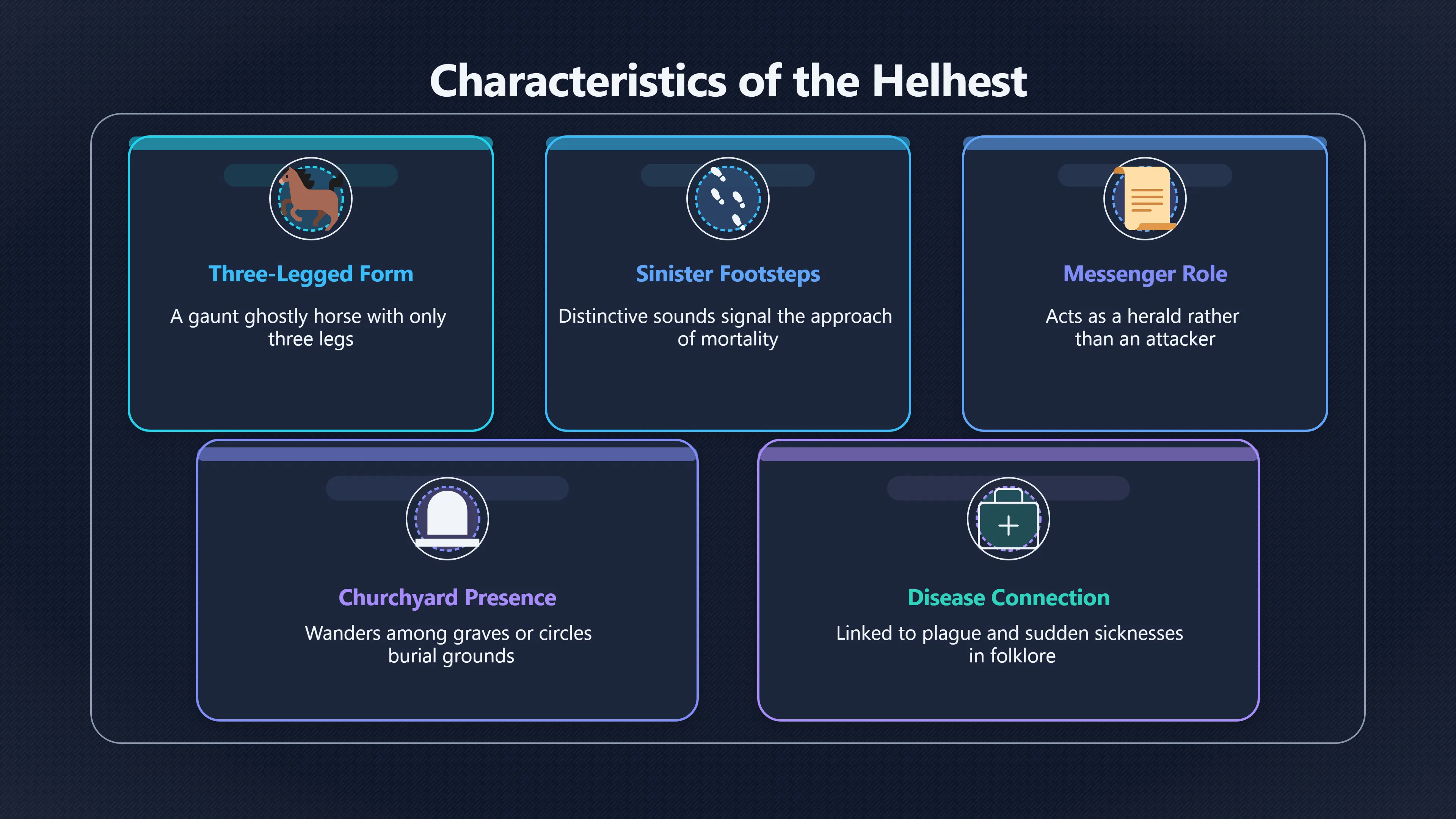
No Danish death omen is more famous than the helhest. In folklore it was usually described as a gaunt horse with three legs, associated with death, sickness and the realm of the dead. Merely seeing it could be interpreted as a warning that someone nearby would soon die, while hearing its distinctive footsteps was also regarded as a sinister sign.[Wikipedia]WikipediaOpen source on wikipedia.org.
The helhest was especially connected with churchyards. Stories placed it wandering among graves at night or circling burial grounds before a death occurred. Nineteenth-century accounts recorded sayings linking the creature directly with plague, disease and mortality. Rather than functioning as a monster that attacked people, the helhest acted as a messenger. Its appearance signalled that death was already approaching.[Wikipedia]WikipediaOpen source on wikipedia.org.
One well-known legend from Aarhus told of a man who looked out towards the cathedral precincts after being told a strange horse outside might be the helhest. After seeing it, he reportedly became terrified, fell ill and died soon afterwards. Such stories reinforced the belief that encounters with omen creatures were themselves dangerous.[Wikipedia]WikipediaOpen source on wikipedia.org.
Why Three Legs?
The helhest’s unusual appearance may reflect older beliefs about churchyard guardians. According to a widespread tradition, when a new churchyard was consecrated, an animal—often a horse—was buried before any human corpse entered the cemetery. In some versions the animal was deliberately maimed, creating the image of a three-legged spectral horse. The dead animal’s spirit then became a supernatural guardian of the sacred ground. Over time, this guardian merged with broader ideas about death omens and developed into the legendary helhest.[wikipedia.org]WikipediaOpen source on wikipedia.org.
Churchyards, Burial Ground Guardians and Fear
Churchyards occupied a special place in Danish folk imagination. They were sacred, but they were also spaces where ordinary people confronted death directly. Folklore often imagined them as guarded territory inhabited by supernatural watchmen.[Wikipedia]WikipediaChurch grimChurch grim
One important figure was the kirkegrim, or church grim. In Danish tradition this was often believed to be the spirit of an animal buried beneath a church or within the churchyard. Unlike the helhest, which warned of death, the kirkegrim primarily protected the cemetery and church from desecration. Yet the distinction was not always clear. A guardian spirit that belonged partly to the world of the dead could easily become a frightening omen in popular storytelling.[Wikipedia]WikipediaChurch grimChurch grim
Folklore linked these guardians to several recurring themes:
- Protection of sacred ground: Churchyards required supernatural defence against evil influences and disturbances.[Wikipedia]WikipediaChurch grimChurch grim
- The first burial problem: Some traditions claimed that the first being buried in a cemetery would be forced to guard it, encouraging stories about animal sacrifices instead of human victims.[Atlas Obscura]atlasobscura.comgrave of the hel horse roskildeAtlas ObscuraGrave of the Hel-Horse in Roskilde10 Jun 2024 — Deep inside the cathedral lies a black, unmarked flat gravestone believed to…
- Warnings of coming deaths: Encounters with churchyard spirits were often interpreted as signs that another funeral would soon follow.[Wikipedia]WikipediaChurch grimChurch grim
- Fear of improper burial: Spirits of the unburied or improperly buried dead were believed to linger uneasily near church grounds.[Wikipedia]WikipediaChurch grimChurch grim
These beliefs reveal how churchyards were imagined not simply as resting places but as active boundaries between worlds.

Ravens, Death Birds and Omen Animals
The helhest was not the only creature associated with death. Danish folklore also attached ominous significance to certain birds, especially ravens. Ravens had long associations with battlefields, corpses and the supernatural in northern Europe. Their presence near places of death made them natural symbols of mortality.[Audubon]audubon.orgDid Folklore Help Bring Denmark's Ravens Back From the…May 26, 2017 — 26 May 2017 — The once-endangered raven is rebounding in…
In Danish legend, the valravn—often translated as a raven of the slain—represented a more supernatural version of this connection. While the valravn belongs to a broader category of legendary beings rather than specifically churchyard folklore, its existence demonstrates how birds could become embodiments of death and the fate of souls.[Wikipedia]WikipediaOpen source on wikipedia.org.
The importance of such creatures lay less in fixed doctrine than in interpretation. A raven calling at an unusual time, gathering near graves or appearing repeatedly around a household could be understood as a warning. Folklore transformed ordinary animal behaviour into a language through which death seemed to announce itself.
How Omen Stories Turned Danger into Local Memory
Death omens served practical social purposes. Before modern medicine, communities often experienced illness, epidemics and sudden death with little explanation. Folklore provided a narrative structure that made these events feel less random. If a strange horse had been seen near the churchyard, or if an uncanny animal had appeared before a funeral, people could retrospectively fit tragedy into a meaningful story.[Wikipedia]WikipediaOpen source on wikipedia.org.
These stories also attached memory to specific locations. Certain churchyards became known for sightings of the helhest. Particular stones, paths or gates acquired reputations as places where omen creatures appeared. At Roskilde Cathedral, tradition held that a stone marked the resting place of a helhest, and visitors reportedly spat upon it for protection. The site transformed folklore into a physical landmark embedded in local memory.[Wikipedia]WikipediaOpen source on wikipedia.org.
Importantly, such legends did not always portray churchyards as evil places. Many stories emphasised guardianship, order and respect for the dead. Fear arose not because the churchyard was inherently malevolent, but because it represented a threshold where the ordinary world met forces beyond human control.[Wikipedia]WikipediaChurch grimChurch grim
How These Traditions Are Viewed Today
Modern Danes generally encounter the helhest and churchyard guardians as folklore rather than living belief. The creatures survive in local legends, museum collections, folklore archives and popular retellings of Scandinavian supernatural traditions. Researchers view them as examples of how Christian burial customs, older Nordic ideas about the dead and local storytelling traditions blended together over centuries.[Wikipedia]WikipediaDanish folkloreDanish folklore
Yet the appeal of these stories remains strong. The image of a three-legged ghost horse pacing among graves, or a hidden guardian watching over a churchyard, captures a universal human concern: the desire to recognise death before it arrives and to believe that the boundary between life and death is being carefully watched. In Danish folklore, omen creatures gave shape to that uncertainty, turning fear, grief and memory into stories that could be shared from one generation to the next.[wikipedia.org]WikipediaOpen source on wikipedia.org.
Amazon book picks
Further Reading
Books and field guides related to Why Danish Churchyards Had Omen Creatures. Use these as the next step if you want deeper reading beyond the article.
The Penguin Book of Ghost Stories
Places helhest-style fears within broader ghost lore.

Scandinavian Folk Belief and Legend
Includes death omens and supernatural belief traditions.
eBay marketplace picks
Marketplace Samples
Live-tested eBay searches with available results related to this page.

Endnotes
1.
Source: Wikipedia
Link:https://en.wikipedia.org/wiki/Helhest
2.
Source: Wikipedia
Title: Danish folklore
Link:https://en.wikipedia.org/wiki/Danish_folklore
3.
Source: Wikipedia
Link:https://es.wikipedia.org/wiki/Helhest
4.
Source: Wikipedia
Title: Church grim
Link:https://en.wikipedia.org/wiki/Church_grim
5.
Source: audubon.org
Link:https://www.audubon.org/magazine/did-folklore-help-bring-denmarks-ravens-back-brink
Source snippet
Did Folklore Help Bring Denmark's Ravens Back From the...May 26, 2017 — 26 May 2017 — The once-endangered raven is rebounding in...
Published: May 26, 2017
6.
Source: atlasobscura.com
Title: grave of the hel horse roskilde
Link:https://www.atlasobscura.com/places/grave-of-the-hel-horse-roskilde
Source snippet
Atlas ObscuraGrave of the Hel-Horse in Roskilde10 Jun 2024 — Deep inside the cathedral lies a black, unmarked flat gravestone believed to...
7.
Source: mythfolks.com
Title: danish folklore
Link:https://www.mythfolks.com/danish-folklore
Source snippet
& Obscure Legends18 Jan 2025 — With its swift, silent movements, the Helhest was said to appear in cemeteries at night. Folklore said tha...
8.
Source: thegreatdevilwar.fandom.com
Title: Hel horse
Link:https://thegreatdevilwar.fandom.com/wiki/Hel_horse
Source snippet
horse - The Great Devil War Wikia - FandomIn Danish folkore, a helhest ("Hel horse") is a ghostly, three-legged horse associated with Hel...
9.
Source: mythoi.substack.com
Title: grim sacrifices
Link:https://mythoi.substack.com/p/grim-sacrifices
Source snippet
Sacrifices - by A.C. Luke - MythoiLike the rest of its spectral pack, the church grim is an omen of death, appearing alongside stormy wea...
Additional References
10.
Source: reddit.com
Link:https://www.reddit.com/r/Denmark/comments/qlrbh2/any_scary_danishnordic_stories_from_folklore/
Source snippet
Any scary Danish/Nordic stories from folklore?: r/DenmarkHi there people of Denmark! I am looking for inspiration for my next project in...
11.
Source: facebook.com
Link:https://www.facebook.com/groups/437314208313803/posts/628132469231975/
Source snippet
Helhest, the three-legged horse of Hel in Norse mythologyIn Danish folkore, a helhest ("Hel horse") is a ghostly, three-legged horse asso...
12.
Source: facebook.com
Link:https://www.facebook.com/groups/aiartuniverse/posts/1100656781699555/
Source snippet
Helhest: ghostly horse in Danish folkloreSeveral legends dictate that in former days, a living horse was to be buried beneath the foundat...
13.
Source: facebook.com
Link:https://www.facebook.com/groups/661200230952488/posts/1134054300333743/
Source snippet
A hearse stopping at someone's door on the way to the funeral is a death omen for the householder.Read more...
14.
Source: tumblr.com
Link:https://www.tumblr.com/bestiarium/681597032209809408/the-church-grim-british-folklore-danishswedish
Source snippet
l being that guarded and protected the church and the graveyard.Read more...
15.
Source: europeanfolktales.com
Title: the church grim of the northern churchyards
Link:https://europeanfolktales.com/the-church-grim-of-the-northern-churchyards/
Source snippet
The Church Grim: A Scandinavian Folktale7 Feb 2026 — A Scandinavian folktale from Denmark and Sweden about the Church Grim, a spectral bl...
16.
Source: facebook.com
Title: Many people might question why Helhest had only three legs.Read more
Link:https://www.facebook.com/groups/131111877494974/posts/166890993917062/
Source snippet
Helhest, the three-legged horse of goddess Hel in Danish...In the folklore, Helhest carries Hel along anywhere in Midgard to fetch the dead...
17.
Source: mnbernardbooks.wordpress.com
Title: Melanie Noell Bernard Danish Church Grims
Link:https://mnbernardbooks.wordpress.com/2017/10/18/danish-church-grims/
Source snippet
Melanie Noell BernardDanish Church Grims - Melanie Noell Bernard - WordPress.com18 Oct 2017 — Danish church grims are said to be the spir...
18.
Source: instagram.com
Link:https://www.instagram.com/p/DYSJgM8sqLZ/
Source snippet
Across English and Scandinavian folklore, graveyards...The Church Grim appeared as a huge black spectral dog haunting churchyards after...
19.
Source: youtube.com
Title: Ghosts & Spirits: Church Grim, guardian spirit of Scandinavian folklore
Link:https://www.youtube.com/watch?v=a83YJ7LJvKs
Source snippet
How to Understand: The Kyrko(Church) Grim, The Swedish Church Guardian...
Topic Tree