What Stories Still Shape Burkina Faso?
Burkina Faso’s folklore is not a single mythology with one fixed cast of gods and monsters. It is a country of many oral traditions, shaped by more than 60 ethnic and cultural communities, where stories, masks, music, sacred places and ritual calendars carry memory from one generation to the next.
Page outline Jump by section
Why Burkina Faso’s folklore is so regional
Burkina Faso sits in inland West Africa, between the Sahel and the more humid savanna zones, and its traditions reflect that variety. The Mossi are the largest group and are central to national origin stories, especially around Ouagadougou and the Mossi kingdoms. Other major communities include Bobo, Bwa, Lobi, Gurunsi, Senufo, Fulani, Gurma and Mandé-speaking groups, each with its own local histories, ritual specialists, artistic forms and oral repertoires. This is why a serious account of Burkinabè folklore has to move between country-level symbols and village-level traditions rather than pretending that one tale stands for everyone.[state.gov]2009-2017.state.govDepartment Burkina Faso (06/09Department Burkina Faso (06/09
Religion adds another layer. A recent United States religious freedom report, using national demographic estimates, gives Burkina Faso as majority Muslim, with large Christian communities and about 9 per cent of the population maintaining exclusively Indigenous beliefs. That figure does not mean older ritual ideas have disappeared. Across West Africa, people may identify as Muslim or Christian while still respecting ancestors, sacred places, local taboos, medicinal knowledge, initiation customs or family obligations inherited from older religious systems. The useful distinction is not “old belief versus modern religion”, but the way older traditions continue to live through kinship, performance, art, healing, farming and memory.[state.gov]2021-2025.state.govburkina fasoState.gov2023 Report on International Religious Freedom: Burkina…63.8 percent of the population is Muslim (predominantly Sunni), 20.1…
For readers, this means Burkina Faso’s folklore is best understood as a living web. Some stories explain where a people came from. Some masks appear at funerals, initiations or farming festivals. Some sacred landscapes protect animals or trees through ritual obligations. Some oral tales teach children how to think, speak and judge character. The supernatural is often practical: it concerns rain, harvests, illness, adulthood, social balance, death and the relationship between the village and the wider world.
Yennenga and the founding memory of the Mossi
The most famous legendary figure associated with Burkina Faso is Princess Yennenga, remembered in Mossi oral tradition as a warrior woman and founding mother. In the common form of the story, she is the daughter of a ruler in the north of present-day Ghana. Her father refuses to let her marry, so she leaves, sometimes disguised as a man, and rides away on her horse. In exile she meets a hunter, often named Rialé, and their son Ouédraogo becomes the ancestor of the Mossi ruling line. The name Ouédraogo is commonly explained through the horse that carried Yennenga into her new destiny.[unesco.org]unesdoc.unesco.orgOpen source on unesco.org.
The story is not just a romantic adventure. It gives the Mossi a founding image in which political authority begins through movement, alliance and a powerful woman’s refusal to be confined. It also links Burkina Faso to northern Ghana and to the broader history of Mossi-Dagomba state formation. Historians have treated the early Mossi-Dagomba past cautiously because the evidence is heavily oral and later written accounts are fragmentary, but the traditions themselves are important historical evidence: they show how communities remember descent, legitimacy and political order.[africabib.org]africabib.orgOpen source on africabib.org.
Yennenga is also a good example of how folklore changes function over time. In older oral tradition, she helps explain ancestry and kingship. In modern Burkina Faso, she has become a national emblem. Her name and image appear in public culture, including monuments and the wider language of national pride. The Golden Stallion, the top award at Ouagadougou’s Pan-African film festival FESPACO, echoes the horse symbolism that makes the Yennenga legend so memorable. The tale therefore sits in several worlds at once: oral history, dynastic memory, women’s heroism, national symbolism and modern cultural branding.[ResearchGate]researchgate.netOpen source on researchgate.net.
The key point is not whether every detail happened exactly as told. Folklore often preserves moral and political truths through memorable narrative rather than documentary precision. Yennenga matters because Mossi and Burkinabè memory have made her matter: she is the rider at the beginning of a lineage, the woman who leaves one order and begins another.
Masks that make spirits visible
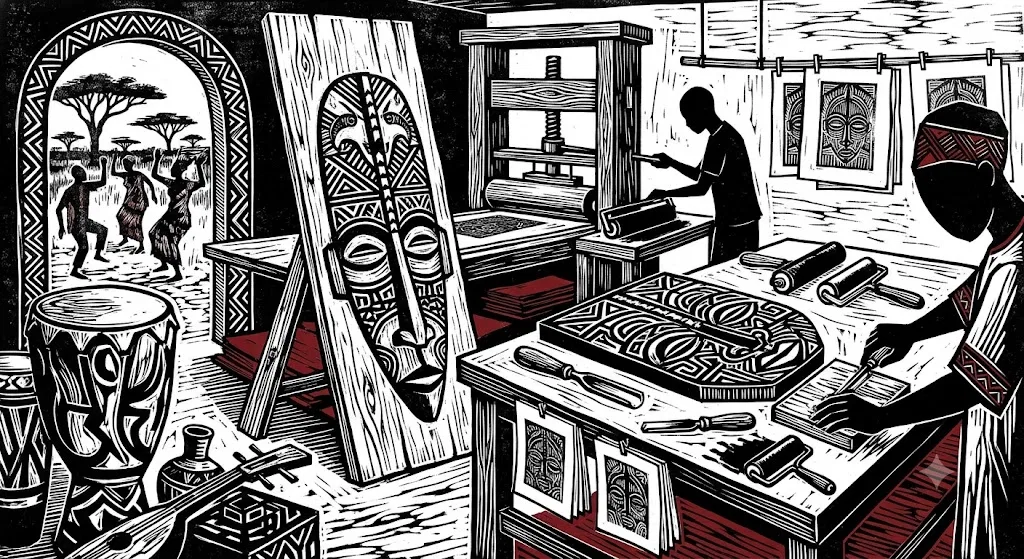
For many outsiders, the most instantly recognisable folklore of Burkina Faso is the mask. That can be misleading if masks are treated merely as “African art”. In many Burkinabè traditions, masks are not just decorative objects: they are performed beings. When worn in dance, with music, costume and ritual knowledge, they may embody ancestors, nature spirits, bush powers or moral rules. The Metropolitan Museum of Art notes that masks associated with Bobo, Bwa, Kurumba, Mossi and related traditions commonly combine human, animal and insect features, and that in performance they embody nature or ancestor spirits that interact with human life.[The Metropolitan Museum of Art]metmuseum.orgThe Metropolitan Museum of Art Bwa blacksmithThe Metropolitan Museum of Art Bwa blacksmith
Among the southern Bwa, large wooden plank masks are often described as representing flying spirits of the natural world. These spirits may be linked with water, insects after rain, birds or other forms that cross the boundary between ordinary sight and hidden presence. Smarthistory’s discussion of a Bwa Nwantantay mask explains that such masks make visible beings that are otherwise largely unseen, and that some traditions remember a first encounter in which a spirit offered humans protection and service.[Smarthistory]smarthistory.orgmask nwantantaymask nwantantay
That idea changes how the viewer should read a mask. A tall plank mask is not simply “a bird” or “a butterfly”. Its colours, geometry and movement belong to a larger system of meaning. Museum and conservation sources describe Bwa masks as using black, red and white patterns, with forms that may refer to animals, ancestors, moral laws or the forces that order community life. Recent technical work on Bwa masks has even studied the plant-based black paint, connecting museum objects back to field observations about local materials and makers.[mdpi.com]mdpi.comOpen source on mdpi.com.
The contexts of performance matter as much as the object. Masks may appear at important funerals, initiation rites and agricultural ceremonies. In funerals, they can honour the dead and help mark the passage from living person to ancestor. In initiation, they introduce young people to adult responsibilities and restricted knowledge. In farming ceremonies, they are connected with seasonal order, rain, fertility and the proper relationship between people and the land.[The Metropolitan Museum of Art]metmuseum.orgThe Metropolitan Museum of Art Bwa blacksmithThe Metropolitan Museum of Art Bwa blacksmith
Dwo, Do and the moral world of Bobo and Bwa tradition
One of the recurring names in discussions of Bobo and Bwa ritual culture is Dwo or Do, though details vary by community and source. In accessible museum explanations, Dwo is often described as a mediating being associated with plant life, wilderness, masks and communication between human beings and the spirit world. Pacific Lutheran University’s African Art Collection, for example, explains Bwa masks as representing Dwo or Do, a messenger between humans and spirits and a figure linked to plant and animal life.[Pacific Lutheran University]plu.eduOpen source on plu.edu.
This is where Burkina Faso’s folklore becomes especially interesting for readers used to “mythology” as a list of gods. Dwo is not simply a character in a storybook. The tradition is enacted through initiation, secrecy, costume, sound, dance and social teaching. A Bobo molo mask, for instance, is described by Missouri State University as part of educational masquerades during male initiation and also as appearing in harvest-time rites and funerals associated with Dwo. The mask tradition is therefore a way of teaching people how to live inside a balanced world.[University Blogs]blogs.missouristate.eduUniversity Blogs Bobo Molo Mask: Researched and Conserved by CoryUniversity Blogs Bobo Molo Mask: Researched and Conserved by Cory
That balance is a repeated theme. Bobo cosmology is often summarised around a creator and the ordering of the world into paired forces such as village and bush, culture and nature, male and female, humans and spirits. Such summaries should be handled carefully because they simplify living traditions, but they point to a real pattern: much Burkinabè ritual folklore is concerned with keeping relations in order. Farming, death, illness, initiation and harvest are all moments when the ordinary world touches invisible powers and needs careful handling.[Wikipedia]WikipediaBobo peopleBobo people
For modern readers, this helps avoid a common misunderstanding. These traditions are not “monster stories” in the horror sense. Their spirits can be dangerous, protective, demanding or helpful, but they are usually embedded in duties, taboos and ceremonies. The fear is not just of a creature attacking; it is of imbalance, disrespect, broken obligations or a failure to recognise powers that make community life possible.
Lobi spirits, shrines and protective figures
In south-western Burkina Faso, Lobi and related communities are widely known for shrine figures used in communication with spirits. Christopher D. Roy’s widely cited work on the art of Burkina Faso describes Lobi religious life as centred not on a centralised political authority but on relations with spiritual powers, mediated by diviners and represented through figures made of wood, clay or metal. These figures are linked to beings often discussed in art-historical literature as nature or protective spirits.[Wikipedia]WikipediaArt of Burkina FasoArt of Burkina Faso
Again, the important point for folklore is function. A carved figure is not only a sculpture for display. It may belong to a shrine, household or ritual specialist, and its meaning depends on offerings, divination, family history and the specific problem being addressed. Protection from illness, accident, conflict or misfortune is part of the practical world of such beliefs.[EBSCO]ebsco.comOpen source on ebsco.com.
This also explains why museum objects can be both valuable and incomplete evidence. Museums preserve form, material and style, but they often remove objects from the ritual setting that gave them force. A Lobi figure in a gallery can teach a visitor about aesthetics and belief, but the full folklore includes the spoken instructions, local names, shrine rules, family obligations and remembered encounters that do not always travel with the object.
Sacred crocodiles at Bazoulé and Sabou
Burkina Faso’s sacred crocodile ponds are among the country’s most striking examples of belief attached to place. Bazoulé, about 30 kilometres from Ouagadougou, is widely reported as a village where people live close to crocodiles regarded as sacred. An Associated Press/Religion News Service report says the local cult of the crocodile is believed to date to the 1500s, when a crocodile is said to have guided local women to water during a severe drought. In gratitude, the animals became revered.[AP News]apnews.comOpen source on apnews.com.
The legend makes sense in a dryland setting where water is life. The crocodile is not merely an animal; it becomes a guide, a sign of survival and a partner in the village’s relationship with the pond. Reports from Bazoulé describe crocodiles as linked to ancestors, with dead crocodiles sometimes treated with funeral respect. The annual Koom Lakre celebration is associated with offerings and requests for health, prosperity, protection, fertility and a good harvest.[Arab News PK]arabnews.pkArab News PKMystical connection: The African village where crocodilesArab News PKMystical connection: The African village where crocodiles
Sabou has a related but distinct reputation for sacred crocodiles. Local accounts describe a pond where crocodiles are protected and associated with ancestral identity, especially through the Kaboré family, who are described in local sources as custodians of the sacred animals. Tourism writing often emphasises the apparent peacefulness between people and crocodiles, but the folklore is deeper than spectacle: it is about custodianship, taboo, respect and the belief that animals can hold ancestral or spiritual significance.[Wikipedia]WikipediaSabou (SabouSabou (Sabou
These crocodile traditions also show the tension between heritage and modern pressure. Sacred ponds can become tourist attractions, and tourism may bring money to local communities, but drought, habitat pressure, changing livelihoods and commercial performance can alter the meaning of the site. The strongest reading is neither cynical nor naïve: the sacred crocodiles are living folklore because they are still narrated, visited, ritually addressed and economically negotiated.[AP News]apnews.comOpen source on apnews.com.
Sacred groves and the folklore of conservation
Not all sacred places in Burkina Faso are spectacular tourist sites. Some are wooded shrines, groves or patches of vegetation protected by ritual restrictions. Research on natural sacred sites in the Bwaba cultural area of western Burkina Faso found that local concepts of sacred places and their ritual administration are complex, diverse and more fluid than outsiders often assume. Such places are not simply “untouched forest”; they are socially managed landscapes with rules, rituals and authorities.[Hal.science]hal.scienceOpen source on hal.science.
This matters because folklore can affect ecology. If a grove is understood as the home of spirits, ancestors or ritual powers, people may avoid cutting trees, hunting or farming there, not because of a modern conservation policy but because of inherited obligations. At the same time, scholars warn against romanticising sacred sites as automatically preserved or ecologically stable. Their protection depends on social belief, local authority, pressure on land, and whether younger generations continue to respect the rules.[ResearchGate]researchgate.netResearch Gate A case study from the Bwaba cultural area (West BurkinaResearch Gate A case study from the Bwaba cultural area (West Burkina
For a folklore reader, sacred groves are important because they show how belief becomes landscape. A story about a spirit in the bush is also a rule about where one may walk, cut, gather, hunt or make offerings. The supernatural is mapped onto land use. That makes Burkina Faso’s sacred ecology one of the clearest examples of folklore doing practical work.
Oral tales, proverbs and the teaching power of story
Burkina Faso’s folklore is not limited to masks and sacred sites. Oral literature remains central: folktales, riddles, proverbs, praise poetry, genealogies, songs and historical recitation. UNESCO describes oral traditions broadly as a way of passing on knowledge, social values and collective memory, and Burkina Faso’s literary history strongly reflects that pattern. Burkinabè literature grew out of oral tradition, and early written works such as Dim-Dolobsom Ouédraogo’s 1934 collection of Mossi maxims, thoughts and riddles show how oral forms were recorded in print during the colonial period.[UNESCO Intangible Cultural Heritage]ich.unesco.orgOpen source on unesco.org.
Alain-Joseph Sissao’s collections of Moose folktales are especially useful for readers seeking actual story material rather than general statements about “oral tradition”. UNESCO’s bibliographic record for Contes du pays des Moose: Burkina Faso identifies it under legends, folk literature and oral tradition, while the English-language Folktales from the Moose of Burkina Faso presents recorded and translated tales from Moose oral heritage.[unesco.org]unesdoc.unesco.orgOpen source on unesco.org.
Animal tales are a major part of the teaching tradition. One publisher’s description of Sissao’s work notes stories involving figures such as the foolish or greedy hyena and the cunning hare, especially for children old enough to enjoy moral contrast and verbal play. Such tales are not only entertainment. They teach judgement: who is greedy, who is clever, who breaks trust, who survives by wit, and what happens when appetite outruns wisdom.[librairienumeriqueafricaine.com]librairienumeriqueafricaine.comOpen source on librairienumeriqueafricaine.com.
Modern scholarship continues to treat these forms as living and adaptable. A 2024 study of Moose and Sã tales and proverbs argues that Burkinabè oral literature carries contemporary concerns, including resilience, crisis and social problem-solving. That is an important corrective to the idea that folklore is merely old material preserved unchanged. In Burkina Faso, as elsewhere, stories remain useful because they can speak to new pressures while keeping familiar forms.[Akofena]revueakofena.comOpen source on revueakofena.com.
Festivals, museums and the modern life of old traditions
Modern Burkina Faso does not simply “preserve” folklore in a glass case. It stages, debates and reinterprets it. FESTIMA, the International Festival of Masks and Arts in Dédougou, was founded in 1996 by the Association for the Safeguarding of Masks and brings together mask traditions from Burkina Faso and neighbouring West African countries. A 2016 Al Jazeera report described the festival as drawing masks from six countries and 50 Burkinabè villages, while more recent event listings continue to present it as one of the region’s major mask festivals.[aljazeera.com]aljazeera.comAl Jazeera In Burkina Faso: FESTIMA, a festival of African masksAl Jazeera In Burkina Faso: FESTIMA, a festival of African masks
FESTIMA is especially revealing because it turns ritual forms into public heritage. A mask that might once have appeared only in a tightly controlled village context may now also appear before visitors, cameras and cultural officials. That does not make it fake, but it does change the frame. The same object or dance can be religious in one setting, educational in another, and cultural diplomacy in a third. Festival organisers and heritage advocates often stress that masks can remain culturally important even for people who do not practise the older religious cults attached to them.[Wikipedia]WikipediaOpen source on wikipedia.org.
The National Culture Week of Burkina Faso, held in Bobo-Dioulasso, is another major setting where oral performance, music, dance, literature, traditional sports and regional arts are brought into a national frame. Recent coverage of the 2026 edition described the theme as culture, youth and the transmission of social values, which neatly captures the modern issue: folklore is valuable only if it can still be learned, performed and understood by younger people.[Xinhua News]english.news.cnOpen source on news.cn.
Museums and international collections add a different kind of afterlife. The Met, Smarthistory, the Kreeger Museum and university collections all present Burkinabè masks as works of art, but the best of these sources also explain their spiritual and social roles. The risk is that masks become detached from community knowledge and treated as anonymous style. The benefit is that careful documentation can help wider audiences understand the depth of Burkinabè traditions, especially when museums acknowledge performance, ritual context and local interpretation.[metmuseum.org]metmuseum.orgThe Metropolitan Museum of Art Bwa blacksmithThe Metropolitan Museum of Art Bwa blacksmith
Old tradition, modern invention and internet-era folklore
A reader searching online for Burkina Faso folklore will find a mixture of scholarship, museum interpretation, travel writing, festival promotion, social media snippets and recycled legend summaries. Some of it is useful; some is thin. The Yennenga story, Bwa and Bobo mask traditions, Lobi shrine practices, Moose folktales and sacred crocodile traditions are all well-attested in serious sources, though details vary by community and collector. Claims become weaker when they flatten all Burkinabè traditions into one “animist” system, treat masks as generic tribal art, or present tourist performances as if they were unchanged survivals from the distant past.
The safest way to read Burkina Faso’s folklore is to ask three questions. First, who tells or performs this tradition: Mossi, Bwa, Bobo, Lobi, Senufo, Fulani, Gurunsi, or another community? Second, what is the setting: a family tale, a royal genealogy, a funeral mask, an initiation, a sacred pond, a festival stage, a museum label or an internet retelling? Third, what does the tradition do: explain origins, protect a place, teach children, honour ancestors, mark adulthood, attract tourists, or symbolise the nation?
Those questions keep the folklore alive rather than vague. Burkina Faso’s legendary culture is powerful not because it offers one neat pantheon, but because it shows how story, land, body, animal, ancestor and performance remain connected. A princess on horseback, a crocodile that reveals water, a plank mask that makes a flying spirit visible, a proverb that teaches resilience: each belongs to a different doorway into the same larger world of Burkinabè memory.
Amazon book picks
Further Reading
Books and field guides related to What Stories Still Shape Burkina Faso?. Use these as the next step if you want deeper reading beyond the article.
The Palm-Wine Drinkard
Captures the spirit-world imagination of West African traditions.
eBay marketplace picks
Marketplace Samples
Live-tested eBay searches with available results related to this page.
Endnotes
1.
Source: 2021-2025.state.gov
Title: burkina faso
Link:https://2021-2025.state.gov/reports/2023-report-on-international-religious-freedom/burkina-faso/
Source snippet
State.gov2023 Report on International Religious Freedom: Burkina...63.8 percent of the population is Muslim (predominantly Sunni), 20.1...
2.
Source: iwgia.org
Link:https://iwgia.org/en/burkina-faso.html
Source snippet
Indigenous peoples in Burkina FasoBurkina Faso comprises 66 different ethnic groups. The M'bororo Fulani and the Tuareg are two of t...
3.
Source: 2009-2017.state.gov
Title: Department Burkina Faso (06/09)
Link:https://2009-2017.state.gov/outofdate/bgn/burkinafaso/125482.htm
4.
Source: unesdoc.unesco.org
Link:https://unesdoc.unesco.org/ark%3A/48223/pf0000230124
5.
Source: researchgate.net
Link:https://www.researchgate.net/publication/377313171_Sartorial_commemoration_of_Princess_Yennenga_through_Wiyaala%27s_War_Costume_Mimicry
6.
Source: africabib.org
Link:https://www.africabib.org/rec.php?RID=190933151
7.
Source: journals.library.columbia.edu
Link:https://journals.library.columbia.edu/index.php/ejab/article/view/6988
8.
Source: smarthistory.org
Title: mask nwantantay
Link:https://smarthistory.org/mask-nwantantay/
9.
Source: mdpi.com
Link:https://www.mdpi.com/2076-3417/13/22/12240
10.
Source: journals.openedition.org
Link:https://journals.openedition.org/techne/pdf/18125
11.
Source: Wikipedia
Title: Bobo people
Link:https://en.wikipedia.org/wiki/Bobo_people
12.
Source: Wikipedia
Title: Art of Burkina Faso
Link:https://en.wikipedia.org/wiki/Art_of_Burkina_Faso
13.
Source: ebsco.com
Link:https://www.ebsco.com/research-starters/religion-and-philosophy/traditions-africa
14.
Source: arabnews.pk
Title: Arab News PKMystical connection: The African village where crocodiles
Link:https://www.arabnews.pk/node/1323861/offbeat
15.
Source: Wikipedia
Link:https://fr.wikipedia.org/wiki/Bazoul%C3%A9
16.
Source: Wikipedia
Title: Sabou (Sabou)
Link:https://fr.wikipedia.org/wiki/Sabou_%28Sabou%29
17.
Source: Wikipedia
Title: Mare aux crocodiles sacrés de Bazoulé
Link:https://fr.wikipedia.org/wiki/Mare_aux_crocodiles_sacr%C3%A9s_de_Bazoul%C3%A9
18.
Source: hal.science
Link:https://hal.science/hal-00542627v1/document
19.
Source: researchgate.net
Title: Research Gate A case study from the Bwaba cultural area (West Burkina
Link:https://www.researchgate.net/publication/225327240_Consequences_of_wooded_shrine_rituals_on_vegetation_conservation_in_West_Africa_A_case_study_from_the_Bwaba_cultural_area_West_Burkina_Faso
20.
Source: ich.unesco.org
Link:https://ich.unesco.org/en/oral-traditions-and-expressions-00053
21.
Source: Wikipedia
Title: Burkinabe literature
Link:https://en.wikipedia.org/wiki/Burkinabe_literature
22.
Source: unesdoc.unesco.org
Link:https://unesdoc.unesco.org/ark%3A/48223/pf0000126068
23.
Source: books.google.com
Link:https://books.google.com/books/about/Folktales_from_the_Moose_of_Burkina_Faso.html?id=OJpwfzhJ5aEC
24.
Source: librairienumeriqueafricaine.com
Link:https://www.librairienumeriqueafricaine.com/livrel/folktales-moose-burkina-faso
25.
Source: kumakonda.com
Title: mask ceremonies and festivals in burkina faso
Link:https://kumakonda.com/mask-ceremonies-and-festivals-in-burkina-faso/
26.
Source: Wikipedia
Link:https://en.wikipedia.org/wiki/FESTIMA
27.
Source: Wikipedia
Title: National Culture Week of Burkina Faso
Link:https://en.wikipedia.org/wiki/National_Culture_Week_of_Burkina_Faso
28.
Source: ich.unesco.org
Title: oral heritage of gelede 00002
Link:https://ich.unesco.org/en/RL/oral-heritage-of-gelede-00002
29.
Source: ich.unesco.org
Title: LHE 19 14.CO M Decisions EN.docx
Link:https://ich.unesco.org/doc/src/LHE-19-14.COM-Decisions-EN.docx
30.
Source: ich.unesco.org
Title: surova folk feast in pernik region 00968
Link:https://ich.unesco.org/en/RL/surova-folk-feast-in-pernik-region-00968
31.
Source: ich.unesco.org
Link:https://ich.unesco.org/en/news/new-inscriptions-to-the-representative-list-of-the-intangible-cultural-heritage-of-humanity-00217
32.
Source: ich.unesco.org
Link:https://ich.unesco.org/es/00493
33.
Source: ich.unesco.org
Link:https://ich.unesco.org/es/00876
34.
Source: ich.unesco.org
Title: Leaflet 2011 inscriptions EN
Link:https://ich.unesco.org/doc/src/Leaflet-2011_inscriptions-EN.pdf
35.
Source: ich.unesco.org
Link:https://ich.unesco.org/en/assistances/promoting-intangible-cultural-heritage-education-in-institutions-of-higher-learning-in-uganda-0131049
36.
Source: ich.unesco.org
Title: burkina faso BF
Link:https://ich.unesco.org/en/state/burkina-faso-BF
37.
Source: ich.unesco.org
Title: 00785 en
Link:https://ich.unesco.org/doc/ngo/00785-en.pdf
38.
Source: ich.unesco.org
Link:https://ich.unesco.org/en/video/943
39.
Source: ich.unesco.org
Link:https://ich.unesco.org/doc/src/36011-FR.docx
40.
Source: Wikipedia
Title: Mossi people
Link:https://en.wikipedia.org/wiki/Mossi_people
41.
Source: Wikipedia
Link:https://en.wikipedia.org/wiki/Yennenga
42.
Source: Wikipedia
Title: Religion in Burkina Faso
Link:https://en.wikipedia.org/wiki/Religion_in_Burkina_Faso
43.
Source: Wikipedia
Title: Demographics of Burkina Faso
Link:https://en.wikipedia.org/wiki/Demographics_of_Burkina_Faso
44.
Source: researchgate.net
Link:https://www.researchgate.net/publication/381011659_Negotiating_the_Creative_Space_between_Oral_and_Written_Tradition_West_African_Griots_as_Record_Keepers_and_Historians_of_Past
45.
Source: researchgate.net
Link:https://www.researchgate.net/publication/375624642_Black_Red_and_White_Characterization_of_Painting_Materials_on_a_Group_of_Bwa_Masks_from_Burkina_Faso
46.
Source: journals.ug.edu.gh
Link:https://journals.ug.edu.gh/index.php/wajae/article/download/2654/1464
47.
Source: folktales.africa
Title: ouedraogo and the origin of the mossi kingdom
Link:https://folktales.africa/ouedraogo-and-the-origin-of-the-mossi-kingdom/
48.
Source: 2021-2025.state.gov
Title: burkina faso
Link:https://2021-2025.state.gov/reports/2020-report-on-international-religious-freedom/burkina-faso/
49.
Source: simlam.idaf.es.gov.br
Title: idaf.es.gov.br Unlocking the Riches of African Literature: Exploring
Link:https://www.simlam.idaf.es.gov.br/portal/?id=817&option=com_k2&task=user&view=itemlist
50.
Source: ebsco.com
Link:https://www.ebsco.com/research-starters/geography-and-cartography/burkina-faso
51.
Source: metmuseum.org
Title: The Metropolitan Museum of Art Bwa blacksmith
Link:https://www.metmuseum.org/art/collection/search/310796
52.
Source: apnews.com
Link:https://apnews.com/article/lifestyle-travel-religion-environment-and-nature-lakes-f7152056bc8fcc622e10eb0cb50eaa29
53.
Source: minorityrights.org
Link:https://minorityrights.org/country/burkina-faso/
54.
Source: pewresearch.org
Link:https://www.pewresearch.org/religion/2010/04/15/traditional-african-religious-beliefs-and-practices-islam-and-christianity-in-sub-saharan-africa/
55.
Source: metmuseum.org
Title: The Metropolitan Museum of Art Bayiri (elderly female spirit) plank mask
Link:https://www.metmuseum.org/art/collection/search/310771
56.
Source: plu.edu
Link:https://www.plu.edu/africanartcollection/masks/bwa-mask/learn-more-bwa-mask/
57.
Source: blogs.missouristate.edu
Title: University Blogs Bobo Molo Mask: Researched and Conserved by Cory
Link:https://blogs.missouristate.edu/arthistory/bobo-molo-mask-researched-and-conserved-by-cory-powell/
58.
Source: revueakofena.com
Link:https://www.revueakofena.com/wp-content/uploads/2024/12/07-HS-N09-07-Alain-Joseph-SISSAO-Kiswindsida-Michel-YAMEOGO-Ousseni-OUEDRAOGO_079-096.pdf
59.
Source: aljazeera.com
Title: Al Jazeera In Burkina Faso: FESTIMA, a festival of African masks
Link:https://www.aljazeera.com/gallery/2016/3/13/in-burkina-faso-festima-a-festival-of-african-masks
60.
Source: english.news.cn
Link:https://english.news.cn/africa/20260426/efbf09d6e2824a07a875db82eaa7660e/c.html
61.
Source: kreegermuseum.org
Title: Plank Mask
Link:https://www.kreegermuseum.org/about-us/collection/african-collection/Bwa-or-Nuna-artist_Plank-Mask
62.
Source: stanleymuseum.uiowa.edu
Title: african art
Link:https://stanleymuseum.uiowa.edu/art/collections/african-art
63.
Source: geofactbook.com
Title: burkina faso
Link:https://geofactbook.com/countries/burkina-faso
64.
Source: facebook.com
Title: [Burkina Faso
Link:https://www.facebook.com/jwang815/posts/burkina-faso-bazoule-un-country-183we-sat-on-wild-crocodiles-today-voluntarily-t/10118068270447993/
65.
Source: beingafrican.org
Title: Burkina Faso
Link:https://beingafrican.org/burkina-faso/
66.
Source: sk.sagepub.com
Link:https://sk.sagepub.com/ency/edvol/africanreligion/chpt/gurunsi
67.
Source: openfactbook.org
Title: Burkina Faso
Link:https://openfactbook.org/countries/burkina-faso/
68.
Source: arabnews.com
Link:https://www.arabnews.com/node/1323861/offbeat
69.
Source: charactorium.com
Link:https://charactorium.com/en/character/yennenga
70.
Source: metmuseum.org
Link:https://www.metmuseum.org/-/media/files/learn/for-educators/publications-for-educators/the-art-of-africa.pdf
Additional References
71.
Source: youtube.com
Title: Faces of Africa: Guardians of the Sacred Crocodiles
Link:https://www.youtube.com/watch?v=ajTz36Njf9A
Source snippet
Listen to West African REAL TRADITIONAL MUSIC - Balafon Sambla - Burkina Faso - Bana...
72.
Source: youtube.com
Title: Princess Yennenga and the Birth of the Mossi Kingdom
Link:https://www.youtube.com/watch?v=C8YJSGDmm3o
Source snippet
Faces of Africa: Guardians of the Sacred Crocodiles...
73.
Source: africanbookscollective.com
Link:https://africanbookscollective.com/books/folktales-from-the-moose-of-burkina-faso/
74.
Source: facebook.com
Link:https://www.facebook.com/PanSALB/posts/african-oral-traditions-which-include-songs-folktales-proverbs-and-sayings-are-a/1405023514987762/
75.
Source: facebook.com
Link:https://www.facebook.com/africanvibes/posts/burkina-faso-turns-another-year-bolder-on-august-5-1960-the-land-of-honest-peopl/1225583419582632/
76.
Source: betbi.org
Link:https://www.betbi.org/art/collection/bwa-plank-mask
77.
Source: chicfaso.com
Link:https://www.chicfaso.com/en/post/la-mare-aux-crocodiles-sacres-de-sabou
78.
Source: facebook.com
Link:https://www.facebook.com/groups/275114380263865/posts/1003998604042102/
79.
Source: discover-burkinafaso.com
Link:https://discover-burkinafaso.com/culture-languages-religions/
80.
Source: facebook.com
Link:https://www.facebook.com/tim.harding.758/posts/dedougou-burkina-faso-is-a-small-town-west-of-ouagadougou-which-hosts-festima-fo/10238768078593257/
Topic Tree
Follow this branch
Related pages 192
- Afghan Folklore
- Albanian Folklore
- Algerian Folklore
- Australian Folklore
- Azerbaijan Folklore
- +187 more in sidebar