Why Kazakhstan's Folklore Still Sings
Kazakhstan’s folklore is best understood as the story culture of the steppe: heroic epics sung by travelling poets, legends tied to graves and rivers, supernatural beings used to explain danger, and seasonal customs shaped by horses, music, migration and Islam’s long meeting with older Turkic beliefs. It is not a single “mythology” with one fixed canon.
Page outline Jump by section
Introduction
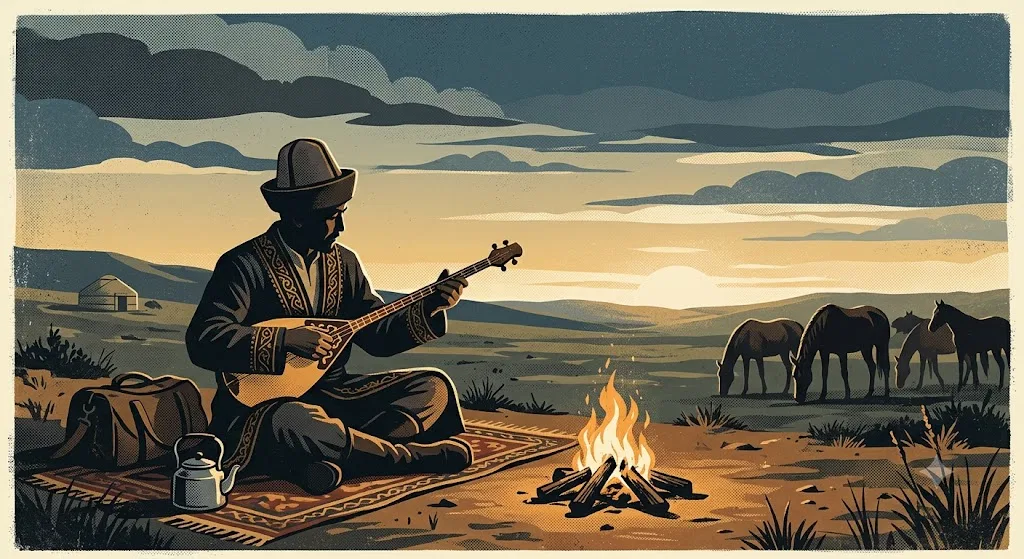
For a curious reader, the most important starting point is this: Kazakh folklore is unusually strong in oral performance. Stories were not only written down; they were sung, improvised, argued, remembered and attached to landscape. UNESCO listings for the art of improvised oral poetry, traditional instrumental performance, spring horse-breeding rites and the epic heritage of Korkyt Ata show how much of Kazakhstan’s legendary culture still lives through performance rather than through books alone.[UNESCO Intangible Cultural Heritage]ich.unesco.orgOpen source on unesco.org.
Why the steppe shaped the stories
Kazakh folklore grew from a mobile pastoral world. A society organised around herds, seasonal movement, kinship, hospitality and memory needed portable culture: songs, riddles, proverbs, genealogies, heroic tales and ritual formulae that could travel with people. In that world, the storyteller was not just an entertainer. The singer, poet or epic performer could preserve lineage, comment on politics, bless ceremonies, mock social failings and carry older beliefs into new settings.
This is why so much Kazakh folklore is bound to voice and instrument. UNESCO describes the art of improvised poetic contest as a public performance in which two performers answer one another in sung or spoken verse, accompanied by traditional instruments, with audiences valuing wit, rhythm, originality and verbal skill. The practice is shared with Kyrgyzstan, which matters because Kazakh folklore is part of a wider Turkic and Central Asian cultural zone, even when individual stories have strongly local forms.[UNESCO Intangible Cultural Heritage]ich.unesco.orgOpen source on unesco.org.
The same applies to instrumental storytelling. The Kazakh art of dombra performance is not simply “music” in a modern concert sense. UNESCO defines it as short solo compositions on a two-stringed plucked instrument, and the tradition is closely associated with stories, emotional memory and social identity. In everyday terms, the instrument can carry a legend without needing a long spoken explanation: melody, rhythm and performance style become part of the tale.[UNESCO Intangible Cultural Heritage]ich.unesco.orgOpen source on unesco.org.
Kazakhstan’s folklore is also shaped by religious layering. Academic work on Kazakh religious culture describes older beliefs involving sky worship, earth and water spirits, fire, cattle and shamanic practice, later coexisting with Islam rather than simply disappearing. This helps explain why a single story may contain both pre-Islamic motifs and Muslim language, or why a sacred place may be understood as a saintly Muslim shrine while still carrying older ideas about landscape, blessing, danger and ancestral presence.[thebrpi.org]ijbss.thebrpi.orgOpen source on thebrpi.org.
The great oral heroes: more than adventure stories
Kazakh heroic epics are often the first place to look for national legend. They are not just tales of strong warriors. They preserve ideals of courage, loyalty, endurance, justice, courtship, kinship and protection of the community. They also turn history into memory: battles, migrations and social conflicts become stories that can be performed, adapted and reinterpreted.
One major example is the epic of Alpamys Batyr. The M. O. Auezov Institute of Literature and Art describes it as one of the best-known heroic epics of the Kazakh people and a major work of Kazakh folklore and literature, reflecting historical events, worldview, customs and national characteristics. That wording is useful because it avoids a common misunderstanding: an epic is not a plain historical record, but it is also not “mere fantasy”. It is a cultural memory machine, turning social values into memorable narrative.[Auezov Institute]auezovinstitute.kzOpen source on auezovinstitute.kz.
Another important heroic figure is Koblandy Batyr, whose story is frequently discussed as part of Kazakh oral epic heritage. Recent scholarship treats such epics as repositories of cultural memory, symbolism and identity rather than as isolated adventure tales.[IJCSCL]ijscl.comIJCSCLSemantics and Functions of Anthroponyms in the KazakhIJCSCLSemantics and Functions of Anthroponyms in the Kazakh
The twentieth and twenty-first centuries changed the way these traditions circulate. Oral epics were collected, edited, printed and studied; later, they were republished in large-scale heritage projects. Research on the hundred-volume “Words of the Ancestors” collection notes that major parts of Kazakh folklore, including historical legends, riddles and other genres, were gathered and published in the 2004–2013 period. That matters because many readers now meet “oral tradition” through books, archives, school material, museum displays or online texts rather than through the older performance setting.[Revista Espacios]revistaespacios.comOpen source on revistaespacios.com.
Korkyt Ata: the musician who could not outrun death
The most powerful Kazakh legend for many modern readers is the story of Korkyt Ata, a wise musician and culture hero associated with the Syr Darya region and the bowed instrument known as the kobyz. In Kazakhstan, he is remembered as a poet, composer, thinker and legendary figure shared with the wider Turkic world. Official material on the Korkyt Ata memorial says he is traditionally placed in the eighth to ninth centuries and remembered as a musician and wise man whose legend centres on the search for immortality.[«Отандастар қоры» | «Фонд Отандастар»]oq.gov.kzOpen source on oq.gov.kz.
The heart of the story is stark. Korkyt tries to escape death. Wherever he goes, he finds signs that his grave is being prepared. He finally understands that death cannot be avoided, and his answer is music. In many retellings, he returns to the river, plays the kobyz and achieves a different kind of immortality through art, memory and the survival of his melodies. Academic discussion of the legend describes this as a meditation on life, death and the limits of human existence, not simply as a magical adventure.[Journal of Oriental Studies]bulletin-orientalism.kaznu.kzOpen source on kaznu.kz.
Korkyt is also important because his tradition is both local and transnational. UNESCO inscribed the heritage of Dede Qorqud, Korkyt Ata and Dede Korkut in 2018 as a shared element of Azerbaijan, Kazakhstan and Türkiye. UNESCO describes this heritage as based on twelve heroic legends, stories and tales, and thirteen traditional musical compositions transmitted through oral expressions, performing arts and music.[UNESCO Intangible Cultural Heritage]ich.unesco.orgOpen source on unesco.org.
In Kazakhstan, the legend is also anchored to place. The Korkyt Ata memorial complex in Kyzylorda region is shaped around the symbolism of the kobyz and the steppe wind. Tourism and cultural sources describe the site as a memorial to the legendary musician and creator of the instrument, while older and newer retellings connect the monument with the idea that Korkyt’s music continues after death.[oq.gov.kz]oq.gov.kzOpen source on oq.gov.kz.
Spirits, witches and dangerous beings
Kazakh supernatural folklore includes hostile spirits, monstrous women, demons and beings that sit between old Turkic belief, Islamic demonology and ordinary cautionary storytelling. These figures are often less internationally famous than the epics, but they are central to the texture of folk belief.
A recurring pattern in Kazakh demonological tales is struggle. A Kazakh history and culture source summarising early folklore notes that spirits in folk tales are generally hostile to humans, and that many tales about demons show both shamanic and Muslim influence. That mixture is important: a spirit may belong to an older world of steppe belief, yet be resisted with Muslim prayer formulae or reinterpreted through later religious language.[«Қазақстан тарихы» порталы]e-history.kz«Қазақстан тарихы» порталыEarly Kazakh Folklore. The Aitys and Tales and Legends«Қазақстан тарихы» порталыEarly Kazakh Folklore. The Aitys and Tales and Legends
One of the best-known frightening figures is Zhalmauyz Kempir, often rendered in English descriptions as a devouring witch or monstrous old woman. Scholarly work on Turkic folklore treats the figure as a complex demonological image, sometimes connected with a seven-headed monster, cannibal threat, witch-crone motifs and the transformation of older mythic beings into fairy-tale villains. The point is not that every village told the same story in the same way, but that the figure gave narrative shape to danger: hunger, wilderness, predation, moral testing and the fear of children being taken.[Academia]academia.eduCharacter of Zhalmauyz in the Folklore of Turkic PeoplesCharacter of Zhalmauyz in the Folklore of Turkic Peoples
Other female supernatural figures, including Albasty and Zheztyrnak, appear in Turkic and Kazakh-related demonological traditions, especially around childbirth, wild places and boundary-crossing. Recent scholarship on Turkic mythology discusses such figures as more than simple “monsters”: they can act as guardians of forbidden knowledge, initiators of heroic trials or embodiments of underworld and wilderness forces.[tsj.enu.kz]tsj.enu.kzOpen source on enu.kz.
These beings should be read carefully. Some modern websites flatten them into monster lists, but the stronger evidence points to changing oral motifs rather than fixed fantasy species. In older settings, such figures helped explain real anxieties: death in childbirth, illness, isolation, bad luck, dangerous terrain, social taboo and the vulnerability of children and travellers.
Sacred places and legends in the landscape
Kazakhstan’s folklore is not only heard; it is visited. Graves, mausoleums, rivers, rocks and old cities carry legends that blend memory, pilgrimage, architecture and local storytelling.
The Mausoleum of Khoja Ahmed Yasawi in Turkestan is the clearest example of a sacred site with national and regional importance. UNESCO dates the monument to the Timurid period, built from 1389 to 1405, and describes it as one of the largest and best-preserved constructions of that period. Its folklore significance lies not in ghost stories, but in sacred geography: the site connects Sufi memory, pilgrimage, royal patronage and the idea of Turkestan as a spiritual centre.[UNESCO World Heritage Centre]whc.unesco.orgOpen source on unesco.org.
The Aisha Bibi Mausoleum near Taraz is a different kind of legendary place. The Historical and Cultural Museum-Reserve in Taraz presents it as a symbol of eternal love, tied to folk legends about Aisha and Karakhan. Tourism sources date the monument to the eleventh or twelfth century and emphasise its distinctive terracotta decoration and restoration history. Here, the folklore is not about proving a romance as literal biography; it is about how a monument becomes a vessel for love, loyalty and loss.[ezhelgi-taraz.kz]ezhelgi-taraz.kzOpen source on ezhelgi-taraz.kz.
Northern Kazakhstan also has landscapes wrapped in legend, especially around Burabay, where rocks, lakes and unusual natural forms invite story. Cultural writing on the region describes places such as Zhumbaktas Rock and Lake Burabay as sacred and mystical sites surrounded by local folklore. These landscape legends often work by turning terrain into character: a rock becomes a sorrowing figure, a lake becomes the setting of longing, punishment or transformation.[Qalam]qalam.globalOpen source on qalam.global.
Sacred sites show a key feature of Kazakh folklore: stories often do not float free of place. They attach themselves to routes, ruins, graves, water, wind and mountains. That makes them especially visible today in cultural tourism, where visitors encounter folklore through plaques, guided tours, museums and restored monuments.

Seasonal customs, horses and the ritual year
Kazakh folklore also lives in seasonal practice. The most vivid example is the spring ritual cycle of horse breeders, recognised by UNESCO in 2018. UNESCO describes these rites as rooted in traditional knowledge of nature and the long relationship between people and horses, inherited from nomadic ancestors. They mark the end of one horse-breeding cycle and the beginning of another.[UNESCO Intangible Cultural Heritage]ich.unesco.orgOpen source on unesco.org.
The rites include first milking, joining stallions to herds and the sharing of the first fermented mare’s milk of the season. These details may sound practical, but in folklore terms they are full of meaning. They turn animal husbandry into ceremony. They express gratitude to nature, renew social bonds and make the seasonal return of abundance visible to the whole community.[UNESCO]unesco.orgdocument 4756document 4756
Nauryz, the spring New Year celebrated across a wide region, also matters for Kazakhstan’s ritual imagination, though it is broader than Kazakhstan alone. UNESCO materials on regional spring celebrations describe such festivals as involving ceremonies, special dishes, music, dance, oral expressions and social renewal. In Kazakhstan, this wider spring pattern sits naturally beside horse-breeding rites because both connect renewal, food, community and the turning of the year.[UNESCO Intangible Cultural Heritage]ich.unesco.orgOpen source on unesco.org.
These customs are a reminder that folklore is not only made of “stories about beings”. It also includes repeated actions that tell a community who it is: how to welcome spring, how to honour animals, how to share food, how to bless a new cycle and how to connect practical survival with symbolic meaning.
Storytelling as public argument
Kazakh oral tradition is not always nostalgic or remote. Some forms are deliberately public, competitive and responsive to the present. The art of improvised poetic contest is especially important because it shows folklore behaving like live social commentary.
UNESCO describes the contest as a performance in which audiences may choose topics and judge the winner by musical skill, rhythm, originality and wit. The form appears at local festivities and national events, and can address social issues. That means it is not simply the preservation of old verses. It is a living method for turning public concern into memorable speech.[UNESCO Intangible Cultural Heritage]ich.unesco.orgOpen source on unesco.org.
This matters for modern readers because it challenges the idea that folklore is only ancient material. In Kazakhstan, a traditional performance form can carry modern themes, political humour, moral criticism and identity debates. The old structure remains recognisable, but the content can change.
The same is true of printed and archived folklore. The Auezov Institute notes extensive publication of epics, fairy tales, improvised poetry and musical folklore, while modern scholarship continues to revisit individual tales and textual variants. Once a story enters an archive, it does not stop being folklore; it becomes part of a new circuit of school reading, academic interpretation, national culture and digital access.[Auezov Institute]auezovinstitute.kzOpen source on auezovinstitute.kz.
Old tradition, literary retelling and modern invention
A careful reader should distinguish several layers in Kazakhstan’s folklore.
Older oral tradition includes epic performance, heroic tales, spirit stories, riddles, proverbs, ritual songs and seasonal customs. These traditions often existed in multiple variants, and their age is not always easy to prove precisely because they were transmitted orally.
Religious reinterpretation reshaped older material. Pre-Islamic sky, nature and spirit beliefs did not simply vanish; they were often absorbed into Muslim sacred geography, prayer language, saint veneration and moral storytelling. Academic studies of Kazakh religion repeatedly describe this as syncretism or a hybrid worldview.[thebrpi.org]ijbss.thebrpi.orgOpen source on thebrpi.org.
Literary and archival preservation changed the form of folklore. Large collections, institute editions and heritage programmes gave oral material a stable printed form, but selection, editing and translation inevitably affect how readers encounter it.[Revista Espacios]revistaespacios.comOpen source on revistaespacios.com.
Tourist and popular retellings make legends visible to new audiences through memorials, guided tours, national branding, festivals and online media. Korkyt Ata, Aisha Bibi and Turkestan are good examples: each is tied to genuine cultural memory, but each is also presented today through modern heritage language, tourism infrastructure and national storytelling.[astanatimes.com]astanatimes.comkobyz sounds korkyt ata legends attract tourists to kyzylorda regionkobyz sounds korkyt ata legends attract tourists to kyzylorda region
Internet-era folklore often turns complex beings into short monster profiles or dramatic “haunted place” lists. These can be entertaining, but they are weaker evidence than academic, museum, UNESCO or well-sourced cultural material. For Kazakhstan, the richest supernatural traditions are usually more subtle than internet monster lists suggest: they are about danger, morality, landscape, childbirth, death, music and the boundaries between human and non-human worlds.
Why Kazakhstan’s folklore still matters
Kazakhstan’s folklore matters because it carries a national culture that was historically built for movement, memory and performance. Its stories preserve heroic ideals, but also practical anxieties: how to survive the steppe, honour guests, respect animals, protect children, face death, remember ancestors and speak truth in public.
It also matters because Kazakhstan sits at a crossroads. Its folklore belongs to Kazakh national identity, but many of its traditions are shared with Turkic neighbours, shaped by Islamic history and connected to the Silk Road. UNESCO’s listings make this visible: Korkyt Ata’s epic heritage is shared with Azerbaijan and Türkiye; improvised poetry is shared with Kyrgyzstan; yurt-making traditions connect Kazakh and Kyrgyz craft knowledge; and spring and New Year customs belong to a wider regional calendar.[UNESCO Intangible Cultural Heritage]ich.unesco.orgOpen source on unesco.org.
The most memorable image may still be Korkyt Ata on the steppe, unable to defeat death by travel, but able to answer it with music. That legend captures much of what makes Kazakh folklore distinctive: the wind, the instrument, the journey, the old fear, the public memory and the belief that a human voice can outlast a human life.

eBay marketplace picks
Marketplace Samples
Live-tested eBay searches with available results related to this page.


Endnotes
1.
Source: ich.unesco.org
Link:https://ich.unesco.org/en/RL/aitysh-aitys-art-of-improvisation-00997
2.
Source: ich.unesco.org
Link:https://ich.unesco.org/en/RL/kazakh-traditional-art-of-dombra-kuy-00996
3.
Source: ich.unesco.org
Link:https://ich.unesco.org/en/RL/traditional-spring-festive-rites-of-the-kazakh-horse-breeders-01402
4.
Source: ich.unesco.org
Link:https://ich.unesco.org/en/RL/heritage-of-dede-qorqud-korkyt-ata-dede-korkut-epic-culture-folk-tales-and-music-01399
5.
Source: unesco.org
Title: document 4028
Link:https://www.unesco.org/archives/multimedia/document-4028
6.
Source: ijbss.thebrpi.org
Link:https://ijbss.thebrpi.org/journals/Vol_3_No_11_June_2012/15.pdf
7.
Source: ijscl.com
Title: IJCSCLSemantics and Functions of Anthroponyms in the Kazakh
Link:https://www.ijscl.com/article_732445_54771cccbf8ce48eff71e2fcce70be8a.pdf
8.
Source: welcome.kz
Title: туры в КазахстанKorkyt Ata Memorial Complex
Link:https://welcome.kz/en/info-cities/kyzylorda-region/korkyt-ata-memorial
9.
Source: academia.edu
Title: Character of Zhalmauyz in the Folklore of Turkic Peoples
Link:https://www.academia.edu/51999722/Character_of_Zhalmauyz_in_the_Folklore_of_Turkic_Peoples
10.
Source: tsj.enu.kz
Link:https://tsj.enu.kz/index.php/new/article/view/618
11.
Source: whc.unesco.org
Link:https://whc.unesco.org/en/list/1103/
12.
Source: ezhelgi-taraz.kz
Link:https://www.ezhelgi-taraz.kz/en/page/ajsha-bibi
13.
Source: welcome.kz
Title: туры в КазахстанMausoleum of Aisha Bibi
Link:https://welcome.kz/en/info-cities/zhambyl-region/aisha-bibi-mausoleum
14.
Source: qalam.global
Link:https://qalam.global/en/articles/11033
15.
Source: unesco.org
Title: document 4756
Link:https://www.unesco.org/archives/multimedia/document-4756
16.
Source: ich.unesco.org
Link:https://ich.unesco.org/en/decisions/13.COM/10.B.21
17.
Source: ich.unesco.org
Link:https://ich.unesco.org/doc/src/ITH-16-11.COM-10.b-EN.docx
18.
Source: ich.unesco.org
Link:https://ich.unesco.org/doc/src/19.COM_3.EVA_5_EN.docx
19.
Source: ich.unesco.org
Link:https://ich.unesco.org/en/RL/traditional-knowledge-and-skills-in-making-kyrgyz-kazakh-and-karakalpak-yurts-turkic-nomadic-dwellings-02284
20.
Source: unesco.org
Link:https://www.unesco.org/en
21.
Source: ich.unesco.org
Title: kazakhstan KZ
Link:https://ich.unesco.org/en/state/kazakhstan-KZ
22.
Source: ich.unesco.org
Link:https://ich.unesco.org/en/video/44838
23.
Source: ich.unesco.org
Link:https://ich.unesco.org/en/video/38832
24.
Source: ich.unesco.org
Link:https://ich.unesco.org/en/video/27794
25.
Source: ich.unesco.org
Title: 39130 EN.doc
Link:https://ich.unesco.org/doc/src/39130-EN.doc
26.
Source: unesco.org
Title: document 4759
Link:https://www.unesco.org/archives/multimedia/document-4759
27.
Source: ich.unesco.org
Link:https://ich.unesco.org/en/video/31191
28.
Source: ich.unesco.org
Link:https://ich.unesco.org/en/decisions/13.COM/10.B.3
29.
Source: ich.unesco.org
Link:https://ich.unesco.org/doc/src/26639.pdf
30.
Source: ich.unesco.org
Link:https://ich.unesco.org/doc/src/30140.pdf
31.
Source: ich.unesco.org
Link:https://ich.unesco.org/en/video/35662
32.
Source: ich.unesco.org
Link:https://ich.unesco.org/doc/src/38050.pdf?v=1507907377
33.
Source: ich.unesco.org
Link:https://ich.unesco.org/en/lists
34.
Source: ich.unesco.org
Link:https://ich.unesco.org/doc/src/20923.pdf
35.
Source: ich.unesco.org
Link:https://ich.unesco.org/doc/src/Signed%20periodic%20report%20-%20Periodic%20report-67370.pdf
36.
Source: ich.unesco.org
Link:https://ich.unesco.org/en/d%C3%A9cisions/9.COM/10.23
37.
Source: ich.unesco.org
Link:https://ich.unesco.org/doc/src/45766.pdf
38.
Source: ich.unesco.org
Link:https://ich.unesco.org/en/video/46652
39.
Source: ich.unesco.org
Link:https://ich.unesco.org/doc/src/38355.pdf
40.
Source: ich.unesco.org
Title: LHE 25 20.CO M 4 EN.docx
Link:https://ich.unesco.org/doc/src/LHE-25-20.COM-4_EN.docx
41.
Source: ich.unesco.org
Title: 26652 EN.doc
Link:https://ich.unesco.org/doc/src/26652-EN.doc
42.
Source: ich.unesco.org
Title: ITH 16 11.COM Decisions 20161207 EN.docx
Link:https://ich.unesco.org/doc/src/ITH-16-11.COM-Decisions-20161207-EN.docx
43.
Source: ich.unesco.org
Link:https://ich.unesco.org/doc/src/36733.pdf
44.
Source: ich.unesco.org
Title: LHE 24 19.CO M Decisions EN.docx
Link:https://ich.unesco.org/doc/src/LHE-24-19.COM-Decisions_EN.docx
45.
Source: socjournal.enu.kz
Link:https://socjournal.enu.kz/index.php/main/article/download/37/52/590
46.
Source: qalam.global
Link:https://qalam.global/en/microrubrics/myth-en/jeztyrnaq-en
47.
Source: qalam.global
Title: MOTHE R-ELEMENT
Link:https://qalam.global/en/articles/women-in-kazakh-mythology-en-2
48.
Source: unesco.az
Link:https://www.unesco.az/en/articles/intangible_cultural_heritage/heritage-dede-qorqud-korkyt-ata-dede-korkut-epic-culture-folk-tales-music
49.
Source: unesco.az
Link:https://unesco.az/index.php/en/articles/news/319
50.
Source: ezhelgi-taraz.kz
Link:https://ezhelgi-taraz.kz/en/news/yunesko-tizimine-engen-aza-stanny-materialdy-emes-m-deni-m-ralary
51.
Source: en.tengrinews.kz
Title: unesco recognizes kazakh yurt and kuy as cultural heritage 257701
Link:https://en.tengrinews.kz/people/unesco-recognizes-kazakh-yurt-and-kuy-as-cultural-heritage-257701/
52.
Source: kirj.ee
Link:https://kirj.ee/wp-content/plugins/kirj/pub/TRAMES-4-2023-415-438_20231105231741.pdf
53.
Source: auezovinstitute.kz
Link:https://auezovinstitute.kz/?lang=en&page_id=6018
54.
Source: revistaespacios.com
Link:https://www.revistaespacios.com/a17v38n45/a17v38n45p33.pdf
55.
Source: keruenjournal.kz
Link:https://keruenjournal.kz/main/article/download/1209/553
56.
Source: oq.gov.kz
Link:https://oq.gov.kz/en/abai/qorqyt-ata-memorialdyq-kesheni
57.
Source: bulletin-orientalism.kaznu.kz
Link:https://bulletin-orientalism.kaznu.kz/index.php/1-vostok/article/download/2017/1517
58.
Source: astanatimes.com
Title: kobyz sounds korkyt ata legends attract tourists to kyzylorda region
Link:https://astanatimes.com/2019/06/kobyz-sounds-korkyt-ata-legends-attract-tourists-to-kyzylorda-region/
59.
Source: e-history.kz
Title: «Қазақстан тарихы» порталыEarly Kazakh Folklore. The Aitys and Tales and Legends
Link:https://e-history.kz/en/news/show/339422
60.
Source: philology-vestnik.buketov.edu.kz
Link:https://philology-vestnik.buketov.edu.kz/philology-vestnik/article/download/566/420
61.
Source: auezovinstitute.kz
Link:https://auezovinstitute.kz/?lang=en&page_id=4075
62.
Source: eurasia.travel
Link:https://eurasia.travel/kazakhstan/culture/unesco-intangible/
63.
Source: Wikipedia
Link:https://en.wikipedia.org/wiki/Kazakhstan
64.
Source: Wikipedia
Title: Aisha Bibi
Link:https://en.wikipedia.org/wiki/Aisha_Bibi
65.
Source: Wikipedia
Title: Zhalmauyz Kempir
Link:https://en.wikipedia.org/wiki/Zhalmauyz_Kempir
66.
Source: keruenjournal.kz
Link:https://keruenjournal.kz/main/article/download/34/7
67.
Source: silkadv.com
Link:https://silkadv.com/en/content/korkyt-ata-0
68.
Source: tripadvisor.com
Title: Aisha Bibi Mausoleum
Link:https://www.tripadvisor.com/Attraction_Review-g1638447-d4954577-Reviews-Aisha_Bibi_Mausoleum-Taraz_Jambyl_Province.html
69.
Source: pps.kaznu.kz
Link:https://pps.kaznu.kz/ru/Main/FileShow2/159014/125/361/2175/%D0%94%D0%B6%D0%B0%D0%B0%D0%BC%D0%B1%D0%B0%D0%B5%D0%B2%D0%B0%20%D0%91%D0%B0%D0%BA%D1%82%D1%83%D0%B3%D1%83%D0%BB%20%D0%90%D1%81%D0%B0%D0%BD%D0%B0%D0%BA%D1%83%D0%BD%D0%BE%D0%B2%D0%BD%D0%B0/2020/1
70.
Source: elibrary.kaznu.kz
Title: 11 kazakh culture illyust lantar fk
Link:https://elibrary.kaznu.kz/wp-content/uploads/2022/11/11-kazakh-culture-illyust-lantar-fk.pdf
71.
Source: elibrary.kaznu.kz
Link:https://elibrary.kaznu.kz/wp-content/uploads/2021/06/vestnik-kaznu.-seriya-istoricheskaya_2018-89-2.pdf
72.
Source: pps.kaznu.kz
Link:https://pps.kaznu.kz/kz/Main/FileShow2/18124/110/2/5/0//
73.
Source: e-history.kz
Link:https://e-history.kz/en/prominent-figures/show/12726
74.
Source: e-history.kz
Link:https://e-history.kz/en/news/show/7637
75.
Source: e-history.kz
Link:https://e-history.kz/en/e-resources/show/13453
76.
Source: auezovinstitute.kz
Link:https://auezovinstitute.kz/?lang=en&page_id=4064
77.
Source: astanatimes.com
Title: stories kazakh heritage sites tell historical places you should visit
Link:https://astanatimes.com/2025/10/stories-kazakh-heritage-sites-tell-historical-places-you-should-visit/
78.
Source: astanatimes.com
Title: aitys gem of kazakh spoken literary tradition platform for human rights
Link:https://astanatimes.com/2017/01/aitys-gem-of-kazakh-spoken-literary-tradition-platform-for-human-rights/
79.
Source: astanatimes.com
Link:https://astanatimes.com/2019/02/unesco-includes-kazakh-horse-breeding-spring-rites-on-intangible-cultural-heritage-of-humanity-list/
80.
Source: astanatimes.com
Title: thousands still flock korkyt ata mausoleum
Link:https://astanatimes.com/2014/07/thousands-still-flock-korkyt-ata-mausoleum/
81.
Source: astanatimes.com
Title: umai deity and modern resonance of kazakh women in mythology
Link:https://astanatimes.com/2024/03/umai-deity-and-modern-resonance-of-kazakh-women-in-mythology/
82.
Source: archive.unesco-ichcap.org
Link:https://archive.unesco-ichcap.org/eng/ek/sub8/pdf_file/08/06_THE%20VALUE%20OF%20ORAL%20AND%20TRADITIONAL%20HERITAGE%20OF%20KAZAKHSTAN%20AND%20THE%20GREAT%20SILK%20ROAD.pdf
83.
Source: archive.unesco-ichcap.org
Link:https://archive.unesco-ichcap.org/eng/ek/sub2017_4/sub2.php
84.
Source: gov.kz
Link:https://www.gov.kz/memleket/entities/mfa/press/news/details/469340?lang=en
85.
Source: jcasc.com
Link:https://jcasc.com/index.php/jcasc/article/view/1609
86.
Source: bazawiedzy.uws.edu.pl
Link:https://bazawiedzy.uws.edu.pl/docstore/download/UPHc2fe142a24574b4dbfac22f0170c8c71/Kaynar.Maral_Sakhitzhanova.Zada_Pre-islamic_beliefs_of_the_Kazakhs_.pdf?entityId=UPHb7b8cc2ef9554335b0d367ab51d45ea7&entityType=article
87.
Source: kureansiklopedi.com
Link:https://kureansiklopedi.com/en/detay/dombra-211e2
88.
Source: ejecs.org
Link:https://www.ejecs.org/index.php/JECS/article/download/2414/613/8807
Additional References
89.
Source: youtube.com
Title: Kazakhstan-Orteke, Traditional Kazakh Puppet-Musical Performing Art
Link:https://www.youtube.com/watch?v=1BsS6hKMxCA
Source snippet
Kazakh 'orteke' puppet theatre granted UNESCO recognition...
90.
Source: eurasia.travel
Link:https://eurasia.travel/15-sacred-sites-of-kazakhstan/
91.
Source: researchgate.net
Link:https://www.researchgate.net/publication/392437330_Revival_of_Tengrism_in_Kazakhstan_as_ancient_belief_of_the_Kazakh_nation_Prospects_and_Challenges
92.
Source: kaskabassov.kz
Link:https://kaskabassov.kz/dissertations-en.html
93.
Source: centralasia-travel.com
Link:https://www.centralasia-travel.com/en/countries/kazakhstan/sights/turkestan-kazakhstan
94.
Source: madikendraws.com
Link:https://madikendraws.com/burn-zhalmauyz
95.
Source: dokumen.pub
Link:https://dokumen.pub/historical-regional-studies-of-kazakhstan-textbook-9786010439030.html
96.
Source: facebook.com
Link:https://www.facebook.com/groups/351161432957084/posts/779442066795683/
97.
Source: facebook.com
Link:https://www.facebook.com/groups/archeologyandcivilizations/posts/24905774149089441/
98.
Source: mythlok.com
Link:https://mythlok.com/korkyt-ata/
Topic Tree
Follow this branch
Related pages 192
- Afghan Folklore
- Albanian Folklore
- Algerian Folklore
- Australian Folklore
- Azerbaijan Folklore
- +187 more in sidebar