Within Libyan Folklore
What Did Old Tripoli Tell at Home?
Collected Tripolitanian tales show how family storytelling, dialect, humour and danger shaped Libya's older oral imagination.
On this page
- Hans Stumme's Tripoli collection
- Udea and her seven brothers
- Family tales before mass media
Page outline Jump by section
Introduction
To understand the folklore of Tripoli, it is necessary to look not for a grand national mythology but for the stories once told inside homes, courtyards and family gatherings. For centuries, the old city of Tripoli preserved a rich oral tradition in which entertainment, moral instruction, humour and danger were woven together through storytelling. Much of what is known today about this tradition survives because the German linguist Hans Stumme recorded tales, poems and spoken narratives from Tripoli in the late nineteenth century and published them in 1898 as Märchen und Gedichte aus der Stadt Tripolis in Nordafrika (“Tales and Poems from the City of Tripoli in North Africa”). The collection remains one of the most important documentary records of urban Libyan oral literature and provides rare evidence of how stories were actually told in the Tripolitanian Arabic dialect of the period.[archive.org]archive.orgInternet ArchiveMärchen und Gedichte aus der Stadt Tripolis in Nordafrika2 Aug 2009 — Märchen und Gedichte aus der Stadt Tripolis in Nord…
These tales matter not simply because they preserve old plots. They capture the atmosphere of storytelling before radio, cinema and television transformed domestic entertainment. They reveal what families found amusing, frightening, admirable or morally troubling, and they show how oral tradition functioned as a living social practice rather than a fixed literary canon. In Libya, where folklore often survived through spoken performance rather than written mythology, Tripoli’s folktales offer one of the clearest surviving records of older narrative culture.[Cambridge University Repository]repository.cam.ac.ukbridge University RepositoryAnimal Tales as Deep History in Modern Libyan WritingDecember 19, 2015 — by C Olszok · 2016 · Cited by 2 —…
Hans Stumme and the Preservation of Tripoli’s Story World
The single most important source for the study of Tripoli’s folktales is Hans Stumme’s 1898 collection. Stumme was a linguist interested in North African Arabic dialects and oral literature. Unlike many nineteenth-century collectors who merely summarised stories, he attempted to record narratives in local speech, preserving linguistic features, storytelling rhythms and poetic passages that might otherwise have disappeared. His volume contains both prose tales and verse material gathered from storytellers in Tripoli.[archive.org]archive.orgInternet ArchiveMärchen und Gedichte aus der Stadt Tripolis in Nordafrika2 Aug 2009 — Märchen und Gedichte aus der Stadt Tripolis in Nord…
The value of the collection extends beyond folklore. It provides one of the earliest substantial records of urban Libyan Arabic. Modern researchers of Libyan literature and culture continue to refer to Stumme’s work because it preserves traditions that were largely transmitted orally and were seldom written down by local authors of the period.[The Silphium Gatherer | مجمّع سلفيوم]silphiumgatherer.comstumme poemThe Silphium Gatherer | مجمّع سلفيومA Poem about being photographed in 1890s TripoliJune 20, 2020 — 20 Jun 2020 — The earliest work on a…
The stories recorded by Stumme demonstrate that Tripoli’s oral culture was connected to a much wider North African storytelling world. Certain motifs appear in Tunisian, Algerian, Saharan and wider Arab traditions, yet the Tripoli versions possess local characteristics in language, social settings and narrative detail. The collection therefore shows both regional interconnectedness and local creativity.[Wikipedia]WikipediaUdea and Her Seven BrothersUdea and Her Seven Brothers
What Did Old Tripoli Tell at Home?
The folktales preserved from Tripoli do not centre on gods or creation myths. Instead, they focus on family relationships, journeys, betrayal, survival, cleverness and fate. Many stories begin within ordinary households before expanding into landscapes populated by magical beings, monsters or extraordinary dangers.[Internet Archive]archive.orgInternet ArchiveMärchen und Gedichte aus der Stadt Tripolis in Nordafrika2 Aug 2009 — Märchen und Gedichte aus der Stadt Tripolis in Nord…
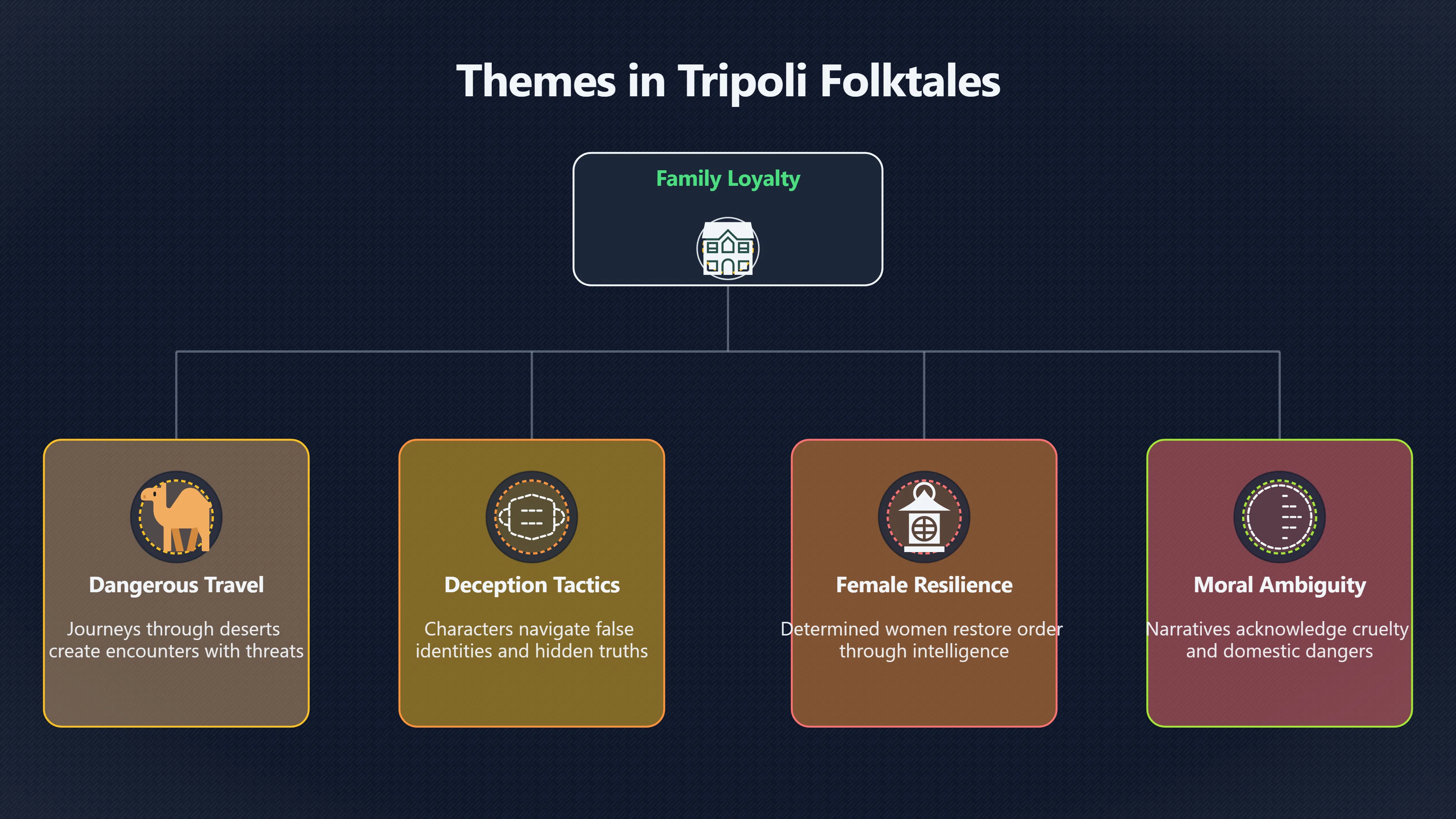
Several recurring themes stand out:
Family loyalty. Brothers and sisters frequently occupy the centre of the narrative. Kinship obligations drive plots forward and often determine whether characters survive or perish.[Wikipedia]WikipediaUdea and Her Seven BrothersUdea and Her Seven Brothers
Dangerous travel. Journeys through deserts, remote dwellings and unfamiliar territories are common. Such settings reflect the realities of North African mobility while also creating opportunities for encounters with supernatural threats.[Wikipedia]WikipediaUdea and Her Seven BrothersUdea and Her Seven Brothers
Deception and disguise. False identities, substituted individuals and hidden truths repeatedly appear. Characters must learn to recognise appearances as unreliable.[Wikipedia]WikipediaUdea and Her Seven BrothersUdea and Her Seven Brothers
Female resilience. Many tales feature determined young women who endure hardship, uncover deception and restore social order through persistence and intelligence rather than brute force.[Wikipedia]WikipediaUdea and Her Seven BrothersUdea and Her Seven Brothers
Moral ambiguity. Unlike simplified modern children’s stories, many Tripoli folktales contain cruelty, jealousy, abandonment and violence. The narratives often acknowledge that family life itself can be a source of danger as well as protection.[Internet Archive]archive.orgInternet ArchiveMärchen und Gedichte aus der Stadt Tripolis in Nordafrika2 Aug 2009 — Märchen und Gedichte aus der Stadt Tripolis in Nord…
These themes suggest that storytelling served multiple functions. It entertained audiences, warned against betrayal, reinforced family values and provided imaginative frameworks for discussing uncertainty and hardship.

Udea and Her Seven Brothers
The most famous tale associated with Stumme’s Tripoli collection is Udea and Her Seven Brothers. The story achieved international visibility when Andrew Lang included an English version in The Grey Fairy Book in 1905, helping a Libyan folktale enter the global fairy-tale tradition.[Wikipedia]WikipediaUdea and Her Seven BrothersUdea and Her Seven Brothers
The narrative begins before Udea’s birth. Seven brothers tell their mother that they long for a sister. Through deception, they are falsely informed that a boy has been born and leave home. Years later, Udea discovers the reason for their disappearance and resolves to find them. Her search leads her through a sequence of dangers involving treachery, displacement, false identities and monstrous threats.[Wikipedia]WikipediaUdea and Her Seven BrothersUdea and Her Seven Brothers
One striking element is the role of betrayal. In several North African variants related to the Tripoli version, a servant or companion attempts to steal the heroine’s identity, creating a dramatic contrast between appearance and truth. The heroine is reduced to servitude while the impostor receives the honour that rightfully belongs to her. Recognition eventually arrives through observation, memory or symbolic tests.[Wikipedia]WikipediaUdea and Her Seven BrothersUdea and Her Seven Brothers
The story also includes encounters with a terrifying man-eater, a figure who functions much like the ogres and monsters of European fairy tales. Yet the setting remains distinctly North African, involving desert travel, camels, family honour and regional social realities.[Ririro]ririro.comUdea and Her Seven Brothers by Hans StummeRead Udea and Her Seven Brothers online for free. A courageous girl braves desert, betray…
Folklorists classify the tale within international tale types concerning sisters searching for lost brothers, demonstrating that Tripoli storytelling participated in a broader network of narrative traditions stretching across North Africa, the Mediterranean and beyond. At the same time, the Tripoli version preserves specifically Libyan narrative textures and imagery.[Wikipedia]WikipediaUdea and Her Seven BrothersUdea and Her Seven Brothers
Storytelling as Performance Rather Than Text
Modern readers often encounter folktales as printed stories, but Tripoli’s traditional storytelling culture was fundamentally performative. A tale existed most fully when spoken aloud.
Storytellers adapted details according to audience, occasion and personal style. Voices changed for different characters. Suspense was stretched or compressed. Humorous passages could be expanded. Repetition helped listeners remember important moments. The performance itself was part of the story.[Internet Archive]archive.orgInternet ArchiveMärchen und Gedichte aus der Stadt Tripolis in Nordafrika2 Aug 2009 — Märchen und Gedichte aus der Stadt Tripolis in Nord…
The importance of performance helps explain why written collections can only partially preserve oral tradition. Stumme’s transcriptions captured words, but not every gesture, pause, facial expression or audience reaction. Nevertheless, his work remains invaluable because it recorded narratives before many older performance contexts disappeared.[Internet Archive]archive.orgInternet ArchiveMärchen und Gedichte aus der Stadt Tripolis in Nordafrika2 Aug 2009 — Märchen und Gedichte aus der Stadt Tripolis in Nord…
Family storytelling also created intergenerational continuity. Grandparents, parents and older relatives transmitted stories to children, ensuring that narratives remained tied to lived social relationships rather than existing solely as literary artefacts. This pattern was especially important in societies where oral communication remained central to cultural transmission.[Cambridge University Repository]repository.cam.ac.ukbridge University RepositoryAnimal Tales as Deep History in Modern Libyan WritingDecember 19, 2015 — by C Olszok · 2016 · Cited by 2 —…

Humour, Fear and Everyday Life
Tripoli’s folktales reveal a narrative world in which humour and fear coexist. Comic misunderstandings often sit alongside scenes of real danger. Tricksters outwit stronger opponents. Characters survive because they notice small clues that others overlook. The audience is encouraged both to laugh and to remain alert.[Internet Archive]archive.orgInternet ArchiveMärchen und Gedichte aus der Stadt Tripolis in Nordafrika2 Aug 2009 — Märchen und Gedichte aus der Stadt Tripolis in Nord…
The stories also preserve glimpses of everyday concerns. Family disputes, marriage arrangements, sibling rivalries and household tensions repeatedly appear. Although magical elements are present, many plots begin with recognisable domestic situations. This grounding in ordinary life may have helped audiences connect emotionally with extraordinary events.[Internet Archive]archive.orgInternet ArchiveMärchen und Gedichte aus der Stadt Tripolis in Nordafrika2 Aug 2009 — Märchen und Gedichte aus der Stadt Tripolis in Nord…
Importantly, supernatural elements are rarely presented as abstract theology. Monsters, magical transformations and uncanny events emerge within practical human dramas. The focus remains on how people respond to challenges rather than on constructing a systematic mythology. This characteristic distinguishes much of Tripoli’s folklore from traditions centred on elaborate pantheons or heroic epics.[Internet Archive]archive.orgInternet ArchiveMärchen und Gedichte aus der Stadt Tripolis in Nordafrika2 Aug 2009 — Märchen und Gedichte aus der Stadt Tripolis in Nord…
From Oral Tradition to Modern Cultural Memory
The decline of traditional storytelling environments during the twentieth century altered the role of folktales in Libyan society. Urbanisation, mass education, radio, television and later digital media reduced the centrality of evening storytelling sessions within many households. Yet the stories did not disappear entirely. Instead, they migrated into books, literary adaptations, academic studies and cultural memory.[Cambridge University Repository]repository.cam.ac.ukbridge University RepositoryAnimal Tales as Deep History in Modern Libyan WritingDecember 19, 2015 — by C Olszok · 2016 · Cited by 2 —…
Modern scholarship on Libyan literature has noted the continuing importance of oral traditions, often referred to through terms associated with folktales and popular narratives. Writers draw upon these inherited story worlds to explore identity, memory, landscape and social change. Oral narratives continue to provide symbolic resources even when the original storytelling contexts have weakened.[Cambridge University Repository]repository.cam.ac.ukbridge University RepositoryAnimal Tales as Deep History in Modern Libyan WritingDecember 19, 2015 — by C Olszok · 2016 · Cited by 2 —…
For readers interested in Libyan folklore, Tripoli’s folktales occupy a special place because they represent one of the best-documented examples of the country’s older oral tradition. Through Stumme’s collection and the enduring popularity of stories such as Udea and Her Seven Brothers, it is still possible to hear echoes of the voices that once filled Tripoli’s homes before the age of mass media. The tales preserve not only plots and characters but also a record of how Libyans imagined family, danger, loyalty, deception and hope through the spoken art of storytelling.[archive.org]archive.orgInternet ArchiveMärchen und Gedichte aus der Stadt Tripolis in Nordafrika2 Aug 2009 — Märchen und Gedichte aus der Stadt Tripolis in Nord…
Amazon book picks
Further Reading
Books and field guides related to What Did Old Tripoli Tell at Home?. Use these as the next step if you want deeper reading beyond the article.
Folktales of the Jews, Volume 2
Connects with Jewish and Arab narrative traditions that also formed part of Libya's cultural history.
The Arabian Nights
Represents the broader storytelling culture that influenced urban tale-telling traditions.
Arab Folktales
Closest mainstream match to the family storytelling traditions documented in Tripoli.
The Classic Fairy Tales
Helps readers compare recurring folktale motifs found in Tripoli narratives.
eBay marketplace picks
Marketplace Samples
Live-tested eBay searches with available results related to this page.




Endnotes
1.
Source: archive.org
Link:https://archive.org/details/mrchenundgedich00stumgoog
Source snippet
Internet ArchiveMärchen und Gedichte aus der Stadt Tripolis in Nordafrika2 Aug 2009 — Märchen und Gedichte aus der Stadt Tripolis in Nord...
2.
Source: gallica.bnf.fr
Link:https://gallica.bnf.fr/ark%3A/12148/bpt6k84099g.texteImage
Source snippet
Märchen und Gedichte aus der Stadt Tripolis in NordafrikaMärchen und Gedichte aus der Stadt Tripolis in Nordafrika: eine Sammlung transk...
3.
Source: Wikipedia
Title: Hans Stumme
Link:https://en.wikipedia.org/wiki/Hans_Stumme
4.
Source: silphiumgatherer.com
Title: stumme poem
Link:https://silphiumgatherer.com/2020/06/20/stumme-poem/
Source snippet
The Silphium Gatherer | مجمّع سلفيومA Poem about being photographed in 1890s TripoliJune 20, 2020 — 20 Jun 2020 — The earliest work on a...
Published: June 20, 2020
5.
Source: Wikipedia
Title: Udea and Her Seven Brothers
Link:https://en.wikipedia.org/wiki/Udea_and_Her_Seven_Brothers
6.
Source: ririro.com
Link:https://ririro.com/udea-and-her-seven-brothers/
Source snippet
Udea and Her Seven Brothers by Hans StummeRead Udea and Her Seven Brothers online for free. A courageous girl braves desert, betray...
7.
Source: archive.org
Link:https://archive.org/stream/in.ernet.dli.2015.70572/2015.70572.Journal-Of-The-Royal-Asiatic-Society-Of-Great-Britain-And-Ireland-For-1924_djvu.txt
Source snippet
nslation of the Kitabn-1 Qadar from the Sahih of al-Bnkhari...
8.
Source: repository.cam.ac.uk
Link:https://www.repository.cam.ac.uk/bitstream/1810/293038/2/ArticleCharis.pdf
Source snippet
bridge University RepositoryAnimal Tales as Deep History in Modern Libyan WritingDecember 19, 2015 — by C Olszok · 2016 · Cited by 2 —...
Published: December 19, 2015
9.
Source: silphiumgatherer.com
Title: libyan fairytales
Link:https://silphiumgatherer.com/2016/06/28/libyan-fairytales/
Source snippet
Book: Libyan Fairytales | خراريف ليبية28 Jun 2016 — An anthology of fairytales collected in the Jabal Akhdar region of eastern Libya by t...
10.
Source: tijer.org
Title: Manipuri Folktales in the Wake of New Media
Link:https://www.tijer.org/tijer/papers/TIJER2601008.pdf
Source snippet
Abstract - In the contemporary era, the evolution of storytelling has been significantly influenced by new media, shifting from tradition...
11.
Source: openlibrary.org
Title: Hans Stumme
Link:https://openlibrary.org/authors/OL1875863A/Hans_Stumme
Source snippet
31 Jul 2025 — Tunisische Märchen und Gedichte: eine Sammlung prosaischer und poetischer Stücke im arabischen Dialecte der Stadt Tunis neb...
Additional References
12.
Source: thesis.unipd.it
Link:https://thesis.unipd.it/handle/20.500.12608/68706
Source snippet
Thesis University of PaduaNew Perspectives on Storytelling and the Oral Traditionby A KOICHUMANOVA · Cited by 1 — I trace the evolution o...
13.
Source: fedoa.unina.it
Link:https://www.fedoa.unina.it/12902/1/184-Book%20Manuscript-1052-1-10-20200630.pdf
Source snippet
between History and Revolution: Resilience, New...by AMDITV SCʜIAттARELLA · Cited by 2 — However, Islamic Sufism, Ibadism, tribal milita...
14.
Source: euro-boek.nl
Link:https://www.euro-boek.nl/boek/isbn/9781020092329.html
Source snippet
gebonden uitgave, pocketboek · Stumme, Hans: · ISBN: 9781020092329 · Stumme, Hans · Märchen Und...Read more...
15.
Source: amazon.com
Link:https://www.amazon.com/M%C3%A4rchen-Gedichte-Tripolis-Nordafrika-German/dp/B009JFW28A?tag=searcht-20
Source snippet
m Tripoli, North Africa, preserved for its cultural importance to civilization.Read more...
16.
Source: researchgate.net
Link:https://www.researchgate.net/publication/372931008_Storytelling_around_the_World_Folktales_Narrative_Rituals_and_Oral_Traditions
Source snippet
terested in storytelling and in multicultural approaches to the arts.Read more...
17.
Source: digital-research-books-beta.nypl.org
Link:https://digital-research-books-beta.nypl.org/work/256355f0-bfd2-4e1b-8d50-a9ea69694856
Source snippet
Work DetailsMärchen und Gedichte aus der Stadt Tripolis in Nordafrika. By Stumme, Hans, ((1864-1936)). FEATURED EDITION. Placeholder Co...
18.
Source: dokumen.pub
Link:https://dokumen.pub/storytelling-around-the-world-folktales-narrative-rituals-and-oral-traditions-9781440872945-9781440872952-1440872945.html
Source snippet
tural understanding of storytelling as an art.Read more...
19.
Source: worldcat.org
Link:https://worldcat.org/oclc/41150865
Source snippet
Gedichte.. Print Book, German, 1893.Read more...
20.
Source: journal.oraltradition.org
Title: Oral Tradition Complete Issue
Link:https://journal.oraltradition.org/wp-content/uploads/files/articles/18ii/18_2_complete.pdf
Source snippet
Issue - Oral Tradition JournalOral Tradition seeks to provide a comparative and interdisciplinary focus for studies in oral literature an...
21.
Source: youtube.com
Title: Reviving Libyan heritage: Restoration underway in Tripoli’s Old City
Link:https://www.youtube.com/watch?v=4U67-CIPGlo
Source snippet
Ramadan festivities bring Tripoli's old city to life: Exploring Libya's Heritage...
Topic Tree