Within Libyan Folklore
Who Were Libya's Older Sacred Beings?
Amazigh ancestor traditions, Gurzil and Greek visions of Libya reveal older mythic layers beneath later Islamic folklore.
On this page
- Amazigh ancestors and protective spirits
- Gurzil and late antique Tripolitania
- Lake Tritonis and Greek mythic Libya
Page outline Jump by section
Introduction
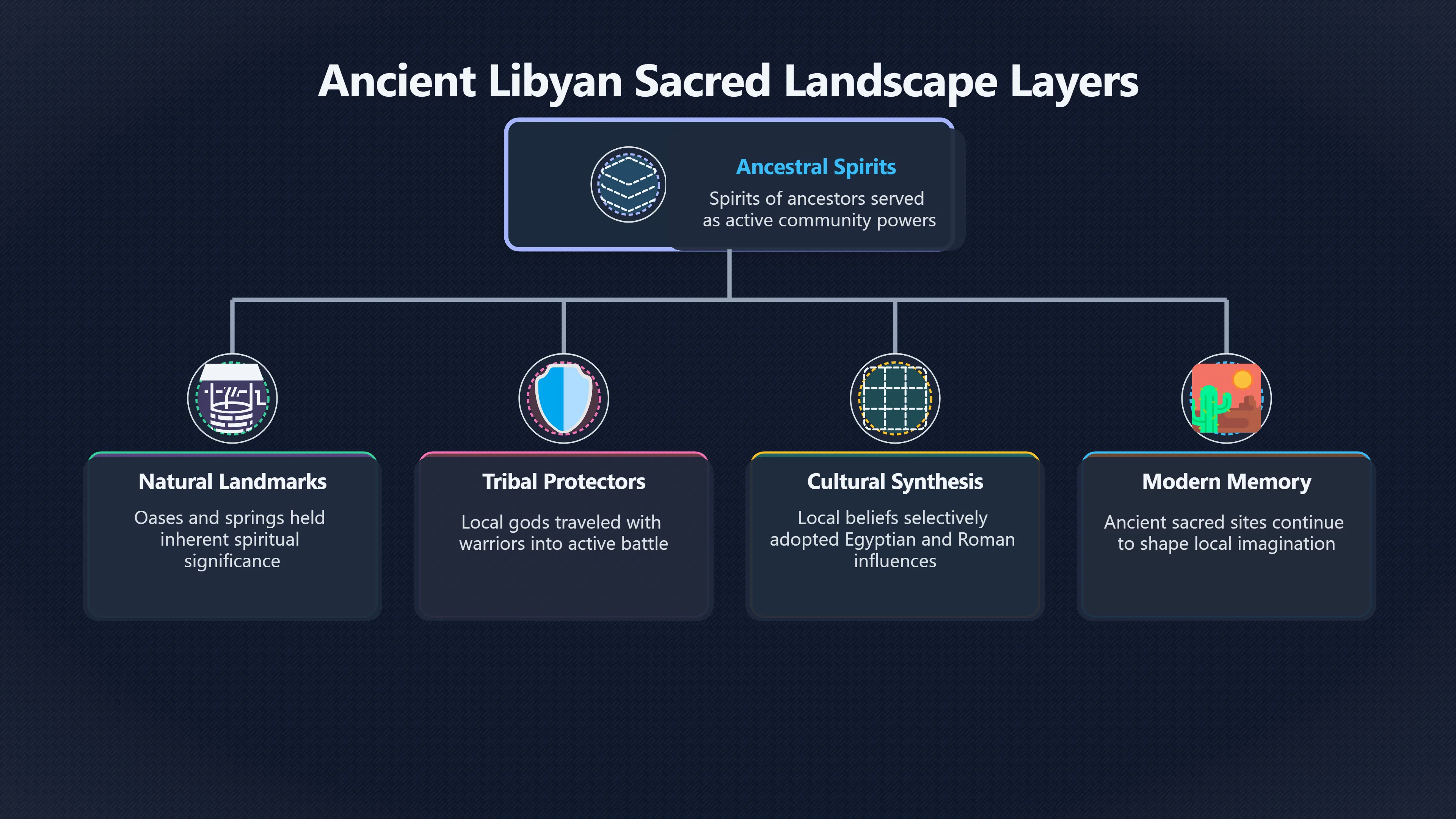
Libya’s folklore does not begin with jinn stories, saints’ shrines or medieval legends. Beneath those later traditions lies a much older sacred landscape shaped by Amazigh ancestors, local gods, desert sanctuaries and mythic lakes. These ancient religious layers are difficult to reconstruct because they survive only in scattered inscriptions, archaeological remains and references by Greek and Roman writers. Even so, they reveal a fascinating world in which ancestors could be consulted through dreams, tribal gods travelled with warriors into battle, and entire landscapes were understood as the homes of divine beings.[ResearchGate]researchgate.netResearch Gate(PDF) Pre-Roman Libyan Religion: Colonial EthnographyResearchGate(PDF) Pre-Roman Libyan Religion: Colonial Ethnography…December 13, 2021 — 26 May 2026 — Since its inception, the study of…
For readers interested in Libyan folklore, these ancient traditions matter because they provided some of the earliest sacred stories attached to Libyan places. Later Islamic beliefs transformed the religious landscape, but memories of holy hills, mysterious ruins, ancestral spirits and powerful desert locations often continued to shape local imagination long after the original gods disappeared.[ResearchGate]researchgate.netResearch Gate(PDF) Pre-Roman Libyan Religion: Colonial EthnographyResearchGate(PDF) Pre-Roman Libyan Religion: Colonial Ethnography…December 13, 2021 — 26 May 2026 — Since its inception, the study of…
Amazigh Ancestors and Protective Spirits
The oldest religious traditions associated with Libya were not organised around a single national pantheon. Ancient Amazigh communities across North Africa practised diverse local religions centred on ancestors, sacred places and protective powers linked to tribes and landscapes. Modern scholars increasingly caution against imagining a uniform “Libyan mythology”; instead, evidence points to many local cults that changed through contact with Egyptian, Punic, Greek and Roman cultures.[researchgate.net]researchgate.netResearch Gate(PDF) Pre-Roman Libyan Religion: Colonial EthnographyResearchGate(PDF) Pre-Roman Libyan Religion: Colonial Ethnography…December 13, 2021 — 26 May 2026 — Since its inception, the study of…
One of the most striking traditions concerned the dead. Classical writers reported that some Libyan groups treated the spirits of ancestors as active powers. The people of Awjila, an oasis region in eastern Libya, were said to swear oaths by their ancestors and seek guidance from them. After making requests, individuals reportedly slept beside tombs in the hope of receiving answers through dreams. Whether every detail is accurate is impossible to know, but the account suggests that ancestors were regarded as continuing members of the community rather than distant historical figures.[Religion Wiki]religion.fandom.comReligion Wiki Traditional Berber religion | Religion WikiLake Tritonis, according to the Libyan…Read more…
This reverence for ancestral presence helps explain why burial sites and ancient tombs remained important landmarks in parts of North Africa for centuries. The sacredness attached to certain locations was often inseparable from the memory of those believed to dwell there. In folklore terms, these traditions represent an early form of sacred landscape in which geography, memory and spiritual power were closely connected.[Religion Wiki]religion.fandom.comReligion Wiki Traditional Berber religion | Religion WikiLake Tritonis, according to the Libyan…Read more…
Ancient Amazigh religion also appears to have included protective local spirits and tribal divine patrons. The exact names and stories are often lost, but archaeological and textual evidence suggests that communities maintained sacred relationships with particular hills, springs, shrines and territories. Rather than a single creation myth or national epic, sacred power was embedded in place.[Libyan Heritage House]libyanheritagehouse.orgLibyan Heritage HouseAmazigh Religion in LibyaThe religion of the Amazigh (colloquially known as Berbers) consists of a set of indigenous…
Why Sacred Places Mattered More Than Temples
A recurring feature of ancient Libyan religion is the importance of landscape itself. Sacred power was often associated with natural locations rather than monumental temple complexes.
Several factors contributed to this pattern:
- Many communities were pastoral or semi-nomadic, making permanent religious centres less important than local sacred landmarks.
- Oases, springs and seasonal lakes were vital for survival and naturally acquired spiritual significance.
- Ancestor traditions tied holiness to burial grounds and clan territories.
- Foreign influences from Egypt, Carthage, Greece and Rome were adopted selectively rather than replacing local beliefs outright.[researchgate.net]researchgate.netResearch Gate(PDF) Pre-Roman Libyan Religion: Colonial EthnographyResearchGate(PDF) Pre-Roman Libyan Religion: Colonial Ethnography…December 13, 2021 — 26 May 2026 — Since its inception, the study of…
This helps explain why later folklore in Libya frequently clusters around caves, isolated hills, ancient ruins and desert landmarks. The idea that a place itself possesses unusual power has roots stretching far back into antiquity.

Gurzil and the Warrior Cults of Tripolitania
Among the few ancient Libyan deities known by name, Gurzil is the most important. He appears in sixth-century sources describing the Laguatan and related Amazigh groups of Tripolitania, the region around modern north-western Libya. Although the surviving evidence is limited, Gurzil seems to have been a powerful tribal god associated with warfare, protection and possibly cattle symbolism.[wikipedia.org]WikipediaOpen source on wikipedia.org.
A Christian poet named Corippus described warriors carrying representations of Gurzil during conflict with Byzantine forces. The god was portrayed as the son of Ammon, a major North African deity connected with the famous oracle of Siwa, and a cow. This unusual genealogy contributed to later interpretations of Gurzil as a bull god. Some modern scholars accept that interpretation, while others argue that cattle symbolism may have been ritual rather than literal.[Wikipedia]WikipediaOpen source on wikipedia.org.
What makes Gurzil especially important for Libyan cultural history is that his worship survived remarkably late. References suggest that cult activity linked to him continued in Tripolitania centuries after the Roman period and long after Christianity and then Islam had entered North Africa.[Oxford Reference]oxfordreference.comOxford ReferenceGurzil Dispels the DarknessGurzil, the sun god, was worshiped among the Huwwara of Tripolitania well into the eleventh ce…
The Sacred Centre at Ghirza
One possible centre of Gurzil’s worship was the settlement now known as Ghirza, south-east of Tripoli. Archaeological remains there include a substantial temple complex, altars and evidence of cattle sacrifice. Some historians believe the place name itself may preserve the god’s name.[Wikipedia]WikipediaOpen source on wikipedia.org.
The site became even more intriguing because an eleventh-century account describes a sanctuary in the region containing a stone idol still revered by local tribes. Scholars debate whether this sanctuary was connected to Gurzil, but the possibility suggests an extraordinary continuity of sacred traditions across many centuries.[Wikipedia]WikipediaOpen source on wikipedia.org.
For folklore historians, Gurzil demonstrates that ancient Libyan religious traditions were not simply erased by later religions. Instead, older sacred associations sometimes lingered around particular places long enough to be noticed by medieval observers.
Lake Tritonis and Greek Mythic Libya
No ancient Libyan sacred place became more famous in the classical world than Lake Tritonis. Greek writers placed this mysterious body of water somewhere in what they called Libya, a geographical term that covered much of North Africa west of Egypt. Its exact location remains debated today, with various scholars identifying it with ancient lakes, lagoons or marsh systems in the broader region.[Wikipedia]WikipediaLake TritonisMarch 26, 2026 — Lake Tritonis (Greek: Τριτωνίδα λίμνην) was a large body of fresh water in North Africa or that was described in many a…
What matters for folklore is not its precise geography but its mythological role. Greek authors associated Lake Tritonis with powerful local traditions and treated it as a place where gods and heroes interacted with the people of Libya. According to accounts recorded by Herodotus and later writers, communities living around the lake honoured Athena, Triton and Poseidon. Some traditions even claimed that Athena herself originated in Libya rather than Greece.[philipharland.com]philipharland.comHerodotos on customs and colonization (fifth century BCE)3 Aug 2022 — But those who live by the Tritonian lake mainly sacrifice to Athena…
Herodotus went further, arguing that aspects of Athena’s appearance and ritual equipment resembled those of Libyan women. Whether or not his interpretation was correct, it shows that Greeks themselves believed Libya possessed ancient sacred traditions older than some familiar Greek stories.[philipharland.com]philipharland.comHerodotos on customs and colonization (fifth century BCE)3 Aug 2022 — But those who live by the Tritonian lake mainly sacrifice to Athena…
A Landscape of Divine Origins
Later mythic traditions transformed Lake Tritonis into a place of divine birth and upbringing. Some versions described Athena as the daughter of Poseidon and the lake itself; others associated her childhood with divine beings living around the waters. The lake was therefore not merely a geographical feature but a sacred landscape capable of generating gods and heroic stories.[theoi.com]theoi.comTRITONIS - Libyan Nymph & Lake-Goddess of…TRITONIS was the goddess-nymph of the salt-water lake Tritonis in Libya, North Africa…
The surrounding peoples also entered Greek mythology. Ancient writers described ritual festivals near the lake and connected local tribes with sacred dramas involving Athena and other divine figures. These stories blended observation, cultural exchange and mythmaking, creating a powerful image of Libya as a land of ancient wisdom and divine origins.[Theoi]theoi.comTRITONIS - Libyan Nymph & Lake-Goddess of…TRITONIS was the goddess-nymph of the salt-water lake Tritonis in Libya, North Africa…
How These Ancient Layers Survive in Modern Understanding
Most Libyans today do not worship Gurzil, seek dreams from ancestor tombs or regard Lake Tritonis as the birthplace of a goddess. Yet these ancient traditions remain important because they reveal how deeply sacred landscapes have shaped the country’s cultural memory.
Modern interest in Amazigh heritage has encouraged renewed attention to pre-Islamic religious traditions, while archaeologists continue to investigate sites such as Ghirza and other ancient settlements. At the same time, classical myths about Lake Tritonis still influence how ancient Libya is represented in popular histories of the Mediterranean world.[libyanheritagehouse.org]libyanheritagehouse.orgLibyan Heritage HouseAmazigh Religion in LibyaThe religion of the Amazigh (colloquially known as Berbers) consists of a set of indigenous…
For students of folklore, the most significant lesson is that Libya’s supernatural traditions did not appear suddenly with later religions. Beneath stories of jinn-haunted caves, saints and desert mysteries lies a much older world of ancestral spirits, warrior gods and sacred waters. Although only fragments survive, those fragments reveal one of the oldest mythic landscapes in North Africa, where memory, place and belief were inseparable.[researchgate.net]researchgate.netResearch Gate(PDF) Pre-Roman Libyan Religion: Colonial EthnographyResearchGate(PDF) Pre-Roman Libyan Religion: Colonial Ethnography…December 13, 2021 — 26 May 2026 — Since its inception, the study of…
Amazon book picks
Further Reading
Books and field guides related to Who Were Libya's Older Sacred Beings?. Use these as the next step if you want deeper reading beyond the article.
The Histories
Contains some of the most influential ancient descriptions of Libya and its peoples.
The Greek Myths
Useful for understanding Lake Tritonis, Athena traditions and Greek mythic interpretations of Libya.
The Myth of the Eternal Return
Helps interpret recurring sacred-place and ancestor traditions in ancient Libya.
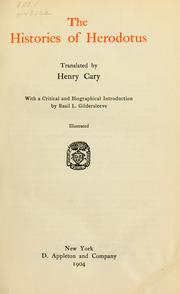
The histories of Herodotus
First published 1899. Subjects: Ancient History, History, Histoire ancienne, open_syllabus_project.
eBay marketplace picks
Marketplace Samples
Live-tested eBay searches with available results related to this page.
Endnotes
1.
Source: researchgate.net
Title: Research Gate(PDF) Pre-Roman Libyan Religion: Colonial Ethnography
Link:https://www.researchgate.net/publication/357261802_Pre-Roman_Libyan_Religion_Colonial_Ethnography_and_the_Problem_of_Religious_Survivals
Source snippet
ResearchGate(PDF) Pre-Roman Libyan Religion: Colonial Ethnography...December 13, 2021 — 26 May 2026 — Since its inception, the study of...
Published: December 13, 2021
2.
Source: Wikipedia
Link:https://en.wikipedia.org/wiki/Berber_traditional_religion
Source snippet
Berber traditional religionThe traditional Berber religions, also called Libyco-Berber religions or Amazigh religions, were various an...
3.
Source: Wikipedia
Link:https://en.wikipedia.org/wiki/Gurzil
4.
Source: Wikipedia
Title: Lake Tritonis
Link:https://en.wikipedia.org/wiki/Lake_Tritonis
Source snippet
March 26, 2026 — Lake Tritonis (Greek: Τριτωνίδα λίμνην) was a large body of fresh water in North Africa or that was described in many a...
Published: March 26, 2026
5.
Source: philipharland.com
Link:https://www.philipharland.com/Blog/2022/08/libyans-herodotos-fifth-century-bce/
Source snippet
Herodotos on customs and colonization (fifth century BCE)3 Aug 2022 — But those who live by the Tritonian lake mainly sacrifice to Athena...
6.
Source: topostext.org
Link:https://topostext.org/place/000000WTri
Source snippet
Tritonis lake (Libya)Herodotus, Histories (Hdt.) §4.180 moreover that Athene is the daughter of Poseidon and of the lake Tritonis, and th...
7.
Source: Wikipedia
Title: Ancient Libya
Link:https://en.wikipedia.org/wiki/Ancient_Libya
8.
Source: theoi.com
Link:https://www.theoi.com/Nymphe/NympheTritonis.html
Source snippet
TRITONIS - Libyan Nymph & Lake-Goddess of...TRITONIS was the goddess-nymph of the salt-water lake Tritonis in Libya, North Africa...
9.
Source: mythologysource.com
Title: Mythology Source Where Exactly was Athena Born?
Link:https://mythologysource.com/where-was-athena-born/
Source snippet
Discover the Real Story...Sep 30, 2020 — Lake Tritonis was said to have been in what the Greeks called Libya, today probably southern Tun...
10.
Source: Wikipedia
Link:https://en.wikipedia.org/wiki/Athena
Source snippet
AthenaAthena was regarded as the patron and protectress of various cities across Greece, particularly the city of Athens, from which s...
11.
Source: Wikipedia
Title: Triton (mythology)
Link:https://en.wikipedia.org/wiki/Triton_%28mythology%29
Source snippet
Triton (mythology)There is also Triton, the god of Lake Tritonis of Ancient Libya encountered by the Argonauts. This Triton is treated...
12.
Source: athena.com
Link:https://www.athena.com/
Source snippet
Top-tier Assistants, World-class DelegationAthena shows you what to delegate, how to delegate, and pairs you with an executive a...
13.
Source: religion.fandom.com
Title: Religion Wiki Traditional Berber religion | Religion Wiki
Link:https://religion.fandom.com/wiki/Traditional_Berber_religion
Source snippet
Lake Tritonis, according to the Libyan...Read more...
14.
Source: libyanheritagehouse.org
Link:https://libyanheritagehouse.org/religion/amazigh-religion-in-libya
Source snippet
Libyan Heritage HouseAmazigh Religion in LibyaThe religion of the Amazigh (colloquially known as Berbers) consists of a set of indigenous...
15.
Source: mythus.fandom.com
Title: Myth and Folklore Gurzil | Myth and Folklore Wiki
Link:https://mythus.fandom.com/wiki/Gurzil
Source snippet
Myth and Folklore Wiki - FandomGurzil was an important Berber deity. He is known from two sources, the Latin poem Iohannis by the 6th-c...
16.
Source: oxfordreference.com
Link:https://www.oxfordreference.com/display/10.1093/oi/authority.20110803095912987?d=%2F10.1093%2Foi%2Fauthority.20110803095912987&p=emailA4W%2FLCsvT93c6
Source snippet
Oxford ReferenceGurzil Dispels the DarknessGurzil, the sun god, was worshiped among the Huwwara of Tripolitania well into the eleventh ce...
17.
Source: culturalecho.wordpress.com
Title: berber mythology
Link:https://culturalecho.wordpress.com/2014/11/10/berber-mythology/
Source snippet
Mythology | culturalecho - WordPress.com10 Nov 2014 — There is no doubt that the Athena of Herodotus, whom the Amazon worshipped around L...
Additional References
18.
Source: mythlok.com
Link:https://mythlok.com/gurzil/
Source snippet
Gurzil: God of WarGurzil is an ancient deity from Berber mythology, particularly venerated by the Laguatan people of Tripolitania. Depic...
19.
Source: nashvilleparthenon.com
Link:https://www.nashvilleparthenon.com/naos
Source snippet
NaosAthena is the Greek goddess of strategic warfare, wisdom, weaving and the patron goddess of the ancient city-state Athens, Greece. He...
20.
Source: reddit.com
Link:https://www.reddit.com/r/AmazighPeople/comments/1siism6/poseidon_was_originally_a_berber_god/
Source snippet
Poseidon was originally a Berber god: r/AmazighPeoplePoseidon's wife Libya, the goddess of the Libyan Berbers, is the daughter of Epaphu...
21.
Source: reddit.com
Link:https://www.reddit.com/r/classics/comments/1foh7t0/triton_born_athene/
Source snippet
“Triton born Athene”: r/classicsOne of the explanations was that Triton was the mother of a specifically Libyan Athena. When translators...
22.
Source: scribd.com
Link:https://www.scribd.com/document/465779714/Berber-Mythology-Berber-Deities-Guanche-Mythology-Libya-in-Greek-Mythology
Source snippet
◦ Mastiman: a Moorish deity mentioned by Corippus. ◦ Neith: a Libyan goddess mentioned by Herodotus. ◦...Read more...
23.
Source: temehu.com
Link:https://www.temehu.com/imazighen/tamazight-mythology.htm
24.
Source: reddit.com
Link:https://www.reddit.com/r/GreekMythology/comments/1gssetj/can_athena_be_considered_the_daughter_of_poseidon/
Source snippet
and Lake Tritonis, and for this reason has blue eyes like Poseidon.Read more...
25.
Source: reddit.com
Link:https://www.reddit.com/r/AskMiddleEast/comments/13v0rn7/mosaic_from_kelibia_tunisia_depicts_the_goddess/
Source snippet
around Lake Tritonis (Chott el djerid in Tunisia) where she...Read more...
26.
Source: reddit.com
Link:https://www.reddit.com/r/AmazighPeople/comments/qt8jwp/what_do_you_know_about_%E2%B4%B0%E2%B4%B3%E2%B5%93%E2%B5%94%E2%B5%A3%E2%B5%89%E2%B5%8D_agurzil_the_berber/
Source snippet
if you interpret it that way. He is in short god of war and...Read more...
27.
Source: medium.com
Link:https://medium.com/%40usailuigi/the-lost-lagoon-of-the-argonauts-how-a-new-paradigm-relocates-the-mythical-lake-tritonis-to-3a4fddaba3eb
Source snippet
ess Athena — in the chotts of Tunisia or the deserts of Libya.Read more...
Topic Tree