What Lives Between Forest, River and Ancestors?
Congo’s folklore is best understood as a living set of oral stories, spirit beliefs, ritual arts and landscape traditions rather than as one single national “mythology”.
Page outline Jump by section
What “Congo folklore” means in practice
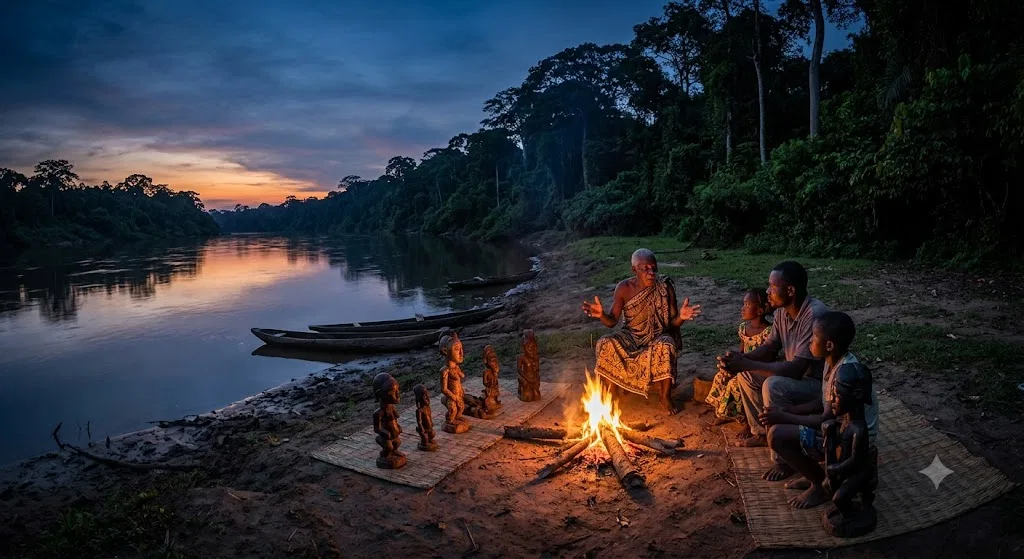
A reader looking for “Congo folklore” may expect a neat list of gods and monsters. The evidence points to something richer and less tidy. Much of the country’s legendary culture has been transmitted orally, through family storytelling, performance, initiation, ritual objects, music, dance and local memory. That means stories often exist in variants rather than in one authorised text. A tale told in a forest district, a coastal Kongo community and an urban Brazzaville setting may share a moral structure while changing characters, landscape details or social emphasis.
The Republic of the Congo is home to many Bantu-speaking peoples, including Kongo, Teke, Mbochi and Sangha groups, while Indigenous forest peoples live especially in northern and western forest regions. This matters because folklore is not evenly distributed like a national school curriculum. Some traditions are strongly local: a dance society in one region, a river-spirit warning along waterways, a forest tale from Mbomo, a Kongo power object associated with healing or justice, or a Teke figure connected to ancestors and protection.[ambacongo-us.org]ambacongo-us.orgOpen source on ambacongo-us.org.
A good way to read Congolese folklore is to ask what a story or practice is doing. Many tales teach social rules: keep promises, respect elders, obey ritual prohibitions, do not challenge the order of nature, do not misuse cleverness, and do not treat the forest or river as empty space. Ritual arts often do something more practical than “represent a myth”: they may protect, heal, judge, initiate, remember the dead, or help a community negotiate danger.[metmuseum.org]metmuseum.orgThe Metropolitan Museum of Art Power Figure: Male (NkisiThe Metropolitan Museum of Art Power Figure: Male (Nkisi
The forest as a storyteller
The most visible recent window into Congo’s folklore is Congo Tales: Told by the People of Mbomo, a multimedia project and book built around stories from the Mbomo region near Odzala-Kokoua National Park. Museum Barberini describes it as a years-long project visualising fables, stories and myths from the Mbomo region in the Republic of Congo; the project used staged photography by Pieter Henket and placed oral culture at the centre of the exhibition.[museum-barberini.de]museum-barberini.deCongo Tales: Told by the People of MbomoCongo Tales: Told by the People of Mbomo
Its value for readers is not that it captures “all Congolese mythology”, but that it shows how local folklore can be inseparable from ecology. The stories gathered around Mbomo frequently use animals, celestial bodies, rivers and forest rules to dramatise human choices. NPR’s account of the project gives the example of “The Mole and the Sun”, in which a request that the sun reverse its course becomes a lesson about the limits of human desire and the order of nature. The same account notes that tales were collected over several years in the Mbomo district and translated into English, French and Lingala for the book.[KERA News]keranews.orgmagical photos bring fables from mbomo to lifemagical photos bring fables from mbomo to life
The setting matters. Odzala-Kokoua is not a decorative backdrop: it is one of the major forest landscapes of the Congo Basin. UNESCO’s World Heritage Centre lists the Forest Massif of Odzala-Kokoua as a natural World Heritage property and records major populations of forest elephants, gorillas and chimpanzees, alongside high mammal and primate diversity. That ecological reality helps explain why folklore from the area so often treats the forest as a moral and spiritual presence rather than a simple wilderness.[UNESCO World Heritage Centre]whc.unesco.orgOpen source on unesco.org.
Modern projects such as Congo Tales also raise an important caution. They are not neutral recordings of untouched antiquity. They are collaborations involving local storytellers, collectors, writers, translators, photographers, curators and international publishers. That does not make them false; it makes them modern retellings of oral material. For a public reader, the distinction is useful: the underlying tales may be old or locally rooted, while the form in which many global audiences meet them — coffee-table book, exhibition, short film, museum app — is very recent.[Pieter Henket]pieterhenket.comOpen source on pieterhenket.com.
Ancestors, power objects and the unseen social world
Some of the best-documented Central African traditions associated with Congo concern the relationship between people, ancestors, spirits and empowered objects. In Kongo cultural areas, including regions that cross the modern borders of the Republic of Congo, DR Congo and Angola, objects known as power figures were not merely “statues” in the modern gallery sense. The Metropolitan Museum of Art explains that Kongo power figures were conceived to house specific mystical forces and were collaborative creations of sculptors and ritual specialists. Once filled with powerful substances, they could be used in matters such as healing, dispute settlement, protection and punishment of wrongdoing.[The Metropolitan Museum of Art]metmuseum.orgThe Metropolitan Museum of Art Power Figure: Male (NkisiThe Metropolitan Museum of Art Power Figure: Male (Nkisi
This is where older European descriptions often mislead. Colonial and travel writing frequently treated such objects as exotic “fetishes”, a label that flattened their social role. Museum explanations now tend to stress function: these objects were part of systems of law, medicine, oath-taking and communal protection. The British Museum describes Kongo figures as used in rituals to catch thieves or witches and to help with health, wealth and good fortune; it also notes that cavities could contain cemetery earth or burial relics, bringing the buried ancestors into the present.[British Museum]britishmuseum.orgOpen source on britishmuseum.org.
The Brooklyn Museum’s account of a Kongo power figure gives a plain example of how the object was imagined to work. Nails or blades were not decorative embellishments; each insertion could activate or call on the figure to assist the community. The same museum notes that some figures were later damaged to disempower them, a reminder that their power was understood as active, not merely symbolic.[Brooklyn Museum]brooklynmuseum.orgOpen source on brooklynmuseum.org.
Teke traditions, also important in the Republic of Congo, include ancestor and power figures of their own. The Met identifies a 19th- to 20th-century Teke male figure from Congo-Brazzaville, while art-historical accounts describe Teke figures as objects associated with curing illness, fertility, protection, hunting and fishing success when ritually charged by a specialist. These traditions sit at the border between folklore, religion, art history and social practice, which is exactly why they matter: they show belief culture in material form.[The Metropolitan Museum of Art]metmuseum.orgThe Metropolitan Museum of Art Figure: MaleThe Metropolitan Museum of Art Figure: Male
Water spirits, rivers and dangerous temptation
The Congo River and its tributaries are natural routes of trade, travel, fishing, migration and story. It is therefore unsurprising that water spirits occupy an important place in Congolese and wider Central African belief culture. One of the best-known is Mami Wata, a water-spirit complex found across parts of West, Central and Southern Africa and in the African Atlantic diaspora. The figure is often described as beautiful, seductive, protective and dangerous — a being associated with water, wealth, healing, danger, desire and moral risk.[National Museums Scotland]nms.ac.ukOpen source on nms.ac.uk.
For Congo specifically, the most relevant point is not to claim that every community tells one identical Mami Wata story. Rather, river-spirit traditions travel, adapt and localise. A University of Basel research note on “Tales from the Congo River” describes Mami Wata as a fluid figure whose meanings shift through rumour and place, and as a cautionary presence said to haunt the Congo River and its tributaries.[ethnologie.philhist.unibas.ch]ethnologie.philhist.unibas.chTales from the Congo River: Catching Mami WataTales from the Congo River: Catching Mami Wata
The figure also shows how folklore changes over time. Mami Wata is not simply a “precolonial goddess” preserved unchanged. Scholars and museum accounts trace her modern iconography through African water-spirit traditions, European mermaid imagery, printed pictures, trade goods and diasporic circulation. For readers, that makes her especially interesting: she is both traditional and modern, local and transregional, sacred and popular, feared and desired.[fowler.ucla.edu]fowler.ucla.edumami wata arts for water spirits in africa and its diasporasmami wata arts for water spirits in africa and its diasporas
Initiation, masks and performance
Congolese folklore is not confined to spoken tales. It is also danced, masked, sung and enacted. One especially important tradition in the Republic of Congo is Kiebe-Kiebe, an initiatory dance associated with Congo-Brazzaville and currently listed by UNESCO as a 2026 nomination under process for the Representative List of the Intangible Cultural Heritage of Humanity. The nomination status is important: it signals official heritage recognition work, but it should not be confused with a completed inscription unless and until UNESCO records it as such.[ICH UNESCO]ich.unesco.orgICH UNESCOCongoICH UNESCOCongo
Kiebe-Kiebe is significant because it brings together moral instruction, spectacle, initiation and group identity. Public descriptions connect it especially with Mbochi and Kouyou/Kuyu contexts in the north and centre of the country, though details vary by source and locality. The tradition is often discussed as both sacred and performative: there is a restricted initiatory dimension and a more public dance display. That double structure is common in many African masquerade traditions, where outsiders may see the visual performance without being admitted to the full ritual knowledge behind it.[Wikipedia]WikipediaMusée Kiebe-KiebeMusée Kiebe-Kiebe
Masks and performances also complicate the modern word “folklore”. To an outside viewer, a masked dance may look like theatre. To participants, it may also carry teachings about origin, hierarchy, danger, the dead, social order or the spirit world. This is why responsible writing about Congolese masked traditions should avoid treating them as spooky costume drama. They are cultural practices with rules, owners, audiences, restrictions and changing meanings.

Oral history and legendary kingdoms
Some Congolese oral traditions preserve more than moral tales. They also carry historical memory, especially around earlier kingdoms and political identities. The Kongo kingdom, whose historical reach included parts of present-day Angola, DR Congo and the Republic of Congo, is linked in oral traditions to founding narratives involving Nimi a Nzima and Nsaku Lau; the Royal Museum for Central Africa notes that the kingdom’s history draws on oral traditions as well as written and material evidence.[Africa Museum]africamuseum.beOpen source on africamuseum.be.
The Republic of Congo’s folklore cannot be separated from the old Kongo, Loango and Teke worlds. A public reader should be careful, though: oral tradition is not a tape recording of the past. Historian Jan Vansina’s influential work on oral tradition emphasised that oral sources can be used historically, but they must be interpreted with attention to transmission, performance, genre and change. Later scholarship on Kongo traditions makes the same point: oral accounts are themselves interpretive histories, not raw data waiting to be copied into a timeline.[Google Books]books.google.comBooks Oral Tradition as HistoryBooks Oral Tradition as History
That is why legendary founders, sacred kings and origin stories matter even when they cannot be reduced to modern fact-checking. They reveal how communities explain authority, land, kinship and legitimacy. In a folklore page, the key question is not only “Did this happen exactly as told?” but “What did this story allow people to remember, justify, question or pass on?”
Rumba, urban memory and modern folk culture
Not all living folklore looks ancient. Congolese rumba, shared by the Republic of Congo and the Democratic Republic of the Congo, was inscribed by UNESCO in 2021 on the Representative List of the Intangible Cultural Heritage of Humanity. UNESCO describes it as a musical genre and dance common in urban areas of both Congos, and its official decision recognised its role in transmitting social and cultural values.[ICH UNESCO]ich.unesco.orgOpen source on unesco.org.
Rumba may seem at first like music history rather than folklore, but it belongs on the same cultural map. It carries proverbs, courtship, satire, social commentary, memory, dance etiquette and shared urban identity. UNESCO’s own article connects the name to an older dance term and presents the modern form as a product of cultural exchange, including African and Afro-Cuban circulation.[UNESCO]unesco.orgnkumba rumba rich intangible cultural heritage congosnkumba rumba rich intangible cultural heritage congos
For folklore readers, rumba is a useful reminder that tradition does not stop at the village or the forest. Brazzaville’s urban culture has also generated forms of collective memory. Songs can do some of the work that folktales do: they preserve names, warn against foolish behaviour, praise beauty, mock pretension, mourn loss and keep communal language alive.
What is old, what is documented, and what is modern retelling?
The evidence for Congo’s folklore is uneven, and that should be said plainly. Some traditions are well represented in museum collections, UNESCO files, academic history and recent cultural projects. Kongo and Teke power figures, Congolese rumba and Congo Tales have comparatively visible documentation. Other local tales, forest beings, family stories, witchcraft beliefs, river warnings and initiation details may be known mainly through oral circulation, local performance or specialist knowledge that is not meant for unrestricted public explanation.
This unevenness has several causes. Oral traditions change with each telling. Colonial collectors often recorded what interested them while misunderstanding or suppressing local meanings. Some sacred knowledge is restricted. Some communities have had their traditions displaced by missionisation, schooling, urbanisation, war, conservation regimes, market pressures and the art trade. At the same time, modern artists, museums and digital projects are creating new public forms for old materials.[africamuseum.be]africamuseum.benkisi nkondenkisi nkonde
The safest reading is therefore layered:
- Old oral tradition includes local tales, origin stories, ancestral teachings and ritual knowledge transmitted across generations.
- Material ritual tradition includes power figures, masks, medicines and charged objects used for healing, justice, protection or initiation.
- Historical memory includes oral accounts of kingdoms, founders, migrations and sacred authority.
- Modern retelling includes books, exhibitions, photography, film, school resources and tourism-linked presentations.
- Internet-era folklore may borrow Congolese names or imagery but should be treated cautiously unless it can be tied back to local sources, credible scholarship or documented performance.
Why Congo’s folklore still matters
Congo’s folklore matters because it gives readers a different map of the country. Instead of seeing Congo only through politics, oil, rainforest conservation or conflict in the wider region, folklore reveals a country of storytellers, ritual specialists, dancers, musicians, hunters, fishers, elders, artists and children learning how to live with one another and with powerful landscapes.
The most memorable Congolese traditions often refuse a hard line between moral teaching and supernatural imagination. A forest tale can be an ecological lesson. A river spirit can be a warning about temptation, danger or improper crossing. A power figure can be art, law, medicine and theology at once. An initiatory dance can be public spectacle and guarded knowledge. A rumba song can be entertainment and social archive.
For a curious reader, the main takeaway is simple: Congo’s folklore is not a museum shelf of strange beliefs. It is a living cultural language for talking about power, nature, danger, desire, justice, memory and belonging. Its stories are strongest when read in place — beside the river, in the forest, in the dance ground, in the family courtyard, in the museum case, and in the modern city where old motifs continue to find new voices.
Amazon book picks
Further Reading
Books and field guides related to What Lives Between Forest, River and Ancestors?. Use these as the next step if you want deeper reading beyond the article.
King Leopold's Ghost
Provides historical context for the region's cultural traditions.
eBay marketplace picks
Marketplace Samples
Live-tested eBay searches with available results related to this page.

Endnotes
1.
Source: ambacongo-us.org
Link:https://www.ambacongo-us.org/en/about-congo/people-culture/people
2.
Source: museum-barberini.de
Title: Congo Tales: Told by the People of Mbomo
Link:https://www.museum-barberini.de/en/ausstellungen/249/congo-tales-told-by-the-people-of-mbomo
3.
Source: whc.unesco.org
Link:https://whc.unesco.org/en/list/692/
4.
Source: fowler.ucla.edu
Title: mami wata arts for water spirits in africa and its diasporas
Link:https://fowler.ucla.edu/exhibitions/mami-wata-arts-for-water-spirits-in-africa-and-its-diasporas/
5.
Source: ethnologie.philhist.unibas.ch
Title: Tales from the Congo River: Catching Mami Wata
Link:https://ethnologie.philhist.unibas.ch/de/default-pages/news/details/tales-from-the-congo-river-catching-mami-wata/
6.
Source: ethnologie.philhist.unibas.ch
Title: tales from the congo river catching mami wata
Link:https://ethnologie.philhist.unibas.ch/en/default-pages/news/details/tales-from-the-congo-river-catching-mami-wata/
7.
Source: ich.unesco.org
Title: ICH UNESCOCongo
Link:https://ich.unesco.org/en/state/congo-CG
8.
Source: ich.unesco.org
Link:https://ich.unesco.org/en/video/84218
9.
Source: Wikipedia
Title: Musée Kiebe-Kiebe
Link:https://fr.wikipedia.org/wiki/Mus%C3%A9e_Kiebe-Kiebe
10.
Source: Wikipedia
Link:https://fr.wikipedia.org/wiki/Kebe-kebe
11.
Source: books.google.com
Title: Books Oral Tradition as History
Link:https://books.google.com/books/about/Oral_Tradition_as_History.html?id=J7wbS71dVbcC
12.
Source: ich.unesco.org
Link:https://ich.unesco.org/en/RL/congolese-rumba-01711
13.
Source: ich.unesco.org
Link:https://ich.unesco.org/en/Decisions/16.com/8.b.8
14.
Source: unesco.org
Title: nkumba rumba rich intangible cultural heritage congos
Link:https://www.unesco.org/en/articles/nkumba-rumba-rich-intangible-cultural-heritage-congos
15.
Source: Wikipedia
Title: Congo Tales
Link:https://en.wikipedia.org/wiki/Congo_Tales
16.
Source: Wikipedia
Link:https://en.wikipedia.org/wiki/Nkisi
17.
Source: Wikipedia
Title: Congolese rumba
Link:https://en.wikipedia.org/wiki/Congolese_rumba
18.
Source: Wikipedia
Title: Odzala Kokoua National Park
Link:https://en.wikipedia.org/wiki/Odzala-Kokoua_National_Park
19.
Source: Wikipedia
Title: Republic of the Congo
Link:https://en.wikipedia.org/wiki/Republic_of_the_Congo
20.
Source: Wikipedia
Title: Kingdom of Loango
Link:https://en.wikipedia.org/wiki/Kingdom_of_Loango
21.
Source: Wikipedia
Title: Kingdom of Kongo
Link:https://en.wikipedia.org/wiki/Kingdom_of_Kongo
22.
Source: Wikipedia
Title: Mami Wata
Link:https://en.wikipedia.org/wiki/Mami_Wata
23.
Source: ich.unesco.org
Title: files 2026 under process 01395
Link:https://ich.unesco.org/en/files-2026-under-process-01395?call=slideshow&id=02453&include=slideshow_inc.php&mode=scroll&width=620
24.
Source: ich.unesco.org
Link:https://ich.unesco.org/en/video/82275
25.
Source: ich.unesco.org
Link:https://ich.unesco.org/en/video/58152
26.
Source: unesco.org
Title: document 4768
Link:https://www.unesco.org/archives/multimedia/document-4768
27.
Source: ich.unesco.org
Title: ritual and festive expressions of the congo culture 01383
Link:https://ich.unesco.org/en/RL/ritual-and-festive-expressions-of-the-congo-culture-01383
28.
Source: ich.unesco.org
Title: congolese rumba 01711
Link:https://ich.unesco.org/en/rl/congolese-rumba-01711?call=film&id=58152&include=film_inc.php&width=700
29.
Source: ich.unesco.org
Title: 8b representative list 01191
Link:https://ich.unesco.org/en/8b-representative-list-01191?call=film&id=58152&include=film.inc.php&width=700
30.
Source: ich.unesco.org
Title: democratic republic of the congo CD
Link:https://ich.unesco.org/en/state/democratic-republic-of-the-congo-CD
31.
Source: ich.unesco.org
Title: photo pop up 00973
Link:https://ich.unesco.org/en/photo-pop-up-00973?photoID=14762
32.
Source: ich.unesco.org
Title: photo pop up 00973
Link:https://ich.unesco.org/en/photo-pop-up-00973?photoID=14748
33.
Source: ich.unesco.org
Title: search 00795
Link:https://ich.unesco.org/en/search-00795?call=film&id=58152&include=film_inc.php&width=700
34.
Source: ich.unesco.org
Title: LHE 21 16.CO M 8.b Rev.2 Add.3 EN.docx
Link:https://ich.unesco.org/doc/src/LHE-21-16.COM-8.b_Rev.2_Add.3-EN.docx
35.
Source: whc.unesco.org
Link:https://whc.unesco.org/en/statesparties/cg
36.
Source: whc.unesco.org
Link:https://whc.unesco.org/en/list/692/documents/
37.
Source: whc.unesco.org
Link:https://whc.unesco.org/archive/2023/whc23-45com-8A-en.pdf
38.
Source: books.google.com
Title: African Tales
Link:https://books.google.com/books/about/African_Tales.html?id=maOckBX0n-MC
39.
Source: omc.obta.al.uw.edu.pl
Link:https://www.omc.obta.al.uw.edu.pl/myth-survey/country/11
40.
Source: folktales.africa
Link:https://folktales.africa/category/african-folktales/central-african-folktales/
41.
Source: archive.org
Link:https://archive.org/details/oraltraditionash0000vans
42.
Source: odzala-kokoua.com
Link:https://www.odzala-kokoua.com/conservation/
43.
Source: metmuseum.org
Title: The Metropolitan Museum of Art Power Figure: Male (Nkisi)
Link:https://www.metmuseum.org/art/collection/search/316404
44.
Source: britishmuseum.org
Link:https://www.britishmuseum.org/collection/object/E_Af1905
45.
Source: keranews.org
Title: magical photos bring fables from mbomo to life
Link:https://www.keranews.org/2018-12-17/magical-photos-bring-fables-from-mbomo-to-life
46.
Source: pieterhenket.com
Link:https://www.pieterhenket.com/congotales
47.
Source: metmuseum.org
Title: The Metropolitan Museum of Art Mangaaka Power Figure (Nkisi N’Kondi)
Link:https://www.metmuseum.org/art/collection/search/320053
48.
Source: brooklynmuseum.org
Link:https://www.brooklynmuseum.org/tr-TR/objects/2957
49.
Source: brooklynmuseum.org
Link:https://www.brooklynmuseum.org/objects/2957
50.
Source: metmuseum.org
Title: The Metropolitan Museum of Art Figure: Male
Link:https://www.metmuseum.org/art/collection/search/310961
51.
Source: nms.ac.uk
Link:https://www.nms.ac.uk/discover-catalogue/the-african-spiritual-tradition-of-mami-wata
52.
Source: africamuseum.be
Link:https://www.africamuseum.be/en/discover/history_articles/kongo-kingdom
53.
Source: africamuseum.be
Title: nkisi nkonde
Link:https://www.africamuseum.be/en/learn/provenance/nkisi-nkonde
54.
Source: visitodzala-kokoua.org
Title: Odzala-Kokoua National Park
Link:https://visitodzala-kokoua.org/en/
55.
Source: republic-congo.com
Title: The People
Link:https://republic-congo.com/en/discover/the-people/
56.
Source: metmuseum.org
Title: great traditions kongo power and majesty
Link:https://www.metmuseum.org/perspectives/great-traditions-kongo-power-and-majesty
57.
Source: metmuseum.org
Title: visual archive historian perspective
Link:https://www.metmuseum.org/exhibitions/listings/2015/kongo/blog/posts/visual-archive-historian-perspective
58.
Source: facebook.com
Link:https://www.facebook.com/groups/155452167800232/posts/5938569749488416/
59.
Source: facebook.com
Link:https://www.facebook.com/groups/717447515653882/posts/1685513665513924/
60.
Source: naturalworldheritagesites.org
Title: Forest Massif of Odzala-Kokoua
Link:https://www.naturalworldheritagesites.org/sites/forest-massif-of-odzala-kokoua
61.
Source: 101lasttribes.com
Title: AFRIC A | 101 Last Tribes
Link:https://www.101lasttribes.com/tribes/vili.html
62.
Source: newsendip.com
Title: unesco intangible cultural heritage humanity inscriptions 2021
Link:https://www.newsendip.com/unesco-intangible-cultural-heritage-humanity-inscriptions-2021/
63.
Source: globalsecurity.org
Link:https://www.globalsecurity.org/military/world/africa/cg-history-1.htm
Additional References
64.
Source: youtube.com
Link:https://www.youtube.com/watch?v=xhG48jbwTuA
Source snippet
THE MAGIC TREE: A TALE FROM THE CONGO | Animated Short (1970)...
65.
Source: youtube.com
Title: Myth of the Biloko/Eloko creatures from the Congo forest-African stories part 2
Link:https://www.youtube.com/watch?v=TgHbfmZ9yd0
Source snippet
Funza The Celestial Guardian of the Kongo Religion...
66.
Source: youtube.com
Title: Funza The Celestial Guardian of the Kongo Religion
Link:https://www.youtube.com/watch?v=QDq5IJaqZmU
Source snippet
The Clever Rooster and the Foolish Leopard | A Congolese Folktale About Pride and Deception...
67.
Source: youtube.com
Link:https://www.youtube.com/watch?v=QVNTNteou0A
Source snippet
Nzambi Mpungu Tulendo — The God of the Bakongo (Kingdom of Kongo)...
68.
Source: tretyakovgallerymagazine.com
Link:https://www.tretyakovgallerymagazine.com/node/4457
69.
Source: researchgate.net
Link:https://www.researchgate.net/publication/355735551_Tales_From_the_Congo_River_Catching_Mami_Wata
70.
Source: researchgate.net
Link:https://www.researchgate.net/publication/403826284_Supernatural_beings_as_symbols_in_masquerades_and_traditional_oral_tales_in_Ogba
71.
Source: instagram.com
Link:https://www.instagram.com/p/DSk5u1kCG1u/
72.
Source: artbma.org
Link:https://artbma.org/wp-content/uploads/2026/02/BMA_african_artofthespiritworld.pdf
73.
Source: anikefoundation.org
Link:https://anikefoundation.org/african-folktales
Topic Tree
Follow this branch
Related pages 192
- Afghan Folklore
- Albanian Folklore
- Algerian Folklore
- Australian Folklore
- Azerbaijan Folklore
- +187 more in sidebar