Where Tricksters, Spirits and Rainforests Meet
Suriname’s folklore is not a single mythology but a meeting place of many living traditions: Afro-Surinamese spirit religion, Maroon oral history, Indigenous Amazonian stories, Anansi trickster tales, and the memories carried by Hindustani, Javanese, Chinese, Jewish, Dutch and other communities.
Page outline Jump by section
Why Surinamese folklore is so layered
Suriname’s folklore grew from the country’s history: Indigenous peoples already had their own story worlds; enslaved Africans brought West and Central African religious and narrative traditions; Maroon communities created free societies in the interior; and later indentured and migrant communities added further languages, rituals and memories. A history of Surinamese literature notes that the country uses many languages, with Dutch, Sranan and Sarnami among the major literary languages, while oral literature remains vital across Amerindian, Maroon and other communities.[DBNL]dbnl.orgOpen source on dbnl.org.
That multilingual setting matters. Folklore in Suriname often changes form as it moves between a family yard, a ritual, a village gathering, a schoolbook, a theatre performance, a museum display or a Dutch-Surinamese diaspora event. The same figure can be sacred in one setting, comic in another, and educational in a third. This is especially clear with Anansi, who may appear as a divine-linked trickster, a selfish rogue, a comic survivor, or a sharp social critic depending on who tells the story and where.[Immaterieel Erfgoed]immaterieelerfgoed.nlAnansi storytelling tradition - Immaterieel Erfgoed…
Suriname’s traditions also resist neat separation between “myth”, “religion” and “folklore”. In some communities, stories are entertainment; in others, they are part of mourning, healing, moral education or territorial memory. The useful way to read Surinamese folklore is therefore not as a catalogue of monsters, but as a cultural map: stories tell people how to behave, how to remember ancestors, how to treat forests and rivers, and how to recognise danger.
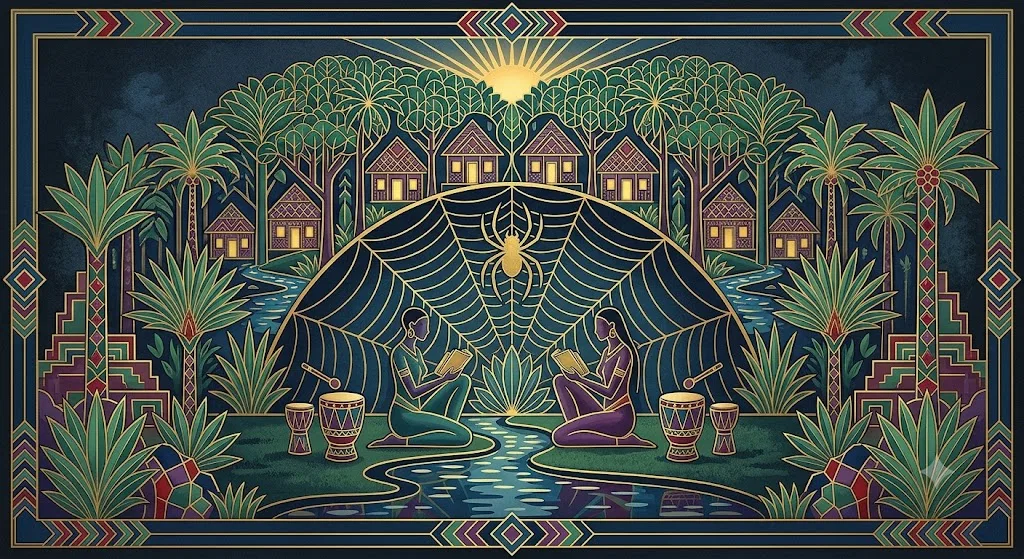
Anansi: the spider who explains people
Anansi is the most widely recognisable Surinamese folk figure. In older Afro-Surinamese collections, many stories were grouped under the name Anansi stories even when they involved animals, kings, ghosts, people or magic rather than the spider alone. Melville and Frances Herskovits, whose 1930s collection remains one of the major documentary sources for Afro-Surinamese folklore, recorded that Anansi was treated as the central story figure, and that many kinds of tale could still be called Anansi tales.[DBNL]dbnl.orgOpen source on dbnl.org.
The basic appeal is easy to understand. Anansi is small but clever. He survives by wit, appetite, language and nerve. He exposes the powerful as foolish, but he is not simply good: he can be greedy, lazy, deceitful, brave, funny or strangely honest. The Dutch Centre for Intangible Cultural Heritage describes the stories as being “not about a spider, but about man in general”, and stresses that the tradition is flexible rather than fixed.[Immaterieel Erfgoed]immaterieelerfgoed.nlAnansi storytelling tradition - Immaterieel Erfgoed…
In Suriname, Anansi’s importance is sharpened by slavery and its aftermath. Trickster tales offered humour and coded criticism in a world where open speech could be dangerous. A tiger, a dog, a wife, a king or a fool might carry social meanings that listeners could recognise without needing the storyteller to spell them out. In Caribbean and Surinamese settings, the trickster’s victory is often temporary; Anansi may outwit someone today and be exposed tomorrow. That unstable balance is part of the tradition’s honesty: cunning is useful, but it does not make life simple.
The older record also shows that Anansi tales were not merely bedtime stories. Herskovits and Herskovits described them as important at wakes and rites for the dead among some Afro-Surinamese and Maroon communities, while also serving education and evening entertainment in yards, plantations and work camps.[DBNL]dbnl.orgOpen source on dbnl.org. Today, the tradition continues in live storytelling, books, theatre, museums, video projects and diaspora settings. As Anansi moves into Dutch museums or digital archives, he changes again, but that adaptability is not a modern corruption of the tradition; it is one of its oldest strengths.[Immaterieel Erfgoed]immaterieelerfgoed.nlAnansi storytelling tradition - Immaterieel Erfgoed…

Winti and the spirit world
The most important Afro-Surinamese religious tradition for understanding Suriname’s supernatural folklore is Winti. It is better understood as a living religion and ritual system than as a set of “myths”. In the Herskovits material, the spirit world around Paramaribo is organised through ideas of the soul, spirits or gods, good and harmful magic, and spirits of the dead. Their account describes divination as a key way these elements were interpreted and managed.[DBNL]dbnl.orgOpen source on dbnl.org.
Winti has roots in the religious worlds of enslaved Africans and developed in Suriname under colonial conditions. Later descriptions commonly emphasise belief in a supreme creator, a range of spirits associated with domains such as earth, water, forest and sky, and the continuing importance of ancestors. Duke University’s Sacred Arts of the Black Atlantic project describes Winti as both the name of a religion and of some spiritual entities within that religion, with a pantheon distributed across natural realms. The Sacred Arts of the Black Atlantic[sacredart.caaar.duke.edu]sacredart.caaar.duke.eduOpen source on duke.edu.
For folklore readers, this matters because many Surinamese “creature” stories make more sense inside a Winti-shaped worldview. Spirits are not simply monsters. They may protect, punish, possess, heal, warn or demand attention. Forest and water beings are linked to place and conduct; ancestor spirits connect the living to family memory; ritual specialists interpret misfortune, illness or conflict through spiritual as well as social causes. In older accounts, offerings, dances, washing, drumming and invocations are not decorative background but practical ways of negotiating relations with unseen powers.[DBNL]dbnl.orgOpen source on dbnl.org.
Winti was also shaped by suppression and survival. The public status of Afro-Surinamese traditions was long complicated by colonial Christianity, law, social stigma and later debates about religion, healing and identity. The United States religious freedom report and Minority Rights Group both point to Suriname’s broad religious diversity today, while census-based figures show Winti as a small formal category compared with Christianity, Hinduism and Islam; those numbers should not be read as measuring the full cultural reach of Winti ideas in family practice, language, healing or folklore.[State Department]2021-2025.state.govDepartment Technical DifficultiesDepartment Technical Difficulties
Spirits, witches and dangerous little beings
Surinamese supernatural folklore includes many beings that are hard to classify because they sit between religion, witchcraft accusation, ghost story and cautionary tale. Some names circulate widely online, but the strongest older evidence comes from Afro-Surinamese ethnographic collections and later Winti-related studies.
One famous example is the bakru, often described in popular retellings as a small, troubling spirit or creature used in harmful magic. The Herskovits collection treats bakru as important carriers of black magic and describes them as “little people” fashioned by sorcerers and animated with the soul of a dead person.[DBNL]dbnl.orgOpen source on dbnl.org. This does not mean every modern internet description of bakru is reliable. The older material places the figure inside concerns about sorcery, protection, pregnancy, illness and social fear, rather than presenting it as a simple fantasy monster.
Another important category is the spirit of the dead. In the older Afro-Surinamese record, spirits of the dead form one of the major elements of the belief system, alongside the soul, spirits or gods, and magic.[DBNL]dbnl.orgOpen source on dbnl.org. This helps explain why ghostly stories, death rites, wakes and ancestor concerns overlap in Surinamese oral culture. A frightening story may be entertainment, but it may also express rules about when to speak, how to honour the dead, or how the living remain vulnerable to the unseen.
The asema, often compared in English to a vampire or witch, is another well-known figure in Surinamese legend, though accessible sources are uneven. Dutch-language summaries describe it as a witch-like being that lives as a person by day and moves at night as a light or disembodied force.[Wikipedia]WikipediaOpen source on wikipedia.org. Because strong primary documentation is thinner than for Anansi or Winti, it is safest to treat asema stories as part of a wider Surinamese and Guianese cluster of witchcraft and night-danger legends rather than as a single fixed national myth.
Maroon oral tradition and the memory of freedom
Maroon folklore in Suriname is inseparable from history. Maroons are descendants of Africans who escaped slavery and formed autonomous communities in the interior. Their stories are not only about spirits or heroes; they preserve routes, battles, village origins, treaty memories, kinship, ritual authority and relationships with rivers and forests. Minority Rights Group describes Maroon villages as largely riverine communities with traditional leadership, ancestor veneration, oracles, shrines, performance, oratory and wood-carving traditions.[Minority Rights Group]minorityrights.orgMinority Rights Group Maroons in SurinameMinority Rights Group Maroons in Suriname
The historical stakes are high. The Dutch Centre for Intangible Cultural Heritage notes that more than a quarter of a million Africans were taken to Suriname between 1650 and 1830, that some escaped into the hinterland, and that peace treaties with Maroon groups became central collective memories. The first treaty with the Aukan people in 1760 is remembered in Maroon history, and 10 October is marked as the Day of the Maroons in Suriname.[Immaterieel Erfgoed]immaterieelerfgoed.nlMaroon culture - Immaterieel Erfgoed…
Oral history also records local versions of settlement and movement. In a study of the Matawai Maroons, DBNL’s digitised text records oral accounts linking the Matawai and Saramaka to the Upper Saramacca region, mountains, tributaries and old villages.[DBNL]dbnl.orgOpen source on dbnl.org. These are not merely picturesque legends. They are claims of belonging, memory maps and social evidence. A story about where ancestors first settled may also explain rights to land, ritual responsibility and why a river bend or mountain matters.
Recent heritage work continues that pattern in digital form. The Matawai have used place-based storytelling tools to preserve traditional knowledge through elders’ oral histories, with stories connected to territory, food, resources and hidden dangers.[Earth Defenders Toolkit]earthdefenderstoolkit.comEarth Defenders Toolkit Matawai: Place-based Storytelling in SurinameEarth Defenders Toolkit Matawai: Place-based Storytelling in Suriname This is folklore in a very practical sense: narrative as survival knowledge, identity and land memory.
Indigenous story worlds and sacred landscapes
Suriname’s Indigenous traditions are older than the colonial state and are rooted in Amazonian landscapes, languages and forms of knowledge. A history of Surinamese literature identifies coastal Indigenous peoples such as the Kari’na and Lokono, as well as interior peoples including Trio, Wayana and Akuriyo, and stresses that in these traditions natural and supernatural worlds are not neatly separated.[DBNL]dbnl.orgOpen source on dbnl.org.
One concrete example is the Katuena oral tradition recorded around Kwamalasamutu in southern Suriname. A documentation project described Katuena as an oral language and worked with local speakers to record and translate myths, including stories about the origin of the moon, a forest monster linked to shamanism, bewitchment, flood and fire, and an origin myth involving a tortoise.[gbs.uni-koeln.de]gbs.uni-koeln.deSmoll KatuenaSmoll Katuena The project notes that these myths explain supernatural acts in a distant past, the creation of humans, plants and animals, relationships between humans and other beings, and cultural customs.[gbs.uni-koeln.de]gbs.uni-koeln.deSmoll KatuenaSmoll Katuena
Suriname’s landscape also holds older sacred and archaeological meaning. Near Kwamalasamutu, the Werehpai caves are known for pre-Columbian petroglyphs and are described by Conservation International Suriname as sacred caves protected within a sanctuary developed with the Trio community.[Conservation International]suriname.conservation.orgOpen source on conservation.org. It would be wrong to treat rock carvings as automatically “folklore”, but they are part of the same reader-facing picture: Suriname’s interior is not empty wilderness in cultural memory. It is a storied landscape of ancestors, spirits, routes, animals, caves and places whose meanings are held by communities.
How Suriname’s folklore survives today
Surinamese folklore survives because it keeps moving. Some traditions remain strongest in family, ritual and village settings; others appear in literature, schools, museum programmes, diaspora storytelling and online media. The Dutch-Surinamese heritage record shows active concern for oral history, archives and intangible cultural heritage, including the need to preserve recordings, interviews and community documentation before fragile material deteriorates.[creativeeuropedesk.nl]creativeeuropedesk.nlMicrosoft WordMicrosoft Word
There is also a tension between preservation and performance. Recording a story can protect it, but it can also freeze a version that was never meant to be final. Anansi is the clearest example: the tradition thrives precisely because tellers adapt the spider to new audiences. The same is true of Maroon place-based stories and Indigenous oral traditions, where the most meaningful versions are often tied to speaker, setting, language and permission.
Modern readers should therefore be cautious with simplified lists of “Surinamese monsters”. They can be fun entry points, but they often detach beings from ritual life, language and community memory. A bakru, a forest spirit, a ghost, an Anansi tale or a sacred cave is most interesting when placed back into its Surinamese setting: a country where folklore is shaped by slavery and freedom, rainforest and river, migration and multilingualism, laughter and mourning, sacred obligation and modern reinvention.
eBay marketplace picks
Marketplace Samples
Live-tested eBay searches with available results related to this page.
Endnotes
1.
Source: dbnl.org
Link:https://www.dbnl.org/tekst/kemp009gesc05_01/kemp009gesc05_01_0018.php
2.
Source: immaterieelerfgoed.nl
Title: Immaterieel Erfgoed
Link:https://www.immaterieelerfgoed.nl/en/anansiverteltraditie
Source snippet
Anansi storytelling tradition - Immaterieel Erfgoed...
3.
Source: dbnl.org
Link:https://www.dbnl.org/tekst/hers005suri01_01/hers005suri01_01_0023.php
4.
Source: dbnl.org
Link:https://www.dbnl.org/tekst/hers005suri01_01/hers005suri01_01_0015.php
5.
Source: sacredart.caaar.duke.edu
Link:https://sacredart.caaar.duke.edu/religions/surinamese-and-dutch-winti/
6.
Source: 2021-2025.state.gov
Title: Department Technical Difficulties
Link:https://2021-2025.state.gov/reports/2023-report-on-international-religious-freedom/suriname/
7.
Source: dbnl.org
Link:https://www.dbnl.org/tekst/hers005suri01_01/hers005suri01_01.pdf
8.
Source: Wikipedia
Link:https://nl.wikipedia.org/wiki/Asema
9.
Source: immaterieelerfgoed.nl
Title: Immaterieel Erfgoed
Link:https://www.immaterieelerfgoed.nl/en/marroncultuur
Source snippet
Maroon culture - Immaterieel Erfgoed...
10.
Source: dbnl.org
Link:https://www.dbnl.org/tekst/beet027peop01_01/beet027peop01_01_0003.php
11.
Source: gbs.uni-koeln.de
Title: Smoll Katuena
Link:https://gbs.uni-koeln.de/sites/gbs/user_upload/Berichte_D/Smoll_Katuena.pdf
12.
Source: suriname.conservation.org
Link:https://suriname.conservation.org/about
13.
Source: creativeeuropedesk.nl
Title: Microsoft Word
Link:https://www.creativeeuropedesk.nl/sites/default/files/files/CR-Suriname-eng_0.pdf
14.
Source: dbnl.org
Link:https://www.dbnl.org/tekst/hers005suri01_01/hers005suri01_01_0153.php
15.
Source: dbnl.org
Link:https://www.dbnl.org/tekst/hers005suri01_01/colofon.htm
16.
Source: dbnl.org
Title: voor007creo01 01
Link:https://www.dbnl.org/tekst/voor007creo01_01/voor007creo01_01.pdf
17.
Source: dbnl.org
Link:https://www.dbnl.org/tekst/voor007creo01_01/voor007creo01_01_0016.php
18.
Source: dbnl.org
Title: Suriname, Zuid-Amerika
Link:https://www.dbnl.org/buitengaats/land.php?id=surin01
19.
Source: dbnl.org
Link:https://www.dbnl.org/tekst/_oso001200001_01/_oso001200001_01.pdf
20.
Source: dbnl.org
Title: oso001198701 01
Link:https://www.dbnl.org/arch/_oso001198701_01/pag/_oso001198701_01.pdf
21.
Source: dbnl.org
Link:https://www.dbnl.org/tekst/kemp009suri02_01/kemp009suri02_01.pdf
22.
Source: Wikipedia
Link:https://en.wikipedia.org/wiki/Winti
23.
Source: Wikipedia
Link:https://en.wikipedia.org/wiki/Anansi
24.
Source: Wikipedia
Link:https://en.wikipedia.org/wiki/Saramaka
25.
Source: Wikipedia
Title: Religion in Suriname
Link:https://en.wikipedia.org/wiki/Religion_in_Suriname
26.
Source: Wikipedia
Link:https://en.wikipedia.org/wiki/Werehpai
27.
Source: Wikipedia
Title: Mythologies of the Indigenous peoples of the Americas
Link:https://en.wikipedia.org/wiki/Mythologies_of_the_Indigenous_peoples_of_the_Americas
28.
Source: creativeeuropedesk.nl
Link:https://www.creativeeuropedesk.nl/sites/default/files/files/AWAD%201%20April%202010%20Program%20Abstracts%20Marronage%20and%20Maroon%20communities%20a%20Common%20Atlantic%20History_0.pdf
Published: April 2010
29.
Source: suriname.nu
Title: [Folklore] Spider Tales
Link:https://www.suriname.nu/302ges/archi56.html
30.
Source: minorityrights.org
Link:https://minorityrights.org/country/suriname/
31.
Source: minorityrights.org
Title: Minority Rights Group Maroons in Suriname
Link:https://minorityrights.org/communities/maroons/
32.
Source: earthdefenderstoolkit.com
Title: Earth Defenders Toolkit Matawai: Place-based Storytelling in Suriname
Link:https://www.earthdefenderstoolkit.com/community/matawai-place-based-storytelling-in-suriname/
33.
Source: immaterieelerfgoed.nl
Link:https://www.immaterieelerfgoed.nl/nl/anansiverteltraditie
34.
Source: sk.sagepub.com
Link:https://sk.sagepub.com/ency/edvol/download/africanreligion/chpt/winti.pdf
35.
Source: earthdefenderstoolkit.com
Link:https://www.earthdefenderstoolkit.com/community/wayana-consultation-protocol-based-on-traditional-laws-and-values/
36.
Source: pure.knaw.nl
Link:https://pure.knaw.nl/portal/files/472910/Anansi.pdf
37.
Source: kekemba.info
Link:https://www.kekemba.info/blogmain.php?aanroep=werehpai+%28Werehpai+-+Rock+carvings+from+long+ago%29%3Dmultidtour%3Dsipaliwini%3D&taal=nederlands&tripsreserveringsnummer=
38.
Source: geography.wisc.edu
Link:https://geography.wisc.edu/cartography/projects/G572/2013FA/Fall2013LimbachAngela/finalcode/cpages/suriname.html
39.
Source: surinameafricanheritage.wordpress.com
Link:https://surinameafricanheritage.wordpress.com/category/culture/spiritual/
Additional References
40.
Source: academia.edu
Link:https://www.academia.edu/8488659/Appendix_Wayana_Myths_and_Historicities
41.
Source: researchgate.net
Link:https://www.researchgate.net/publication/313267530_Archaeological_Investigation_of_Suriname_Maroon_Ancestral_Communities
42.
Source: researchgate.net
Link:https://www.researchgate.net/publication/387183082_Chapter_10_Governance_system_of_Maroons_communities_in_Suriname
43.
Source: encyclopedia.com
Link:https://www.encyclopedia.com/environment/encyclopedias-almanacs-transcripts-and-maps/afro-surinamese-religions
44.
Source: instagram.com
Link:https://www.instagram.com/p/DQSct-AgVgv/
45.
Source: occult-world.com
Link:https://occult-world.com/asema/
46.
Source: facebook.com
Link:https://www.facebook.com/groups/vampcommunity/posts/1345616568858541/
47.
Source: facebook.com
Link:https://www.facebook.com/RaincrowStudios/posts/meet-the-spirit-bakru-considered-to-be-the-evil-creations-of-magicians-bakru-can/2671586719526667/
48.
Source: dokumen.pub
Link:https://dokumen.pub/comparing-religions-a-limitative-approach-an-analysis-of-akan-para-creole-and-ifo-sananda-rites-and-prayers-reprint-2011nbsped-9027931704-9789027931702.html
49.
Source: imean.ai
Link:https://www.imean.ai/attraction/Het-Koto-Museum-3598169
Topic Tree
Follow this branch
Related pages 192
- Afghan Folklore
- Albanian Folklore
- Algerian Folklore
- Australian Folklore
- Azerbaijan Folklore
- +187 more in sidebar