Why Jamaica's Folklore Still Feels Alive
Jamaican folklore is a living mix of African-derived storytelling, spirit belief, Christian influence, Maroon memory, Indigenous traces, plantation history, performance, music and modern tourism.
Page outline Jump by section
Introduction
The strongest evidence for older Jamaican story culture comes from folklore collections, archives and cultural institutions rather than from modern internet lists. Martha Warren Beckwith’s 1924 collection of Jamaican Anansi stories, for example, was gathered from more than sixty storytellers in rural Jamaica during field visits in 1919 and 1921, with music recorded by Helen Roberts where possible.[Project Gutenberg]gutenberg.org72735 h72735 h The National Library of Jamaica also identifies Anancy stories, duppy belief, obeah and Jamaican proverbs as core elements of the island’s cultural heritage, while its Louise Bennett-Coverley archive shows how later writers and performers kept Anansi material active in theatre, print and performance.[nlj.gov.jm]nlj.gov.jmOpen source on nlj.gov.jm.
Why Jamaican folklore feels so distinctive
Jamaica’s belief culture cannot be understood as a single “mythology” in the neat classical sense. It is better understood as a layered oral tradition shaped by forced migration, plantation slavery, African retention, creole language, Christianity, Maroon autonomy, rural life, death rituals and popular entertainment. That is why the same cultural world can contain a comic spider trickster, terrifying roadside beasts, river spirits, Christmas masquerade, ancestral ceremonies and haunted plantation houses.
The National Library of Jamaica describes Jamaican culture as drawing from African, European and other influences, with folklore including obeah, duppies, proverbs and Anancy stories. It also notes that Jamaican Creole developed from English and African languages, and that dances such as Jonkonnu, Kumina and Revival form part of the country’s cultural heritage.[nlj.gov.jm]nlj.gov.jmOpen source on nlj.gov.jm. This matters for readers because many Jamaican legends are not isolated “creatures” invented for entertainment; they belong to social settings: night travel, funerals, rivers, plantations, Christmas gatherings, village yards, children’s storytelling, ritual healing and public performance.
A second key point is that Jamaican folklore often distinguishes between story, warning and belief. Anansi stories are commonly told for humour, intelligence and moral play. Duppy stories, by contrast, sit closer to ghost belief, fear, protection and death ritual. Obeah is even more complicated: it has been feared, criminalised, used as a label by colonial authorities, and reinterpreted by scholars as a broad field of African-Caribbean spiritual power, healing and resistance rather than simply “witchcraft”.[cambridge.org]cambridge.orgOpen source on cambridge.org.
Anansi: the clever spider at the centre of Jamaican storytelling
Anansi, often spelt Anancy in Jamaican sources, is probably Jamaica’s most famous folklore figure. He is a trickster, usually associated with the spider, who survives through cleverness rather than strength. In story after story he cheats, bargains, flatters, escapes, wins food, loses face, tricks stronger animals and teaches listeners that intelligence can be both a survival tool and a moral danger. The Smithsonian records a work titled Anansi: Jamaica’s Trickster Hero, reflecting his place as a national folk figure rather than a minor storybook character.[Smithsonian Institution]si.eduOpen source on si.edu.
The Jamaican Anansi tradition has deep African roots. Anansi is linked to Akan-speaking West African story worlds and travelled through the Atlantic slave trade into the Caribbean and the wider African diaspora.[Wikipedia]WikipediaOpen source on wikipedia.org. In Jamaica, however, he became a local character: not just an imported spider, but a creole hero whose stories reflected the wit needed to live under unequal power. This is one reason Anansi is often read as both comic and political. He may be selfish, greedy and ridiculous, but he also shows how a small, vulnerable figure can outwit larger powers.
Beckwith’s 1924 Jamaica Anansi Stories is one of the most important early collections because it tried to capture oral performance, not merely plot summaries. Beckwith wrote that the stories were taken from more than sixty storytellers in remote country districts, and that the original performance style could include story, song and dance.[Project Gutenberg]gutenberg.org72735 h72735 h That detail is crucial: Anansi is not only a character on a page. He belongs to voice, rhythm, repetition, laughter, audience response and the social art of telling.
Louise Bennett-Coverley, known widely as Miss Lou, later became central to preserving and celebrating Jamaican language and oral culture. The National Library of Jamaica’s archive includes manuscripts and typescripts relating to Anancy, including Anancy and Miss Lou, Anancy stories in Bennett-Coverley’s handwriting, and pantomime material featuring Anancy.[nlj.gov.jm]nlj.gov.jmOpen source on nlj.gov.jm. Through figures like Bennett-Coverley, Anansi moved from rural oral tradition into print, theatre, education and national cultural memory without losing his mischievous edge.

Duppies: ghosts, spirits and the fear of the restless dead
A duppy is broadly a ghost or spirit, but in Jamaican folklore the word carries more cultural weight than the English word “ghost”. Duppies can be feared as restless, troublesome or dangerous presences, especially at night. Folklorist MacEdward Leach’s 1961 article “Jamaican Duppy Lore” remains an important scholarly reference for the topic; later summaries note his classification of duppies as the soul of the dead appearing in human form, in fabulous beast form, or as a being associated with the cotton tree.[JSTOR]jstor.orgOpen source on jstor.org.
Duppy belief connects closely with death customs. The Jamaican Nine Night wake is often explained as a ritual period during which family, neighbours, food, music, prayer and social gathering help manage the passage of the dead and the danger of a spirit lingering among the living. A travel and culture explainer describes Nine Nights as traditionally intended to ensure that the dead person’s duppy did not return to haunt the living.[Rough Guides]roughguides.com6 fascinating jamaican traditions and customs6 fascinating jamaican traditions and customs More detailed scholarly discussion of Nine Night links the practice to Christian forms, African-derived ancestral ideas, candles, food offerings, water and the belief that the spirit may return to the home on the ninth night.[Academia]academia.eduEgúngún in disguise: The Jamaican Nine Night ceremonyEgúngún in disguise: The Jamaican Nine Night ceremony
This does not mean every Jamaican treats duppy stories as literal belief. As with many living traditions, there is a range: some people tell duppy stories for fun, some treat them as warnings, some connect them with family experience, and others see them as part of older rural culture. But the stories endure because they make death socially manageable. They turn grief, fear, guilt, unsafe roads, unexplained sounds and moral wrongdoing into memorable narrative forms.
The Rolling Calf and the terror of the road
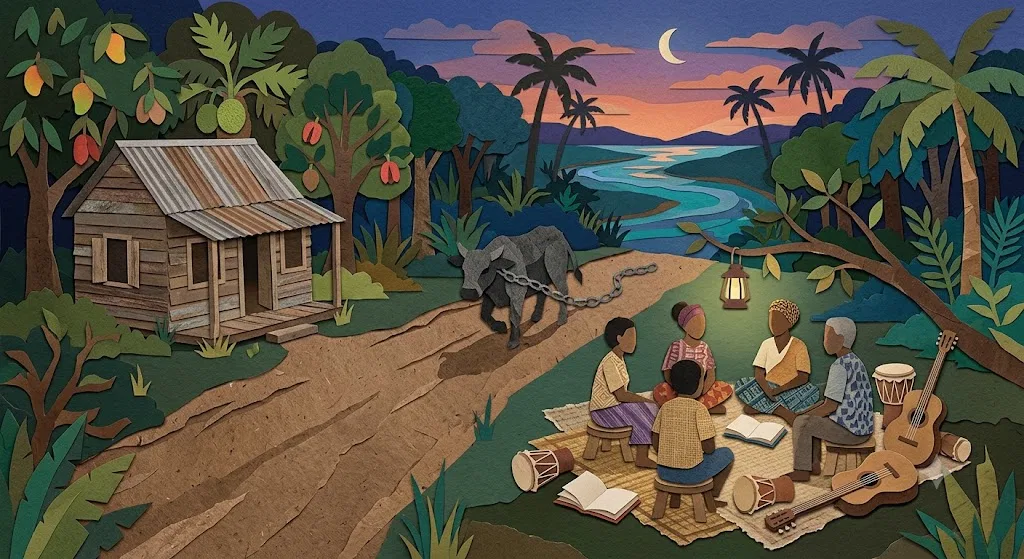
The Rolling Calf is one of Jamaica’s most recognisable duppy creatures. Modern retellings usually describe it as a monstrous calf or bull-like spirit with fiery eyes, smoke or flame, and a chain dragging behind it. Beckwith’s Anansi collection includes a note describing Rolling Calf as a duppy with fiery eyes and flames from its nostrils, dragging a chain whose rattle terrifies night travellers.[Project Gutenberg]gutenberg.org72735 h72735 h
The creature is often said to be the spirit of a wicked person, sometimes a dishonest butcher, who cannot rest after death. A Jamaica Observer folklore feature describes it as a huge calf-like being haunting lonely country roads, blocking night travellers and dragging a chain behind it.[Jamaica Observer]jamaicaobserver.comJamaica Observer Glimpses of Jamaican FolkloreJamaica Observer Glimpses of Jamaican Folklore That setting is important. The Rolling Calf belongs to the dangerous after-dark road: a world of poor lighting, rural paths, moral caution and childhood warnings. It is frightening, but it is also practical folklore. It tells people not to wander carelessly at night, not to travel alone, and not to live wickedly.
Traditional escape motifs vary, but many retellings say the creature can be delayed by dropping objects for it to count, or by reaching a crossroads or protected place. Those details place the Rolling Calf within a wider Caribbean and African-diasporic pattern in which spirits are powerful but bound by rules, distractions and ritual limits.
Ol’ Higue and the night-hag fear
Ol’ Higue is usually described as an old woman or witch-like figure who removes her skin at night and feeds on babies or children. She belongs to a wider Caribbean family of night-hag or blood-sucking female spirit traditions, but in Jamaica she has a recognisably local place in domestic warning stories. The figure is often used to explain infant danger, night crying, unexplained sickness or the fear that harm can enter the home while a family sleeps.
Because Ol’ Higue is heavily transmitted through oral and popular retellings, details vary. Some versions say she can be trapped by salt, pepper, rice grains or by finding and damaging the skin she has hidden before flight. The important point is not to treat her as a fixed monster with one canonical biography. She is better understood as a night-fear figure: part witch, part duppy, part cautionary tale, and part way of speaking about vulnerability inside the household.
River Mumma and the dangerous beauty of water
The River Mumma is Jamaica’s best-known female water spirit. She is commonly imagined as a mermaid-like guardian of rivers and freshwater pools, sometimes combing her hair with a golden comb and luring the curious towards the water. Popular Jamaican retellings describe her as a female water spirit guarding river sources, while another account presents her as a river figure whose fish should not be eaten because they are imagined as her children.[Real Jamaica Vacations]real-jamaica-vacations.comReal Jamaica Vacations Jamaican Folk TalesReal Jamaica Vacations Jamaican Folk Tales
Her story carries several meanings at once. At the simplest level, it warns children and travellers about deep water, slippery rocks and dangerous pools. At a symbolic level, it presents rivers as living places with guardians, secrets and moral boundaries. In that sense the River Mumma is not merely Jamaica’s version of a mermaid. She expresses a local water ethic: rivers are beautiful, useful and dangerous, and they demand respect.
Obeah: feared magic, colonial law and spiritual power
Obeah is one of the most contested words in Jamaican belief culture. In everyday usage it is often associated with harmful magic, curses, spiritual attack or hidden power. In historical and scholarly work, however, it is much broader and more difficult to define. Scholars have shown that British colonial authorities used “obeah” to describe a wide range of African-derived ritual, healing, oath-making and spiritual practices that they saw as threatening, especially when enslaved people organised resistance.[University of Miami Scholar Library]scholar.library.miami.eduOpen source on miami.edu.
The legal history is central. Recent scholarship notes that obeah first appeared in British colonial law in Jamaica in 1760, after a major slave revolt, and that the practice was criminalised not simply because of theology but because colonial authorities associated it with rebellion, oath-taking and collective power.[College of Liberal Arts]cla.umn.edukatharine gerbner history obeah and religious freedomkatharine gerbner history obeah and religious freedom Diana Paton’s work on the cultural politics of obeah traces how anti-obeah law developed in Jamaica and other Caribbean colonies, including the persistence of vague legal definitions after emancipation.[Cambridge University Press & Assessment]cambridge.orgOpen source on cambridge.org.
This matters because a reader will often meet obeah in ghost stories, tourist tales or horror fiction as if it simply means “black magic”. That is too narrow. Obeah has been demonised by colonial law, feared within communities, used by some as a language of harm, and reinterpreted by historians as part of African-Caribbean knowledge, healing and spiritual agency. The fact that Jamaica’s obeah law has remained a subject of debate into the 2020s shows that this is not just an old superstition but an unresolved cultural and legal issue.[Jamaica Observer]jamaicaobserver.comJamaica Observer Obeah battleJamaica Observer Obeah battle

Maroon and ancestral traditions: where folklore becomes living ritual
Jamaican folklore is not only made of tales told for entertainment. In Maroon communities, ancestral memory, music, language and ritual have formed part of living heritage. UNESCO recognises the Maroon heritage of Moore Town, noting that Kromanti ceremonies use dances, songs and specific drumming styles to invoke ancestral spirits, and that these ceremonies include a language of African origin.[UNESCO Intangible Cultural Heritage]ich.unesco.orgOpen source on unesco.org.
Kromanti Play or Kromanti Dance is especially important because it links folklore, religion, healing and history. Kenneth Bilby’s work on Jamaican Maroon spirit language records that participants in Kromanti Play believe ancestors who possess living mediums continue to speak in the language they knew when alive, even though independent historical evidence for the early language is limited.[jefftk.com]jefftk.comOpen source on jefftk.com. The Library of Congress description of the Kenneth M. Bilby Jamaican Maroon Collection also notes recordings from Moore Town, Scott’s Hall, Accompong and Charles Town in 1977–78, documenting song and drumming genres of the Kromanti Dance ritual complex, along with Kumina, Convince and grave-digging songs.[Library of Congress]hdl.loc.govLibrary of Congress Kenneth M. Bilby Jamaican Maroon CollectionLibrary of Congress Kenneth M. Bilby Jamaican Maroon Collection
This is a useful corrective to the idea that folklore is always “old stories from the past”. In Jamaica, some traditions are archived in books, some are performed on stage, some are marketed to tourists, and some remain embedded in ritual communities where ancestors, language and music still carry social force.
Jonkonnu: Christmas masquerade, memory and performance
Jonkonnu is one of Jamaica’s most striking seasonal folk traditions. It is a Christmas-time masquerade involving costumed characters, music, dance and public performance. The Jamaica Information Service describes Jonkonnu as a band of masquerades usually performed in towns and villages at Christmas, with characters such as King and Queen, Cow Head and Horse Head.[Jamaica Information Service]jis.gov.jmOpen source on jis.gov.jm. Another JIS feature calls Jonkonnu one of Jamaica’s oldest dance traditions and says it was originally celebrated during the public holidays given to enslaved Africans.[Jamaica Information Service]jis.gov.jmOpen source on jis.gov.jm.
The tradition matters because it turns the Christmas holiday into a stage for memory, satire and African-derived performance. The Jamaican culture ministry has described Jonkonnu as a Christmas tradition with African spiritual roots, combining costume, music and dance, and has supported efforts to revive it as a living art form.[Jamaica Information Service]jis.gov.jmculture ministry seeking to revive jonkonnuculture ministry seeking to revive jonkonnu Duke University’s Sylvia Wynter archive similarly describes Jonkonnu as a Jamaican celebration believed to have originated in the early eighteenth century among enslaved Africans during Christmas holidays, featuring costumes, masks, parades and dances connected to African movement and festival traditions.[exhibits.library.duke.edu]exhibits.library.duke.eduOpen source on duke.edu.
For folklore readers, Jonkonnu shows that the supernatural and the comic often overlap. Characters such as Horse Head and Cow Head are not simply “monsters”, but masquerade figures whose power lies in performance: the mask, the crowd, the rhythm, the sudden appearance in public space. Jonkonnu also links naturally to other Caribbean masquerade traditions, but Jamaica’s versions have their own local characters, histories and revival efforts.
Indigenous traces: Taíno sacred objects and the older island landscape
Most internationally familiar Jamaican folklore is African-Caribbean and creole in form, but the island also has older Indigenous histories. Taíno religious culture is difficult to reconstruct in full because colonisation, disease, violence and forced labour devastated Indigenous communities after European arrival. Even so, archaeological finds show that Jamaica was part of a wider Taíno sacred landscape.
A major study in Antiquity discusses three carved wooden Taíno images from Jamaica, describing them as the most important find of Taíno carvings from the island in two centuries.[Cambridge University Press & Assessment]cambridge.orgOpen source on cambridge.org. A related account explains that wooden images known as zemís had complex symbolic importance and that a group of three wooden figures was discovered in Jamaica’s Carpenter’s Mountains in 1792, with further objects coming to light in the twentieth century.[Academia]academia.eduPDF) Zemís, trees and symbolic landscapes: three TaínoPDF) Zemís, trees and symbolic landscapes: three Taíno Smarthistory explains that the word zemí refers not merely to an object but to a spiritual and vital force connected with deities and ancestors.[Smarthistory]smarthistory.orgOpen source on smarthistory.org.
These sources do not justify inventing a neat list of “Jamaican Taíno gods” for modern consumption. The better interpretation is more cautious and more interesting: Jamaica’s folklore landscape has African-Caribbean dominance today, but beneath it lies an older Indigenous sacred geography of caves, carved beings, ancestors, trees and ritual objects. That older layer is fragmentary, but it reminds readers that Jamaica’s supernatural imagination did not begin with the plantation era.
Haunted places and the White Witch of Rose Hall
The White Witch of Rose Hall is Jamaica’s most famous haunted-house legend, but it is also a good example of the difference between folklore, literature, tourism and history. The modern story usually says that Annie Palmer, a cruel plantation mistress at Rose Hall near Montego Bay, practised dark magic, murdered husbands or lovers, abused enslaved people and now haunts the Great House. Rose Hall’s own visitor material presents the tale of Annee Palmer as a central part of its day and night tours, including a “haunted night tour”.[Rose Hall Jamaica]rosehall.comOpen source on rosehall.com. Visit Jamaica likewise markets Rose Hall through the White Witch legend.[Visit Jamaica]visitjamaica.comOpen source on visitjamaica.com.
Historically, however, the legend is far shakier than the tourist version suggests. A scholarly article on the Rose Hall legend notes that, despite evidence that the story is thoroughly fabricated, accounts continue to present Palmer as Jamaica’s “white witch”. It examines written versions from James Castello’s 1868 pamphlet through H. G. de Lisser’s 1929 novel and later adaptations.[Sage Journals]journals.sagepub.comOpen source on sagepub.com. This is the crucial distinction: Rose Hall is a real plantation site with a real history tied to slavery and colonial wealth, but the familiar Annie Palmer ghost narrative appears to have been shaped heavily by literary and commercial retelling.
That does not make the legend unimportant. Folklore is not valuable only when it is factually true. The White Witch story shows how a plantation house can become a stage on which Jamaica processes fear, cruelty, race, gender, slavery, gothic fiction and tourism. But responsible retelling should avoid presenting the legend as confirmed history. The real horrors of plantation slavery do not need a fictional murderess to make them serious.

How Jamaican folklore changed in print, theatre, tourism and pop culture
Jamaican folklore has never been frozen. Oral tales entered books; rural duppy stories entered newspapers and tourism; Anansi moved into children’s literature, pantomime and national performance; Jonkonnu became both community practice and heritage revival; obeah moved between fear, law, scholarship and film; Rose Hall became a heritage attraction built around a ghost legend.
Printed collections changed the tradition by preserving material while also removing some of the live qualities of performance. Beckwith herself acknowledged that voice changes, dramatic action and rapid vernacular could not fully appear on the printed page, even though she tried to record the stories as closely as possible to how they were told.[Project Gutenberg]gutenberg.org72735 h72735 h Archives such as Miss Lou’s show the next stage: folklore adapted by Jamaican performers who valued the language, humour and stage energy of oral culture rather than treating it as a museum specimen.[nlj.gov.jm]nlj.gov.jmOpen source on nlj.gov.jm.
Tourism changed the tradition in a different way. Rose Hall, haunted tours and simplified creature lists often package folklore as spooky entertainment. That can introduce visitors to Jamaican legends, but it can also flatten complex traditions into monsters and jump scares. The same problem appears online, where long unsourced lists of “Jamaican mythical creatures” may mix genuine older figures with modern invention, duplication or generic fantasy labels. A careful reader should give more weight to archives, field collections, cultural institutions, scholarship and well-sourced local accounts than to viral listicles.
What readers usually misunderstand
The most common misunderstanding is to treat Jamaican folklore as a catalogue of monsters. The Rolling Calf, River Mumma and Ol’ Higue are memorable, but they are only one part of a larger belief world that includes trickster intelligence, funerary practice, ritual healing, ancestral presence, masquerade, proverbs, language and performance.
Another misunderstanding is to assume every tradition has one official version. Oral traditions are variable by nature. Anansi changes from teller to teller. Duppy protections vary by district and family. River Mumma stories differ from one river setting to another. Jonkonnu characters shift across time. Even the White Witch of Rose Hall has changed through pamphlet, novel, tour script and television haunting. Variation is not a flaw; it is how oral culture lives.
A final misunderstanding is to divide everything into “true history” or “fake story”. Jamaican folklore often sits between those categories. Anansi is not a historical person, yet his stories preserve real strategies of wit under pressure. Duppies are presented as spirits, but duppy lore also records attitudes to death, danger and moral conduct. Obeah has been sensationalised, but its criminalisation is a real legal and colonial history. Rose Hall’s ghost story may be fabricated, but the plantation world that made the legend powerful was real.
Jamaica’s folklore in one view
Jamaica’s folklore is best understood as a national story-world built from survival, warning, wit and memory. Anansi teaches that the small can outsmart the strong, though cleverness can become selfishness. Duppies and Rolling Calves turn death, wrongdoing and night travel into unforgettable warnings. River Mumma gives rivers a guardian and a danger. Ol’ Higue brings household fears into the language of night attack. Obeah reveals how African-Caribbean spiritual power was feared, used, criminalised and debated. Jonkonnu turns Christmas into masquerade, satire and ancestral performance. Maroon Kromanti traditions show that spirit, language and history can remain living practice. Rose Hall shows how legend, literature and tourism can transform a plantation site into a haunted national landmark.
The result is a folklore tradition that is entertaining, frightening and funny, but also historically serious. Jamaica’s legends are not just stories about things that go bump in the night. They are ways of remembering how people made sense of danger, death, injustice, landscape, community and power — and how they kept telling those meanings in voices strong enough to survive.
eBay marketplace picks
Marketplace Samples
Live-tested eBay searches with available results related to this page.
Endnotes
1.
Source: gutenberg.org
Title: 72735 h
Link:https://www.gutenberg.org/files/72735/72735-h/72735-h.htm
2.
Source: archive.org
Link:https://archive.org/details/jamaicaanansisto00beck
3.
Source: nlj.gov.jm
Link:https://nlj.gov.jm/history-notes-jamaica/
4.
Source: nlj.gov.jm
Link:https://www.nlj.gov.jm/archives/Miss_Lou/bennett-3.html
5.
Source: cambridge.org
Link:https://www.cambridge.org/core/books/cultural-politics-of-obeah/creole-slave-society-obeah-and-the-law/614D64A80BF1F8CCF008F662FC7AD8D3
6.
Source: Wikipedia
Link:https://en.wikipedia.org/wiki/Anansi
7.
Source: jstor.org
Link:https://www.jstor.org/stable/537633
8.
Source: academia.edu
Title: Egúngún in disguise: The Jamaican Nine Night ceremony
Link:https://www.academia.edu/12253881/Eg%C3%BAng%C3%BAn_in_disguise_The_Jamaican_Nine_Night_ceremony
9.
Source: real-jamaica-vacations.com
Title: Real Jamaica Vacations Jamaican Folk Tales
Link:https://www.real-jamaica-vacations.com/jamaican-folk-tales.html
10.
Source: scholar.library.miami.edu
Link:https://scholar.library.miami.edu/slaves/Religion/religion.html
11.
Source: ich.unesco.org
Link:https://ich.unesco.org/en/RL/maroon-heritage-of-moore-town-00053
12.
Source: jefftk.com
Link:https://www.jefftk.com/bilby1983.pdf
13.
Source: jis.gov.jm
Link:https://jis.gov.jm/information/25daysofchristmas/jonkonnu-day-2/
14.
Source: jis.gov.jm
Link:https://jis.gov.jm/radio_programs/jonkunu-jamaica/
15.
Source: jis.gov.jm
Title: culture ministry seeking to revive jonkonnu
Link:https://jis.gov.jm/culture-ministry-seeking-to-revive-jonkonnu/
16.
Source: exhibits.library.duke.edu
Link:https://exhibits.library.duke.edu/exhibits/show/sylvia-wynter/jonkunnu-maskarade
17.
Source: cambridge.org
Link:https://www.cambridge.org/core/journals/antiquity/article/zemis-trees-and-symbolic-landscapes-three-taino-carvings-from-jamaica/8B860B4122CB671F82E7CE188885558C
18.
Source: academia.edu
Title: (PDF) Zemís, trees and symbolic landscapes: three Taíno
Link:https://www.academia.edu/2359242/Zem%C3%ADs_trees_and_symbolic_landscapes_three_Ta%C3%ADno_carvings_from_Jamaica
19.
Source: smarthistory.org
Link:https://smarthistory.org/taino-zemis-and-duhos/
20.
Source: nationalarchives.gov.uk
Link:https://www.nationalarchives.gov.uk/explore-the-collection/stories/louise-bennett-coverley/
21.
Source: Wikipedia
Link:https://en.wikipedia.org/wiki/Jamaica
22.
Source: Wikipedia
Link:https://en.wikipedia.org/wiki/Jamaicans
23.
Source: Wikipedia
Link:https://en.wikipedia.org/wiki/Duppy
24.
Source: Wikipedia
Title: Mac Edward Leach
Link:https://en.wikipedia.org/wiki/MacEdward_Leach
25.
Source: Wikipedia
Link:https://en.wikipedia.org/wiki/Junkanoo
26.
Source: Wikipedia
Title: Annie Palmer (White Witch of Rose Hall)
Link:https://en.wikipedia.org/wiki/Annie_Palmer_%28White_Witch_of_Rose_Hall%29
27.
Source: Wikipedia
Title: Kromanti dance
Link:https://en.wikipedia.org/wiki/Kromanti_dance
28.
Source: gutenberg.org
Link:https://www.gutenberg.org/ebooks/72735
29.
Source: gutenberg.org
Link:https://www.gutenberg.org/ebooks/subject/21065
30.
Source: gutenberg.org
Link:https://www.gutenberg.org/ebooks/author/9554
31.
Source: nlj.gov.jm
Link:https://nlj.gov.jm/jamaican-proverbs-2/
32.
Source: nlj.gov.jm
Title: JNB50 Author Title
Link:https://nlj.gov.jm/wp-content/uploads/2016/11/JNB50_Author_Title.pdf
33.
Source: nlj.gov.jm
Link:https://nlj.gov.jm/wp-content/uploads/2016/11/JNB2002.pdf
34.
Source: nlj.gov.jm
Title: Legal20Deposit20Bibliography202004 2014
Link:https://nlj.gov.jm/wp-content/uploads/2016/11/Legal20Deposit20Bibliography202004-2014.pdf
35.
Source: nlj.gov.jm
Link:https://nlj.gov.jm/exhibition/christmas-ja/
36.
Source: nlj.gov.jm
Link:https://www.nlj.gov.jm/archives/Miss_Lou/index.html
37.
Source: nlj.gov.jm
Title: Miss Lou’s Archive Series 8 Photographic and audio-visual materials
Link:https://www.nlj.gov.jm/archives/Miss_Lou/bennett-8.html
38.
Source: jstor.org
Link:https://www.jstor.org/stable/26855622
39.
Source: jstor.org
Title: Black Britain: The Jamaicans
Link:https://www.jstor.org/stable/1259683
40.
Source: jstor.org
Link:https://www.jstor.org/stable/20006626
41.
Source: jstor.org
Link:https://www.jstor.org/stable/26899983
42.
Source: jstor.org
Link:https://www.jstor.org/stable/40986295
43.
Source: jstor.org
Link:https://www.jstor.org/stable/23019871
44.
Source: nationalarchives.gov.uk
Link:https://www.nationalarchives.gov.uk/
45.
Source: archive.org
Link:https://archive.org/stream/journalamerican09unkngoog/journalamerican09unkngoog_djvu.txt
46.
Source: archive.org
Link:https://archive.org/details/jamaicalabrish00benn
47.
Source: academia.edu
Link:https://www.academia.edu/99277662/Obeah_to_Rastafari_Jamaica_as_a_Colony_of_Ridicule_Oppression_and_Violence
48.
Source: academia.edu
Link:https://www.academia.edu/25866087/Christmas_with_the_Ancestors_Jonkonnu_and_Related_Festivities_in_Jamaica
49.
Source: ro.uow.edu.au
Link:https://ro.uow.edu.au/ndownloader/files/50401182
50.
Source: jis.gov.jm
Title: origin anancynancy stories
Link:https://jis.gov.jm/information/get-the-facts/origin-anancynancy-stories/
51.
Source: jis.gov.jm
Link:https://jis.gov.jm/information/jamaican-history/
52.
Source: historyworkshop.org.uk
Title: the racist history of jamaicas obeah laws
Link:https://www.historyworkshop.org.uk/empire-decolonisation/the-racist-history-of-jamaicas-obeah-laws/
53.
Source: si.edu
Link:https://www.si.edu/object/siris_sil_555021
54.
Source: roughguides.com
Title: 6 fascinating jamaican traditions and customs
Link:https://www.roughguides.com/article/6-fascinating-jamaican-traditions-and-customs/
55.
Source: jamaicaobserver.com
Title: Jamaica Observer Glimpses of Jamaican Folklore
Link:https://www.jamaicaobserver.com/2012/08/05/glimpses-of-jamaican-folklore/
56.
Source: cla.umn.edu
Title: katharine gerbner history obeah and religious freedom
Link:https://cla.umn.edu/history/news-events/story/katharine-gerbner-history-obeah-and-religious-freedom
57.
Source: jamaicaobserver.com
Title: Jamaica Observer Obeah battle
Link:https://www.jamaicaobserver.com/2026/06/09/obeah-battle/
58.
Source: hdl.loc.gov
Title: Library of Congress Kenneth M. Bilby Jamaican Maroon Collection
Link:https://hdl.loc.gov/loc.afc/eadafc.af002001.3
59.
Source: rosehall.com
Link:https://rosehall.com/rose-hall/
60.
Source: visitjamaica.com
Link:https://www.visitjamaica.com/listing/rose-hall-great-house/56/
61.
Source: journals.sagepub.com
Link:https://journals.sagepub.com/doi/10.1177/0021989414529784
62.
Source: natureandsupernaturalnature.wordpress.com
Title: macedward leach
Link:https://natureandsupernaturalnature.wordpress.com/tag/macedward-leach/
63.
Source: raquelbahadoorsingh.wordpress.com
Title: river mumma
Link:https://raquelbahadoorsingh.wordpress.com/river-mumma/
64.
Source: lifeinpleasantville.com
Link:https://www.lifeinpleasantville.com/rose-hall-great-house-and-the-white-witch/
65.
Source: folkways.si.edu
Link:https://folkways.si.edu/harold-courlander/anansi-the-oldest-of-animals/childrens-prose/track/smithsonian
66.
Source: my-island-jamaica.com
Link:https://www.my-island-jamaica.com/rolling_calf.html
67.
Source: thepalmsjamaica.com
Title: Annie Palmer
Link:https://thepalmsjamaica.com/annie-palmer-white-witch-rose-hall/
68.
Source: bandgallery.com
Title: Jonkonnu | Experience Folk Traditions
Link:https://www.bandgallery.com/jonkonnu
69.
Source: jamaicagreathouses.com
Title: Rose Hall
Link:https://jamaicagreathouses.com/rosehall/index.html
70.
Source: library.mcmaster.ca
Link:https://library.mcmaster.ca/finding-aid/bennett
71.
Source: amstardmc.com
Title: White Witch of Rose Hall
Link:https://www.amstardmc.com/en/excursions/bewitched-jamaican-tour/
72.
Source: caribbeanlanguages.org.jm
Link:https://www.caribbeanlanguages.org.jm/node/52
73.
Source: openlibrary.org
Title: Louise Bennett
Link:https://openlibrary.org/authors/OL629650A/Louise_Bennett
74.
Source: abookofcreatures.com
Title: rolling calf
Link:https://abookofcreatures.com/2017/05/29/rolling-calf/
75.
Source: en.wikisource.org
Title: Jamaica Anansi Stories
Link:https://en.wikisource.org/wiki/Jamaica_Anansi_Stories
76.
Source: visitjamaica.com
Link:https://www.visitjamaica.com/
Additional References
77.
Source: youtube.com
Title: Jamaican Duppy Stories Anansi, Rolling Calf & White Witch of Rose Hall
Link:https://www.youtube.com/watch?v=j0FcJ9pX0cE
Source snippet
5 Dark Jamaican Folklore Stories That Will Haunt You Forever...
78.
Source: youtube.com
Title: 5 Dark Jamaican Folklore Stories That Will Haunt You Forever
Link:https://www.youtube.com/watch?v=DLzX2DLi1-M
Source snippet
The Terrifying Legend of Jamaican Duppies...
79.
Source: hugendubel.de
Link:https://www.hugendubel.de/de/buch_gebunden/martha_warren_beckwith-jamaica_anansi_stories-53090003-produkt-details.html?srsltid=AfmBOoqIDZoLhzjiATrHVkzDkex7gxfDbn6BxfdM4p4rLCZkz9gQuAj-
80.
Source: researchgate.net
Link:https://www.researchgate.net/publication/355714743_The_Waters_Were_Made_for_Her_River_Mumma_beliefs_in_19th_and_20th_century_Jamaican_ethnographic_accounts
81.
Source: facebook.com
Link:https://www.facebook.com/gleanerjamaica/posts/anansi-is-a-jamaican-national-folkloric-hero-who-should-be-so-honoured-he-is-a-s/1823383397816757/
82.
Source: cjids.in
Link:https://cjids.in/anansi-myth-and-resistance-exploring-anansi-folklore-as-trangressive-culture-during-slavery/
83.
Source: substack.com
Link:https://substack.com/home/post/p-150882735
84.
Source: scribd.com
Link:https://www.scribd.com/document/846427425/Jamaican-folklore-and-customs
85.
Source: medium.com
Link:https://medium.com/%40karennordhus/annie-palmer-the-white-witch-of-rose-hall-81b434be4a2e
86.
Source: facebook.com
Link:https://www.facebook.com/groups/Taino101/posts/3230006247146618/
Topic Tree
Follow this branch
Related pages 192
- Afghan Folklore
- Albanian Folklore
- Algerian Folklore
- Australian Folklore
- Azerbaijan Folklore
- +187 more in sidebar