Within Philippine Folklore
Who Lives in the Philippine Spirit World?
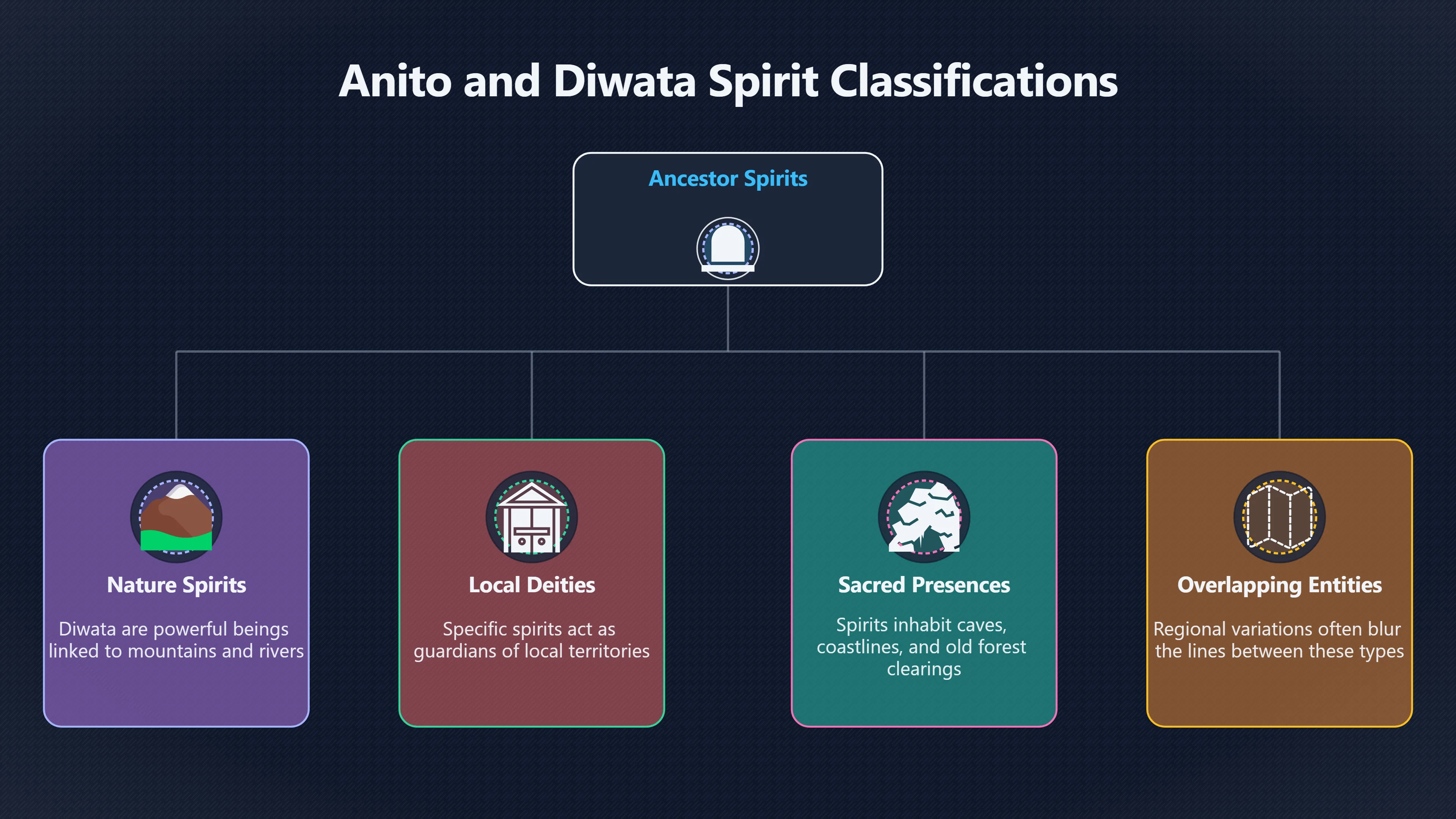
Anito and diwata traditions show a spirit world where ancestors, nature beings and ritual specialists shape everyday rules of respect.
On this page
- Ancestor spirits and nature beings
- Ritual specialists, offerings and healing
- Why old trees and mounds matter
Page outline Jump by section
Introduction
Many Philippine tales make the most sense when viewed through a simple idea: the landscape is alive. A river is not just water, a mountain is not just rock, and a great old tree is not merely part of the scenery. Across many indigenous traditions of the Philippines, places are understood as social spaces shared with ancestors, spirits and powerful unseen beings. The names and details vary from region to region, but two of the most important concepts are often described in English as anito and diwata—terms associated with ancestor spirits, nature beings and sacred presences that shape relationships between people and place.[Wikipedia]WikipediaOpen source on wikipedia.org.
This spirit-filled landscape is not simply a collection of supernatural stories. It provides a framework for understanding illness, healing, good fortune, misfortune, memory, kinship and proper behaviour. Many customs that survive today—from asking permission before entering a forest to showing respect near old trees or burial grounds—reflect older ideas about living alongside unseen neighbours.[Wikipedia]WikipediaReligion in pre-colonial PhilippinesFebruary 24, 2026 — Wooden images of ancestral spirits (anito) in a museum in Bontoc, Philippines…
Who Lives in the Philippine Spirit World?
The terms anito and diwata do not have exactly the same meaning everywhere in the Philippines. Different languages and communities use them in different ways. Broadly speaking, however, anito are often associated with ancestors and the spirits of the dead, while diwata are commonly linked with nature spirits, local deities and powerful beings connected to the landscape. In some regions the distinction is blurred, and the two terms can overlap.[Wikipedia]WikipediaOpen source on wikipedia.org.
Rather than imagining a distant heaven separated from daily life, many traditional beliefs describe a world in which spiritual beings remain close to human communities. The dead may continue to influence the fortunes of their descendants. Nature spirits may inhabit mountains, rivers, caves, forests or particular trees. Communities therefore exist within a network of relationships that extends beyond the visible world.[Wikipedia]WikipediaReligion in pre-colonial PhilippinesFebruary 24, 2026 — Wooden images of ancestral spirits (anito) in a museum in Bontoc, Philippines…
Ancestor spirits and nature beings
Ancestor spirits occupy a special place because they are family. They are not always portrayed as all-powerful or entirely benevolent, but they remain connected to their descendants. Offerings, prayers and remembrance help maintain this relationship. In many traditions, ancestors can provide protection, guidance or warnings when properly respected.[Wikipedia]WikipediaOpen source on wikipedia.org.
Diwata, meanwhile, are often linked to particular locations and natural forces. Modern popular culture sometimes reduces them to fairy-like beings, but older traditions frequently present them as powerful guardians, local deities or spirit rulers associated with specific landscapes. A mountain may have its own diwata. A forest clearing may be regarded as belonging to one. Certain rivers, caves or coastlines can likewise be understood as spiritually occupied territory.[aswangproject.com]aswangproject.comTHE ASWANG PROJECTThe DIWATA of Philippine Mythology | Ancestors, Spirits, &…Mar 3, 2016 — A DIWATA is most popularly known in modern…
This helps explain why so many Philippine legends begin with an accidental trespass. A hunter enters the wrong grove, a traveller disturbs a forbidden place, or a farmer ignores local warnings. The story is often less about monsters than about broken relationships between humans and the living landscape.
How People Communicated with the Spirit World
Traditional communities did not necessarily view spirits as distant objects of worship. They were participants in local life, and communication with them formed part of community practice. This communication usually occurred through rituals known in some regions as pag-anito or pagdiwata, ceremonies involving offerings, prayers and requests for assistance.[Wikipedia]WikipediaOpen source on wikipedia.org.
The goal was often practical rather than abstract. People sought healing, protection, successful harvests, favourable weather, safe travel or relief from illness. Spirits might be thanked, consulted or appeased depending on the situation.[Wikipedia]WikipediaOpen source on wikipedia.org.
Ritual specialists, offerings and healing
A central figure in many traditions was the ritual specialist known by names such as babaylan or katalonan. These individuals acted as intermediaries between the human and spirit worlds. Historical accounts describe them as healers, mediums, religious leaders and custodians of ritual knowledge. Many were women, while some communities also recognised feminised male ritual specialists who occupied respected spiritual roles.[Wikipedia]WikipediaFilipino shamansApril 22, 2026 — These shamans specialized in communicating, appeasing, or harnessing the spirits of the dead and the spirits of nature…
Healing was one of their most important responsibilities. Illness might be interpreted not only as a physical condition but also as a disturbance in relationships between people, ancestors and spirits. Rituals could involve offerings, chanting, herbal knowledge, divination or spirit communication intended to restore balance.[Wikipedia]WikipediaFilipino shamansApril 22, 2026 — These shamans specialized in communicating, appeasing, or harnessing the spirits of the dead and the spirits of nature…
Offerings varied by region and occasion. Food, drink, flowers and other valued items could be presented to spirits. Historical descriptions also mention ritual objects, spirit images and ceremonial spaces used in community observances. These acts expressed respect and reciprocity rather than simple fear.[nationalmuseum.gov.ph]nationalmuseum.gov.phRitual ObjectsRituals form an important part of the indigenous knowledge and practices among Philippine ethnolinguistic groups. Reflectin…

Why Old Trees and Mounds Matter
One of the most enduring features of Philippine belief culture is the idea that certain places deserve special caution. Stories repeatedly identify old trees, large anthills, caves, riverbanks, forest clearings, rocky outcrops and burial areas as locations where unseen beings may dwell.[scribd.com]scribd.comAncient Philippine Animism Explained | PDFThe diwata were nature spirits that inhabited sacred places such as mountains and trees a…
The practical result is a set of landscape manners. People may avoid unnecessary disturbance, speak respectfully when entering unfamiliar places or make symbolic gestures acknowledging local spirits. Even among people who no longer accept the beliefs literally, these customs often survive as habits, jokes or acts of cultural respect.[Wikipedia]WikipediaReligion in pre-colonial PhilippinesFebruary 24, 2026 — Wooden images of ancestral spirits (anito) in a museum in Bontoc, Philippines…
Old trees occupy a particularly important place in folklore. Their age, size and apparent permanence make them natural candidates for stories about spirit residents. A giant tree can become a landmark, a community memory site and a focus of local supernatural traditions all at once. Similar ideas attach to ancient mounds and unusual landscape features that appear older than human settlement.[Scribd]scribd.comAncient Philippine Animism Explained | PDFThe diwata were nature spirits that inhabited sacred places such as mountains and trees a…
From a folkloric perspective, these beliefs do more than explain strange experiences. They encourage caution toward places that are ecologically significant, historically important or culturally meaningful. The landscape becomes a community of relationships rather than a collection of resources.
How the Tradition Changed After Colonisation
Spanish colonisation and the spread of Christianity transformed Philippine religious life, but older spirit traditions did not simply disappear. Instead, many beliefs adapted and merged with new religious frameworks. Ancestors, local spirits and sacred places often continued to exist within popular practice even when official religious teachings changed.[Wikipedia]WikipediaReligion in pre-colonial PhilippinesFebruary 24, 2026 — Wooden images of ancestral spirits (anito) in a museum in Bontoc, Philippines…
Colonial writers frequently described indigenous spirit figures as idols, demons or superstitions, which altered how later generations understood them. Over time, the word anito became associated not only with spirits themselves but also with carved images representing them. Meanwhile, diwata were increasingly reimagined through literature, art and modern entertainment.[Wikipedia]WikipediaIndigenous Philippine folk religionsIndigenous Philippine folk religions
This process helps explain why modern depictions sometimes portray diwata as fairy-like characters. The older traditions contain much broader and more powerful concepts than the familiar fantasy image suggests.[THE ASWANG PROJECT]aswangproject.comTHE ASWANG PROJECTThe DIWATA of Philippine Mythology | Ancestors, Spirits, &…Mar 3, 2016 — A DIWATA is most popularly known in modern…

Why These Ideas Still Matter
Anito and diwata traditions remain important because they offer a distinctly Philippine way of understanding place. They connect family memory, environmental awareness, healing practices and local identity into a single worldview. Even where formal belief has weakened, the stories continue to influence language, etiquette, popular culture and attitudes toward the natural world.[Digital Commons]digitalcommons.ciis.eduDigital CommonsDeep Ecology, Nature Spirits, and the Filipino…by CL Cervantes · Cited by 8 — These spirits in nature are often called…
For folklorists, the most revealing aspect of these traditions is not whether spirits literally inhabit a mountain or tree. It is the idea that landscapes are social and moral spaces. Rivers, forests, houses and ancestral lands are treated as places where relationships matter. Respect is not directed only toward other people but toward the wider world that surrounds them.[Wikipedia]WikipediaReligion in pre-colonial PhilippinesFebruary 24, 2026 — Wooden images of ancestral spirits (anito) in a museum in Bontoc, Philippines…
In that sense, the Philippine spirit world is not separate from the landscape at all. The landscape itself is part of the story.
Amazon book picks
Further Reading
Books and field guides related to Who Lives in the Philippine Spirit World?. Use these as the next step if you want deeper reading beyond the article.
eBay marketplace picks
Marketplace Samples
Live-tested eBay searches with available results related to this page.


Endnotes
1.
Source: Wikipedia
Link:https://en.wikipedia.org/wiki/Anito
2.
Source: Wikipedia
Title: Indigenous Philippine folk religions
Link:https://en.wikipedia.org/wiki/Indigenous_Philippine_folk_religions
3.
Source: Wikipedia
Link:https://en.wikipedia.org/wiki/Religion_in_pre-colonial_Philippines
Source snippet
Religion in pre-colonial PhilippinesFebruary 24, 2026 — Wooden images of ancestral spirits (anito) in a museum in Bontoc, Philippines...
Published: February 24, 2026
4.
Source: Wikipedia
Title: Philippine mythology
Link:https://en.wikipedia.org/wiki/Philippine_mythology
Source snippet
Philippine mythologyAnito, or anitu In Philippine mythology, refers to ancestor spirits, spirits of the dead, evil spirits and the woo...
5.
Source: scribd.com
Link:https://www.scribd.com/document/599712772/Iya-Article-Animismong-Pilipino-JAS
Source snippet
Ancient Philippine Animism Explained | PDFThe diwata were nature spirits that inhabited sacred places such as mountains and trees a...
6.
Source: aswangproject.com
Link:https://www.aswangproject.com/diwata/
Source snippet
THE [ASWANG]({{ 'aswang/' | relative_url }}) PROJECTThe DIWATA of Philippine Mythology | Ancestors, Spirits, &...Mar 3, 2016 — A DIWATA is most popularly known in modern...
7.
Source: Wikipedia
Link:https://en.wikipedia.org/wiki/Diwata
8.
Source: nationalmuseum.gov.ph
Link:https://www.nationalmuseum.gov.ph/our-collections/ethnology/ritual-objects/
Source snippet
Ritual ObjectsRituals form an important part of the indigenous knowledge and practices among Philippine ethnolinguistic groups. Reflectin...
9.
Source: Wikipedia
Title: Filipino shamans
Link:https://en.wikipedia.org/wiki/Filipino_shamans
Source snippet
April 22, 2026 — These shamans specialized in communicating, appeasing, or harnessing the spirits of the dead and the spirits of nature...
Published: April 22, 2026
10.
Source: studocu.com
Link:https://www.studocu.com/ph/document/sti-college/art-appreciation/religion-none/46367715
Source snippet
untains, hills, trees, anthills. bodies of wate...Read more...
11.
Source: Wikipedia
Link:https://en.wikipedia.org/wiki/Animism
12.
Source: scribd.com
Link:https://www.scribd.com/document/430358869/Anito
Source snippet
PDF | Religion And Belief13 Oct 2019 — Anito, also spelled anitu, refers to ancestor spirits, nature spirits, and deities (diwata) in the...
13.
Source: digitalcommons.ciis.edu
Link:https://digitalcommons.ciis.edu/context/ijts-transpersonalstudies/article/1797/viewcontent/IJTS_42_01_03_Cervantes_2023_Deep_ecology_nature_spirits_and_the_Filipino_transpersonal_worldview.pdf
Source snippet
Digital CommonsDeep Ecology, Nature Spirits, and the Filipino...by CL Cervantes · Cited by 8 — These spirits in nature are often called...
14.
Source: researchgate.net
Link:https://www.researchgate.net/publication/358565438_Babaylan_in_Philippine_Communities_liminality_myth_and_inspiration
Source snippet
Babaylan in Philippine Communities: liminality, myth and...Babaylan are now construed as a female or a transgender being that has mystic...
Additional References
15.
Source: apa.si.edu
Link:https://apa.si.edu/babaylan/
Source snippet
Ang babaylan nga nahimong bayotBabaylan were our pre-colonial spiritual leaders who practiced animism. They were a matriarchy that allowe...
16.
Source: hisour.com
Link:https://www.hisour.com/data/anito/
Source snippet
Anito – HiSoUR – Hi So You AreAnito, also spelled anitu, refers to ancestor spirits, nature spirits, and deities (diwata) in the indigeno...
17.
Source: facebook.com
Link:https://www.facebook.com/HeneralAgimat8/posts/the-anitos-are-ancestral-spirits-that-are-said-to-reside-in-trees-rivers-and-oth/1335506264917824/
Source snippet
THE 'ANITOS' ARE ANCESTRAL SPIRITS THAT ARE SAID...The term "anito" in pre-colonial Philippines refers to a range of supernatural beings...
18.
Source: openmindproject.com
Link:https://openmindproject.com/oceanic-religions/pacific-islands-indigenous-religions/anito
19.
Source: factsanddetails.com
Link:https://factsanddetails.com/southeast-asia/Philippines/sub5_6c/entry-9953.html
20.
Source: facebook.com
Link:https://www.facebook.com/groups/memoriesoldmanila/posts/990920407729479/
Source snippet
A belief where there is one God above all with high respect to all gods creations. Respect of elders and...Read more...
21.
Source: youtube.com
Link:https://www.youtube.com/watch?v=6LxIZnD5v2g
Source snippet
15.1 | The Babaylan of Pre-Colonial PhilippinesNHCP's Museum of Philippine Social History. Full Documentary on Philippine Shamanism (with...
22.
Source: facebook.com
Link:https://www.facebook.com/kirbynoodle/videos/-diwata-anito-engkanto-theyre-not-the-same-and-they-were-never-meant-to-be-diwat/714136578193059/
Source snippet
♂️ And Engkanto? That term was introduced under colonialism. It...
23.
Source: instagram.com
Link:https://www.instagram.com/reel/DMee6I4OoXI/?hl=en
Source snippet
he universe. Anito refers to ancestral spirits, often honored...
24.
Source: facebook.com
Title: National Museum of the Philippines
Link:https://www.facebook.com/nationalmuseumofthephilippines/posts/one-of-the-nationalmuseumphs-advantages-in-having-15-national-museums-outside-ma/3150351558322474/
Source snippet
ManilaThe Pana-et ritual of Tubungan, Iloilo, involving babaylanes or spirit mediums, is one such practice that speaks volumes about our...
Topic Tree