Living Folklore of Egypt
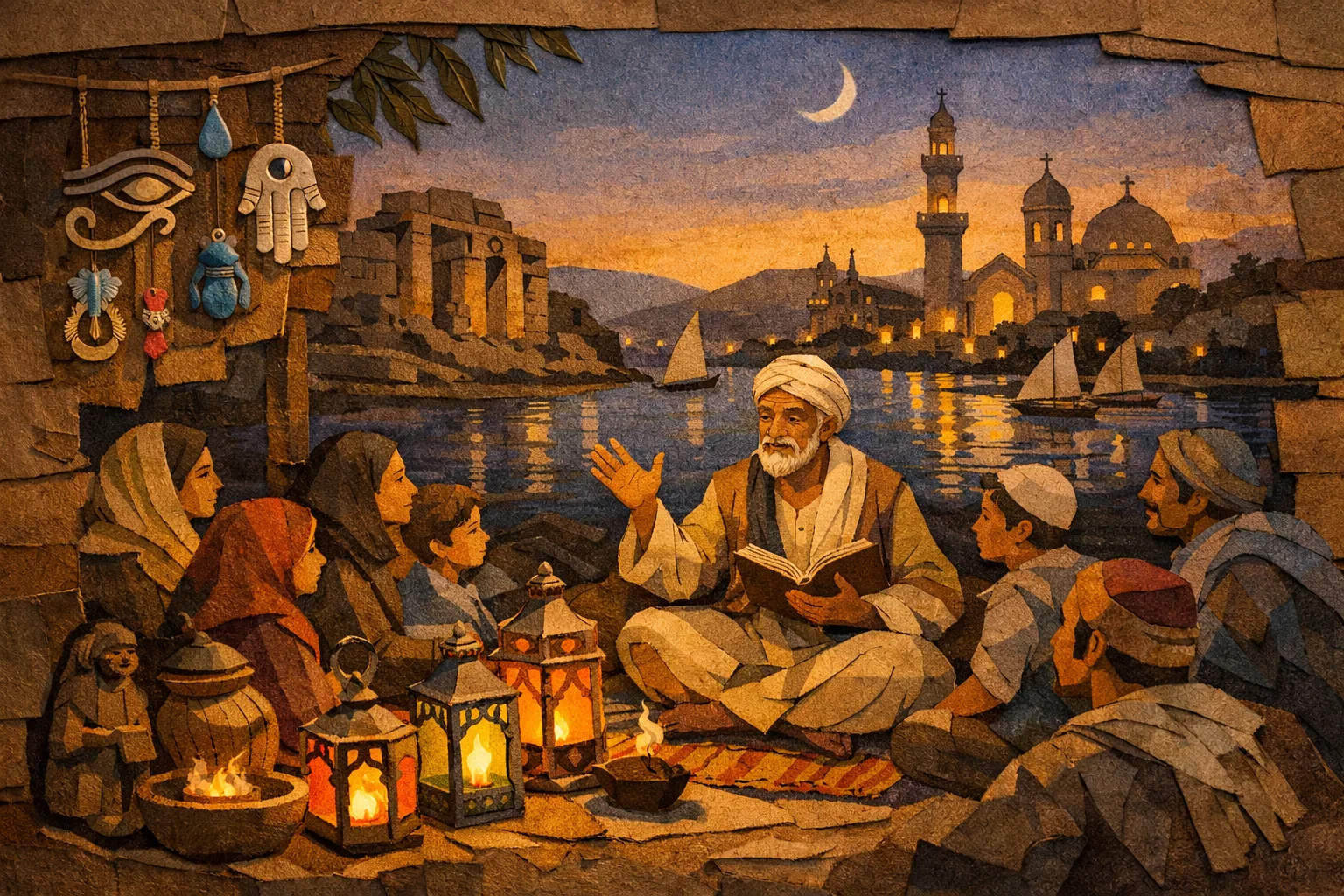
Egyptian folklore is not just a set of old stories about pharaohs, pyramids and gods. It is a living mix of oral epics, saints’ festivals, protective charms, spirit beliefs, puppet theatre, Coptic pilgrimage legends, desert monsters, household rituals and modern retellings.
Page outline Jump by section
Introduction
For a first-time reader, the most useful way to understand folklore in Egypt is to separate three layers that often overlap: ancient myth and magic preserved in temples, tombs and museum objects; later oral and religious traditions performed in villages, homes, streets and festivals; and modern versions shaped by books, television, horror films, tourism and the internet. Egypt’s folklore matters because it shows how people have explained danger, illness, luck, birth, death, migration, holiness and social disorder in everyday terms, not only through official religion or written history.
What Counts as Egyptian Folklore?
Egyptian folklore covers far more than ancient mythology. The gods of ancient Egypt are important, but a folklore page on Egypt also needs to include the stories and practices that ordinary people carried, performed and adapted: sung epics, family tales, village saints’ festivals, charms against envy, spirit-healing rites, comic puppets, rumours about haunted ruins, and local legends attached to mosques, churches, tombs, rivers and deserts.
This is why Egypt can feel confusing to outsiders. A museum label may describe a protective amulet from the Late Period; a Coptic community may celebrate a stop on the Holy Family’s journey; a family may speak of envy or harmful spirits; a performer may recite an epic in a café style inherited from earlier generations. These are not the same tradition, but they share a concern with the unseen world and with stories that help communities explain fortune, danger and identity.
Egypt’s official intangible heritage record gives a useful starting point. UNESCO lists Egypt’s oral epic of the Bani Hilal, traditional hand puppetry, festivals connected with the Journey of the Holy Family, and other practices under intangible cultural heritage, showing that modern heritage work treats performance, ritual and oral tradition as part of the country’s cultural inheritance rather than as marginal superstition.[UNESCO ICH]ich.unesco.orgUNESCO ICHEgyptSafeguarding and capacity building for the intangible cultural heritage of Al-Aragoz traditional hand puppetry in Egypt ·…
Ancient Magic Is Not the Whole Story, But It Still Matters
The most famous Egyptian stories outside Egypt are usually ancient: Osiris, Isis, Horus, Anubis, Ra, mummies, curses and the afterlife. These belong to religion and myth as much as folklore, but they shaped later imagination because they were full of vivid narrative images: a murdered king restored by his wife, a child-god protected from dangerous animals, a sun god travelling through darkness, and the dead needing words, objects and ritual knowledge to pass safely beyond life.
Ancient Egyptian magic was not simply “spooky” entertainment. It was a practical system for protection, healing and cosmic order. Museum objects show this clearly. A “Horus on the Crocodiles” magical stele, also called a cippus, showed the child Horus standing over crocodiles and grasping dangerous creatures; water poured over such inscribed objects was believed to become curative, especially against snake and scorpion venom.[egypt-museum.com]egypt-museum.comEgypt Museum Cippus of HorusEgypt Museum Cippus of Horus
Household protection was just as important as royal religion. The goddess Taweret, often shown with hippopotamus, lion, crocodile and human features, was especially associated with pregnancy, childbirth and the protection of women and children. The Metropolitan Museum of Art notes her role as a protective figure in pregnancy and childbirth, while Glencairn Museum describes Taweret amulets as part of the religious life of ancient Egyptian families.[The Metropolitan Museum of Art]metmuseum.orgThe Metropolitan Museum of Art Taweret AmuletThe Metropolitan Museum of Art Taweret Amulet
This ancient material should not be flattened into a claim that modern Egyptian folk beliefs are simply “survivals” from the pharaohs. Some symbols and concerns recur: protection from harm, the danger of envy, the vulnerability of children, the power of words and images, and the need to manage unseen forces. But modern Egyptian folklore has also been shaped by Arabic-speaking culture, Islam, Christianity, Ottoman and colonial-era urban life, migration, mass media and regional exchange.
The Great Oral Epic: Bani Hilal in Egyptian Performance
One of Egypt’s most important folklore traditions is the epic of the Bani Hilal. UNESCO describes it as an oral poem recounting the migration of the Bani Hilal tribe from the Arabian Peninsula to North Africa, and identifies it as one of the major epic poems of the Arabic folk tradition. It was inscribed on UNESCO’s Representative List of the Intangible Cultural Heritage of Humanity in 2008.[UNESCO ICH]ich.unesco.orgOpen source on unesco.org.
For readers used to written myths, the key point is that this was not just a text. It was a performance tradition. Poets and singers carried the story in musical form, adapting episodes for audiences and occasions. The epic connected Egypt to a wider Arabic-speaking world, but Egypt became especially important because the tradition remained strongly associated with Egyptian performers and communities.
The story’s attraction lies partly in its scale. It is a migration legend, a heroic tale, a tribal memory, and a performance of social values. It deals with courage, loss, loyalty, trickery, exile and identity. In heritage terms, it is valuable because it preserves a form of oral artistry that is harder to maintain in an age of television, smartphones and changing public entertainment. UNESCO’s description explicitly frames the epic as a living but threatened oral tradition.[UNESCO ICH]ich.unesco.orgOpen source on unesco.org.
There is also a useful caution here. Heritage listings can make a tradition look neat and fixed, while oral tradition is usually fluid. Versions vary; performers emphasise different characters; collectors and archivists shape what later readers see. For Egyptian folklore, the Bani Hilal epic is best understood not as a single “official story”, but as a great river of connected performances.
Saints’ Festivals Turn Places Into Story
Egyptian folklore is strongly tied to place. Some of the country’s most memorable traditions are not just stories told about saints, but festivals performed around saints’ tombs, mosques, churches and neighbourhoods. These festivals are often described in English as moulids: birthday or saint-day celebrations that mix devotion, music, food, markets, vows, family visits, performance and public spectacle.
The American Research Center in Egypt describes Egyptian moulids as popular, long-standing saints’ festivals held across the country, with the saint at the centre transforming a busy gathering into a festival of blessing, ritual and fellowship.[Google Arts & Culture]artsandculture.google.comOpen source on google.com.
A striking example is the festival of Abu al-Haggag in Luxor. The saint’s mosque stands within the ancient Luxor Temple complex, making the site a vivid example of layered sacred geography. Local legend says Abu al-Haggag asked a queen for only a camel hide to sleep on, then turned it into a cord long enough to encircle and claim the city; in some versions the queen converts.[Google Arts & Culture]artsandculture.google.comOpen source on google.com.
The Abu al-Haggag festival is often noted because it seems to echo older procession traditions associated with Luxor, though such continuities should be handled carefully. It is safer to say that the festival shows how a place can gather different religious histories into one public landscape: ancient temple, Islamic saint, local legend, procession, family celebration and tourist curiosity.[google.com]artsandculture.google.comOpen source on google.com.
Coptic Christian traditions also form a major part of Egypt’s sacred folklore. UNESCO lists festivals related to the Journey of the Holy Family in Egypt, commemorating the flight of Mary, Joseph and the infant Jesus from Bethlehem to Egypt. These festivals turn biblical memory into local geography, linking churches, monasteries, villages and pilgrimage routes to a sacred story that Egyptian Christians have made distinctively local.[UNESCO ICH]ich.unesco.orgOpen source on unesco.org.
Spirits, Healing and the Social Life of Fear
Egyptian supernatural folklore includes jinn, afarit, ghouls, protective saints, dreams, envy, apparitions, haunted places and spirit possession. These beliefs should be described as traditions and narratives, not as proof of supernatural events. Their importance lies in what they reveal about fear, illness, social pressure and the search for relief.
One of the best-documented examples is zar, a spirit-possession and healing ritual complex found in Egypt and around the Red Sea and Arabian Gulf. Hager El Hadidi’s study, published by the American University in Cairo Press, describes zar both as a possessing spirit and as a set of reconciliation rites between spirits and human hosts; the AUC Press summary also notes that the book examines a waning culture in which Muslim women negotiate relations with spirits.[The American University in Cairo Press]aucpress.comThe American University in Cairo Press ZarThe American University in Cairo Press Zar
Zar is often misunderstood by outsiders as simple exorcism or spectacle. In Egyptian settings, it has more often worked as a social and musical healing practice, especially for women. It creates a space where distress can be named through spirit relationships, music, rhythm, offerings and ritual obligation. That does not mean every participant or observer interprets it in the same way. Some may see it as healing, some as unorthodox religion, some as performance, some as heritage, and some as superstition.
The broader spirit world of Egyptian folklore overlaps with Arabic and Islamic categories. Jinn are part of wider Islamic cosmology, while afarit and ghouls appear in folk speech, tales and popular horror. Academic work on the Arabic ghoul describes it as a frightening human-like monster associated with deserts, lonely places and danger to travellers, while studies of Arab folklore identify figures such as ogres, devils and afarit as recurring belief-characters in narrative tradition.[jstor.org]jstor.orgThe Arabic Ghoul and its Western TransformationThe Arabic Ghoul and its Western Transformation
For a reader, the main takeaway is that Egyptian monster folklore is often local and situational. It is attached to ruins, canals, cemeteries, roads, abandoned houses, deserts and thresholds. These are places where ordinary safety feels uncertain. The monster or spirit gives shape to that uncertainty.
The Evil Eye and Everyday Protection
Some of the most persistent folklore in Egypt is not told as a dramatic tale at all. It appears in everyday speech, gestures, jewellery, household objects and explanations for misfortune. Belief in envy or the evil eye is a good example. In many Egyptian contexts, sudden illness, a broken possession, business trouble or a child’s distress may be explained through harmful envy, whether intentional or not.
This belief is not uniquely Egyptian. It is widespread across the Middle East, North Africa, the Mediterranean and beyond. But in Egypt it sits naturally beside older and newer protection practices: amulets, religious phrases, charms, protective symbols, prayers, and avoidance of excessive praise. Popular journalism from Egypt describes evil-eye objects and protective charms as part of everyday life, while museum discussions of ancient Egyptian amulets show that protective objects have a much older history in the Nile Valley.[dailynewsegypt.com]dailynewsegypt.comDaily News Egypt The evil eye in EgyptDaily News Egypt The evil eye in Egypt
The temptation is to draw a straight line from ancient amulets to modern charms. The better interpretation is more cautious and more interesting. Egyptians across very different religious periods have repeatedly used objects, words and symbols to manage vulnerability. The forms changed, but the emotional problem stayed recognisable: how do you protect a child, a pregnancy, a home, a journey, a new possession or a fragile piece of good fortune?

Folktales, Coffeehouse Storytelling and Comic Puppets
Egyptian folklore also lives in humour. Not every supernatural or traditional form is solemn. Folk stories, jokes, trickster tales and comic performances have long allowed Egyptians to laugh at authority, expose foolishness and turn daily frustration into entertainment.
Hasan M. El-Shamy’s Folktales of Egypt is a major English-language collection of modern Egyptian folk narratives. The University of Chicago Press description notes that El-Shamy gathered seventy recently collected Egyptian tales and presented them with Middle Eastern and African parallels, giving Egyptian oral narrative a level of scholarly attention that earlier collections had often lacked.[researchgate.net]researchgate.netResearch Gate(PDF) Folktales of EgyptResearch Gate(PDF) Folktales of Egypt
Another important tradition is Al-Aragoz, Egypt’s traditional hand puppetry. UNESCO describes it as an old form of Egyptian theatre in which puppeteers perform from inside a small portable stage, using a distinctive voice modifier for the main puppet and presenting comic, interactive scenes about daily life. It was inscribed in 2018 on UNESCO’s List of Intangible Cultural Heritage in Need of Urgent Safeguarding.[UNESCO ICH]ich.unesco.orgtraditional hand puppetry 01376traditional hand puppetry 01376
Al-Aragoz matters because it shows folklore as public play. The puppet can mock, interrupt, exaggerate and expose. Its comedy is not separate from social commentary; it is one of the ways ordinary audiences recognise themselves. Like many performance traditions, it is threatened not because people no longer enjoy humour, but because the chain of skilled performers, apprentices, portable stages and regular public venues has weakened.[UNESCO ICH]ich.unesco.orgtraditional hand puppetry 01376traditional hand puppetry 01376
Desert Monsters, Haunted Ruins and the Tourist Imagination
Egypt’s global image has made its folklore unusually vulnerable to outside reinvention. Foreign audiences often expect curses, mummies, secret tombs and ancient gods returning from the dead. These motifs are now part of world popular culture, but they are not the same thing as Egyptian folk tradition.
The “mummy’s curse” is a good example of the difference between local belief, colonial-era media and modern entertainment. Ancient Egyptians certainly believed in powerful words, protective inscriptions and dangers around the dead. But the modern curse story was amplified by European and American fascination with tomb discoveries, especially in the age of mass newspapers and cinema. It tells us as much about foreign fears of disturbing Egypt as it does about Egyptian tradition.
Inside Egypt, haunted-place stories more often attach to specific social landscapes: cemeteries, old houses, canals, desert roads, ruins, shrines and treasure sites. Jinn and afarit may be imagined as guarding, misleading or punishing. Ghouls belong especially well to desert and lonely-road folklore because they embody the danger of being lured away from safety.[JSTOR]jstor.orgThe Arabic Ghoul and its Western TransformationThe Arabic Ghoul and its Western Transformation
Modern Egyptian and Arab horror media continue to recycle these figures. Scholarship on the supernatural in Arab films notes that Egyptian cinema has drawn on a culture rich in superstitions and supernatural beliefs, even though horror has historically been less dominant than comedy and melodrama in Egyptian film.[ijll.thebrpi.org]ijll.thebrpi.orgThe Supernatural in Contemporary Arab FilmsThe Supernatural in Contemporary Arab Films
Folklore as Shared Heritage, Not a Frozen Past
Egyptian folklore is often strongest where traditions cross boundaries. The Bani Hilal epic links Egypt to North Africa and the Arabian Peninsula. Zar points towards Red Sea, Sudanese, Ethiopian and Gulf networks. Moulids link sacred stories to markets, music and neighbourhood identity. Holy Family festivals turn Christian memory into Egyptian landscape. Ancient amulets and modern protection practices both speak to fear, illness and vulnerability, even when their theology and symbolism differ.
This makes Egyptian folklore less like a museum cabinet and more like a crowded festival street. It contains devotion and commerce, fear and comedy, old motifs and new media, local pride and national heritage policy. Some practices are well documented; others survive mostly through family memory, local performance or fragmentary reports. Some are celebrated by heritage bodies; others are dismissed as superstition, discouraged by reformers, or repackaged for tourism.
The safest way to read Egyptian folklore is therefore neither to romanticise it nor to reduce it to “myths”. It is a set of living and remembered traditions through which Egyptians have told stories about the unseen forces that press on ordinary life: illness, envy, childbirth, travel, death, holiness, migration, political power, family honour and the hope of blessing.
What Readers Usually Misunderstand
The first misunderstanding is that Egyptian folklore equals ancient Egyptian mythology. Ancient myth is central to Egypt’s global image, but the country’s folklore also includes Arabic oral epic, Coptic pilgrimage, Islamic saints’ festivals, puppetry, spirit healing, evil-eye protection and modern urban legends.
The second misunderstanding is that old traditions are unchanged survivals. Some practices do echo older concerns, especially protection, fertility, healing and sacred place. But folklore changes whenever performers, believers, tourists, scholars, clergy, governments or media producers reinterpret it.
The third misunderstanding is that folklore is only “belief”. In Egypt, folklore is often performance: a singer reciting an epic, a puppet mocking social life, a saint’s festival filling streets, a family visiting a sacred site, musicians leading a healing rite, or a storyteller adapting a tale to a new audience.
The fourth misunderstanding is that official heritage recognition captures the whole tradition. UNESCO listings are useful signposts, especially for threatened practices such as Al-Aragoz and the Bani Hilal epic, but much Egyptian folklore remains informal, local, private or contested.[UNESCO ICH]ich.unesco.orgUNESCO ICHEgyptSafeguarding and capacity building for the intangible cultural heritage of Al-Aragoz traditional hand puppetry in Egypt ·…

Why Egyptian Folklore Still Matters
Egyptian folklore matters because it gives a people-centred view of a country too often reduced to monuments. Pyramids, temples and royal tombs are extraordinary, but folklore shows how later Egyptians continued to make meaning in streets, homes, shrines, churches, cafés, deserts and performance spaces.
It also reveals how traditions survive by changing. A protective goddess becomes a museum object, but the need for protection remains. An oral epic becomes a heritage archive, but its themes of migration and identity still speak to modern audiences. A saint’s festival becomes a tourist attraction, but for local participants it may remain an act of devotion. A puppet tradition becomes endangered, but its comic spirit survives in other forms of Egyptian satire.
The richest view of Egypt is therefore layered: ancient without being trapped in antiquity, Islamic and Coptic without being reducible to formal religion, African and Mediterranean as well as Arab, local as well as national, playful as well as sacred. Its folklore is not a single canon. It is a living conversation between the visible and invisible worlds Egyptians have imagined, feared, mocked, honoured and retold.
Amazon book picks
Further Reading
Books and field guides related to What Makes Egyptian Folklore So Alive?. Use these as the next step if you want deeper reading beyond the article.
The Oxford Encyclopedia of Ancient Egypt
Offers historical context for folklore and belief traditions.
eBay marketplace picks
Marketplace Samples
Live-tested eBay searches with available results related to this page.
Endnotes
1.
Source: ich.unesco.org
Link:https://ich.unesco.org/en/state/egypt-EG
Source snippet
UNESCO ICHEgyptSafeguarding and capacity building for the intangible cultural heritage of Al-Aragoz traditional hand puppetry in Egypt ·...
2.
Source: ich.unesco.org
Link:https://ich.unesco.org/en/RL/festivals-related-to-the-journey-of-the-holy-family-in-egypt-01700
3.
Source: ich.unesco.org
Link:https://ich.unesco.org/en/RL/al-sirah-al-hilaliyyah-epic-00075
4.
Source: ich.unesco.org
Title: traditional hand puppetry 01376
Link:https://ich.unesco.org/en/USL/traditional-hand-puppetry-01376
5.
Source: egypt-museum.com
Title: Egypt Museum Cippus of Horus
Link:https://egypt-museum.com/cippus-of-horus/
6.
Source: artsandculture.google.com
Link:https://artsandculture.google.com/story/celebrating-saints-egyptian-moulids-american-research-center-in-egypt/wQXRQhO-lFCL1g?hl=en
7.
Source: artsandculture.google.com
Link:https://artsandculture.google.com/story/moulid-festival-of-abu-39-l-hajjaj-american-research-center-in-egypt/3QWhj0K4BGm51w?hl=en
8.
Source: jstor.org
Link:https://www.jstor.org/stable/j.ctv2x8v82k
9.
Source: jstor.org
Title: The Arabic Ghoul and its Western Transformation
Link:https://www.jstor.org/stable/40646532
10.
Source: archive.org
Link:https://archive.org/details/typesoffolktalei00hasa
11.
Source: researchgate.net
Title: 326279379 Folklore of the Arab World
Link:https://www.researchgate.net/publication/326279379_Folklore_of_the_Arab_World
12.
Source: inside-egypt.com
Title: egyptian superstitions beliefs and legends
Link:https://www.inside-egypt.com/egyptian-superstitions-beliefs-and-legends.html
13.
Source: researchgate.net
Title: Research Gate(PDF) Folktales of Egypt
Link:https://www.researchgate.net/publication/37690804_Folktales_of_Egypt
14.
Source: unesco.org
Title: document 4773
Link:https://www.unesco.org/archives/multimedia/document-4773
15.
Source: ijll.thebrpi.org
Title: The Supernatural in Contemporary Arab Films
Link:https://ijll.thebrpi.org/journals/ijll/Vol_5_No_1_June_2017/10.pdf
16.
Source: archive.org
Link:https://archive.org/details/folktalesofegypt00elsh
17.
Source: researchgate.net
Link:https://www.researchgate.net/publication/277816715_The_Mythical_Ghoul_in_Arabic_Culture
18.
Source: researchgate.net
Link:https://www.researchgate.net/publication/345699211_Zar_Spirit_Possession_Music_and_Healing_Rituals_in_EgyptSpirit_Possession_Music_and_Healing_Rituals_in_Egypt
19.
Source: researchgate.net
Title: 336931548 The Arab Oral Epic of the Bani Hilal Tribe Al Sirah al Hilaliyyah
Link:https://www.researchgate.net/publication/336931548_The_Arab_Oral_Epic_of_the_Bani_Hilal_Tribe_Al-Sirah_al-Hilaliyyah
20.
Source: researchgate.net
Link:https://www.researchgate.net/publication/348021667_The_Celebration_of_Mulid_Sidi_al-cIryan_Saint_Barsum_the_Naked_from_an_Intangible_Cultural_Heritage_Perspective
21.
Source: researchgate.net
Link:https://www.researchgate.net/publication/233321212_The_Evil_Eye_and_Cultural_Beliefs_among_the_Bedouin_Tribes_of_the_Negev_Middle_East_1
22.
Source: researchgate.net
Title: 394954216 Ancient Egyptian Funerary Tools and Beliefs
Link:https://www.researchgate.net/publication/394954216_Ancient_Egyptian_Funerary_Tools_and_Beliefs
23.
Source: researchgate.net
Link:https://www.researchgate.net/publication/286988193_From_Jinn_to_genies_Intertextuality_media_and_the_making_of_global_folklore
24.
Source: ar.unesco.org
Link:https://ar.unesco.org/silkroad/node/795
25.
Source: ich.unesco.org
Link:https://ich.unesco.org/en/home?id=41540&include=film_inc.php
26.
Source: ich.unesco.org
Title: egypt EG
Link:https://ich.unesco.org/en-state/egypt-EG?call=film&id=41541&include=film_inc.php&width=700
27.
Source: ich.unesco.org
Link:https://ich.unesco.org/es/00379
28.
Source: ich.unesco.org
Link:https://ich.unesco.org/en/video/63842
29.
Source: ich.unesco.org
Link:https://ich.unesco.org/en/video/41542
30.
Source: whc.unesco.org
Link:https://whc.unesco.org/en/tentativelists/6028/
31.
Source: glencairnmuseum.org
Link:https://www.glencairnmuseum.org/newsletter/2022/7/17/horus-on-the-crocodiles-egyptian-magic-and-medicine-in-the-glencairn-museum-collection
32.
Source: britishmuseum.org
Link:https://www.britishmuseum.org/collection/object/Y_EA60958
33.
Source: metmuseum.org
Title: The Metropolitan Museum of Art Taweret Amulet
Link:https://www.metmuseum.org/art/collection/search/545344
34.
Source: glencairnmuseum.org
Link:https://www.glencairnmuseum.org/newsletter/september-2014-the-goddess-taweret-protector-of-mothers-and.html
Published: september 2014
35.
Source: exploreluxor.org
Link:https://exploreluxor.org/moulid-of-abu-al-haggag/
36.
Source: aucpress.com
Title: The American University in Cairo Press Zar
Link:https://aucpress.com/9781617977725/
37.
Source: dailynewsegypt.com
Title: Daily News Egypt The evil eye in Egypt
Link:https://www.dailynewsegypt.com/2013/03/31/the-evil-eye-in-egypt/
38.
Source: metmuseum.org
Title: egyptian amulets
Link:https://www.metmuseum.org/essays/egyptian-amulets
39.
Source: books.google.com.om
Title: Google Books Folktales of Egypt
Link:https://books.google.com.om/books?id=YiUVMIUt7mcC
40.
Source: dailynewsegypt.com
Link:https://www.dailynewsegypt.com/2018/11/28/egypts-oldest-puppet-show-al-aragouz-joins-unescos-intangible-cultural-heritage-list/
41.
Source: journals.ub.uni-heidelberg.de
Link:https://journals.ub.uni-heidelberg.de/index.php/aegyp/article/view/105658/104370
42.
Source: metmuseum.org
Title: sunday at the met divine egypt gods
Link:https://www.metmuseum.org/perspectives/sunday-at-the-met-divine-egypt-gods
Additional References
43.
Source: youtube.com
Title: Egyptian Gods Explained In 13 Minutes
Link:https://www.youtube.com/watch?v=bURNgGA2lzM
Source snippet
Egyptian folklore legends myths Entire Egyptian Mythology Explained In 60 Seconds! | Mythical Madness Mythical Madness...
44.
Source: youtube.com
Title: The Story of El Naddaha and the Ghoul in Egyptian Folklore
Link:https://www.youtube.com/watch?v=eK76u6ang_M
Source snippet
Puppet Shows in Cairo Teach Egyptian Folklore...
45.
Source: academia.edu
Link:https://www.academia.edu/5802424/The_Mythical_Ghoul_in_Arabic_Culture
46.
Source: fides.org
Link:https://www.fides.org/en/news/66292-AFRICA_EGYPT_Egyptian_authorities_may_the_Way_of_the_Holy_Family_be_declared_a_UNESCO_World_Heritage_Site
47.
Source: esft.info
Link:https://www.esft.info/Books/Sira%20Helalia.pdf
48.
Source: facebook.com
Link:https://www.facebook.com/BahraniHistory/posts/al-ghoul-devilish-arabian-monsterhow-a-supernatural-creature-preoccupied-the-liv/1177430391238131/
49.
Source: archiqoo.com
Link:https://archiqoo.com/unesco/intangible_sub_lists.php?subsite=al_sirah_al_hilaliyyah_epic&uw_country=egypt
50.
Source: eif.co.uk
Link:https://www.eif.co.uk/events/al-sirah-al-hilaliyyah
51.
Source: facebook.com
Link:https://www.facebook.com/Egypt.Museum/posts/amulet-of-goddess-taweretlate-period-ca-664-332-bcmade-of-egyptian-faiencenow-in/1024446883044234/
52.
Source: research-archive.org
Link:https://research-archive.org/index.php/rars/preprint/download/1528/2186/1897
Topic Tree
Follow this branch
Related pages 192
- Afghan Folklore
- Albanian Folklore
- Algerian Folklore
- Australian Folklore
- Azerbaijan Folklore
- +187 more in sidebar