Where Cambodia's Legends Still Live
Cambodia’s folklore is not a separate “story world” kept apart from ordinary life. It runs through temple sculpture, village guardian-spirit rites, ancestor festivals, dance, shadow theatre, music, animal tales, royal origin legends and modern heritage revival.
Page outline Jump by section
Introduction
The best way to understand Cambodian folklore is therefore not to look only for monsters or fairy tales, but to follow how stories are used. A founding legend explains the birth of the Khmer world. Local spirits protect fields, roads and villages. Epic scenes from India were transformed into Cambodian court art and performance. Trickster tales teach wit and social judgement. Festivals for the dead and for rain show how Buddhist practice, older spirit beliefs and community memory continue to overlap in public life. UNESCO’s listings of Cambodian living heritage, from Royal Ballet to shadow theatre and long-necked lute song, also show that folklore remains a living performance tradition, not merely an archive category.[unesco.org]ich.unesco.orgOpen source on unesco.org.
The founding legend: a serpent princess, a foreign prince and the birth of Khmer identity
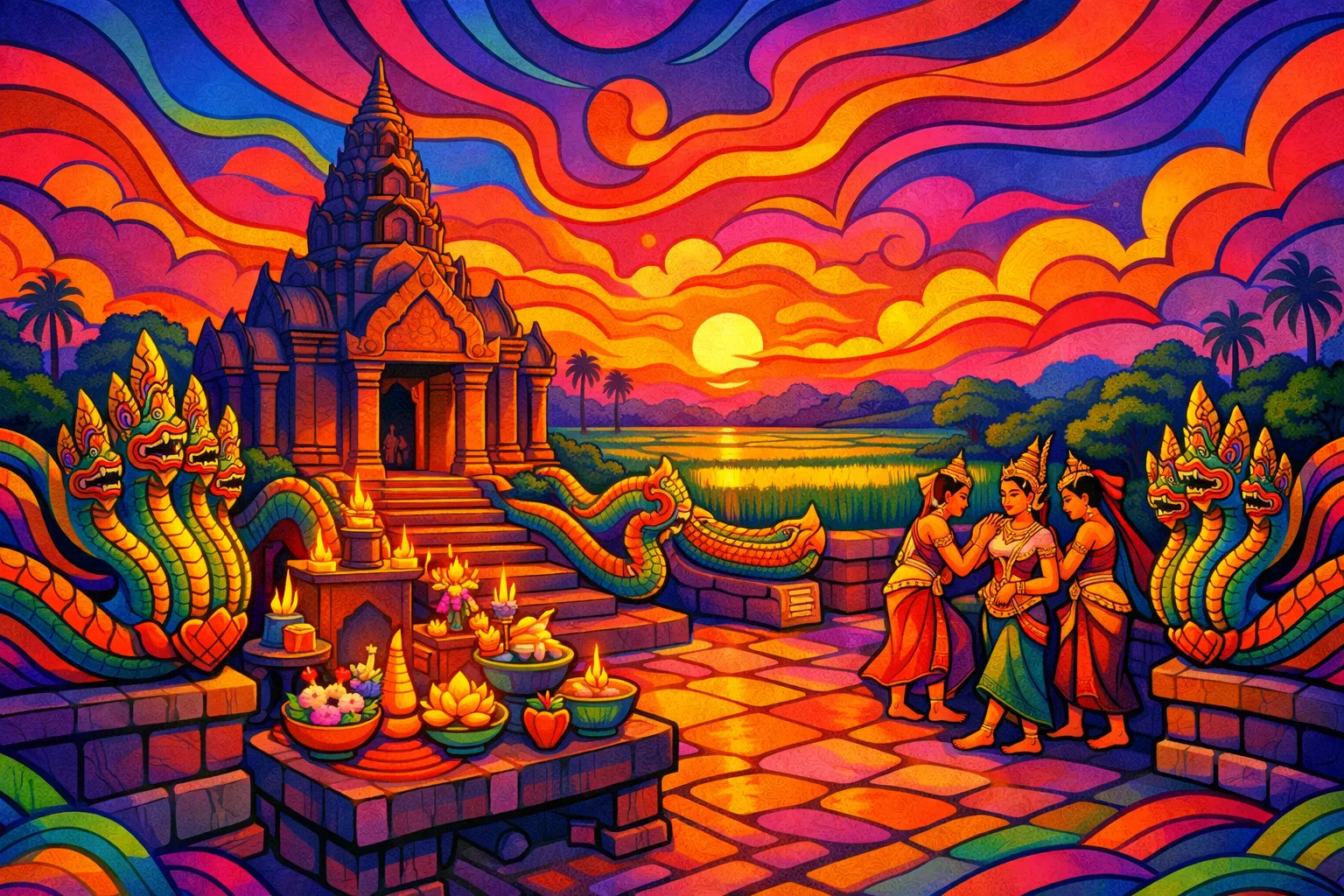
One of Cambodia’s most important origin traditions tells of a foreign prince or culture-bringer who marries a serpent princess. In later Khmer retellings the couple is commonly known as Preah Thong and Neang Neak; in older historical discussion they are often linked with Kaundinya and Soma, legendary founders associated with the early kingdom of Funan. The story matters because it gives Cambodia a mythic genealogy: Khmer civilisation is imagined as born from the union of an outside arrival and a local serpent-linked female power, joining sea routes, land, water, kingship and ancestral legitimacy.[Angkor Database]angkordatabase.asiaAngkor Database Kauṇḍinya, Preah Thaong, and the "Nāgī Somā"AAngkor Database Kauṇḍinya, Preah Thaong, and the "Nāgī Somā"A
The details vary, which is typical of a long-lived legend. Some versions emphasise courtly marriage; others stress conquest, divine signs, serpent ancestry or the transformation of watery land into settled territory. What stays constant is the symbolic pattern: Cambodian origin is not presented as simple invasion or simple isolation, but as a meeting between worlds. The serpent princess represents local power, fertility and the water-landscape of the Mekong region; the prince represents long-distance connection and new political order. That is why the story remains useful both as folklore and as national symbolism.[Angkor Database]angkordatabase.asiaAngkor Database Kauṇḍinya, Preah Thaong, and the "Nāgī Somā"AAngkor Database Kauṇḍinya, Preah Thaong, and the "Nāgī Somā"A
The legend is not the same thing as straightforward history. Chinese accounts, inscriptions and later court traditions are difficult to line up neatly, and scholars have treated the Kaundinya-Soma complex as a layered tradition rather than a single recoverable event. Recent genetic and archaeological discussion can support the broader idea that South Asian and local populations interacted in early Cambodia, but it does not “prove” the legend in a literal storybook sense. A careful reading treats the tale as a cultural memory of contact, legitimacy and place-making rather than as a simple factual chronicle.[asianethnology.scholasticahq.com]asianethnology.scholasticahq.comOpen source on scholasticahq.com.
The continuing public life of the legend is easy to see. In 2022 Cambodia inaugurated a large copper monument to Preah Thong and Neang Neak in Preah Sihanouk province, described by official media as symbolising the birth of Khmer land, culture, traditions and civilisation. That modern statue is a useful reminder that folklore is not only old material preserved in books: it is also remade in public art, tourism, school memory and national self-presentation.[information.gov.kh]information.gov.khOpen source on information.gov.kh.
Guardian spirits: why Cambodian folklore is tied to place
A large part of Cambodian belief culture is place-based. Guardian spirits are associated with villages, fields, roads, forests, shrines, homes and particular landscapes. These spirits are not simply “ghosts” in the horror-story sense. They are often treated as local powers who may protect a community if properly respected, but who may also be feared if neglected or offended. Scholarly summaries describe these guardian spirits as territorial and ancestral figures, inseparable from the land or social group they protect.[Academia]academia.eduneak ta spirits: belief and practices in cambodian folk religionneak ta spirits: belief and practices in cambodian folk religion
This is why Cambodian folklore often feels practical rather than abstract. A spirit may matter because farmers need rain, travellers need protection, a village needs health, or a family wants to avoid misfortune. Spirit houses, shrines and offerings make the unseen world part of the visible landscape. Buddhism is the dominant public religion in Cambodia, but local spirit practice has long coexisted with Buddhist temples, monks and merit-making. Sources on Cambodian folk religion repeatedly warn against imagining Cambodian religious life as purely doctrinal Buddhism; older land and ancestor spirits remain important in how many communities understand protection, illness, luck and obligation.[Academia]academia.eduneak ta spirits: belief and practices in cambodian folk religionneak ta spirits: belief and practices in cambodian folk religion
A recent example shows how alive this tradition remains. In May 2026, Associated Press reported on villagers north-west of Phnom Penh holding a centuries-old guardian-spirit ceremony to pray for rain, prosperity and protection from disease as the monsoon season began. Participants processed to a shrine, made offerings of food and drink, dressed as spirits, played drums and gongs, and ended with holy water. The report also noted that the ritual has become rarer in modern times, which makes it both a living tradition and a fragile one.[AP News]apnews.comAP News Cambodians honor village's guardian spirits | AP NewsAP News Cambodians honor village's guardian spirits | AP News
The most important point for readers is that these practices are not fringe curiosities. They show how Cambodian folklore connects social life, agriculture and landscape. The question is not merely “Do people believe in spirits?” but “What work does belief do?” In village ritual, spirits can help organise community memory, mark the agricultural year, honour ancestors, dramatise local identity and give people a shared language for hope, danger and protection.
Ancestors, hungry ghosts and the moral calendar
Cambodian folklore is also strongly shaped by the dead. The best-known annual expression is Pchum Ben, often described in English as Ancestors’ Day or a festival for the dead. It is a 15-day Cambodian religious festival culminating around the end of the Buddhist rains retreat, when families make offerings, visit pagodas and remember deceased relatives. Accessible accounts and religious studies discussions describe it as one of Cambodia’s most important spiritual holidays, especially because it focuses on ancestors who may be suffering or unable to move on peacefully.[Berkley Center]berkleycenter.georgetown.eduOpen source on georgetown.edu.
For folklore, Pchum Ben matters because it turns cosmology into family duty. The dead are not only remembered sentimentally; they are imagined as beings who may need food, prayers and merit. In more formal Buddhist understanding, laypeople offer food to monks and transfer merit to the dead. In more popular village practice, stories often speak more directly of feeding hungry spirits. Those two models can coexist, overlap or compete, showing again how Cambodian tradition blends doctrine, ritual, family feeling and older supernatural imagination.[Wikipedia]WikipediaPchum BenPchum Ben
This is not just a “ghost festival” in the spooky modern sense. It is a social and moral season. Families return home, pagodas become centres of memory, and the boundary between living and dead is ritually acknowledged. The emotional power lies in a simple idea: the living still have responsibilities to those who came before them. For a folklore reader, that makes Pchum Ben one of the clearest windows into Cambodian ideas about kinship, karma, memory and the unseen consequences of human action.
Epic stories on stone, stage and shadow
Cambodia’s most famous mythic art is not confined to oral tales. It is carved into temple walls and performed in dance and theatre. Angkor Wat’s bas-relief galleries include more than 1,000 square metres of sculpted scenes, including legendary and epic material intended for public religious and moral instruction. The APSARA National Authority notes that these reliefs represent legendary and historical scenes, with the Battle of Kurukshetra from the Mahabharata among them, even though that Indian epic is much less familiar in modern Cambodia than some other traditions.[APSARA National Authority]apsaraauthority.gov.khAPSARA National Authority Angkor WatAPSARA National Authority Angkor Wat
The more culturally central epic adaptation is the Reamker, Cambodia’s version of the Ramayana tradition. It is not simply an imported story retold in another language. Over centuries, the plot, characters and moral emphasis were reshaped through Cambodian court performance, dance, painting, sculpture and Buddhist ethical interpretation. In public-facing terms, the Reamker is a story-world of exile, loyalty, temptation, violence, kingship and moral order; in cultural terms, it is one of the great reservoirs from which Cambodian performing arts draw characters and scenes.[Asia Society]asiasociety.orgOpen source on asiasociety.org.
The Royal Ballet of Cambodia is crucial here. UNESCO describes the Royal Ballet, also known as Khmer Classical Dance, as closely associated with the Khmer court for more than a thousand years and traditionally performed for coronations, marriages, funerals and holidays. It also notes that the art form narrowly escaped annihilation in the 1970s. This matters for folklore because dance is not decoration added to a story; it is one of the main ways old stories were embodied, remembered and transmitted.[UNESCO Intangible Cultural Heritage]ich.unesco.orgOpen source on unesco.org.
Shadow theatre gives another route into the same world. UNESCO’s account of Sbek Thom describes a Khmer shadow theatre dating from before the Angkorian period, using large leather puppets representing gods and deities, traditionally performed at night outdoors near a rice field or pagoda. The form has moved from ritual activity into recognised art while retaining ceremonial dimensions. For a reader, that means Cambodian folklore is not only “what the story says”, but also where, when and how the story is performed: at night, with music, leather silhouettes, sacred characters and a community gathered in shared attention.[UNESCO]unesco.org15th anniversary of the inscription of Sbek Thom as UNESCO Intangible15th anniversary of the inscription of Sbek Thom as UNESCO Intangible
Animal tales and the clever small hero
Not all Cambodian folklore is grand, royal or sacred. Some of its most approachable stories are animal tales, especially those centred on a clever hare or rabbit figure often translated into English as Judge Hare or Judge Rabbit. A University of Hawai‘i Khmer-language learning resource introduces a collection of 27 classic Cambodian hare tales by noting that elders passed such stories to children both to teach and to entertain, and that the small hare repeatedly outsmarts elephants, crocodiles, tigers and people.[hawaii.edu]hawaii.eduTales of the Hare: 27 Classic Folktales from CambodiaTales of the Hare: 27 Classic Folktales from Cambodia
These tales are memorable because they reverse the obvious hierarchy of power. The small animal wins not through strength, beauty or rank, but through speech, timing and judgement. That makes the hare a classic trickster figure, but with a Cambodian social flavour: many stories are about disputes, foolishness, greed, laziness or the need to see through appearances. In a society where formal power may sit with elders, officials, landowners or stronger creatures, the clever small hero offers another kind of justice.
The animal world in these stories is also local and vivid. Elephants, tigers, crocodiles and cobras are not random fantasy beasts; they belong to the ecological imagination of mainland Southeast Asia. The humour often comes from making dangerous animals ridiculous. The moral lessons are rarely delivered like dry rules. They are carried by a scene: a hare escaping a tiger, dividing fish, exposing deception or turning fear into advantage.
Sacred landscapes: mountains, temples and protective powers
Cambodian legendary geography is inseparable from sacred places. Angkor is the most famous example, but it is not only an archaeological site; it is also a landscape where royal, Hindu, Buddhist and local spirit traditions have layered over one another. APSARA’s account of Angkor Wat notes the continuing protective reputation of Ta Reach, a powerful four-armed statue worshipped near the western entrance, whose powers are known throughout the Angkor region. That kind of detail reminds readers that temple heritage is not only ancient stone: it can also be an active religious and folkloric presence.[APSARA National Authority]apsaraauthority.gov.khAPSARA National Authority Angkor WatAPSARA National Authority Angkor Wat
Phnom Kulen is another important sacred landscape. UNESCO’s World Heritage tentative-list entry identifies the range north-east of Angkor as the site of ancient Mahendraparvata, a late eighth- to early ninth-century urban and religious centre with temples, reservoirs, channels, rock shelters, sculpted riverbeds and a venerated reclining Buddha. The same entry notes the mountain’s connection to the sources of rivers feeding the Angkor region.[UNESCO World Heritage Centre]whc.unesco.orgOpen source on unesco.org.
For folklore, the key point is that sacred geography joins water, kingship and protection. A mountain can be remembered as a source of political origin, a place of hermits, a Buddhist pilgrimage site and a source of water that nourishes a temple civilisation. A riverbed carved with sacred symbols is not just art; it makes flowing water part of a ritual landscape. Cambodia’s legendary places often work this way: they are historical, religious, touristic and mythic at the same time.

Music, wit and living oral tradition
Cambodia’s oral tradition is not limited to fireside tales. It also lives through sung storytelling, social commentary and improvised performance. Chapei Dang Veng, a tradition built around a long-necked lute and sung narration, is recognised by UNESCO as closely associated with Cambodian life, customs and beliefs. UNESCO placed it on the List of Intangible Cultural Heritage in Need of Urgent Safeguarding in 2016, reflecting both its cultural value and its vulnerability.[UNESCO Intangible Cultural Heritage]ich.unesco.orgOpen source on unesco.org.
This tradition matters because it shows folklore as conversation. Performers can entertain, teach, joke, moralise and comment on current life while drawing on older forms. The long-necked lute is not merely an instrument; it supports a public voice. Cambodian Living Arts’ 2018 Chapei Dang Veng festival, with workshops and performances in Siem Reap, shows how cultural organisations have tried to keep such forms active through teaching and public events rather than treating them as museum relics.[cambodianlivingarts.org]cambodianlivingarts.orgchapei dang veng festivalchapei dang veng festival
Modern reinterpretation can be controversial if it flattens tradition into branding, but it can also keep old forms audible for younger audiences. Contemporary Cambodian music has sometimes brought traditional instruments and elder masters into dialogue with pop and hip-hop. Reporting on singer Laura Mam and Cambodian music revival highlighted Master Kong Nay, a celebrated chapei virtuoso, appearing alongside younger artists in a modern cultural-renewal frame.[Condé Nast Traveler]cntraveler.comOpen source on cntraveler.com.
Monsters, ghosts and the limits of evidence
Cambodia has many ghost and spirit stories, but they are harder to summarise responsibly than the major public traditions above. Some supernatural figures circulate across mainland Southeast Asia, including tales of dangerous female spirits, restless dead, possession and night terrors. Internet summaries often present these as fixed “creatures”, but real belief is usually more local, varied and situational. A spirit feared in one village, named one way in one language community, or linked to one ritual specialist may not map neatly onto a modern monster encyclopaedia entry.
The safer distinction is between three kinds of evidence. First, well-attested public traditions such as guardian-spirit rites, ancestor festivals, epic performance and heritage-listed arts have strong institutional or journalistic documentation. Second, local spirit beliefs are well supported in ethnographic discussion, but details vary by place and informant. Third, modern online monster lists often blend Cambodian, Thai, Lao and wider Southeast Asian motifs without clearly showing what is specifically Cambodian. That does not make the stories fake; it means readers should be cautious about treating a viral creature profile as old Cambodian folklore without local evidence.[academia.edu]academia.eduneak ta spirits: belief and practices in cambodian folk religionneak ta spirits: belief and practices in cambodian folk religion
This distinction is especially important because Cambodian supernatural tradition is not mainly a catalogue of monsters. Its centre of gravity is relational: people negotiate with ancestors, land spirits, protective powers, monks, ritual specialists and dangerous unseen forces. The dramatic creature is less important than the question of relationship: Who is owed respect? What boundary was crossed? What offering, prayer or ritual action might restore balance?
How Cambodian folklore changed through history
Cambodian folklore changed because Cambodia itself changed. Indian epics, Sanskritic kingship, local serpent traditions, Buddhist ethics, village land spirits and court performance all met in the same cultural field. The result was not a single neat mythology, but an additive tradition in which old and new layers could coexist. A temple might show Hindu epic scenes, later Buddhist devotion and local protective worship. A festival might combine Buddhist merit-making with older ideas about feeding or appeasing the dead. A court dance might preserve mythic characters while being re-created after historical catastrophe.[apsaraauthority.gov.kh]apsaraauthority.gov.khAPSARA National Authority Angkor WatAPSARA National Authority Angkor Wat
The 20th century created a particularly severe rupture. UNESCO’s language around the Royal Ballet notes that it narrowly escaped annihilation in the 1970s, and Cambodian heritage discussions often frame performance revival as survival after loss. This matters for folklore because oral and performative traditions depend on teachers, lineages, memory and repeated practice. When artists, monks, elders and communities are killed or displaced, folklore does not simply continue unchanged. It must be remembered, reconstructed, taught and sometimes adapted to new settings.[UNESCO Intangible Cultural Heritage]ich.unesco.orgOpen source on unesco.org.
At the same time, Cambodian folklore is not frozen in recovery mode. New monuments, festivals, tourism routes, school materials, diaspora retellings and digital performances keep reshaping what counts as familiar tradition. The challenge is to tell the difference between old oral memory, courtly literary adaptation, local ritual practice, heritage safeguarding and recent reinvention. A good Cambodian folklore page should not treat all of these as equally ancient, but it should recognise that all of them can become meaningful to living communities.
What to remember about Cambodian folklore
Cambodian folklore is best understood as a living web of story, ritual, place and performance. Its most famous origin legend links the Khmer world to a serpent princess and a foreign prince, turning water, marriage and kingship into national symbolism. Its village spirit traditions show how land and community are protected through offerings, processions and seasonal rites. Its ancestor festivals make the dead part of family and moral life. Its epics survive through stone carving, ballet and shadow theatre. Its animal tales celebrate wit over strength. Its sacred landscapes make mountains, rivers and temples feel alive with memory.
The most common misunderstanding is to reduce Cambodian folklore either to “mythology” in the ancient-textbook sense or to “ghost stories” in the internet-horror sense. Cambodia has both mythic grandeur and frightening spirits, but its folklore is broader and more practical than either label suggests. It is a way of explaining origins, caring for ancestors, asking for rain, protecting villages, teaching children, performing moral drama and rebuilding cultural memory after historical loss.
Amazon book picks
Further Reading
Books and field guides related to Where Cambodia's Legends Still Live. Use these as the next step if you want deeper reading beyond the article.
When Broken Glass Floats
Provides cultural context and lived experience of Cambodian society.
eBay marketplace picks
Marketplace Samples
Live-tested eBay searches with available results related to this page.


Endnotes
1.
Source: ich.unesco.org
Link:https://ich.unesco.org/en/RL/royal-ballet-of-cambodia-00060
2.
Source: unesco.org
Title: 15th anniversary of the inscription of Sbek Thom as UNESCO Intangible
Link:https://www.unesco.org/en/articles/15th-anniversary-inscription-sbek-thom-unesco-intangible-cultural-heritage
3.
Source: ich.unesco.org
Link:https://ich.unesco.org/en/USL/chapei-dang-veng-01165
4.
Source: Wikipedia
Title: Preah Thong and Neang Neak
Link:https://en.wikipedia.org/wiki/Preah_Thong_and_Neang_Neak
5.
Source: asianethnology.scholasticahq.com
Link:https://asianethnology.scholasticahq.com/article/148920-kaundinya-preah-thaong-and-the-nagi-soma-some-aspects-of-a-cambodian-legend.pdf
6.
Source: information.gov.kh
Link:https://www.information.gov.kh/articles/73215
7.
Source: academia.edu
Title: neak ta spirits: belief and practices in cambodian folk religion
Link:https://www.academia.edu/40262486/NEAK_TA_SPIRITS_BELIEF_AND_PRACTICES_IN_CAMBODIAN_FOLK_RELIGION
8.
Source: Wikipedia
Title: Neak ta
Link:https://en.wikipedia.org/wiki/Neak_ta
9.
Source: Wikipedia
Title: Pchum Ben
Link:https://en.wikipedia.org/wiki/Pchum_Ben
10.
Source: apsaraauthority.gov.kh
Title: APSARA National Authority Angkor Wat
Link:https://apsaraauthority.gov.kh/2021/06/14/angkor-wat/
11.
Source: Wikipedia
Link:https://en.wikipedia.org/wiki/Reamker
12.
Source: hawaii.edu
Title: Tales of the Hare: 27 Classic Folktales from Cambodia
Link:https://www.hawaii.edu/khmer/KhmerMaterials/27TalesOfHare.html
13.
Source: whc.unesco.org
Link:https://whc.unesco.org/en/tentativelists/6460/
14.
Source: ich.unesco.org
Title: Intangible Cultural Heritageich.unesco.org
Link:https://ich.unesco.org/en/state/cambodia-KH
15.
Source: cambodianlivingarts.org
Title: chapei dang veng festival
Link:https://www.cambodianlivingarts.org/en/archive/chapei-dang-veng-festival/
16.
Source: unesco.org
Link:https://www.unesco.org/en/articles/chapei-dang-veng-four-years-after-its-inscription-unesco-intangible-cultural-heritage-list
17.
Source: unesco.org
Link:https://www.unesco.org/en
18.
Source: ich.unesco.org
Title: royal ballet of cambodia 00060
Link:https://ich.unesco.org/en/RL/royal-ballet-of-cambodia-00060?RL=00060&id=41618&include=film_inc.php
19.
Source: unesco.org
Title: the Royal Ballet of Cambodia
Link:https://www.unesco.org/archives/multimedia/document-3752
20.
Source: ich.unesco.org
Title: sbek thom khmer shadow theatre 00108
Link:https://ich.unesco.org/en/RL/sbek-thom-khmer-shadow-theatre-00108
21.
Source: ich.unesco.org
Title: cambodia KH
Link:https://ich.unesco.org/en/state/cambodia-KH?info=elements-on-the-lists
22.
Source: ich.unesco.org
Link:https://ich.unesco.org/en/nhk?call=film&id=31047&include=film_inc.php&width=700
23.
Source: ich.unesco.org
Link:https://ich.unesco.org/doc/src/30276.pdf
24.
Source: ich.unesco.org
Link:https://ich.unesco.org/en/video/41618
25.
Source: ich.unesco.org
Title: cambodia KH
Link:https://ich.unesco.org/ar-state/cambodia-KH?call=film&id=41620&include=film_inc.php&width=700
26.
Source: ich.unesco.org
Link:https://ich.unesco.org/en/lists
27.
Source: ich.unesco.org
Link:https://ich.unesco.org/doc/src/Signed%20periodic%20report%20-%20Periodic%20report-67245.pdf
28.
Source: ich.unesco.org
Title: cambodia KH
Link:https://ich.unesco.org/en/state/cambodia-KH?info=periodic-reporting
29.
Source: unesco.org
Link:https://www.unesco.org/en/node/82132
30.
Source: unesco.org
Title: and cambodia jointly promote safeguarding koh ker cultural heritage site
Link:https://www.unesco.org/en/articles/unesco-and-cambodia-jointly-promote-safeguarding-koh-ker-cultural-heritage-site
31.
Source: unesco.org
Link:https://www.unesco.org/archives/multimedia/producer/cambodia.%2Bministry%2Bof%2Bculture%2Band%2Bfine%2Barts
32.
Source: unesco.org
Title: congratulates cambodia kramas inscription
Link:https://www.unesco.org/en/articles/unesco-congratulates-cambodia-kramas-inscription
33.
Source: unesco.org
Title: commends cambodia inscription koh ker world heritage list
Link:https://www.unesco.org/en/articles/unesco-commends-cambodia-inscription-koh-ker-world-heritage-list
34.
Source: unesco.org
Title: heritage day cambodia saturday 10 october 2020
Link:https://www.unesco.org/en/articles/heritage-day-cambodia-saturday-10-october-2020
Published: october 2020
35.
Source: unesco.org
Title: document 4374
Link:https://www.unesco.org/archives/multimedia/document-4374
36.
Source: unesco.org
Title: celebrates 30 years safeguarding bayon temple angkor thom project
Link:https://www.unesco.org/en/articles/unesco-celebrates-30-years-safeguarding-bayon-temple-angkor-thom-project
37.
Source: Wikipedia
Link:https://en.wikipedia.org/wiki/Preta
38.
Source: Wikipedia
Link:https://en.wikipedia.org/wiki/Krasue
39.
Source: Wikipedia
Title: Royal Ballet of Cambodia
Link:https://en.wikipedia.org/wiki/Royal_Ballet_of_Cambodia
40.
Source: Wikipedia
Title: Nieng Arp
Link:https://en.wikipedia.org/wiki/Nieng_Arp
41.
Source: Wikipedia
Title: Bon Om Touk
Link:https://en.wikipedia.org/wiki/Bon_Om_Touk
42.
Source: Wikipedia
Title: Phnom Kulen
Link:https://en.wikipedia.org/wiki/Phnom_Kulen
43.
Source: Wikipedia
Title: Queen Soma
Link:https://en.wikipedia.org/wiki/Queen_Soma
44.
Source: siem-reap.de
Title: Phnom Kulen
Link:https://www.siem-reap.de/en/phnom-kulen-the-sacred-mountain-and-the-birthplace-of-the-cambodian-origin-story/
45.
Source: academia.edu
Link:https://www.academia.edu/100212580/The_2_Mountains_of_the_Phnom_Kulen
46.
Source: academia.edu
Link:https://www.academia.edu/10082309/From_Filth_Ghost_to_Khmer_Witch_Phi_Krasues_Changing_Cinematic_Construction_and_its_Symbolism_2014_
47.
Source: archive.org
Link:https://archive.org/details/cambodianfolksto00carr
48.
Source: angkordatabase.asia
Title: Angkor Database Kauṇḍinya, Preah Thaong, and the “Nāgī Somā”A
Link:https://angkordatabase.asia/publications/kaundinya-preah-thaong-and-the-n%C4%81g%C4%AB-som%C4%81-some-aspects-of-a-cambodian-legend
49.
Source: apnews.com
Title: AP News Cambodians honor village’s guardian spirits | AP News
Link:https://apnews.com/article/7a9f98caff63e9aa497ab208c385bc3f
50.
Source: berkleycenter.georgetown.edu
Link:https://berkleycenter.georgetown.edu/posts/nourishing-spirit-nourishing-nation-feasts-for-the-living-and-the-dead-at-the-pchum-ben-festival
51.
Source: asiasociety.org
Link:https://asiasociety.org/education-2025/reamker
52.
Source: cntraveler.com
Link:https://www.cntraveler.com/story/singer-laura-mam-is-on-a-mission-to-revive-cambodias-vibrant-music-scene
53.
Source: tandfonline.com
Link:https://www.tandfonline.com/doi/full/10.1080/14755610.2024.2306283
54.
Source: pjcoggan.wordpress.com
Title: preah thong
Link:https://pjcoggan.wordpress.com/tag/preah-thong/
55.
Source: visit-angkor.org
Title: Pchum Ben
Link:https://www.visit-angkor.org/blog/pchum-ben-ancestors-day-history-legend/
56.
Source: visit-angkor.org
Title: Phnom Kulen
Link:https://www.visit-angkor.org/blog/phnom-kulen-the-holy-mountain-nearby-angkor/
57.
Source: cdn.angkordatabase.asia
Link:https://cdn.angkordatabase.asia/libs/docs/publications/kau%E1%B9%87%E1%B8%8Dinya-preah-thaong-and-the-n%C4%81g%C4%AB-som%C4%81-some-aspects-of-a-cambodian-legend/kaundinya-neak-neang.pdf
58.
Source: angkordatabase.asia
Link:https://angkordatabase.asia/publications/the-place-of-animism-within-popular-buddhism-in-cambodia-the-example-of-the-monastery
59.
Source: lsawaterfestival.org
Link:https://www.lsawaterfestival.org/waterfestivalhistory
60.
Source: books.google.com
Title: Preah Thong and Neang Neak
Link:https://books.google.com/books/about/Preah_Thong_and_Neang_Neak.html?id=9vnp0QEACAAJ
61.
Source: mekongreview.com
Title: ghost stories
Link:https://mekongreview.com/ghost-stories/
62.
Source: danceinteractive.jacobspillow.org
Link:https://danceinteractive.jacobspillow.org/dance-the-spirit-of-cambodia/reamker/
63.
Source: artsmeme.com
Title: unesco cultural treasure royal ballet of cambodia to long beach
Link:https://artsmeme.com/2014/10/01/unesco-cultural-treasure-royal-ballet-of-cambodia-to-long-beach/
Additional References
64.
Source: researchgate.net
Link:https://www.researchgate.net/publication/233684351_An_Alternative_Memory_of_the_Khmer_Rouge_Genocide_The_Dead_of_the_Mass_Graves_and_the_Land_Guardian_Spirits_Neak_ta
65.
Source: cambodgemag.com
Link:https://www.cambodgemag.com/en/post/22nd-anniversary-of-the-inscription-of-the-royal-ballet-of-cambodia-on-the-unesco-world-heritage-lis
66.
Source: instagram.com
Link:https://www.instagram.com/p/CclXR7wvj0w/
67.
Source: facebook.com
Link:https://www.facebook.com/100063563409387/videos/ancestors-day-festival-in-cambodia-today-hungry-ghosts-festival-ancestors-day-pc/1321551562343394/
68.
Source: facebook.com
Link:https://www.facebook.com/AmazingWorldCultureClub3/posts/angkor-wat-was-built-by-indians-hindu-mythology-and-the-legend-of-preah-thong-an/122230316864271515/
69.
Source: facebook.com
Link:https://www.facebook.com/groups/amazingasean/posts/866205598084051/
70.
Source: instagram.com
Link:https://www.instagram.com/reel/DCW5Bg8PDR6/?hl=en
71.
Source: helloangkor.com
Link:https://helloangkor.com/events-festivals-and-holidays/cambodias-water-festival-bon-oum-touk/
72.
Source: scribd.com
Link:https://www.scribd.com/document/814454361/Cambodian-Folklore-Tales-of-Magic-Mystery-and-Terror-from-My-Grandma
73.
Source: scribd.com
Link:https://www.scribd.com/document/811021624/In-Cambodian-Culture-Ghosts-and-Folklore-Hold-a-Significant-Place-Deeply-Rooted-in-the-Beliefs-Traditions-And-Spiritual-Practices-of-the-Khmer-Peo
Topic Tree
Follow this branch
Related pages 192
- Afghan Folklore
- Albanian Folklore
- Algerian Folklore
- Australian Folklore
- Azerbaijan Folklore
- +187 more in sidebar