Why Philippine Folklore Refuses One Mythology
Philippine folklore is not a single mythology with one fixed cast of gods and monsters. It is a crowded island world of oral tales, ancestor spirits, local guardian beings, heroic epics, Catholic-era legends, Muslim and indigenous traditions, horror cinema, comics and modern internet retellings.
Page outline Jump by section
Why Philippine folklore is so varied
The Philippines is an archipelago, and that geography helps explain why its folklore resists tidy summary. Stories moved by sea routes, trade, migration, conversion, schooling and print, but they also stayed rooted in local speech communities. A tale from the northern highlands, a Visayan monster story, a Maranao epic from Mindanao and a Manila ghost story may all be “Philippine folklore”, yet they come from different historical and religious worlds.
This is why it is better to think of Philippine folklore as a layered tradition rather than a single ancient book of myths. Older indigenous spirit beliefs overlap with Islam in parts of Mindanao and the Sulu region, with Spanish Catholic imagery in many lowland communities, and with American-period schooling, modern publishing and film. The result is not a clean replacement of one system by another, but a long process of adaptation. Scholars of native religious belief have stressed that Philippine traditions include ancestor spirits, nature spirits, local deities, ritual specialists and offerings, while also warning against forcing them into a neat hierarchy copied from other religions.[asj.upd.edu.ph]asj.upd.edu.phhislop anitism survey religious beliefs native philippineshislop anitism survey religious beliefs native philippines
A useful reader’s rule is this: when a Philippine folklore source says “Filipinos believe”, ask where, when and according to whom. The aswang, for example, is often described as the country’s most famous monster, but even that word may refer to different beings in different places: witches, ghouls, animal-shifters, corpse-eaters, blood-drinkers or the self-separating flying figure usually called the manananggal.[THE ASWANG PROJECT]aswangproject.comramos aswangTHE ASWANG PROJECTThe Maximo Ramos Taxonomical Classifications of…1 Oct 2023 — The aswang is an umbrella term for various shape-shifti…
The spirit world behind many stories
Many Philippine supernatural traditions begin with the idea that the visible world is not empty. Mountains, rivers, forests, houses, mounds, trees, the dead and the forces of weather may be bound up with unseen powers. The terms anito and diwata are often used in English-language discussions, though they do not map perfectly across all Philippine languages and communities. In broad terms, anito is often associated with ancestor spirits or spirit beings, especially in Luzon contexts, while diwata is widely used for nature spirits or divine beings, especially in Visayan and Mindanao contexts. Hislop’s survey notes that the word diwata has varied uses across Philippine languages and that, among some groups, it can function as an equivalent to anito.[asj.upd.edu.ph]asj.upd.edu.phhislop anitism survey religious beliefs native philippineshislop anitism survey religious beliefs native philippines
This matters because many “creature” stories are not simply spooky entertainment. They encode manners for living in a charged landscape: do not disturb certain places casually; respect old trees and mounds; recognise that illness, bad luck or strange encounters may be interpreted through relationships with unseen beings. Even when people no longer treat these beliefs literally, the etiquette remains familiar in stories, jokes, warnings and popular culture.
The old spiritual world was also mediated by ritual specialists. Spanish and later observers often described native practices through hostile or Christianised language, so the record has to be read carefully. Still, recurring evidence points to mediums, healers and ritual leaders who communicated with spirits, sought cures, made offerings and helped communities negotiate danger, illness, harvest and death.[asj.upd.edu.ph]asj.upd.edu.phhislop anitism survey religious beliefs native philippineshislop anitism survey religious beliefs native philippines

Monsters people still recognise
Philippine folklore is internationally known for its monsters because they are vivid, frightening and unusually adaptable. They have moved from village warnings into comics, cinema, television, children’s books, tourist branding and online art. Yet the most interesting thing about them is not just how strange they look, but how social they are: they often express anxieties about pregnancy, strangers, predation, envy, night travel, gender, illness and the thin line between neighbour and threat.
The aswang is the clearest example. In popular summaries it is often called a vampire-like or shape-shifting monster, but this is too narrow. The term can work as a broad label for several feared beings: a flesh-eater, a witch, a graveyard creature, a night predator, an animal-shaped deceiver or a viscera-sucker. Modern folklore sites and pop-culture explainers often present it as an umbrella category, while also noting that local communities may preserve more specific names and traits.[THE ASWANG PROJECT]aswangproject.comramos aswangTHE ASWANG PROJECTThe Maximo Ramos Taxonomical Classifications of…1 Oct 2023 — The aswang is an umbrella term for various shape-shifti…
The manananggal is one of the most visually memorable forms associated with this cluster: a being whose upper body separates from the lower body and flies at night. It is now a staple of Philippine horror imagery, partly because film and television have made its body unmistakable. The 1984 horror anthology film Shake, Rattle & Roll included a “Manananggal” segment, and the wider franchise helped keep Philippine monsters in mainstream popular memory.[THE ASWANG PROJECT]aswangproject.comTHE ASWANG PROJECTWhy "MANANANGGAL" is the best SHAKE RATTLE &THE ASWANG PROJECTWhy "MANANANGGAL" is the best SHAKE RATTLE &
Other widely recognised beings include the tikbalang, often imagined with horse-like features and linked to roads, forests or disorientation; the kapre, commonly pictured as a huge tree-dwelling figure; small mound or earth beings often treated with caution; and water, fire or wind spirits that appear in local legends and modern fantasy. These figures are not all “evil”. Some are dangerous, some are tricksters, some are guardians, and some are better understood as signs that a place has agency and should not be treated carelessly.
Epics, chants and heroic memory
The country’s folklore is not only a catalogue of creatures. Some of its most important traditions are long narrative chants and epics performed in community settings. Two internationally recognised examples are the Hudhud chants of the Ifugao and the Darangen epic of the Maranao people of Lake Lanao.
The Hudhud consists of narrative chants traditionally performed by the Ifugao, a community associated with the rice terraces of the northern Philippine highlands. UNESCO describes the chants as being practised during rice sowing, harvest, funeral wakes and rituals; they tell of ancestral heroes, customary law, religious beliefs and rice cultivation, and a full recitation can last for days.[ICH UNESCO]ich.unesco.orgOpen source on unesco.org.
The Darangen, by contrast, belongs to the Maranao people of the Lake Lanao region in Mindanao. UNESCO describes it as an ancient epic song containing a wealth of Maranao knowledge. It is often discussed as a pre-Islamic oral tradition that continued within a later Islamic cultural setting, which makes it a particularly good example of how Philippine traditions can preserve older narrative worlds while living inside changed religious and social realities.[ICH UNESCO]ich.unesco.orgOpen source on unesco.org.
These traditions change how a reader should understand “mythology”. The most durable Philippine mythic materials are not always short stories about gods. They may be sung across nights, tied to agriculture or ritual, remembered by trained performers, and embedded in rules of kinship, rank, grief, beauty and law.
Sacred places, haunted landscapes and local power
Many Philippine legends are anchored in place. Mountains, caves, lakes, old trees, bridges, churches, houses and crossroads can become story sites because they gather memory. Some stories explain how a landscape feature came to be; others warn against disrespecting spirits; others attach a ghost to a historical trauma or an old building.
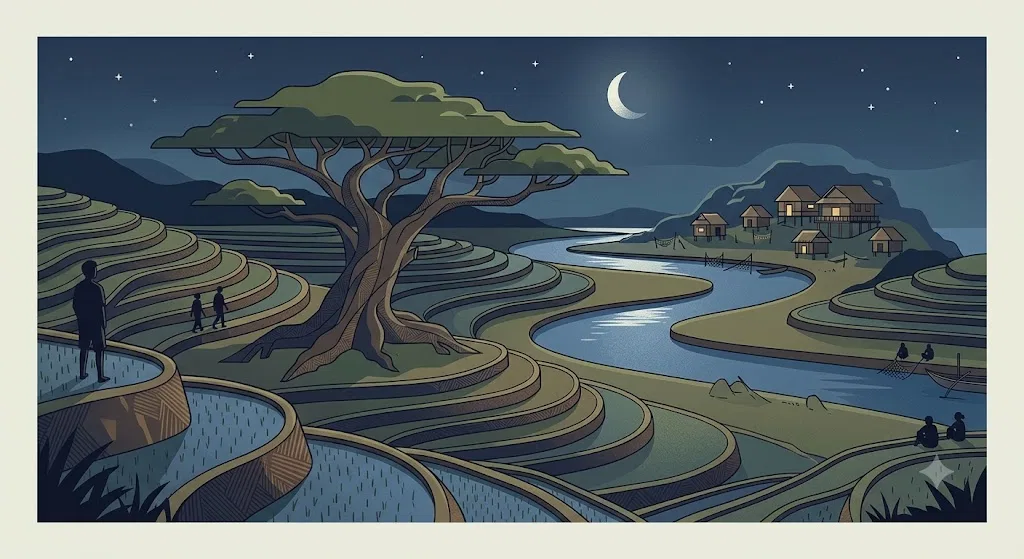
The best-known sacred landscapes include the Ifugao rice terraces, not because they are merely scenic, but because they are part of a living cultural system in which rice agriculture, ritual, memory and oral performance reinforce one another. The Hudhud’s connection to sowing, harvest and funeral rites shows that folklore may be inseparable from labour and landscape.[ICH UNESCO]ich.unesco.orgOpen source on unesco.org.
Other places acquire reputations through healing and magic. Siquijor, for example, is often described in travel and local cultural writing as an island associated with traditional healers and magical reputation. Sensational versions turn this into a simple “witch island” cliché, but the more grounded reading is that healing practice, tourism, Catholic imagery, herbal knowledge and folklore have become entangled in the island’s public identity.[Travel + Leisure Asia]travelandleisureasia.comsiquijor islandsiquijor island
Haunted-place folklore is especially fluid. A story about a white figure by a road, a crying woman, a haunted school or a cursed tree may be old in structure but modern in detail. These stories often update themselves around new settings: highways replace forest paths, hospitals replace ritual houses, and city apartments become homes for older spirits.
Colonial change without simple replacement
Spanish colonisation, Catholic missionisation, Islamic expansion in parts of the south, American education and modern mass media all shaped how Philippine folklore was recorded and retold. This does not mean older beliefs vanished. It means they were reinterpreted, condemned, absorbed, disguised, printed, commercialised or turned into entertainment.
One common claim is that Spanish colonisers “invented” the aswang to demonise powerful women or indigenous ritual specialists. That version is too neat. There is good reason to study how colonial writers reframed native belief, gender and spiritual authority, but it is safer to say that colonialism changed the meanings and uses of monster stories rather than simply inventing them from nothing. Discussions of the aswang and the babaylan often note this theory, while also warning that the historical record is more complicated than a single-origin explanation.[THE ASWANG PROJECT]aswangproject.comTHE ASWANG PROJECTFrom Babaylan to Aswang?THE ASWANG PROJECTFrom Babaylan to Aswang?
Catholicism also gave Philippine folklore new figures and settings: saints, processions, holy images, church ruins, souls, devils and miracle stories. In everyday belief culture, these do not always sit apart from older ideas. A person might speak of saints, ghosts, ancestral presence and local spirits in the same moral universe. That blending is one reason Philippine supernatural storytelling can feel both recognisably Catholic and deeply local.
How folklore was collected and preserved
Much Philippine folklore reached readers through collection, translation and classification. That is both valuable and limiting. It preserves stories that might otherwise be hard to access, but it also freezes living oral traditions into print, often through the choices of collectors, translators, teachers or colonial-era observers.
Damiana Eugenio’s work remains central for English-language readers because she gathered and organised large bodies of Philippine folk literature. Her Philippine Folk Literature: The Myths, published by the University of the Philippines Press in 1993, is listed as the second volume of a wider Philippine folk literature series and runs to more than 500 pages.[Google Books]books.google.comBooks Philippine Folk Literature: The mythsBooks Philippine Folk Literature: The myths Her 1985 article on Philippine folktales also makes an important distinction between myths, legends and folktales, which helps prevent the common mistake of treating every supernatural story as the same kind of evidence.[Asian Ethnology]asianethnology.orgAsian Ethnology
Francisco Demetrio’s work is another major reference point. A revised encyclopaedia of Philippine folk beliefs and customs, first published in 1991 and based on his earlier dictionary work, reportedly contained thousands of entries across subjects such as amulets, spirits, witches, rituals and folk customs.[Lifestyle.INQ]lifestyle.inquirer.netencyclopedia aswang engkanto csanjose 20180919encyclopedia aswang engkanto csanjose 20180919 Such compilations show the scale of the tradition, but they should be used with care: an encyclopaedia entry may not tell us how widely a belief was held, how old it is, or whether it was still active when recorded.
UNESCO listings add another kind of preservation. The Hudhud and Darangen are not just texts to be read; they are recognised as intangible cultural heritage, meaning their performance, transmission and community setting matter. UNESCO also lists Philippine elements beyond narrative folklore, such as ritual systems and traditional practices, showing that oral tradition belongs inside a larger field of living heritage.[ICH UNESCO]ich.unesco.orgphilippines PHphilippines PH
Modern folklore: horror, comics and the internet
Modern Philippine folklore is not a weakened version of older belief. It is one of the main ways the tradition survives. Horror films, television, comics, urban legends and online illustration have made old beings visible to new audiences, while also changing their meanings.
The comic series Trese, created by Budjette Tan and Kajo Baldisimo, is one of the clearest modern examples. It turns Philippine supernatural beings into part of a noir Manila, where crimes and monsters overlap. Netflix’s official description of the animated adaptation includes an aswang clan by the pier, showing how a local monster tradition has moved into global streaming culture.[Netflix]netflix.comOpen source on netflix.com.
This shift has benefits and risks. On the positive side, modern adaptations introduce younger and international readers to Philippine folklore, often with pride rather than embarrassment. They also let creators rework old figures around corruption, urbanisation, gender, class and memory. On the risky side, popular media can flatten regional differences into a single “monster universe”, making it seem as if every being has one official design, power set and origin story.
Internet-era folklore adds another layer. Short videos, fan art, listicles and horror threads spread creatures quickly, but they often detach them from place, language and ritual context. That does not make them worthless. It makes them modern folklore: fast-moving, remixable and sometimes poorly sourced, but still revealing what people fear, enjoy and want to reclaim.
What readers often get wrong
The first common mistake is treating Philippine folklore as if it had a single canon. It does not. There are important collections and famous figures, but there is no one authorised national mythology equivalent to a sacred scripture or a single ancient epic cycle.
The second mistake is assuming that monsters are merely “superstition”. Stories about the aswang, manananggal or other night beings can carry social information: warnings about vulnerability, pregnancy, envy, strangers, illness, predatory behaviour or dangerous travel. A reader does not need to believe in the creature literally to understand why the story works.
The third mistake is making everything precolonial. Some traditions are old, some are colonial-era, some are literary, some are tourist retellings and some are modern inventions built from older parts. The more honest question is not “Is this completely ancient?” but “What evidence shows where this version came from?”
The fourth mistake is ignoring performance. The Hudhud and Darangen are not just plots. They are ways of singing, remembering, gathering and transmitting knowledge. Reading a summary of them is useful, but it is not the same as understanding their social life.[ICH UNESCO]ich.unesco.orgOpen source on unesco.org.
Why Philippine folklore still matters
Philippine folklore matters because it is a living map of how communities have understood danger, place, family, death, nature and power. Its stories explain why a mound might be treated carefully, why a stranger in the night might be feared, why a rice harvest can be a ritual event, and why a city detective in a modern comic can still need to know the old rules.
It also matters because it refuses simple categories. Philippine folklore is indigenous and Catholic, local and national, oral and printed, frightening and funny, old and newly invented. Its monsters can be horror icons, but its deeper world is one of relationships: between the living and the dead, people and land, communities and memory, old ritual and new media.
For curious readers, the best way in is not to memorise a monster list. Start with the major patterns: regional variation, spirit-filled landscapes, oral performance, colonial transformation and modern reinvention. Once those are clear, the famous figures become richer. The aswang is no longer just a Filipino vampire; the manananggal is no longer just a flying torso; the Hudhud is no longer just an old chant. Each becomes part of a much larger Philippine tradition in which stories continue to travel, change and return home.
Amazon book picks
Further Reading
Books and field guides related to Why Philippine Folklore Refuses One Mythology. Use these as the next step if you want deeper reading beyond the article.
Philippine Folk Literature
Directly covers Philippine myths across regions and traditions.
eBay marketplace picks
Marketplace Samples
Live-tested eBay searches with available results related to this page.
Endnotes
1.
Source: asianethnology.org
Title: Asian Ethnology
Link:https://asianethnology.org/article/148458-philippine-folktales-an-introduction.pdf
2.
Source: asj.upd.edu.ph
Title: hislop anitism survey religious beliefs native philippines
Link:https://www.asj.upd.edu.ph/mediabox/archive/ASJ-09-02-1971/hislop-anitism-survey-religious%20beliefs-native-philippines.pdf
3.
Source: aswangproject.com
Title: ramos aswang
Link:https://www.aswangproject.com/ramos_aswang/
Source snippet
THE ASWANG PROJECTThe Maximo Ramos Taxonomical Classifications of...1 Oct 2023 — The aswang is an umbrella term for various shape-shifti...
4.
Source: aswangproject.com
Title: THE ASWANG PROJECTWhy “MANANANGGAL” is the best SHAKE RATTLE &
Link:https://www.aswangproject.com/manananggal-srr/
5.
Source: ich.unesco.org
Link:https://ich.unesco.org/en/RL/hudhud-chants-of-the-ifugao-00015
6.
Source: unesco.org
Title: document 1735
Link:https://www.unesco.org/archives/multimedia/document-1735
7.
Source: ich.unesco.org
Link:https://ich.unesco.org/en/RL/darangen-epic-of-the-maranao-people-of-lake-lanao-00159
8.
Source: aswangproject.com
Title: THE ASWANG PROJECTFrom Babaylan to Aswang?
Link:https://www.aswangproject.com/babaylan-aswang/
9.
Source: books.google.com
Title: Books Philippine Folk Literature: The myths
Link:https://books.google.com/books/about/Philippine_Folk_Literature.html?id=Tq_fAAAAMAAJ
10.
Source: ich.unesco.org
Title: philippines PH
Link:https://ich.unesco.org/en/state/philippines-PH
11.
Source: ich.unesco.org
Link:https://ich.unesco.org/en/Decisions/14.COM/10.a.4
12.
Source: netflix.com
Link:https://www.netflix.com/title/81012541
13.
Source: ich.unesco.org
Link:https://ich.unesco.org/en/video/41732
14.
Source: ich.unesco.org
Title: 40272 EN
Link:https://ich.unesco.org/doc/src/40272-EN.pdf?v=1528386802
15.
Source: ich.unesco.org
Title: tugging rituals and games 01080
Link:https://ich.unesco.org/en/RL/tugging-rituals-and-games-01080
16.
Source: ich.unesco.org
Link:https://ich.unesco.org/en/lists
17.
Source: ich.unesco.org
Title: philippines PH
Link:https://ich.unesco.org/en/state/philippines-PH?info=periodic-reporting
18.
Source: ich.unesco.org
Title: 30164 EN
Link:https://ich.unesco.org/doc/src/30164-EN.pdf
19.
Source: ich.unesco.org
Title: 00264 EN
Link:https://ich.unesco.org/doc/src/00264-EN.pdf
20.
Source: ich.unesco.org
Title: the school of living traditions slt 01739
Link:https://ich.unesco.org/en/BSP/the-school-of-living-traditions-slt-01739
21.
Source: ich.unesco.org
Link:https://ich.unesco.org/doc/src/Signed%20periodic%20report%20-%20Periodic%20report-65292.pdf
22.
Source: ich.unesco.org
Title: five new elements inscribed on the list in need of urgent safeguarding 13246
Link:https://ich.unesco.org/en/news/five-new-elements-inscribed-on-the-list-in-need-of-urgent-safeguarding-13246
23.
Source: ich.unesco.org
Title: 00010 EN
Link:https://ich.unesco.org/doc/src/00010-EN.pdf
24.
Source: ich.unesco.org
Title: 00290 EN PDF+Corr
Link:https://ich.unesco.org/doc/src/00290-EN-PDF%2BCorr.pdf?v=1268152635
25.
Source: ich.unesco.org
Link:https://ich.unesco.org/en/video/31809
26.
Source: ich.unesco.org
Title: Leaflet 2011 inscriptions EN
Link:https://ich.unesco.org/doc/src/Leaflet-2011_inscriptions-EN.pdf
27.
Source: ich.unesco.org
Title: project education
Link:https://ich.unesco.org/es/project-education/00489?projectID=00489
28.
Source: science.upd.edu.ph
Title: upd.edu.ph Filipino folklore through a scientific lens
Link:https://science.upd.edu.ph/science-and-the-supernatural-filipino-folklore-through-a-scientific-lens/
29.
Source: books.google.com
Link:https://books.google.com/books?id=VPj2HIYXjYgC&printsec=frontcover
30.
Source: books.google.com
Title: Philippine Folk Literature
Link:https://books.google.com/books/about/Philippine_Folk_Literature.html?id=IeeXPwAACAAJ
31.
Source: books.google.com
Title: Philippine Folk Literature
Link:https://books.google.com/books/about/Philippine_Folk_Literature.html?id=v67fAAAAMAAJ
32.
Source: journals.gsu.edu.ph
Link:https://journals.gsu.edu.ph/himal-us/article/download/122/120
33.
Source: tuklas.up.edu.ph
Title: up.edu.ph Eugenio, Damiana L
Link:https://tuklas.up.edu.ph/Author/Home?author=Eugenio%2C+Damiana+L
34.
Source: tuklas.up.edu.ph
Title: up.edu.ph Philippine folk literature the myths
Link:https://tuklas.up.edu.ph/Record/UP-1685523046125399819
35.
Source: journal.usep.edu.ph
Link:https://journal.usep.edu.ph/index.php/Southeastern_Philippines_Journal/article/download/143/69/1144
36.
Source: Wikipedia
Link:https://en.wikipedia.org/wiki/Anito
37.
Source: travelandleisureasia.com
Title: siquijor island
Link:https://www.travelandleisureasia.com/sea/trips/beaches-and-islands/siquijor-island/
38.
Source: lifestyle.inquirer.net
Title: encyclopedia aswang engkanto csanjose 20180919
Link:https://lifestyle.inquirer.net/502904/encyclopedia-aswang-engkanto-csanjose-20180919/
39.
Source: archive.org
Title: Internet Archive Trese Issue #1
Link:https://archive.org/details/trese-issue-tpb-1
40.
Source: facebook.com
Link:https://www.facebook.com/groups/203701346005326/posts/813798541662267/
41.
Source: Wikipedia
Link:https://en.wikipedia.org/wiki/Philippines
42.
Source: Wikipedia
Link:https://en.wikipedia.org/wiki/Aswang
43.
Source: Wikipedia
Title: Damiana Eugenio
Link:https://en.wikipedia.org/wiki/Damiana_Eugenio
44.
Source: Wikipedia
Link:https://en.wikipedia.org/wiki/Trese
45.
Source: aswangproject.com
Title: creatures mythical beings philippine folklore mythology
Link:https://www.aswangproject.com/creatures-mythical-beings-philippine-folklore-mythology/
46.
Source: aswangproject.com
Title: philippine mythology deities creatures heroes
Link:https://www.aswangproject.com/philippine-mythology-deities-creatures-heroes/
47.
Source: aswangproject.com
Link:https://www.aswangproject.com/
48.
Source: aswangproject.com
Link:https://www.aswangproject.com/diwata/
49.
Source: aswangproject.com
Title: philippine folkloric creatures amidst cultural identity crisis
Link:https://www.aswangproject.com/philippine-folkloric-creatures-amidst-cultural-identity-crisis/
50.
Source: scribd.com
Title: THE ASWANG PROJ
Link:https://www.scribd.com/document/479354990/THE-ASWANG-PROJ
51.
Source: scribd.com
Link:https://www.scribd.com/document/430358869/Anito
52.
Source: kulturkaufhaus.de
Title: Philippine Folk Literature
Link:https://www.kulturkaufhaus.de/de/detail/ISBN-9789715423571/Eugenio-Damiana-L/Philippine-Folk-Literature
53.
Source: allthatsinteresting.com
Link:https://allthatsinteresting.com/aswang
54.
Source: cryptidz.fandom.com
Link:https://cryptidz.fandom.com/wiki/Aswang
55.
Source: mythus.fandom.com
Link:https://mythus.fandom.com/wiki/Manananggal
56.
Source: trese.fandom.com
Link:https://trese.fandom.com/wiki/Trese
57.
Source: whatculture.com
Title: netflix trese every supernatural creature explained
Link:https://whatculture.com/tv/netflix-trese-every-supernatural-creature-explained?page=12
58.
Source: traveloka.com
Link:https://www.traveloka.com/en-ph/explore/tips/philippine-mythical-creatures/63711
59.
Source: newsinfo.inquirer.net
Title: calamities horror stories and folklore
Link:https://newsinfo.inquirer.net/81609/calamities-horror-stories-and-folklore
Additional References
60.
Source: youtube.com
Title: ASWANG Folklore
Link:http://www.youtube.com/watch?v=goLgDpSStmc
Source snippet
Philippine folklore mythology aswang manananggal legends Manananggal: The Flying, Disembodied, Blood Sucking Nightmare | Monstrum Storied...
61.
Source: youtube.com
Title: Manananggal: The Flying, Disembodied, Blood Sucking Nightmare | Monstrum
Link:http://www.youtube.com/watch?v=_axaqyGbSmk
Source snippet
Forget Skinwalkers: Meet the ASWANG! (Filipino Shapeshifters)...
62.
Source: youtube.com
Title: Forget Skinwalkers: Meet the ASWANG! (Filipino Shapeshifters)
Link:http://www.youtube.com/watch?v=B9jLa6zxsnE
Source snippet
They Were Gods, Not Fairies! The Sacred Power of Diwatas...
63.
Source: youtube.com
Title: They Were Gods, Not Fairies! The Sacred Power of Diwatas
Link:http://www.youtube.com/watch?v=0N5M3DDanSk
Source snippet
BAKUNAWA: Moon Eating Dragon of the Philippines...
64.
Source: researchgate.net
Link:https://www.researchgate.net/publication/364954770_Rediscovering_the_Value_of_Philippine_Mythology_for_Philippine_Schools_Literature_Review
65.
Source: researchgate.net
Link:https://www.researchgate.net/publication/387965387_Babaylans_as_Catalysts_for_Resistance_The_Role_of_Indigenous_Spiritual_Beliefs_in_Philippine_Peasant_Ideology_against_Spanish_and_American_Colonialism_GEED_002_Readings_in_Philippine_History
66.
Source: researchgate.net
Link:https://www.researchgate.net/publication/395025887_Myth_Legend_and_Folklore_An_Exploration_of_Narrative_Foundations_and_the_Filipino_Tapestry_Parts_I_and_II
67.
Source: researchgate.net
Link:https://www.researchgate.net/publication/395456722_Exploring_the_Signs_and_Objects_in_Aswang_Accounts_and_Descriptions_in_Academic_Texts_A_Semiotic_and_Critical_Interpretation
68.
Source: medium.com
Link:https://medium.com/%40michaelanthony.33/aswang-a-mythical-creature-in-philippine-folklore-da82f69b3146
69.
Source: scribd.com
Link:https://www.scribd.com/document/415477796/Historiographic-Study-on-the-Aswang-from
Topic Tree
Follow this branch
Related pages 192
- Afghan Folklore
- Albanian Folklore
- Algerian Folklore
- Australian Folklore
- Azerbaijan Folklore
- +187 more in sidebar