Where Togolese Folklore Still Lives Today
Togo’s folklore is best understood as a living web of oral stories, ancestral rites, sacred landscapes and regional ceremonies rather than as a single national mythology.
Page outline Jump by section
Introduction
The strongest evidence for Togo’s folklore therefore comes less from printed fairy-tale collections and more from ritual calendars, oral-history landscapes, museum objects, community festivals and contemporary reporting. That matters because many Togolese traditions were transmitted orally and locally, often across borders with Ghana, Benin and Nigeria. A reader looking for “Togolese folklore” should expect a layered picture: some traditions are ancient or long-attested; some have changed through migration, colonial rule, Christianity, Islam, tourism and diaspora return; and some modern online retellings blur local evidence with broader West African motifs.[unesco.org]ich.unesco.orgOpen source on unesco.org.
Why Togo’s folklore is regional, not one single story-world
Togo is a narrow country, but its belief culture is highly varied. Southern traditions are strongly associated with Ewe, Mina and Guin communities and with Vodun-related ritual life; northern traditions include Kabyè initiation practices and Batammariba sacred landscapes; central and other regional communities add their own harvest rites, ancestor customs, dances, proverbs and tales. Minority Rights Group notes that Ewe are Togo’s largest ethnic group and are related to southern groups such as Ouatchi, Mina and Adja, while also stressing that religious life often blends Christianity, Islam and traditional practice rather than fitting neatly into separate boxes.[Refworld]refworld.orgWorld Directory of Minorities and Indigenous PeoplesWorld Directory of Minorities and Indigenous Peoples
That regional pattern explains why a country-level folklore page on Togo should not pretend there is one fixed pantheon or one national monster. The better question is: which local practices have become especially visible, durable or symbolically important? Three answers stand out. First, the Guin sacred-stone rite at Glidji has become one of the country’s clearest public examples of divination, ancestral time and ritual renewal. Second, Koutammakou shows how a landscape can hold folklore through built form, shrines, initiation places and ancestor-linked space. Third, Vodun and related spirit traditions connect Togo to a wider coastal West African religious world while still taking specific local forms in Lomé, Glidji, Aného and Ewe-Mina communities.[unesco.org]ich.unesco.orgOpen source on unesco.org.
Togo’s folklore is also cross-border by nature. Ewe-speaking communities live in both Togo and Ghana; Guin and Mina traditions overlap with coastal histories of Ghana, Benin and Togo; Yoruba-Nago ritual forms such as Gelede are recognised by UNESCO as extending across Benin, Nigeria and Togo. This does not make the traditions less Togolese. It simply reflects older migration routes, shared languages, trade, ritual exchange and colonial borders that cut across cultural regions.[UNESCO Intangible Cultural Heritage]ich.unesco.orgOpen source on unesco.org.
The sacred stone of Glidji and the Guin New Year
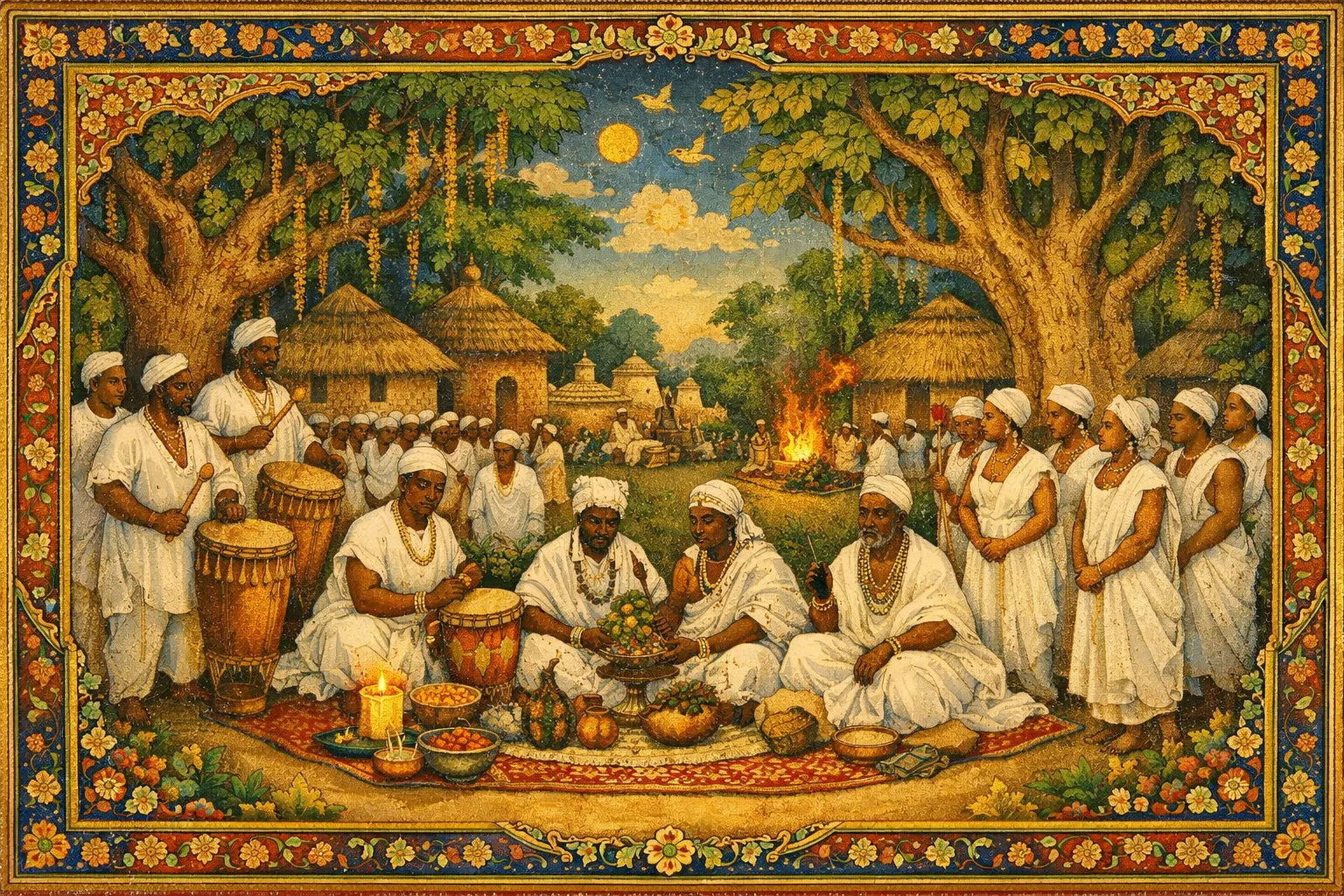
The best-known single ritual in Togolese folklore is the Guin New Year ceremony at Glidji in south-eastern Togo, often described through the sacred-stone rite. UNESCO lists “The bearing of the sacred stone or the rites of the New Year in the Guin country in Togo” and identifies the central rite as the taking of a sacred stone, with other key elements in the cycle of ceremonies.[UNESCO Intangible Cultural Heritage]ich.unesco.orgOpen source on unesco.org.
For general readers, the heart of the tradition is simple but powerful: a community renews time by consulting a sacred object. During the annual ceremony, the stone is brought out and its appearance is interpreted as an omen for the coming year. Africanews reported in August 2024 that thousands of people dressed in white gathered for the ceremony at Glidji, where a traditional priest described the event as the community’s New Year and linked it to prayers for peace and prosperity.[Africanews]africanews.comtogo guin people mark new year with sacred stone ceremonytogo guin people mark new year with sacred stone ceremony
This rite matters because it turns folklore into a public civic moment. It is not just a tale told about the past. It is an event in which ancestors, priests, families, visitors and the wider Guin community meet in one symbolic action. Earlier reporting on the same tradition described priests and priestesses invoking Guin divinities to protect the stone after it came out from the forest, while the stone was carried through the public square under the gaze of ritual elders and police.[Daily Trust]dailytrust.comDaily Trust Togo: Dances and a mysterious sacred stoneDaily Trust Togo: Dances and a mysterious sacred stone
The stone’s meaning is often reported through colour and prophecy, but care is needed. Tourist and popular accounts sometimes present a tidy code in which each colour has a fixed prediction. The stronger evidence shows a more careful picture: the stone is ritually revealed, then interpreted by religious authorities and elders within a specific ceremonial context. The ceremony is therefore better understood as community divination and ritual renewal, not as a simple fortune-telling spectacle.[UNESCO Intangible Cultural Heritage]ich.unesco.orgOpen source on unesco.org.
The Glidji rite also shows how tradition adapts. It attracts pilgrims and visitors from Togo and neighbouring countries, and reporting has noted both worship and tourism around the ceremony. That public visibility has not erased its sacred status, but it has changed how outsiders encounter it: as heritage, as religious practice, as cultural tourism and as a media image of Togolese identity.[Gulf News]gulfnews.comGulf News Togo: Dances, trances and a mysterious sacred stoneGulf News Togo: Dances, trances and a mysterious sacred stone

Vodun, spirits and the southern supernatural imagination
Vodun is central to any serious account of Togolese supernatural tradition, especially in the south. It should not be reduced to horror-film “voodoo” imagery. In West African usage, Vodun refers to spirit-centred religious traditions practised across coastal Benin, Togo, Ghana and Nigeria, with strong diversity between communities and shrines. Scholarly work on Vodun in Togo and Benin highlights deities such as Legba and complex traditions of possession, healing, social memory and resistance.[JSTOR]jstor.orgOpen source on jstor.org.
One reason Vodun is so important for folklore is that it links stories, objects, places and bodies. Spirits may be associated with crossroads, earth, thunder, water, illness, wealth, ancestors or particular communities. Belief is often expressed through shrines, offerings, songs, dance, possession and ritual specialists rather than through written scriptures. UNESCO’s broader description of oral traditions is useful here: legends, myths, prayers, chants and songs pass on memory and social values, and in Togo those forms often sit inside ritual performance rather than separate from it.[UNESCO Intangible Cultural Heritage]ich.unesco.orgOpen source on unesco.org.
Mami Wata is one of the most widely recognised water-spirit figures in coastal West and Central African traditions, and scholarship on Mami Wata includes Togolese material. Henry Drewal’s work on Mami Wata describes a visual and ritual culture of African and African Atlantic water spirits, while Dana Rush’s research discusses Mami Wata and “India spirits” in West African Vodun, including an Etron temple in Lomé.[UW Staff]staff.washington.eduUW Staff Mami WataUW Staff Mami Wata
This is a good example of how folklore changes over time. Mami Wata is often described as a beautiful water spirit, mermaid-like figure or serpent-associated being, but her imagery has absorbed imported prints, maritime contact, Indian Ocean references, local water-spirit traditions and modern ideas of wealth, beauty and danger. In Togo, as elsewhere, this means she is not simply an “ancient goddess” preserved unchanged; she is a living supernatural complex shaped by trade, colonial-era images, migration and contemporary devotion.[UW Staff]staff.washington.eduUW Staff Mami WataUW Staff Mami Wata
Lomé’s Akodessawa market is often presented to travellers as a Vodun or “fetish” market, and it has become one of the most visible places where outsiders encounter ritual objects connected with Togolese spirit practice. Such markets can easily be sensationalised, because animal remains and ritual materials look dramatic to visitors. A more grounded reading is that the market sits at the intersection of healing, protection, commerce, tourism and religious supply, and should not be treated as a museum of “dark magic”.[FoluOyefeso]foluoyefeso.comFolu Oyefeso Visiting the Akodessewa Fetish Market (Marche De FeticheursFolu Oyefeso Visiting the Akodessewa Fetish Market (Marche De Feticheurs
Koutammakou: where houses, hills and ancestors carry story
In northern Togo, Koutammakou, the Land of the Batammariba, is one of the country’s most important folklore landscapes. UNESCO describes it as a cultural landscape in north-eastern Togo and neighbouring Benin, home to the Batammariba and their remarkable mud tower-houses, known as takienta. Crucially, UNESCO states that nature is strongly associated with the rituals and beliefs of society there, and that the landscape’s value lies not only in architecture but also in farmland, forest and the relationships between people and place.[UNESCO World Heritage Centre]whc.unesco.orgOpen source on unesco.org.
For folklore readers, the key point is that Koutammakou is not just scenic architecture. The house itself is a cosmological object. A scholarly chapter on the site describes the takienta as a family dwelling that reflects Batammariba culture and belief, housing both living people and ancestors, with construction rules that combine ordinary function and sacred meaning.[Springer]link.springer.comOpen source on springer.com.
This makes Koutammakou different from a haunted castle or legendary ruin in the European sense. Its supernatural meaning is built into everyday settlement. Fields, forests, springs, rocks, initiation spaces and houses form a map of belonging. UNESCO’s 2003 evaluation of the site noted the strong interrelationship between symbolism, function and traditional practices, while later World Heritage material continues to stress the link between tower-houses, social structure and ritual belief.[UNESCO World Heritage Centre]whc.unesco.orgOpen source on unesco.org.
Koutammakou also shows why “folklore” should not be limited to stories about creatures. A sacred landscape may preserve mythic memory through rules about where to build, how to farm, where to initiate young people, how to honour ancestors, and how to move through certain places. For Batammariba communities, the supernatural is not necessarily a separate realm; it is embedded in the built and natural environment.[UNESCO World Heritage Centre]whc.unesco.orgOpen source on unesco.org.
The site has also become a national symbol and a heritage challenge. UNESCO records Koutammakou as Togo’s World Heritage property, extended in 2023 into Benin, while intangible-heritage work has focused on safeguarding knowledge, ritual practices, building skills and transmission. That matters because migration, tourism, changing building materials and environmental pressures can weaken the living practices that make the landscape meaningful in the first place.[UNESCO World Heritage Centre]whc.unesco.orgOpen source on unesco.org.

Initiation, wrestling and ritual calendars
Not all Togolese folklore is about spirits appearing in story form. Much of it is carried through rites of passage and seasonal festivals. The Kabyè Evala festival in northern Togo is a strong example. The International Centre of Martial Arts, under UNESCO auspices, describes Evala as a traditional wrestling game of the Kabiye ethnic group and a rite of passage for young men, involving physical and mental preparation as well as ritual expectations.[유네스코국제무예센터]unescoicm.orgOpen source on unescoicm.org.
From the outside, Evala can look like a sports event. Within Kabyè society, it is better understood as a public test of endurance, discipline and transition into adulthood. Sources describe annual wrestling ceremonies in the Kara region, with young men training, competing and entering adult social status through a wider initiation process.[유네스코국제무예센터]unescoicm.orgOpen source on unescoicm.org.
The folklore dimension lies in the ritual frame: elders, ancestors, sacred places, bodily discipline and public honour all matter. The contest is not simply about who wins a bout. It dramatises the values a young person is expected to carry into adult life: courage, restraint, stamina, loyalty to family and respect for community authority.[유네스코국제무예센터]unescoicm.orgOpen source on unescoicm.org.
Togo’s ritual calendar also includes harvest and historical festivals in several regions. Travel and festival sources list events such as Agbogbo-Za at Notsé, which commemorates Ewe migration memory, and harvest festivals connected with local crops and thanksgiving. These sources vary in detail and reliability, but they point to a wider truth: Togolese oral tradition often appears in annual gatherings where history is sung, danced, re-enacted or ritually remembered rather than written down as a fixed text.[Blastours]blastours.comOpen source on blastours.com.
UNESCO’s ongoing project on traditional dances of Togo is important in this context. The project aims to identify, safeguard and promote traditional dances by inventorying their techniques, music, rhythms, contexts, dress, norms and social, spiritual and secular roles. That wording is revealing: in Togo, dance is not just entertainment but a vessel for history, social identity, ritual knowledge and sometimes spiritual communication.[UNESCO Intangible Cultural Heritage]ich.unesco.orgOpen source on unesco.org.
Oral tales, tricksters and what is hard to prove
Compared with the sacred-stone rite or Koutammakou, printed sources for specifically Togolese folktales are thinner and more scattered. This does not mean Togo lacks oral tales. It means many tales remain local, multilingual, performance-based and under-published in accessible English. General studies of African oral literature describe familiar animal tricksters such as hare, tortoise and spider across many African narrative traditions, but those broad patterns should not automatically be treated as uniquely Togolese without local evidence.[OpenEdition Books]books.openedition.orgOpen Edition Books Oral Literature in AfricaOpen Edition Books Oral Literature in Africa
Readers may find modern websites retelling “Togolese” spider stories or wisdom tales. Some may be based on real oral motifs, but many are unattributed, newly written or adapted from wider West African Anansi and trickster traditions. Anansi, for example, is especially associated with Akan and Ashanti traditions in Ghana and the wider African diaspora, although spider-trickster motifs circulate widely across West Africa. For a Togo page, it is better to say that spider, hare and tortoise tales belong to a broader regional storytelling ecology unless a source clearly anchors a version to a Togolese language community, performer or collection.[Mythopia]mythopia.ioAnanse StoriesAnanse Stories
The most reliable way to think about Togolese oral tales is as social practice. They teach caution, cleverness, generosity, respect for elders, suspicion of greed and awareness of unseen consequences. They are also tied to performance: voice, timing, song, audience response and local language matter. UNESCO’s definition of oral traditions includes proverbs, riddles, tales, legends, myths, songs, prayers and chants, all of which are relevant to Togo even when individual stories are not widely published online.[UNESCO Intangible Cultural Heritage]ich.unesco.orgOpen source on unesco.org.
This is also where modern folklore can become misleading. Internet-era summaries often flatten West African traditions into a generic list of gods, monsters and “myths”. Togo’s better-attested folklore is more concrete: a stone revealed in Glidji, a tower-house in Koutammakou, a rite of wrestling in Kara, a water-spirit shrine in Lomé, a dance whose steps carry social memory. These are stronger anchors than unsourced lists of creatures copied from country to country.[unesco.org]ich.unesco.orgOpen source on unesco.org.
Twin figures, ancestors and material folklore
Material objects also carry Togolese folklore. Among Ewe-related communities in Togo and neighbouring areas, twin figures known as Venavi are associated with beliefs about twins, death, memory and spiritual continuity. Museum and gallery sources describe these figures as memorial or ritual objects connected with the idea that a deceased twin remains socially and spiritually present rather than simply gone.[soul-of-africa.com]soul-of-africa.comOpen source on soul-of-africa.com.
The twin-figure tradition is part of a wider West African pattern, with better-known parallels among Yoruba ère ìbejì figures in Nigeria and Benin. The comparison is useful, but it should not erase local difference. In Togolese Ewe contexts, Venavi figures belong to family care, remembrance and the social handling of twinship; they are not merely “dolls” in the ordinary toy sense.[soul-of-africa.com]soul-of-africa.comOpen source on soul-of-africa.com.
Such objects challenge a common misunderstanding about folklore. Folklore is not only what people say; it is also what people make, keep, feed, dress, carry, hide, sell, inherit or place on altars. A carved figure, a shrine object or a ritual instrument can preserve a story about the dead, a theory of the soul, a family’s relationship with danger, or a community’s belief about blessing and misfortune.[soul-of-africa.com]soul-of-africa.comOpen source on soul-of-africa.com.
UNESCO’s project on traditional musical instruments in Togo makes the same point from another angle. It focused on safeguarding knowledge of how to manufacture and play instruments in the Maritime region, including the dances and practices associated with them. Instruments are therefore part of oral tradition’s infrastructure: without makers, players and dancers, many stories and rites lose their living setting.[UNESCO Intangible Cultural Heritage]ich.unesco.orgOpen source on unesco.org.

Sacred tradition and modern life
Togolese folklore has not disappeared under modern religion, schooling or urban life. Instead, it often coexists with them. Religious-demography sources differ in their figures, but they consistently indicate that Christianity, Islam and indigenous or Vodun-related practice overlap in Togo; Minority Rights Group specifically notes that some Christians and Muslims also engage in traditional religious practices.[Minority Rights Group]minorityrights.orgOpen source on minorityrights.org.
That overlap is important for understanding how traditions survive. A person may attend church, identify as Muslim or live in a modern city while still respecting ancestors, fearing witchcraft, consulting a healer, attending a festival, or treating a sacred family object seriously. Folklore does not have to exist in a sealed “traditional” world to remain meaningful.[Minority Rights Group]minorityrights.orgOpen source on minorityrights.org.
Tourism and heritage recognition have also changed how Togolese traditions are seen. Koutammakou is a UNESCO World Heritage site; the sacred-stone rite has been recognised through UNESCO intangible-heritage channels; traditional dances and instruments have been the subject of safeguarding projects. These recognitions can help protect knowledge and raise visibility, but they can also make sacred practices vulnerable to simplification, staged performance or outsider misunderstanding.[unesco.org]whc.unesco.orgOpen source on unesco.org.
The most respectful approach is to treat Togolese folklore as living culture, not as exotic spectacle. The sacred stone of Glidji is not a prop. Koutammakou’s houses are not fantasy castles. Vodun objects are not horror decorations. Evala is not merely sport. Each belongs to communities that continue to negotiate what may be shown, what must remain guarded, and how inherited practices should survive in a changing country.[africanews.com]africanews.comtogo guin people mark new year with sacred stone ceremonytogo guin people mark new year with sacred stone ceremony
What to remember about Togo’s folklore
The most memorable feature of Togolese folklore is its closeness to place. In Glidji, a stone marks the renewal of the year. In Koutammakou, houses and hills carry ancestral meaning. In the Kara region, wrestling helps turn boys into socially recognised adults. In Lomé and the coastal south, Vodun-related spirits, shrines and ritual markets connect healing, danger, wealth, memory and the invisible world.[unesco.org]ich.unesco.orgOpen source on unesco.org.
The second lesson is that Togo’s folklore is shared but not generic. It overlaps with Ghana, Benin, Nigeria and the wider African Atlantic world, yet its local expressions matter. The same spirit name, animal motif or ritual form may mean different things in different towns, lineages or shrines. Good interpretation therefore starts with place, community and evidence rather than with a universalised “West African mythology” template.[UNESCO Intangible Cultural Heritage]ich.unesco.orgOpen source on unesco.org.
The third lesson is that the evidence is uneven. Some traditions are well documented by UNESCO, scholarship and journalism. Others remain mostly oral, local or filtered through tourism and modern retellings. That unevenness is not a weakness of Togolese folklore; it is part of what oral tradition is. The task is to listen for what is well-attested, avoid inflating thin claims, and recognise that much of Togo’s legendary and supernatural culture still lives most fully in performance, family memory, ritual authority and landscape.[UNESCO Intangible Cultural Heritage]ich.unesco.orgOpen source on unesco.org.
Amazon book picks
Further Reading
Books and field guides related to Where Togolese Folklore Still Lives Today. Use these as the next step if you want deeper reading beyond the article.
Mami Wata
Explores one of the most influential spirit traditions connected to coastal Togo.

Vodun
First published 2018. Subjects: Secrecy (psychology), Tourism, Ethnology, nigeria, Benin, Vodou.
African Religions and Philosophy
Provides essential context for folklore, ancestors, ritual life and oral traditions across West Africa including themes relevant to Togo.
Myths of Africa
Surveys African mythic traditions and helps place Togolese folklore within wider regional story worlds.
eBay marketplace picks
Marketplace Samples
Live-tested eBay searches with available results related to this page.


Endnotes
1.
Source: ich.unesco.org
Link:https://ich.unesco.org/en/RL/the-bearing-of-the-sacred-stone-or-the-rites-of-the-new-year-in-the-guin-country-in-togo-02241
2.
Source: whc.unesco.org
Link:https://whc.unesco.org/en/list/1140/
3.
Source: ich.unesco.org
Link:https://ich.unesco.org/en/assistances/identification-capacity-building-safeguarding-and-promotion-of-traditional-dances-of-togo-as-a-vector-of-sustainable-cultural-development-02072
4.
Source: ich.unesco.org
Link:https://ich.unesco.org/en/oral-traditions-and-expressions-00053
5.
Source: africanews.com
Title: togo guin people mark new year with sacred stone ceremony
Link:https://www.africanews.com/2024/08/30/togo-guin-people-mark-new-year-with-sacred-stone-ceremony/
6.
Source: refworld.org
Title: World Directory of Minorities and Indigenous Peoples
Link:https://www.refworld.org/reference/countryrep/mrgi/2018/64939
7.
Source: jstor.org
Link:https://www.jstor.org/stable/27096056
8.
Source: ich.unesco.org
Link:https://ich.unesco.org/en/RL/oral-heritage-of-gelede-00002
9.
Source: foluoyefeso.com
Title: Folu Oyefeso Visiting the Akodessewa Fetish Market (Marche De Feticheurs
Link:https://www.foluoyefeso.com/post/visiting-the-akodessewa-fetish-market-marche-de-feticheurs-lome
10.
Source: link.springer.com
Link:https://link.springer.com/chapter/10.1007/978-3-030-80910
11.
Source: whc.unesco.org
Link:https://whc.unesco.org/document/151851
12.
Source: whc.unesco.org
Title: World Heritage Centre WHV
Link:https://whc.unesco.org/document/199259
13.
Source: blastours.com
Link:https://blastours.com/festivals-in-togo/
14.
Source: books.openedition.org
Title: Open Edition Books Oral Literature in Africa
Link:https://books.openedition.org/obp/1201?lang=en
15.
Source: mythopia.io
Title: Ananse Stories
Link:https://mythopia.io/tagged/1/ananse
16.
Source: soul-of-africa.com
Link:https://www.soul-of-africa.com/en/exhibitions/twin-altar.html
17.
Source: ich.unesco.org
Link:https://ich.unesco.org/en/assistances/inventory-safeguarding-and-promoting-knowledge-of-how-to-manufacture-and-play-togo-s-traditional-musical-instruments-pilot-phase-in-the-maritime-region-south-togo-00912
18.
Source: ich.unesco.org
Title: benin BJ
Link:https://ich.unesco.org/en/state/benin-BJ
19.
Source: ich.unesco.org
Title: zaouli popular music and dance of the guro communities in cote d ivoire 01255
Link:https://ich.unesco.org/en/RL/zaouli-popular-music-and-dance-of-the-guro-communities-in-cote-d-ivoire-01255
20.
Source: ich.unesco.org
Title: togo TG
Link:https://ich.unesco.org/en/state/togo-TG
21.
Source: unesco.org
Link:https://www.unesco.org/en/countries/tg
22.
Source: ich.unesco.org
Title: cote d ivoire CI
Link:https://ich.unesco.org/en/state/cote-d-ivoire-CI
23.
Source: ich.unesco.org
Title: congo CG
Link:https://ich.unesco.org/en/state/congo-CG?info=projects
24.
Source: ich.unesco.org
Title: vodun beliefs social practices and ways of living 02386
Link:https://ich.unesco.org/en/assistances/vodun-beliefs-social-practices-and-ways-of-living-02386
25.
Source: ich.unesco.org
Link:https://ich.unesco.org/fr/assistances/developper-et-tester-du-materiel-pedagogique-relatif-au-patrimoine-culturel-immateriel-pci-dans-des-etablissements-de-formation-des-enseignants-du-primaire-au-zimbabwe-01616
26.
Source: ich.unesco.org
Link:https://ich.unesco.org/en/video/76581
27.
Source: ich.unesco.org
Title: 01857 EN
Link:https://ich.unesco.org/doc/src/01857-EN.pdf
28.
Source: ich.unesco.org
Title: what is intangible heritage 00003
Link:https://ich.unesco.org/en/what-is-intangible-heritage-00003
29.
Source: ich.unesco.org
Title: ghana GH
Link:https://ich.unesco.org/en/state/ghana-GH
30.
Source: ich.unesco.org
Title: 00114 EN
Link:https://ich.unesco.org/doc/src/00114-EN.pdf
31.
Source: ich.unesco.org
Link:https://ich.unesco.org/en/lists
32.
Source: ich.unesco.org
Link:https://ich.unesco.org/en/RL/mapoyo-oral-tradition-and-its-symbolic-reference-points-within-their-ancestral-territory-00983
33.
Source: ich.unesco.org
Link:https://ich.unesco.org/en/decisions-bureau/18.COM%202.BUR/4.6
34.
Source: ich.unesco.org
Title: national oral traditions not additional collection component 01528
Link:https://ich.unesco.org/en/assistances/national-oral-traditions-not-additional-collection-component-01528
35.
Source: ich.unesco.org
Link:https://ich.unesco.org/en/video/75357
36.
Source: ich.unesco.org
Link:https://ich.unesco.org/en/video/35105
37.
Source: ich.unesco.org
Title: togo strengthens the safeguarding of its traditional musical instruments 13435
Link:https://ich.unesco.org/en/news/togo-strengthens-the-safeguarding-of-its-traditional-musical-instruments-13435
38.
Source: ich.unesco.org
Link:https://ich.unesco.org/en/convention
39.
Source: ich.unesco.org
Link:https://ich.unesco.org/en/decisions/12.COM/11.B.2
40.
Source: ich.unesco.org
Title: young people from south togo rediscover traditional musical instruments 00228
Link:https://ich.unesco.org/en/news/young-people-from-south-togo-rediscover-traditional-musical-instruments-00228
41.
Source: ich.unesco.org
Title: 01858 EN
Link:https://ich.unesco.org/doc/src/01858-EN.pdf?v=1367333960
42.
Source: ich.unesco.org
Link:https://ich.unesco.org/en/video/81541
43.
Source: unesco.org
Title: document 1450
Link:https://www.unesco.org/archives/multimedia/document-1450
44.
Source: folktales.africa
Title: three beninese folktales that teach lessons on life loss and companionship
Link:https://folktales.africa/three-beninese-folktales-that-teach-lessons-on-life-loss-and-companionship/
45.
Source: folktales.africa
Title: the spider who tried to steal wisdom
Link:https://folktales.africa/the-spider-who-tried-to-steal-wisdom/
46.
Source: travel.com
Link:https://travel.com/regions/africa/togo/togo-top-festivals-to-check-out-when-visiting/
47.
Source: foluoyefeso.com
Title: koutammakou excursion discovering the ancient batammariba tribe of togo
Link:https://www.foluoyefeso.com/post/koutammakou-excursion-discovering-the-ancient-batammariba-tribe-of-togo
48.
Source: mythopia.io
Title: Tortoise Trickster Tales
Link:https://mythopia.io/tagged/502/tortoise-tales
49.
Source: blastours.com
Title: Evala in Kara
Link:https://blastours.com/evala-in-kara/
50.
Source: unesco.nl
Link:https://unesco.nl/werelderfgoed/koutammakou-land-van-de-batammariba
51.
Source: journals.openedition.org
Link:https://journals.openedition.org/etudesafricaines/pdf/18767
52.
Source: journals.openedition.org
Link:https://journals.openedition.org/etudesafricaines/18767
53.
Source: minorityrights.org
Link:https://minorityrights.org/country/togo/
54.
Source: dailytrust.com
Title: Daily Trust Togo: Dances and a mysterious sacred stone
Link:https://dailytrust.com/null-2709/
55.
Source: gulfnews.com
Title: Gulf News Togo: Dances, trances and a mysterious sacred stone
Link:https://gulfnews.com/world/africa/togo-dances-trances-and-a-mysterious-sacred-stone-1.1590530
56.
Source: staff.washington.edu
Title: UW Staff Mami Wata
Link:https://staff.washington.edu/ellingsn/Drewal-Mami_Wata-AfAr.2008.41.2.pdf
57.
Source: Wikipedia
Link:https://en.wikipedia.org/wiki/Koutammakou
58.
Source: unescoicm.org
Link:https://www.unescoicm.org/eng/library/global_martialarts.php?code=global_martialarts_eng&idx=7179&page=1&ptype=view
59.
Source: Wikipedia
Title: West African mythology
Link:https://en.wikipedia.org/wiki/West_African_mythology
60.
Source: Wikipedia
Link:https://en.wikipedia.org/wiki/Togo
61.
Source: ama.africatoday.com
Link:https://www.ama.africatoday.com/storytelling.htm
62.
Source: apsaidal.com
Title: Koutammakou, the Land of the Batammariba
Link:https://apsaidal.com/koutammakou/
63.
Source: beingafrican.org
Link:https://beingafrican.org/togo/
64.
Source: openfactbook.org
Link:https://openfactbook.org/countries/togo/
65.
Source: universvoyage.com
Title: Mami Wata
Link:https://universvoyage.com/en/voodoo-mami-wata-mother-of-the-waters-queen-of-the-seas-and-oceans/
66.
Source: ebsco.com
Link:https://www.ebsco.com/research-starters/religion-and-philosophy/west-african-vodun
Additional References
67.
Source: theguardian.com
Link:https://www.theguardian.com/global-development/2025/oct/06/twin-carvings-yoruba-ere-ibej-statuettes-nigerian
Source snippet
However, many of these statuettes have been displaced into international museums, and the tradition has waned. In response, Adegbola foun...
68.
Source: youtube.com
Link:https://www.youtube.com/watch?v=HUhSFuZDrnM
Source snippet
This Glidji 2025: Epé Ekpé, the message of the ancestors for the nation video captures the sacred stone ceremony of the Guin community in...
69.
Source: youtube.com
Title: Exploring Koutammakou, Togo: Journey to the UNESCO World Heritage Site
Link:https://www.youtube.com/watch?v=fj4tWE6s1w4
Source snippet
Glidji 2025: Epé Ekpé, the message of the ancestors for the nation...
70.
Source: youtube.com
Title: Discovering Koutammakou: The Land of the Batammariba
Link:https://www.youtube.com/watch?v=UV5hkEnrzsA
Source snippet
Exploring Koutammakou, Togo: Journey to the UNESCO World Heritage Site...
71.
Source: instagram.com
Link:https://www.instagram.com/p/DaKRoUEtXGC/
72.
Source: fairytalez.com
Link:https://fairytalez.com/region/african/
73.
Source: researchgate.net
Link:https://www.researchgate.net/publication/376071588_The_Material_Culture_of_Vodun_Case_Studies_from_Ghana_Togo_Germany_and_In-Between
74.
Source: pressbooks.pub
Link:https://pressbooks.pub/africanguide/chapter/chapter-1/
75.
Source: facebook.com
Link:https://www.facebook.com/groups/275114380263865/posts/878756359899661/
76.
Source: facebook.com
Link:https://www.facebook.com/groups/archeologyandcivilizations/posts/9047394455353998/
Topic Tree
Follow this branch
Related pages 192
- Afghan Folklore
- Albanian Folklore
- Algerian Folklore
- Australian Folklore
- Azerbaijan Folklore
- +187 more in sidebar