Within Lithuanian Folklore
Who Was Lithuania's Thunder God?
Perkunas and Velnias show how Lithuanian folklore blends storm, justice, sacred nature and Christian-era storytelling.
On this page
- Perkunas as storm, order and justice
- Velnias, devils and the trouble with translation
- Sacred trees, stones, snakes and fire
Page outline Jump by section
Introduction
Who was Lithuania’s thunder god? In folklore, the answer is Perkūnas, the fierce ruler of storms, lightning and moral order. Yet understanding Perkūnas means understanding his constant opponent as well: Velnias, a shadowy figure linked with the underworld, the dead, trickery and later the Christian devil. Together they form one of the most important patterns in Lithuanian traditional belief. Their rivalry explains thunderstorms, moral justice, sacred landscapes and the tension between order and disorder that runs through many Baltic stories. Because Lithuania converted to Christianity later than most of Europe, memories of older religious ideas remained unusually visible in folklore, place names, customs and legends long after official conversion. Perkūnas and Velnias therefore stand at the centre of one of the most distinctive surviving windows into the pre-Christian Baltic imagination.[academia.edu]academia.eduBaronas, S.C. Rowell. The Conversion of Lithuania….January 1, 2015 — Medieval Lithuania was the last state in Europe to accept Christi…

Perkūnas as Storm, Order and Justice
Among the deities remembered in Lithuanian tradition, Perkūnas is the most clearly documented and arguably the most important. Historical records, folklore collections, linguistic evidence and sacred place traditions all point to a thunder god who occupied a central position in the old Baltic religious world. Modern scholarship describes him not merely as a weather spirit but as a figure connected with justice, social order, fertility and the maintenance of cosmic balance.[academia.edu]academia.eduPerkūnas's origins trace back to Indo…Read more…
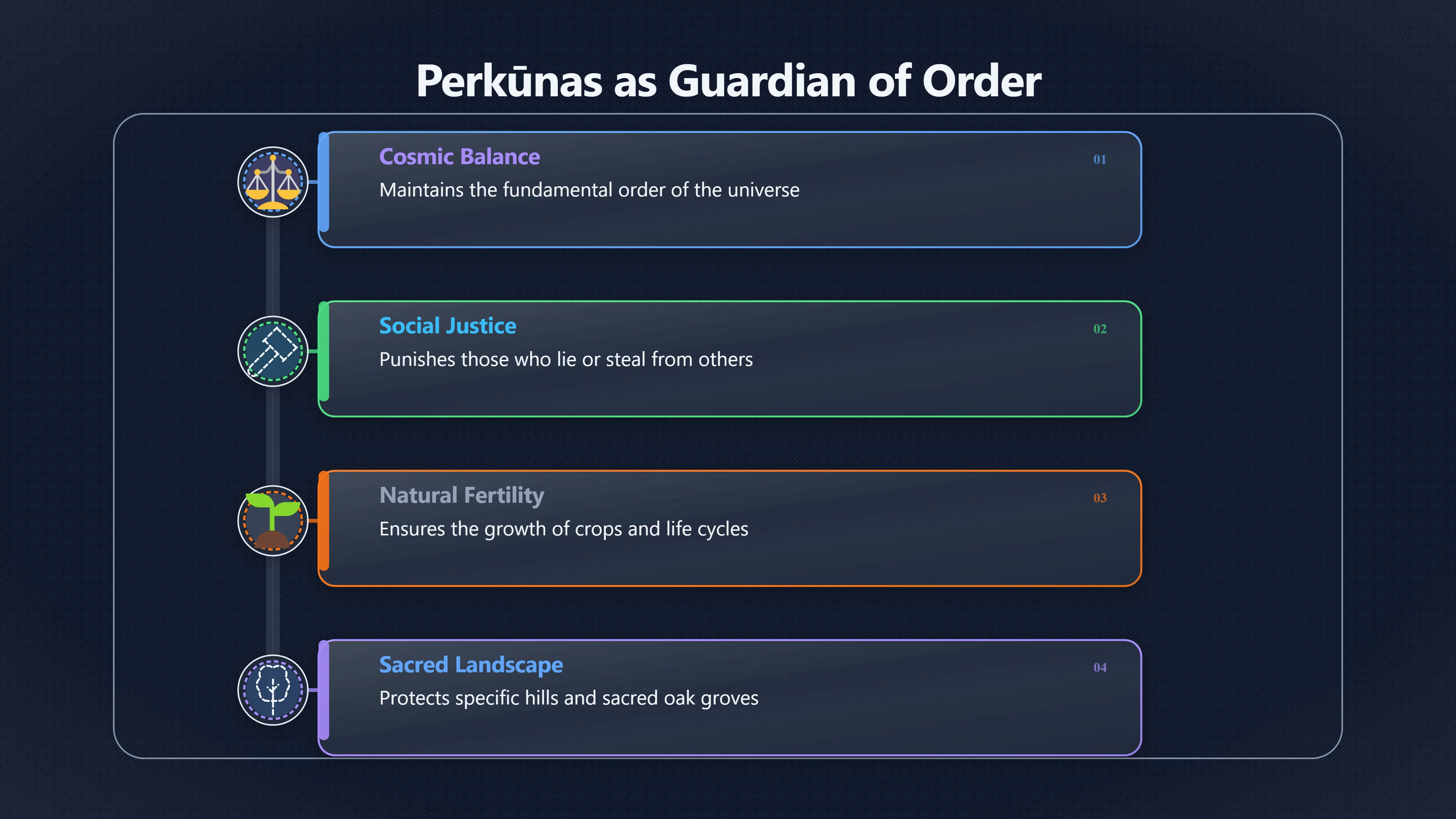
Thunderstorms were understood as signs of his activity. Lightning was not random. It represented judgement. Folklore repeatedly portrays Perkūnas striking those who break proper order, lie, steal or cooperate with dark forces. His weapons vary from story to story—axes, hammers, arrows or lightning itself—but the underlying idea remains consistent: he punishes wrongdoing and restores balance.[mythcloud.eu]mythcloud.euPerkūnasPerkūnas is typically depicted wielding weapons like the "god's whip" (lightning) or stone axes, which he uses to punish wrongdoi…
Many features of the natural landscape became associated with him:
- Oak trees were especially sacred and frequently linked to his presence.
- Hills and elevated places were considered fitting locations for worship.
- Fire and lightning carried particular religious significance.
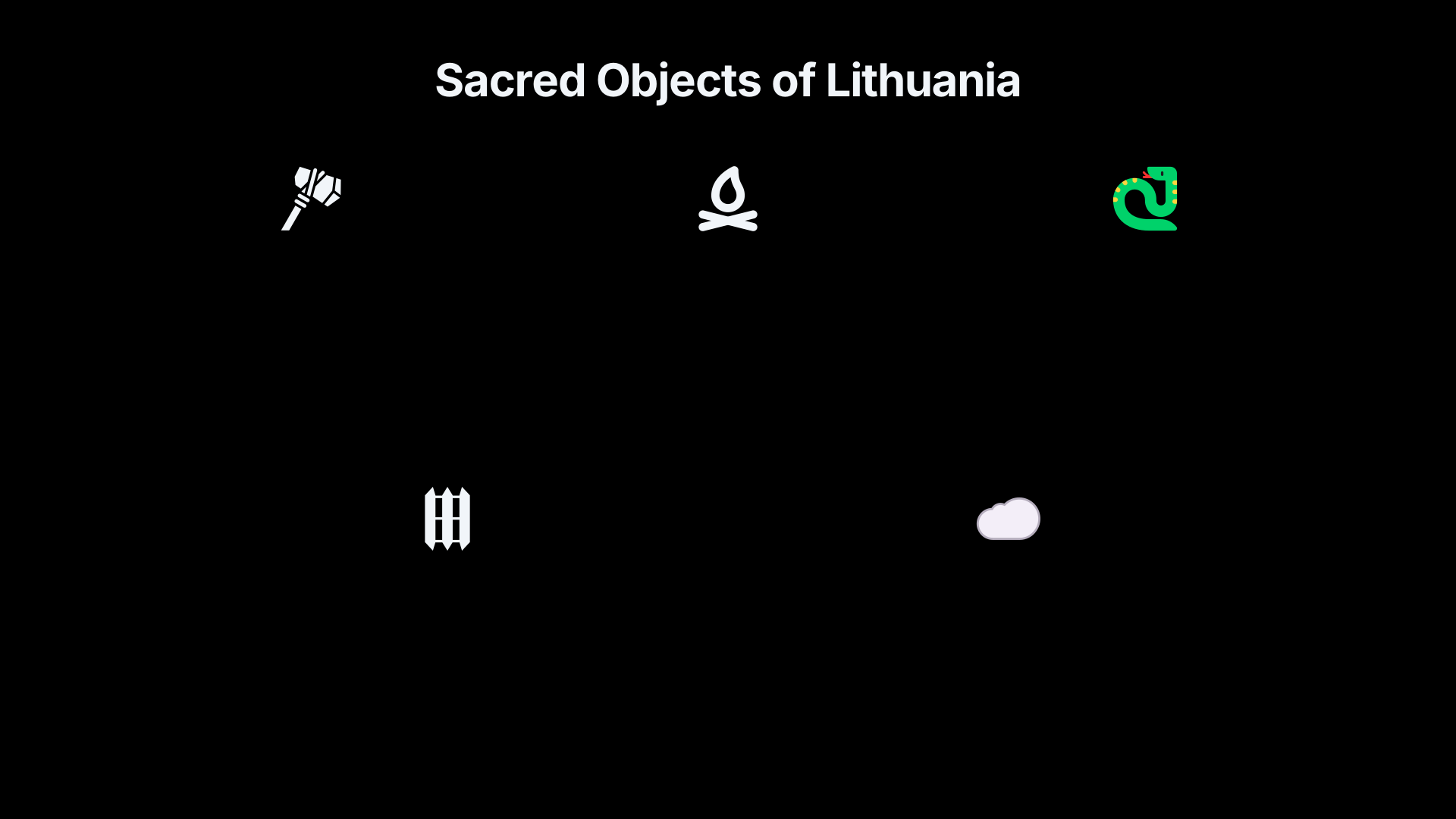
- Certain stones and prehistoric axe-heads found in fields were interpreted as thunderstones connected with his power.[academia.edu]academia.eduPerkūnas's origins trace back to Indo…Read more…
The image that emerges from folklore is not simply that of a storm god. Perkūnas acts as a defender of rightful order. In this role he resembles other Indo-European thunder deities, yet Lithuanian tradition gives the conflict a particularly vivid local form through his relationship with Velnias.[Academia]academia.eduPerkūnas's origins trace back to Indo…Read more…
Velnias, Devils and the Trouble with Translation
Modern readers often encounter Velnias translated as “the devil”. That translation is useful but incomplete.
Before Christianity, Velnias appears to have been a much more complex figure. Evidence from folklore and comparative mythology suggests connections with the underworld, livestock, wealth, wild places and the spirits of the dead. After Christianisation, many of these older features were gradually absorbed into the image of the Christian devil. The result is a figure who is neither entirely pagan nor entirely Christian.[Wikipedia]WikipediaLithuanian mythologyLithuanian mythology
This explains why Velnias behaves so differently across Lithuanian stories. Sometimes he is frightening. Sometimes he is comic. Sometimes he tricks humans; at other times humans trick him. He may appear as a wealthy landowner, a shape-shifter, a forest being or a devil in the Christian sense. Rather than a single fixed character, Velnias became a meeting point where older Baltic beliefs and Christian storytelling overlapped.[Wikipedia]WikipediaLithuanian mythologyLithuanian mythology
The famous conflict between Perkūnas and Velnias lies at the heart of many folk explanations for thunder. In numerous tales, Velnias steals something, hides among rocks or trees, blocks waters, disguises himself as an animal or taunts the thunder god. Perkūnas then pursues him across the landscape. Lightning strikes are interpreted as blows aimed at the fleeing trickster. Thunder becomes the sound of the chase itself.[Academia]academia.eduPerkūnas's origins trace back to Indo…Read more…
What makes these stories memorable is that they are not simply battles between good and evil in a Christian sense. They preserve traces of an older mythic structure in which order confronts chaos, sky confronts underworld and the forces of fertility confront forces that obstruct or disrupt the natural world.[Academia]academia.eduPerkūnas's origins trace back to Indo…Read more…
Why Thunderstorms Became Mythic Dramas
For many generations, thunderstorms were among the most powerful natural events people experienced directly. Folklore transformed them into stories with characters, motives and consequences.
In Lithuanian tradition, a storm could be imagined as Perkūnas hunting Velnias through forests, over fields and across rivers. The landscape itself became part of the drama. A tree shattered by lightning might be interpreted as a place where Velnias attempted to hide. Strange stones could be explained as weapons cast by the thunder god. Sudden storms acquired moral meaning because they were linked to the enforcement of justice.[academia.edu]academia.eduPerkūnas's origins trace back to Indo…Read more…
This mythic interpretation also helped explain uncertainty. Crops depended on rain but could be destroyed by storms. Lightning could bring fire, yet fire was sacred and life-sustaining. Perkūnas therefore represented both danger and protection. He was feared, respected and appealed to in ritual contexts connected with weather and harvests. Historical and folkloric evidence records prayers, offerings and ceremonies directed toward him.[Academia]academia.eduPerkūnas's origins trace back to Indo…Read more…

Sacred Trees, Stones, Snakes and Fire
The old Lithuanian religious world was not organised around a single sacred book. Instead, holiness was often attached to places and natural objects.
Oaks and Sacred Places
The oak was especially important in traditions associated with Perkūnas. Sacred groves and prominent trees appear repeatedly in historical descriptions and folklore. The association between thunder and oaks is widespread across Europe, but in Lithuania it remained unusually persistent in folk memory. Some traditions describe ritual fires burning near sacred oaks or on hills linked to the thunder god.[Academia]academia.eduPerkūnas's origins trace back to Indo…Read more…
Stones and Thunderstones
Ancient stone axe-heads discovered in fields were often interpreted as objects thrown from the sky during thunderstorms. Such “thunderstones” appear in folklore across Europe, but Lithuanian traditions strongly connected them with Perkūnas and his weapons. The belief helped tie archaeological objects to living folk narratives.[Academia]academia.eduPerkūnas's origins trace back to Indo…Read more…
Snakes and Household Fortune
Snakes occupied a very different symbolic role from the serpent imagery familiar in much Christian tradition. In Lithuanian folklore, snakes could be linked with household prosperity, protection and sacred power. Their presence reflects a wider Baltic religious outlook in which animals could act as intermediaries between the human world and unseen forces. Although not directly part of every Perkūnas story, snake traditions reveal how nature itself was woven into the sacred landscape.[lnkc.lt]lnkc.ltLithuanian Religion and MythologyFolklore usually emphasizes that Perkūnas is a patron of weather, he lives between the heaven and the ea…
Fire That Must Not Die
Sacred fire appears frequently in accounts of Baltic religion. Fire was associated with continuity, ritual and divine presence. Scholars studying Lithuanian religion note repeated connections between Perkūnas, sacred fires and ritual practice. In folklore, lightning itself could be viewed as heavenly fire descending to earth, linking storm and worship through a common symbol.[academia.edu]academia.eduPerkūnas's origins trace back to Indo…Read more…
What Changed After Christianity Arrived?
Lithuania officially adopted Christianity in 1387, while Samogitia followed in the early fifteenth century. Yet conversion was a long process rather than a single event. Older beliefs did not simply vanish. Instead, they were reinterpreted, absorbed and reshaped.[Academia]academia.eduBaronas, S.C. Rowell. The Conversion of Lithuania….January 1, 2015 — Medieval Lithuania was the last state in Europe to accept Christi…
Perkūnas gradually ceased to be worshipped as a deity, but stories about him survived. Velnias underwent an even more dramatic transformation. His name became the ordinary Lithuanian word for the devil, encouraging the merger of older mythological traditions with Christian teachings about evil. Even so, folklore preserved many features that do not fit neatly into Christian theology. The result is a rich body of tales where pagan and Christian layers remain visible at the same time.[Wikipedia]WikipediaLithuanian mythologyLithuanian mythology
This blending is one reason Lithuanian folklore attracts such interest from historians and folklorists. Rather than offering a perfectly preserved ancient religion, it shows how traditions adapt. Perkūnas and Velnias survived not because old beliefs remained unchanged, but because stories continued to evolve while keeping traces of much older ideas.[academia.edu]academia.eduPerkūnas's origins trace back to Indo…Read more…
Why Perkūnas Still Matters
Today, few people regard Perkūnas as a living god, yet he remains one of the most recognisable figures in Lithuanian cultural memory. His image appears in literature, art, heritage interpretation and modern reconstructions of Baltic pagan traditions. Velnias likewise survives in folk art, devil museums, festivals and storytelling traditions, often with the same mixture of humour and menace found in older tales.[baltukelias.lt]baltukelias.ltOpen source on baltukelias.lt.
Their enduring appeal comes from more than mythology. Together they embody a distinctly Lithuanian vision of the world: forests and storms are alive with meaning, justice can be heard in thunder, and the landscape itself remembers stories from a time before Christianity. Even after centuries of religious and cultural change, the chase between Perkūnas and Velnias still echoes through the folklore of Lithuania.[academia.edu]academia.eduPerkūnas's origins trace back to Indo…Read more…
Amazon book picks
Further Reading
No matched book cards were available for Who Was Lithuania's Thunder God?, so this fallback keeps a direct Amazon reading path visible.
Topical books
Thunder God Justice guide
Browse books, explainers and reference titles related to this topic.
Search AmazonRelated search
Perkūnas rivalry guide
Browse books, explainers and reference titles related to this topic.
Search AmazonRelated search
Baltic folklore guide
Browse books, explainers and reference titles related to this topic.
Search AmazonEndnotes
1.
Source: academia.edu
Link:https://www.academia.edu/41171051/D_Baronas_S_C_Rowell_The_Conversion_of_Lithuania_From_Pagan_Barbarians_to_Late_Medieval_Christians_Vilnius_2015_
Source snippet
Baronas, S.C. Rowell. The Conversion of Lithuania....January 1, 2015 — Medieval Lithuania was the last state in Europe to accept Christi...
Published: January 1, 2015
2.
Source: cambridge.org
Title: University Press & Assessment The conversion of Lithuania
Link:https://www.cambridge.org/core/journals/journal-of-ecclesiastical-history/article/conversion-of-lithuania-from-pagan-barbarians-to-late-medieval-christians-by-darius-baronasand-s-c-rowell-pp-xi-627-incl-9-colour-maps-and-26-blackandwhite-and-colour-ills-vilnius-institute-of-lithuanian-literature-and-folklore-2015-978-609-425-152-8/B53438F0255C6057E019BE9313AEE5EE
Source snippet
From pagan barbarians to late...by N Nowakowska · 2017 — As a big, synthetic-interpretative study, The conversion of Lithuania seeks to...
3.
Source: academia.edu
Link:https://www.academia.edu/116430617/Nijol%C4%97_Laurinkien%C4%97_The_God_Perk%C5%ABnas_of_the_Ancient_Lithuanians_in_Language_Folklore_and_Historical_Sources
Source snippet
Perkūnas's origins trace back to Indo...Read more...
4.
Source: mythcloud.eu
Link:https://www.mythcloud.eu/compendium/perkunas
Source snippet
PerkūnasPerkūnas is typically depicted wielding weapons like the "god's whip" (lightning) or stone axes, which he uses to punish wrongdoi...
5.
Source: lnkc.lt
Link:https://www.lnkc.lt/eknygos/eka/mythology/relmyth.html
Source snippet
Lithuanian Religion and MythologyFolklore usually emphasizes that Perkūnas is a patron of weather, he lives between the heaven and the ea...
6.
Source: baltukelias.lt
Link:https://www.baltukelias.lt/en/editable-separated/id-415/
7.
Source: Wikipedia
Title: Lithuanian mythology
Link:https://en.wikipedia.org/wiki/Lithuanian_mythology
8.
Source: youtube.com
Title: LITHUANIAN MYTHOLOGY is this dark?!
Link:https://www.youtube.com/watch?v=rYQRklboLlE
Source snippet
Baltic - Lithuanian Mythology: A Journey Through the Divine Realm...
9.
Source: youtube.com
Link:https://www.youtube.com/watch?v=9uxDq_7PVeY
Source snippet
Who is Perkunas? The most powerful god you didn't know about...
10.
Source: journals.vu.lt
Link:https://www.journals.vu.lt/td/article/download/35931/34129/94329
Source snippet
Vilnius University PressThe God Perkūnas (Re)Introducedby A Skujytė-Razmienė · 2024 — The pantheon of Baltic pre-Christian gods is one of...
11.
Source: folklorefellows.fi
Title: FFNB 59 REVIEW Vaitkeviciene
Link:https://www.folklorefellows.fi/wp-content/uploads/FFNB-59-REVIEW-Vaitkeviciene.pdf
Source snippet
highlight the religious aspects of Perkūnas including his divine functions...
Additional References
12.
Source: scispace.com
Title: christians in late pagan and pagans in early christian wavtutbz0b
Link:https://scispace.com/pdf/christians-in-late-pagan-and-pagans-in-early-christian-wavtutbz0b.pdf
Source snippet
CHRISTIANS IN LATE PAGAN, AND PAGANS IN EARLY...ABSTRACT This paper deals with the issue of the presence of Christians and pagans in pag...
13.
Source: facebook.com
Link:https://www.facebook.com/groups/183268005069640/posts/2128373307225757/
Source snippet
Meaning of Diviriks in Lithuanian mythologyThe most revered god in the Baltic religion after Dievas was Perkūnas, the depicts the thunder...
14.
Source: facebook.com
Link:https://www.facebook.com/groups/baltiskapasauleziura/posts/25598329853150610/
Source snippet
Perkunas the thunder god in baltic religionHe is described as the deity of the sky, thunder, lightning, storms, rain, fire, war, law, ord...
15.
Source: prussia.online
Link:https://prussia.online/Data/Book/th/the-conversion-of-lithuania/Baronas%20D.%2C%20Rowell%20S.%20The%20Conversion%20of%20Lithuania%20%282015%29%2C%20OCR.pdf
Source snippet
The Conversion of LithuaniaThis book is intended to be a guide through the murky waters of pagan and early Christian Lithuania. Notwithst...
16.
Source: brewminate.com
Title: the last pagan realm lithuanias medieval transformation under christianization
Link:https://brewminate.com/the-last-pagan-realm-lithuanias-medieval-transformation-under-christianization/
Source snippet
Lithuania: The Last Pagan State in Medieval Europe28 Nov 2025 — Lithuania's 1387 conversion reshaped its politics, culture, and place in...
17.
Source: instagram.com
Title: Perkunas is the Baltic god of thunder, lightning, and storms
Link:https://www.instagram.com/reel/DSbW9sgjuEi/
Source snippet
was the patron diety of rain, fire, war, mountains, and oak trees. He is typically depicted wielding an axe or hammer, whi...
18.
Source: gs.elaba.lt
Title: lt Darius Baronas, SC Rowell, The Conversion of Lithuania
Link:https://gs.elaba.lt/object/elaba%3A33686079/33686079.pdf
Source snippet
by M Ščavinskas · 2018 — Chapter 6 initiates an analysis of the history of Lithuania's conversion in. 1386–1387, focusing not just on the...
19.
Source: instagram.com
Link:https://www.instagram.com/p/DMZQcwSsabg/
Source snippet
d of thunder, lightning, storms, war, and justice.Read more...
20.
Source: researchgate.net
Title: Darius Baronas, S.C
Link:https://www.researchgate.net/publication/333575360_Darius_Baronas_SC_Rowell_The_Conversion_of_Lithuania_From_Pagan_Barbarians_to_the_Late_Medieval_Christians_Vilnius_Institute_of_Lithuanian_Literature_and_Folklore_2015_627_p_ISBN
Source snippet
Rowell, The Conversion of Lithuania....... Conversion of Lithuania. From Pagan Barbarians to the Late Medieval Christians, Vilnius: Inst...
21.
Source: scribd.com
Link:https://www.scribd.com/document/625912403/Baltic-Mythology
Source snippet
It covers various historical periods when pagan beliefs were actualized...
Amazon book picks
Further Reading
Books and field guides related to Who Was Lithuania's Thunder God?. Use these as the next step if you want deeper reading beyond the article.
Topic Tree