Why Iceland's Landscape Still Tells Strange Stories
Icelandic folklore is not a single “mythology” but a living story-map of a country where farms, lava fields, mountains, lakes and winter darkness have long been treated as places with memory.
Page outline Jump by section
Introduction
The evidence is stronger than a tourist cliché. Iceland has major manuscript collections, published nineteenth-century folk-tale collections, modern folklore archives, mapped legend databases and recent surveys of folk belief. Sagnagrunnur, a geographically mapped database of Icelandic legends, records material from 19 published collections and roughly 10,100 legends, including about 2,600 from Jón Árnason’s influential nineteenth-century national collection.[Sagnagrunnur]sagnagrunnur.arnastofnun.isSagnagrunnur Instructions – SagnagrunnurSagnagrunnur Instructions – Sagnagrunnur These sources show a culture where stories are not merely “old tales”, but ways of thinking about landscape, danger, hospitality, morality, memory and national identity.
Why Icelandic folklore feels tied to the land
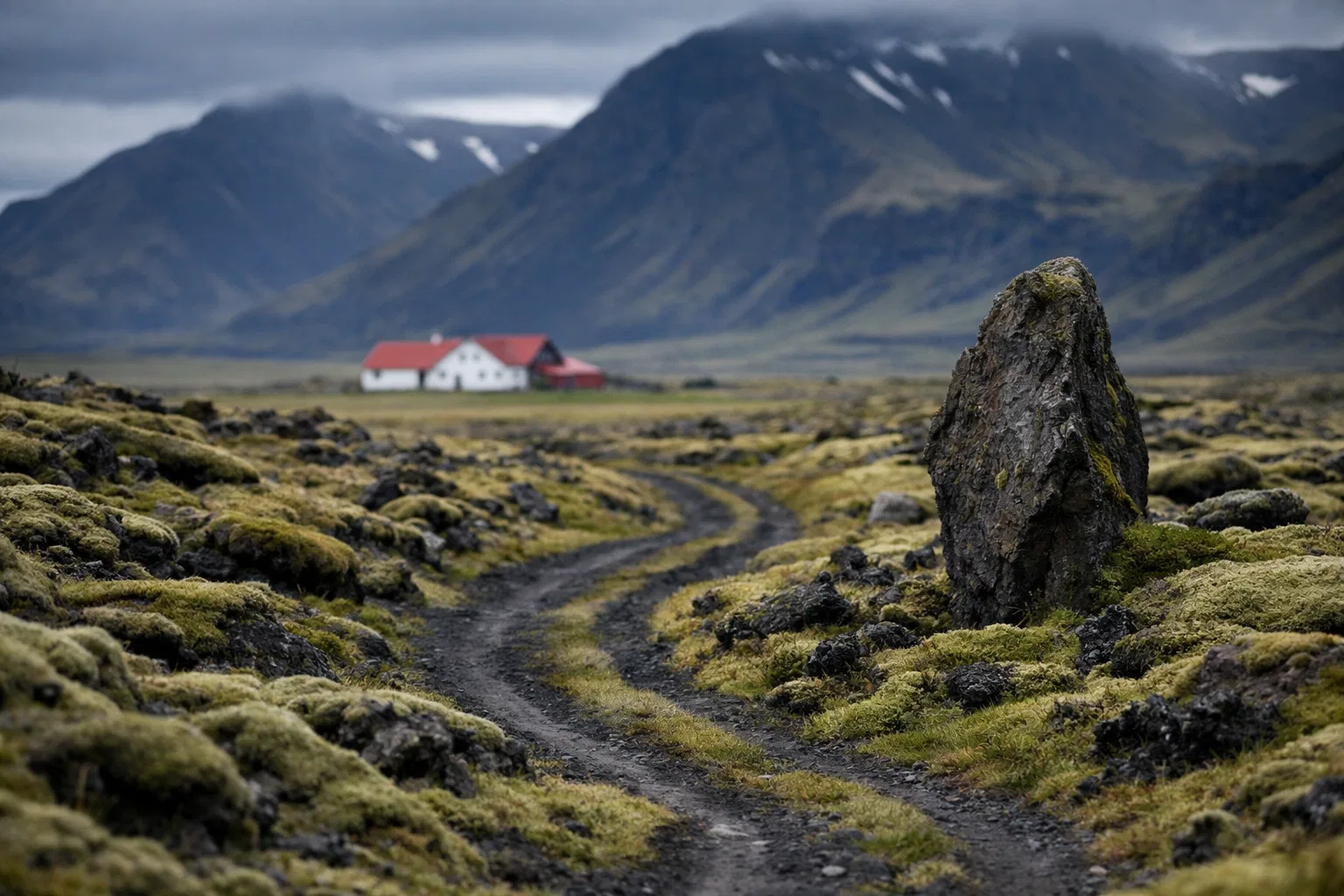
The first thing to understand is that Icelandic folklore is local. Many stories are not simply about a troll, ghost or hidden being; they are about this rock, that hill, that lake, that farm, or the dangerous road between two named places. Sagnagrunnur makes this visible by connecting published Icelandic legends to the homes of storytellers and collectors and to places mentioned in the tales, with most of the legends coming from collections made between the mid-nineteenth and early twentieth centuries.[Sagnagrunnur]sagnagrunnur.arnastofnun.isSagnagrunnur About Sagnagrunnur – SagnagrunnurSagnagrunnur About Sagnagrunnur – Sagnagrunnur
This place-based quality partly reflects Iceland’s settlement history and landscape. Medieval Icelandic writing preserved genealogies, disputes, voyages, feuds and marvels in a society where memory mattered. The Árni Magnússon manuscript collection, for example, contains Icelandic material from across the country’s literary history, with the oldest manuscripts dating from the twelfth century.[Árnastofnun]arnastofnun.isÁrnastofnun The Árni Magnússon collection | ÁrnastofnunÁrnastofnun The Árni Magnússon collection | Árnastofnun The Icelandic Saga Map project also shows how deeply narrative and geography are linked: it has geo-referenced the Sagas of Icelanders and The Book of Settlements, and also incorporates nineteenth-century travellers’ accounts by saga enthusiasts.[Icelandic Saga Map]sagamap.hi.isOpen source on hi.is.
That does not mean every folk legend is medieval. Many familiar versions were collected, edited or standardised much later. Icelandic folklore should be read as a layered tradition: medieval literature, oral storytelling, Christian belief, early modern magic, nineteenth-century nationalism, local memory, children’s custom, tourism and modern media all overlap. The most interesting question is often not “Is this ancient?” but “Which layer of Icelandic culture made this version important?”
Hidden people and elves: belief, respect and modern misunderstanding
The best-known Icelandic supernatural beings are the hidden people and elves, usually imagined as human-like beings who live in or near natural features such as rocks, hills, cliffs and lava formations. In many stories they are not tiny winged fairies. They are neighbours in a parallel social world, sometimes beautiful, sometimes dangerous, and often offended by careless disturbance.
Modern writing about Iceland often exaggerates the claim that “most Icelanders believe in elves”. The reality is subtler. A 2023 Social Science Institute survey at the University of Iceland asked 2,792 respondents about folk belief. It found that 5.9% said they had seen elves or hidden people, while 94.1% said they had not.[ssri.is]ssri.isFolkbelief 2023 enFolkbelief 2023 en On the broader question of whether hidden people and elves exist, the same survey found 26.7% considered their existence impossible, 27.9% unlikely, 24.6% possible, 12.3% probable and 8.4% certain.[ssri.is]ssri.isFolkbelief 2023 enFolkbelief 2023 en
That spread matters. Many Icelanders do not “believe” in hidden people in a simple literal way, but may still treat the stories with cultural respect. A rock associated with hidden people can function as a landmark, a local memory site, a joke, a warning, a conservation argument, a family tradition or a serious sacred place depending on who is speaking.
This is why construction stories attract so much attention. International reports have described road projects being delayed or rerouted after objections involving hidden people or elf rocks, but the stronger interpretation is cultural rather than cartoonish: landscape features can matter because they carry local heritage, not because every engineer is checking for invisible residents. The 2023 survey’s questions about enchanted or cursed places also show that this belief field still has social reality: 4.8% of respondents said they had experienced difficulties after disturbing such a place, and among that small group, 75.4% attributed the difficulty to hidden people or elves.[ssri.is]ssri.isFolkbelief 2023 enFolkbelief 2023 en
Trolls: giants in the mountains, stones in the daylight
Icelandic trolls are usually larger, rougher and more threatening than hidden people. They belong to the mountains, wilderness, caves and dangerous edges of settlement. A common pattern is the night troll who is caught by sunrise and turned to stone, a story type that helps explain dramatic rock formations and coastal stacks.
Troll stories often work as landscape explanations. A strange stone may be a petrified troll; a dangerous path may be dangerous because a troll once lived there; a mountain shape may be read as a frozen body. This gives the land a story-readable surface. The same rock can be geology, local landmark and narrative evidence all at once.
Yet trolls are not always simple monsters. Icelandic tales can make them greedy, stupid, violent or child-eating, but also lonely, grateful, comic or bound by rules. Their stories often turn on wit: the human survives by outsmarting the troll, delaying it until daylight, tricking it with language, or exploiting its inability to understand human cunning. In that sense, troll tales are also survival tales. They imagine ordinary people facing overwhelming forces and winning through patience, speech and cleverness rather than strength.
The line between trolls, giants and older Old Norse beings is not always clean. Modern readers often flatten different beings into “giants”, but scholarship on Old Icelandic saga material warns that translation can blur distinctions between different categories of large or non-human figures.[gripla.arnastofnun.is]gripla.arnastofnun.isA PROBLEM OF GIANT PROPORTIONS DistinguishingA PROBLEM OF GIANT PROPORTIONS Distinguishing Icelandic folklore therefore sits between medieval mythic inheritance and later rural storytelling, not in one neat box.
Ghosts and the restless dead
Icelandic ghost tradition is among the country’s most vivid folklore. Ghosts may haunt farms, roads, churches, shorelines or family lines. Some are attached to a wrong, an unfinished duty, a violent death, a curse or a particular household. Others behave more like aggressive undead bodies than pale apparitions.
The wider Old Norse and Icelandic tradition includes powerful stories of the dead who physically return. Medieval saga literature gives memorable examples of the undead as disruptive presences that must be confronted, contained or destroyed. Later folk legends continue the theme in more local and domestic forms: a haunted house, a troublesome revenant, a ghost sent by magic, or a presence tied to a farm’s history.
Recent Icelandic belief data suggests that haunting remains a meaningful category even today. In the 2023 Social Science Institute survey, 28.7% of respondents said they had lived or stayed in a house they had personal reason to believe was haunted; the same table compares this with 18% in 1974, 32% in 2006 and 36% in 2007.[ssri.is]ssri.isFolkbelief 2023 enFolkbelief 2023 en This does not prove ghosts exist, but it does show that haunting is not merely a museum topic. It remains one of the ways Icelanders may describe unsettling experiences, family memory and place.
Ghost stories also differ from hidden-people stories in tone. Hidden people often express the moral of careful coexistence with the land. Ghost stories more often express unresolved conflict: violence, grief, guilt, broken obligation, or a household’s inability to keep the past buried.
Sea monsters, lake serpents and dangerous water
Icelandic folklore is also full of water beings: sea monsters, lake creatures, seals with uncanny qualities, mermen, water horses and serpents. These stories fit a country where fishing, travel, weather and water have always carried real danger.
The most famous example is the Lagarfljót Worm, a serpent-like lake monster associated with eastern Iceland. The tradition is often said to have medieval roots, with a marvel at Lagarfljót recorded in annalistic material for 1345 and later associated with a worm or serpent.[Wikipedia]WikipediaLagarfljót WormLagarfljót Worm Jón Árnason’s nineteenth-century collection gives a folktale version in which a small creature kept with gold grows into a monster and is thrown into the lake.[Wikipedia]WikipediaLagarfljót WormLagarfljót Worm
The Lagarfljót tradition is useful because it shows how Icelandic folklore can hold several meanings at once. To some readers it is a cryptid story, like a northern cousin of other lake-monster legends. To folklorists it is a long-lived narrative complex attached to a specific body of water. To sceptics it may involve foam, gas, floating debris, optical effects or retellings that grow in the telling. Jón Árnason himself noted that rational explanations existed in his own time.[Wikipedia]WikipediaLagarfljót WormLagarfljót Worm
That mixture is typical. Icelandic monster lore is rarely just about “a creature”. It is about how people interpret dangerous or strange environments when direct evidence is partial, weather is severe, and stories have already taught them what kinds of beings might live there.
Witchcraft, sorcery and the Westfjords
Icelandic magic traditions are often misunderstood online, especially when modern symbols are presented as ancient Viking secrets. The stronger evidence points to a more complex mixture of early modern manuscripts, Christian prayers, charms, learned magic, runic-looking signs, folk medicine, curse narratives and witch-trial history.
The Museum of Icelandic Sorcery and Witchcraft in Hólmavík describes its work as collecting knowledge about the history of Icelandic sorcery and witchcraft, researching the subject and explaining the lives, outlook and survival strategies of people in the Strandir region in the seventeenth century.[galdrasyning.is]galdrasyning.isGaldrasýning á StröndumGaldrasýning á Ströndum Its exhibitions focus on the witchcraft history of Iceland and on folklore-linked practices such as magical staves, grimoires and strange magical objects.[Visit Westfjords]westfjords.isOpen source on westfjords.is.
One reason Icelandic witchcraft stands out is that its witch trials differed from the better-known pattern in much of Europe: accusations in Iceland often centred on men and on written or symbolic magic rather than the stereotype of women’s covens. The folklore around sorcery includes infamous motifs such as necropants, milk-stealing creatures, weather magic, protection signs and grimoires. These should be treated as recorded traditions and accusations, not as proof that the practices were actually performed in the lurid form later retellings describe.
Magical staves are a particularly good example of old tradition meeting modern reinvention. The Museum of Sorcery and Witchcraft notes that such staves occur in old manuscripts and are often derived from ancient runes, with examples found in manuscript margins.[galdrasyning.is]galdrasyning.isGrimoires The book of HlíðarendiGrimoires The book of Hlíðarendi But many symbols now sold as timeless pagan emblems passed through early modern manuscript culture and modern occult revival before becoming tourist icons. The difference matters: Icelandic magic is fascinating enough without pretending every design is a direct survival from the Viking Age.
Christmas creatures: how old fears became family tradition
Iceland’s Christmas folklore is one of the clearest examples of tradition changing over time. The modern festive cast includes the thirteen Yule Lads, their troll mother Grýla, her lazy husband Leppalúði and the fearsome Yule Cat. Today they appear in public decorations, children’s events and family customs, but older versions were darker.
The City of Reykjavík’s Christmas Creatures project, begun in 2010, explicitly uses these figures to honour Icelandic storytelling tradition and encourage locals and visitors to tell stories about them. It presents the thirteen Yule Lads as boisterous troublemakers, Grýla and Leppalúði as bad-tempered mountain trolls, and the Yule Cat as terrifying.[Visit Reykjavík]visitreykjavik.isVisit Reykjavík The Christmas Creatures | Visit ReykjavíkVisit Reykjavík The Christmas Creatures | Visit Reykjavík The National Museum of Iceland has also hosted Yule Lad visits in which the figures arrive one by one and teach children about their mischief and lore from the old farming community.[Þjóðminjasafnið]thjodminjasafn.isjolasveinarnir heimsaekja safnidjolasveinarnir heimsaekja safnid
The key to the Yule Lads is that they are domestic troublemakers. Their mischief often concerns old farm life: stealing food, licking spoons, scraping pots, slamming doors, peeping through windows or sniffing out treats. In older rural contexts, these were not random jokes. They played with scarcity, household order, winter fear and children’s behaviour.
Modern Iceland has softened them. The Yule Lads now leave small gifts for children, while naughty children may receive a potato. This is a good example of folklore adapting rather than disappearing. A frightening seasonal warning becomes a family ritual, a public art project, a tourism emblem and a shared national joke, while still carrying traces of older winter darkness.
Sagas, manuscripts and the border between literature and folklore
No page on Icelandic folklore can ignore the sagas, but they need careful handling. The Sagas of Icelanders are medieval prose narratives about early Icelandic families, feuds, poets, outlaws, voyages and conflicts. They are not folk tales in the same sense as short oral legends about elves or ghosts, yet they deeply shape Iceland’s legendary imagination.
The sagas are especially important because they anchor story to real geography. Readers can travel through regions associated with famous saga events, and modern projects such as the Icelandic Saga Map make that connection explicit by geo-referencing saga texts and settlement material.[Icelandic Saga Map]sagamap.hi.isOpen source on hi.is. Tourism sites in West Iceland likewise market the region through saga landscapes, noting that major sagas such as Egils Saga, Laxdæla Saga and Eyrbyggja Saga are associated with the west.[Visit West Iceland]west.isOpen source on west.is.
The sagas also contain supernatural material: dreams, omens, hauntings, prophetic women, shape-shifting, curses and the undead. But their authority is different from a local legend. A saga is a literary work preserved in manuscript culture, shaped by scribes, authors and later readers. A local ghost story or elf hill legend may have been collected from oral tradition centuries later. Both belong to Iceland’s story culture, but they entered the record in different ways.
This distinction helps avoid a common mistake: treating “Norse mythology”, “Icelandic sagas” and “Icelandic folklore” as the same thing. They overlap, but they are not identical. Norse myth concerns gods and cosmology preserved partly through Icelandic medieval texts. Sagas are literary narratives about heroic and social worlds. Folklore includes oral legends, customs, beliefs, supernatural encounters and local story traditions, many of which were collected in modern times.
How collectors and archives shaped what survives
Much of what readers now recognise as Icelandic folklore comes through collectors, editors and archives. Jón Árnason’s nineteenth-century collection is central, but it was not a neutral recording machine. Like the Brothers Grimm in Germany, Icelandic collectors worked during a period when folklore was tied to national culture, language, identity and the search for a people’s voice.
Sagnagrunnur’s data makes this collecting history visible. It identifies the published collection in which a legend appears, the source or storyteller, the collector, place names, key words and narrative summaries.[Sagnagrunnur]sagnagrunnur.arnastofnun.isSagnagrunnur Instructions – SagnagrunnurSagnagrunnur Instructions – Sagnagrunnur This matters because a legend is not only a story; it is also an event of transmission. Someone told it, someone wrote it down, someone edited it, someone published it, and later readers learned to treat it as “Icelandic folklore”.
The archive also shows that Icelandic folklore is not one uniform national voice. It has regional texture. A story from the Westfjords may emphasise sorcery and harsh survival; an eastern lake story may centre on a serpent; a Reykjavík Christmas project may turn rural troll figures into urban public culture. Mapping legends back onto place helps restore that variety.
What Icelandic folklore means today
Icelandic folklore today lives in several overlapping worlds. It is studied in universities, preserved in manuscripts and archives, performed in museums, used in Christmas celebrations, retold on walking tours, turned into children’s books, cited in environmental arguments, adapted in fiction and marketed to visitors. Some people treat the beings as real, some as possible, some as symbolic, some as family inheritance, and some as enjoyable stories.
Recent survey evidence supports that mixed picture. Few Icelanders claim direct encounters with elves or hidden people, but a much larger share allows for possibility, and haunting remains a meaningful category of experience for a notable minority.[ssri.is]ssri.isFolkbelief 2023 enFolkbelief 2023 en This is exactly the kind of ambiguity folklore often inhabits: not official doctrine, not simple disbelief, but a flexible cultural language for wonder, caution, place and memory.
For visitors and general readers, the most respectful approach is to avoid both mockery and over-romanticising. Iceland is not a country where everyone literally believes every rock contains an elf family. Nor is folklore merely a quaint tourist costume thrown over a modern society. The stories matter because they preserve ways of relating to land, weather, isolation, danger, kinship, winter and the dead.
The lasting power of Icelandic folklore lies in that balance. It can be playful, frightening, sceptical, commercial, sacred and literary at the same time. A lava field may be a geological formation, an environmental concern, a building obstacle, a family story, a hidden-people site and a tourist photograph. Icelandic folklore is the tradition that lets all those meanings occupy the same ground.
Amazon book picks
Further Reading
Books and field guides related to Why Iceland's Landscape Still Tells Strange Stories. Use these as the next step if you want deeper reading beyond the article.
Icelandic Folktales and Legends
Directly covers the breadth of Icelandic folk traditions.
Norse Mythology
Introduces readers to the broader mythic world associated with Iceland.
eBay marketplace picks
Marketplace Samples
Live-tested eBay searches with available results related to this page.
Endnotes
1.
Source: sagnagrunnur.arnastofnun.is
Title: Sagnagrunnur Instructions – Sagnagrunnur
Link:https://sagnagrunnur.arnastofnun.is/instructions/
2.
Source: sagnagrunnur.arnastofnun.is
Title: Sagnagrunnur About Sagnagrunnur – Sagnagrunnur
Link:https://sagnagrunnur.arnastofnun.is/english/
3.
Source: arnastofnun.is
Title: Árnastofnun The Árni Magnússon collection | Árnastofnun
Link:https://www.arnastofnun.is/en/arni-magnusson-collection
4.
Source: ssri.is
Title: Folkbelief 2023 en
Link:https://ssri.is/sites/ssri.is/files/2024-02/Folkbelief_2023_en.pdf
5.
Source: gripla.arnastofnun.is
Title: A PROBLEM OF GIANT PROPORTIONS Distinguishing
Link:https://gripla.arnastofnun.is/index.php/gripla/article/download/97/116
6.
Source: Wikipedia
Title: Lagarfljót Worm
Link:https://en.wikipedia.org/wiki/Lagarflj%C3%B3t_Worm
7.
Source: galdrasyning.is
Title: Galdrasýning á Ströndum
Link:https://galdrasyning.is/en/
8.
Source: westfjords.is
Link:https://www.westfjords.is/en/service/the-icelandic-sorcery-and-witchcraft-museum
9.
Source: galdrasyning.is
Title: Grimoires The book of Hlíðarendi
Link:https://galdrasyning.is/en/galdraskraedur/
10.
Source: west.is
Link:https://www.west.is/en/experiences/saga-culture-and-art
11.
Source: sagnagrunnur.arnastofnun.is
Link:https://sagnagrunnur.arnastofnun.is/orkney/
12.
Source: arnastofnun.is
Link:https://www.arnastofnun.is/is/conference-speakers
13.
Source: sagnagrunnur.arnastofnun.is
Link:https://sagnagrunnur.arnastofnun.is/
14.
Source: ordogtunga.arnastofnun.is
Link:https://ordogtunga.arnastofnun.is/index.php/ord-og-tunga/article/download/322/178
15.
Source: gripla.arnastofnun.is
Link:https://gripla.arnastofnun.is/index.php/gripla/article/download/554/244/244
16.
Source: gripla.arnastofnun.is
Link:https://gripla.arnastofnun.is/index.php/gripla/article/download/144/100/100
17.
Source: gripla.arnastofnun.is
Link:https://gripla.arnastofnun.is/index.php/gripla/issue/download/7/10
18.
Source: ordogtunga.arnastofnun.is
Title: is The Devil’s in the Detail
Link:https://ordogtunga.arnastofnun.is/index.php/ord-og-tunga/article/download/322/178/234
19.
Source: ritaskra.arnastofnun.is
Link:https://ritaskra.arnastofnun.is/media/skraning_pdf/The_Rimur_Poetry_of_Ten_Kv%C3%A6%C3%B0amenn.pdf
20.
Source: gripla.arnastofnun.is
Link:https://gripla.arnastofnun.is/index.php/gripla/article/download/120/15/15
21.
Source: gripla.arnastofnun.is
Link:https://gripla.arnastofnun.is/index.php/gripla/article/download/591/483/521
22.
Source: gripla.arnastofnun.is
Link:https://gripla.arnastofnun.is/index.php/gripla/article/download/564/463/470
23.
Source: ritaskra.arnastofnun.is
Title: GRIPLA XXXV 05122024 RAFR 1
Link:https://ritaskra.arnastofnun.is/media/skraning_pdf/GRIPLA_XXXV_05122024_RAFR_1.pdf
24.
Source: gripla.arnastofnun.is
Link:https://gripla.arnastofnun.is/index.php/gripla/issue/download/42/20
25.
Source: gripla.arnastofnun.is
Link:https://gripla.arnastofnun.is/index.php/gripla/article/download/585/477
26.
Source: galdrasyning.is
Link:https://galdrasyning.is/en/galdrastafir/
27.
Source: archive.org
Title: Icelandiclegends000197449v1PoweReyk orig
Link:https://archive.org/download/Icelandiclegends000197449v1PoweReyk/Icelandiclegends000197449v1PoweReyk_orig.pdf
28.
Source: archive.org
Link:https://archive.org/download/icelandic-magic-practical-secrets-of-the-northern-grimoires-stephen-e.-flowers-z-lib.org/Icelandic%20Magic%20Practical%20Secrets%20of%20the%20Northern%20Grimoires%20%28Stephen%20E.%20Flowers%29%20%28z-lib.org%29.pdf
29.
Source: archive.org
Title: bub gb b J 7j Ds JPQUC
Link:https://archive.org/details/bub_gb_bJ_7jDsJPQUC
30.
Source: archive.org
Title: Icelandiclegends000197449v2PoweReyk orig
Link:https://archive.org/download/Icelandiclegends000197449v2PoweReyk/Icelandiclegends000197449v2PoweReyk_orig.pdf
31.
Source: Wikipedia
Link:https://en.wikipedia.org/wiki/Hulduf%C3%B3lk
32.
Source: Wikipedia
Title: Icelandic Christmas folklore
Link:https://en.wikipedia.org/wiki/Icelandic_Christmas_folklore
33.
Source: Wikipedia
Title: Museum of Sorcery and Witchcraft
Link:https://en.wikipedia.org/wiki/Museum_of_Sorcery_and_Witchcraft
34.
Source: Wikipedia
Link:https://en.wikipedia.org/wiki/Draugr
35.
Source: sagamap.hi.is
Link:https://sagamap.hi.is/
36.
Source: visitreykjavik.is
Title: Visit Reykjavík The Christmas Creatures | Visit Reykjavík
Link:https://visitreykjavik.is/see-do/be-inspired-your-visit-reykjavik/christmas-creatures
37.
Source: thjodminjasafn.is
Title: jolasveinarnir heimsaekja safnid
Link:https://www.thjodminjasafn.is/en/vidburdir/jolasveinarnir-heimsaekja-safnid
38.
Source: visitreykjavik.is
Link:https://visitreykjavik.is/hidden-world-walks
39.
Source: visitreykjavik.is
Link:https://visitreykjavik.is/thirteen-footsteps-snow-story-icelands-yule-lads
40.
Source: visitreykjavik.is
Link:https://visitreykjavik.is/service/sagatrail
41.
Source: visitreykjavik.is
Title: world words
Link:https://visitreykjavik.is/service/world-words
42.
Source: overlanding-travel-log.blog
Title: museum of icelandic sorcery and witchcraft
Link:https://overlanding-travel-log.blog/2026/06/20/museum-of-icelandic-sorcery-and-witchcraft/
43.
Source: icelandair.com
Title: the yule lads
Link:https://www.icelandair.com/arora/the-yule-lads/
44.
Source: tinyiceland.com
Title: Yule Lads
Link:https://tinyiceland.com/yule-lads-the-13-santa-clauses-from-iceland/
45.
Source: dmovies.org
Link:https://dmovies.org/2024/06/11/arni/
46.
Source: letterboxd.com
Link:https://letterboxd.com/film/arni/
Additional References
47.
Source: youtube.com
Title: The Neckbone on the Knife, Icelandic Folktale
Link:https://www.youtube.com/watch?v=9JRQQajMeZ0
Source snippet
Icelandic folklore hidden people huldufolk legends The Huldufólk: My Search for Iceland's Hidden People 21ST CENTURY DYSTOPIAN...
48.
Source: youtube.com
Title: The Hidden Folk of Iceland: Elves, Fairies, and Folklore in Real Life
Link:https://www.youtube.com/watch?v=dFnAvn2PbS4
Source snippet
The Neckbone on the Knife, Icelandic Folktale...
49.
Source: youtube.com
Title: Iceland’s magical world of elves | BBC Ideas
Link:https://www.youtube.com/watch?v=XzGmwlXirC4
Source snippet
The Hidden Folk of Iceland: Elves, Fairies, and Folklore in Real Life...
50.
Source: academia.edu
Link:https://www.academia.edu/4969347/The_Icelandic_Tradition_of_Magic_Analysis_of_a_Late_Eighteenth_Century_Icelandic_Galdrab%C3%B3k_Contents
51.
Source: researchgate.net
Link:https://www.researchgate.net/publication/398881829_Elves_in_Distress_Icelandic_Huldufolk_Legends_in_Light_of_Nineteenth-Century_Internal_Migration
52.
Source: facebook.com
Link:https://www.facebook.com/MedievalHistoryLovers/posts/article-5-magic-spells-from-medieval-iceland-medieval-iceland/952431833584650/
53.
Source: creativeiceland.is
Link:https://creativeiceland.is/icelandic-elves-and-headen-people-elf-school-iceland
54.
Source: researchgate.net
Link:https://www.researchgate.net/publication/236743146_Vampires_and_Watchmen_Categorizing_the_Mediaeval_Icelandic_Undead
55.
Source: reddit.com
Link:https://www.reddit.com/r/Norse/comments/96msjw/checked_out_the_icelandic_sorcery_and_witchcraft/
56.
Source: panoramaglasslodge.com
Link:https://panoramaglasslodge.com/do-hidden-people-elves-really-exist-in-iceland-discover-the-truth/
Topic Tree
Follow this branch
Related pages 192
- Afghan Folklore
- Albanian Folklore
- Algerian Folklore
- Australian Folklore
- Azerbaijan Folklore
- +187 more in sidebar