Where Desert Stories Meet Sea Spirits
Folklore in the United Arab Emirates is best understood as a living mixture of desert memory, seafaring fear, family storytelling, poetry, ritual hospitality and modern heritage-making. Its best-known supernatural figures are often jinn: unseen beings in Islamic and Gulf tradition that appear in stories as tempters, tricksters, guardians or threats.
Page outline Jump by section
What makes Emirati folklore distinctive?
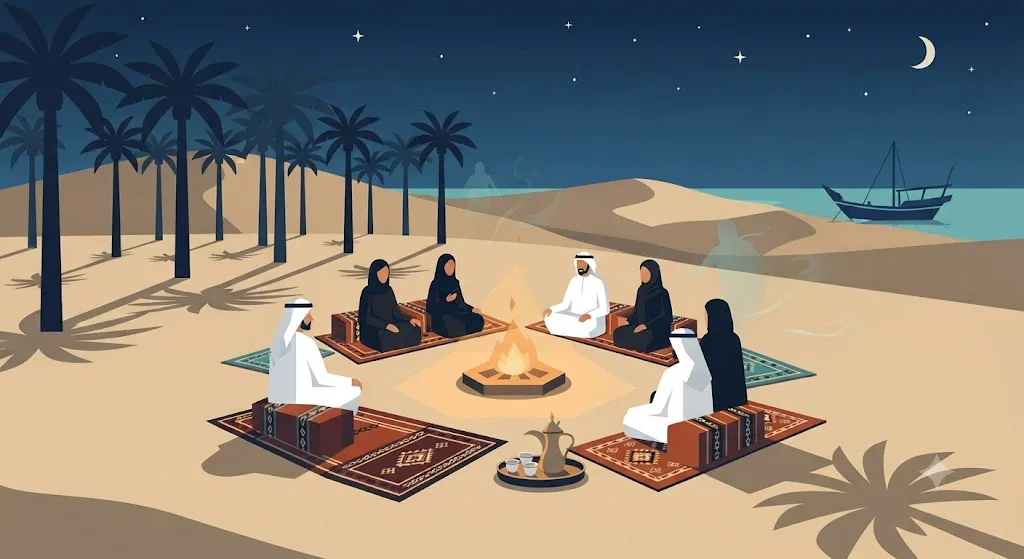
The UAE’s folklore grew from several overlapping worlds: Bedouin desert life, oasis agriculture, mountain communities, coastal fishing settlements, pearl-diving crews and the wider trading routes of the Gulf. That helps explain why its stories move so easily between sand, sea and settlement. A frightening spirit might warn pearl divers about the dangers of the night sea; a desert chant might preserve pride, love or endurance; a social custom might teach generosity, restraint and honour without needing to sound like a formal lesson.
One important point for readers is that the UAE is a young state but not a young culture. Many traditions now presented as national heritage began as local, tribal, occupational or regional practices before the federation was formed in 1971. Some are shared with Oman, Saudi Arabia, Qatar and the wider Arabian Peninsula, which is why several UNESCO inscriptions list the UAE jointly with neighbouring countries. That shared listing does not make the traditions any less Emirati; it reflects the older reality of mobile tribes, camel routes, maritime travel and cultural exchange across the Gulf.[UNESCO ICH]ich.unesco.orgICHUnited Arab EmiratesICHUnited Arab Emirates
The strongest Emirati folklore sources are not always monster catalogues. They include oral-history archives, UNESCO files, museum displays, newspaper interviews with storytellers, academic work on Emirati folktales and living performance traditions. The National Library and Archives describes oral history as a way to record UAE history and intangible heritage through narratives and first-hand accounts preserved in older people’s memories. That matters because many folktales were not fixed texts; they changed with the storyteller, the audience and the place of telling.[nla.ae]nla.aeOpen source on nla.ae.
The jinn stories people remember
For many outsiders, the most memorable part of Emirati folklore is its jinn lore. These stories should not be treated as confirmed supernatural reports, but as traditional narratives that carried fear, humour, social warning and imagination. Older accounts often place jinn at boundaries: night roads, empty houses, the sea, abandoned settlements, palm groves, desert edges and moments when ordinary rules seem to loosen.
The best-known figure is Umm Al Duwais, usually described as a dangerous female jinn who appears as an alluring woman before revealing a monstrous form. Newspaper accounts and modern retellings describe her as beautifully dressed and perfumed, attracting men before turning on them. In this form, the story works as a moral warning about desire, vanity, infidelity and wandering at night.[Khaleej Times]khaleejtimes.comof jinns fairytales and folkloreof jinns fairytales and folklore
Modern UAE artists and writers have also reworked Umm Al Duwais. A 2013 report in The National described young filmmakers and artists reconsidering her as a “misunderstood monster” rather than a simple villain. That shift is important: the same old figure can become a new way to discuss gender, blame and power. Folklore survives partly because later generations argue with it.[The National]thenationalnews.comThe National The ghost of Emirati presentThe National The ghost of Emirati present
Other supernatural figures are less internationally famous but still important in local storytelling. Reports on Emirati tale collections mention sea spirits, mirage spirits, chain-bearing bogeymen and wicked temptresses alongside comic and moral tales. These are not always well documented in English, and their details often vary. That variation is not a flaw; it is a sign of oral tradition, where each telling may preserve a different family memory or local emphasis.[The National]thenationalnews.comThe National Tales preserved for the futureThe National Tales preserved for the future
Why the sea has its own monsters
A striking feature of UAE folklore is how much fear and wonder comes from the sea. Before oil wealth transformed the country, coastal communities depended heavily on fishing, trade and pearl diving. The sea offered livelihood, but it also brought drowning, storms, exhaustion, hunger and long absences. Folklore gave those dangers a face.
The most vivid example is Baba Darya, also called Bu Darya, often glossed as “Father of the Sea”. In Emirati and wider Gulf retellings, he is a sea spirit or demon associated with sailors, fishermen and pearl divers. One account connected with the preservation of Emirati fables describes him as a spirit that “enchants the oceans of the Gulf”, while noting that versions differ according to the imagination of the storyteller.[The National]thenationalnews.comThe National Tales preserved for the futureThe National Tales preserved for the future
Popular versions say Baba Darya steals pearls, drags sleeping fishermen from boats or threatens pearl divers in the deep. These details make cultural sense: pearl diving involved breath-holding, darkness below the surface, dangerous weather and communal labour far from shore. The monster is less interesting as a literal creature than as a folk explanation for the sea’s appetite. It turns economic danger into story.[alrawypublishing.com]alrawypublishing.comthe prominence of mythical creatures in folklore storytellingthe prominence of mythical creatures in folklore storytelling
Baba Darya is also a reminder that UAE folklore belongs to a Gulf network. Similar “Lord of the Sea” stories are found in Qatar and other coastal traditions, with names and details shifting across communities. That is exactly what one would expect in a maritime region where sailors, divers and traders carried stories as well as goods.[Wikipedia]WikipediaQatari folkloreQatari folklore
Poetry is folklore, not just literature
A visitor looking only for ghosts will miss one of the UAE’s most important folklore forms: oral poetry. In Emirati culture, poetry has often carried memory, emotion, praise, social commentary and identity. It can be entertainment, but it can also be a record of values.
Al-Taghrooda is a traditional Bedouin chanted poetry associated with camel riders, herders and desert travel. UNESCO describes it as poetry composed and recited by men travelling on camelback through desert areas of the UAE and Oman, while Abu Dhabi Culture explains that it began in desert, mountain and rural settings as improvised verse among camel riders and herders. Today it is performed nationally and at events, no longer limited to the old travel conditions that shaped it.[UNESCO ICH]ich.unesco.orgOpen source on unesco.org.
Al Azi, another major poetic tradition, is a performed recital of praise, pride and fortitude. UNESCO places it on the List of Intangible Cultural Heritage in Need of Urgent Safeguarding, and Abu Dhabi Culture describes its call-and-response form: a poet leads, a chorus answers, and symbolic weapons express unity and courage. The folklore here is not a plot about a monster, but a public performance of belonging.[UNESCO ICH]ich.unesco.orgOpen source on unesco.org.
Al-Ayyala also shows how performance can preserve story-like memory without becoming a narrative tale. UNESCO describes it as a traditional performing art of Oman and the UAE involving chanted poetry, drums and dance, with two rows of men facing each other and carrying thin bamboo sticks that signify spears or swords. It simulates battle, but its modern role is social and ceremonial: a remembered martial image transformed into public celebration.[UNESCO ICH]ich.unesco.orgOpen source on unesco.org.
The majlis, coffee and the social life of stories
Folklore needs places where people can tell it. In the UAE, one of those places is the majlis: a social space for receiving guests, discussing matters, exchanging news and transmitting values. UNESCO lists the majlis as intangible cultural heritage shared by the UAE with Oman, Qatar and Saudi Arabia. For folklore, its importance lies not only in architecture or etiquette, but in conversation: stories, poems, proverbs, jokes and memories need an audience.[Wikipedia]WikipediaList of Intangible Cultural Heritage elements in the United Arab EmiratesList of Intangible Cultural Heritage elements in the United Arab Emirates
Arabic coffee, also UNESCO-listed as a symbol of generosity, belongs to this same world of hospitality. Coffee rituals are not “myths” in the narrow sense, but they help create the setting in which oral tradition moves between generations. A story told over coffee in a family gathering, desert camp or formal reception is part of a wider moral culture: how to welcome, how to listen, how to speak, when to advise and when to entertain.[UNESCO ICH]ich.unesco.orgICHUnited Arab EmiratesICHUnited Arab Emirates
This is why Emirati folklore should not be reduced to spooky tales. The everyday customs around welcome, food, conversation, poetry and performance carry as much cultural meaning as the supernatural beings. Folklore is the whole pattern: the story, the teller, the place, the occasion and the values being passed along.
Crafts and patterns as memory
Some UAE traditions preserve memory through hands rather than plot. Al Sadu, the traditional weaving skill associated with Bedouin women, is a good example. UNESCO describes it as a weaving practice using natural fibres, with patterns reflecting the desert environment through geometric repetition and symmetry. The same UNESCO account notes that rapid economic development and social change after oil contributed to a sharp decline in the practice, before safeguarding efforts helped support its continuation.[UNESCO ICH]ich.unesco.orgOpen source on unesco.org.
The folklore value of Al Sadu lies partly in its social setting. UNESCO’s description notes that weavers gather in small groups to spin and weave, exchanging family news and sometimes chanting or reciting poetry. In other words, the craft is not only an object. It is also a scene of women’s knowledge, memory, rhythm and speech.[UNESCO ICH]ich.unesco.orgOpen source on unesco.org.
Al Talli, traditional embroidery in the UAE, has a similar cultural depth. UNESCO describes it as a craft practised in various parts of the country, with demand especially high before religious festivals and the summer marriage season. Its colourful forms can carry symbolic meanings tied to desert and sea life. Here again, heritage is not only what is displayed in a museum; it is what people wear, make, exchange and recognise at important moments.[UNESCO ICH]ich.unesco.orgOpen source on unesco.org.
Haunted heritage and modern legend
Modern UAE folklore has not disappeared into museums. It has adapted to new spaces: newspapers, films, social media, heritage tourism and urban legend. One of the clearest examples is Al Jazeera Al Hamra in Ras Al Khaimah, often presented as a “ghost village”. Visit Ras Al Khaimah describes it as the only remaining historical pearling village in the Gulf, with coral-stone houses, wind towers, mosques and markets that preserve a rare view of pre-oil life. The site was abandoned as residents left between 1968 and 1971.[Visit Ras Al Khaimah]visitrasalkhaimah.comVisit Ras Al Khaimah Al Jazeera Al HamraVisit Ras Al Khaimah Al Jazeera Al Hamra
Because the village contains empty houses and old lanes, it has attracted jinn stories, ghost hunters and filmmakers. Condé Nast Traveller notes that the abandoned fishing port has drawn jinn-seekers, history buffs and film crews, while also stressing its substantial built heritage: hundreds of buildings, including a fort, schools, market and mosques.[CN Traveller]cntraveller.comCN Traveller The story behind Ras Al Khaimah's abandoned ghost villageCN Traveller The story behind Ras Al Khaimah's abandoned ghost village
This is a useful case because it shows the difference between history and legend. Historically, Al Jazeera Al Hamra is important because it preserves pearling-era architecture and settlement life. Folklorically, its emptiness has invited stories about unseen presences. The two meanings now overlap: visitors come for heritage, atmosphere and the thrill of a haunted reputation, even when the strongest evidence is architectural and historical rather than paranormal.[Visit Ras Al Khaimah]visitrasalkhaimah.comVisit Ras Al Khaimah Al Jazeera Al HamraVisit Ras Al Khaimah Al Jazeera Al Hamra
How old and well-attested are these traditions?
The answer varies by tradition. Some practices, such as poetry, weaving, coffee hospitality, camel culture and performance arts, are strongly documented through UNESCO files, official heritage bodies, living practitioners and public performance. Their exact origins may be older than the records, but their present-day practice is well attested.[unesco.org]ich.unesco.orgICHUnited Arab EmiratesICHUnited Arab Emirates
Supernatural tales are harder to date. Umm Al Duwais, Baba Darya and other jinn stories are clearly part of Emirati and Gulf oral tradition, but English-language evidence often comes from journalistic interviews, modern retellings, educational projects and scattered academic references rather than old written manuscripts. That does not make them fake; it means they belong to a tradition where family memory, performance and local variation mattered more than fixed publication.[thenationalnews.com]thenationalnews.comThe National Tales preserved for the futureThe National Tales preserved for the future
There is also a risk of internet-era flattening. Online posts often turn complex local beings into simple horror characters, sometimes borrowing language from global creepypasta or fantasy fandom. A careful reader should ask: is this an older oral motif, a modern artistic reinterpretation, a tourist-facing ghost story, or a recent internet summary? The best answer is often “a mixture”, especially for figures such as Umm Al Duwais, whose older warning-tale role now sits beside feminist, comic and horror retellings.[The National]thenationalnews.comThe National The ghost of Emirati presentThe National The ghost of Emirati present
Why preservation matters in a rapidly changed country
The UAE’s transformation over the last half-century has been extraordinarily fast. That speed makes folklore preservation both urgent and complicated. Practices once embedded in everyday labour — pearl diving, camel travel, hand weaving, communal outdoor storytelling — may survive today in festivals, schools, archives, staged performances, museums or family memory rather than in their original working settings.
UNESCO’s UAE page is revealing because it includes not only spectacular performance arts but also irrigation knowledge, camel calling, embroidery, coffee, date-palm practices, falconry and the majlis. This broad view treats folklore as a practical cultural system: how people moved, worked, gathered, welcomed guests, raised animals, marked celebrations and remembered the past.[UNESCO ICH]ich.unesco.orgICHUnited Arab EmiratesICHUnited Arab Emirates
Museums and archives now play a major role. The National Library and Archives records oral narratives and first-hand accounts, while Sharjah Heritage Museum has been noted for presenting oral traditions, customs and local legends for visitors. These institutions do not simply “freeze” folklore; they reshape how it is encountered, moving stories from family evenings and village spaces into public heritage settings.[nla.ae]nla.aeOpen source on nla.ae.
UAE folklore today
Today, UAE folklore exists in several forms at once. It is performed at national celebrations, taught through heritage programmes, displayed in museums, discussed in academic work, retold in newspapers, revived by artists and remixed online. A chanted poem may appear at an official ceremony; a jinn story may become an animated film, a social-media thread or a tourist ghost walk; a weaving practice may be preserved through workshops and UNESCO safeguarding.
The most useful way to approach Emirati folklore is therefore not to ask whether it is “ancient” or “modern”, but how each tradition has travelled. Al-Taghrooda travelled from camel routes to staged and national performance. Al Sadu travelled from Bedouin women’s practical weaving to protected cultural heritage. Baba Darya travelled from maritime fear to Gulf-wide sea legend. Umm Al Duwais travelled from moral warning to horror icon and gendered reinterpretation. Al Jazeera Al Hamra travelled from pearling settlement to abandoned village, heritage site and haunted landmark.[abudhabiculture.ae]abudhabiculture.aeOpen source on abudhabiculture.ae.
That layered quality is what makes the UAE’s folklore compelling. It is not a single mythology with one official canon. It is a set of living memories shaped by desert movement, sea labour, Islamic belief, family storytelling, craft knowledge, performance, national preservation and modern reinvention. Its ghosts and monsters are memorable, but its deeper subject is how a rapidly changing country keeps speaking with its older worlds.
eBay marketplace picks
Marketplace Samples
Live-tested eBay searches with available results related to this page.
Endnotes
1.
Source: ich.unesco.org
Title: ICHUnited Arab Emirates
Link:https://ich.unesco.org/en/state/united-arab-emirates-AE?info=elements-on-the-lists
2.
Source: ich.unesco.org
Link:https://ich.unesco.org/en/what-is-intangible-heritage-00003
3.
Source: nla.ae
Link:https://www.nla.ae/en/our-history/oral-history/overview/overview/
4.
Source: ich.unesco.org
Link:https://ich.unesco.org/en/RL/al-taghrooda-traditional-bedouin-chanted-poetry-in-the-united-arab-emirates-and-the-sultanate-of-oman-00744
5.
Source: ich.unesco.org
Title: ICHUnited Arab Emirates
Link:https://ich.unesco.org/en/state/united-arab-emirates-AE
6.
Source: historians.org
Link:https://www.historians.org/perspectives-article/peoples-histories-of-the-united-arab-emirates-creating-archives-and-oral-histories-in-dubai-and-abu-dhabi-october-2014/
Published: october 2014
7.
Source: alrawypublishing.com
Title: the prominence of mythical creatures in folklore storytelling
Link:https://alrawypublishing.com/the-prominence-of-mythical-creatures-in-folklore-storytelling/
8.
Source: Wikipedia
Title: Qatari folklore
Link:https://en.wikipedia.org/wiki/Qatari_folklore
9.
Source: abudhabiculture.ae
Link:https://abudhabiculture.ae/en/cultural-resources/publications/al-taghrooda
10.
Source: ich.unesco.org
Link:https://ich.unesco.org/en/USL/al-azi-art-of-performing-praise-pride-and-fortitude-poetry-01268
11.
Source: ich.unesco.org
Link:https://ich.unesco.org/en/RL/al-ayyala-a-traditional-performing-art-of-the-sultanate-of-oman-and-the-united-arab-emirates-01012
12.
Source: Wikipedia
Title: List of Intangible Cultural Heritage elements in the United Arab Emirates
Link:https://en.wikipedia.org/wiki/List_of_Intangible_Cultural_Heritage_elements_in_the_United_Arab_Emirates
13.
Source: ich.unesco.org
Link:https://ich.unesco.org/en/RL/al-sadu-traditional-weaving-skills-in-the-united-arab-emirates-02223
14.
Source: ich.unesco.org
Link:https://ich.unesco.org/en/RL/traditional-weaving-of-al-sadu-02158
15.
Source: unesco.org
Title: document 2217
Link:https://www.unesco.org/archives/multimedia/document-2217
16.
Source: ich.unesco.org
Link:https://ich.unesco.org/en/RL/al-talli-traditional-embroidery-skills-in-the-united-arab-emirates-01712
17.
Source: ich.unesco.org
Link:https://ich.unesco.org/en/decisions/9.COM/10.33
18.
Source: ich.unesco.org
Link:https://ich.unesco.org/en/video/33501
19.
Source: ich.unesco.org
Link:https://ich.unesco.org/en/video/8684
20.
Source: ich.unesco.org
Link:https://ich.unesco.org/en/video/80242
21.
Source: ich.unesco.org
Link:https://ich.unesco.org/en/video/76022
22.
Source: ich.unesco.org
Title: united arab emirates AE
Link:https://ich.unesco.org/en/state/united-arab-emirates-AE?call=film&id=16675&include=film_inc.php&width=700
23.
Source: ich.unesco.org
Link:https://ich.unesco.org/en/BSP/safeguarding-programme-for-al-sadu-traditional-weaving-skills-in-the-united-arab-emirates-02473
24.
Source: ich.unesco.org
Link:https://ich.unesco.org/en/video/41273
25.
Source: ich.unesco.org
Title: capoeira 01268
Link:https://ich.unesco.org/en/RL/capoeira-01268
26.
Source: ich.unesco.org
Title: 11 representative list 00520
Link:https://ich.unesco.org/en/11-representative-list-00520?id=00744&include=slideshow_inc.php
27.
Source: ich.unesco.org
Title: 11a urgent safeguarding list 00938
Link:https://ich.unesco.org/en/11a-urgent-safeguarding-list-00938?id=01268&include=slideshow_inc.php
28.
Source: ich.unesco.org
Link:https://ich.unesco.org/doc/src/30321.pdf
29.
Source: ich.unesco.org
Link:https://ich.unesco.org/en/lists
30.
Source: ich.unesco.org
Link:https://ich.unesco.org/en/video/48887
31.
Source: ich.unesco.org
Link:https://ich.unesco.org/en/video/16675
32.
Source: ich.unesco.org
Link:https://ich.unesco.org/en/decisions/20.COM/7.B.48
33.
Source: Wikipedia
Link:https://en.wikipedia.org/wiki/El_Al
34.
Source: Wikipedia
Link:https://en.wikipedia.org/wiki/AL
35.
Source: Wikipedia
Title: Al Jazeera English
Link:https://en.wikipedia.org/wiki/Al_Jazeera_English
36.
Source: Wikipedia
Title: Al Jazirah Al Hamra
Link:https://en.wikipedia.org/wiki/Al_Jazirah_Al_Hamra
37.
Source: genies.fandom.com
Title: United Arab Emirates
Link:https://genies.fandom.com/wiki/United_Arab_Emirates
38.
Source: ich.ae
Link:https://ich.ae/about
39.
Source: khaleejtimes.com
Title: of jinns fairytales and folklore
Link:https://www.khaleejtimes.com/uae/of-jinns-fairytales-and-folklore
40.
Source: thenationalnews.com
Title: The National The ghost of Emirati present
Link:https://www.thenationalnews.com/lifestyle/the-ghost-of-emirati-present-1.293127
41.
Source: thenationalnews.com
Title: The National Tales preserved for the future
Link:https://www.thenationalnews.com/uae/tales-preserved-for-the-future-1.523725
42.
Source: visitrasalkhaimah.com
Title: Visit Ras Al Khaimah Al Jazeera Al Hamra
Link:https://visitrasalkhaimah.com/discover/attractions/al-jazeera-al-hamra/
43.
Source: cntraveller.com
Title: CN Traveller The story behind Ras Al Khaimah’s abandoned ghost village
Link:https://www.cntraveller.com/article/ras-al-khaimahs-abandoned-ghost-village-al-jazeera-al-hamra
44.
Source: facebook.com
Title: Jazeera Al Hamra
Link:https://www.facebook.com/groups/2328608905/posts/10154976509208906/
45.
Source: thenationalnews.com
Title: a tale of the invisible traditions of the emirates 1.429665
Link:https://www.thenationalnews.com/uae/heritage/a-tale-of-the-invisible-traditions-of-the-emirates-1.429665
46.
Source: thenationalnews.com
Link:https://www.thenationalnews.com/arts-culture/2022/04/18/from-falconry-to-sadu-the-uae-has-12-traditions-on-unescos-intangible-heritage-lists/
47.
Source: tripadvisor.com
Title: Ghost village
Link:https://www.tripadvisor.com/ShowUserReviews-g298063-d6429106-r650257909-Al_Jazeera_Al_Hamra_Heritage_Village-Ras_Al_Khaimah_Emirate_of_Ras_Al_Khaimah.html
48.
Source: nationalarchives.gov.uk
Link:https://www.nationalarchives.gov.uk/
49.
Source: literatur.review
Title: umm al duwais
Link:https://literatur.review/en/literature/umm-al-duwais
50.
Source: americanmary.com
Link:https://www.americanmary.com/
Additional References
51.
Source: youtube.com
Link:https://www.youtube.com/watch?v=0IHP-WWaipU
Source snippet
Emirati traditional dance, Al Ayyala, Al Yowla, UAE cultural heritage, Arabic folk dance...
52.
Source: youtube.com
Title: Dubai’s Pearl Divers: The Forgotten Foundation of a Global City
Link:https://www.youtube.com/watch?v=8HYHz-j1phk
Source snippet
Umm Al Duwais… The Woman Who Appears at Night — Is She a Jinn… or Something Else?...
53.
Source: youtube.com
Title: 360° Virtual Tour: Discover Al Ain’s Rich Heritage
Link:https://www.youtube.com/watch?v=BltsXzH1VZE
Source snippet
Dubai's Pearl Divers: The Forgotten Foundation of a Global City...
54.
Source: academia.edu
Link:https://www.academia.edu/34106946/A_Tale_of_The_Lord_of_the_Sea_in_Qatari_Folklore_and_Tradition
55.
Source: al-monitor.com
Link:https://www.al-monitor.com/
56.
Source: abudhabiculture.getanchor.io
Link:https://abudhabiculture.getanchor.io/en/discover/performances/al-azi.html
57.
Source: archiqoo.com
Link:https://archiqoo.com/unesco/intangible_sub_lists.php?subsite=al_azi_art_of_performing_praise_pride_and_fortitude_poetry&uw_country=uae
58.
Source: thinkingnomads.com
Link:https://thinkingnomads.com/al-jazirat-al-hamra-a-ghost-city-uae/
59.
Source: archiqoo.com
Link:https://archiqoo.com/unesco/intangible_sub_lists.php?subsite=al_sadu_traditional_weaving_skills_in_uae&uw_country=uae
60.
Source: prezi.com
Link:https://prezi.com/p/m3lnsndi4anr/al-taghrooda-mep-work/
Topic Tree
Follow this branch
Related pages 192
- Afghan Folklore
- Albanian Folklore
- Algerian Folklore
- Australian Folklore
- Azerbaijan Folklore
- +187 more in sidebar