Within Uganda Folklore
Why Kintu and Nambi Still Matter
The Kintu and Nambi story explains the first humans, marriage, divine warning and the arrival of death in Buganda tradition.
On this page
- The story of Kintu, Nambi and Ggulu
- Walumbe and the arrival of death
- Kingship, identity and modern retellings
Page outline Jump by section
Introduction
The story of Kintu and Nambi is the best-known origin myth in Uganda and one of the most important traditions of the Buganda kingdom. Although it belongs specifically to the Baganda people, the tale is widely taught, retold and referenced across the country. At its heart, it explains three fundamental questions: where human society came from, why marriage and family matter, and why death exists in the world. The story combines romance, divine testing, moral lessons and political symbolism, making it far more than a simple creation narrative. Over generations it has been preserved through oral tradition, recorded by early ethnographers, reinterpreted by scholars and adapted by modern writers and performers.[Wikipedia]WikipediaOpen source on wikipedia.org.
Unlike many creation stories that focus on gods creating the universe, Kintu and Nambi centres on the establishment of human life and social order. The myth links the origins of the Baganda people to a relationship between a man living on earth and a woman from the heavens, while also explaining how mortality entered human existence. Its influence extends beyond folklore into discussions of identity, kingship and cultural memory in Uganda.[Academic Journals]academicjournals.orgthe kintu myth and the construction of ethno political identities in ugandaAcademic Journalsthe kintu myth and the construction of ethno-political…7 Jun 2018 — This article examines the significance of the Kin…
The Story of Kintu, Nambi and Ggulu
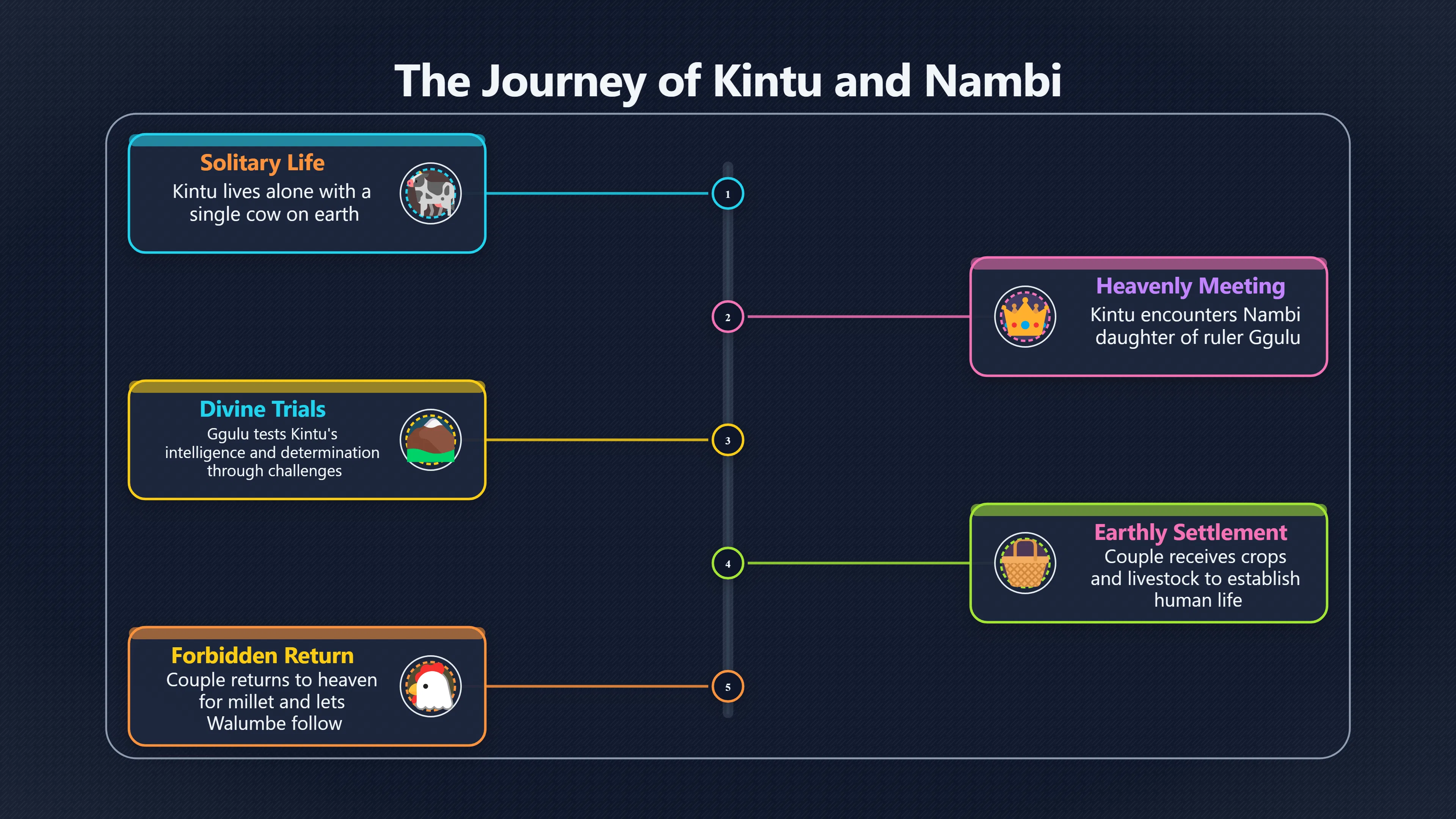
According to the most familiar versions of the tradition, Kintu was the first human being on earth. He lived alone with a single cow, surviving from its milk and wandering the land without companions. One day he encountered Nambi, daughter of the heavenly ruler Ggulu. Nambi was drawn to Kintu, and their meeting set the story in motion.[Wikipedia]WikipediaOpen source on wikipedia.org.
When Ggulu learned of Kintu’s existence, he did not immediately approve the marriage. Instead, he subjected Kintu to a series of difficult trials designed to test his intelligence, determination and worthiness. Different versions of the myth describe the challenges in slightly different ways, but the central theme remains the same: Kintu succeeds despite overwhelming odds, often with Nambi’s support. Impressed by his character, Ggulu finally allows the marriage and sends the couple back to earth with gifts that will help establish human life. These gifts commonly include crops, livestock and domestic animals associated with agriculture and settlement.[Wikipedia]WikipediaOpen source on wikipedia.org.
The crucial moment comes just before their departure. Ggulu warns the newly married couple not to return to heaven for any reason. He is especially concerned that Nambi’s brother Walumbe might discover their plans and follow them. The warning appears straightforward, but it becomes the moral turning point of the entire narrative.[Wikipedia]WikipediaOpen source on wikipedia.org.
After reaching earth, the couple realise that they have forgotten millet needed to feed a hen that travelled with them. Despite Ggulu’s warning, they return to retrieve it. In many versions, this decision gives Walumbe the opportunity to join them on their journey back to earth. A seemingly small mistake therefore produces consequences for all future generations.[Wikipedia]WikipediaOpen source on wikipedia.org.
The story’s enduring appeal comes partly from this structure. It combines a successful courtship and heroic trials with a warning that is ignored. Like many origin myths around the world, it explains a permanent feature of human life through a moment when a different outcome still seemed possible.[Wikipedia]WikipediaOpen source on wikipedia.org.
Walumbe and the Arrival of Death
Walumbe is the figure who gives the myth its deepest emotional power. His name is commonly associated with death or disease, and he serves as the explanation for why human beings do not live forever.[Wikipedia]WikipediaOpen source on wikipedia.org.
Once on earth, Walumbe asks Kintu for one of his children. Kintu refuses repeatedly. In response, Walumbe begins taking the lives of Kintu and Nambi’s children. The deaths continue despite efforts to stop him, transforming a world that had begun as a place of abundance into one marked by loss and suffering.[Wikipedia]WikipediaOpen source on wikipedia.org.
Ggulu eventually sends another son, Kayikuzi, to capture Walumbe and return him to heaven. The pursuit becomes one of the most dramatic episodes in the tradition. Walumbe repeatedly escapes by burrowing underground while Kayikuzi digs after him. The chase nearly succeeds, but a crucial silence that Kayikuzi orders is broken. Because the conditions of the pursuit are violated, Walumbe escapes permanently. Death therefore remains on earth and becomes an unavoidable part of human existence.[Wikipedia]WikipediaOpen source on wikipedia.org.
This section of the myth serves several functions at once:
- It explains why death exists.
- It portrays mortality as something that entered the world rather than being present from the beginning.
- It links death to broken instructions and failed opportunities.
- It presents death as powerful but not originally intended for humanity.[Wikipedia]WikipediaOpen source on wikipedia.org.
For many listeners, Walumbe is the most memorable figure in the story because he personifies a universal human experience. Rather than describing death as an abstract concept, the myth gives it a character, a history and a place within a larger narrative.[Wikipedia]WikipediaOpen source on wikipedia.org.

The Landscape of Walumbe
One reason the story remains vivid is that it is connected to real places. The Tanda Pits in central Uganda are traditionally associated with Walumbe’s attempt to hide from Kayikuzi. Local traditions identify the pits as places connected to the struggle between the two brothers, and the site has become one of the most famous locations linked to Buganda mythology. Modern archaeological explanations suggest the pits were created by historical iron-working activities, but folklore and physical landscape continue to coexist at the site.[Monitor]monitor.co.ugTanda Pits: Holding the legend of death in BugandaJan 5, 2021 — Kintu and Nambi were, therefore, forced to go to earth together wi…
The Tanda Pits illustrate an important feature of Ugandan folklore: stories are often anchored to actual locations. Visitors are not simply told a myth; they encounter a landscape that communities have long interpreted through the lens of that myth.[Wikipedia]WikipediaTanda pitsTanda pits
Kingship, Identity and Modern Retellings
Kintu and Nambi is not only a story about the first humans. In Buganda tradition, Kintu is also connected to ideas about the origins of political authority and the foundations of society. Some versions portray him as establishing boundaries, institutions and social organisation after arriving on earth. As a result, the myth became intertwined with concepts of kingship and the historical identity of the Buganda kingdom.[Wikipedia]WikipediaOpen source on wikipedia.org.
Scholars have argued that the Kintu narrative has played a significant role in shaping Baganda identity. Rather than functioning merely as entertainment, the myth has been used as a cultural reference point during periods of political change and debate. It provides a shared origin story that helps define belonging and continuity.[Academic Journals]academicjournals.orgthe kintu myth and the construction of ethno political identities in ugandaAcademic Journalsthe kintu myth and the construction of ethno-political…7 Jun 2018 — This article examines the significance of the Kin…
The story has also attracted historical interpretation. Some traditions and later writings connect Kintu and Nambi with remembered historical figures associated with the early kingdom of Buganda. Whether viewed as history, myth or a blend of both, the narrative occupies a central place in how the kingdom understands its origins.[Wikipedia]WikipediaNambi (mythologyNambi (mythology
Modern Ugandan literature has repeatedly returned to the myth. The award-winning novel Kintu by Jennifer Nansubuga Makumbi draws extensively on Baganda traditions and demonstrates how the story continues to inspire contemporary storytelling. Recent literary scholarship has also explored how modern writers reinterpret the myth, question older assumptions and highlight characters who received less attention in traditional versions.[Wikipedia]WikipediaKintu (novelMarch 2, 2026 — Kintu is based on the Baganda history and focuses on generational curses, transgression, Baganda mythology and sexism tha…
Why the Story Endures
Many origin myths survive because they answer a single question. Kintu and Nambi survives because it answers several at once. It explains the beginnings of humanity, the origins of marriage and family life, the arrival of agriculture, the source of political order and the mystery of death.[Wikipedia]WikipediaOpen source on wikipedia.org.
The story also remains relevant because its themes are timeless. Readers and listeners still recognise the tension between obedience and temptation, the consequences of seemingly small decisions and the human desire to understand suffering. At the same time, the myth continues to function as a marker of cultural identity within Buganda and as one of the most widely recognised traditional narratives in Uganda.[Academic Journals]academicjournals.orgthe kintu myth and the construction of ethno political identities in ugandaAcademic Journalsthe kintu myth and the construction of ethno-political…7 Jun 2018 — This article examines the significance of the Kin…
For many Ugandans, Kintu and Nambi is not simply a tale about a distant past. It is a story that connects landscape, history, morality and identity, helping explain both how the world began and why people continue to tell stories about it.[Academic Journals]academicjournals.orgthe kintu myth and the construction of ethno political identities in ugandaAcademic Journalsthe kintu myth and the construction of ethno-political…7 Jun 2018 — This article examines the significance of the Kin…
Amazon book picks
Further Reading
Books and field guides related to Why Kintu and Nambi Still Matter. Use these as the next step if you want deeper reading beyond the article.
Oral Literature in Africa
Explains preservation and retelling of oral epics and origin myths.
African Religions and Philosophy
Explores themes of mortality, cosmology and ancestry reflected in the myth.
Endnotes
1.
Source: Wikipedia
Link:https://en.wikipedia.org/wiki/Kintu
2.
Source: Wikipedia
Title: Nambi (mythology)
Link:https://en.wikipedia.org/wiki/Nambi_%28mythology%29
3.
Source: Wikipedia
Link:https://en.wikipedia.org/wiki/Warumbe
4.
Source: Wikipedia
Link:https://en.wikipedia.org/wiki/Kaikuzi
5.
Source: Wikipedia
Title: Tanda pits
Link:https://en.wikipedia.org/wiki/Tanda_pits
6.
Source: Wikipedia
Title: Kintu (novel)
Link:https://en.wikipedia.org/wiki/Kintu_%28novel%29
Source snippet
March 2, 2026 — Kintu is based on the Baganda history and focuses on generational curses, transgression, Baganda mythology and sexism tha...
Published: March 2, 2026
7.
Source: academicjournals.org
Title: the kintu myth and the construction of ethno political identities in uganda
Link:https://academicjournals.org/journal/AJHC/article-in-press-abstract/the_kintu_myth_and_the_construction_of_ethno_political_identities_in_uganda
Source snippet
Academic Journalsthe kintu myth and the construction of ethno-political...7 Jun 2018 — This article examines the significance of the Kin...
8.
Source: monitor.co.ug
Link:https://www.monitor.co.ug/uganda/lifestyle/reviews-profiles/tanda-pits-holding-the-legend-of-death-in-buganda-1560846
Source snippet
Tanda Pits: Holding the legend of death in BugandaJan 5, 2021 — Kintu and Nambi were, therefore, forced to go to earth together wi...
9.
Source: oriire.com
Title: The Story of Kintu
Link:https://oriire.com/article/the-story-of-kintu-ugandan-folktale
Source snippet
Ugandan FolktaleApr 3, 2026 — Once upon a time, a very long while ago, there were no people in the country of Uganda except one man, and...
10.
Source: ganyanasafaris.com
Link:https://www.ganyanasafaris.com/blog/walumbe/
Source snippet
May 8, 2026 — In anger, Walumbe began killing Kintu's children one by one. This is believed in Buganda mythology to be the origin of deat...
Published: May 8, 2026
11.
Source: lughayangu.com
Title: the story of kintu
Link:https://lughayangu.com/post/the-story-of-kintu
Source snippet
👨 The Story of KintuApr 2, 2022 — A Baganda myth explaining the origin of death. How the clumsiness of Nambi the wife to Kintu made death...
Additional References
12.
Source: terrain-safaris.com
Link:https://terrain-safaris.com/our-blog/the-ancient/
Source snippet
The Ancient Buganda Cultural Sites | Uganda Wildlife SafarisTanda Pits is the place where Walumbe is traditionally thought to have fallen...
13.
Source: scribd.com
Link:https://www.scribd.com/document/927827174/ST-68-4-KintuAndNambi
Source snippet
The Tale of Kintu and Nambi | PDF | FolkloreThe myth of Kintu and Nambi attributes the origin of death and disease to the character Walum...
14.
Source: sk.sagepub.com
Link:https://sk.sagepub.com/ency/edvol/download/africanreligion/chpt/kintu-myth-cycle.pdf
Source snippet
SAGE KnowledgeEncyclopedia of African ReligionKintu goes on to have children of his own with Nambi, but her brother, Walumbe, whose name...
15.
Source: realestatedatabase.net
Link:https://www.realestatedatabase.net/Afrika/Content.aspx?SelectedPageCode=6116
16.
Source: youtube.com
Link:https://www.youtube.com/watch?v=sgzh0cxvzLg
Source snippet
THE PITS OF DEATH #WALUMBECAVES...THE CAVES THAT PROCLAIM THE ANCIENTS CAVES WHERE ITS THOUGHT WALUMBE NAMBI AND THE OTHERS BROTHERS FIG...
17.
Source: youtube.com
Link:https://www.youtube.com/watch?v=nkOK1r04__8
Source snippet
The Ancient Origins of Buganda: Kintu & Nambi ExplainedBefore Uganda existed, one kingdom rose from myth and legend — Buganda. In this fi...
18.
Source: youtube.com
Link:https://www.youtube.com/watch?v=7XsjqQl_pUU
Source snippet
The story of Kintu & Nambi: A Buganda folktaleThis video brings to life the timeless tale of Kintu and Nambi, a story that explains the o...
19.
Source: ngaziarts.com
Title: Ngazi Arts The Legend of Kintu and Nambi
Link:https://www.ngaziarts.com/kintu-nambi.php
Source snippet
The Legend of Kintu and Nambi - Ngazi ArtsKintu and Nambi is a beloved Ugandan folktale that tells the story of how the first man on Eart...
20.
Source: youtube.com
Link:https://www.youtube.com/watch?v=VPwbUMBjTRU
Source snippet
The legend of Kintu & Nambi (Part 2) | The Forbidden Beginning of Humanity (Ugandan Creation Myth)...
21.
Source: youtube.com
Link:https://www.youtube.com/watch?v=h39o8g-2bw0
Source snippet
Kintu & Nambi: The Epic Ugandan Story of the Battle Between Life and Death, Who Wins?...
Topic Tree