Where Moldova's Stories Still Walk
Moldova’s folklore is best understood as a living borderland tradition: Romanian-speaking village culture at its core, shaped by older Moldavian history, Orthodox Christianity, seasonal farming life, Soviet-era cultural collection, and the country’s minority communities.
Page outline Jump by section
Introduction
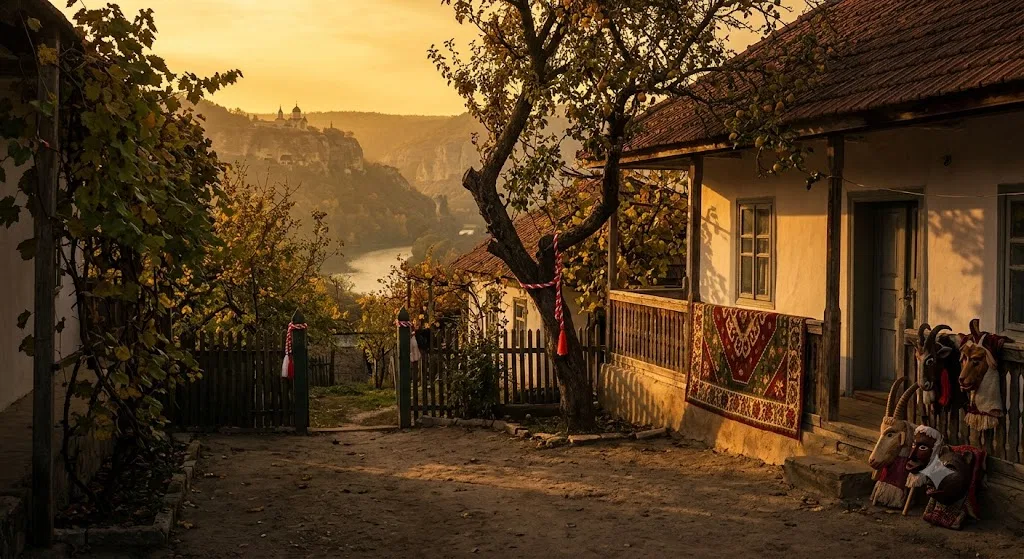
The most important thing for a first-time reader is this: Moldovan folklore is less about a neat “mythology” and more about practices that tie story to household, season and place. A red-and-white thread marks the risky threshold between winter and spring; a group of young men singing at Christmas renews the village’s social bonds; a carpet on the wall can carry family, regional and even funerary meaning; and a fortress legend can turn a stork with grapes into a national image of rescue.[unesco.org]ich.unesco.orgOpen source on unesco.org.
Why Moldova’s folklore feels both familiar and distinctive
Moldova’s folklore sits inside a larger Moldavian and Romanian cultural zone, so many of its supernatural figures and customs have close relatives across the modern border in Romania. That is why readers looking for “Moldovan monsters” often find names that also appear in Romanian folklore: fairy-like women of midsummer, forest mothers, dragons, witches, restless dead and magical horses. This does not make them any less Moldovan. It reflects the older history of the region of Moldavia, later divided between different states, and the way oral tradition travels through language, marriage, migration, printed collections and village performance.
At the same time, the modern Republic of Moldova is not simply a folklore footnote to Romania. It has its own institutions, archives, tourist routes, festivals and heritage policy. UNESCO lists the Republic of Moldova as a state party with several inscribed elements, including men’s Christmas carolling with Romania, wall-carpet craftsmanship with Romania, and the 1 March spring practices shared with Bulgaria, North Macedonia and Romania.[Intangible Cultural Heritage]ich.unesco.orgrepublic of moldova MDrepublic of moldova MD Moldova’s official tourism pages also present folklore, costumes, song, dance and crafts as part of the country’s cultural identity, not merely as museum pieces.[Moldova Travel]moldova.travelOpen source on moldova.travel.
The country’s diversity matters too. The Gagauz in southern Moldova are Turkic-speaking Orthodox Christians, and scholarship on Gagauz and Moldavian fairy tales notes both close links and distinctive local character in the fantastic tale repertoires of southern Moldova.[ceeol.com]ceeol.comarticle detailarticle detail That means “Moldovan folklore” should not be reduced to one ethnic or linguistic line. The mainstream Romanian-speaking village tradition is central, but Moldova’s belief culture also includes Gagauz, Ukrainian, Russian, Bulgarian, Roma and Jewish layers, as well as more recent Soviet and post-Soviet reinterpretations.
The foundation legend: the aurochs, the river and the birth of Moldavia
One of the best entry points into Moldova’s legendary imagination is the aurochs, the wild cattle head that still appears in the country’s state symbolism. The official description of Moldova’s coat of arms places an aurochs head on the shield, with a star between its horns, a rose on one side and a crescent on the other.[presedinte.md]presedinte.mdOpen source on presedinte.md. In folklore terms, the animal matters because it links heraldry to a famous foundation story.
In the traditional legend, a ruler or hunter associated with the early founding of Moldavia pursues an aurochs across the mountains. Versions differ. Some tell of the animal being chased to the Moldova River; some include the death of the hunter’s dog, often named Molda; some connect the river’s name and the principality’s name to that story. The earliest chronicle traditions and later retellings do not agree on every detail, and historians treat the story as a foundation legend rather than a literal account of state formation.[Wikipedia]WikipediaDragoș, Voivode of MoldaviaDragoș, Voivode of Moldavia
Its cultural power comes from the way it compresses several ideas into one image: a dangerous hunt, a crossing into new territory, an animal sacrifice, a named river, and a sign that becomes political identity. This is typical of foundation legends across Europe: they do not merely explain a place name; they give a landscape a dramatic beginning. In Moldova, the aurochs is not just an extinct animal in a medieval tale. It is a bridge between story, coat of arms, national branding and the memory of the older Principality of Moldavia.
Stephen the Great, fortresses and the making of national legend
Moldovan historical folklore often gathers around Stephen the Great, the late medieval ruler of Moldavia. Modern historical summaries remember him for his long reign, military campaigns, fortifications and church patronage, but popular tradition turns him into something larger: a ruler whose actions explain monasteries, fortresses, roads and sacred places.[Wikipedia]WikipediaStephen the GreatStephen the Great
The most vivid example is the legend of the white storks at Soroca Fortress. In the popular version, the fortress is besieged and the defenders are close to collapse from hunger and thirst. At the desperate moment, white storks arrive carrying grapes in their beaks and drop them into the fortress, saving the soldiers and helping them regain hope. The legend is promoted in Chisinau’s visitor material and is also used by Moldovan cultural and commercial storytelling, which shows how a local fortress tale can become a portable national symbol.[Visit Chișinău]visit.chisinau.mdOpen source on chisinau.md.
This is a good example of how Moldovan folklore blends history and moral image. Soroca Fortress is a real monument, and Stephen the Great is a real historical ruler, but the storks belong to legend. The story does not need to be read as battlefield evidence. Its meaning is symbolic: gratitude repaid, nature aiding the defenders, grapes as life-giving food, and the fortress as a place where Moldova survives through endurance.
Seasonal customs: the ritual calendar is Moldova’s living folklore
For many Moldovans, folklore is not mainly encountered through old monster stories. It is met through the calendar: Christmas, New Year, spring, weddings, funerals, village festivals and craft fairs. These traditions are public, performative and often family-centred. They also show how pre-Christian seasonal symbolism, Orthodox Christian timing and modern heritage culture overlap.
Christmas carolling as social renewal
The men’s group Christmas carolling tradition, inscribed by UNESCO for Romania and the Republic of Moldova in 2013, is one of the clearest examples of Moldovan folklore as living performance. On Christmas Eve, groups of young men visit households and perform festive songs. UNESCO describes the songs as epic in content and adapted to the circumstances of the host; performers may also sing auspicious songs for unmarried girls and dance with them, a practice traditionally associated with hopes of marriage in the coming year. Hosts give ritual gifts and money after the performance.[Intangible Cultural Heritage]ich.unesco.orgOpen source on unesco.org.
The point is not simply that people sing carols. The group moves through the village, recognises households, blesses or praises them in song, and reinforces social belonging. UNESCO explicitly frames the practice as important for social identity and cohesion.[UNESCO]unesco.orgdocument 3518document 3518 For a folklore reader, this makes the tradition especially valuable: it shows story, music, courtship, gift exchange and community order working together.
New Year masks and folk theatre
Winter also brings masked folk theatre. Recent museum activity in Moldova shows the tradition still being curated and performed: a 2024 exhibition at the National Museum of Ethnography and Natural History in Chisinau presented winter folk theatre masks and included a parade from Măcărești with Goat, Little Horse and Stork games.[Moldova]moldovalive.mdMoldova Exhibition of Winter Folk Theater Masks at the NationalMoldova Exhibition of Winter Folk Theater Masks at the National Research on folk theatre in Moldova and Ukraine identifies zoomorphic characters such as goat, horse, bear, stork, ram and fox, and links the goat procession with New Year performance.[ceeol.com]ceeol.comarticle detailarticle detail
These masked customs are not best understood as “Halloween-like” spectacle, though they can look dramatic to outsiders. Their older logic is seasonal transformation. Animals, noise, grotesque masks and comic scenes help mark the dangerous turn of the year, when the old season is driven out and the new one is invited in. A goat that dies and revives, a horse that dances, or a stork that enters the ritual scene can carry ideas of fertility, luck and renewal without needing a formal written myth behind it.
The red-and-white thread of spring
The 1 March spring-thread custom, shared by Moldova with neighbouring countries and inscribed by UNESCO in 2017, is one of the most accessible Moldovan traditions for visitors. The main practice is making, giving and wearing a red-and-white thread, then removing it when the first blossom tree, swallow or stork is seen. UNESCO also notes local practices such as purification and cleaning actions in Moldova, and describes the artefact as symbolically protective against perils including capricious weather.[Intangible Cultural Heritage]ich.unesco.orgOpen source on unesco.org.
This small object does a lot of folklore work. It marks spring’s arrival, protects the wearer at a vulnerable seasonal threshold, and turns natural signs — blossom, swallow, stork — into signals for ritual action. It is also a good example of shared Balkan and south-east European heritage: Moldova’s version belongs to a wider family of spring customs, but local practice, family memory and public festivals make it Moldovan in use.
Spirits, witches and the uneasy supernatural
Moldovan supernatural tradition is not dominated by one globally famous creature in the way Transylvania is often flattened into Dracula tourism. Instead, it shares a wider Romanian and south-east European repertoire of witches, fairies, dangerous female spirits, dragons, night beings and protective charms. The evidence is scattered across early learned descriptions, folk collections and modern retellings, so it is important not to over-systematise it into a tidy “Moldovan pantheon”.
A key early source is Dimitrie Cantemir’s early eighteenth-century description of Moldavia. In a passage on popular beliefs and ritual names, he lists figures and practices including fairies, midsummer beings, carolling, charms, the flying lover figure, night beings, witches and werewolf-like creatures.[la.wikisource.org]la.wikisource.orgPagina:Dimitrie CantemirPagina:Dimitrie Cantemir Cantemir’s Latin text and later Romanian editions are not neutral folklore fieldwork in the modern sense; he was an elite scholar interpreting village belief through classical and Christian categories. Still, the passage is important because it shows that Moldavian belief culture was already being noticed as a mixture of songs, calendar customs, magical language and named supernatural forces.
The witch-like figure called striga is especially revealing. Cantemir’s tradition associates it with an old witch rather than the later pop-culture vampire image, and modern summaries of Romanian vampire lore note that he discussed such beings as mostly Moldavian and Transylvanian beliefs while linking them more to witchcraft than blood-drinking undead.[bp-soroca.md]bp-soroca.mdCantemir Dimitrie. Descrierea Moldovei. 1909Cantemir Dimitrie. Descrierea Moldovei. 1909 That distinction matters. Internet folklore often collapses every eastern European night creature into “vampire”, but Moldovan and Romanian belief contains several categories: witches, charm-workers, restless dead, animal-changing beings and harmful spirits. They overlap in stories, but they are not all the same creature.
The fairy-like and forest beings of the wider Romanian-Moldavian tradition are similarly fluid. Some are beautiful, dangerous women associated with dancing, midsummer, illness or enchantment; others are monstrous mothers or wild female powers of the forest. In folk tales, dragons and giants may guard princesses, block roads or demand tribute, while a clever or brave hero wins through magical helpers. These motifs appear widely across south-east Europe, so the safest way to read them in a Moldovan page is as shared regional story-patterns with local Moldovan tellings, not as creatures exclusive to the Republic of Moldova.

Folk tales: clever peasants, magic helpers and Soviet-era collections
Moldovan folk tales survive through oral tradition, school culture, literary retelling and printed collections. One important English-language doorway is Grigore Botezatu’s collection of Moldavian folk tales, published in Chisinau in the Soviet period and available in digitised form. Archive records describe the 1986 edition as a collection of Moldovian folk tales, collected and retold by Botezatu, translated into English and illustrated.[Internet Archive]archive.orgmoldovian folk tales kishinev literatura artistika 1986moldovian folk tales kishinev literatura artistika 1986
These collections are valuable, but they should be read with care. “Collected and retold” means the tales are not raw transcripts from a fireside; they are literary versions shaped for readers, often children. Soviet-era publishing also tended to favour peasant wisdom, class-readable morals, hardworking heroes and optimistic endings. That does not make the tales fake. It means they are part of a chain: oral telling, folklorist collection, editorial shaping, translation, illustration and modern digital rediscovery.
The recurring pleasures are familiar to anyone who reads European fairy tales: the youngest sibling underestimated by others, the magical horse, the grateful animal, the impossible task, the hidden treasure that turns out to be labour or wisdom, and the poor person who outwits the powerful. A tale such as “Jug with Gold Coins”, described in relation to Botezatu’s Moldavian material, turns the search for buried treasure into a moral about work: the brothers dig the land looking for gold and become successful farmers through their labour.[Mir Books]mirtitles.orgMir Books Jug With Gold Coins: A Moldovian Folk TaleMir Books Jug With Gold Coins: A Moldovian Folk Tale
That kind of story is central to Moldovan folklore because it places wonder inside rural life. The magic is not only in dragons and enchanted horses; it is also in the orchard, the field, the household and the moral economy of work, fairness and cunning.
Sacred landscapes: monasteries, caves and places “full of mystery”
Moldovan legend is strongly attached to landscape. Orheiul Vechi, with its cave monasteries, churches, ancient and medieval ruins and dramatic rock formations, is promoted by Moldova’s official tourism site as a place of mystery, legends and striking scenery.[Moldova Travel]moldova.travelOpen source on moldova.travel. It is a good example of a Moldovan sacred landscape: not just one monument, but a layered place where archaeology, monastic life, river gorge and local storytelling reinforce each other.
The site also shows how folklore and tourism interact. A visitor may come for views and photographs, but the experience is framed through older settlement, cave churches, monastic endurance and village hospitality. That does not mean every story told to tourists is ancient. Some may be recent retellings or simplified guide narratives. But the landscape itself gives the stories staying power because it looks and feels like a place where hidden histories could live.
Saharna Monastery offers another clear example. Moldova’s tourism material describes it as a pilgrimage magnet because of a legend in which a monk sees a shining figure of the Mother Mary on a cliff above the monastery; when he reaches the place, she has vanished, but a footprint remains.[Moldova Travel]moldova.travelOpen source on moldova.travel. This is classic sacred-place folklore: a vision, a trace left in stone, a difficult ascent and a site that becomes meaningful because the supernatural event is anchored to a visible mark.
Carpets, costumes and the folklore of objects
Not all folklore is a spoken tale. Moldova’s wall-carpet tradition shows how objects can carry story, identity and ritual meaning. UNESCO’s listing for traditional wall-carpet craftsmanship in Romania and the Republic of Moldova explains that such carpets were once used not only for decoration and insulation, but also as part of a bride’s dowry. Patterns could indicate where a weaver came from, and carpets could play roles in funerals, symbolising a passage for the soul to the hereafter.[Intangible Cultural Heritage]ich.unesco.orgOpen source on unesco.org.
This is folklore in textile form. A carpet can say something about family status, regional belonging, marriage, death and the order of the home. Its motifs may not always encode a single decipherable “myth”, but they participate in a symbolic world where colour, pattern, inheritance and display matter.
Moldovan cultural promotion often places carpets alongside costumes, pottery, dance and song. Official tourism material points visitors towards handicraft centres and ateliers where traditional costumes, carpets and pottery can be seen being made.[Moldova Travel]moldova.travelOpen source on moldova.travel. This modern craft setting changes the context: what once belonged mainly to household economy and ritual life is now also heritage education, tourism and national presentation. The best modern interpretation recognises both sides. A carpet in a museum is not the same as a carpet in a dowry chest or funeral rite, but it can still preserve knowledge that would otherwise disappear.
Minority and borderland traditions
Moldova’s folklore is also shaped by its position between cultural zones. The country includes Romanian-speaking majorities and minority communities whose traditions complicate any single national story. The Gagauz are one of the most distinctive: a Turkic-speaking Orthodox Christian minority concentrated in southern Moldova. Minority Rights Group describes the Gagauz as historically connected to Bessarabia from the late eighteenth and early nineteenth centuries, with a language close to Turkish and heavy Slavic influence.[Minority Rights Group]minorityrights.orgOpen source on minorityrights.org.
Folklore scholarship on Moldavian and Gagauz fantastic fairy tales in southern Moldova points to close ties between the repertoires while also emphasising distinct national character in protagonists, language, everyday-life details, landscape and social relations.[ceeol.com]ceeol.comarticle detailarticle detail That is exactly what one would expect in a multilingual borderland: stories cross village and language boundaries, but they are retold with local food, kinship, humour, social hierarchy and landscape.
This matters because folklore can be used too easily as a symbol of political sameness or difference. Moldova’s traditions show both. Some customs link Moldova closely to Romania and the wider Balkans; others reveal local minority identities; still others are shared because neighbours have lived, traded, married and sung near one another for generations. A good country-level folklore page should hold that complexity rather than forcing every tradition into a single origin story.
How folklore is preserved and reimagined today
Moldovan folklore today lives in several places at once. It survives in families and villages; it is performed by ensembles; it is taught through museums and festivals; it is promoted by tourism boards; it appears in digitised Soviet-era books; and it circulates online in simplified forms. The National Museum of Ethnography and Natural History in Chisinau is especially important as a public heritage institution. Travel and museum descriptions present it as Moldova’s oldest museum, founded in 1889, with large collections relating to natural history, archaeology and ethnography.[Visit.MD]visit.mdnational museum of ethnography and natural historynational museum of ethnography and natural history
UNESCO recognition has also changed the status of certain practices. When a custom such as men’s Christmas carolling or the 1 March thread is listed as intangible heritage, it becomes more visible internationally and more likely to be taught, staged and documented.[Intangible Cultural Heritage]ich.unesco.orgrepublic of moldova MDrepublic of moldova MD That can help preservation, but it can also make traditions look more fixed than they were in ordinary life. Folklore is usually variable: songs change by village, masks change by maker, and legends change depending on who tells them.
Modern tourism adds another layer. Orheiul Vechi, Saharna and Soroca are now visitor destinations as well as story places.[Moldova Travel]moldova.travelOpen source on moldova.travel. This can lead to memorable public storytelling, but readers should distinguish between three levels: old oral motifs, documented heritage practice, and modern promotional retelling. The storks of Soroca, for example, are culturally meaningful whether or not a particular tourist version is old in every detail.
What readers usually misunderstand about Moldovan folklore
The first common misunderstanding is to expect a closed mythology with named gods, fixed family trees and official monster categories. Moldova’s folklore is not like that. It is a mixture of oral tales, seasonal rites, Christian legends, household magic, local history and regional supernatural motifs.
The second misunderstanding is to treat Moldova as simply “Romania but smaller” in folklore terms. Shared language and heritage are real, and some UNESCO inscriptions are explicitly joint with Romania.[Intangible Cultural Heritage]ich.unesco.orgOpen source on unesco.org. But the Republic of Moldova has its own landscapes, institutions, minority traditions, Soviet-era publication history and modern heritage politics.
The third misunderstanding is to over-vampirise the tradition. Moldavian sources do include witch-like and night-haunting beings, and Cantemir’s early account is important for that reason.[la.wikisource.org]la.wikisource.orgPagina:Dimitrie CantemirPagina:Dimitrie Cantemir Yet Moldova’s folklore is much broader than horror. Its most culturally central traditions may be a Christmas song, a spring thread, a fortress rescue legend, a dowry carpet or a masked New Year performance.
The final misunderstanding is to assume that staged folklore is automatically fake. A museum mask parade, a national dance ensemble or a tourist retelling is not the same as an old village performance, but it can still be part of tradition’s life. Folklore changes whenever it is performed for children, visitors, festivals, schoolbooks, television or the internet. The useful question is not only “Is this ancient?” but also “Who tells it now, why, and what older practice or story does it preserve?”
Conclusion
Moldova’s folklore is strongest when approached through its thresholds: winter to spring, household to village, human to animal, history to legend, visible landscape to sacred trace. Its best-known traditions are not isolated curiosities but ways of making community meaningful. Men’s carolling turns Christmas into a village-wide act of recognition; the red-and-white spring thread makes seasonal change wearable; wall carpets turn domestic craft into family and funerary symbolism; and legends of aurochs, storks, saints and monasteries attach memory to rivers, fortresses and cliffs.[unesco.org]unesco.orgdocument 3518document 3518
The result is a folklore tradition that feels intimate rather than monumental. Moldova’s legendary world is found in the song at the door, the mask at New Year, the woven pattern on the wall, the cave church in the rock and the old story that explains why a wild animal, a white stork or a footprint in stone still matters.
Amazon book picks
Further Reading
Books and field guides related to Where Moldova's Stories Still Walk. Use these as the next step if you want deeper reading beyond the article.
The Book of Imaginary Beings
Provides comparative folklore context for legendary creatures.

Bram Stoker's Dracula omnibus
First published 1897. Subjects: Fiction, horror, Children: Grades 3-4, Dracula, count (fictitious character), fiction, Frankenstein (fict...
eBay marketplace picks
Marketplace Samples
Live-tested eBay searches with available results related to this page.
Endnotes
1.
Source: ich.unesco.org
Link:https://ich.unesco.org/en/RL/men-s-group-colindat-christmas-time-ritual-00865
2.
Source: ich.unesco.org
Link:https://ich.unesco.org/en/RL/cultural-practices-associated-to-the-1st-of-march-01287
3.
Source: ich.unesco.org
Link:https://ich.unesco.org/en/RL/traditional-wall-carpet-craftsmanship-in-romania-and-the-republic-of-moldova-01167
4.
Source: unesco.org
Title: document 3518
Link:https://www.unesco.org/archives/multimedia/document-3518
5.
Source: visit.chisinau.md
Link:https://visit.chisinau.md/en/legenda-berzei-albe/
6.
Source: ich.unesco.org
Title: republic of moldova MD
Link:https://ich.unesco.org/en/state/republic-of-moldova-MD
7.
Source: moldova.travel
Link:https://moldova.travel/en/experience/folklore-and-traditions/
8.
Source: moldova.travel
Link:https://moldova.travel/en/cultural-heritage/
9.
Source: ceeol.com
Title: article detail
Link:https://www.ceeol.com/search/article-detail?id=479831
10.
Source: presedinte.md
Link:https://presedinte.md/eng/emblem
11.
Source: Wikipedia
Title: Dragoș, Voivode of Moldavia
Link:https://en.wikipedia.org/wiki/Drago%C8%99%2C_Voivode_of_Moldavia
12.
Source: Wikipedia
Title: Stephen the Great
Link:https://en.wikipedia.org/wiki/Stephen_the_Great
13.
Source: ceeol.com
Title: article detail
Link:https://www.ceeol.com/search/article-detail?id=847802
14.
Source: ich.unesco.org
Link:https://ich.unesco.org/doc/src/ITH-17-12.COM-Decisions-EN.docx
15.
Source: la.wikisource.org
Title: Pagina:Dimitrie Cantemir
Link:https://la.wikisource.org/wiki/Pagina%3ADimitrie_Cantemir_-Operele_Principelui_Demetriu_Cantemiru%2C_typ%C4%83rite_de_Societatea_Academic%C4%83_Rom%C3%A2n%C4%83._Volumul_1-_Descriptio_Moldaviae._Cu_charta_g.pdf/151
16.
Source: bp-soroca.md
Title: Cantemir Dimitrie. Descrierea Moldovei. 1909
Link:https://bp-soroca.md/soroca/Cantemir%20Dimitrie.%20Descrierea%20Moldovei.%201909.pdf
17.
Source: Wikipedia
Link:https://en.wikipedia.org/wiki/Strigoi
18.
Source: archive.org
Title: moldovian folk tales kishinev literatura artistika 1986
Link:https://archive.org/details/moldovian-folk-tales-kishinev-literatura-artistika-1986
19.
Source: archive.org
Title: Moldavian Folktales
Link:https://archive.org/details/MoldavianFolktales
20.
Source: moldova.travel
Link:https://moldova.travel/en/orheiul-vechi/
21.
Source: moldova.travel
Link:https://moldova.travel/en/places-to-visit/
22.
Source: moldova.travel
Link:https://moldova.travel/en/experience/manastiri-en/
23.
Source: moldova.travel
Link:https://moldova.travel/en/culture/
24.
Source: visit.md
Title: national museum of ethnography and natural history
Link:https://www.visit.md/en/tour/national-museum-of-ethnography-and-natural-history/
25.
Source: Wikipedia
Link:https://en.wikipedia.org/wiki/M%C4%83r%C8%9Bi%C8%99or
26.
Source: Wikipedia
Title: Muma Pădurii
Link:https://en.wikipedia.org/wiki/Muma_P%C4%83durii
27.
Source: Wikipedia
Title: Descriptio Moldaviae
Link:https://ro.wikipedia.org/wiki/Descriptio_Moldaviae
28.
Source: Wikipedia
Title: Flag and coat of arms of Moldavia
Link:https://en.wikipedia.org/wiki/Flag_and_coat_of_arms_of_Moldavia
29.
Source: Wikipedia
Title: Founding of Moldavia
Link:https://en.wikipedia.org/wiki/Founding_of_Moldavia
30.
Source: Wikipedia
Title: Coat of arms of Moldova
Link:https://en.wikipedia.org/wiki/Coat_of_arms_of_Moldova
31.
Source: Wikipedia
Title: Gagauz people
Link:https://en.wikipedia.org/wiki/Gagauz_people
32.
Source: Wikipedia
Title: Culture of Moldova
Link:https://en.wikipedia.org/wiki/Culture_of_Moldova
33.
Source: Wikipedia
Link:https://en.wikipedia.org/wiki/Strzyga
34.
Source: la.wikisource.org
Title: Descriptio Moldaviae
Link:https://la.wikisource.org/wiki/Descriptio_Moldaviae
35.
Source: la.wikisource.org
Link:https://la.wikisource.org/wiki/Pagina%3ADimitrie_Cantemir_-Operele_Principelui_Demetriu_Cantemiru%2C_typ%C4%83rite_de_Societatea_Academic%C4%83_Rom%C3%A2n%C4%83._Volumul_1-_Descriptio_Moldaviae._Cu_charta_g.pdf/153
36.
Source: archive.org
Title: lp moldavian folk dances national ensembles of moldavia
Link:https://archive.org/details/lp_moldavian-folk-dances_national-ensembles-of-moldavia
37.
Source: ich.unesco.org
Title: 8 representative list 00665
Link:https://ich.unesco.org/en/8-representative-list-00665?call=slideshow&id=00865&include=slideshow_inc.php&mode=scroll&width=620
38.
Source: ich.unesco.org
Link:https://ich.unesco.org/en/lists?id=18228&include=film_inc.php
39.
Source: ich.unesco.org
Link:https://ich.unesco.org/en/video/36647
40.
Source: ich.unesco.org
Link:https://ich.unesco.org/en/activities/traditional-wall-carpet-craftsmanship-in-romania-and-the-republic-of-moldova-00514
41.
Source: ich.unesco.org
Link:https://ich.unesco.org/en/video/18228
42.
Source: ich.unesco.org
Link:https://ich.unesco.org/en/11com?call=film&id=18228&include=film_inc.php&width=700
43.
Source: ich.unesco.org
Link:https://ich.unesco.org/en/decisions/12.COM/11.B.7
44.
Source: ich.unesco.org
Link:https://ich.unesco.org/en/decisions/8.COM/8.24
45.
Source: ich.unesco.org
Link:https://ich.unesco.org/en/decisions/11.COM/10.B.26
46.
Source: ich.unesco.org
Title: 36231 EN.doc
Link:https://ich.unesco.org/doc/src/36231-EN.doc
47.
Source: ich.unesco.org
Title: ITH 13 8.CO M 8+Add.2 EN.doc
Link:https://ich.unesco.org/doc/src/ITH-13-8.COM-8%2BAdd.2-EN.doc
48.
Source: ich.unesco.org
Title: ITH 16 11.CO M 10.b EN.docx
Link:https://ich.unesco.org/doc/src/ITH-16-11.COM-10.b-EN.docx
49.
Source: ich.unesco.org
Title: les pratiques culturelles associees au 1er mars 01287
Link:https://ich.unesco.org/fr/RL/les-pratiques-culturelles-associees-au-1er-mars-01287
50.
Source: ich.unesco.org
Link:https://ich.unesco.org/en/lists
51.
Source: ich.unesco.org
Title: ITH 16 11.COM Decisions 20161207 EN.docx
Link:https://ich.unesco.org/doc/src/ITH-16-11.COM-Decisions-20161207-EN.docx
52.
Source: ich.unesco.org
Title: ITH 13 8.CO M Decisions EN.doc
Link:https://ich.unesco.org/doc/src/ITH-13-8.COM-Decisions-EN.doc
53.
Source: ich.unesco.org
Title: ITH 17 12.CO M 11.b Add. EN.docx
Link:https://ich.unesco.org/doc/src/ITH-17-12.COM-11.b_Add.-EN.docx
54.
Source: ich.unesco.org
Title: 18440 EN
Link:https://ich.unesco.org/doc/src/18440-EN.pdf
55.
Source: ich.unesco.org
Title: ITH 15 10.CO M Decisions EN.doc
Link:https://ich.unesco.org/doc/src/ITH-15-10.COM-Decisions_-EN.doc
56.
Source: ich.unesco.org
Title: ITH 14 9.CO M 4 Rev. EN.doc
Link:https://ich.unesco.org/doc/src/ITH-14-9.COM-4_Rev.-EN.doc
57.
Source: ich.unesco.org
Title: LHE 23 18.CO M INF.7.c EN.docx
Link:https://ich.unesco.org/doc/src/LHE-23-18.COM-INF.7.c_EN.docx
58.
Source: ich.unesco.org
Title: 36231 FR.doc
Link:https://ich.unesco.org/doc/src/36231-FR.doc
59.
Source: ich.unesco.org
Title: ITH 15 10.CO M 10.b EN.doc
Link:https://ich.unesco.org/doc/src/ITH-15-10.COM-10.b_EN.doc
60.
Source: ich.unesco.org
Title: 14653 EN
Link:https://ich.unesco.org/doc/src/14653-EN.pdf
61.
Source: ich.unesco.org
Link:https://ich.unesco.org/en/decisions/%20-/12?call=film&id=81467&include=film.inc.php&width=700
62.
Source: moldova.travel
Link:https://moldova.travel/en/martisor/
63.
Source: moldova.travel
Link:https://moldova.travel/en/adventure-travel/medieval-town-birdwatching-trail/
64.
Source: moldova.travel
Link:https://moldova.travel/en/adventure-travel/getic-fortress-birdwatching-trail/
65.
Source: moldova.travel
Title: Arhivă Routes of life
Link:https://moldova.travel/en/rutele-vietii/page/23/
66.
Source: moldova.travel
Link:https://moldova.travel/en/adventure-travel/morova-gorte-birdwatching-trail/
67.
Source: moldova.travel
Link:https://moldova.travel/en/adventure-travel/trebujeni-furceni-birdwatching-trail/
68.
Source: moldova.travel
Link:https://moldova.travel/en/center-of-moldova/
69.
Source: presedinte.md
Link:https://presedinte.md/eng/simbolurile-statului
70.
Source: en.cantemir.ro
Title: dimitrie cantemir biografie
Link:https://en.cantemir.ro/despre-noi/dimitrie-cantemir-biografie/
71.
Source: minorityrights.org
Link:https://minorityrights.org/communities/gagauz/
72.
Source: moldovalive.md
Title: Moldova Exhibition of Winter Folk Theater Masks at the National
Link:https://moldovalive.md/exhibition-of-winter-folk-theater-masks-at-the-national-museum-of-ethnography-and-natural-history/
73.
Source: mirtitles.org
Title: Mir Books Jug With Gold Coins: A Moldovian Folk Tale
Link:https://mirtitles.org/2018/05/05/jug-with-gold-coins-a-moldovian-folk-tale-grigore-botezatu/
74.
Source: europeanheritagedays.com
Title: Moldova Uncovers Its Intricate Tradition at the 5th National Carpet Fair
Link:https://www.europeanheritagedays.com/EHD-Programme/Press-Corner/News/Moldova-Uncovers-Its-Intricate-Tradition-at-the-5th-National-Carpet-Fair
75.
Source: facebook.com
Link:https://www.facebook.com/groups/flagsoftheworld/permalink/4712593545421997/
76.
Source: facebook.com
Link:https://www.facebook.com/Striga.artist/?locale=en_GB
77.
Source: facebook.com
Link:https://www.facebook.com/SlavicSpirituality/photos/one-of-the-earliest-mentions-of-a-historical-strigoi-was-jure-grando-alilovi%C4%87-15/2036803733159142/
78.
Source: facebook.com
Link:https://www.facebook.com/groups/645668457426690/posts/1118946936765504/
79.
Source: livetheworld.com
Title: Soroca Fortress
Link:https://www.livetheworld.com//post/soroca-fortress-the-protection-symbol-of-moldova-pq3j
80.
Source: witcher.fandom.com
Link:https://witcher.fandom.com/wiki/Striga
81.
Source: kids.kiddle.co
Title: Stephen the Great
Link:https://kids.kiddle.co/Stephen_the_Great
82.
Source: scribd.com
Link:https://www.scribd.com/document/171690087/Flag-of-Moldova
83.
Source: shutterstock.com
Link:https://www.shutterstock.com/search/moldova-coat-arms
84.
Source: old.gov.md
Title: moldovas martisor included unescos heritage
Link:https://old.gov.md/en/content/moldovas-martisor-included-unescos-heritage
85.
Source: worldflag.org
Link:https://www.worldflag.org/moldova-flag
86.
Source: graphicmaps.com
Link:https://www.graphicmaps.com/moldova/flag
87.
Source: moldovalive.md
Title: origins of gagauz folk dance
Link:https://moldovalive.md/origins-of-gagauz-folk-dance/
88.
Source: moldovaillinoishc.com
Link:https://moldovaillinoishc.com/moldova/state-power-structure-symbols/
89.
Source: business-review.eu
Link:https://business-review.eu/featured/unesco-heritage-list-to-contain-mens-group-colindat-in-romania-and-the-republic-of-moldova-52458
90.
Source: academia.edu
Link:https://www.academia.edu/30691218/Moldova_lui_Dimitrie_Cantemir_%C8%99i_Descrierea_ei_pdf
91.
Source: discovergagauzia.md
Link:https://discovergagauzia.md/en/history/
92.
Source: gursesintour.com
Title: Soroca Fortress
Link:https://gursesintour.com/en/world/sorokskaya-krepost-unikalnyj-simvol-zashhity-moldovy/1200091/
93.
Source: unesco-centerbg.org
Link:https://www.unesco-centerbg.org/en/inscribed-elements-en/moldova-en/
94.
Source: new-east-archive.org
Title: moldova gagauz yeri christian turkic photographs alessandro vincenzi
Link:https://www.new-east-archive.org/features/show/12325/moldova-gagauz-yeri-christian-turkic-photographs-alessandro-vincenzi
95.
Source: moldpres.md
Link:https://www.moldpres.md/eng/culture/moldova-joins-unesco-executive-board-for-the-first-time-moldovan-culture-minister-describes-move-as-cristian-jardan-a-great-responsibility-and-opportunity-to-promote-our-values
Additional References
96.
Source: youtube.com
Title: Stephen the Great: How a Prince Defied Empires and Became a Legend
Link:https://www.youtube.com/watch?v=BF6XBfDXh8o
Source snippet
Exploring Moldova's Hidden Cultural Gems: Moldova Country & Moldova Travel...
97.
Source: youtube.com
Title: Mărțișor. Legend. Symbol of Spring and Rebirth. Legends and Myths
Link:https://www.youtube.com/watch?v=v9HyE5HQChQ
Source snippet
Stephen the Great: How a Prince Defied Empires and Became a Legend...
98.
Source: youtube.com
Title: Reality of the Week: The tradition of Mărțișor in Moldova
Link:https://www.youtube.com/watch?v=NYYucku_qak
Source snippet
Mărțișor. Legend. Symbol of Spring and Rebirth. Legends and Myths...
99.
Source: instagram.com
Link:https://www.instagram.com/p/Ctbv05yuKuB/
100.
Source: academia.edu
Link:https://www.academia.edu/10439929/Dimitrie_Cantemir_Descrierea_Moldovei
101.
Source: researchgate.net
Link:https://www.researchgate.net/publication/277756271_Living_in_the_Present_The_Gagauz_in_Moldova
102.
Source: researchgate.net
Link:https://www.researchgate.net/publication/327184218_Moldovan_ethnographic_science_the_second_half_of_the_20th_century_about_the_traditions_and_folk_culture_of_the_romanians_moldovans_from_the_chernivtsi_region_Ukraine
103.
Source: researchgate.net
Link:https://www.researchgate.net/publication/344445097_UNESCO_Representative_List_of_the_Intangible_Cultural_Heritage_of_Humanity_and_Moldavian_postage_stamps_since_1991_artistic_aspects
104.
Source: muzeu.md
Title: Grigore Botezatu 1929 2021 Tamara Macovei
Link:https://www.muzeu.md/wp-content/uploads/2023/08/Grigore-Botezatu-1929-2021-Tamara-Macovei.pdf
105.
Source: ief.hr
Link:https://www.ief.hr/en/about-us/
Topic Tree
Follow this branch
Related pages 192
- Afghan Folklore
- Albanian Folklore
- Algerian Folklore
- Australian Folklore
- Azerbaijan Folklore
- +187 more in sidebar