Within UK Folklore
Why Black Dogs Haunt British Roads
Black dogs and ghostly places turn ordinary lanes, churchyards and ruins into local maps of danger, memory and warning.
On this page
- Black Shuck, Barghest and church grims
- Roads, storms and churchyard boundaries
- Local fear as story, warning and tourism
Page outline Jump by section
Introduction
Few features of British folklore tie fear so tightly to real landscapes as the stories of spectral black dogs and haunted roads. Across England, Scotland, Wales and the wider British Isles, lonely lanes, churchyard paths, windswept coasts and ruined boundaries have long been associated with ghostly hounds that appear without warning, vanish into darkness and leave behind a sense of doom. These tales are not simply monster stories. They are part of a wider tradition in which ordinary places become maps of memory, danger and local identity. A bend in a road, a church gate or a stretch of moorland acquires meaning because generations have repeated the same story there. Black dogs, haunted routes and fearful landmarks reveal how communities have used folklore to explain risk, mark boundaries and remember unsettling events.[Wikipedia]WikipediaBlack dog (folkloreBlack dog (folklore

Why Black Dogs Appear on Roads and Boundaries
One of the most striking features of British black dog traditions is where the creatures are said to appear. They are rarely associated with busy market squares or domestic interiors. Instead, they haunt thresholds: crossroads, ancient tracks, churchyard entrances, marsh edges, coastal paths and isolated roads. Folklorists have long noted that such places were traditionally regarded as uncertain spaces where the ordinary world met the unknown.[Wikipedia]WikipediaBlack dog (folkloreBlack dog (folklore
The black dog often functions less as a predator than as a warning. In many stories, seeing the animal foretells death, illness or misfortune rather than causing it directly. The road itself becomes part of the narrative. Travellers moving through darkness, storms or unfamiliar territory encounter something that embodies local anxieties about getting lost, meeting strangers, suffering accidents or approaching places associated with death.[Wikipedia]WikipediaBlack dog (folkloreBlack dog (folklore
This connection with roads helps explain why black dog legends are so widespread. Almost every community possessed dangerous routes, lonely stretches of countryside and locations where accidents or unexplained events could be remembered through storytelling. The tale attached fear to a place and made that place memorable.
Black Shuck, Barghest and Church Grims
Black Shuck of East Anglia
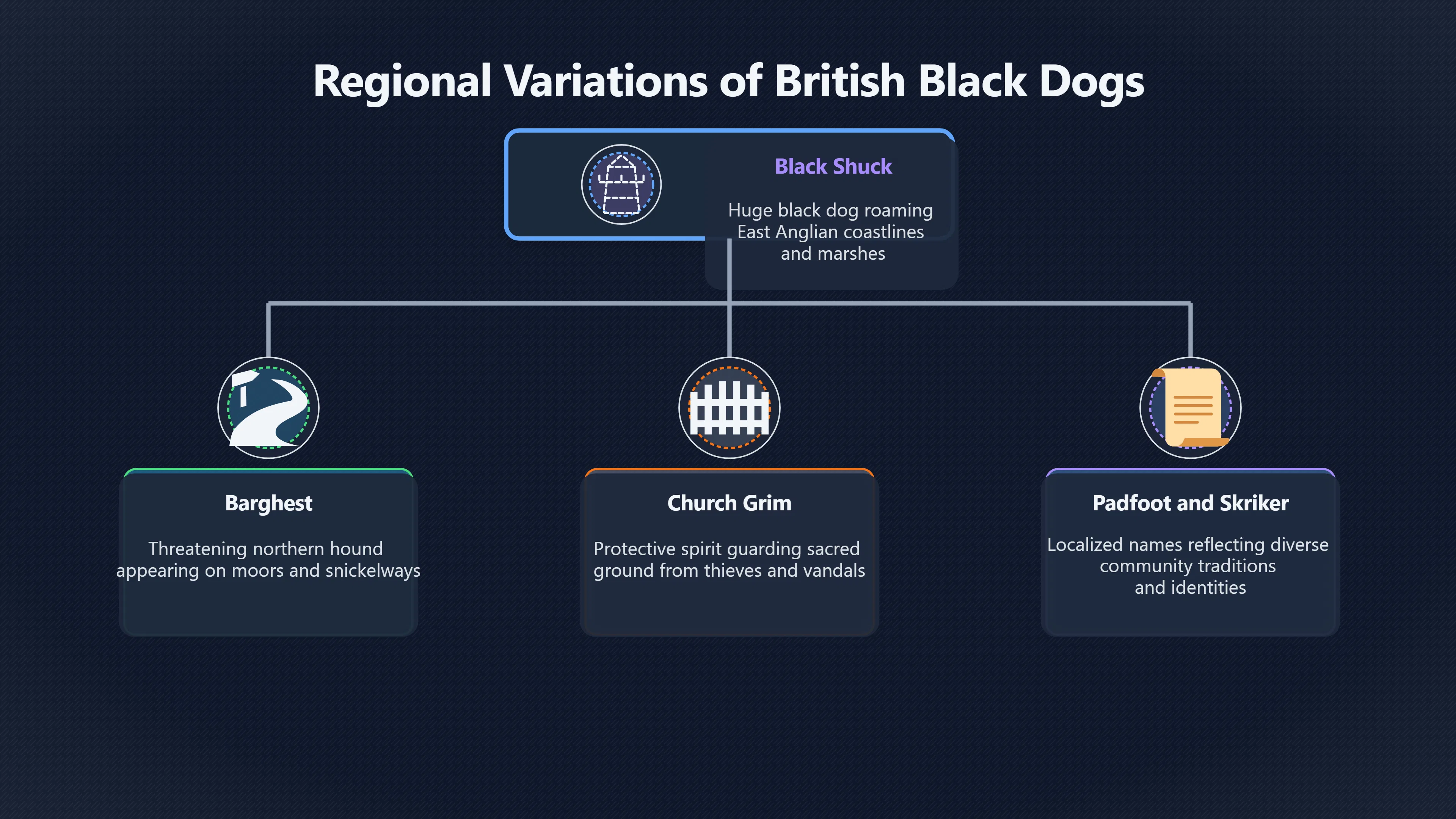
Among Britain’s best-known spectral hounds is Black Shuck, associated with Norfolk, Suffolk and the East Anglian coast. Accounts describe a huge black dog with glowing eyes roaming roads, churchyards, marshes and lonely countryside. In some traditions Shuck is a straightforward omen of death. In others it is less threatening, appearing briefly before disappearing into the darkness.[Wikipedia]WikipediaBlack ShuckBlack Shuck, Old Shuck, Old Shock or simply Shuck is the name given to a ghostly black dog which is said to roam the coastline…
The most famous story concerns the violent storm of August 1577. According to later tradition, Black Shuck burst into churches at Bungay and Blythburgh during the storm, killing worshippers and leaving marks that local folklore still associates with the creature. Whether understood as a supernatural event, a dramatic interpretation of a lightning strike or a mixture of memory and legend, the story became one of the defining examples of British haunted-place folklore.[eastangliabylines.co.uk]eastangliabylines.co.ukblack shuck the hound of myth and mysteryBlack Shuck: the hound of myth and mystery10 Aug 2023 — According to legend Black Shuck entered Bungay church in 1577 and then made its w…
What makes Black Shuck especially important is the way the legend links specific locations into a regional network of fear. Churches, roads and coastal paths become part of a shared folklore landscape stretching across East Anglia.[Wikipedia]WikipediaBlack ShuckBlack Shuck, Old Shuck, Old Shock or simply Shuck is the name given to a ghostly black dog which is said to roam the coastline…
The Barghest of Northern England
In Yorkshire and parts of northern England, the equivalent figure is often the Barghest. Unlike some black dogs that merely appear and vanish, the Barghest frequently occupies a more threatening role. Stories place it on lanes, snickelways, moors and roads near settlements, where it acts as a harbinger of death or disaster.[Wikipedia]WikipediaOpen source on wikipedia.org.
York traditions in particular associate the creature with narrow passageways and routes through the city. Seeing it was believed to signal approaching tragedy. Other versions describe shape-shifting abilities, allowing the Barghest to appear in different forms while retaining its connection to fear and ill fortune.[Wikipedia]WikipediaOpen source on wikipedia.org.
The Barghest demonstrates how local communities adapted a common black dog motif into a specifically northern folklore figure. Although related to broader British traditions, it acquired its own geography, personality and reputation.[Wikipedia]WikipediaOpen source on wikipedia.org.
Church Grims and Sacred Ground
Not every spectral dog was malevolent. The Church Grim occupies a different place in folklore. Rather than threatening travellers, it guards churches and churchyards. Usually appearing as a large black dog, the Grim protects sacred ground from thieves, vandals and supernatural threats.[Wikipedia]WikipediaChurch grimChurch grim
Traditions recorded in England and Scotland describe churchyard guardianship in striking ways. Some accounts claim that a black dog was buried in a churchyard so that its spirit could serve as a protector. Others tell of the Grim appearing before deaths or watching over funerals. The result is a figure that combines fear with protection: frightening to encounter, yet ultimately acting in defence of the community’s dead.[Wikipedia]WikipediaChurch grimChurch grim
Church Grims show that black dog folklore was not solely about terror. The same image could represent both danger and guardianship, depending on the place and story involved.
Roads, Storms and Churchyard Boundaries
Many black dog sightings occur during storms, at night or in poor weather. This recurring detail is significant. Roads were genuinely dangerous before modern lighting, navigation and transport. Storms increased the risk of becoming lost, injured or stranded. Folklore translated these practical dangers into memorable supernatural encounters.[Wikipedia]WikipediaBlack dog (folkloreBlack dog (folklore
Churchyard boundaries also appear repeatedly in the stories. Historically, churchyards marked a division between the living and the dead, the familiar village and the mysterious realm beyond. Black dogs standing near gates, walls or paths leading to churches symbolised this boundary. They were creatures of transition, appearing where categories overlapped.[Wikipedia]WikipediaChurch grimChurch grim
Ancient tracks and old roads carried similar symbolic weight. Long-distance routes connected settlements but also passed through lonely country. A spectral hound encountered on such a road reflected fears of isolation and uncertainty. The folklore therefore attached itself not just to places, but to movement through places.
Local Fear, Social Memory and Storytelling
Black dog legends endured because they served practical social functions. A frightening tale could discourage children from wandering into dangerous marshes, abandoned ruins or isolated roads after dark. It could explain accidents, reinforce respect for churchyards or encourage caution during storms.[Wikipedia]WikipediaBlack dog (folkloreBlack dog (folklore
At the same time, these stories preserved local memory. A fatal accident, an unusual storm or an unsettling landscape feature might eventually become associated with a spectral dog. Over generations, the original event could fade while the legend remained. The folklore acted as a cultural archive, preserving emotional memories rather than historical facts.
The persistence of regional names—Shuck, Barghest, Padfoot, Skriker and many others—shows how communities reshaped a common motif into local tradition. Each district inherited the idea of the black dog but gave it its own landmarks, roads and stories.[Wikipedia]WikipediaBlack dog (folkloreBlack dog (folklore
Why These Legends Still Matter
Modern Britain is filled with roads illuminated by streetlights, mapped by satellite navigation and travelled at high speed, yet black dog stories continue to attract attention. Heritage organisations, local museums, tourism campaigns and folklore enthusiasts regularly revisit tales of Black Shuck, the Barghest and other spectral hounds. The stories remain compelling because they transform ordinary geography into something richer and stranger.[eastangliabylines.co.uk]eastangliabylines.co.ukblack shuck the hound of myth and mysteryBlack Shuck: the hound of myth and mystery10 Aug 2023 — According to legend Black Shuck entered Bungay church in 1577 and then made its w…
They also illustrate a broader truth about British folklore: fear is often attached to place rather than abstract monsters. The haunted lane, the churchyard gate and the storm-swept road matter as much as the creature itself. Black dogs survive in cultural memory not merely because they are frightening, but because they provide a way of reading the landscape. A dark road becomes a story, a churchyard becomes a boundary, and a familiar route acquires a second life in local imagination.[Wikipedia]WikipediaBlack dog (folkloreBlack dog (folklore
Amazon book picks
Further Reading
Books and field guides related to Why Black Dogs Haunt British Roads. Use these as the next step if you want deeper reading beyond the article.
The Lore of the Land
Includes many haunted locations and legendary black dog traditions.
The Penguin Guide to the Superstitions of Britain and Ireland
Explains beliefs surrounding omens, spirits and haunted places.
eBay marketplace picks
Marketplace Samples
Live-tested eBay searches with available results related to this page.


Endnotes
1.
Source: Wikipedia
Title: Black dog (folklore)
Link:https://en.wikipedia.org/wiki/Black_dog_%28folklore%29
2.
Source: Wikipedia
Link:https://en.wikipedia.org/wiki/Black_Shuck
Source snippet
Black ShuckBlack Shuck, Old Shuck, Old Shock or simply Shuck is the name given to a ghostly black dog which is said to roam the coastline...
3.
Source: Wikipedia
Title: Church grim
Link:https://en.wikipedia.org/wiki/Church_grim
4.
Source: Wikipedia
Link:https://en.wikipedia.org/wiki/Barghest
5.
Source: eastangliabylines.co.uk
Title: black shuck the hound of myth and mystery
Link:https://eastangliabylines.co.uk/lifestyle/culture/black-shuck-the-hound-of-myth-and-mystery/
Source snippet
Black Shuck: the hound of myth and mystery10 Aug 2023 — According to legend Black Shuck entered Bungay church in 1577 and then made its w...
6.
Source: Wikipedia
Link:https://en.wikipedia.org/wiki/Black
Source snippet
BlackIt is the color most commonly associated with mourning, the end, secrets, magic, force, violence, fear, evil, and elegance.Read more...
7.
Source: Wikipedia
Title: Black (singer)
Link:https://en.wikipedia.org/wiki/Black_%28singer%29
Source snippet
Black (singer)Black was an English singer-songwriter. He emerged from the punk rock music scene and achieved mainstream pop success in...
8.
Source: forgottenrealms.fandom.com
Link:https://forgottenrealms.fandom.com/wiki/Barghest
Source snippet
Forgotten Realms Wiki - FandomBarghests were treacherous tyrants that craved power over others, ruling goblinoids through fear and force...
9.
Source: cyberpunk.fandom.com
Link:https://cyberpunk.fandom.com/wiki/BARGHEST
Source snippet
Cyberpunk Wiki - FandomBARGHEST is a militia and gang operating in Night City. They are based out of Dogtown. BARGHEST serve as Kurt Hans...
10.
Source: mythus.fandom.com
Title: Church grim
Link:https://mythus.fandom.com/wiki/Church_grim
Source snippet
grim - Myth and Folklore Wiki - FandomThe Church Grim usually takes the form of a large black dog and guards churchyards from those who w...
11.
Source: creatures-of-myth.fandom.com
Title: Black Shuck
Link:https://creatures-of-myth.fandom.com/wiki/Black_Shuck
Source snippet
A. Dutt, in his 1901 Highways & Byways in East Anglia describes the creature thus: He takes the form of a huge black dog, and prowls alon...
12.
Source: mythus.fandom.com
Link:https://mythus.fandom.com/wiki/Black_Shuck
Source snippet
Shuck - Myth and Folklore Wiki - FandomIn some accounts, it only has one eye, which is in the middle of its forehead like a Cyclops...
13.
Source: buddhamoon.co.uk
Title: the grim churchyard guardian
Link:https://buddhamoon.co.uk/blogs/celtic-and-british-isles-mythology/the-grim-churchyard-guardian
Source snippet
The Grim | Churchyard Guardian27 Dec 2025 — The Church Grim serves various protective roles. It is primarily known for guarding the churc...
14.
Source: countryfile.com
Link:https://www.countryfile.com/culture/barghest
Source snippet
This monstrous hellhound is thought to have inspired Dracula11 Jul 2025 — Many sources claim that Stoker was inspired by legends of the B...
15.
Source: sarna.net
Link:https://www.sarna.net/wiki/Barghest
Source snippet
BattleTechWiki - Sarna.netThe Barghest is built on an Earthwerk GRF Quad chassis that supports a Magna 350 XL engine that saves weight an...
16.
Source: wamfest.co.uk
Title: church grim
Link:https://wamfest.co.uk/church-grim/
Source snippet
The Hidden Guardian of England's Churchyards1 Sept 2025 — The Church Grim is traditionally described as a guardian spirit or creature ass...
Additional References
17.
Source: merriam-webster.com
Link:https://www.merriam-webster.com/dictionary/black
Source snippet
BLACK Definition & Meaning4 days ago — The meaning of BLACK is having the very dark color of the night sky or the eye's pupil: of the co...
18.
Source: ronelthemythmaker.com
Link:https://www.ronelthemythmaker.com/barguest-the-spectral-dog-folklore/
Source snippet
Barguest: The Spectral Dog #folkloreA hellish black hound of the northern English moors, eyes afire, on the hunt for its next victim. app...
19.
Source: facebook.com
Link:https://www.facebook.com/groups/661200230952488/posts/1134054300333743/
Source snippet
Church grims: folklore of graveyards' first buried soulsThe church grim usually takes the form of a large black dog and guard's churchyar...
20.
Source: reddit.com
Link:https://www.reddit.com/r/FolkloreAndMythology/comments/1mx1ffu/legend_of_the_black_dog/
Source snippet
Legend of the Black Dog: r/FolkloreAndMythologyBarghest means "town ghost" appears as the mythical Black Dog or Barghest. allegedly head...
21.
Source: reddit.com
Link:https://www.reddit.com/r/Ghosts/comments/hon34p/the_black_shuck_of_norfolk/
Source snippet
The Black Shuck of Norfolk.: r/GhostsA local legend of an enormous ghost dog or Demon Hound (who is thought to have originated from Viki...
22.
Source: thesuffolkcoast.co.uk
Link:https://www.thesuffolkcoast.co.uk/articles/the-legend-of-the-bungay-black-dog
Source snippet
The Legend of the Bungay Black DogAccording to folklore, the spectre haunts the landscapes of East Anglia, primarily coastline, graveyard...
23.
Source: medium.com
Link:https://medium.com/horror-hounds/the-supernatural-black-dogs-of-britain-fc768052adee
24.
Source: netflix.com
Link:https://www.netflix.com/title/80214013
25.
Source: instagram.com
Link:https://www.instagram.com/6lack/?hl=en-gb
Source snippet
black (@6lack) • Instagram photos and videosNYC — love is the new gangsta. UNRELEASED LIVE. one night only. just me, you, a mic & some sp...
26.
Source: medium.com
Link:https://medium.com/seroxcats-salon/britains-phantom-black-dogs-4f4b02516f82
Topic Tree