Where Jordan's Stories Live in the Landscape
Jordanian folklore is best understood as a living mix of desert storytelling, village memory, religious belief, family ritual, song, food, and place-based legend.
Page outline Jump by section
Introduction
The most important point for a curious reader is that Jordanian folklore is not a fixed book of myths. It is a web of traditions shaped by Bedouin mobility, village life, Islamic belief, older regional story patterns, Palestinian and wider Levantine connections, tourism, state heritage work, and digital media. Some traditions are ancient in form, some are recent retellings for visitors, and many sit somewhere between the two.[folkculturebh.org]folkculturebh.orgOpen source on folkculturebh.org.
What makes Jordanian folklore distinctive?
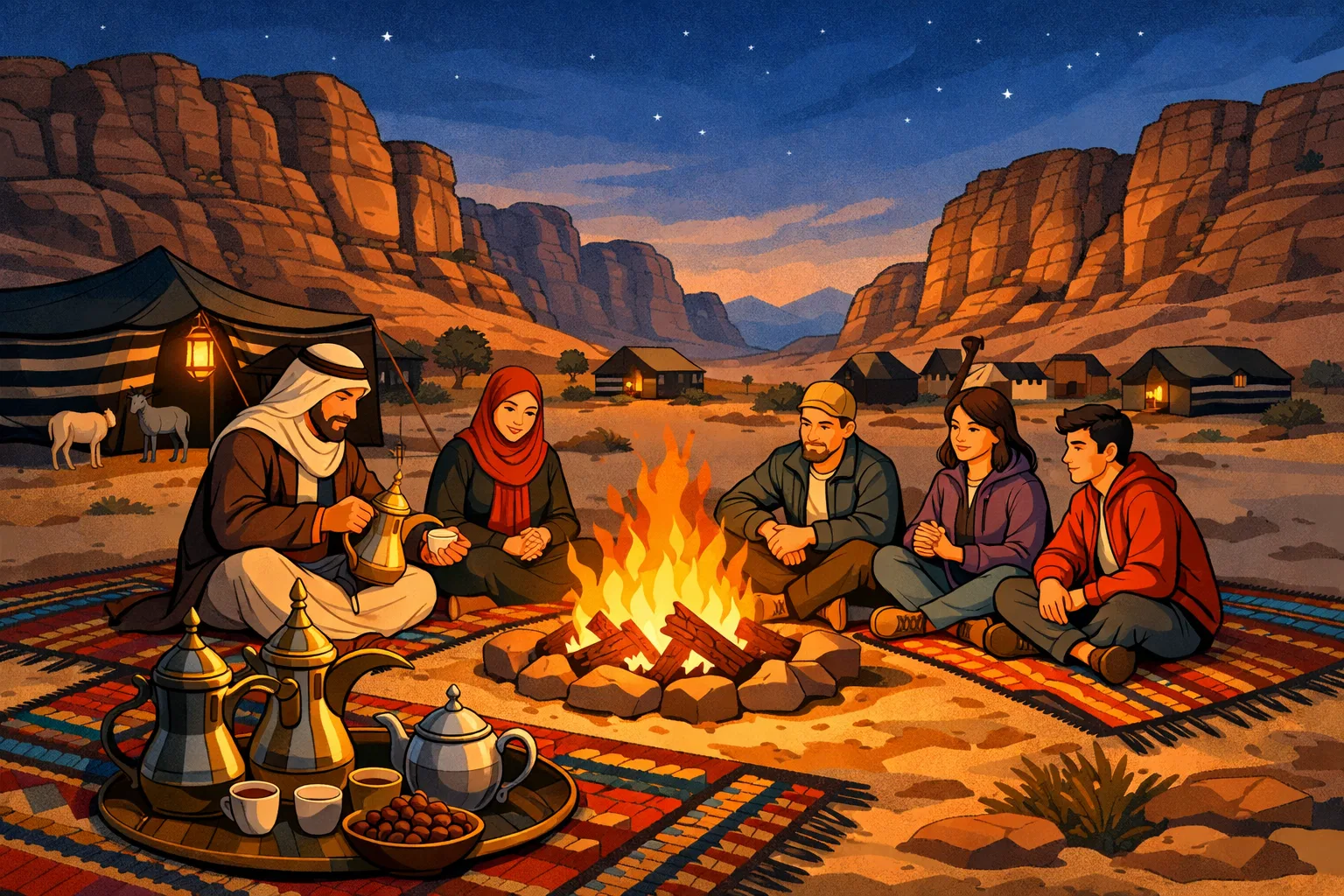
Jordan’s folklore is unusually tied to landscape. In Petra and Wadi Rum, stories are not simply told “about” the desert; they are attached to valleys, rocks, water routes, camps, grazing knowledge, and named places. UNESCO’s description of the Bedu cultural space stresses that mythology appears through oral forms such as poetry, folktales and songs, and that these expressions are closely linked to particular places.[UNESCO Intangible Cultural Heritage]ich.unesco.orgOpen source on unesco.org.
That place-based quality matters because Jordan’s best-known landscapes are also major heritage and tourism sites. Petra is a Nabataean caravan city between the Red Sea and the Dead Sea, carved into rock and surrounded by gorges and mountains; UNESCO describes it as a place where ancient Eastern traditions blend with Hellenistic architecture. Wadi Rum, meanwhile, is a 74,000-hectare protected desert landscape with cliffs, arches, gorges, caverns, petroglyphs and inscriptions testifying to long human occupation.[UNESCO World Heritage Centre]whc.unesco.orgWorld Heritage Centre PetraWorld Heritage Centre Petra
This makes Jordanian folklore especially easy to romanticise. Tour guides and travel writing often present Petra and Wadi Rum as places of mystery, genies and ancient secrets. Some of that mood reflects genuine local storytelling; some is tourist packaging. A careful reading keeps both in view: the desert is a real archive of oral tradition, but not every dramatic “legend” marketed to visitors is necessarily an old community tradition.[unesco.org]ich.unesco.orgOpen source on unesco.org.
Petra, Wadi Rum and the Bedouin story world
The clearest internationally recognised centre of Jordanian folklore is the Bedouin cultural space of Petra and Wadi Rum. It was proclaimed a Masterpiece of the Oral and Intangible Heritage of Humanity in 2005 and later inscribed on UNESCO’s Representative List in 2008. The tradition includes oral expression, social practices, traditional knowledge, craftsmanship and a strong relationship between stories and landscape.[UNESCO Intangible Cultural Heritage]ich.unesco.orgOpen source on unesco.org.
For readers looking for “Jordanian myths”, this is where the answer begins. Bedouin oral culture in southern Jordan includes poetry, folktales, songs, animal knowledge, hospitality, memory of routes, and stories linked to rocks, springs and camps. These are not separate boxes in local life. A song may preserve family memory; a story may encode advice about danger; a place-name may carry an older tale; a performance for guests may be both hospitality and heritage.[UNESCO Intangible Cultural Heritage]ich.unesco.orgOpen source on unesco.org.
There is also a modern tension here. Petra became a UNESCO World Heritage Site in 1985, while Bedouin intangible heritage around Petra and Wadi Rum later received separate recognition. Heritage scholars have noted that this created competing pressures: archaeological conservation, tourism, national identity, Bedouin rights, and local claims to living knowledge do not always fit neatly together.[ResearchGate]researchgate.netOpen source on researchgate.net.
That tension is part of the folklore story itself. When a Bedouin tale is told beside a fire for family, it works differently from the same story told to tourists in a camp, filmed for a heritage project, or posted online. The tradition can still be meaningful in all these settings, but the setting changes what the story does.[UNESCO]unesco.orgdocument 2272document 2272

Spirits, fear and protective belief
The most recognisable supernatural figures in Jordanian oral tales are spirits such as jinn and ghouls. In Islamic and wider Middle Eastern tradition, jinn are intelligent unseen beings; in local storytelling they may appear as dangerous presences, tricksters, causes of misfortune, or beings associated with lonely and liminal places. A recent study of Jordanian oral folk tales argues that figures such as ghouls and jinn often work as narrative tools for teaching caution, resilience and moral awareness.[Pew Research Center]pewresearch.orgPew Research Center Chapter 4: Other Beliefs and PracticesPew Research Center Chapter 4: Other Beliefs and Practices
This is important because fear in folklore is not only entertainment. A frightening tale about a ghoul, a haunted house, an unsafe road, or a spirit near water can teach children where not to go, warn against arrogance, reinforce family rules, or explain misfortune in a culturally legible way. The Jordanian study frames fear as a way of transmitting values and preserving collective memory, rather than merely a taste for spooky stories.[JCASC]jcasc.comOpen source on jcasc.com.
Belief in the evil eye, protective words, amulets, and Qur’anic protection also belongs to this wider field of folk religion. A country study of Jordan describes villagers using written Qur’anic verses, the name of God, and copies of the Qur’an as protection against jinn and the evil eye. Pew’s wider survey of Muslim societies also notes that jinn, witchcraft and the evil eye are rooted in Islamic textual references and remain widely recognised ideas across many Muslim-majority contexts.[Country Studies]countrystudies.usCountry Studies JordanCountry Studies Jordan
These beliefs should not be flattened into “superstition” or treated as proof of the supernatural. They are part of a practical moral world: people use them to talk about envy, illness, vulnerability, danger, family protection and the unseen consequences of human behaviour. In modern clinical and social research, attribution of distress to jinn, the evil eye or witchcraft is treated as an important cultural framework that professionals may need to understand, not simply dismiss.[Cambridge University Press & Assessment]cambridge.orgOpen source on cambridge.org.
Haunted houses, ghouls and older regional tale patterns
Jordanian folktales share many motifs with Palestinian, Syrian, Iraqi and broader Arab oral tradition. That does not make them less Jordanian; it reflects the reality of a connected Levant, where families, traders, shepherds, pilgrims and migrants have carried stories across modern borders. A study of folktales in Palestine and Jordan points to shared ancient roots, including stories of ghosts, haunted houses, underground encounters with jinn, and recurring narrative motifs found in neighbouring countries.[Folk Culture BH]folkculturebh.orgOpen source on folkculturebh.org.
The ghoul is a useful example. In Arabic tradition, the ghoul is commonly associated with deserts, lonely places and predatory deception. Research on the Arabic ghoul’s later Western transformation notes that the figure has long been represented as a frightening, human-like monster linked with desolate or secluded locations. In Jordanian tales, this kind of figure fits especially well with landscapes of desert travel, night journeys and isolated ruins.[JSTOR]jstor.orgThe Arabic Ghoul and its Western TransformationThe Arabic Ghoul and its Western Transformation
The “haunted house” is another strong regional motif. In the Palestinian-Jordanian folktale discussion, fear of ghosts and haunted houses is connected with local practices such as avoiding actions that might disturb unseen beings. Such motifs are not just decorative horror elements; they offer explanations for misfortune, danger, illness, strange noises, abandoned places and social boundaries.[Folk Culture BH]folkculturebh.orgOpen source on folkculturebh.org.
The difficulty for modern readers is evidence. Many Jordanian ghost and ghoul stories survive through oral telling, family memory, local performance or scattered academic references rather than neat, widely available collections. That means individual versions often vary. The safest approach is to treat them as living narrative patterns rather than single canonical stories.[Folk Culture BH]folkculturebh.orgOpen source on folkculturebh.org.
Sacred landscapes and remembered places
Jordan’s sacred geography is layered. Islamic, Christian, biblical, Nabataean, Bedouin and local traditions all attach meaning to particular places. Petra’s ancient monuments, Wadi Rum’s rock formations, shrines, springs, trees, tombs and ruins can all become story-bearing sites, even when the historical, religious and tourist explanations do not perfectly agree.[unesco.org]whc.unesco.orgWorld Heritage Centre PetraWorld Heritage Centre Petra
Petra is the most famous example of a place where archaeology and legend overlap. The city’s carved architecture is historically Nabataean, but its later life includes Bedouin memory, tourist legend, local place-names, and imaginative readings of tombs, caves and temples. Archaeological research has also explored how Nabataean monuments may relate to light, shadow and celestial events, though such findings should not be confused with later folk legends unless direct continuity can be shown.[unesco.org]whc.unesco.orgWorld Heritage Centre PetraWorld Heritage Centre Petra
Wadi Rum works differently. Its cliffs, natural arches, inscriptions and desert routes invite stories about giants, spirits and ancient presences, but its strongest documented folklore value lies in living Bedouin oral culture and knowledge of place. UNESCO’s Bedu listing keeps the focus on communities, transmission and performance rather than treating the landscape as an empty stage for exotic myth.[UNESCO Intangible Cultural Heritage]ich.unesco.orgOpen source on unesco.org.
Sacred trees and shrines also sit within a wider Middle Eastern pattern in which certain natural features may be associated with saints, spirits or protective power. Research on sacred trees in the region notes that trees can be understood as abodes of spirits or as connected with saintly blessing, although local details vary and should not be automatically projected onto every Jordanian site.[PMC]pmc.ncbi.nlm.nih.govPMCOn the typology and the worship status of sacred treesPMCOn the typology and the worship status of sacred trees
Songs, weddings and the folklore of celebration
Jordanian folklore is not only about monsters and spirits. Much of it is sung, danced, cooked and performed at family events. Wedding songs, women’s songs, Bedouin songs, harvest songs, mourning songs and children’s performances preserve memory in ways that written myth collections often miss.[The Guardian]theguardian.comOpen source on theguardian.com.
A vivid modern example is the “I’m My Voice” project by Tajalla for Music and Arts, reported in 2024. Volunteers searched for older women, including women over 70, and recorded folk songs from different Jordanian regions and neighbouring cultural zones. The project collected 43 songs and taught them to children’s choirs, showing how oral tradition can move from grandmother to child through organised cultural work rather than only through family life.[The Guardian]theguardian.comOpen source on theguardian.com.
Wedding songs are especially important because they turn private life into public performance. Jordanian wedding traditions include sung forms associated with henna nights, processions, ululation, dance and collective joy. A heritage entry on Jordanian wedding songs describes inherited poems and melodies performed by men and women during festive occasions in homes, yards and roofs, where everyday spaces become temporary stages.[iHeritage]iheritage.euOpen source on iheritage.eu.
The key change today is transmission. Rural-to-urban migration, changing agricultural work, schooling, recorded music and social media have all altered how songs survive. A song once learned while planting, harvesting or preparing for marriage may now be preserved through field recordings, children’s choirs, stage performances or online clips.[The Guardian]theguardian.comOpen source on theguardian.com.
Food, hospitality and ritual meaning
Food can be folklore when it carries story, etiquette, identity and ritual obligation. In Jordan, the clearest example is mansaf, a festive banquet centred on meat, yoghurt sauce, rice or bulgur and bread. UNESCO inscribed Al-Mansaf in Jordan on the Representative List in 2022, describing it as central to social and cultural events and as a symbol of identity and social cohesion.[UNESCO Intangible Cultural Heritage]ich.unesco.orgOpen source on unesco.org.
Mansaf matters because it is not only a recipe. It appears at weddings, reconciliations, major gatherings and hospitality occasions. Its meaning comes from the act of sharing: the host honours guests, the group eats together, and the dish helps express belonging. UNESCO links the tradition to an agro-pastoral lifestyle in which meat and dairy are readily available.[UNESCO Intangible Cultural Heritage]ich.unesco.orgOpen source on unesco.org.
Arabic coffee belongs to a similar world of hospitality. In 2024, Arabic coffee as a symbol of generosity was inscribed by UNESCO for Jordan and several other Arab states. The listing emphasises coffee’s role in traditions of hospitality, where serving and receiving coffee communicates respect, welcome and social meaning.[UNESCO Intangible Cultural Heritage]ich.unesco.orgOpen source on unesco.org.
These traditions are not supernatural in themselves, but they are part of belief culture. Hospitality rituals define what a good host is, how honour is displayed, how guests are protected, and how conflict may be softened. In a folklore page on Jordan, mansaf and coffee matter because they show that “legendary culture” is not only about old tales; it is also about repeated acts that carry inherited meaning.[UNESCO Intangible Cultural Heritage]ich.unesco.orgOpen source on unesco.org.
Museums, archives and the problem of preservation
Jordan has official institutions that collect and display folk heritage. The Jordan Folklore Museum in Amman, located on the western side of the Roman Theatre, was established by the Department of Antiquities in 1975 to collect, preserve, research, record and display traditional heritage. Its collections represent desert, village and town cultures, including clothing, tools, handicrafts and everyday objects.[museums.visitjordan.com]museums.visitjordan.comOpen source on visitjordan.com.
Nearby, the Jordanian Museum of Popular Traditions is also associated with the Roman Theatre complex and focuses on folk heritage, including costumes, jewellery, household objects and material culture from Jordan and the wider region. These museums are important because folklore is not only spoken; it is also stitched into dresses, woven into rugs, played on instruments, served in vessels and carried in tools.[Wonders Travel and Tourism]jordan-travel.comWonders Travel and Tourism Jordanian Museum of Popular TraditionsWonders Travel and Tourism Jordanian Museum of Popular Traditions
Digital archives add another layer. The ACOR Photo Archive includes extensive visual material on Jordanian cultural heritage and social history, including the Jane Taylor collection with thousands of photographs covering Jordan and the wider region. Such archives do not replace oral tradition, but they help document contexts that oral stories may refer to: landscapes, ceremonies, houses, crafts, markets and changing everyday life.[photoarchive.acorjordan.org]photoarchive.acorjordan.orgACO R Digital ArchiveACO R Digital Archive
Preservation, however, can freeze living culture if it is handled badly. A museum display can make a dress, coffee pot or musical instrument look like a relic, even when related practices continue in homes, villages, weddings and tourist camps. The strongest heritage work therefore treats folklore as both memory and present practice.[visitjordan.com]museums.visitjordan.comOpen source on visitjordan.com.
Modern Jordan: TikTok, tourism and new folklore
Modern Jordanian folklore is being reshaped by phones, tourism and social media. In Petra, young Bedouins have used TikTok and Instagram to document daily life, songs, animals, caves, desert scenes and hospitality for global audiences. Condé Nast Traveler reported in 2023 that Petra’s Bedouin creators use social platforms both to share culture and to attract visitors, blending old storytelling settings with digital distribution.[Condé Nast Traveler]cntraveler.comOpen source on cntraveler.com.
This does not mean tradition has become fake. Oral cultures have always adapted to new audiences and technologies, from family gatherings to radio, stage performance, tourism and now short video. The question is not whether a tradition changes, but who controls the retelling, who benefits, and whether local communities are represented as living people rather than picturesque scenery.[Condé Nast Traveler]cntraveler.comOpen source on cntraveler.com.
Tourism can also create simplified legends. A dramatic story about desert spirits may be easier to sell than a careful explanation of land rights, tribal memory, women’s songs or agricultural change. That is why the best reading of Jordanian folklore keeps popular legends beside less flashy traditions such as wedding songs, coffee etiquette, oral poetry, protective beliefs and everyday objects.[exodustravels.com]exodustravels.comuncover the legends of jordan with our local leadersuncover the legends of jordan with our local leaders
The internet has also produced a new kind of folklore: clips, captions, staged performances, tourist anecdotes, and repeated “mystery” claims that circulate faster than older oral forms. Some help preserve traditions; others blur old belief, entertainment and marketing. For Jordan, that distinction is especially important because famous places such as Petra and Wadi Rum already carry a global aura of wonder.[cntraveler.com]cntraveler.comOpen source on cntraveler.com.
Old tradition, modern invention and how to tell the difference
A useful rule is to ask where a Jordanian folklore claim comes from. If it is documented by community heritage work, UNESCO files, museum collections, academic research, oral-history projects or repeated local practice, it has a stronger basis than a single travel-blog anecdote. If it appears only in tourist copy or social media captions, it may still be interesting, but it should be treated as a modern retelling rather than an established tradition.[unesco.org]ich.unesco.orgOpen source on unesco.org.
Several signs point towards older or better-attested tradition: the story is linked to a specific community, place, ritual or performance; it appears in more than one source; elders or practitioners are named as transmitters; it has a social function beyond entertainment; or it fits known regional motifs such as jinn, ghouls, the evil eye, wedding songs or hospitality customs.[jcasc.com]jcasc.comOpen source on jcasc.com.
Several signs suggest caution: the story is presented as an ancient secret without evidence; it uses vague language such as “locals believe” without naming a community; it turns Bedouin culture into fantasy scenery; or it treats Islamic belief, archaeology and tourist legend as if they were all the same thing. Jordan’s folklore is rich enough without forcing every ruin or rock formation into a supernatural claim.[ResearchGate]researchgate.netOpen source on researchgate.net.
The most rewarding way to approach Jordanian folklore is therefore not to search for one national monster or one master myth. Look instead at how stories, songs, food, places and protective beliefs work together. Jordan’s legendary culture lives in the desert tale, the haunted house, the wedding song, the coffee cup, the museum case, the family warning, the tourist camp, and the phone video — each carrying a different piece of the country’s inherited imagination.[unesco.org]ich.unesco.orgOpen source on unesco.org.
Amazon book picks
Further Reading
Books and field guides related to Where Jordan's Stories Live in the Landscape. Use these as the next step if you want deeper reading beyond the article.
![Cover for The Arabian Nights Entertainments [7 stories]](https://covers.openlibrary.org/b/id/1046897-M.jpg)
Arab Folktales
Covers folk traditions and storytelling patterns found across Jordan and the Levant.
The Golden Tradition
Provides comparative context for oral tradition and cultural memory.
eBay marketplace picks
Marketplace Samples
Example marketplace items related to this page. Use the search link to explore similar finds on eBay.



Endnotes
1.
Source: ich.unesco.org
Link:https://ich.unesco.org/en/RL/cultural-space-of-the-bedu-in-petra-and-wadi-rum-00122
2.
Source: museums.visitjordan.com
Link:https://museums.visitjordan.com/en/Museum/12
3.
Source: folkculturebh.org
Link:https://folkculturebh.org/en/?id=39&issue=11&page=article
4.
Source: researchgate.net
Link:https://www.researchgate.net/publication/232854833_Assembling_heritage_Investigating_the_UNESCO_proclamation_of_Bedouin_intangible_heritage_in_Jordan
5.
Source: whc.unesco.org
Title: World Heritage Centre Petra
Link:https://whc.unesco.org/en/list/326/
6.
Source: ich.unesco.org
Link:https://ich.unesco.org/doc/src/07950-EN.pdf?v=1290702102
7.
Source: unesco.org
Title: document 2272
Link:https://www.unesco.org/archives/multimedia/document-2272
8.
Source: jcasc.com
Link:https://jcasc.com/index.php/jcasc/article/view/2703
9.
Source: jcasc.com
Link:https://jcasc.com/index.php/jcasc/article/download/2703/807
10.
Source: cambridge.org
Link:https://www.cambridge.org/core/journals/the-psychiatrist/article/jinn-and-mental-health-looking-at-jinn-possession-in-modern-psychiatric-practice/0012DFF288FA8958C7A52CAB2F29B679
11.
Source: jstor.org
Title: The Arabic Ghoul and its Western Transformation
Link:https://www.jstor.org/stable/40646532
12.
Source: arxiv.org
Title: arXiv Light and Shadows over Petra: astronomy and landscape in Nabataean lands
Link:https://arxiv.org/abs/1209.1540
13.
Source: pmc.ncbi.nlm.nih.gov
Title: PMCOn the typology and the worship status of sacred trees
Link:https://pmc.ncbi.nlm.nih.gov/articles/PMC1500805/
14.
Source: researchgate.net
Link:https://www.researchgate.net/publication/6486267_The_supernatural_characters_and_powers_of_sacred_trees_in_the_Holy_Land
15.
Source: iheritage.eu
Link:https://www.iheritage.eu/featured_item/al-taraweed-al-urdinya/
16.
Source: ich.unesco.org
Link:https://ich.unesco.org/en/RL/al-mansaf-in-jordan-a-festive-banquet-and-its-social-and-cultural-meanings-01849
17.
Source: unesco.org
Title: document 6067
Link:https://www.unesco.org/archives/multimedia/document-6067
18.
Source: ich.unesco.org
Link:https://ich.unesco.org/en/RL/arabic-coffee-a-symbol-of-generosity-02111?call=film&id=72571&include=film_inc.php&width=700
19.
Source: ich.unesco.org
Link:https://ich.unesco.org/en/decisions/19.COM/7.B.55
20.
Source: photoarchive.acorjordan.org
Title: ACO R Digital Archive
Link:https://photoarchive.acorjordan.org/
21.
Source: ich.unesco.org
Title: examples of regional living heritage 00379
Link:https://ich.unesco.org/en/examples-of-regional-living-heritage-00379
22.
Source: ich.unesco.org
Link:https://ich.unesco.org/en/lists
23.
Source: ich.unesco.org
Title: 00010 EN
Link:https://ich.unesco.org/doc/src/00010-EN.pdf
24.
Source: ich.unesco.org
Title: Leaflet 2011 inscriptions EN
Link:https://ich.unesco.org/doc/src/Leaflet-2011_inscriptions-EN.pdf
25.
Source: ich.unesco.org
Link:https://ich.unesco.org/en/assistances/promoting-intangible-cultural-heritage-education-in-institutions-of-higher-learning-in-uganda-0131049
26.
Source: ich.unesco.org
Title: 07952 EN
Link:https://ich.unesco.org/doc/src/07952-EN.pdf
27.
Source: ich.unesco.org
Title: 07953 EN.doc
Link:https://ich.unesco.org/doc/src/07953-EN.doc
28.
Source: ich.unesco.org
Title: 06859 EN
Link:https://ich.unesco.org/doc/src/06859-EN.pdf
29.
Source: unesco.org
Title: document 3462
Link:https://www.unesco.org/archives/multimedia/document-3462
30.
Source: ich.unesco.org
Title: search 00795
Link:https://ich.unesco.org/en/search-00795?call=film&id=41614&include=film_inc.php&width=700
31.
Source: ich.unesco.org
Link:https://ich.unesco.org/en/video/16675
32.
Source: ich.unesco.org
Link:https://ich.unesco.org/en/USL/cultural-practices-and-expressions-linked-to-the-m-bolon-a-traditional-musical-percussion-instrument-01689
33.
Source: ich.unesco.org
Link:https://ich.unesco.org/en/decisions/17.COM/7.B.19
34.
Source: ich.unesco.org
Link:https://ich.unesco.org/en/video/62290
35.
Source: ich.unesco.org
Link:https://ich.unesco.org/en/video/59235
36.
Source: ich.unesco.org
Title: jordan JO
Link:https://ich.unesco.org/en/state/jordan-JO
37.
Source: ich.unesco.org
Link:https://ich.unesco.org/en/decisions/16.COM/8.A.3
38.
Source: ich.unesco.org
Title: al mansaf in jordan a festive banquet and its social and cultural meanings 01849
Link:https://ich.unesco.org/en/RL/al-mansaf-in-jordan-a-festive-banquet-and-its-social-and-cultural-meanings-01849?call=film&id=62290&include=film_inc.php&width=700
39.
Source: ich.unesco.org
Link:https://ich.unesco.org/es/00379
40.
Source: ich.unesco.org
Title: search 00795
Link:https://ich.unesco.org/en/search-00795?call=film&id=62290&include=film_inc.php&width=700
41.
Source: ich.unesco.org
Link:https://ich.unesco.org/en/USL/les-pratiques-et-expressions-culturelles-liees-au-m-bolon-instrument-de-musique-traditionnel-a-percussion-01689?call=film&id=59235&include=film_inc.php&width=700
42.
Source: unesco.org
Link:https://www.unesco.org/en/tags/musical-instruments
43.
Source: ich.unesco.org
Title: photo pop up 00973
Link:https://ich.unesco.org/en/photo-pop-up-00973?photoID=15387
44.
Source: ich.unesco.org
Link:https://ich.unesco.org/es/asistencias/01583
45.
Source: ich.unesco.org
Title: photo pop up 00973
Link:https://ich.unesco.org/en/photo-pop-up-00973?photoID=15382
46.
Source: ich.unesco.org
Title: jordan JO
Link:https://ich.unesco.org/en/state/jordan-JO?call=film&id=62290&include=film_inc.php&width=700
47.
Source: ich.unesco.org
Link:https://ich.unesco.org/es/video/59235
48.
Source: ich.unesco.org
Title: 7b representative list 01281
Link:https://ich.unesco.org/en/7b-representative-list-01281?call=film&id=62290&include=film.inc.php&width=700
49.
Source: ich.unesco.org
Title: 7b representative list 01281
Link:https://ich.unesco.org/en/7b-representative-list-01281?call=slideshow&id=01849&include=slideshow_inc.php&mode=scroll&width=620
50.
Source: ich.unesco.org
Title: 8a urgent safeguarding list 01192
Link:https://ich.unesco.org/en/8a-urgent-safeguarding-list-01192?call=slideshow&id=01689&include=slideshow_inc.php&mode=scroll&width=620
51.
Source: researchgate.net
Link:https://www.researchgate.net/publication/398306685_Perception_of_Fear_in_Jordanian_Oral_Folk_Tales_A_Cultural_and_Psychological_Perspective
52.
Source: researchgate.net
Link:https://www.researchgate.net/figure/Statements-of-knowledge-of-Folk-tales_tbl2_398306685
53.
Source: researchgate.net
Link:https://www.researchgate.net/publication/328124453_Evil_Eye_Jinn_Possession_and_Mental_Health_Issues_An_Islamic_Perspective
54.
Source: researchgate.net
Link:https://www.researchgate.net/publication/256119338_Sociodemographic_and_clinical_characteristics_of_possessive_disorder_in_Jordan
55.
Source: international.visitjordan.com
Title: comtold stories
Link:https://international.visitjordan.com/page/40/told-stories/
56.
Source: instagram.com
Link:https://www.instagram.com/p/Cl3Fz10JV2a/
57.
Source: cambridge.org
Title: Folklore (Chapter 13)
Link:https://www.cambridge.org/core/books/cambridge-companion-to-modern-arab-culture/folklore/EEFEE3655054CAAFB2BFDE49AA2BB188
58.
Source: theguardian.com
Link:https://www.theguardian.com/global-development/2024/apr/12/on-the-trail-of-jordan-forgotten-folk-music
59.
Source: cntraveler.com
Link:https://www.cntraveler.com/story/jordans-young-bedouins-are-documenting-their-traditions-on-tiktok
60.
Source: worldheritageoutlook.iucn.org
Link:https://worldheritageoutlook.iucn.org/node/1165
61.
Source: exodustravels.com
Title: uncover the legends of jordan with our local leaders
Link:https://www.exodustravels.com/insights/uncover-the-legends-of-jordan-with-our-local-leaders
62.
Source: pewresearch.org
Title: Pew Research Center Chapter 4: Other Beliefs and Practices
Link:https://www.pewresearch.org/religion/2012/08/09/the-worlds-muslims-unity-and-diversity-4-other-beliefs-and-practices/
63.
Source: countrystudies.us
Title: Country Studies Jordan
Link:https://countrystudies.us/jordan/40.htm
64.
Source: jordan-travel.com
Title: Wonders Travel and Tourism Jordanian Museum of Popular Traditions
Link:https://jordan-travel.com/jordanian-museum-of-popular-traditions/
65.
Source: publication.doa.gov.jo
Link:https://publication.doa.gov.jo/uploads/publications/224/Binder1-en-133-145.pdf
66.
Source: doa.gov.jo
Title: Home Page
Link:https://doa.gov.jo/Default/EN/
67.
Source: pmc.ncbi.nlm.nih.gov
Link:https://pmc.ncbi.nlm.nih.gov/articles/PMC4801492/
68.
Source: pmc.ncbi.nlm.nih.gov
Link:https://pmc.ncbi.nlm.nih.gov/articles/PMC3425750/
69.
Source: Wikipedia
Title: Jordan Folklore Museum
Link:https://en.wikipedia.org/wiki/Jordan_Folklore_Museum
70.
Source: Wikipedia
Link:https://en.wikipedia.org/wiki/Jinn
71.
Source: ich.gov.jo
Link:https://www.ich.gov.jo/sites/default/files/ich-legal_protection_of_intangible_cultural_heritage_in_jordan_-_hani_hayajneh.pdf
72.
Source: gtjordan.com
Title: jordanian museum of popular traditions
Link:https://gtjordan.com/jordanian-museum-of-popular-traditions/
73.
Source: jordan-travel.com
Link:https://jordan-travel.com/jordan-folklore-museum/
74.
Source: scholarlypublications.universiteitleiden.nl
Link:https://scholarlypublications.universiteitleiden.nl/access/item%3A3765811/view
75.
Source: jordantimes.com
Title: unesco tackles preservation intangible cultural heritage jordan
Link:https://jordantimes.com/news/local/unesco-tackles-preservation-intangible-cultural-heritage-jordan
Additional References
76.
Source: youtube.com
Link:https://www.youtube.com/watch?v=ZhqtI9bEJuw
Source snippet
The last Bedu of Petra & Wadi Rum | SLICE | Full documentary...
77.
Source: youtube.com
Title: The Cultural Space of the Bedu in Petra and Wadi Rum
Link:https://www.youtube.com/watch?v=sEVd2Ughp7k
Source snippet
Intangible Cultural Heritage of Jordan: the cultural space of the Bedu in Petra & Wadi Rum...
78.
Source: youtube.com
Title: Jordan: History, Culture, and Beyond
Link:https://www.youtube.com/watch?v=GwUEpARrMBo
Source snippet
Cultural space of the Bedu in Petra and Wadi Rum The Cultural Space of the Bedu in Petra and Wadi Rum UNESCO...
79.
Source: academia.edu
Link:https://www.academia.edu/164930528/A_Religious_and_Sociological_Inquiry_into_the_Belief_in_the_Evil_Eye_Nazar
80.
Source: academia.edu
Link:https://www.academia.edu/89164638/Being_Bedouin_around_Petra_life_at_a_World_Heritage_Site_in_the_twenty_first_century
81.
Source: facebook.com
Link:https://www.facebook.com/stevebackshallofficial/posts/majilis-al-jinn-the-gathering-place-of-genies-was-the-second-largest-chamber-in-/1215932309893347/
82.
Source: facebook.com
Link:https://www.facebook.com/VisitJordan/posts/petra-is-a-unesco-world-heritage-site-and-the-most-iconic-backdrop-in-jordan-now/1447629670737474/
83.
Source: rissc.jo
Link:https://rissc.jo/docs/turab/The-Holy-Sites-of-Jordan.pdf
84.
Source: facebook.com
Link:https://www.facebook.com/waterstones/posts/suffused-with-the-bewitching-magic-of-muslim-folklore-julys-childrens-book-of-th/10160239112530953/
85.
Source: goethe.de
Link:https://www.goethe.de/prj/ruy/en/dos/hkw/25324373.html
Topic Tree
Follow this branch
Related pages 192
- Afghan Folklore
- Albanian Folklore
- Algerian Folklore
- Australian Folklore
- Azerbaijan Folklore
- +187 more in sidebar