Where Vietnamese Legends Still Walk Today
Vietnamese folklore is not a single book of myths or a neat pantheon. It is a living mixture of origin legends, village spirits, ancestor rites, heroic founders, fairy tales, sacred animals, haunted souls, seasonal festivals and modern performance.
Page outline Jump by section
Introduction
The strongest way to understand Vietnam’s folklore is to see it as both story and practice. Some traditions survive as tales told to children, such as the famous story of Tấm and Cám. Others are maintained through festivals, temple worship and family ritual. UNESCO-listed traditions such as the worship of the Hùng Kings, the Gióng Festival and the Mother Goddesses of Three Realms show that Vietnamese legend is not only entertainment; it is also a way of expressing ancestry, local identity, gratitude, protection and national belonging.[UNESCO ICH]unesco.orgICHWorship of Hùng kings in Phú ThọThe tradition embodies spiritual solidarity and provides an occasion to acknowledge national origins aUNESCO ICHWorship of Hùng kings in Phú ThọThe tradition embodies spiritual solidarity and provides an occasion to acknowledge national or…
Vietnam’s folklore begins with ancestry, not distant gods
Many countries place their old stories in a remote mythical age. Vietnam does that too, but with a distinctive emphasis: the old stories often lead back to kinship. The legendary Hùng Kings are treated as ancestral founders, and their worship in Phú Thọ is recognised by UNESCO as an intangible cultural heritage practice. UNESCO describes the tradition as one that expresses spiritual solidarity and acknowledges national origins and Vietnamese cultural and moral identity.[UNESCO ICH]unesco.orgICHWorship of Hùng kings in Phú ThọThe tradition embodies spiritual solidarity and provides an occasion to acknowledge national origins aUNESCO ICHWorship of Hùng kings in Phú ThọThe tradition embodies spiritual solidarity and provides an occasion to acknowledge national or…
This matters because the Hùng Kings are not only characters in a mythic past. They are ritually remembered. The Hùng Kings Temple Festival, held around the eighth to eleventh days of the third lunar month, draws processions and pilgrims to the temple complex in Việt Trì City, according to Vietnam’s official tourism authority.[Vietnam Tourism]vietnam.travelKing Vương is legendary and his origin story is celebrated every year in either April or…Read more… In a public-facing sense, this is where Vietnam’s folklore becomes unusually visible: a national origin story is not just printed in schoolbooks or retold in museums, but enacted through pilgrimage, offerings and festival movement.
Ancestor veneration also shapes everyday Vietnamese religious life far beyond major national festivals. Pew Research Center’s 2024 survey of religion and spirituality in East Asian societies found that ancestor-related practices were especially common in Vietnam: 96% of adults surveyed said they had burned incense in the previous year, and 90% said they had offered flowers or lit candles to honour ancestors.[Pew Research Center]pewresearch.orgPew Research Center5. Ancestor veneration, funerals and afterlife beliefsPew Research Center5. Ancestor veneration, funerals and afterlife beliefs The same Pew project reported that 86% of Vietnamese adults surveyed had offered food, water or drinks to honour or care for ancestors in the past year.[Pew Research Center]pewresearch.orgPew Research Center Religion and Spirituality in East Asian SocietiesPew Research Center Religion and Spirituality in East Asian Societies
For readers used to separating “religion”, “family custom” and “folklore”, Vietnam can blur those categories. A home altar, a village shrine, a festival procession and a fairy tale may all belong to the same wider moral imagination: the living are not alone, the dead are not simply gone, and the past continues to make claims on the present.
The dragon-child origin story and the idea of a shared people
One of Vietnam’s central origin legends tells of a union between a dragon-associated father and a fairy or mountain-associated mother, producing the ancestors of the Vietnamese people. The details vary in retellings, but the cultural work of the story is clear: it imagines the people as descended from both water and mountain worlds, and it gives a mythic explanation for unity across landscape and descent.
That water-and-mountain pattern runs through Vietnamese legend more broadly. Vietnam’s geography makes the pattern easy to understand: the country has river deltas, mountain regions, long coastlines and monsoon rhythms. Folklore repeatedly turns these into personalities, powers and moral tests rather than treating landscape as passive scenery.
The famous flood-conflict tale of Sơn Tinh and Thủy Tinh is a good example. In popular retellings, two powerful suitors compete for a princess: one associated with mountains and one with water. When the mountain spirit wins, the water spirit’s anger explains repeated flooding. A tourism retelling presents the story as a contest over Princess Mỵ Nương, with each suitor promising a different realm of happiness and splendour.[Vietnam Tourism]vietnamtourism.org.vnVietnam Tourism The legend of Son Tinh and Thuy TinhVietnam Tourism The legend of Son Tinh and Thuy Tinh
The tale is memorable because it turns an environmental fact into a social drama. Flooding is not presented as a meteorological lecture but as an annual renewal of rivalry. That does not mean readers should treat it as a literal weather explanation; rather, it shows how folklore makes climate, agriculture and royal legitimacy emotionally graspable.
Hero legends make landscape sacred
Vietnamese legend often attaches supernatural help to specific places. The result is a folklore map: temples, citadels, lakes and mountains become meaningful because a spirit, hero or miraculous animal is said to have acted there.
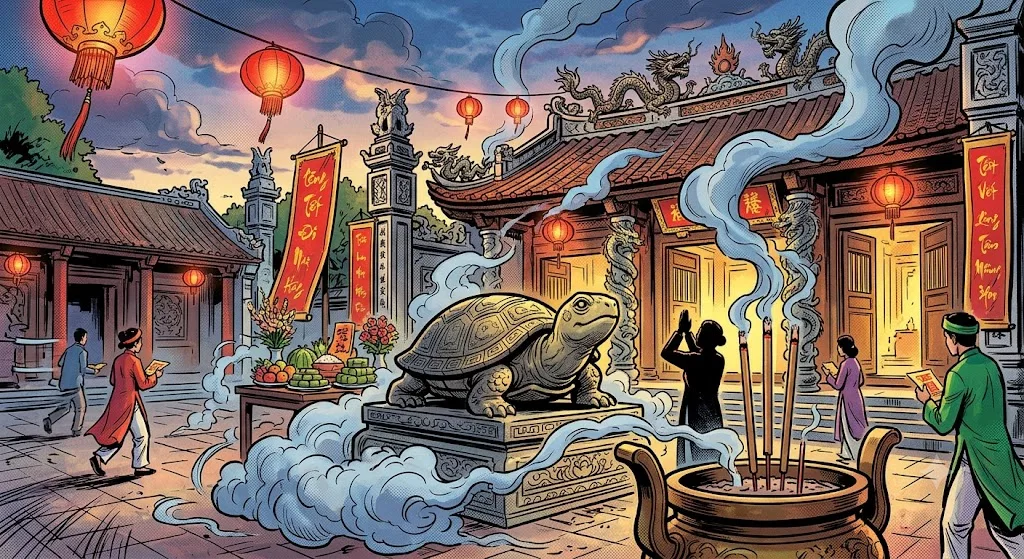
The legend of An Dương Vương and the Golden Turtle is one of the clearest cases. Cổ Loa, north of modern Hanoi, is historically important as an ancient citadel site, and Vietnam’s tourism authority notes that it has yielded relics of the Bronze Age Đông Sơn culture. The same official account also records the local folklore that An Dương Vương chose the site and received supernatural assistance.[Vietnam Tourism]vietnamtourism.gov.vnOpen source on vietnamtourism.gov.vn. A Cổ Loa heritage site account describes the king’s citadel-building story as a tale preserved through folk legend and later ancient books.[Thành Cổ Loa]thanhcoloa.vnOpen source on thanhcoloa.vn.
The Golden Turtle story has the classic ingredients of a foundation legend: a ruler, a difficult construction, a supernatural helper, a magical weapon and a betrayal. Its emotional force comes from the collapse of protection. The turtle’s aid helps establish power, but human weakness undoes it. In folklore terms, the story does not simply say “a citadel was built here”; it asks why states fall even when they seem magically defended.
Hanoi’s Hoàn Kiếm Lake carries another turtle-linked legend, this time associated with the return of a sword. Such stories make turtles more than animals. They become messengers between human power and sacred order, a theme reinforced by the wider importance of the tortoise among Vietnam’s sacred animal imagery.
Sacred animals are not just decoration
Dragons, turtles, phoenixes and unicorn-like sacred beasts appear across Vietnamese temple art, court art, folk art and museum collections. The Vietnam National Museum of History’s exhibition on mythical creatures described the Four Sacred Animals — dragon, kylin, tortoise and phoenix — as among the most popular sacred animals in Vietnamese cults, while noting that they appear in many Asian cultures and took on Vietnamese artistic forms. Bảo tàng Lịch sử Quốc gia[baotanglichsu.vn]baotanglichsu.vnspecial exhibition mythical creatures of vietnamspecial exhibition mythical creatures of vietnam
This is an important distinction. Vietnam’s sacred animals are part of a regional symbolic world influenced by China and broader East Asia, but they are not simply imported decorations. They were adapted into Vietnamese dynastic architecture, village worship, folk art and local storytelling. VietnamPlus reported that the Vietnam National Museum of History displayed more than 100 artefacts in a sacred animals exhibition, including material connected with the Đông Sơn civilisation and later historical periods.[VNA News]vietnam.vnanet.vnVNA News Sacred Animals in Vietnamese CultureVNA News Sacred Animals in Vietnamese Culture
The turtle is especially useful for readers trying to understand Vietnamese folklore because it links several layers at once: longevity, wisdom, sacred protection, ancient foundations and specific legends such as Cổ Loa and the sword-return story at Hoàn Kiếm Lake. The dragon, meanwhile, is both a royal and ancestral figure, not merely a monster. It can symbolise water, power, imperial authority and origin.
The point is not that every carved dragon or turtle tells a full story by itself. Rather, sacred animals create a visual folklore. They let temples, pagodas, palaces, stelae and festival objects speak in a shared symbolic language.
Village gods, local protectors and the everyday supernatural
A large part of Vietnamese folklore lives at village level. Protective spirits may be linked to founders, heroes, natural forces, local miracles or historical figures who have become sacred through communal memory. This is why the boundary between folklore and folk religion is often porous.
The United States State Department’s religious freedom reporting has noted that Vietnamese law distinguishes “belief activities”, including traditional communal practices of ancestor, hero or folk worship, from more formal religious organisations.[State Department]2021-2025.state.govOpen source on state.gov. Open Development Mekong similarly summarises Vietnam as a country where formally recognised religions exist alongside widespread traditional or folk spiritual activities that many people may not label as “religion”.[Open Development Vietnam]vietnam.opendevelopmentmekong.netOpen Development Vietnam Overview of Religions in VietnamOpen Development Vietnam Overview of Religions in Vietnam
For folklore readers, this means that a village spirit should not be approached only as a character in a story. In many cases, the spirit is also the focus of ritual, offerings, communal festivals and local identity. A legend may explain why a spirit is powerful; a festival keeps that relationship socially alive.
Hanoi’s old protective temple traditions show this well. Vietnam’s official tourism site describes the Four Guarding Temples of Thăng Long as protective landmarks around the old capital. Its account of Bạch Mã Temple links the temple’s name to a legend in which a white horse guides King Lý Thái Tổ to the right place to build.[Vietnam Tourism]vietnam.travelOpen source on vietnam.travel. Whether read as legend, urban sacred geography or dynastic memory, the story gives Hanoi’s landscape a supernatural logic.
The Mother Goddesses and spirit mediumship today
One of Vietnam’s most vivid living traditions is the worship of the Mother Goddesses of Three Realms. UNESCO describes this practice as worship of Mother Goddesses associated with heaven, water, and mountains and forests, along with heroic spirits. The tradition includes daily worship, ceremonies, rituals and festivals, and is linked to wishes for health, success and help in everyday life.[UNESCO]unesco.orgdocument 4389document 4389
The Mother Goddesses tradition is important because it shows that Vietnamese supernatural culture is not only about old stories preserved in books. It includes performance, music, costume, trance, offerings and embodied ritual. The United Nations in Vietnam notes that the Mother Goddesses include Liễu Hạnh, described in the UNESCO context as a nymph who descended to earth, lived as a human and became a Buddhist nun, as well as other spirits considered legendary heroes.[The United Nations in Viet Nam]vietnam.un.orgThe United Nations in Viet NamVietnamese Practices related to the Việt beliefs in…5 Dec 2016 — The Mother Goddesses include Liễu Hạnh…
For mainstream readers, the key point is that this is not best understood as a simple “goddess myth”. It is a complex devotional system in which sacred mothers, heroic spirits, ritual specialists and communities interact. It also demonstrates a recurring Vietnamese pattern: Buddhism, Taoist-inflected ritual, local spirit worship, hero cults and ancestor-centred values often coexist rather than replacing one another.
Vietnamese researchers have used the phrase “cultural additivity” to describe the way Confucian, Buddhist and Taoist values can coexist and interact in Vietnamese folktales and social life. A 2018 quantitative study of long-standing Vietnamese folktales used that idea to examine how the “Three Teachings” appear together rather than in sealed compartments.[arXiv]arxiv.orgOpen source on arxiv.org. The concept is useful for folklore because many Vietnamese stories are not doctrinally tidy. They are layered.
Ghosts, wandering souls and care for the dead
Vietnamese ghost belief is closely tied to the moral responsibilities of the living. The dead may become honoured ancestors, but neglected or unsettled spirits are a different matter. This is one reason offerings, incense, death anniversaries and seasonal rites matter so much.
The Ghost Festival, also known in travel-oriented English accounts as Wandering Souls Day, is described by Vietnam’s official tourism authority as a time in late August or early September when the spirit realm opens and ancestors return to visit earthly homes. Families may offer prayers, flowers and fruit at graves, and burn paper money and clothes for spirits to use in the afterlife.[Vietnam Tourism]vietnam.travelKing Vương is legendary and his origin story is celebrated every year in either April or…Read more…
This tradition is easy to misunderstand if it is reduced to “Vietnamese Halloween”. Its emotional centre is not costume horror but obligation, remembrance and compassion. It concerns the possibility that some dead may be hungry, forgotten or without descendants to care for them. That makes it part ghost tradition, part family rite and part moral economy.
The modern evidence also shows that these practices remain widespread. Pew’s 2024 data on Vietnam’s ancestor rituals suggests that ritual care for the dead is not a marginal survival but a mainstream practice.[Pew Research Center]pewresearch.orgPew Research Center5. Ancestor veneration, funerals and afterlife beliefsPew Research Center5. Ancestor veneration, funerals and afterlife beliefs At the same time, individuals may understand these practices differently: as religion, culture, family duty, respect, habit, spiritual protection or some combination of these.
Fairy tales: justice, transformation and the darker side of moral order
Vietnamese fairy tales often look familiar at first and then become startlingly local. The best-known example for many readers is Tấm and Cám, a Vietnamese tale often compared with Cinderella. EBSCO’s literature overview notes the story’s resemblance to Cinderella-type narratives.[EBSCO]ebsco.comOpen source on ebsco.com. A comparative article on Vietnamese and Lao magical fairy tales identifies Tấm and Cám as a tale of a motherless child, stepfamily oppression, magical forces and transformation motifs.[AmeliCA Portal]portal.amelica.orgOpen source on amelica.org.
What makes Tấm and Cám especially interesting is that it does not stop at rescue by marriage. Many versions continue into cycles of death, transformation and return. The heroine may reappear through birds, trees or objects before reclaiming her place. The revenge ending in some versions can be disturbing to modern readers, and this is one reason contemporary retellings often soften or reshape the tale.
That tension is valuable. It reminds us that folk tales are not always gentle moral lessons for children. They can preserve older ideas about retribution, envy, family cruelty and cosmic balance. In Tấm and Cám, justice is not merely legal or sentimental. It is bodily, magical and sometimes severe.
Modern media keeps the tale active. The 2016 film adaptation “Tam Cam: The Untold Story” brought the folktale into fantasy cinema, showing how traditional material can be reworked for popular entertainment.[Wikipedia]WikipediaThe Story of Tấm and CámThe Story of Tấm and Cám This kind of adaptation does not replace the older tale; it creates another layer in the story’s life.
Festivals keep legends from becoming museum pieces
Vietnam’s folklore survives partly because it is performed seasonally. The Gióng Festival is one of the clearest examples. UNESCO describes the Gióng Festival of Phù Đổng and Sóc temples as a heritage tradition connected with Saint Gióng, with celebrations at Sóc temple in the first lunar month and at Phù Đổng temple in the fourth lunar month.[UNESCO ICH]ich.unesco.orgUNESCO ICHGióng festival of Phù Ðông and Sóc templesThe celebrations at Sóc temple, where saint Gióng ascended to heaven, take place in t…
Saint Gióng is a heroic figure associated with miraculous growth, defence of the land and ascent to heaven. The festival does not merely retell his story; it stages communal memory through processions, ritual actions and symbolic performance. That makes it a living bridge between heroic legend and local religious calendar.
Vietnam’s festival year also includes traditions that combine folklore, agriculture and seasonal change. The Mid-Autumn Festival is now strongly associated with children, lanterns, masks, lion dances and moon-viewing, according to Vietnam’s official tourism site.[Vietnam Tourism]vietnam.travelKing Vương is legendary and his origin story is celebrated every year in either April or…Read more… In the Mekong Delta, the Khmer Oóc Om Bóc festival gives thanks to the moon for the harvest and includes boat racing, showing how Vietnam’s folklore landscape includes ethnic minority traditions as well as Kinh-majority national narratives.[Vietnam Tourism]vietnam.travelKing Vương is legendary and his origin story is celebrated every year in either April or…Read more…
This diversity matters. A country-level folklore page on Vietnam should not imply that all Vietnamese traditions are identical. Vietnam officially recognises 54 ethnic groups, and the Kinh majority coexists with many regional and minority cultural traditions.[GOV.UK]GOV.UKCountry policy and information note: ethnic and religiousCountry policy and information note: ethnic and religious Folklore in Vietnam is therefore national, regional and local at the same time.
Water puppetry turns folklore into visible theatre
Water puppetry is one of the most accessible ways for visitors to encounter Vietnamese folklore in performance. Vietnam’s official tourism authority describes water puppetry as a folk art that developed from popular entertainment into court performance under the Lý dynasty in the 12th century, and says it remains a cherished intangible cultural heritage of Vietnam.[Vietnam Tourism]vietnam.travelOpen source on vietnam.travel. The Vietnam National Authority of Tourism also describes water puppetry as an ancient art associated with the 11th-century Red River Delta.[Vietnam Tourism]vietnamtourism.gov.vnVietnam Tourism Water puppetryVietnam Tourism Water puppetry
The form matters because it is perfectly suited to the world of Vietnamese folk imagination. The water surface can become a rice field, pond, river, lake or spirit realm. Dragons can rise from it, villagers can fish on it, and legendary scenes can unfold without needing realistic stage scenery.
Brighton Museums’ account of Vietnamese water puppets notes that the tradition includes historical, legendary and mythical characters such as phoenixes, water spirits and fairies, alongside ordinary rural figures such as fishermen and duck tenders.[Brighton & Hove Museums]brightonmuseums.org.ukOpen source on brightonmuseums.org.uk. That mixture is central to Vietnamese folklore: daily village life and supernatural spectacle belong on the same stage.
For modern audiences, especially travellers in Hanoi, water puppetry can sometimes feel like a tourist show. Yet its tourist visibility should not lead readers to dismiss it. Many folklore traditions survive precisely because they become adaptable: village performance, court entertainment, national heritage, museum object and commercial theatre can all be stages in the same tradition’s history.
Old tradition, literary retelling and internet-era folklore
Vietnamese folklore has never been frozen. Some stories were transmitted orally before being written down. Others were shaped by court chronicles, local temple records, colonial-era collectors, school anthologies, children’s books, theatre, cinema, tourism and online retellings.
That means the question “what is the original version?” is often harder than it sounds. Tấm and Cám, for example, has older oral roots but is known today through published collections, school versions, scholarly comparison and popular media. The Cổ Loa story likewise exists as archaeology, local sacred geography, temple narrative and ancient-book tradition.[Vietnam Tourism]vietnamtourism.gov.vnOpen source on vietnamtourism.gov.vn.
Internet-era folklore adds another layer. Ghost stories, demon lists, illustrated bestiaries and social media explainers circulate quickly, sometimes drawing on older terms and sometimes inventing modern atmospheres around them. A Saigoneer feature on Vietnamese folk demons and restless spirits, for example, presents contemporary interest in cataloguing native spirits and notes concern that Vietnam’s folk traditions have not always been valued or developed effectively in popular culture.[Saigoneer]saigoneer.comOpen source on saigoneer.com.
The safest way to read modern Vietnamese supernatural content is to ask four questions:
- Is this a well-attested ritual tradition, such as ancestor veneration or Mother Goddess worship?
- Is it a named national or regional legend attached to a place, such as Cổ Loa or the Hùng Kings temples?
- Is it a literary or schoolroom folktale, such as Tấm and Cám?
- Is it a modern creative retelling, internet list, horror adaptation or tourist version?
Those categories can overlap, but separating them helps prevent two common mistakes: treating every modern ghost post as ancient tradition, or dismissing living ritual simply because it has changed over time.
Why Vietnamese folklore still matters
Vietnamese folklore matters because it explains how people connect family, land, morality and the unseen. Its legends do not float in an abstract mythic universe. They attach themselves to temples, lakes, citadels, drums, puppets, festivals, home altars, grave offerings and village processions.
It also matters because it shows how flexible tradition can be. The same cultural field can include Bronze Age objects, medieval dynastic legends, Buddhist and Taoist influences, Confucian family ethics, goddess mediumship, folk theatre, children’s lantern festivals, horror-tinged fairy tales and modern cinema. That flexibility is not a weakness. It is one reason the traditions remain recognisable while continuing to change.
The most memorable Vietnamese folklore is therefore not simply about dragons, ghosts or magical turtles. It is about relationship: between descendants and ancestors, rulers and sacred protectors, villages and guardian spirits, mountains and floods, the living and the restless dead, old oral tales and new media. Vietnam’s legendary world is rich because it keeps asking how the past remains present — and what the living owe to the powers, places and people who came before them.
Amazon book picks
Further Reading
Books and field guides related to Where Vietnamese Legends Still Walk Today. Use these as the next step if you want deeper reading beyond the article.

The Penguin Book of Dragons
Links to dragon imagery prominent in Vietnamese origin stories.
eBay marketplace picks
Marketplace Samples
Live-tested eBay searches with available results related to this page.

Endnotes
1.
Source: ich.unesco.org
Link:https://ich.unesco.org/en/RL/worship-of-[hung-kings
Source snippet
UNESCO ICHWorship of Hùng kings in Phú ThọThe tradition embodies spiritual solidarity and provides an occasion to acknowledge national or...
2.
Source: ich.unesco.org
Link:https://ich.unesco.org/en/RL/giong-festival-of-phu-djong-and-soc-temples-00443
Source snippet
UNESCO ICHGióng festival of Phù Ðông and Sóc templesThe celebrations at Sóc temple, where saint Gióng ascended to heaven, take place in t...
3.
Source: vietnam.travel
Link:https://vietnam.travel/things-to-do/top-festivals-vietnam
Source snippet
King Vương is legendary and his origin story is celebrated every year in either April or...Read more...
4.
Source: vietnamtourism.gov.vn
Link:https://vietnamtourism.gov.vn/en/post/11690
5.
Source: 2021-2025.state.gov
Link:https://2021-2025.state.gov/reports/2020-report-on-international-religious-freedom/vietnam/
6.
Source: vietnam.travel
Link:https://vietnam.travel/things-to-do/hanoi-six-heritage-sites
7.
Source: unesco.org
Title: document 4389
Link:https://www.unesco.org/archives/multimedia/document-4389
8.
Source: arxiv.org
Link:https://arxiv.org/abs/1803.06304
9.
Source: ebsco.com
Link:https://www.ebsco.com/research-starters/literature-and-writing/tam-and-cam-vietnamese-folktale
10.
Source: portal.amelica.org
Link:https://portal.amelica.org/ameli/journal/517/5173592010/html/
11.
Source: Wikipedia
Title: The Story of Tấm and Cám
Link:https://en.wikipedia.org/wiki/The_Story_of_T%E1%BA%A5m_and_C%C3%A1m
12.
Source: GOV.UK
Title: Country policy and information note: ethnic and religious
Link:https://www.gov.uk/government/publications/vietnam-country-policy-and-information-notes/country-policy-and-information-note-ethnic-and-religious-groups-vietnam-february-2022-accessible-version
13.
Source: vietnam.travel
Link:https://vietnam.travel/things-to-do/vietnam-water-puppets
14.
Source: vietnamtourism.gov.vn
Title: Vietnam Tourism Water puppetry
Link:https://vietnamtourism.gov.vn/en/post/17806
15.
Source: saigoneer.com
Link:https://saigoneer.com/saigon-culture/25690-from-oral-lore-to-a-mini-encyclopedia-of-vietnam-s-folk-demons%2C-ghosts%2C-and-restless-spirits
16.
Source: ich.unesco.org
Link:https://ich.unesco.org/en/RL/practices-related-to-the-viet-beliefs-in-the-mother-goddesses-of-three-realms-01064
17.
Source: ich.unesco.org
Link:https://ich.unesco.org/en/video/36762
18.
Source: ich.unesco.org
Link:https://ich.unesco.org/doc/src/Signed%20periodic%20report%20-%20Periodic%20report-67379.pdf
19.
Source: ich.unesco.org
Title: worship of hung kings in phu tho 00735
Link:https://ich.unesco.org/en/RL/worship-of-hung-kings-in-phu-tho-00735?call=film&id=13219&include=film_inc.php&width=700
20.
Source: ich.unesco.org
Link:https://ich.unesco.org/en/video/4256
21.
Source: ich.unesco.org
Title: xoan singing of phu th province viet nam 01260
Link:https://ich.unesco.org/en/RL/xoan-singing-of-phu-th-province-viet-nam-01260
22.
Source: ich.unesco.org
Title: 07508 EN
Link:https://ich.unesco.org/doc/src/07508-EN.pdf
23.
Source: ich.unesco.org
Title: 11013 EN
Link:https://ich.unesco.org/doc/src/11013-EN.pdf
24.
Source: ich.unesco.org
Link:https://ich.unesco.org/?call=film&id=04255&include=film_inc.php&width=700
25.
Source: ich.unesco.org
Title: 6 representative list 00335
Link:https://ich.unesco.org/en/6-representative-list-00335?id=00443&include=slideshow_inc.php
26.
Source: ich.unesco.org
Link:https://ich.unesco.org/doc/src/33434.pdf
27.
Source: ich.unesco.org
Title: photo pop up 00973
Link:https://ich.unesco.org/en/photo-pop-up-00973?photoID=03055
28.
Source: ich.unesco.org
Title: 11 representative list 00520
Link:https://ich.unesco.org/en/11-representative-list-00520?id=00735&include=slideshow_inc.php
29.
Source: ich.unesco.org
Title: NGO 90666
Link:https://ich.unesco.org/doc/src/NGO-90666.pdf
30.
Source: ich.unesco.org
Link:https://ich.unesco.org/?call=film&id=13219&include=film_inc.php&width=700
31.
Source: ich.unesco.org
Link:https://ich.unesco.org/doc/src/19334.pdf
32.
Source: ich.unesco.org
Link:https://ich.unesco.org/doc/src/16656.pdf
33.
Source: ich.unesco.org
Link:https://ich.unesco.org/doc/src/05745.pdf
34.
Source: ich.unesco.org
Title: ITH 15 10.CO M Decisions EN.doc
Link:https://ich.unesco.org/doc/src/ITH-15-10.COM-Decisions_-EN.doc
35.
Source: Wikipedia
Title: Vietnamese folk religion
Link:https://en.wikipedia.org/wiki/Vietnamese_folk_religion
36.
Source: Wikipedia
Title: Ghosts in Vietnamese culture
Link:https://en.wikipedia.org/wiki/Ghosts_in_Vietnamese_culture
37.
Source: Wikipedia
Title: Kim Quy
Link:https://en.wikipedia.org/wiki/Kim_Quy
38.
Source: Wikipedia
Title: Water puppetry
Link:https://en.wikipedia.org/wiki/Water_puppetry
39.
Source: Wikipedia
Title: Religion in Vietnam
Link:https://en.wikipedia.org/wiki/Religion_in_Vietnam
40.
Source: 2021-2025.state.gov
Link:https://2021-2025.state.gov/reports/2023-report-on-international-religious-freedom/vietnam/
41.
Source: vietnam.travel
Link:https://vietnam.travel/
42.
Source: special.vietnamplus.vn
Title: vietnam preserves promotes values of mother goddesses worship
Link:https://special.vietnamplus.vn/2023/12/19/vietnam-preserves-promotes-values-of-mother-goddesses-worship/
43.
Source: vietnamtourism.gov.vn
Link:https://vietnamtourism.gov.vn/en/post/13567
44.
Source: vietnam.un.org
Link:https://vietnam.un.org/en/7740-vietnamese-practices-related-vi%E1%BB%87t-beliefs-mother-goddesses-three-realms-receive-inscription
Source snippet
The United Nations in Viet NamVietnamese Practices related to the Việt beliefs in...5 Dec 2016 — The Mother Goddesses include Liễu Hạnh...
45.
Source: pewresearch.org
Title: Pew Research Center5. Ancestor veneration, funerals and afterlife beliefs
Link:https://www.pewresearch.org/religion/2024/06/17/ancestor-veneration-funerals-and-afterlife-beliefs/
46.
Source: pewresearch.org
Title: Pew Research Center Religion and Spirituality in East Asian Societies
Link:https://www.pewresearch.org/religion/2024/06/17/religion-and-spirituality-in-east-asian-societies/
47.
Source: vietnamtourism.org.vn
Title: Vietnam Tourism The legend of Son Tinh and Thuy Tinh
Link:https://www.vietnamtourism.org.vn/attractions/culture/myths-legends-folklores/the-legend-of-son-tinh-and-thuy-tinh.html
48.
Source: thanhcoloa.vn
Link:https://thanhcoloa.vn/en/story-about-king-an-duong-vuong-throgh-ancient-books
49.
Source: baotanglichsu.vn
Title: special exhibition mythical creatures of vietnam
Link:https://baotanglichsu.vn/en/Articles/3173/18939/special-exhibition-mythical-creatures-of-vietnam.html
50.
Source: vietnam.vnanet.vn
Title: VNA News Sacred Animals in Vietnamese Culture
Link:https://vietnam.vnanet.vn/english/tin-tuc/sacred-animals-in-vietnamese-culture-100163.html
51.
Source: vietnam.opendevelopmentmekong.net
Title: Open Development Vietnam Overview of Religions in Vietnam
Link:https://vietnam.opendevelopmentmekong.net/en/topics/overview-of-religions-in-vietnam/
52.
Source: brightonmuseums.org.uk
Link:https://brightonmuseums.org.uk/discovery/history-stories/vietnamese-waterpuppets/
53.
Source: dictionary.cambridge.org
Link:https://dictionary.cambridge.org/vi/dictionary/english/vietnamese
54.
Source: vietnam.vnanet.vn
Title: mother goddesses worship 138248
Link:https://vietnam.vnanet.vn/english/tin-tuc/mother-goddesses-worship-138248.html
Additional References
55.
Source: youtube.com
Title: Vietnam’s Sacred Spirit Ritual – Inside a Full Hau Dong Ceremony
Link:https://www.youtube.com/watch?v=znss94cK3Yc
Source snippet
Mother Goddess Worship: The Physical Representation of the Gods...
56.
Source: youtube.com
Title: Giong Festival at Phu Dong and Soc Temples
Link:https://www.youtube.com/watch?v=VkJ8Y7it0HY
Source snippet
Vietnam's Sacred Spirit Ritual – Inside a Full Hau Dong Ceremony...
57.
Source: uscirf.gov
Link:https://www.uscirf.gov/countries/vietnam
58.
Source: uscirf.gov
Link:https://www.uscirf.gov/sites/default/files/Tier1_VIETNAM_2019.pdf
59.
Source: youtube.com
Title: Mother Goddess Worship: The Physical Representation of the Gods
Link:https://www.youtube.com/watch?v=fwWZnbSWKJk
Source snippet
Discover the Giant Hero Who Amazed Vietnam...
60.
Source: researchgate.net
Link:https://www.researchgate.net/publication/382770315_Exploring_Culture_through_Vietnamese_Legends
61.
Source: researchgate.net
Link:https://www.researchgate.net/publication/374410680_Vietnamese_People%27s_Customs_of_Worshiping_the_Soul_Concept_Content_and_Current_Changes
62.
Source: researchgate.net
Link:https://www.researchgate.net/publication/343829544_Ancestor_Worshiping_Beliefs_in_the_Beliefs_and_Religion_Life_of_Vietnamese_People_Nature_Values_and_Changes_of_it_in_the_Current_Period
63.
Source: researchgate.net
Link:https://www.researchgate.net/publication/351147594_SIMILARITIES_AND_DIFFERENCES_BETWEEN_VIETNAMESE_CULTURE_AND_LAO_CULTURE_THROUGH_THE_MOTIF_OF_BUILDING_ORPHAN_CHARACTERS_IN_THE_MAGICAL_FAIRY_TALES_OF_TAM_AND_CAM_AND_THE_GOLDEN_TURTLE
64.
Source: flavorsofhanoi.com
Link:https://flavorsofhanoi.com/ancestor-veneration-and-religious-practices-in-vietnam/
Topic Tree
Follow this branch
Related pages 192
- Afghan Folklore
- Albanian Folklore
- Algerian Folklore
- Australian Folklore
- Azerbaijan Folklore
- +187 more in sidebar