Within Jamaican Folklore
Why Anansi Still Outsmarts Everyone
Anansi's Jamaican tales turn a small spider trickster into a comic figure of wit, appetite, survival and moral risk.
On this page
- African roots and Jamaican creole storytelling
- Trickster humour, hunger and social power
- Collectors, Miss Lou and performance tradition
Page outline Jump by section
Introduction
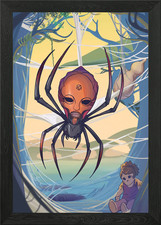
Anansi, often called Anancy in Jamaica, is far more than a talking spider from children’s stories. He is the island’s most famous folk character: a trickster who survives through wit, nerve and improvisation rather than strength or authority. In tale after tale he steals food, deceives rivals, escapes punishment, gains advantage over stronger opponents and occasionally suffers humiliating consequences of his own greed. The enduring appeal of these stories lies in their double nature. They are funny entertainment, full of verbal play and absurd situations, but they also explore how vulnerable people survive in unequal worlds. For generations of Jamaicans, Anansi stories have linked local storytelling traditions with deeper African cultural memories carried across the Atlantic during slavery.[jis.gov.jm]jis.gov.jmorigin anancynancy storiesStories about this character have origins in the Akan culture in Africa.Read more…
Unlike many legendary heroes, Anansi is not noble. He lies, cheats and boasts. Yet that moral ambiguity is exactly what has kept him alive in Jamaican culture. He reflects everyday struggles, appetites and weaknesses while demonstrating the power of intelligence when physical power is lacking.[ebsco.com]ebsco.comAnansi | Literature and Writing | Research StartersAnansi is a central figure in West African and Caribbean folklore, most notably r…
Why Anansi Still Outsmarts Everyone
The central idea behind most Anansi stories is simple: a small creature faces a stronger one and wins through cleverness. Anansi may be a spider, but he regularly defeats larger animals, neighbours, authority figures or supernatural opponents. His victories rarely come from courage alone. Instead, he uses persuasion, manipulation, trickery or the ability to spot opportunities others miss.[wikipedia.org]WikipediaOpen source on wikipedia.org.
This pattern helps explain why Anansi became such a powerful figure in the Caribbean. Enslaved Africans and their descendants lived in societies where power was concentrated in the hands of others. A hero who succeeded through intelligence rather than force carried obvious emotional and cultural significance. Scholars of the African diaspora have often interpreted Anansi as a symbol of adaptation and resistance, even when individual stories remain comic rather than openly political.[ebsco.com]ebsco.comAnansi | Literature and Writing | Research StartersAnansi is a central figure in West African and Caribbean folklore, most notably r…
At the same time, the stories rarely turn Anansi into a flawless champion. He is frequently selfish. Sometimes his schemes collapse. Sometimes he tricks friends and family. Listeners are invited to laugh both at his successes and at his failures. This balance prevents him from becoming a straightforward moral hero. Instead, he represents human resourcefulness mixed with human weakness.[Jamaica Information Service]jis.gov.jmorigin anancynancy storiesStories about this character have origins in the Akan culture in Africa.Read more…
African Roots and Jamaican Creole Storytelling
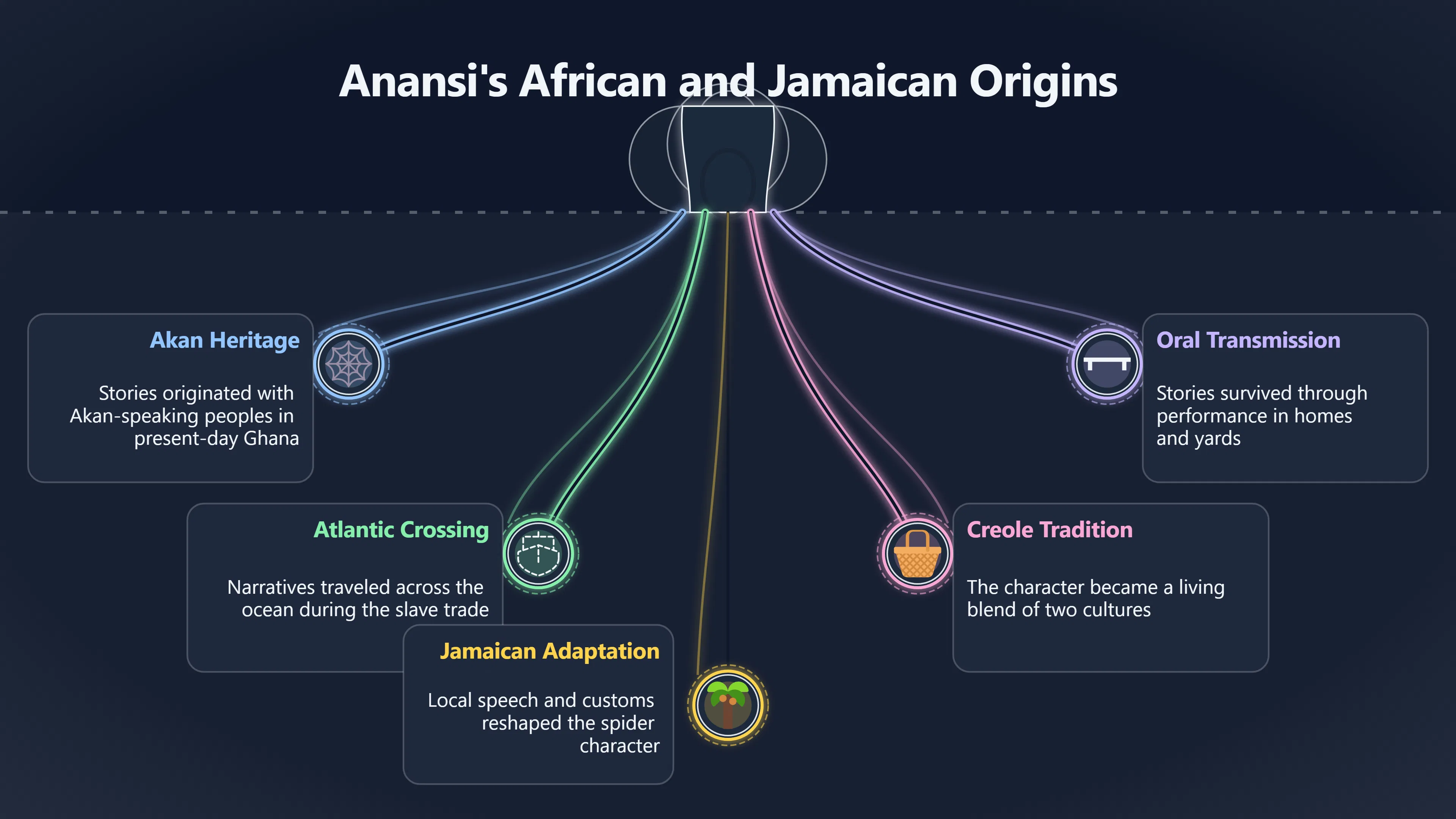
Anansi originated among Akan-speaking peoples of what is now Ghana, where spider stories formed part of a rich oral tradition. Through the Atlantic slave trade, these narratives travelled into the Caribbean and other parts of the African diaspora. Jamaica became one of the most important centres for their preservation and transformation.[jis.gov.jm]jis.gov.jmorigin anancynancy storiesStories about this character have origins in the Akan culture in Africa.Read more…
The Jamaican Anancy of folklore is therefore both African and Jamaican. His name, character and many narrative patterns point back to West Africa, yet generations of storytellers reshaped him within a Jamaican social world. Local speech, humour, customs and concerns became woven into the tales. The result was not a frozen survival from Africa but a living creole tradition.[jis.gov.jm]jis.gov.jmorigin anancynancy storiesStories about this character have origins in the Akan culture in Africa.Read more…
One reason the stories survived so successfully is that they were transmitted orally. They were told in homes, yards, villages and community gatherings rather than primarily through books. Storytelling involved performance as much as plot. Voice changes, rhythm, audience participation, songs and dramatic pauses could all be part of the experience. Early folklorist Martha Warren Beckwith emphasised that Jamaican Anansi storytelling was a performed tradition rather than simply a collection of written narratives. Her landmark 1924 collection drew on dozens of storytellers and preserved songs and performance elements alongside the stories themselves.[gutenberg.org]gutenberg.org72735 hProject GutenbergJamaica Anansi stories16 Jan 2024 — Jamaica Anansi Stories by Martha Warren Beckwith with music recorded in the field by…

Trickster Humour, Hunger and Social Power
Many Anansi stories revolve around food. Anansi is constantly hungry. He wants extra meals, hidden provisions or someone else’s share. His appetite creates comic situations, but it also reflects a deeper concern with scarcity and survival. In societies shaped by hardship, food is never just food. It becomes a symbol of security, status and ingenuity.[Project Gutenberg]gutenberg.org72735 hProject GutenbergJamaica Anansi stories16 Jan 2024 — Jamaica Anansi Stories by Martha Warren Beckwith with music recorded in the field by…
Humour is equally important. Jamaican audiences have long enjoyed stories in which clever talk overturns expectations. Anansi wins arguments, exploits misunderstandings and manipulates language itself. The pleasure comes partly from watching established hierarchies briefly collapse. The smallest character can become the most powerful person in the room if he can think quickly enough.[jamrockmuseum.com]jamrockmuseum.comFolk Traditions & Storytelling in Jamaica: Anansi, Jonkunnu…18 Jul 2025 — Originating with the Akan people of Ghana, Anansi was brough…
Yet the stories rarely celebrate trickery without limits. Anansi’s greed often goes too far. When that happens, he may end up embarrassed, injured or exposed. The lesson is subtle rather than preachy. Intelligence is valuable, but selfishness carries risks. The audience is left to weigh admiration against criticism.[Jamaica Information Service]jis.gov.jmorigin anancynancy storiesStories about this character have origins in the Akan culture in Africa.Read more…
This tension helps explain why Anansi remains compelling. He occupies a grey area between hero and rogue. Readers and listeners can recognise parts of themselves in him without necessarily approving of everything he does.
Collectors, Miss Lou and the Performance Tradition
The survival of Jamaican Anansi stories owes much to collectors and performers who recognised their cultural value before rapid social change could erode oral traditions. Martha Warren Beckwith’s Jamaica Anansi Stories, published in 1924, remains one of the foundational records of the tradition. It preserved not only stories but also dialect forms, songs and details about performance.[gutenberg.org]gutenberg.org72735 hProject GutenbergJamaica Anansi stories16 Jan 2024 — Jamaica Anansi Stories by Martha Warren Beckwith with music recorded in the field by…
In the twentieth century, few figures did more to celebrate Jamaican folk culture than Louise Bennett-Coverley. Through poetry, radio, stage performance and storytelling, Miss Lou championed Jamaican Creole and folk traditions at a time when they were often dismissed by cultural elites. Anancy stories featured prominently in her storytelling repertoire, helping bring oral traditions to new audiences without stripping away their distinctive voice.[jis.gov.jm]jis.gov.jmJamaica Information Service HonLouise Bennett-Coverley – Mother Of Jamaican Culture19 Nov 2019 — Celebrated Jamaican poet, performer, writer, educator, folklorist and a…
The importance of performance cannot be overstated. Reading an Anansi tale on a page is not quite the same as hearing it told. Storytellers use timing, facial expression, repetition and audience response to create humour and suspense. The tradition survives not only because of memorable plots but because storytelling itself remains a valued cultural art.[Project Gutenberg]gutenberg.org72735 hProject GutenbergJamaica Anansi stories16 Jan 2024 — Jamaica Anansi Stories by Martha Warren Beckwith with music recorded in the field by…
From Folk Character to Cultural Symbol
Today Anansi appears in schoolbooks, children’s literature, theatre, festivals, academic studies and international popular culture. He has become one of the most recognisable figures associated with Jamaican folklore, even though his roots extend across the wider African diaspora.[jamrockmuseum.com]jamrockmuseum.comFolk Traditions & Storytelling in Jamaica: Anansi, Jonkunnu…18 Jul 2025 — Originating with the Akan people of Ghana, Anansi was brough…
What continues to resonate is the core idea embedded in the stories: survival through intelligence. Anansi is rarely the strongest figure in a tale. Often he is the weakest. Yet he persists because he adapts. That theme has allowed the character to move across centuries, continents and changing social conditions without losing relevance.[TED-Ed]ed.ted.comEd The myth of Anansi, the trickster spiderHe is physically weak and thwarts his powerful opponents using the only means available to him, his wit…Read more…
For many readers, Anansi remains funny because his schemes are outrageous. For others, he represents cultural continuity between West Africa and the Caribbean. For still others, he embodies the universal appeal of the underdog who finds a way to win. These meanings coexist, which is one reason Jamaica’s spider trickster continues to outsmart not only his rivals but also the passage of time itself.[jis.gov.jm]jis.gov.jmorigin anancynancy storiesStories about this character have origins in the Akan culture in Africa.Read more…
Amazon book picks
Further Reading
Books and field guides related to Why Anansi Still Outsmarts Everyone. Use these as the next step if you want deeper reading beyond the article.
The Annotated African American Folktales
Traces trickster storytelling traditions across the African diaspora.
eBay marketplace picks
Marketplace Samples
Live-tested eBay searches with available results related to this page.

Endnotes
1.
Source: Wikipedia
Link:https://en.wikipedia.org/wiki/Anansi
2.
Source: ed.ted.com
Title: Ed The myth of Anansi, the trickster spider
Link:https://ed.ted.com/lessons/the-myth-of-anansi-the-trickster-spider-emily-zobel-marshall/digdeeper
Source snippet
He is physically weak and thwarts his powerful opponents using the only means available to him, his wit...Read more...
3.
Source: ebsco.com
Link:https://www.ebsco.com/research-starters/literature-and-writing/anansi
Source snippet
Anansi | Literature and Writing | Research StartersAnansi is a central figure in West African and Caribbean folklore, most notably r...
4.
Source: jamrockmuseum.com
Link:https://www.jamrockmuseum.com/cultural/folk-traditions-storytelling-in-jamaica-anansi-jonkunnu-and-the-living-heritage-of-the-people/
Source snippet
Folk Traditions & Storytelling in Jamaica: Anansi, Jonkunnu...18 Jul 2025 — Originating with the Akan people of Ghana, Anansi was brough...
5.
Source: cjids.in
Link:https://cjids.in/anansi-myth-and-resistance-exploring-anansi-folklore-as-trangressive-culture-during-slavery/
Source snippet
itions at large evolved during the colonial era, and how Anansi's myths contributed to...Read more...
6.
Source: wilderutopia.com
Link:https://wilderutopia.com/traditions/myth/ashanti-of-ghana-how-spider-obtained-the-sky-gods-stories/
Source snippet
(The word Anansi is Akan and means, simply, spider.) They later spread to other...Read more...
7.
Source: gutenberg.org
Title: 72735 h
Link:https://www.gutenberg.org/files/72735/72735-h/72735-h.htm
Source snippet
Project GutenbergJamaica Anansi stories16 Jan 2024 — Jamaica Anansi Stories by Martha Warren Beckwith with music recorded in the field by...
8.
Source: en.wikisource.org
Title: New York. Published by The American Folk-Lore Society.Read more
Link:https://en.wikisource.org/wiki/Jamaica_Anansi_Stories
Source snippet
Jamaica Anansi Stories - Wikisource, the free online library4 Nov 2024 — Jamaica Anansi Stories by Martha Warren Beckwith with...
9.
Source: journals.openedition.org
Link:https://journals.openedition.org/miranda/pdf/8021
Source snippet
OpenEdition JournalsMervyn Morris, Miss Lou – Louise Bennett and Jamaican...by E Doumerc · 2016 — The fourth chapter deals with Louise B...
10.
Source: jamaicans.com
Title: and Jamaica
Link:https://jamaicans.com/anancy_intro/
Source snippet
Jamaicans and Jamaica - Jamaicans.comAnancy Introduction20 Mar 2004 — The tradition of oral folklore however, is alive and well on the is...
11.
Source: books.google.com
Link:https://books.google.com/books/about/Anansi.html?id=ODHijwEACAAJ
Source snippet
Google BooksAnansi: Jamaican Stories of the Spider God17 May 2016 — The Anansi tales originated from the Ashanti people of present-day Ghana...
Published: May 2016
12.
Source: sites.google.com
Title: anansi trickster stories
Link:https://sites.google.com/view/blackatlanticproject/anansi-trickster-stories
Source snippet
Trickster StoriesHere is an audio recording of Anansi stories titled “Ashanti Folk Tales from Ghana”, which gives insight into version of...
13.
Source: books.google.com
Title: Jamaica Anansi Stories
Link:https://books.google.com/books/about/Jamaica_Anansi_Stories.html?id=I83YAAAAMAAJ
Source snippet
Anansi Stories - Martha Warren BeckwithAnansi (Legendary character) - 295 pages. Collected by Martha Warren - 1924 Jamaica Anansi. Folk-l...
14.
Source: Wikipedia
Title: Jamaica Anansi Stories
Link:https://en.wikipedia.org/wiki/Jamaica_Anansi_Stories
Source snippet
Jamaica Anansi StoriesJamaica Anansi Stories is a book by Martha Warren Beckwith published in 1924. It is a collection of folklore, ri...
15.
Source: jis.gov.jm
Title: origin anancynancy stories
Link:https://jis.gov.jm/information/get-the-facts/origin-anancynancy-stories/
Source snippet
Stories about this character have origins in the Akan culture in Africa.Read more...
16.
Source: jis.gov.jm
Title: Jamaica Information Service Hon
Link:https://jis.gov.jm/features/hon-louise-bennett-coverley-mother-of-jamaican-culture/
Source snippet
Louise Bennett-Coverley – Mother Of Jamaican Culture19 Nov 2019 — Celebrated Jamaican poet, performer, writer, educator, folklorist and a...
17.
Source: amazon.com
Title: Anansi stories
Link:https://www.amazon.com/Anansi-stories-Jamaican-Folklore/dp/B0DZTV896F?tag=searcht-20
Source snippet
CanuteA collection of traditional tales featuring Anansi the spider, who uses wit and cunning to overcome powerful adversaries in stories...
18.
Source: nlj.gov.jm
Link:https://www.nlj.gov.jm/archives/Miss_Lou/bennett-3.html
Source snippet
Miss Lou's ArchiveMiss Lou's Archive; 3.3.3, Pantomime: Anancy and Beeny Bud, by Louise Bennett: playscript and part scripts; 3.3.4, Pa...
Additional References
19.
Source: globalgreyebooks.com
Link:https://www.globalgreyebooks.com/jamaica-anansi-stories-ebook.html
Source snippet
Global GreyJamaica Anansi Stories, by Martha Warren BeckwithJamaica Anansi Stories is a book by American folklorist Martha Warren Beckwit...
20.
Source: amazon.com
Link:https://www.amazon.com/Jamaica-Anansi-stories-Martha-Beckwith/dp/1636522467?tag=searcht-20
Source snippet
Jamaica Anansi stories: Martha Warren BeckwithBeckwith is a captivating collection of traditional Jamaican folktales centered around Anan...
21.
Source: publications.iai.spk-berlin.de
Link:https://publications.iai.spk-berlin.de/servlets/MCRFileNodeServlet/Document_derivate_00002175/BIA_046_181_192.pdf
Source snippet
BENNETT: BETWEEN SUBCULTURESLouise Bennett, deeply rooted in the local folk culture of Jamaica, has won wide recognition in the anglophon...
22.
Source: en.wiktionary.org
Link:https://en.wiktionary.org/wiki/anancy
Source snippet
Anansi, a mythical spider (god) from West African folklore. Noun. anancy (plural anancies). (Jamaica) A nonpoisonous arachnid, daddy long...
23.
Source: facebook.com
Link:https://www.facebook.com/JAMAICALIVEFESTIVAL/posts/%EF%B8%8F%EF%B8%8F-jamaicanculture-storytelling-anansi-is-a-central-figure-in-jamaican-storytell/1328648589281200/
Source snippet
⚫️🟡🟢⚫️🇯🇲 #JamaicanCulture #storytelling Anansi is a...His stories, called Anansesem, originated with the Akan people of Ghana and were b...
24.
Source: researchgate.net
Link:https://www.researchgate.net/publication/306329885_Anansi%27_s_Journey_A_Story_of_Jamaican_Cultural_Resistance
25.
Source: youtube.com
Link:https://www.youtube.com/watch?v=0VV4vOQ3OyQ
Source snippet
The Origin of Anansi StoriesThe and nancy tales are believed to have originated from the ashanti people in ghana and a nancy's name comes...
26.
Source: goodreads.com
Title: Jamaica Anansi Stories by Martha Warren Beckwith Genres Folk Tales
Link:https://www.goodreads.com/en/book/show/3083944-jamaica-anansi-stories
Source snippet
376 pages, Paperback. First published January 1, 1924. Book... This collection of Anansi tales from Jamaica is challenging to read, to s...
Published: January 1, 1924
27.
Source: sacred-texts.com
Link:https://sacred-texts.com/afr/jas/index.htm
Source snippet
Internet Sacred Text ArchiveJamaica Anansi Stories IndexSacred Texts Africa. Jamaica Anansi Stories. BY. MARTHA WARREN BECKWITH. Music tr...
28.
Source: universallifechurch.org
Title: anansi how a trickster crossed an ocean and inspired hope
Link:https://www.universallifechurch.org/2018/04/19/anansi-how-a-trickster-crossed-an-ocean-and-inspired-hope/
Source snippet
Anansi: How a Trickster Crossed an Ocean and Inspired Hope19 Apr 2018 — Passed down mostly through oral tradition, Anansi's stories still...
Topic Tree